How to Complete Successful Traffic Management Plan TMP in 2 Days: 7 Sydney Course Paths
Are you choosing a short course because it sounds useful, or because it leads directly to the work you want to do next?
That distinction matters when you're comparing construction, civil work, hospitality, first aid and traffic control training in Sydney. The right pathway depends on the role you want, the practical outcome employers expect and how quickly you need workplace-ready skills. TP Training delivers hands-on training through centres including Penrith, Burwood, Auburn, Parramatta and Sydney CBD, giving learners several locations to consider alongside their career plans.
This directory connects seven practical outcomes with real vocational pathways. It also gives special attention to the Traffic Management Plan TMP pathway, because completing the two-day Prepare Work Zone Traffic Management Plan course involves more than memorising signs. This pathway is commonly associated with the Units of Competency RIIRIS402E and RIICWD503E, so learners should be ready to interpret work-zone risks, select workable controls and explain why their decisions protect workers, pedestrians and drivers. Use the guide to choose the outcome that fits your next job, then prepare deliberately for practical assessment.
Table of Contents
- 1. Traffic Control Setup and Sign Placement
- 2. Work Zone Hazard Identification and Risk Assessment
- 3. Traffic Diversion and Lane Management Strategy
- 4. Personnel and Work Zone Safety Protocols
- 5. Communication, Stakeholder Coordination and Approval Process
- 6. Incident Response and Emergency Procedures
- 7. Compliance, Monitoring, Maintenance and Adaptive Management
- Traffic Management Plan, 7-Point Comparison
- Turn Two Days of Training Into Workplace Confidence
1. Traffic Control Setup and Sign Placement
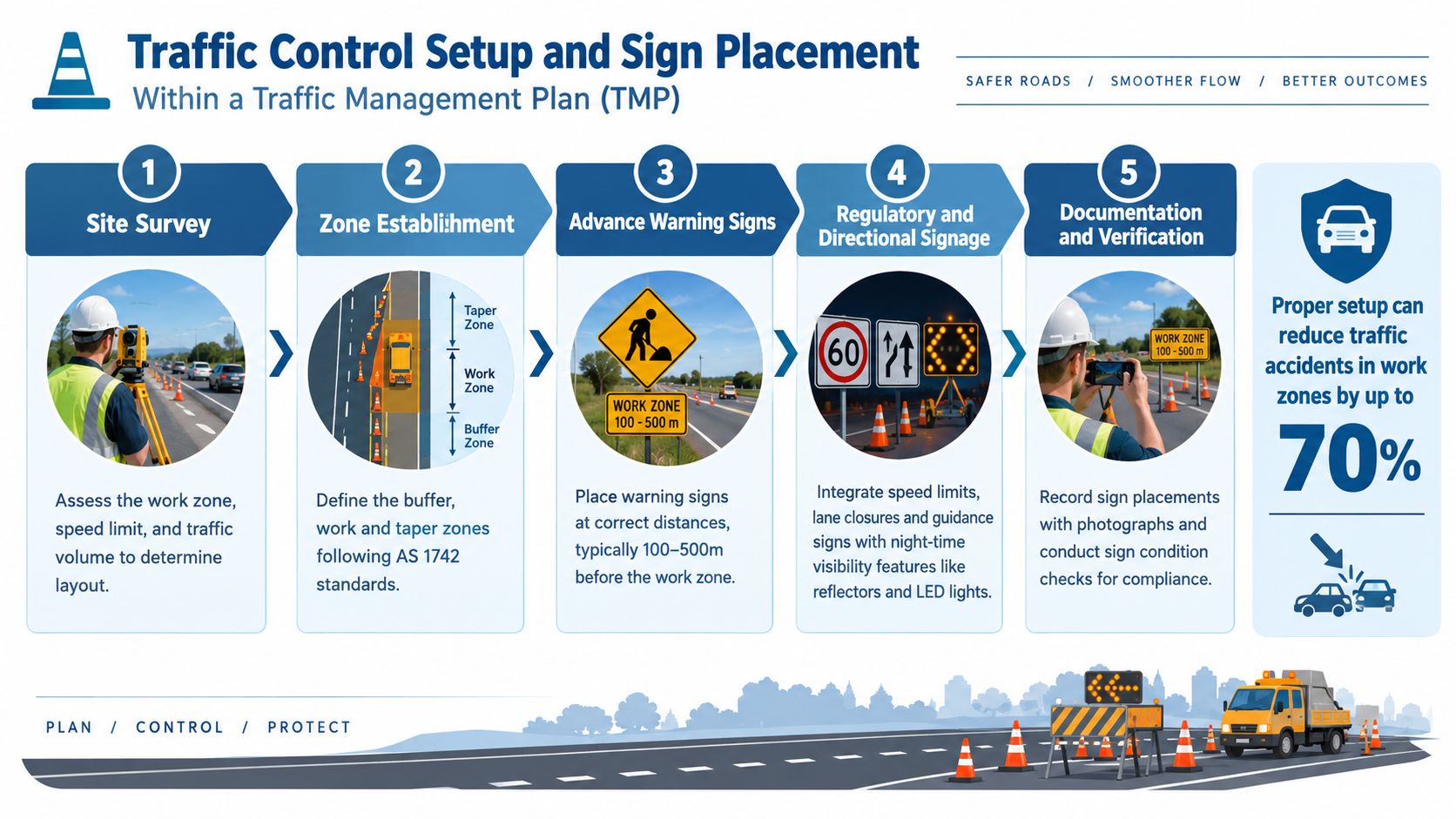
Can a driver understand the work zone before reaching it? A sound Traffic Management Plan TMP answers that question through the placement of signs, barriers, tapers, walkways and other devices. The national technical reference for traffic control on worksites is AS 1742.3, identified by Austroads as the benchmark for device selection and roadwork layouts through its temporary traffic management framework (Austroads training and competency guidance).
On the M1, M4 or M7, drivers may receive advance warnings before a lane shift, then encounter regulatory signs, directional devices and a separated work area. A Sydney CBD project may need sign placement coordinated with temporary traffic signals. Western Sydney civil works also require enough approach distance for drivers to recognise and respond to changed conditions.
Build the layout in zones
For the two-day Prepare Work Zone Traffic Management Plan course, study the layout as a sequence of controlled areas. Mark the advance warning area, then define the taper, buffer and work zones. Confirm that every sign is visible, stable and suited to the movement it controls. Night work requires reflective materials and lighting that improve recognition without glare or confusion.
Use this routine on site:
Walk the approach: Check sight distance, driveways, intersections, pedestrian movements and likely conflict points before placing devices.
Record the arrangement: Add sign and device locations to the TMP, using photographs where appropriate.
Inspect every shift: Replace or reposition damaged, displaced or dirty devices before work resumes.
Match the timing: Consider traffic volume and peak travel conditions when setting out the arrangement.
Practical rule: A sign works only when drivers can see it, understand it and act before reaching the hazard.
Access points need the same discipline. Confirm who controls gates, when vehicles may enter and whether opening procedures could expose workers or road users to moving traffic. A clear understanding of how a GSM gate opener works can help learners ask the right access-control questions, although the TMP must still define the site's approved process.
Learners seeking a related field pathway can consider TP Training's Traffic Controller Course Blue Card, which provides practical, nationally recognised training with experienced trainers across NSW. Broader site awareness also includes understanding how truck or trailer-mounted attenuators protect workers and road users.
2. Work Zone Hazard Identification and Risk Assessment
How will the TMP control hazards that change as the work zone changes? Treat it as a risk-control document for people, vehicles and plant, not a catalogue of signs. Safe Work Australia traffic management guidance identifies pedestrian and vehicle flow, interaction frequency, barrier and walkway layouts, and short-term, mobile and complex traffic situations as planning considerations.
Start with the actual Sydney site. Night work in the CBD can reduce visibility for drivers, pedestrians and workers. At a Penrith construction site, a temporary pedestrian crossing may create the main exposure. An Auburn civil project may involve heavy vehicles, deliveries and public traffic moving through the same area. Each setting demands controls suited to its movements, timing and access points.
Build controls around the interaction
The Swiss cheese model helps identify gaps between controls. Correct sign placement alone cannot prevent a collision if a sightline is blocked, a driver is distracted or a worker enters the wrong area. Combine independent measures, including physical separation, communication, supervision, speed management and emergency access. The trade-off is practical: extra controls may require more space, people or setup time, but relying on one measure leaves the site exposed when conditions change.
Involve the people who will operate the arrangement. Consult the site manager, traffic controllers, plant operators and workers implementing the plan. Check the route from the perspective of pedestrians, cyclists, children, older people and anyone who may find a temporary path difficult to interpret.
Record the assessment in a way the team can use during the shift:
Describe each hazard: State its location, exposed people, possible consequence and existing controls.
Use evidence: Include photographs, site observations, near-miss information and relevant incident learnings.
Review changes: Update the risk register when staging, access, weather or work activities change.
Test the controls: Confirm that each control can be installed, inspected and maintained while work continues.
For learners building a related vocational pathway, TP Training offers the TLILIC0005 Licence to Operate a Boom-Type Elevating Work Platform (Over 11m) course with practical training across NSW. Its guidance on work platform risk assessment reinforces the same habit used in a TMP: identify the activity, assess surrounding interactions, then select controls that workers can apply.
3. Traffic Diversion and Lane Management Strategy
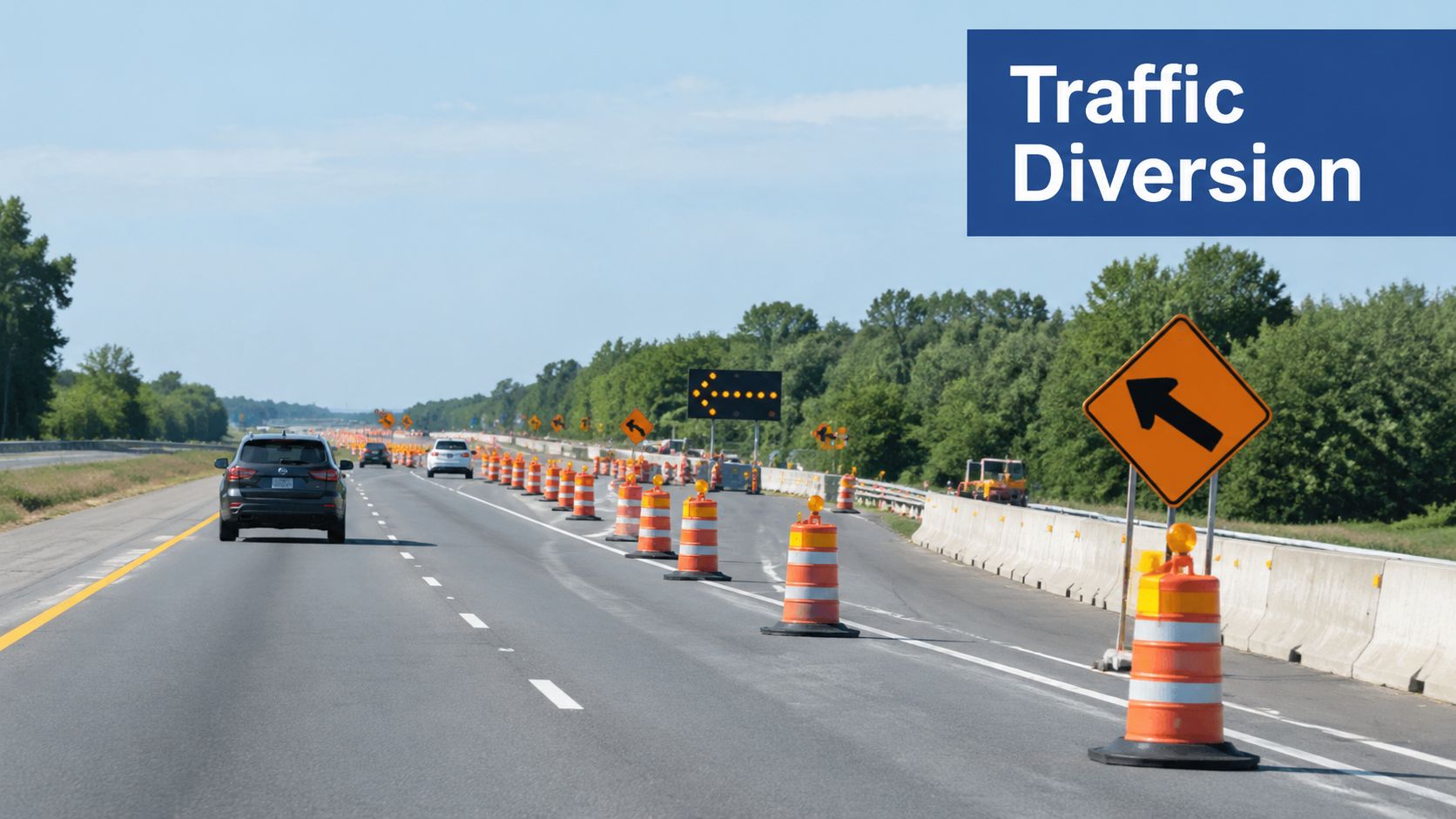
A diversion plan must make the intended vehicle movement clear before drivers reach the work area. Choose the arrangement according to the road layout, work activity, available capacity and operating period. Lane closures, merges, shifts, detours and temporary signals each create different driver decisions and control requirements.
For staged motorway works near Burwood, a gradual lane shift may give drivers more time to adjust, while creating a longer transition that needs careful monitoring. An Auburn project could schedule a closure outside peak periods. Parramatta CBD works may need different treatment around buses, pedestrians, intersections and local access. In Sydney CBD, signal coordination matters when several movements converge at a constrained intersection.
Show how the arrangement will perform
A plan assessor needs the reasoning behind the drawing. Identify each merge and conflict point, nominate who controls it, and state what action follows if queues extend beyond the expected location.
Transport for NSW's work-zone end-of-queue study describes queue-growth categories from small reductions of 0–1 km/h through very large reductions of more than 5 km/h, supporting a measured approach to queue risk rather than a general instruction to keep traffic flowing (Transport for NSW work-zone end-of-queue study). For learners, the practical lesson is to connect the proposed layout with traffic conditions that can be observed during the shift.
Use the plan to answer four operational questions:
Where are the control points? Mark merges, crossings, lane changes and positions where extra controllers may be needed.
How will queues be handled? Show likely accumulation areas and the trigger for changing the arrangement.
How will access remain available? Provide a workable route for emergency services, authorised site vehicles and affected properties.
How will performance be checked? Set inspection points and use available traffic information to confirm the approved setup remains suitable.
The Prepare Work Zone Traffic Management Plan course information from TP Training outlines practical expectations for this Red Card pathway. During the two-day course, practise explaining why each staging choice suits the site. That skill matters in assessment and on a live Sydney project, where conditions can require a controlled adjustment.
4. Personnel and Work Zone Safety Protocols
A TMP works only when every person on site can apply it under real conditions. Traffic controllers, supervisors, plant operators, subcontractors, visitors and workers entering or crossing the work zone need clear responsibilities. Safe Work Australia states that a TMP should be developed by a competent person, tested on site by its authors and implementers, and made available to workers onsite (Safe Work Australia workplace traffic management guide).
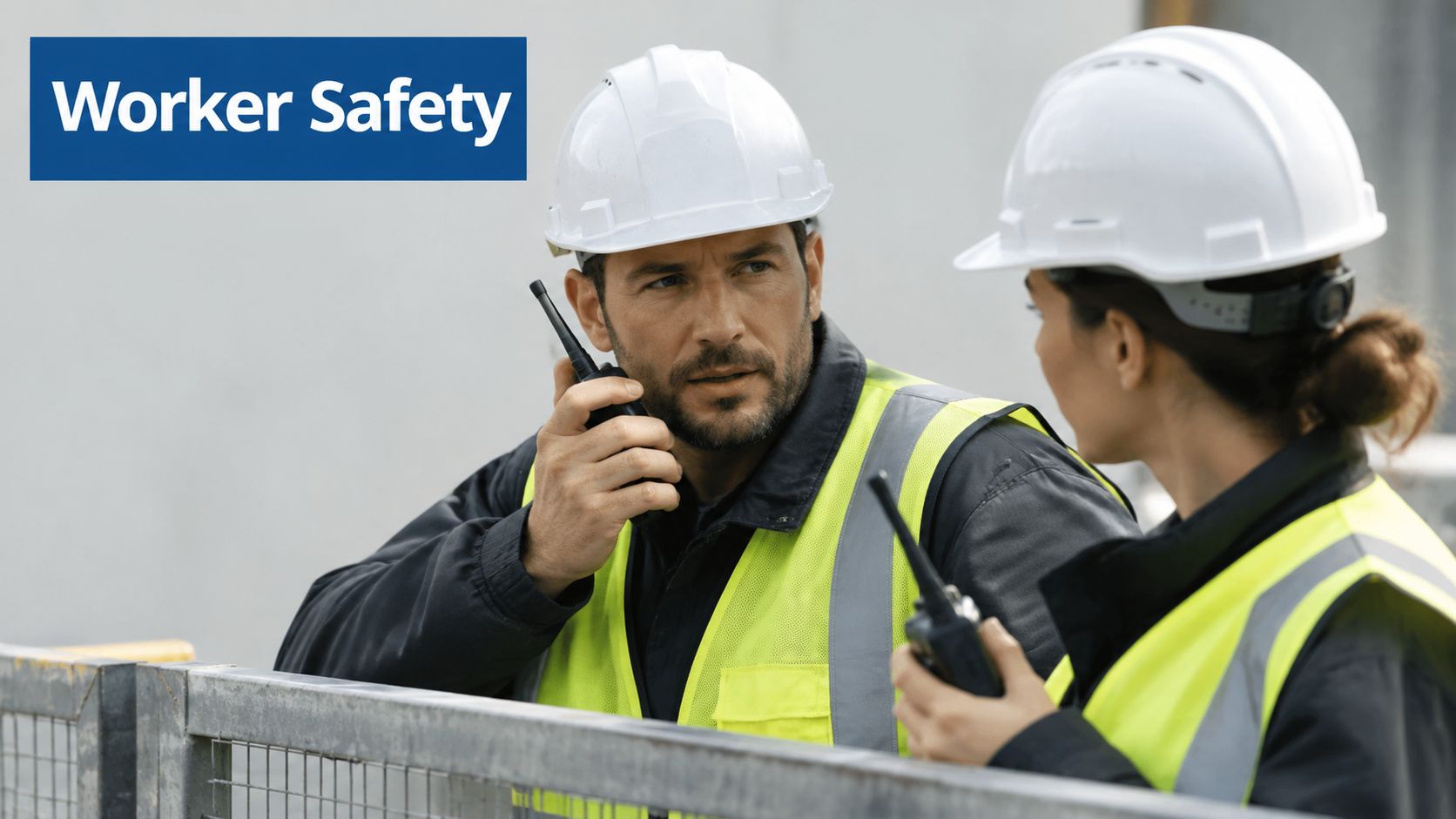
Site conditions shape the controls. A Penrith project may require high-visibility clothing with suitable reflective performance and extra lighting for low-light work. An Auburn roadwork site may need a defined separation area between live traffic and personnel. In Sydney CBD, two-way radios can help controllers and supervisors coordinate around noise, buildings and complex pedestrian movements. Regional NSW works may use a clearly marked cold zone, accessible only to authorised personnel.
Turn the plan into behaviour
Begin with a documented site briefing. Cover access points, exclusion areas, radio channels, hand signals, emergency codes and each person's authority to stop work when conditions become unsafe. A lookout system can provide added protection when the assigned person has an unobstructed view, understands the warning process and has no competing duties.
Use controls that remain practical during the shift. Check high-visibility clothing against applicable AS/NZS 4602 requirements, separate pedestrian routes from vehicle paths and reinforce the arrangement through toolbox talks. Supervisors should confirm that workers understand their task before plant or traffic movements begin.
One clear instruction delivered early is safer than a complicated instruction nobody remembers under pressure.
First aid readiness forms part of the site safety system. TP Training provides practical, nationally recognised First Aid training information alongside its traffic and construction pathways. For the two-day Red Card course, prepare to explain how personnel responsibilities connect with incident response, site supervision and emergency access. That preparation helps learners relate course assessment to workplace decisions on Sydney projects.
5. Communication, Stakeholder Coordination and Approval Process
Who needs to know what, and who can approve a change? A technically sound TMP can fail if traffic controllers, workers, supervisors and road users receive conflicting instructions. Set the communication path before work starts. Councils, road authorities, emergency services, nearby businesses and the public may each require different information.
For work on or near a public road, contact the relevant road authority about local traffic management requirements. Authorisation may be required before certain traffic control devices or public-road arrangements are implemented, as outlined in the Safe Work Australia construction traffic management guide. NSW guidance also treats a TMP as a record of the work, associated risks and accepted control measures. Approval coordination therefore belongs in the plan from the start.
Match the message to the decision
A large M7 project may have several work areas operating under different supervisors and communication systems. A Parramatta CBD project may require regular contact between traffic staff, construction crews and council representatives. Sydney CBD work can involve TfNSW, councils, emergency services and affected businesses, while Penrith projects may need advance notices for retailers and nearby communities.
Set one normal channel for instructions, updates and approvals. Name the person who controls that channel and the person who can approve a change. Keep a backup method, such as radios, agreed hand signals or mobile phones, for equipment failure or poor coverage. Emergency instructions need their own route, including who may issue them and how every work group will receive the message.
Record the communication that affects the TMP. Meeting minutes, notifications, radio logs, site briefings and approval records can show what was agreed, when it changed and who was informed. Use the same terms in the plan, signs, briefings and radio calls. Managers may need a concise summary, while residents, customers and local businesses need plain-language notices.
During the two-day Prepare Work Zone Traffic Management Plan course, practise describing one control in technical terms for an assessor and clear operational terms for a worker. That exercise builds a direct workplace skill: turning an approved plan into instructions people can follow on Sydney projects.
6. Incident Response and Emergency Procedures
What should a crew do after a collision, medical emergency, spill or severe weather event? The TMP needs a clear response path that works under pressure. It should identify emergency traffic procedures, responsibilities and the work zone layout, consistent with the Safe Work Australia guidance noted earlier.
A multi-vehicle collision on the M1 near Burwood may require immediate scene protection, access for emergency services and a temporary change to traffic controls. If a worker is struck at an Auburn site, the response must arrange medical support, control continuing traffic exposure and preserve relevant conditions for investigation. Severe weather in Sydney CBD may require equipment to be secured and people moved to a safer location.
Set the response before work starts
Nominate the site supervisor, or another responsible person, to coordinate the incident. List emergency contacts, access routes, assembly areas, first aid resources and the method for notifying workers. Keep the instructions short enough to use during a noisy, stressful event. A practical guide to incident reporting systems can support the documentation approach, while the TMP remains specific to the site.
Use a decision sequence rather than relying on individual judgement:
Make the scene safe: Stop or isolate the activity and keep vehicles and people away from the hazard.
Call for assistance: Contact emergency services and give clear location and access details.
Maintain responder access: Adjust signs, barriers or traffic controls so responders can enter without creating another conflict.
Record the event: Capture conditions, injuries, notifications, actions and temporary controls.
Check the TMP: Review whether the incident or near miss requires a change to the plan.
Run through likely scenarios before work begins. During the two-day Prepare Work Zone Traffic Management Plan course, practise explaining the response in a way an assessor can evaluate and a work crew can apply. That skill transfers directly to Sydney projects, where conditions can change faster than a written briefing.
After an incident, assign specific follow-up actions. A revised lookout position, clearer radio instruction or different pedestrian route is more useful than a general reminder to take care. Confirm who will update the TMP, brief affected workers and verify the new control in the field.
7. Compliance, Monitoring, Maintenance and Adaptive Management
How do you keep a TMP compliant after approval? Treat it as a working control document. Site conditions change, equipment wears, traffic patterns shift and work stages progress. Transport for NSW describes a TMP as a document that sets out the work, identifies traffic risks and defines accepted controls. Its TCAWS guidance requires a TMP for temporary traffic management works and commonly supports it with a risk assessment, Traffic Guidance Scheme and Vehicle Movement Plan (Transport for NSW traffic engineering guidance).
A motorway project on the M1, M4 or M7 may require formal compliance checks and regular field monitoring. On a Penrith site, queue growth may require revised signal timing. Auburn roadworks may need weather-damaged signs replaced. A longer Sydney CBD project needs a maintenance routine covering devices, barriers, lighting and records.
Treat change as part of the design
Build a checklist around the approved TMP, road authority conditions, workplace safety duties and the condition of each traffic control device. Assign inspection responsibility, set inspection times and record findings with photographs. Walk the site during the conditions the plan is intended to control, rather than relying only on document checks.
Austroads' Guide to Temporary Traffic Management provides a national planning structure based on traffic assessment and risk assessment. Part 2 was published on 13 September 2021, and the framework supports temporary traffic management practice across Australia and New Zealand (Austroads Part 2 planning framework). Updated guidance released in May 2026 covers planning, Traffic Guidance Scheme design, sample layouts and assurance practices. Part 8 also introduced nationally harmonised training and accreditation updates (May 2026 framework update).
Use a transport management system to track inspections, corrective actions and document versions. A practical UK haulier TMS explanation can clarify the system concept, but the TMP still needs site-specific controls and local approval requirements.
Prepare for the current framework, then verify local road authority requirements before submitting or implementing the plan.
Set review triggers for changed staging, altered access, unexpected queues, damaged devices, new pedestrian movements, incidents and weather conditions. TP Training's traffic control refresher course guidance supports the wider principle that competencies and site practices require regular attention. During the two-day Prepare Work Zone Traffic Management Plan course, practise checking controls against field conditions and explaining the required update clearly. That preparation helps Sydney learners complete assessment tasks and apply the same process at work.
Traffic Management Plan, 7-Point Comparison
| Item | Implementation complexity 🔄 | Resource requirements ⚡ | Expected outcomes ⭐ | Ideal use cases 💡 | Key advantages 📊 |
|---|---|---|---|---|---|
| Traffic Control Setup and Sign Placement | Medium, standard procedures + practical placement skills | Low–Medium, signs, barriers, reflectors, crews, maintenance | High ⭐⭐⭐, clear guidance; up to ~70% accident reduction | Roadworks, highway works, night shifts, short‑term TMPs | Cost‑effective safety; regulatory compliance; easily adjustable |
| Work Zone Hazard Identification and Risk Assessment | High, systematic analysis and experienced judgement required | Low–Medium, assessor time, documentation tools, photos | High ⭐⭐⭐, prevents incidents; proportionate controls | Complex or changeable sites; training/assessment scenarios | Prioritises risks; documents duty of care; enables continuous improvement |
| Traffic Diversion and Lane Management Strategy | High, traffic engineering, sequencing and modelling | High, monitoring, temporary signals, VMS, traffic controllers | Medium–High ⭐⭐✳️, reduces congestion; maintains throughput when well designed | Motorways, CBD works, peak‑period or reversible lane projects | Minimises delays; improves productivity; adaptable with real‑time data |
| Personnel and Work Zone Safety Protocols | Medium, defined procedures, training and drills | Medium, PPE, radios, training, lookout personnel | High ⭐⭐⭐, reduces worker injury; legal WHS compliance | Any live traffic site, high pedestrian exposure, long projects | Protects workers; enables rapid emergency response; creates accountability |
| Communication, Stakeholder Coordination and Approval Process | Medium–High, multi‑agency workflows and approvals | Medium–High, meetings, VMS, notifications, admin resources | Medium–High ⭐⭐✳️, reduces confusion; secures approvals and support | Large projects, community‑sensitive works, multi‑jurisdiction sites | Reduces complaints; aligns stakeholders; supports coordinated response |
| Incident Response and Emergency Procedures | Medium, clear command structure and scenario planning | Medium, first aid, radios, training, documented processes | High ⭐⭐⭐, minimises harm; improves emergency coordination | High‑risk sites, works near emergency access routes, events | Rapid life‑safety response; documented investigations; corrective actions |
| Compliance, Monitoring, Maintenance and Adaptive Management | High, ongoing audits, change control and adaptive decisions | High, dedicated staff, inspections, records, maintenance budgets | High ⭐⭐⭐, sustained compliance and performance over time | Long‑term motorway projects, multi‑stage works, highly regulated sites | Ensures legal compliance; early issue detection; continuous improvement |
Turn Two Days of Training Into Workplace Confidence
The best short course is the one that matches the work you want to perform. Choose traffic controller training if your next role involves directing road users and applying field controls. Choose a civil construction or plant pathway if you need to operate equipment around changing site conditions. Choose first aid when your workplace responsibility includes responding to injuries and supporting emergency procedures. Hospitality pathways make more sense when your immediate goal is customer-facing work.
For the Prepare Work Zone Traffic Management Plan course, prepare for decisions rather than rote learning. Review work-zone terminology before class, practise spotting hazards in photographs and on site, and learn to distinguish a risk from the control used to manage it. Bring focused questions about NSW road authority expectations, Traffic Guidance Schemes, Vehicle Movement Plans, pedestrian access and how staging changes the risk profile.
The course is completed across two days, so use the time actively. Read each scenario carefully. Identify the road users, workers, plant, access points and likely conflict areas before drawing a solution. When you place a sign or choose a lane arrangement, rehearse a short explanation covering visibility, movement, separation, communication and emergency access.
Prepare for practical assessment
Successful learners don't try to sound impressive. They make their reasoning easy to follow. Explain what could go wrong, which control addresses it, who implements that control and how the team will know whether it remains effective.
Practise these areas before attending:
Sign placement: Explain the purpose and sequence of warning, regulatory and directional devices.
Risk controls: Connect each control to a specific hazard and affected road user.
Traffic staging: Describe how vehicles, pedestrians and workers move through every phase.
Communication: State who receives instructions, which method is primary and what happens if it fails.
Emergency response: Explain how the site is isolated, how help is called and how access is maintained.
Confirm the Sydney centre that suits your travel plans, whether that's Penrith, Burwood, Auburn, Parramatta or Sydney CBD. Then review the Prepare Work Zone Traffic Management Plan course and arrive ready to participate, ask questions and explain your decisions clearly. TP Training is one relevant option for learners building practical skills across traffic control, construction, civil construction, first aid and workplace safety.
For the article's hero image, use a realistic Australian training-centre or roadwork scene with learners in high-visibility PPE, a trainer reviewing a TMP beside traffic-control equipment, cones, barriers and a work vehicle. Subtle TP Training branding on uniforms, hard hats or training materials should support a premium, welcoming and career-focused composition, with cinematic lighting and generous space for the headline.
TP Training offers practical, nationally recognised safety and vocational courses across Sydney locations including Penrith, Burwood, Auburn, Parramatta and Sydney CBD. If you're preparing for the Traffic Management Plan TMP pathway, visit TP Training to explore the two-day Red Card course and choose training that fits your next workplace outcome.

You may also like
Yellow Card NSW: Requirements, Units and How to Enrol

Construction Induction Training in NSW Explained