

How Long Licence Crystalline Silica Prevention Last
There is no fixed expiry date for crystalline silica prevention training itself. In practice, its status is governed by the employer's records kept for 5 years after the worker leaves, the 10830NAT course currency window from 25 November 2024 to 24 November 2029, and the fact that workers trained before 1 September 2024 don't need to repeat the course immediately.
The popular advice is to treat silica prevention like a licence that expires on a printed date. That advice is wrong for NSW workplaces. 10830NAT is a nationally recognised training course, not a High Risk Work licence, and SafeWork NSW doesn't issue a silica licence card that tells you when the training stops counting.
The better question is: which compliance clock are you asking about? Course currency, worker competency and employer recordkeeping run alongside each other. A worker may hold a valid Statement of Attainment while still needing task-specific induction or refresher training after workplace changes. An employer may also need to produce records years after the worker has stopped performing silica-generating work.
Table of Contents
- Why the Crystalline Silica Prevention Licence Is Not a Simple Ticket
- The Australian Framework Behind the Training
- The Three Clocks That Decide If Your Training Still Counts
- When the Training Has to Be Repeated in NSW
- How Employers Prove the Training Is Still Current
- A Simple Crystalline Silica Compliance Checklist for 2026
Why the Crystalline Silica Prevention Licence Is Not a Simple Ticket
A crystalline silica prevention qualification is not a licence with a simple expiry date. A High Risk Work licence normally comes with a card, licence number and defined administrative framework. Silica prevention training works differently. The worker completes approved training, receives evidence of completion and must apply that knowledge in a workplace where materials, tools, controls and exposure risks can change.
The 10830NAT Silica Awareness Training course is best treated as a competency statement, not a permanent licence. Its Statement of Attainment confirms completion of the relevant training. It does not, on its own, prove that the worker has completed your site induction, understands the current dust controls or remains competent after a significant process change.
Three clocks govern whether the training counts
Clock one is course currency. The nationally accredited 10830NAT course is currently listed with a currency window from 25 November 2024 to 24 November 2029, subject to regulator updates, as recorded in Comcare's silica guidance. That date applies to the training product and its approval status. It does not automatically require every worker who completed the course to repeat it on the same day.
Clock two is individual competency. The worker's knowledge must remain suitable for the assigned task. Silica training should form part of induction and refresher training, be provided when a worker starts a silica-dust task, and be reviewed when workplace changes alter exposure risk. A worker may therefore need further instruction before the course reaches the end of its listed currency window.
Clock three is the employer's recordkeeping duty. NSW employers must retain training records while the worker performs the relevant high-risk work and for 5 years after the worker stops doing that work, according to SafeWork NSW training guidance.
Practical rule: Check the training product, the worker's task competency and the employer's records. A card alone does not establish compliance.
SafeWork NSW inspectors look for evidence connected to the actual work. That includes how the worker was trained, when the task began, which controls apply and whether the training record supports the work being performed. The compliance question is not how long a crystalline silica prevention licence lasts. It is whether all three clocks are being managed today.
The Australian Framework Behind the Training
Australian silica rules do not create a simple, once-only ticket. They require employers to prevent or minimise exposure to respirable crystalline silica, then show that workers understand the risks and controls for their work. The national workplace exposure standard is 0.05 mg/m³ as an eight-hour time-weighted average, and Safe Work Australia explains how it applies through Commonwealth, state and territory WHS laws in its workplace exposure standard guidance.
That standard gives supervisors a reference for exposure management. Where a task can generate respirable silica dust, the PCBU must identify the hazard, select suitable controls and manage exposure. Training supports those duties by covering how silica is produced, how dust controls operate and what workers must do if controls fail. Read our overview of crystalline silica exposure prevention requirements for the broader compliance context.
What the NSW framework requires
NSW PCBUs must eliminate or minimise risks from respirable crystalline silica under the WHS framework. Training is one part of that duty. It does not replace wet methods, on-tool extraction, isolation, housekeeping, respiratory protection or exposure monitoring. A certificate without effective controls gives an employer weak evidence of compliance.
The recognised training pathway is 10830NAT Course in Crystalline Silica Prevention. Course materials and delivery may also refer to units CPCCDO3011A and CPCCDE3014A, which relate to silica-risk work in relevant construction and demolition settings. A competent person must deliver the training. South Australian guidance specifies a minimum 3-hour duration, which helps show the scale of the initial training event. Employers must still apply the rules governing their own jurisdiction, task and workplace.
Why there is no NSW licence card
SafeWork NSW does not issue a crystalline silica licence card. The framework regulates training, worker competency, exposure controls and records rather than granting a personal operating licence. Evidence will usually be a Statement of Attainment or approved training record, supported by workplace documentation.
For employers addressing more than one hazard, 10830Nat 11084Nat Crystalline Silica Exposure Prevention Asbestos Awareness Combo Courses combine silica prevention and asbestos awareness training through a nationally recognised delivery model, with practical learning available across NSW.
The framework sets the training and risk-management duties, but it does not establish a universal annual renewal date. Whether training still counts depends on the course's currency, the worker's current competency and the employer's records. Silica risk changes with the material, task, equipment, controls and workplace conditions.
The Three Clocks That Decide If Your Training Still Counts
A crystalline silica prevention licence does not run on one universal expiry date. Compliance depends on three separate clocks: course currency, worker competency and employer recordkeeping.
| Clock | What It Measures | Duration | Question It Answers |
|---|---|---|---|
| Course currency | Whether the approved 10830NAT training product remains current | Currently listed from 25 November 2024 to 24 November 2029, subject to regulator re-accreditation | Is the training product still an approved pathway? |
| Worker competency | Whether the individual can safely perform the assigned silica-related task | Ongoing, with induction and refresher training when tasks, controls or exposure risks change | Can this worker perform this task safely at this workplace now? |
| Employer recordkeeping | Whether the business can prove training and compliance after the work ends | While the worker performs the relevant work, then 5 years after the worker stops, under Queensland regulator guidance and NSW requirements | Can the employer support its training position during an audit or investigation? |
The first clock sits with the training system and registered training organisation. If the course is updated or replaced, the RTO and regulator set the transition arrangements. A worker does not automatically lose completed training because the course later changes.
The second clock is controlled by the job. A new starter needs site induction before generating silica dust. A returning worker may need a competency check after time away. A worker moving from cutting to another silica-generating process needs instruction that matches the new exposure risk, equipment and controls.
The third clock belongs to the employer. Keep the Statement of Attainment, training register, induction evidence, competency checks, refresher notes and related compliance records. The business needs these records when preparing for inspection, responding to an incident or showing how it controlled a known hazard.
Training completed before 1 September 2024 can generally remain recognised under the national transition position, so immediate repetition is not automatically required. The employer must still provide site induction, task instruction and refresher training whenever the worker, task, controls or workplace conditions change.
When the Training Has to Be Repeated in NSW
A crystalline silica prevention certificate does not decide compliance by itself. NSW supervisors should review competency when the work, controls or worker's connection with the task changes. Those events matter more than waiting for a printed expiry date.
A new or transferred worker must complete suitable induction before generating silica dust. The induction should cover the materials, tools, extraction or wet-cutting controls, housekeeping rules and escalation process used at that site. It applies to stonemasons, demolition workers, construction labourers and engineered stone benchtop installers.
Changes to engineered controls also require a competency review. New water suppression, altered ventilation or on-tool extraction can change how a task must be performed. Workers must know how to operate, inspect and report faults with the revised control. A previous certificate does not demonstrate that knowledge.
Operational triggers for a competency reset
Use the event that changes the worker's risk profile, rather than an arbitrary calendar date, to decide what happens next.
| Trigger | Who Repeats | Delivery Format | Recordkeeping |
|---|---|---|---|
| New starter or transferred worker before silica-generating work | The new or transferred worker | Full approved training and site-specific induction | Add the Statement of Attainment, induction date and task assignment to the register |
| New water suppression, extraction or other engineered control | Workers affected by the changed task | Refresher or updated task training that addresses the control change | Record the change, attendees, content and trainer |
| Documented gap of more than 12 months without silica-generating work | The returning worker | Competency review and refresher delivery before the task resumes | Record the gap, assessment, refresher and return-to-task date |
| Incident, near miss or monitoring result above the 0.05 mg/m³ exposure standard | Workers involved or exposed, plus affected supervisors | Targeted retraining, control review and reassessment | Attach incident or monitoring evidence to corrective-action records |
An experienced worker returning to the same task may need only a toolbox-style refresher if it directly covers the current risk and workplace procedures. Use full approved training for a new starter, a worker who has not completed the required course or a materially changed task. For flexible delivery options, see the online crystalline silica exposure prevention course.
Safe Work Australia's national silica work guide supports induction, task-based delivery and refresher training after significant changes.
TP Training offers nationally recognised Courses delivered by experienced trainers, including practical learning across NSW. The supervisor's test is direct: can the worker explain the current control, use it correctly and respond if it stops working?
How Employers Prove the Training Is Still Current
A silica training certificate does not settle compliance. Employers must prove three things at once: the course remains accepted, the worker can perform the task safely, and the business has kept the required evidence.
Start with the original 10830NAT Statement of Attainment from a registered training organisation. Check the worker's legal identity, training product and completion date. Store a readable copy in a system supervisors can access, rather than relying on the worker's memory or a photograph on a personal phone.
Then connect the certificate to the workplace. The dated site induction should record when the worker began silica-generating work and which site controls were explained. Course completion shows what the worker studied. The induction shows how that knowledge applies at this site.
The five-record verification playbook
- Training evidence: Keep the Statement of Attainment, issuing RTO details and course information together.
- Worker register: Record the worker's name, training date, RTO, course or unit details and current work status.
- Site induction: Record the date silica-generating work began and the controls covered during induction.
- Refresher history: File toolbox records and updated training notes after control changes, incidents, near misses or a return to the task.
- Exposure evidence: Maintain the current exposure assessment showing how the workplace manages the 0.05 mg/m³ eight-hour standard.
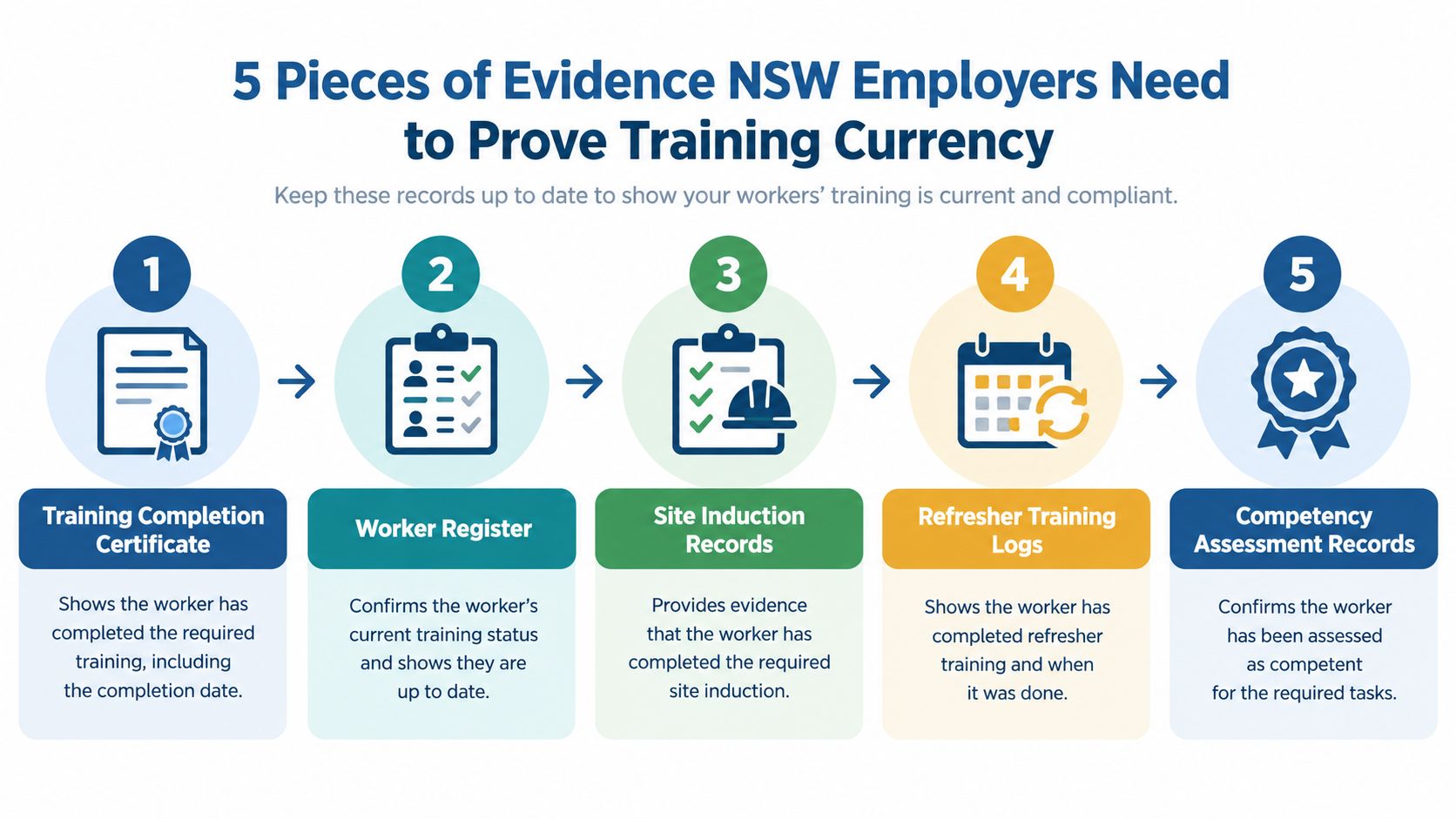
The employer owns the recordkeeping duty, regardless of where the RTO operates. A NSW business must retain the required records for 5 years after the worker stops performing the relevant silica work, under NSW requirements and the SafeWork NSW silica training information, accessed October 2026.
Audit test: A reviewer should move from the worker's name to the certificate, induction, task, refresher history and exposure controls without asking the business to rebuild the record.
A certificate alone leaves a compliance gap. It proves attendance, not that the worker was prepared for the assigned task under the controls in place. A well-maintained register gives supervisors a clear basis for deciding whether the evidence is complete and whether further action is needed.
Apply the same filing standard used for other safety credentials. For example, the process used to verify construction induction information through a White Card number guide can help staff locate and check silica training records quickly.
A Simple Crystalline Silica Compliance Checklist for 2026
Treat 2026 as a good time to clean up the records, not as a reason to wait for a renewal notice. The most effective approach is a short audit that checks all three clocks against the people and tasks operating in your business.
Ten checks for NSW supervisors
Confirm training evidence. Check that each worker performing silica-related work has suitable approved training evidence. For workers who completed an approved course before 1 September 2024, confirm the transition position rather than automatically booking duplicate training.
Match identity details. Compare every Statement of Attainment with the worker's legal name and internal personnel record. Resolve spelling differences before an inspection exposes them.
Review the course pathway. Confirm that the RTO and training product were appropriate when the worker completed the course. Use the national training register to verify the provider's registration rather than relying on an informal certificate image.
Check returning workers. Identify anyone with a documented gap of more than 12 months away from silica-generating tasks. Arrange a competency review and refresher before that person resumes the work.
Compare exposure results. Review air-monitoring information against the 0.05 mg/m³ eight-hour time-weighted average described by SafeWork NSW's silica work guidance. Escalate results that show controls aren't achieving the required outcome.
Document each task control. For cutting, grinding, drilling, polishing or demolition, record the control method that applies. Workers need task instructions that match the tools and materials they use.
Update the training register. Cross-reference the worker, RTO, date, course information, induction and any refresher activity. Don't keep certificates in a folder that isn't connected to the roster.
File post-employment records. Keep silica training and related evidence for the required 5-year period after the worker stops doing the relevant work. Set a retention process so records aren't deleted during routine personnel-file clean-ups.
Review site induction material. Make sure induction content reflects current extraction, wet methods, housekeeping, PPE and stop-work procedures. A generic induction can miss the controls that define your site.
Book the next crew session. Where several workers need the same update, organise a coordinated session and record attendance. Onsite delivery for 8 or more workers can be an efficient way to refresh a crew in one morning, provided the delivery meets the applicable training requirements.
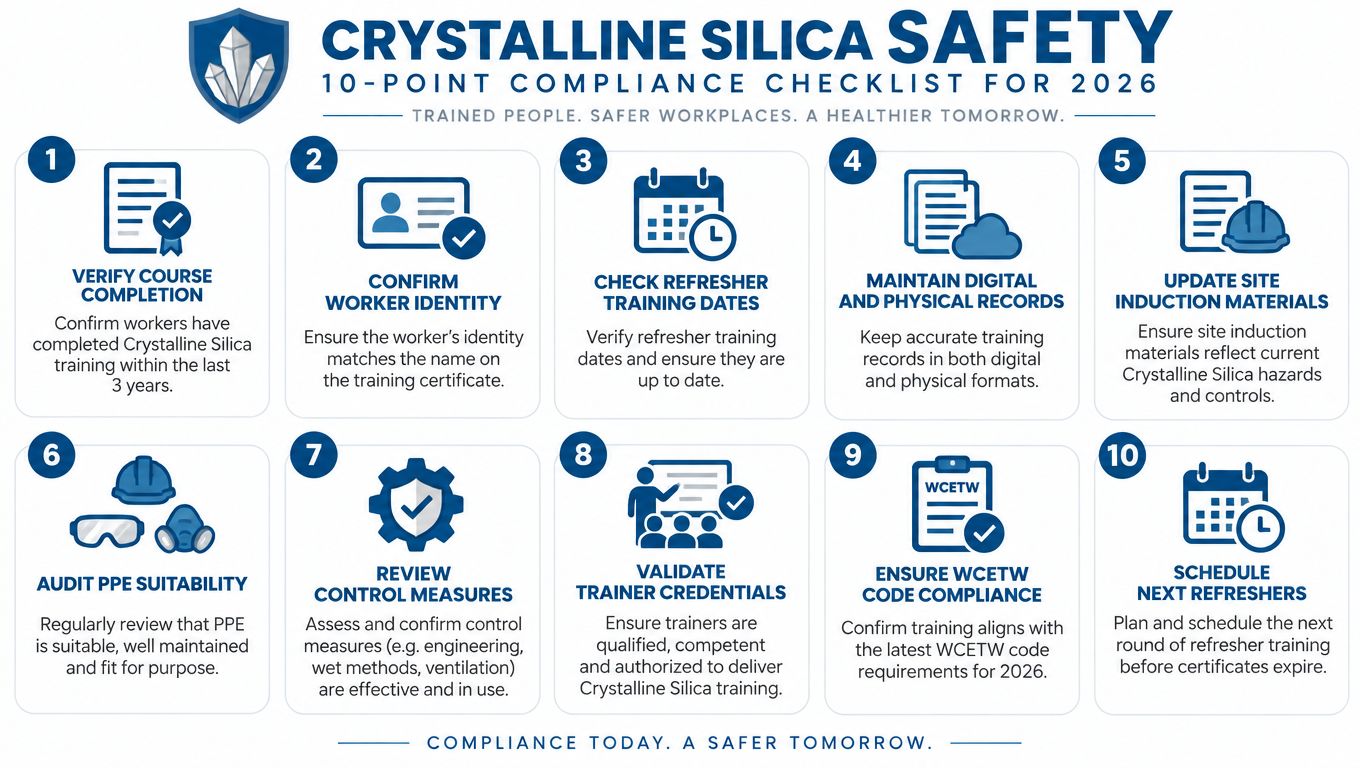
The checklist works because it separates proof from performance. The certificate proves a training event occurred. The induction and refresher records show how the worker was prepared for the current task. Exposure assessments and control documents show whether the business is managing the hazard rather than just collecting paperwork.
Use the workplace inspection checklist to structure the wider site review, then assign one person to close every missing record. Don't wait until an incident, regulator visit or client prequalification request reveals that the three clocks were never tracked together.
TP Training delivers practical crystalline silica prevention training through experienced trainers and hands-on learning across NSW. If your crew needs approved training, refresher support or a coordinated group session, visit TP Training and discuss the course and delivery option that fits your workplace.

You may also like

White Card Validity NSW: A Practical Guide for 2026

CPR Course Parramatta: What to Expect and How to Book