Online Crystalline Silica Exposure Prevention Course Guide
A Penrith concreter can finish a shift believing the dust was harmless because it cleared from the air before smoko. That assumption is exactly why an Online Crystalline Silica Exposure Prevention Course needs to teach more than definitions and respirator names. Workers and supervisors must understand what happens before the saw starts, while dust controls are operating, and after a task creates an exposure concern.
The practical question isn't, “Have you completed training?” It's whether the site can show a suitable control process, a silica risk control plan where required, effective supervision, appropriate respiratory protection, and air monitoring when exposure is uncertain. This guide connects online learning with the worksite decisions that protect people across Penrith, Western Sydney, NSW and Australia.
Table of Contents
- Why Crystalline Silica Matters on Australian Worksites Right Now
- Understanding Crystalline Silica and Its Health Risks
- Australian Exposure Standards and the Engineered Stone Ban
- What the Online Crystalline Silica Exposure Prevention Course Covers
- Silica Awareness Training and the Asbestos Awareness Combo Option
- How to Enrol and Complete the Course Online with TP Training
- Turning the Certificate into Compliant Site Practice
- Common Questions and Next Steps for Penrith Students
Why Crystalline Silica Matters on Australian Worksites Right Now
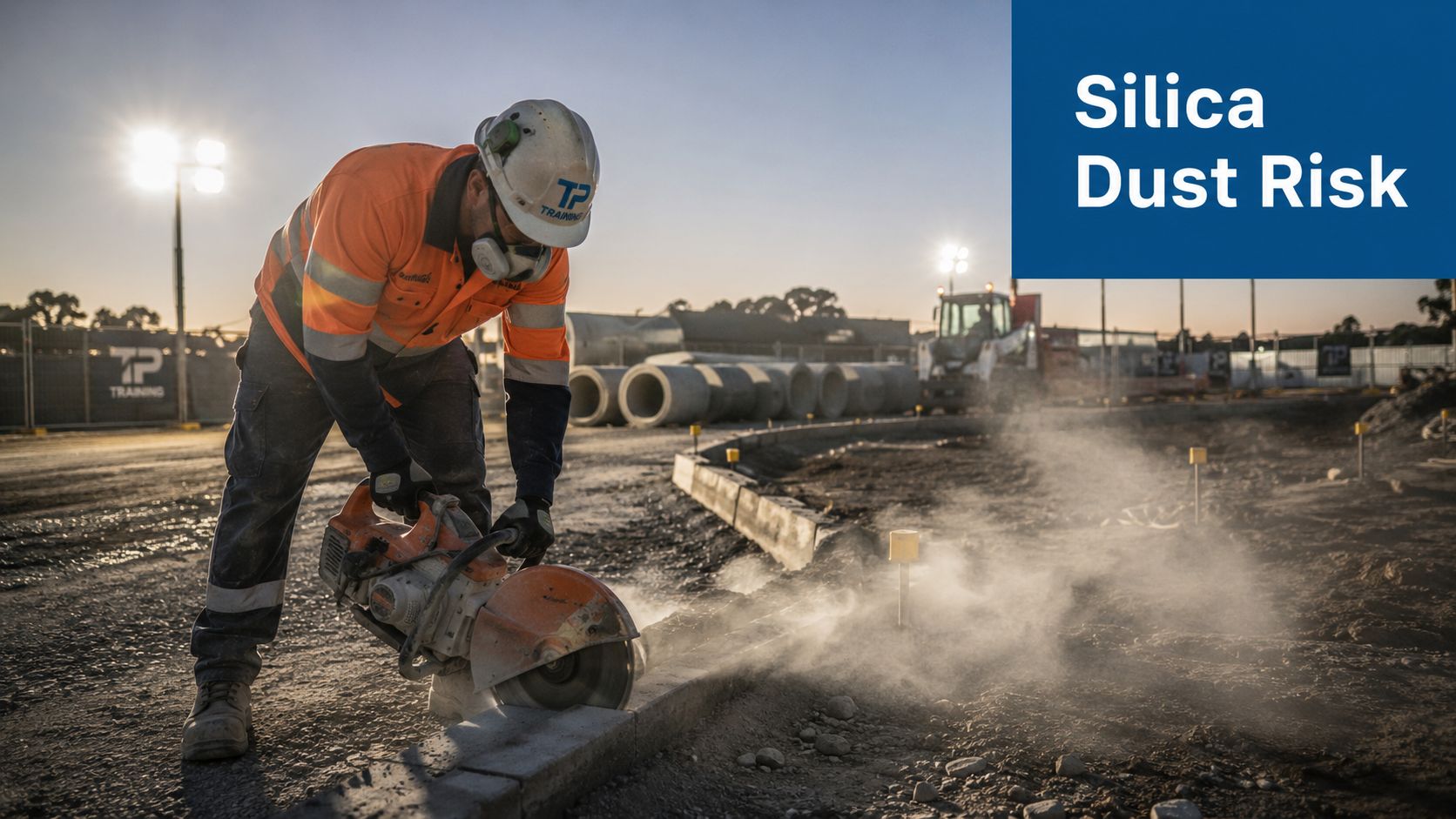
Before sunrise on a Western Sydney civil project, a worker cuts concrete kerbing under floodlights. The saw is loud, the schedule is tight, and a pale cloud forms around the blade. Although the dust soon settles, the task may have released respirable crystalline silica, particles fine enough to travel deep into the lungs.
Safe Work Australia estimated that up to 1.45 million Australian workers were employed in industries where respirable crystalline silica exposure may occur, including manufacturing and construction. Earlier research estimated that about 6.6% of Australian workers were exposed in 2011, including 3.7% who were heavily exposed. The issue therefore extends well beyond stonemasonry. Construction, demolition, tunnelling, mining, quarrying, manufacturing and civil work can all involve silica-generating tasks. Safe Work Australia's risk analysis explains the breadth of the exposure problem.
The regulatory position changed sharply after WHS ministers agreed unanimously on 13 December 2023 to ban the use, supply and manufacture of engineered stone from 1 July 2024. Australia became the first country to announce such a ban. The national prohibition began on 1 July 2024, while the Commonwealth import ban began on 1 January 2025 for engineered stone benchtops, slabs and panels containing more than 1% silica. Safe Work Australia's engineered stone ban information sets out that timeline.
A certificate cannot replace a planned task. It should help a worker recognise the hazard, question an unsafe method and follow the controls selected by the PCBU. Sound risk management in construction applies the same duty-of-care discipline to silica as it does to other site hazards. The control plan must match the material, task and equipment, rather than relying on a generic PPE checklist.
Silica prevention also sits beside other worksite risks, including workplace fall risks in Wisconsin. The jurisdictions and hazards differ, but the practical lesson is shared: employers and supervisors must identify the risk, select workable controls and check that workers can follow them.
For NSW sites, online training has value when it supports those decisions. Workers need relevant instruction, while principal contractors, employers and supervisors need controls that operate in the field and records that demonstrate the process. That is how course knowledge becomes safer, more accountable site practice.
Understanding Crystalline Silica and Its Health Risks
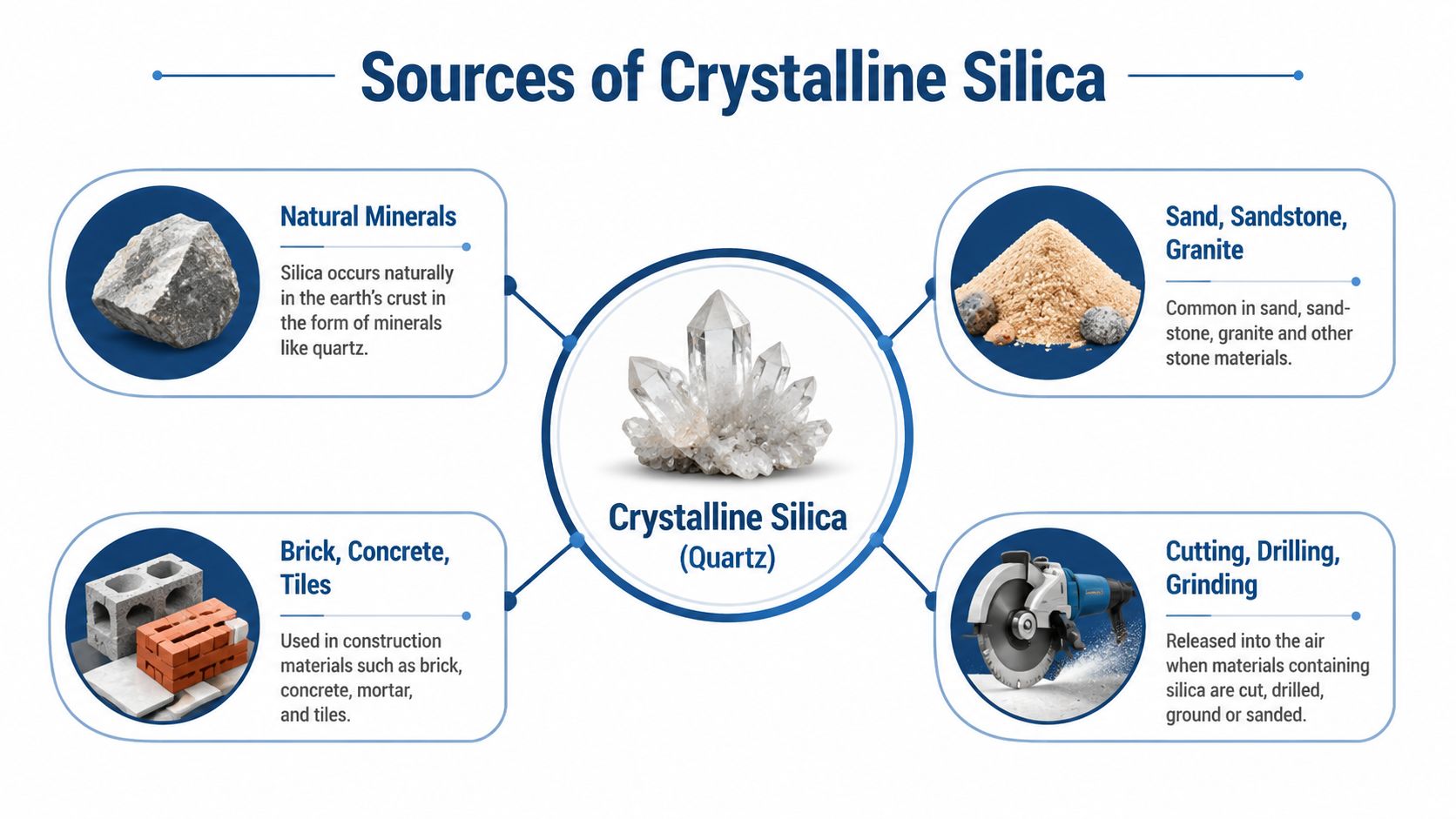
Crystalline silica is a mineral form of silica found naturally in materials such as quartz, sand, sandstone and granite. It also occurs in common construction products including brick, concrete, mortar, tiles and ceramics. The material itself may look ordinary, but cutting, drilling, grinding, polishing, crushing or blasting it can release respirable dust.
A useful comparison is to think of the hazardous particles as far finer than visible sand. They can bypass the body's upper airways and reach the alveoli, the small air sacs where oxygen passes into the bloodstream. A worker might not feel immediate discomfort, yet repeated exposure can cause lasting damage.
Tasks that create concern
On NSW worksites, higher-risk activities can include:
- Concrete work: Cutting, coring, chasing and drilling slabs, kerbs and paths.
- Masonry work: Brick cutting, tuckpointing, grinding mortar and removing damaged materials.
- Finishing work: Dry tile cutting, polishing and grinding stone or concrete surfaces.
- Blasting and excavation: Abrasive blasting and disturbing sandstone or other silica-containing ground.
- Fabrication: Processing engineered stone benchtops, slabs and panels, subject to the applicable prohibition and transitional requirements.
The task, material, equipment, duration and controls all matter. A course should therefore teach learners to ask what material is being disturbed and how the dust will be captured, suppressed, isolated or removed.
What exposure can do
Silicosis is an irreversible lung disease caused by inhaling respirable crystalline silica. It can develop in different forms, including accelerated and acute silicosis associated with intense exposure. A stonemason diagnosed at 38 may have years of working life ahead, but scarring in the lungs can't be undone by changing jobs.
Exposure is also associated with lung cancer and chronic obstructive pulmonary disease. Safe Work Australia guidance explains that exposure may also relate to autoimmune conditions and other health effects. The risk is cumulative, so a worker shouldn't treat each dusty task as an isolated event. NSW workplace safety guidance reinforces the importance of recognising hazards before work begins.
For learners who need both hazard topics, 10830Nat 11084Nat Crystalline Silica Exposure Prevention Asbestos Awareness Combo Courses combines practical, nationally recognised training with experienced trainers and hands-on learning across NSW.
Australian Exposure Standards and the Engineered Stone Ban
Australia's workplace exposure standard for respirable crystalline silica is 0.05 mg/m³ as an eight-hour time-weighted average, and the standard must not be exceeded. That figure isn't a visual dust test. Clear air doesn't prove that exposure is below the standard, which is why Safe Work Australia's national guidance focuses on air monitoring and control verification.
Monitoring becomes important when the employer isn't certain whether exposure is above the standard, or when measurements are needed to determine whether there's a health risk. Safe Work Australia also recommends monitoring at least annually when workers work with silica-containing products. A competent occupational hygienist can design sampling that represents the worker's actual shift and task, rather than relying on assumptions about the amount of visible dust.
The engineered stone response changed the way many businesses think about silica. Ministers agreed to the ban in December 2023, the national prohibition began on 1 July 2024, and the Commonwealth import ban for relevant products began on 1 January 2025. The shift matters because prevention is no longer based only on making a hazardous process safer. Where the law prohibits the product or process, elimination takes priority.
A hierarchy, not a checklist
Training should show how controls fit together:
- Elimination: Remove the hazardous material or task where lawful and practicable.
- Substitution: Choose a less hazardous material or method.
- Engineering controls: Use wet cutting, on-tool extraction, isolation, enclosure or suitable ventilation.
- Administrative controls: Plan the work, restrict access, provide instructions, maintain records and supervise.
- PPE: Select, fit, use and maintain respiratory protection as the final layer.
From 1 September 2024, WHS regulation amendments strengthened controls for work with materials containing at least 1% crystalline silica, including engineered stone, and applied to the broader category of crystalline silica substances. Comcare's summary of the amendments explains the wider scope.
A worker who also needs traffic planning knowledge may encounter the Prepare Work Zone Traffic Management Plan Course Pwz Red Card, which TP Training provides as practical, nationally recognised training with experienced trainers and hands-on learning across NSW. The point is the same across safety topics. Online learning is a baseline for informed work, not a substitute for site controls.
What the Online Crystalline Silica Exposure Prevention Course Covers
A practical online course should move through the same decisions a worker faces on site. Learners log in, work through short lessons, test their understanding with scenarios and complete a final knowledge assessment. The useful measure isn't how many slides the course contains. It's whether the learner can make a safer decision when a supervisor asks them to cut, grind or drill a silica-containing product.
The learning sequence
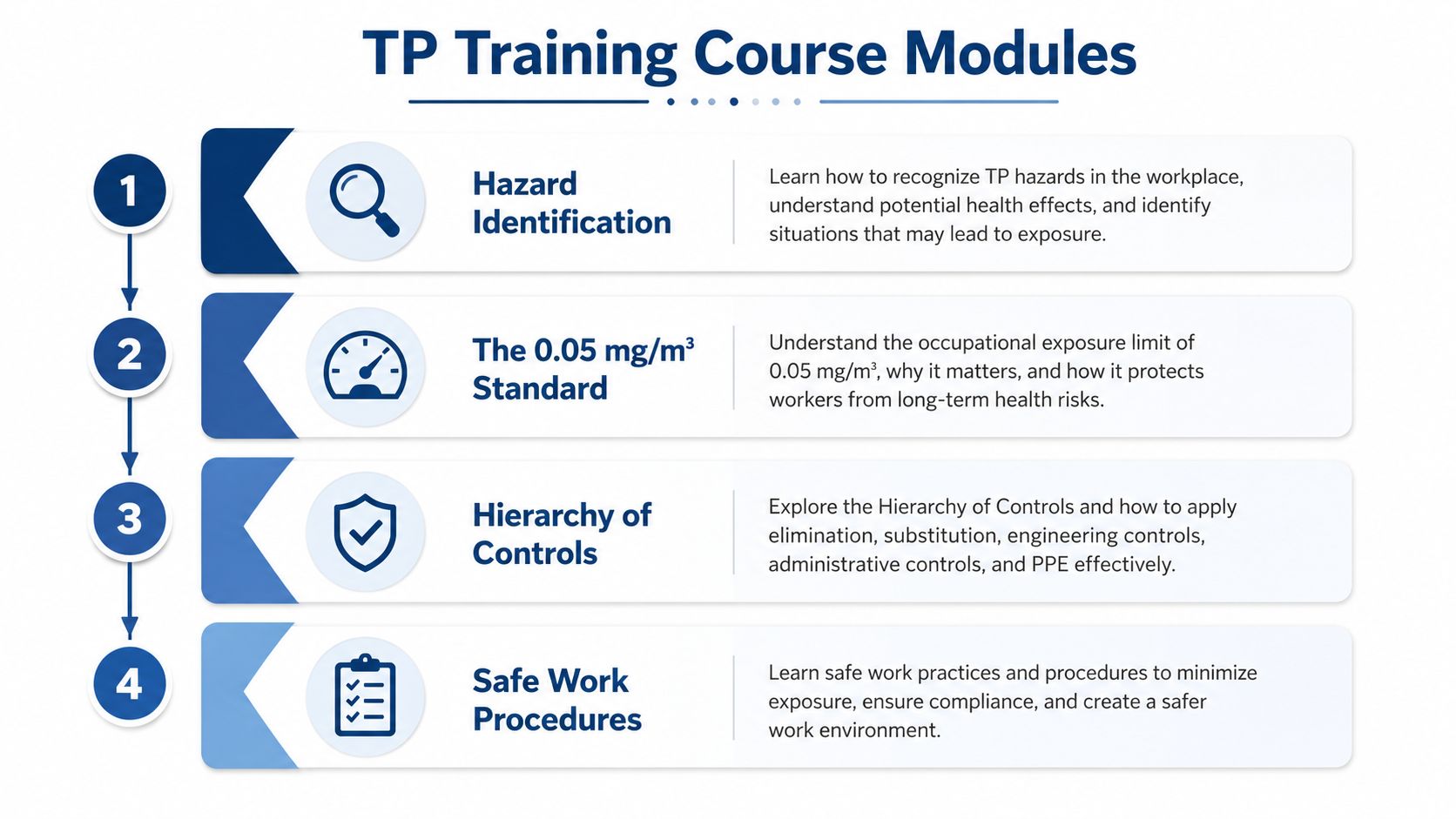
The core modules generally address:
- Hazard identification: Recognise quartz and silica-containing products, identify dust-generating tasks and understand who may be exposed.
- The exposure standard: Apply the 0.05 mg/m³ eight-hour time-weighted average and understand why measurement matters.
- Hierarchy of controls: Select elimination, substitution, engineering, administrative and PPE controls in the correct order.
- Safe work procedures: Connect risk assessments, safe work method statements, task planning, reporting and clean-up requirements.
Respiratory protection is covered as part of the control system, not as the first or only response. Learners should understand that a respirator needs appropriate selection, correct use, maintenance and, where required, fit testing.
Short scenario-based quizzes after each module help expose common mistakes. One scenario might ask whether a worker should dry cut a brick indoors, while another may ask what to do when a dust extraction system stops working. The learner then completes a final assessment and receives a downloadable statement of attainment where the course requirements are met.
A typical self-paced online format takes three to four hours, although learners may complete it in shorter sessions. The online theory can sit within a broader VET framework, depending on the course and training product. It still needs to connect with supervised practical activities, such as respirator fit testing, wet cutting demonstrations, extraction checks and correct clean-up methods.
Practical rule: If the learner can't explain what they would do when a control fails, the training hasn't yet reached the worksite.
Silica Awareness Training and the Asbestos Awareness Combo Option
The standalone pathway and the combo pathway solve different training problems. A stonemason, concrete cutter or civil worker who needs silica content may choose a silica-focused course. A renovation, demolition, construction or maintenance worker may face both silica-containing products and older asbestos materials, making combined awareness training more relevant.
The asbestos awareness training information can help learners understand why the second hazard requires its own recognition skills and procedures. Silica and asbestos aren't interchangeable hazards. The controls, registers, removal requirements and escalation steps differ, even though both require disciplined planning and supervision.
| Feature | Standalone Silica Course | Silica and Asbestos Combo |
|---|---|---|
| Primary focus | Respirable crystalline silica hazards, exposure prevention and silica controls | Silica prevention plus asbestos hazard awareness |
| Suitable workers | Stonemasons, civil workers, concrete cutters and workers disturbing silica-containing materials | Renovation, demolition, construction and maintenance workers who may encounter both hazards |
| Work planning | Silica task controls, risk control planning and respiratory protection | Silica planning plus asbestos register awareness and asbestos-specific controls |
| Site decisions | Identify dust-generating work and apply the hierarchy of controls | Recognise when asbestos may be present and escalate before disturbance |
| Training value | Focused learning for a single primary hazard | Broader awareness for dual-hazard environments |
A bundled course can reduce duplicated administration and give supervisors a more complete awareness base, but it doesn't grant a licence to remove asbestos. Learners must still follow the applicable NSW requirements, site procedures and licensed removal triggers. Combined accreditation may support a supervisor who coordinates work across older buildings, renovation sites and civil projects, while a standalone course remains the clearer fit for a role centred on silica.
How to Enrol and Complete the Course Online with TP Training
A Penrith learner can start by visiting the TP Training website and selecting the crystalline silica exposure prevention course. The booking page is available online here, where the learner checks the course information, enters personal details and selects the delivery option shown by the provider.
During enrolment, the learner may be asked for a Unique Student Identifier, or USI, where the training arrangement requires one. The USI setup guide explains the basic process for creating and managing that identifier. Learners should enter their details carefully so the training record can be matched correctly.

What happens after booking
After confirmation, the learner receives instructions for accessing the learning management system. The dashboard normally shows the available modules, records progress and identifies the assessment stage. A sensible approach is to study in a quiet place, keep the course notes available and write down questions to raise with a supervisor or trainer.
The learner then completes the module activities, scenario questions and final knowledge assessment. The required pass result depends on the course arrangement, so students should check the current provider information rather than rely on an assumption.
Once the training requirements are completed, the statement of attainment or digital certificate is issued according to the provider's process. If the training is recorded through the relevant VET arrangements, the record may also connect with the learner's USI transcript. Students should save the digital document in a secure folder and provide it to the employer or principal contractor when requested.
Penrith learners who need help with access, scheduling or enrolment details can contact TP Training by phone or email. Refresher arrangements should be confirmed with the employer and training provider, particularly when the work method, material, equipment or regulatory expectations change.
Turning the Certificate into Compliant Site Practice
The certificate becomes useful when it changes the pre-start conversation. Before cutting a slab, the supervisor should know what material is involved, whether the task is permitted, who may be exposed, which controls will operate and what happens if those controls fail.
A written silica risk control plan is required for high-risk processing of crystalline silica substances under the model Code of Practice. NSW guidance also expects at-risk employers to implement control processes, provide training and clear instructions, and prepare the relevant plan. Safe Work Australia's silica duties guidance provides the national context.
Applying the hierarchy at the task
Elimination may mean avoiding a prohibited engineered stone activity or removing the need to disturb the material. Substitution can involve selecting a different product or method. Engineering controls may include wet cutting, on-tool extraction, enclosed equipment or isolating the worker from the dust source.
Administrative controls support the physical measures. They include exclusion zones, signs, sequencing, supervision, equipment checks, worker instruction and records. P2 or half-face respirators may form part of the respiratory protection program, but the selection must suit the hazard and workers need appropriate fit testing, use and maintenance arrangements.
Air monitoring is triggered when the employer isn't certain that exposure remains below the standard or needs measurements to determine whether there is a health risk. A hygienist's report can show how a task compares with the 0.05 mg/m³ eight-hour time-weighted average, identify shortcomings and inform changes to the written plan.
Health monitoring also matters. Safe Work Australia guidance says workers who are exposed, suspected of being exposed or concerned about exposure should be referred for health monitoring, with annual medical examinations recommended. NSW's silica dashboard reported 59 silicosis cases and 5 deaths in 2024-25, showing the issue remains current. Health monitoring guidance explains why a course alone can't replace medical advice or workplace arrangements.
A certificate can support a SafeWork NSW inspection or toolbox talk as evidence that training occurred. It doesn't prove that the respirator fitted, the extraction worked or the risk plan reflected the task. Those facts must be demonstrated on site, alongside wider workplace credentials such as CPR, First Aid, White Card and safety certifications.
Common Questions and Next Steps for Penrith Students
Can I complete the course in one sitting?
Many learners complete self-paced online theory in one focused session, while others spread it across several evenings. The important point is comprehension. Don't rush through hazard recognition or the final assessment to obtain a document, because workers need to remember the controls when conditions change.
Is the certificate recognised outside NSW?
Training delivered under a nationally recognised arrangement can support work across Australia, but site access rules still vary between employers, principal contractors and jurisdictions. Before travelling for a project, check whether the receiving site requires additional induction, practical verification, refresher evidence or a particular training product.
Do I need refresher training?
Refresher learning is commonly expected annually or when controls change, but the exact requirement should come from the employer, PCBU, principal contractor and current guidance. A change in material, equipment, work method or risk control plan should prompt a review rather than waiting for a calendar reminder.
Is online learning enough for compliance?
No. Online theory can teach the hazard, exposure standard, hierarchy of controls and reporting responsibilities. It can't physically demonstrate wet cutting, confirm that an extraction system is effective, complete respirator fit testing or verify clean-up procedures.
The PCBU still needs suitable site controls, supervision, instructions and records. Health monitoring and air monitoring must also be arranged where the circumstances require them. A short non-VET WHS course may not require a USI, while a nationally recognised VET arrangement may require one, so students should confirm the position during enrolment.
Penrith learners should bookmark the course page, check the next enrolment cut-off and ask TP Training about group bookings for Western Sydney crews or job sites. Employers should also provide the task information before training so the learner can connect the online scenarios with real cutting, drilling, grinding or excavation work.
TP Training provides practical crystalline silica exposure prevention training for workers and supervisors who need to connect online theory with safer site decisions across NSW. Visit TP Training to review the relevant course pathway, confirm enrolment details and discuss group training for Penrith and Western Sydney worksites.

You may also like

Government Fund Courses in Australia: A Practical Guide
Workplace Safety Training: A 2026 Guide for Australia