10 Workplace Safety Tips: An Industry-Specific Guide
Is your workplace as safe as it could be, or are people just getting by without a clear system? In high-risk NSW environments, especially construction, civil works, and traffic control, safety isn't a slogan. It's the daily difference between a controlled job and an avoidable incident. Australia's latest national work health and safety data show 188 workers died from traumatic injuries in 2024, with a fatality rate of 1.3 fatalities per 100,000 workers, and 146,700 serious workers' compensation claims involved at least one week of lost time, with 84% of serious claims concentrated in four major hazard groups, body stressing, falls, being hit by moving objects, and mental stress (Safe Work Australia statistics). That tells you where the risk sits, and it tells you why generic safety talk isn't enough.
Good workplace safety tips are practical, specific, and tied to the work being done. A warehouse, a roadwork crew, and a civil site don't fail for the same reasons, but they do share the same pattern. People miss hazards, controls are too weak, supervision is inconsistent, and training doesn't match the task.
The strongest safety systems start with the basics and then adapt them to the job. That means PPE that suits the hazard, SWMS that reflect the site, traffic management that separates people from plant, and training that gives workers the confidence to act. It also means linking what people learn to nationally recognised qualifications, because competence matters as much as caution.
Table of Contents
- 1. Personal Protective Equipment and Proper Use
- 2. Hazard Identification and Risk Assessment
- 3. Hierarchy of Control in Real Jobs
- 4. Safe Work Method Statements and Work Planning
- 5. Worker Consultation That Actually Changes the Job
- 6. Competency and Training Requirements
- 7. Incident Reporting, Investigation, and Learning
- 8. Supervision and Site Leadership
- 9. Environmental Monitoring and Exposure Control
- 10. Emergency Preparedness and Response Planning
- 10-Point Workplace Safety Comparison
- Build Your Safety Skills with TP Training
1. Personal Protective Equipment and Proper Use
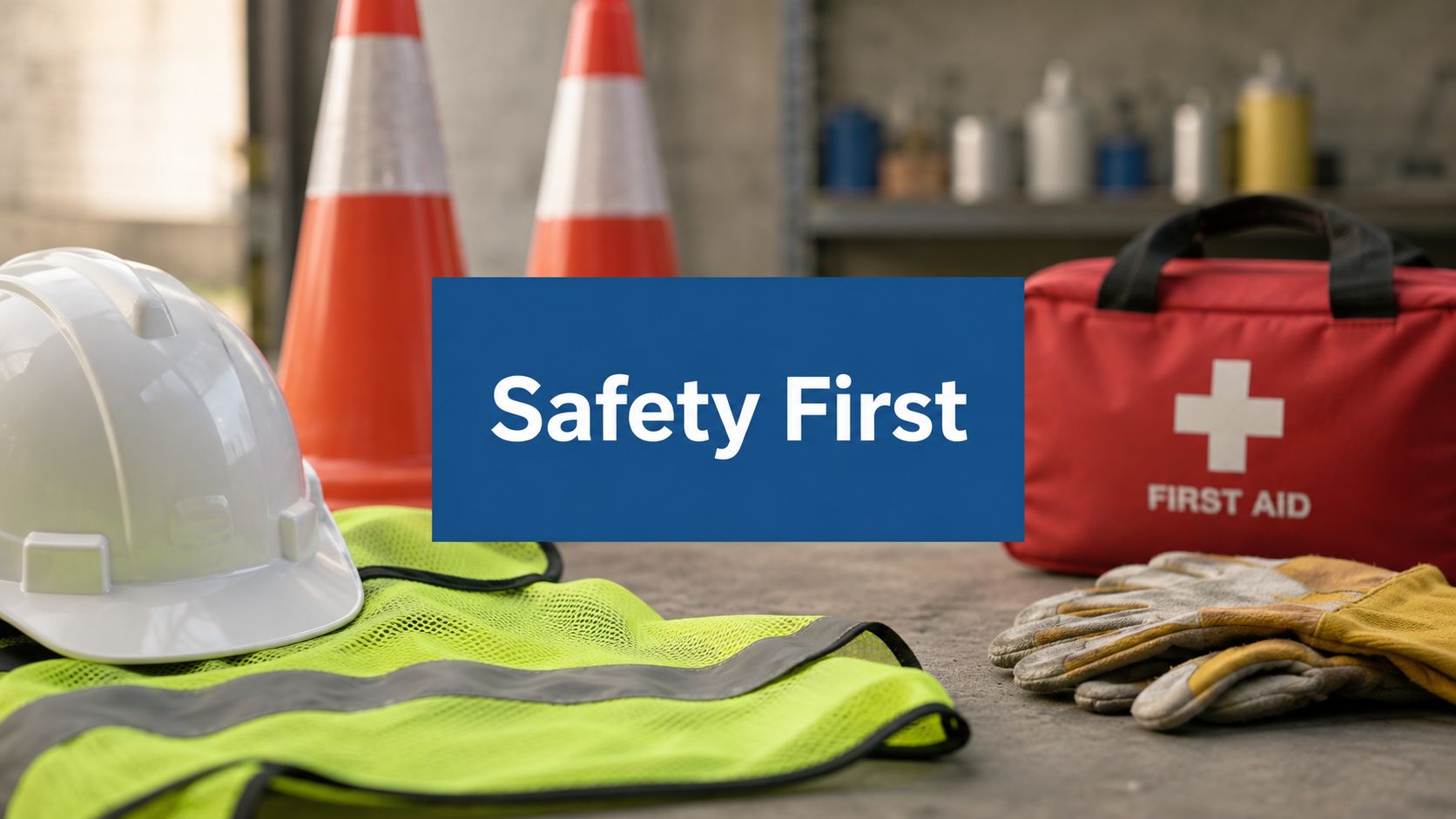
PPE works best when it's treated as the final barrier, not the main control. On a construction site, that usually means hard hats, safety glasses, high-visibility clothing, gloves, and safety footwear. In traffic control, reflective clothing matters just as much as visibility on the road shoulder, and in warehousing, eye and hand protection become critical during loading and material handling.
The mistake many sites make is buying PPE once and assuming the job is done. Fit, comfort, and condition all affect whether workers wear the gear correctly. If gloves reduce dexterity too much, people take them off. If boots are damaged or the wrong size, workers cut corners. If a vest is worn in the wrong setting, it can give a false sense of protection.
For construction induction, White Card Training Course training gives workers practical, nationally recognised safety basics, and it fits naturally with the PPE conversation because people need to understand when PPE is required and why. That understanding is what turns gear into a control, instead of a box-ticking exercise.
Practical rule: choose PPE after the hazard is identified, not before. A hard hat won't solve a dust exposure problem, and gloves won't stop a struck-by risk from moving plant.
Use these habits on real jobs:
- Match PPE to the task: Select eye, hand, foot, hearing, and respiratory protection based on the actual hazard, not the generic site rule.
- Check fit before shift start: Make sure helmets, eyewear, and gloves are adjusted properly, especially for new starters and subcontractors.
- Replace damaged items immediately: Cracked eyewear, torn gloves, and worn soles should come out of service straight away.
- Store gear properly: Keep PPE in a clean, dry place so it lasts longer and stays effective.
The best sites make PPE easy to access and easy to replace. That's what keeps compliance steady when the work gets busy.
2. Hazard Identification and Risk Assessment
Hazards don't disappear because the crew is experienced. They usually stay hidden until someone slows down long enough to look properly. That's why a good risk assessment starts with what people do on site, not what the procedure says they should do.
In construction and civil works, that means checking for working at heights, moving machinery, electrical risks, manual handling, and environmental exposure. It also means watching for silica dust during demolition and cutting tasks, because the hazard often sits in the task itself, not in the obvious site layout. A lift plan might look solid on paper, but if the crew changes the route, adds a new subcontractor, or shifts the work area, the risk profile changes too.
The best assessments aren't written from a desk. The people who do the work every day usually know where the shortcuts happen, where visibility is poor, and where the pinch points sit. That's why consultation should be part of the process, not a separate afterthought.
For construction teams looking to strengthen that planning process, risk management in construction is a useful starting point because it aligns hazard spotting with practical control design.
A solid risk assessment process should include:
- Task-specific observation: Watch the job being done in real conditions, not just in a meeting room.
- Worker input: Ask the people doing the task where things go wrong and what they avoid doing.
- Change triggers: Review the assessment when equipment, personnel, weather, or work methods change.
- Clear documentation: Record the hazard, the risk, and the control so the next shift can follow the same logic.
A weak assessment often reads well but fails on the ground. A strong one helps the supervisor make the next decision faster, and safer.
3. Hierarchy of Control in Real Jobs
The hierarchy of control gets talked about a lot, but it only helps when managers use it. If the first thought is PPE, the site is already behind. The strongest controls remove the hazard, replace it with something less dangerous, or build the risk out of the task altogether.
That's easy to say and harder to do on a live site. Still, the logic is simple. If a crew can do work at ground level instead of at height, that's better than depending on harnesses. If a material can be substituted to reduce silica exposure, that's better than relying on respiratory protection alone. If a traffic lane can be physically separated from pedestrians, that beats asking people to stay alert around moving plant.
The same applies to manual handling. A trolley, ramp, or mechanical aid usually does more for safety than a reminder to “bend your knees.” Administrative controls matter too, but they work best when they support an engineered solution rather than carry the entire load.
The strongest control is the one that makes the dangerous action unnecessary.
A practical control review on a NSW site should ask:
- Can the hazard be eliminated? Remove the task, the exposure source, or the conflicting movement where possible.
- Can it be substituted? Use a less hazardous material, process, or work method.
- Can engineering do more? Add barriers, platforms, dust extraction, or separation zones.
- Can procedures support the task? Use permits, traffic plans, or sequencing rules only after the higher controls are in place.
Training still matters, but it should support the controls, not replace them. Workers need to know why a control exists and how it works, especially when the job gets rushed. That's where practical courses tied to construction induction and site practice make the difference between a control that exists on paper and one that changes behaviour.
4. Safe Work Method Statements and Work Planning
A good SWMS isn't a form. It's a working document that tells the crew how the job will be done safely, step by step, on that site, with that equipment, under those conditions. If the document could be copied into ten different jobs without changing a line, it's probably too generic to be useful.
Construction, excavation, scaffolding, working at heights, and traffic management all need site-specific planning because the hazards shift with location, weather, access, and plant movements. A SWMS for a roof job should deal with edge protection, rescue arrangements, and weather limits. An excavation SWMS should cover utility location, supervision, exclusion zones, and emergency procedures. A traffic SWMS should deal with visibility, positioning, vehicle movement, and fatigue on long shifts.
The practical value of SWMS is strongest before work starts. Once the crew is already mid-task, it's too late to discover that the sequence is wrong or the controls don't fit the site. Supervisors should use the document during pre-start briefings, and workers should be able to explain the work back in plain language.
For work that may involve confined spaces, confined space training is one example of how planning and competence need to line up before the job starts. The paperwork alone doesn't protect anyone if the team doesn't understand the hazards and entry controls.
What strong work planning looks like
A solid SWMS process usually includes:
- Site-specific hazards: Include actual access points, plant movement, weather exposure, and nearby work.
- Competency checks: Name who's allowed to do the task and what training they need.
- Control sequencing: Spell out which controls happen first, and who is responsible.
- Review points: Update the document before work, after any change, and after any incident.
The better the SWMS, the fewer awkward surprises on site. It also gives supervisors a better way to stop and correct the job before a near-miss turns into a claim.
5. Worker Consultation That Actually Changes the Job
Consultation works when workers can see their feedback change the way the site runs. It fails when people are asked for input and then nothing happens. That's why the best safety teams treat consultation as a working process, not a meeting.
The people doing the job often know where the control plan breaks down. A traffic controller knows when a layout creates blind spots. An operator knows when the machine access point forces an awkward movement. A labourer knows when a housekeeping rule sounds good but doesn't match the pace of the job. If you want better controls, ask better questions.
Good consultation also builds trust. Workers are far more likely to report a near-miss or a tricky task when they know the response won't be blame. That matters on sites where people move fast and conditions change by the hour. The supervisor who listens early usually spends less time fixing bigger problems later.
Ask, “What makes this task difficult to do safely?” That question gets you better answers than a general “Any concerns?”
Use these consultation habits:
- Hold short, regular toolbox talks: Keep them tied to that day's work, not a generic safety speech.
- Close the loop: Tell workers what changed because of their feedback.
- Include the people on the tools: Bring operators, spotters, and labourers into the discussion.
- Record what was said: Notes matter when the same hazard keeps returning.
Consultation isn't soft management. It's practical risk control. The strongest sites use it to improve procedures, sharpen training, and catch hazards before they spread across the whole job.
6. Competency and Training Requirements
Safety gets much easier when everyone knows who is qualified to do what. That sounds obvious, but it's one of the first things that slips on busy sites. A worker may be fit and keen, but if the task needs a ticket, a licence, or job-specific training, confidence alone isn't enough.
Construction induction is a clear example. Traffic control is another. Civil works equipment, suspended loads, first aid, asbestos awareness, and work at height all bring their own competency expectations. Employers need a system that tracks those requirements before the job starts, not after someone has already been sent to site.
TP Training's practical, nationally recognised courses help close that gap in a way that suits real workplaces. For example, CPR, First Aid, White Card and Workplace Safety Certifications are directly relevant when a team needs both entry-level site knowledge and emergency response capability.
The best competency systems do more than collect certificates. They match the right person to the right task, at the right time, and they keep records current. That matters for supervisors as much as it matters for workers.
What to verify before someone starts
- Legal ticketing: Check whether the role needs a White Card, traffic control certification, or a machinery licence.
- Task-specific experience: Formal training helps, but on-the-job familiarity still needs checking.
- Refresher timing: Don't wait until a credential has lapsed to look at replacements.
- Training records: Keep documentation easy to find, especially for audits and inductions.
There's also a commercial side to this. Safe Work Australia reports 146,700 serious workers' compensation claims in 2022 to 23, with a median time lost of 5.8 working weeks and median compensation paid of A$14,400 (OSHA safety management page used in the brief). That's a strong reminder that skills, compliance, and incident prevention aren't just safety issues, they're business issues too.
Competency is not a paperwork exercise. It's the difference between a person being present on site and being ready to work safely.
7. Incident Reporting, Investigation, and Learning
A good incident report doesn't ask who to blame. It asks what failed. That shift matters because most incidents are not caused by one mistake alone. They usually involve a combination of poor layout, weak supervision, incomplete training, and a process that made the unsafe choice too easy.
Near-misses deserve the same attention as injuries. A dropped tool, a vehicle near-miss, a slip on a wet floor, or a machine stoppage can all point to a bigger system problem. If the report process is clumsy or people worry about punishment, warning signs stay hidden until someone gets hurt.
The best investigations move past the obvious event and look at the setup. Was the area cluttered? Was the procedure realistic? Was the worker rushed? Were the controls in place? Those are the questions that lead to better fixes.
A strong reporting culture is simple to use and quick to respond. If people have to chase approvals just to lodge a near-miss, reporting will dry up. If they see action after they report, the habit sticks.
**Report the near-miss like it already mattered, because the next one might.
Practical incident learning should include:
- Easy reporting: Make it simple for any worker to report without extra gatekeeping.
- Root cause focus: Look for system, design, supervision, and procedure failures.
- Fast corrective action: Fix the obvious low-cost problems quickly when you can.
- Shared learning: Push the lesson to other teams, not just the crew involved.
The test of incident management is whether the next shift works differently. If nothing changes, the report was just admin.
8. Supervision and Site Leadership
Strong supervision is one of the biggest differences between a site that looks safe and a site that stays safe. Supervisors set the tone at the gate, in the toolbox talk, at the plant interface, and when a job starts drifting off plan. If they ignore small issues, crews learn that the rules are flexible.
Good supervisors don't just watch for mistakes. They notice patterns. They see when a crew keeps lifting awkwardly, when a traffic setup is creating hesitation, or when a task is being rushed because the schedule is too tight. They also have the authority to stop work when the risk changes.
That authority has to be real, not theoretical. A supervisor who can't pause a task without getting overruled is being set up to fail. The most effective leaders are visible, calm, and willing to explain the reason behind the control. Workers usually accept a tough call when it's clearly based on risk rather than convenience.
On civil and traffic jobs, that leadership is especially important because conditions change quickly. A supervisor has to keep checking whether the plan still fits the site. If not, the plan changes.
What good supervisors do every day
- Start with the day's hazards: Use toolbox talks to set the standard before work begins.
- Correct unsafe practice early: Don't let small drift become site culture.
- Model the rule: If the supervisor cuts corners, everyone notices.
- Back the controls: Make sure the procedure is practical and being followed.
Safe sites don't happen by accident. They're led that way. That's why management training and supervision skills matter as much as task training.
9. Environmental Monitoring and Exposure Control
Some of the most serious workplace hazards aren't dramatic. Dust, noise, heat, chemical vapours, and vibration can build slowly until the damage shows up later. That's why environmental monitoring matters, especially on demolition, concrete cutting, civil, and industrial sites.
The point of monitoring is simple. You can't control what you never measured. If you don't know how much dust is in the air, how loud the task is, or whether a chemical exposure is creeping up, you're guessing. Good monitoring tells managers where engineering controls need improvement and whether existing controls are doing their job.
For silica-related tasks, TP Training's Crystalline Silica Awareness content fits naturally into the conversation because awareness, monitoring, and control need to work together on the ground. A dust mask alone is not a full solution if the cutting method and cleanup process are still creating exposure.
The best exposure control plans combine several layers. Ventilation, water suppression, and extraction do the heavy lifting. Work methods reduce the time people spend near the source. PPE backs up the system when the hazard can't be fully removed. Monitoring then confirms whether the setup is working.
Practical exposure controls that hold up on site
- Dust control: Use suppression and extraction at the source, not after the dust spreads.
- Noise control: Keep hearing protection in place, but don't ignore quieter equipment or better layout.
- Heat management: Plan shade, hydration, and rest into outdoor work, especially on long shifts.
- Chemical handling: Make sure ventilation and PPE match the products being used.
Monitoring isn't just for compliance files. It gives supervisors the evidence they need to change the job before exposure becomes injury.
10. Emergency Preparedness and Response Planning
A site can do everything right and still face an emergency. Fires, spills, entrapment, medical events, and vehicle incidents still happen. The difference between a controlled response and a chaotic one is usually preparation.
Emergency plans should be specific to the workplace. A warehouse needs different arrangements from a roadwork crew. A construction site needs clear routes, a muster point, first aid coverage, and a way to communicate when someone is injured near plant or below scaffolding. A traffic team needs roadside procedures that account for live vehicles, visibility, and restricted access.
The plan only works if people know it. That means induction, drill practice, and direct supervision. If a worker can't say where to assemble or who to call, the plan is too abstract. The best emergency systems are simple enough to remember under pressure and detailed enough to handle the risks on site.
For first aid and emergency response capability, First Aid Certification Australia is a useful reminder that response skills are part of workplace readiness, not a side topic.
A practical emergency setup should include:
- Visible evacuation routes: Mark them clearly and keep them usable.
- Trained responders: Identify first aiders and emergency coordinators before work starts.
- Communication checks: Test how the team calls for help when conditions are noisy or stressful.
- Regular drills: Practise the response so people don't freeze when an event happens.
Emergency planning is one of those areas where weak preparation gets exposed fast. The sites that invest early usually recover faster and with less confusion.
10-Point Workplace Safety Comparison
| Item | Implementation complexity 🔄 | Resource requirements ⚡ | Expected outcomes 📊 | Ideal use cases | Key advantages ⭐ |
|---|---|---|---|---|---|
| Personal Protective Equipment (PPE) – Selection and Proper Use | Low–Medium: selection, fit and training required | Low–Medium: purchase, maintenance, replacement | Reduces injury severity and frequency; visible compliance | Designated high-risk zones and tasks where higher controls not feasible | Readily deployable protection; cost-effective vs injury |
| Hazard Identification and Risk Assessment | Medium–High: systematic surveys and reviews | Medium: skilled assessors, time, documentation | Prevents incidents; prioritises controls and resources | Project start-ups, changes in process or equipment | Early prevention, legal evidence of due diligence |
| Hierarchy of Control – Implementation of Safety Controls | High: planning, design and multi-level implementation | High: engineering, capital investment, expert input | Highest long-term risk reduction when applied correctly | Recurring, high-risk hazards needing systemic solutions | Reduces reliance on behaviour; most effective control strategy |
| Safe Work Method Statements (SWMS) and Work Planning | Medium: detailed, site-specific documentation | Medium: time, competent authors, review process | Clear procedures; fewer errors and consistent task execution | High-risk tasks (scaffolding, excavation, machinery) | Site-specific guidance; strong regulatory evidence |
| Worker Consultation and Engagement in Safety | Medium: process establishment and cultural change | Low–Medium: meetings, feedback systems, time | Higher compliance, practical solutions, earlier hazard ID | Operations needing practical input and cultural improvement | Increases buy-in and uncovers real-world hazards |
| Competency and Training Requirements – Meeting Legal Obligations | Medium: training programs and assessments | Medium: course fees, time off-site, record-keeping | Competent workforce; meets legal obligations and reduces incidents | Roles with statutory licences or high-risk tasks | Verifies skills, improves confidence and compliance |
| Incident Reporting, Investigation, and Learning | Medium–High: reporting systems and investigative capability | Medium: investigation expertise, tracking systems | Systemic improvements; reduced repeat incidents | Any workplace seeking continuous improvement | Identifies root causes; supports organisational learning |
| Supervision and Site Leadership – Accountability and Culture | Medium: leadership training and authority structures | Medium: time for supervision, training and support | Fewer unsafe acts; stronger safety culture and accountability | Dynamic sites where immediate intervention matters | Immediate hazard correction; models safe behaviour |
| Environmental Monitoring and Control – Exposure Management | High: technical monitoring and interpretation | High: monitoring equipment, specialists, medical surveillance | Objective exposure data; prevents chronic health effects | Silica, noise, chemical exposures, confined spaces | Verifies control effectiveness; protects long-term health |
| Emergency Preparedness and Response Planning | Medium: planning, roles, drills and coordination | Medium: training, equipment, regular drills | Faster, coordinated response; reduced harm in emergencies | Sites with fire, spills, entrapment or medical risks | Saves lives; reduces confusion and disruption |
Build Your Safety Skills with TP Training
A safe workplace is built on knowledge, skills, and commitment. These workplace safety tips only work when they're applied consistently on real jobs, with the right controls, the right supervision, and the right training behind them. In NSW construction, civil, and traffic environments, that means moving beyond general advice and giving workers practical tools they can use on site.
The most effective safety habits are the ones that support competence as well as compliance. A White Card helps people step onto a site with the right foundation. Traffic control and work zone planning training support safer road and civil work. First aid skills matter when something goes wrong and minutes count. Each of those qualifications fits into a broader system that protects workers and keeps the job moving.
TP Training offers nationally recognised, hands-on courses across NSW, including locations in Penrith, Burwood, Auburn, Parramatta, and Sydney CBD. For workers entering the industry, changing roles, or refreshing core skills, that mix of practical training and recognised certification gives a direct pathway from safety knowledge to job readiness. Employers also benefit when their teams understand the same site language, follow the same controls, and know how to respond when conditions change.
If you're building a safer crew, start with the qualifications that match the work. Construction induction, traffic control, workplace safety, and first aid aren't optional extras on high-risk sites. They're part of the baseline needed to work with confidence and to protect everyone around you. For many employers, that's the difference between a reactive site and a prepared one.
If you're ready to turn safety advice into practical capability, visit TP Training and choose the course that matches your role. Whether you need site entry, traffic control, or first aid training, TP Training can help your team build the skills needed to work safely and meet workplace requirements.

You may also like
Dogging Rigging Ticket: Your Complete NSW Guide
How Often Should CPR Be Refreshed in Australia