

CE for Nurses Online: The Complete AU Guide
You're on a night shift, the roster's already messy, and your registration renewal is suddenly closer than you thought. The laptop stays shut. At 11pm, you open your phone, scroll past a pile of “free certificates”, and try to work out which modules will count. That's the job of CE for nurses online, not finding the flashiest course page, but turning limited time into documented, compliant learning that fits your practice and your life.
For Australian nurses, the useful question isn't whether online continuing education exists. It's how to choose it, finish it, and prove it without wasting precious off-duty hours. Online credit-bearing nursing CE has been around for a long time, with a late-1990s peer-reviewed study already describing multiple online delivery methods, including five sites running online programs and one site using e-mail for CE delivery, all tied to certificate-based credit approval through a board or sponsoring agency (PubMed study). The model is established. The harder part is using it well.
If you're an RN, EN, midwife, or student trying to build a clean first renewal cycle, this guide gives you the workflow, not a shopping list. It also flags where marketers oversell convenience and where regulators draw the line, especially for nurses outside major cities who don't have the luxury of easy backfill or reliable internet.
Why Online CE Matters for Nurses Right Now
A registered nurse finishes a double, gets home, deals with family, then remembers renewal paperwork is looming. Online CE matters in that moment because it lets you learn in fragments, on a phone or laptop, without booking travel or giving up a whole day to a classroom.
That convenience has been around for years. As noted earlier, online nursing CE was already being delivered through multiple sites and approved for credit by a board or sponsoring agency. For Australian nurses, the core question is whether the module produces learning you can substantiate and defend if anyone asks for evidence.
Practical rule: A course only helps if it gives you something you can keep, a certificate, a clear hour value, and enough context to show why it fits your practice.
That matters because generic “free CE” pages often lead with convenience and bury the compliance details. A course can be short, cheap, and easy to start, but if it does not align with your scope, your employer's expectations, or your audit trail, it still costs you time. The better approach is to treat online CE like a workflow, choose with intent, complete with evidence, and file everything immediately.
A rural nurse might be finishing documentation after a long shift, catching ten minutes before school pickup, then doing another short module later that night once the connection is stable. Those fragments still count if the course gives proper proof of completion and fits the CPD record you need to keep.
This guide is written for nurses who need that workflow in plain English. It is for people balancing shifts, family, study, and renewal dates, and it is also for nurses working rurally or remotely, where online should mean less travel, not false reassurance. A useful online module is one that reduces friction, not one that only looks flexible on the sales page. The same rule applies when the course is about practical workplace topics, including CPR, first aid, white card, and workplace safety certifications.
What Nursing CE Is
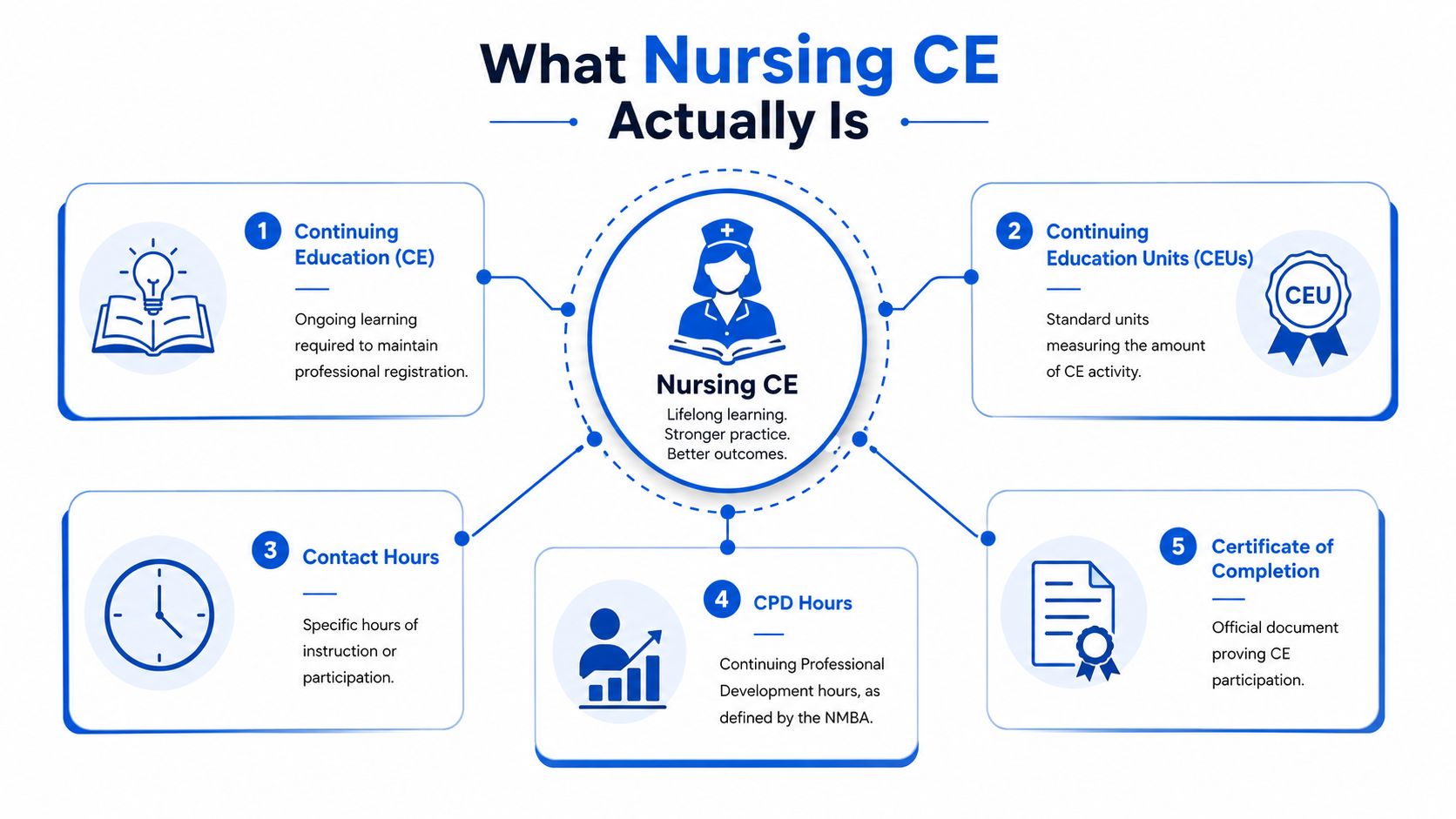
The vocabulary gets confusing fast, so start with the unit itself. Continuing education, or CE, is the learning activity. CEUs are the unit used to measure it, contact hours are the actual instructional time, and CPD hours are what the NMBA looks for when it reviews your professional development record.
The course is the transaction, the contact hours are the deposit, and the CPD record is the account your regulator reviews. One continuing education unit equals 10 contact hours of instruction, and the minimum award can be as small as 0.1 CEU (NursingCE). In plain terms, 1 CEU equals 10 hours, and short modules can still count in tenths if the provider structures them that way.
Certificates matter more than marketing language
A certificate of completion shows you participated. A certificate of accreditation shows the provider has tied the activity to recognised educational standards. Those are not the same thing, and you need to know which one you're getting before you enrol.
For Australian nurses, the useful habit is to read the course page like an auditor would. If the page says the module is 3 hours, that's a useful start. If it also gives learning objectives, an assessment, and a downloadable certificate, you can usually see how the activity will fit into your CPD file. One provider currently lists 60+ online courses, including over 50 separate 3-hour courses and seven 30-hour bundles, which shows how modular the online CE market has become.
That scale is helpful, but it also creates noise. More choice does not automatically mean better learning. A small, relevant module that fits your roster and practice area can be far more valuable than a large bundle you half-finish and never file properly.
If you work in a hands-on setting, the same logic applies across other regulated training. TP Training's Cpccldg3001 Perform Dogging Licence Course And Training In Sydney is a practical example of a nationally recognised, hands-on course format, which shows how structured learning and documented completion sit together in other industries too. For nursing, the same principle applies, clear learning plus clear evidence. If you need help setting up your record, this guide to creating and managing your unique student identifier shows the kind of documentation habit that makes compliance easier later.
How NMBA CPD Requirements Shape Your CE Choices
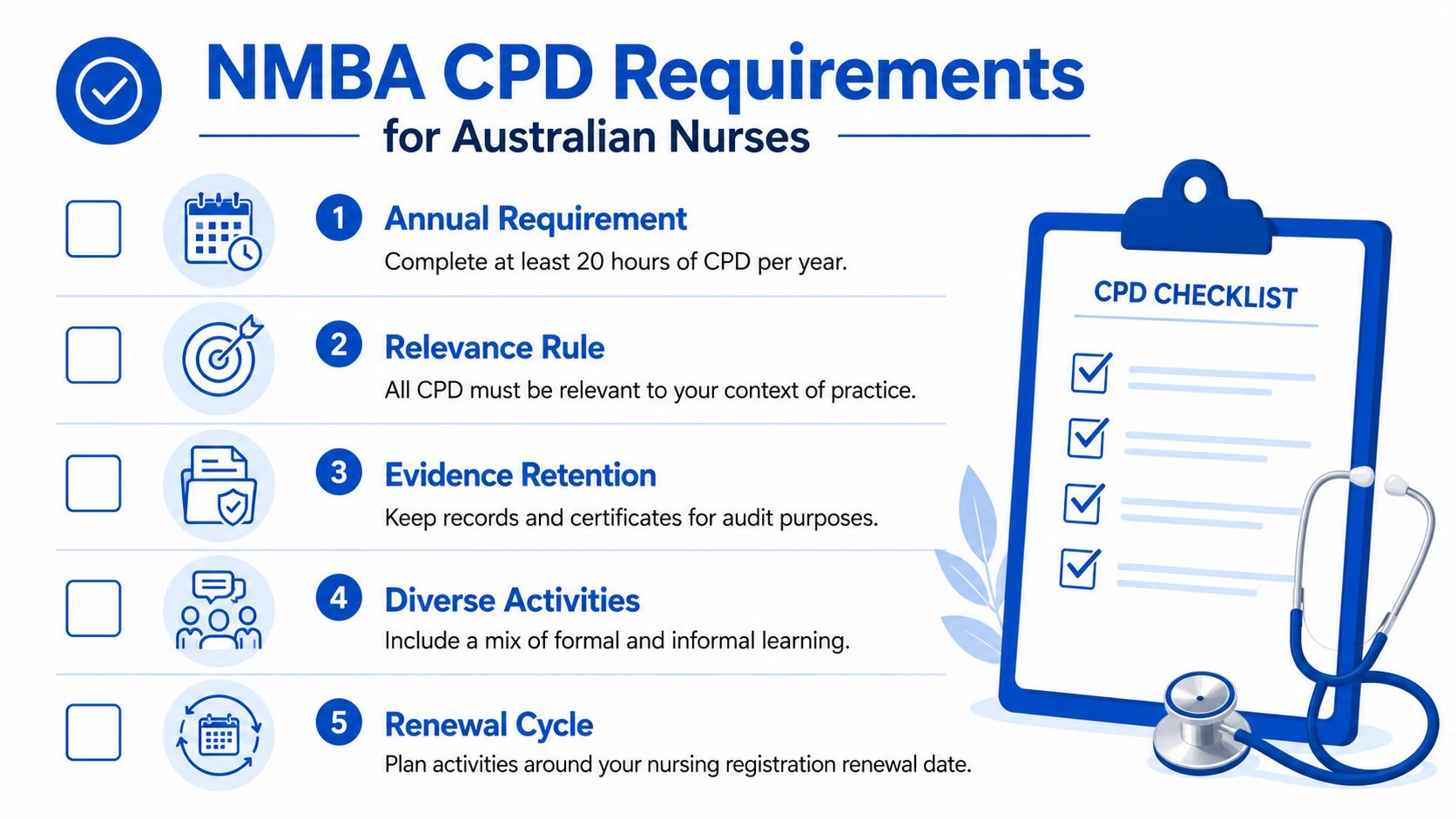
A nurse can finish an online module, feel confident, and still have a weak audit file. That gap is why the NMBA rule matters. Registered nurses and midwives need to complete at least 20 hours of CPD each registration year, and the learning must fit their context of practice, with evidence kept for audit. The regulator is checking both the hours and the match to practice, not just whether a certificate was issued (Nursingworld).
Build your CPD file as you go
If a module feels useful but leaves you with nothing to save, it may not help much when audit time arrives. Keep the certificate, the date, the provider name, the learning objectives, and a short reflective note that shows what changed in your practice. If the module also gives you timestamps or completion records, save those too.
A CPD file works like a patient chart. If one key entry is missing, the story becomes harder to verify. The same applies here, because a certificate on its own tells only part of the story.
For example, a triage nurse choosing between a generic leadership module and an emergency-specific clinical update should ask two questions. Which one connects to current practice? Which one creates the clearest evidence trail? The emergency update usually gives clearer clinical relevance, while the leadership module may still count if it matches the nurse's role and is documented properly. For broader examples of how regulated training is recorded, the audit habits used in CPR and first aid certification records show why employers often expect the completion evidence to be easy to trace.
Audit habit: Save the certificate first, then write the reflective note while the content is still fresh. If you leave that note for later, it often never gets written.
What to keep for each module
A sensible audit pack usually contains the following:
- Certificate of completion, with your name and the date visible.
- Course outline or objectives, so the topic and relevance are clear.
- Time evidence, such as the stated duration or completion timestamp.
- Reflective note, showing what you learned and how it applies.
- Folder or export, stored in one place for the full renewal year.
The point is not to build paperwork for its own sake. It is to show that the time you spent was real, relevant, and linked to your scope. A course that only gives you a login screen and a floating “instant certificate” prompt is a weak choice if it does not leave you with the evidence trail you need.
For nurses comparing providers, the same logic applies to CE for nurses online. The course still needs to fit the CPD requirement, and the record still needs to stand up if someone asks how it was completed.
How to Verify That Online CE Is Genuinely Accredited
A course can look polished and still be poor for compliance. The quickest way to avoid that is to check for four signals before you pay. If you can't find them in under a minute, move on.
The four signals that matter
First, look for an identifiable accreditation body or board recognition. Second, look for a clear CEU or contact-hour statement. Third, make sure the module includes written learning objectives. Fourth, confirm there's a downloadable certificate with your name, the date, and the provider details.
Now compare that with the usual red flags. Vague phrases like “approved by experts” don't tell you who approved it. A missing accreditation footer makes verification harder. Lifetime certificates can be fine for a record, but they don't tell you when the learning happened. “Instant CE” bundles with no assessment often feel convenient, but they rarely help you judge whether the learning was meaningful.
| Signal | Likely Accredited | Likely Non-Accredited |
|---|---|---|
| Approval body | Named board, college, or recognised accreditor | “Approved by experts” with no named body |
| Hour statement | Clear CEU or contact-hour value | No visible hour count |
| Learning design | Objectives and assessment included | No objectives, no quiz, no learning map |
| Certificate | Downloadable, dated, learner-specific | Generic page with no identity or date |
| Audit readiness | Easy to save and file | Hard to prove what was completed |
The verification routine is quick. Open the course page, scan for the accreditor, scan for hours, scan for objectives, scan for a certificate sample. If all four are there, you're probably looking at a serious provider. If two or more are missing, don't assume the course will satisfy your registration or employer.
If you also need a sanity check on learner setup, the same cautious mindset applies to platform guidance such as this USI explainer. The topic is different, but the habit is the same, verify identity, verify records, then enrol.
How Premiere Education Can Help
Premiere Education is a U.S.-based online continuing education platform that serves healthcare, education, and adjacent industries. It delivers accredited CE courses and certifications, plus assignment, tracking, and documentation tools for individuals and organisations. For nurses comparing platforms, that combination matters because it addresses the full workflow, not just the lesson itself.
Its catalog is broad, with 500+ topics across healthcare, education, and hospitality, and it also includes state-mandated training, clinical certifications like ACLS, BLS, and PALS, plus membership plans and group portals for enrolment and completion tracking. It also reports reporting and documentation support, including certificates of completion and agency reporting where applicable. That's useful if you're trying to manage multiple learners or keep a tight audit trail.
A practical way to assess a platform like this is to ask whether it solves the three biggest problems nurses face, finding relevant content, proving completion, and keeping records together. If you want a bundled CE membership model rather than piecing together one-off modules, the page for CE for nurses online shows the kind of membership structure some nurses use when they need ongoing access rather than a single course.
Seven-step use case for a busy nurse
- Identify your gap, pick a topic that matches your current practice.
- Check the hour value, make sure it fits your CPD plan.
- Confirm the accreditor, don't rely on marketing language.
- Review the objectives, see whether the topic is clinically useful.
- Start only when you can finish, avoid half-done modules.
- Download the certificate immediately, before you close the browser.
- File it in one folder, so audit prep doesn't turn into a scavenger hunt.
That workflow is where a platform earns its place. If it helps you finish, document, and store CE without extra admin, it's doing real work. If it only gives you a bigger course catalogue, it's just adding noise.
A Repeatable Workflow for Completing Online CE
The safest online CE habit is steady and plain. Choose the module, complete it, save the proof, and move on. That sounds simple because it is, but nurses still get caught by the same avoidable mistakes, especially when everything is left until the end of the registration cycle.
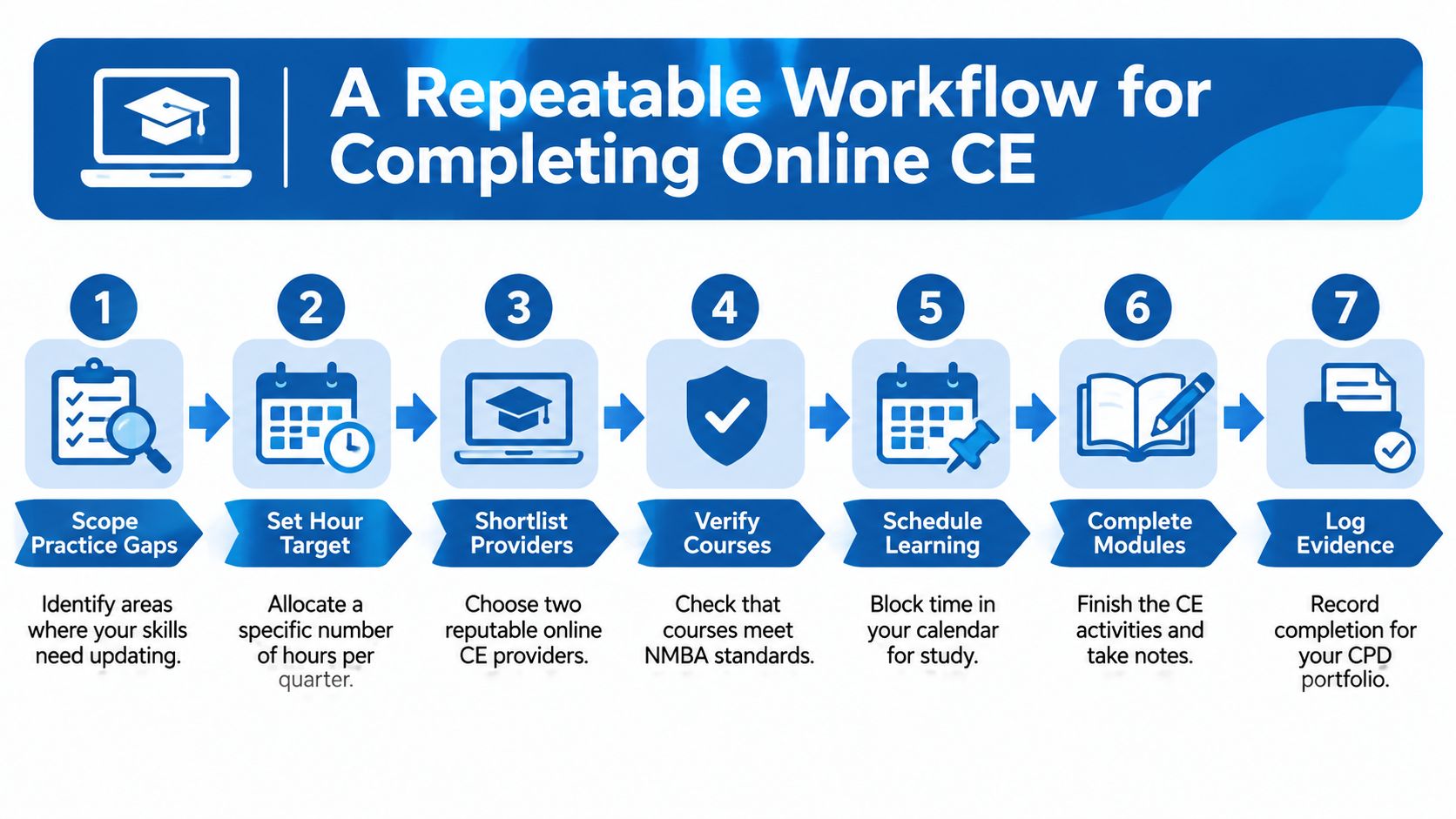
Run the same seven steps every time
- Scope practice gaps. Start with the part of your work that needs attention, not the topic that sounds most interesting. A rural nurse may need generalist updates that apply across settings, not a narrow specialty module that never comes up at the bedside. If you need a practical starting point for generalist refreshers, TP Training's basic life-saving course is an example of the kind of core content that can fit this need.
- Set an hour target. Break the total into small blocks across the year so you are not chasing hours at the last minute.
- Shortlist two providers. Keep one backup in case a module is full, slow, or poorly documented.
- Verify the course. Check the accreditor, the hours, the objectives, and the certificate before you enrol.
- Schedule the learning. Put it in your calendar like a rostered task, because it will not happen by accident.
- Complete the module and write one reflection. A few lines about what changed in your practice are often enough if they are specific. If the course is generalist, tie that reflection back to real bedside decisions, such as airway support, deterioration checks, or first-response care.
- Log and file the evidence. Save the certificate in a dedicated folder, then back it up somewhere you will remember.
Common mistake: Completing a module at midnight on the day renewal closes, then finding out the certificate email never arrived.
That mistake is avoidable. It usually happens because the nurse treated CE like a one-off errand rather than a cycle. Rural and remote nurses feel that risk more sharply, since internet reliability, roster backfill, and generalist work patterns can all interrupt study time. Online learning helps, but only if the workflow matches the reality of shift work and patchy access.
The safest approach is to assume you will be busy, tired, and interrupted. Build the course plan around that reality. If a module needs a stable connection or long video streaming, do it when you have proper access, not on the edge of a shift change.
Online Does Not Always Mean Accessible
“Online” gets sold as the answer to distance, but that's only partly true. A nurse in a regional town may still be studying on unstable internet, without cover for the shift that study time would displace. If the module depends on heavy streaming video or a desktop browser that doesn't behave on mobile, the convenience claim falls apart fast.
Older nursing education research already pointed to the barriers rural nurses face, distance, cost, and the lack of personnel to cover shifts. Australia magnifies those barriers because the geography is bigger, and many services rely on lean teams. Online CE can reduce travel, but it can't erase roster pressure or weak connectivity.
What actually makes online CE accessible
The best options are the ones that reduce friction, not just travel. Downloadable modules help when the internet is patchy. Offline PDFs help when a phone is all you've got during a break. Short, text-based lessons help generalist nurses who need content that applies across settings, not just tertiary hospitals.
This is also where the marketing language needs a reality check. A course page can say “anytime, anywhere” and still be a poor fit if it assumes uninterrupted screen time. For a nurse who's juggling a rotating roster, study has to fit around fatigue, family, and the practical reality of getting time away from care.
The same logic applies to support and language access. If the platform only works for one kind of learner, it's less usable than it looks. TP Training's multilingual support information, including English, Mandarin, Korean, and Vietnamese assistance, is an example of how service design can remove barriers when support is available, not just advertised (TP Training multilingual support).
A quick way to judge accessibility is to ask three questions before starting a module. Can I finish it without perfect internet? Can I pause and return without losing progress? Can I save the evidence immediately? If the answer to any of those is no, the course may still be valid, but it isn't accessible for your working life.
Course Categories Worth Prioritising
Not every CE topic pulls the same weight. Some categories support day-to-day safety, some are employer-driven, and some are better for long-term career development. The smart move is to sort them by clinical priority, then match them to the setting you work in.
Start with the topics that follow the patient
CPR and basic life support sit near the top for most nurses because they connect directly to emergencies and are commonly expected by employers. Infection prevention and control is another high-priority category, especially in hospitals, aged care, and community settings where exposure control matters every day. Medication safety and calculations matter wherever medicines are administered, documented, or checked.
Then there are the practice-specific topics. Wound care is especially relevant in community, aged care, and post-acute settings. Mental health and suicide prevention can strengthen communication and response skills across general nursing. Cultural safety and Aboriginal health deserve attention because they improve the quality of care in a wide range of Australian settings. Manual handling is often employer-driven, while aged-care-specific updates are useful for nurses working with older adults and complex care needs.
Practical way to prioritise: If the topic changes what you do at the bedside next week, it belongs ahead of a topic that only broadens your background knowledge.
The challenge is not finding categories. It's choosing the right sequence. A nurse in a medical ward will usually get more immediate value from CPR, infection control, and medication safety than from a general leadership series. A community nurse may need wound care and cultural safety earlier. Aged care nurses often need a mix of clinical refreshers and resident-focused updates.
If you're unsure where to start, check what your employer expects first, then build around your role. First aid and CPR are also widely delivered through Australian RTOs such as TP Training, and you can use that kind of practical training as one part of a broader CPD plan. For location-based searching, the phrase CPR courses near me usually surfaces the sort of local option many nurses use when face-to-face refreshers are needed.
Renewal Checklist and Common Questions
Before you renew, use the same checklist each time. A simple routine is enough if it catches missing proof, unrecorded hours, and courses that looked useful but do not stand up in a review.
Pre-renewal checklist
- Count your hours. Confirm that your CPD activity matches the NMBA expectation for your annual cycle and fits your context of practice.
- Check the evidence. Every finished module should give you a certificate or similar proof you can save.
- Review your reflections. Keep brief notes on what changed in your practice and how you will use it.
- Separate good from convenient. A course can be easy to start and still be poor evidence if it is hard to document later.
- Do one final verification pass. Open the course page again if needed and confirm the provider, hours, and completion record before you file anything.
Three questions nurses often ask
Does interstate or overseas CE count? Sometimes it does. Acceptance depends on whether the activity is relevant to your practice and whether you can show what it was, when you completed it, and how long it took. Keep the evidence and check the fit, do not assume the location alone settles it.
What if the provider disappears before renewal? Download the certificate as soon as you finish. Keep a local copy, a cloud copy, and a folder label with the date. If the site disappears later, your records still stay with you.
What if records are incomplete during an audit? Give what you have, then rebuild the rest from emails, screenshots, calendar entries, or learner notes if you can. The shorter the gap between completion and filing, the less likely this problem becomes.
The calmest renewal cycles are the ones prepared early. Choose relevant modules, save proof straight away, and keep the folder tidy through the year. If you are due for a refresh, pick one course today, download the certificate as soon as you finish, and file it before your next shift starts.

You may also like
First Aid Training Cost: A Complete Guide for Sydney Workers

How Long Licence Crystalline Silica Prevention Last