

Construction Jobs No Experience: How to Get Hired in 2026
The listing said labourer, no experience needed, immediate start. You sent your details on the Monday, rang on the Wednesday, and by Friday the same ad was back online with a fresh closing date. That silence is the part most guides skip.
Entry-level construction hiring in NSW runs on a narrow filter. Employers need to know you can legally walk onto a site, that you'll front for a 6.30am start in the cold, and that you'll take instruction from a supervisor without treating it as a debate. Experience is a proxy for those three things, not the thing itself, which is why people get hired without it every week.
The obstacle is documentation. You can't step onto a construction site in this state without a White Card, and no amount of enthusiasm substitutes for one. What follows is the order that works: which tickets to buy first, how to read a job title before you apply, how apprentice pay is meant to work if you're older than 21, and how to judge a first job by the training it gives you rather than how quickly it starts.
Table of Contents
- Tickets to Earn Before You Apply for Site Work
- Vetting Entry-Level Ads and Employers
- Apprenticeships and Pay for Career Changers
- How to Apply Without Experience, Step by Step
- 1. Get the White Card and carry it to every interview
- 2. Apply for the titles that match your actual experience, which is none
- 3. Build a one-page resume with the tickets at the top
- 4. Prepare three interview answers
- 5. Ask about supervision, training and classification before accepting
- 6. Set the goal at a Certificate III, not a trade title
- The sentence to put at the top of your cover note
- Upskilling From First Job to Certificate III
- Book Your White Card and Traffic Ticket This Week
Tickets to Earn Before You Apply for Site Work
Australia's construction workforce is large enough to absorb people with no site history. The Jobs and Skills Australia workforce profile reported approximately 1,320,000 people employed in construction in February 2024, about 9.2% of Australia's total workforce, after the industry grew by roughly 173,300 workers, or 15.1%, over the preceding decade.
Labourers accounted for around 15% of that workforce. About one in three construction workers held no post-school qualification, while more than half held a Certificate III or higher. Read those two figures together and the structure becomes obvious: a qualification isn't a door pass, but it's what separates a first job from a fifth one. Jobs and Skills Australia also names apprenticeships and traineeships as the most common pathway into the construction-dominant trades, including carpentry, electrical work, plumbing and painting.
The first conversation with any employer is really about access, not skill. No site accepts enthusiasm in place of induction, and "no experience" has never meant "no safety training".

Three tickets cover most entry points for a beginner. Each does a different job, and buying them out of order costs both money and weeks.
| Ticket | What it opens | Typical length | Certificate on the day |
|---|---|---|---|
| White Card (construction induction) | Entry to any construction site | About 1 day | Yes, statement of attainment at course end |
| Traffic Controller Blue Card (RIISS00054) | Traffic control at roadworks and work zones | About 1 day | Temporary certificate issued immediately |
| Provide First Aid | Responding to injuries on crews | 1-2 days | Temporary certificate issued immediately |
Start with the White Card, always
The White Card is the general induction every worker completes before stepping onto a construction site, and it's the ticket most employers check before they read anything else about you. It runs about seven hours, so a single day off work covers it and you can be applying with a current card the next morning. If you want the enrolment steps spelled out, our guide to how to get a White Card covers what to bring and what happens across the day.
Add the Blue Card when roadworks is the target
The Traffic Controller Blue Card (RIISS00054) is a one-day course and the fastest genuine route into paid work, because road crews always need people who can hold a stop paddle and follow a traffic management plan without improvising. A temporary certificate is issued immediately, so a student can start working before the plastic card arrives. We issue temporary certificates straight away on our First Aid and Traffic Control courses for precisely that reason.
Hold first aid and the later cards in sequence
Provide First Aid isn't an entry ticket and won't get you hired on its own. It earns its place once you're on a crew where somebody has to respond to a laceration, a crush injury or heat collapse, and it's a cheap way to be the person a supervisor trusts with more. The Yellow Card (implementing traffic management) and Red Card (preparing a work zone traffic management plan) come later, when you've spent months inside a work zone and understand why a plan reads the way it does. Buying them first is money spent on theory you can't apply.
The order that works: general site work, book the White Card first. Roadworks, add the Blue Card. First aid once the first job is secured.
Vetting Entry-Level Ads and Employers
Two ads sit in the same scroll. One says labourer. The other says apprentice carpenter. Google results for "construction jobs no experience" return both without explaining that they are different legal arrangements. I treat the title as the decision tool. Labourer and apprentice carpenter are not rungs on the same ladder at the same height. Paperwork, pay rules and the employer's obligations change with the wording.
Read the row that matches the ad before you apply.
| Job title | What it usually involves | Ticket or training expected | Question to ask before accepting |
|---|---|---|---|
| Labourer | Manual support on site, cleaning up and moving materials | White Card and manual handling | Who supervises me on the first day? |
| Offsider or site hand | Helping trades and plant operators with set-up and clean-up | White Card | How often will I rotate between tasks? |
| Traffic controller trainee | Directing vehicles and pedestrians in a work zone under a traffic plan | Blue Card | Who writes the traffic management plan? |
| Civil construction trainee | Roadworks, drainage and concrete support | White Card, often a traffic ticket | Is a Certificate III on offer? |
| Registered apprentice | Paid trade work combined with formal study | Registered training contract | Is my contract registered with the state training authority? |
Three things to read before you apply
Every ad answers three questions if you read it closely rather than skimming to the rate.
- The award or classification named. A named classification means the employer knows what it is paying for. Silence usually means the rate is negotiable in the employer's favour.
- The tickets or training contract required. A White Card is standard for site work. A traffic ticket narrows the role to a work zone. A registered training contract changes the whole arrangement from casual labour to a training pathway.
- Whether apprentice wages sit inside a registered arrangement. This one has a legal answer rather than an interpretive one.
Fair Work's pay entitlements guidance for young workers is blunt on the point: an employee can only be paid a trainee or apprentice rate when a formal training contract exists, and the training must be registered and recognised by the relevant state or territory training authority. An ad quoting apprentice wages should name the contract and the registered pathway behind it. If it cannot, the apprentice rate may not be lawful.
Four questions to ask before you accept
- Who supervises me on day one? A name and a role, not "the crew". Supervision is the difference between learning a method and guessing at one.
- Is overtime expected, and how is it paid? Site hours stretch. You want to know whether the extra hours land at a penalty rate or get folded into a flat daily figure.
- What training happens each month? "You'll learn on the job" is not a training plan. Ask what unit or task you will be signed off on first.
- What happens to my apprenticeship if the project finishes early? Projects end. Ask whether the contract moves with you and who you would ring on the last day.
Three red flags
- No named supervisor. If nobody can tell you who is responsible for you, nobody is.
- No training contract. The word apprentice in an ad means nothing without registered paperwork behind it.
- Trade pay promised for labouring work. A rate that does not match the classification in the award is a conversation to have before you start, not after.
Ask what the site does about silica dust and asbestos. Cutting concrete, chasing walls or refurbishing older buildings puts both in the air. TP Training offers the Crystalline Silica Exposure Prevention course and the Asbestos Awareness course as separate online courses. Ask who controls the dust on that job, and whether awareness training sits inside induction.
Judge the job by retention, not the start date
Starting is the easy part. Analysts at Jobs and Skills Australia, in the Jobs and Skills Australia analysis of training pathways, note that shortages in apprentice-reliant occupations can also be constrained by poor completion rates, occupational retention and training-provider capacity. Plenty of people begin and do not finish.
People who complete are much more likely to be employed or in further study than those who leave early. Electrician completions run well ahead of the all-occupation rate. Partial training still carries weight: people who start a Certificate III in carpentry or plumbing and do not finish still show employment gains.
What that means for a first job: I judge the offer by supervision you can name, training you can document and a progression route that survives the project, not by the fastest start or the highest opening rate.
If traffic control is the row you are applying against, our guide to finding a traffic control job in Sydney covers what employers ask at interview and how the ticket feeds into the hiring decision.
Apprenticeships and Pay for Career Changers
Say you're 34, you've spent nine years on forklifts and pick lines, and you've decided you'd rather build things than move them. Two offers land in the same week. The first is a registered apprenticeship with a training contract, a named supervisor, a day a week at a registered training organisation and a stated progression. The second is a "carpenter's apprentice" role at a small outfit on apprentice rates, no contract, no training provider named, and a promise to sort the paperwork later.
Only one of those is an apprenticeship in any sense the law recognises, and it's the one with the contract.
Age isn't the barrier people assume
Fair Work's guidance on adult apprentice pay in the Building and Construction Award defines an adult apprentice as someone aged 21 or older when the apprenticeship starts, and the award contains a specific pay rule for that group. An adult apprentice must generally receive whichever is higher: the ordinary hourly rate for a Construction Worker Level 1 including the relevant industry allowance, or the applicable apprentice ordinary hourly rate plus the allowances included in that rate.
There's a second provision that matters for anyone already on a site. For building, construction and civil construction employees, the special rule applies where the person worked for that employer for at least six months full-time or on daily hire before the apprenticeship began. A labourer who has already proven themselves on a crew is in a stronger position than a stranger off the street, and the award reflects that.
How the rate actually climbs
Fair Work's guidance on apprentice pay under the Building and Construction Award sets out the mechanics. The rate advances either on a time basis, such as completing 12 months, or earlier through competency-based progression once the required skills are signed off. At completion, the worker moves onto the applicable tradesperson rate.
That's the detail separating the two offers above. One has a written path from a percentage of a trade rate to a full trade rate. The other has a conversation and a hope.
Rule of thumb: if an offer uses the word apprentice but nobody produces a training contract, you've been offered a labouring job with a discount attached.
When you're rewriting your work history for the application, these career change resume summary examples show how to translate warehouse, retail or hospitality experience into language a site employer recognises.
Before signing anything, check three things: the award classification on the paperwork, the allowances included in the rate, and the registration of the training contract with the state training authority. None of those is a detail you can fix after you've started.
How to Apply Without Experience, Step by Step
The sequence below is the order that works. Each step answers a question an employer is already asking before you sit down, which is why doing them out of order costs you weeks.
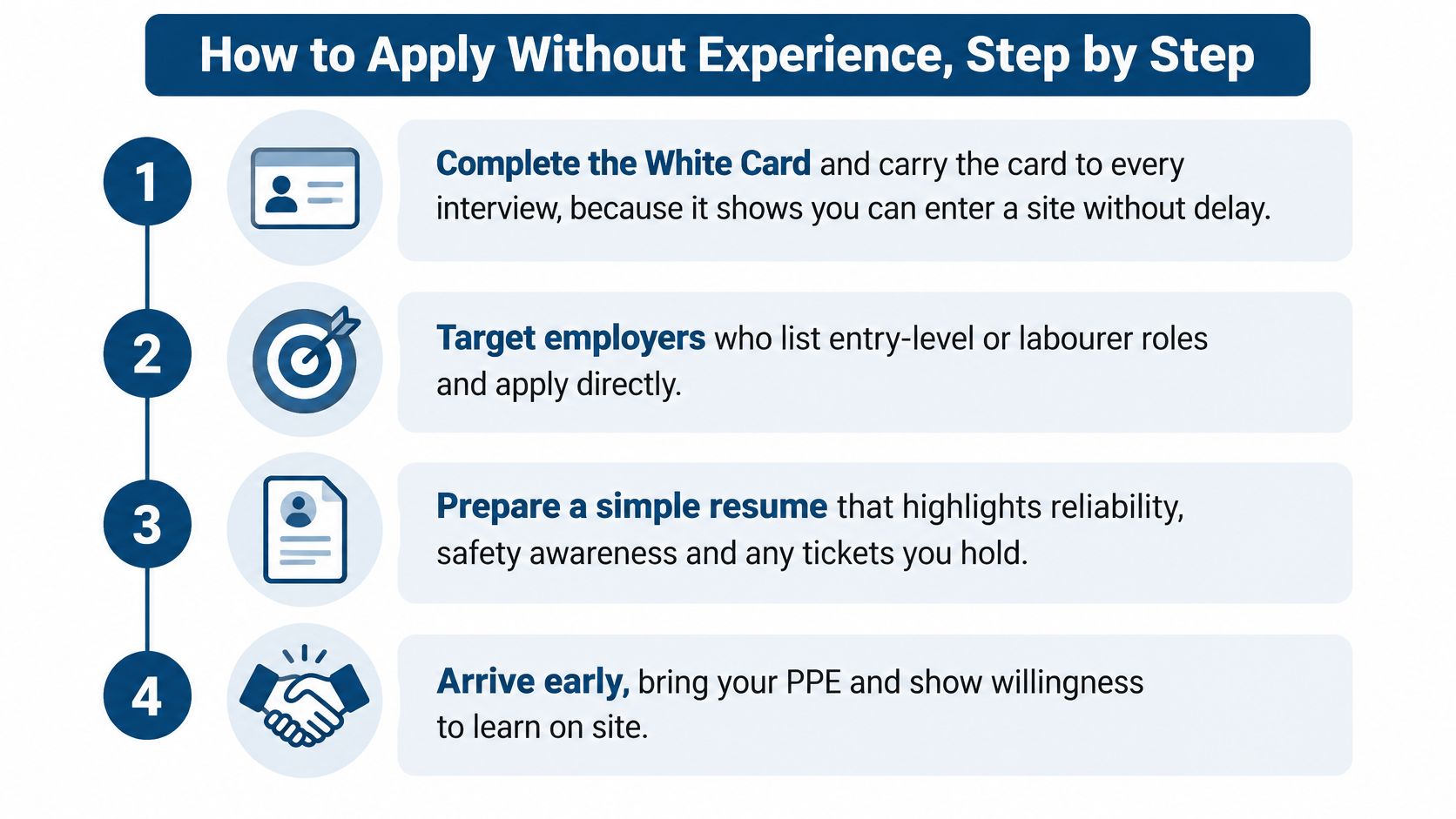
The infographic is the short version. The detail underneath is what gets you through the interview.
1. Get the White Card and carry it to every interview
The White Card Training Course is the first thing to book, and it changes how you're read at the interview table. Turning up without one signals you haven't started. Turning up with one signals you can be inducted and put on a site without the employer waiting on you. Bring the card or the statement of attainment, not a photo of it on your phone.
2. Apply for the titles that match your actual experience, which is none
Target vacancies labelled labourer, trainee, offsider or apprentice. Don't apply for roles that assume trade competence, and don't claim competence you haven't earned. The Jobs and Skills Australia construction industry profile found that lack of experience, qualifications or registration are the most common reasons applicants are judged unsuitable, while many labourer occupations sit at Skill Level 5 and typically don't require tertiary qualifications. That's the opening: apply where the bar is low, not where you hope it is.
The same profile notes that formal trade occupations generally require structured on-the-job training, competency assessment and often close to two years of relevant experience in employer selection practices. A short course doesn't compress that, and interviewers who've run crews for a decade spot the overreach within two questions.
3. Build a one-page resume with the tickets at the top
Tickets first, because that's what an employer scans for before deciding whether to keep reading. Then transferable evidence, each claim backed by one real example: punctuality (six months of 5am warehouse starts, no missed shifts), manual handling (pallet work and stock rotation), teamwork (closing shifts with a crew of four), communication (handover notes, customer escalations), and hazard reporting (a damaged rack or a spill you flagged and got fixed). None of that needs a construction site behind it to be credible.
4. Prepare three interview answers
Why construction, a time you were reliable under pressure, and a safety moment where you spoke up rather than walked past. Rehearse them out loud, because the difference between a good answer and a rambling one is repetition. If you want a structured way to practise, our mock interview online session is built for exactly this kind of preparation.
5. Ask about supervision, training and classification before accepting
Pay is one part of an offer, not the whole of it. Ask who your supervisor will be, what training happens in the first month, and which award classification you'll be paid under. An employer who answers those in detail is organised. One who deflects is improvising, and you'll absorb the cost of that improvisation.
6. Set the goal at a Certificate III, not a trade title
A trade title takes supervised hours and competency sign-off. A Certificate III is the qualification sitting underneath it. Treat the first twelve months as the entry fee rather than a waiting period.
If you want a second opinion on pitching yourself with no relevant history, this Capstone Workforce job seeker guidance covers the same ground from the employment side.
The sentence to put at the top of your cover note
Cover note template: name the card you hold, name one period where you turned up reliably to early shifts, and name the role you want to learn. A usable version reads: "I hold a current White Card, six months of early warehouse shifts with no missed rostered days, and I'm looking to learn formwork under a supervisor."
That's honest, specific, and it answers the three questions an employer has: can you get on site, will you turn up, and do you know what you're asking for.
Upskilling From First Job to Certificate III
A first job is a starting point. What happens across the next twelve months decides whether it becomes a trade or just a run of shifts. Plan it in order.
1. Get the qualification named in writing
A trainee role should arrive with a Certificate III enrolment attached. An apprenticeship should arrive with a registered training contract. If neither exists, you've got a job, which is worth having, but it isn't training, and you should price that in before turning down something better.
2. Keep your own log
Hours worked, tasks signed off, units completed, supervisor names and dates. Employers lose paperwork and providers change systems. A notebook or a simple spreadsheet is the only record that reliably travels with you to the next site and gets partial training recognised.
3. Add tickets as the work demands them
If the work moves into roadworks, add the Traffic Controller Blue Card. If the crew has no trained responder, add Provide First Aid. If plant operation is the direction you want, our civil construction plant operations courses run through the ticket structure for excavators, loaders, skid steers and rollers, each of which is a separate competency rather than one general "machine ticket".
4. Leave the Yellow and Red cards until the work gives them meaning
Both are worth having. Neither is much use to someone who has never stood inside a live work zone and watched a plan get applied, adjusted and argued over across a shift. Experience first, then the card.
5. Review every six months
Compare what you were promised at interview with what you've received. Change employer when the training stops, not when a pay rise appears. Staying inside a credible progression route beats an extra dollar an hour at a site that teaches you nothing.
Once your work moves into refurbishment or demolition, asbestos awareness stops being optional. Our Enroll In The 11084Nat Asbestos Awareness Training Course is delivered as nationally recognised, hands-on training across NSW, which matters when the buildings you're working in are older than you are.
Book Your White Card and Traffic Ticket This Week
The gap between reading about construction jobs no experience and being hirable is usually one booking. Everything else in this article gets easier the moment that's done.

The White Card takes seven hours and costs $95. The RIISS00054 Traffic Controller Skill Set (Blue Card) takes one day and costs $282, and it issues a temporary certificate immediately so you can work before the card arrives in the post. Which one you book depends entirely on the target: general site work starts with the White Card, roadworks starts with the Blue Card.
Our guide to the Blue Card traffic control course explains what the day covers and what the assessor watches for, which is useful to know before you walk in.
TP Training runs both courses from training centres in Penrith, Burwood, Auburn, Parramatta and the Sydney CBD, so there's usually a location within reach of home or a current job. PPE is provided for construction and traffic management courses, which removes one of the small practical excuses that delay a booking by a fortnight.
The three-part checklist for this week
- Book the ticket. One course, one date, confirmed in your calendar.
- Update the resume. Card at the top, one transferable example under each claim you make.
- Apply to three roles. Labourer, trainee or offsider, with the card referenced in your first line and a start date you can make.
Nobody can promise instant employment here, and anyone who does is selling something. What's on offer is a route: a card that gets you through the gate, a resume that survives the first scan, and a shortlist of jobs worth the application. That's enough to be working within weeks rather than watching the same ad reappear with a new closing date.
TP Training delivers nationally recognised White Card and traffic control training from centres across Sydney, with experienced trainers and hands-on sessions built around what happens on a site. If you're still working out whether the White Card or the Blue Card comes first for the work you want, visit TP Training and check the next available dates near you. Book the course this week, then send three applications before Friday.

You may also like

CBD First Aid Courses in Sydney: Costs and Booking

MSMWHS217 Gas Test Atmospheres: A Practical Guide