
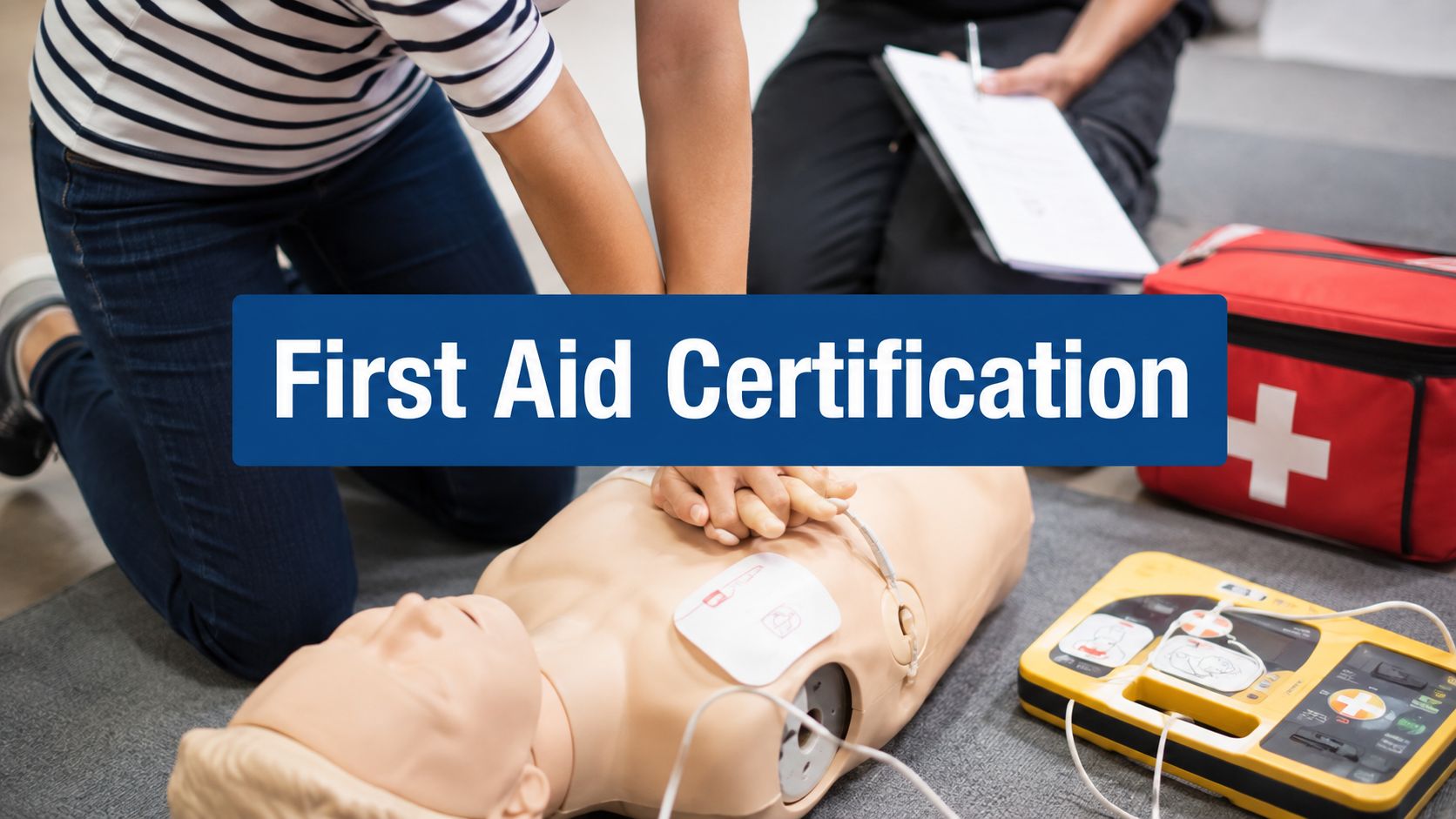
First Aid Certification Australia: Your Guide for 2026
HLTAID011 Provide First Aid is the nationally recognised baseline for workplace compliance in Australia. It's generally valid for 3 years, but the CPR component needs an annual refresh.
For most new workers, that's the part that gets missed. People assume a first aid certificate stays current as long as the card looks valid, but compliance in Australia depends on both the qualification and the currency of its CPR component.
First aid certification in Australia is more than a box to tick. It sits inside workplace safety systems, industry rules, and real-life emergency response, especially where help might be delayed or the environment is high risk. The practical question isn't just whether you've ever done a course. It's whether your qualification still meets the checks an employer, regulator, or site manager is likely to ask for.
Table of Contents
- Why First Aid Certification Matters in Australia
- Understanding Recognised First Aid Units and Course Types
- Industry Requirements and Who Needs Certification
- Step-by-Step Process to Get Certified
- Validity Periods and Renewal Requirements
- How to Choose the Right Training Provider
- What to Expect on Course Day
- Common Questions About Compliance and Evidence
Why First Aid Certification Matters in Australia
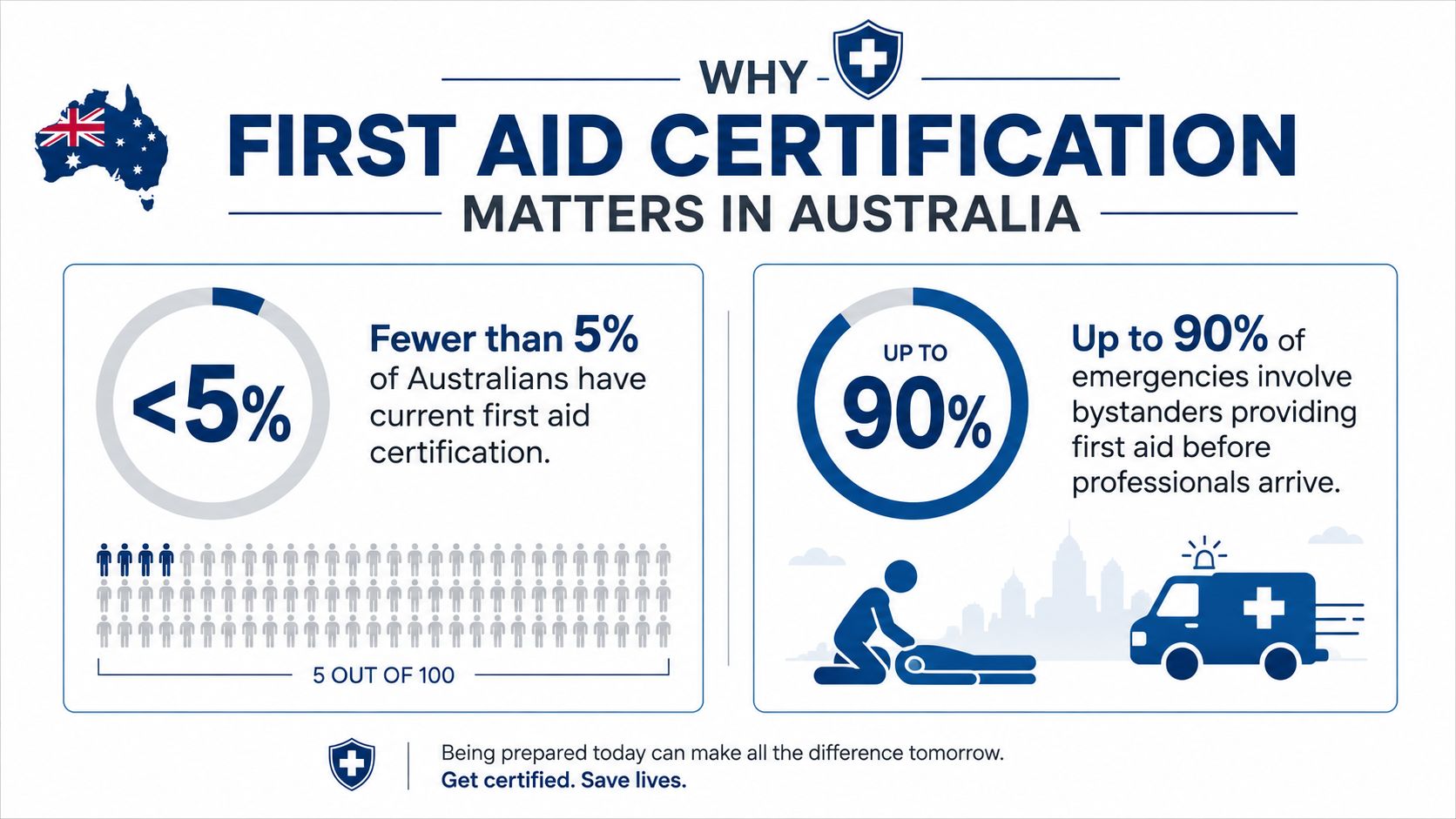
Australia has a real first aid gap. The Australian Red Cross has repeatedly said fewer than 5% of people in Australia are trained in first aid, and that rate has been described as one of the lowest in the world. At the same time, a national study in BMJ Open found 56% of Australian adults had ever undertaken CPR training, but only 22% had trained within the previous 12 months. That gap matters because CPR is a core part of workplace first aid and because skills fade if they're not refreshed.
Why employers care about the gap
Workplaces don't train people in first aid just to be generous. They do it because the injury burden is large, and because trained response can matter before ambulances arrive. Australia sees around 500,000 hospitalisations for injuries each year and about 12,000 injury deaths annually, which is why first aid capability is treated as part of normal safety planning rather than a nice extra.
The expectation also shows up in public and community settings. In 2018, St John Ambulance Australia treated 129,674 people at public events, and volunteer surf lifesavers delivered 65,296 first aid treatments to beachgoers in 2017–18. Those figures show that first aid isn't limited to office incidents. It's part of the wider safety net across events, beaches, transport corridors, and worksites.
What this means for your career
If you're moving into construction, logistics, healthcare, hospitality, or any job with physical risk, first aid certification signals that you can contribute to a safer workplace. It also shows you understand compliance, not just practical care. For many employers, that matters when they choose between candidates who seem equally capable on paper.
The other reason it matters is simple. A worker who can stabilise a casualty, call for help properly, and start CPR can change the outcome of an incident. That's why first aid training sits inside induction, onboarding, and ongoing compliance systems. For broader vocational context, see TP Training's overview of vocational training in Australia, which sits alongside first aid as part of job-ready skills development.
Practical rule: If a role involves moving equipment, public contact, vehicles, machinery, or isolated work, assume first aid capability will be part of the expectation until you've confirmed otherwise.
Understanding Recognised First Aid Units and Course Types
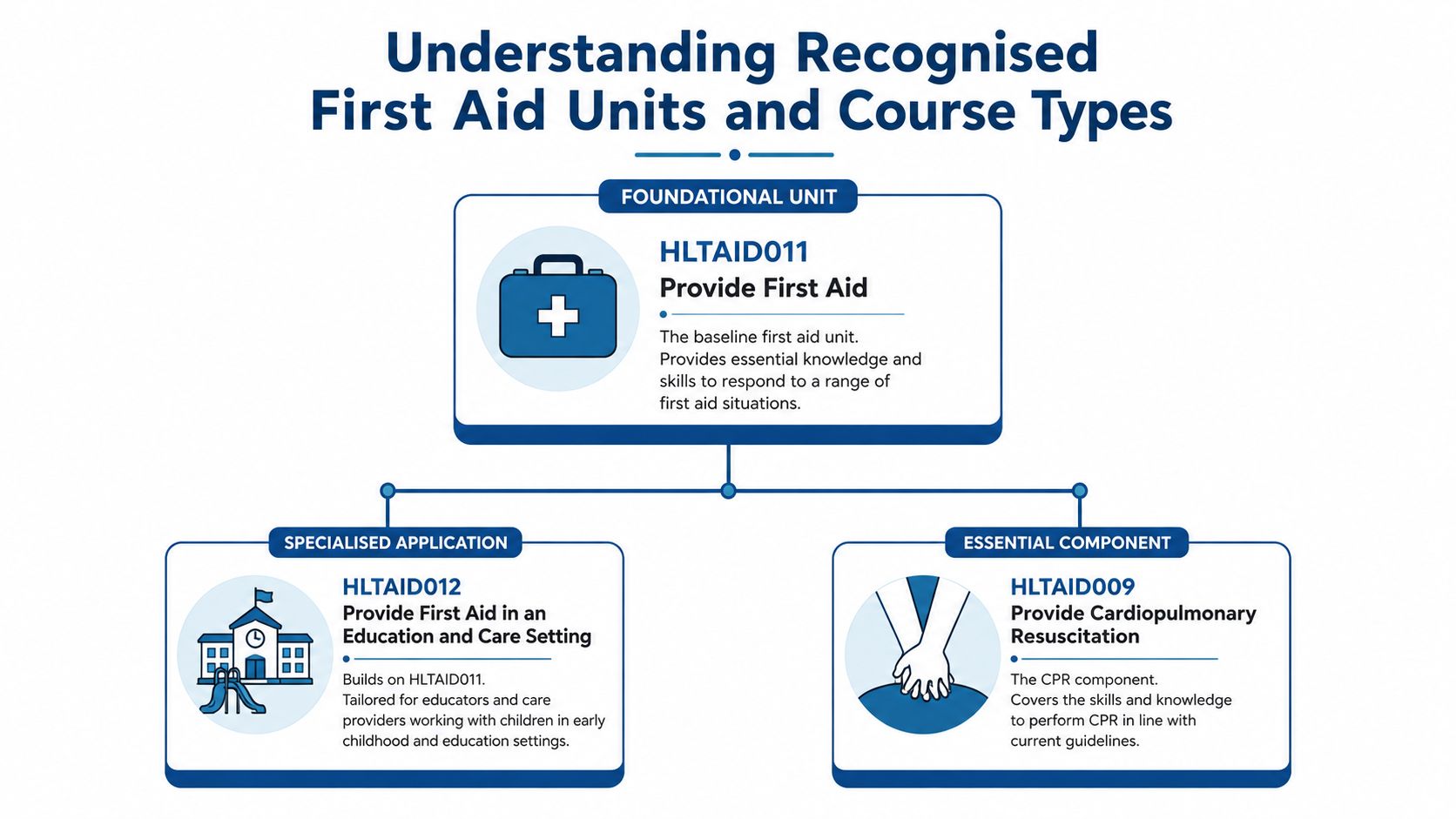
The key unit to know is HLTAID011 Provide First Aid. It's the baseline nationally recognised workplace first-aid unit and it's formally listed on training.gov.au, the Australian Government's national VET register. That matters because it separates formal vocational training from casual first aid knowledge. If a qualification isn't part of the national training system, it may not satisfy workplace or regulator checks.
The core units
The standard workplace choice is HLTAID011 Provide First Aid, which covers the broad skills most employers expect. The CPR-only unit is HLTAID009 Provide Cardiopulmonary Resuscitation, which is the right fit when someone already holds a current broader qualification and only needs the resuscitation component renewed. For education and care settings, HLTAID012 Provide First Aid in an Education and Care Setting is the more relevant pathway because childcare and early learning settings bring their own risks and response requirements.
If you want a practical course option that sits in that mainstream workplace lane, the Provide First Aid Course is a recognised example of this type of training, delivered as practical, nationally recognised workplace learning across NSW.
How to choose the right unit
The right course depends on your role, not on which title sounds most complete. A warehouse worker with an existing certificate may only need CPR renewal, while a new starter in construction is usually better matched to full workplace first aid. A childcare educator should look at the education and care pathway rather than assuming the standard workplace unit is enough.
The best certificate is the one that fits the hazards, response time, and compliance needs of your actual worksite.
You'll also see remote-area first aid discussed for isolated or delayed-response environments. That's not just a broader version of standard first aid. It's a different training emphasis because the casualty may need to be managed for longer before emergency services arrive. For a plain-language guide to standard first aid versus CPR expectations, see TP Training's basic life saving course overview.
Industry Requirements and Who Needs Certification
Safe Work Australia guidance, as reported in Australian media, recommends workplaces have at least 1 first aider per 50 workers in office settings and 1 per 25 workers in higher-risk environments such as construction. That ratio gives you the starting point, but individual industries often add their own compliance layers. If you're in a regulated environment, don't assume a generic office benchmark will be enough.
| Industry | Requirement Level | Recommended Ratio | Key Considerations |
|---|---|---|---|
| Office and administration | Baseline workplace coverage | 1 per 50 workers | Cover for common incidents, evacuation support, and incident reporting |
| Construction and higher-risk sites | Stronger coverage expectation | 1 per 25 workers | Higher likelihood of injury, machinery, and delayed access to help |
| Childcare and education | Regulatory compliance focus | Site-dependent | Child-specific response skills and current competency matter |
| Maritime operations | Formal compliance requirement | Site and role dependent | Current certification is required for approval and expired certificates aren't accepted |
| Hospitality and public venues | Practical readiness | Employer-defined | Burns, cuts, slips, and crowd incidents are common |
| Logistics, transport, and industrial work | Safety-critical coverage | Site-dependent | Manual handling, vehicles, and emergency access issues raise the stakes |
AMSA is especially strict. For domestic certificate-of-competency applications, it requires a current HLTAID011 or accepted equivalent, and it does not accept expired first-aid certificates. That means compliance can turn on currency, not just the fact that you once completed training. If you're checking training expectations against broader compliance systems, LeaveWizard's compliance training advice gives a useful reminder that records, dates, and evidence matter as much as capability.
Construction and civil roles often bring extra qualification layering, too. A worker may hold first aid, CPR, and a construction induction card, but that doesn't mean the first aid requirement is finished. For example, TP Training's construction and workplace safety certification guide is relevant reading if you're trying to understand how those pieces fit together. In some work contexts, a high-risk occupation such as dogging also sits alongside first aid planning, and Cpccldg3001 Perform Dogging Licence Course And Training In Sydney is an example of how safety training often stacks across roles rather than standing alone.
For context, first aid is used far beyond offices and workyards. The numbers from St John Ambulance Australia and surf lifesaving show that public events and recreation settings rely on trained people too. That's why certification is treated as a practical foundation, not a paper exercise.
Compliance check: if your worksite has shifting crews, subcontractors, or after-hours operations, ask who covers the ratio when the main team leaves.
Step-by-Step Process to Get Certified
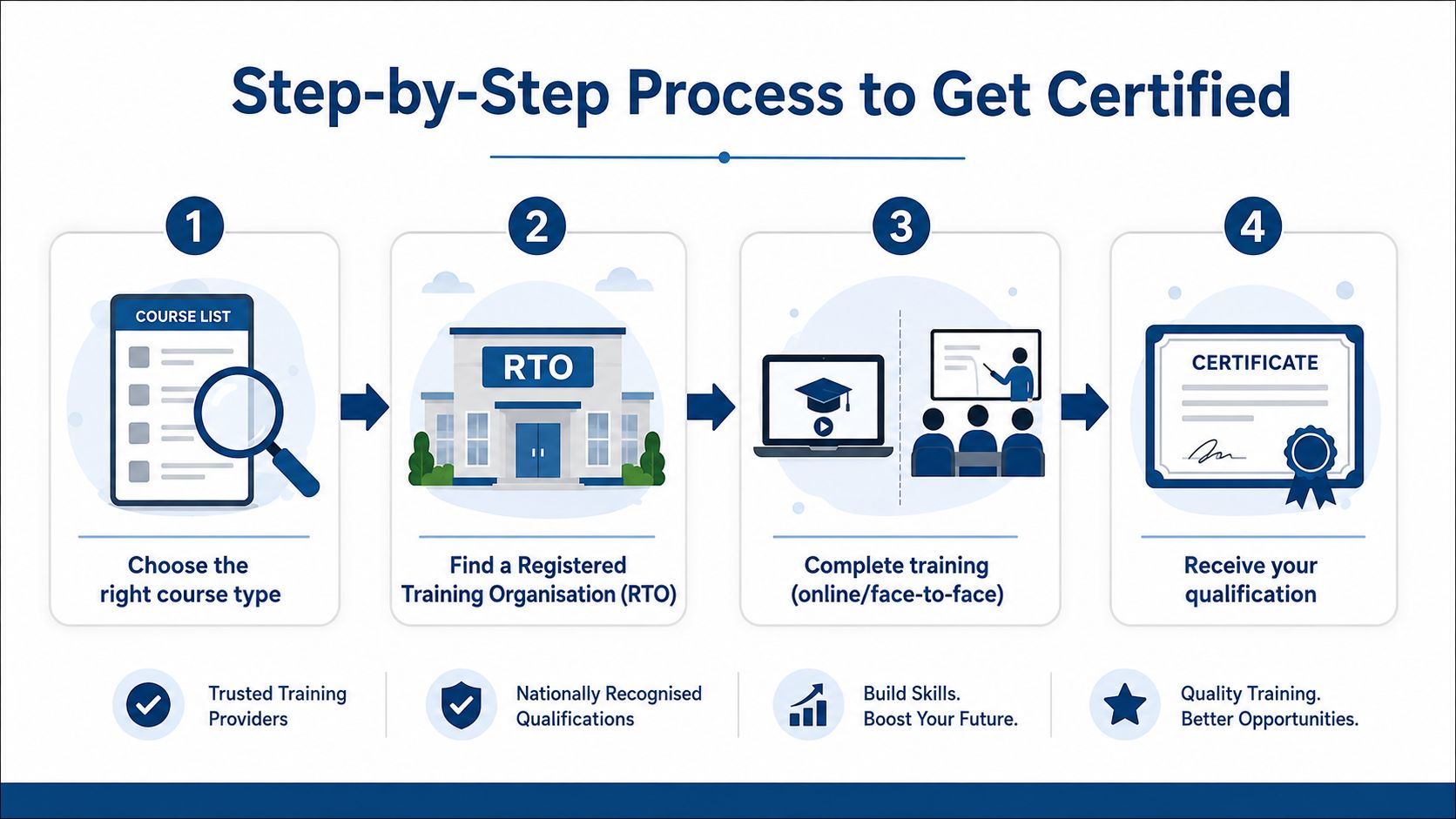
The process is straightforward if you treat it like a compliance task, not an informal class. Start by matching the unit to the job. If your employer wants full workplace first aid, book HLTAID011. If you only need CPR currency, book HLTAID009. If you work in an education or care setting, look at the childcare-specific pathway instead of guessing.
Choose an RTO and delivery mode
Australian first-aid training guidance notes that training must be delivered by a Registered Training Organisation (RTO) and include a mandatory practical assessment, so attending a course is only part of the process. You're not buying attendance, you're completing regulated training and assessment through the VET system. The safest way to verify a provider is to check that the qualification appears on the national register and that the organisation can issue a legitimate statement of attainment.
Delivery can be face-to-face, blended, or fully in-person depending on the provider. Blended delivery usually means online theory first, then a practical session where you demonstrate the skills. TP Training's USI guide is useful if you need to sort out your Unique Student Identifier before enrolment, because providers will often need it to issue your result correctly.
Prepare, attend, and complete the assessment
Bring identification, wear practical clothes, and be ready to work on the floor if the trainer asks you to practice recovery positions, CPR, or bandaging. Most courses are designed for beginners, so you're expected to learn as you go. Trainers are looking for safe technique, not perfection on the first attempt.
The assessment usually combines skills practice and scenario response. In plain terms, you'll need to show that you can follow instructions, respond calmly, and perform the required steps. Once you pass, the RTO issues your qualification or statement of attainment. That's the document you keep for your records and show to an employer when asked.
Validity Periods and Renewal Requirements
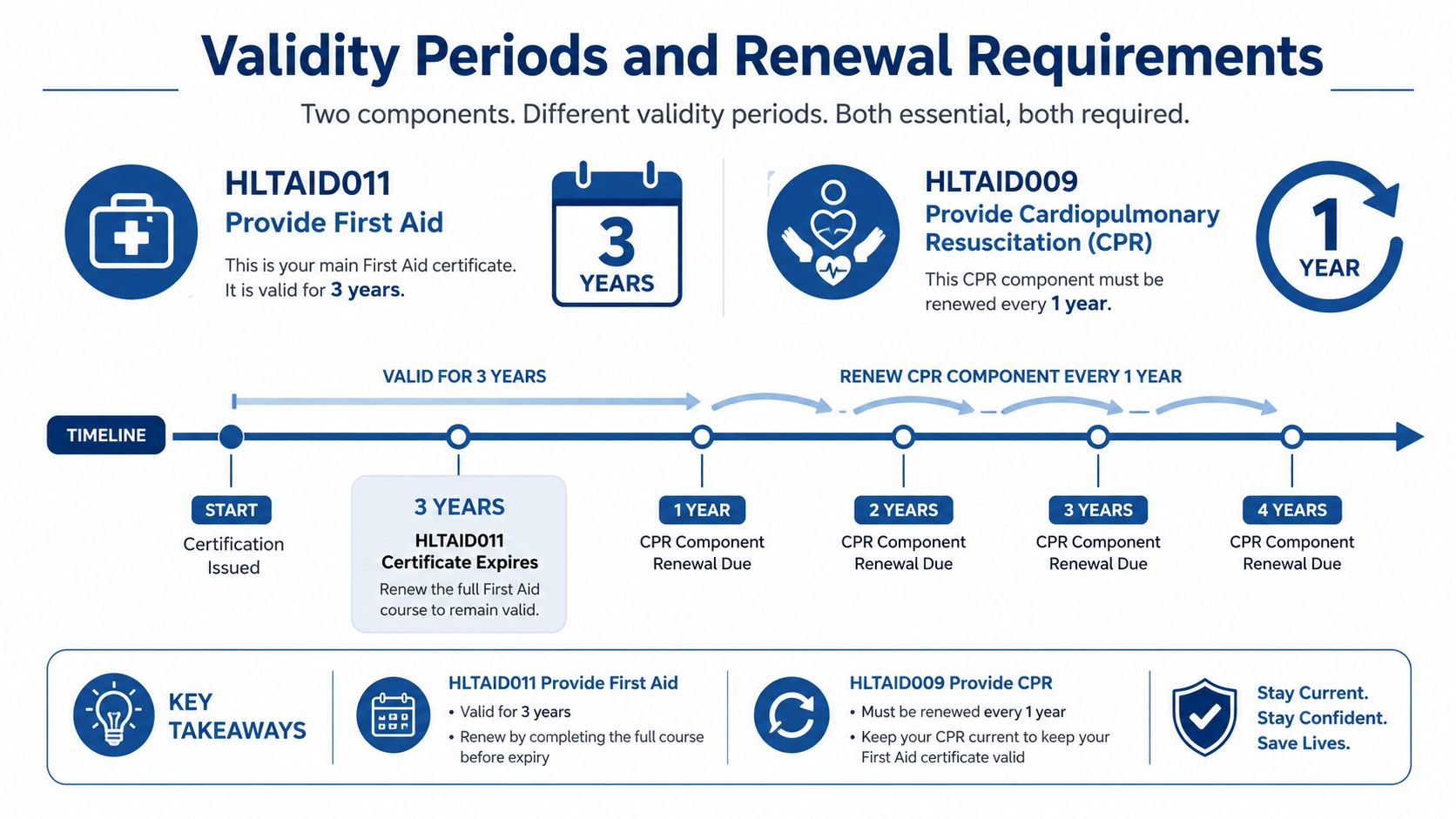
A lot of workers get caught out here. They think the certificate itself tells the full story, but compliance often depends on whether the CPR component is current as well. HLTAID011 is generally treated as a 3-year qualification, while HLTAID009 is typically refreshed every 12 months. That split is why a worker can still appear to hold a valid first aid certificate overall and still fail a site check for expired CPR currency.
Why currency matters more than people expect
The practical effect is simple. If your CPR renewal lapses, you may still be “qualified” on paper, but you're no longer current in the component most likely to be checked in a safety-critical incident. That's especially important in workplaces where rapid CPR and defibrillation can't wait for someone to look up expiry dates.
AMSA is explicit on this point. It requires a current HLTAID011 or accepted equivalent for domestic certificate-of-competency applications and doesn't accept expired first-aid certificates. For maritime workers, that means expiry isn't a minor admin issue, it can affect approval.
A simple renewal system
Use the course dates as a rolling schedule, not a one-off event. Put the CPR renewal date in your calendar when you receive the certificate, then set another reminder well before the three-year first aid date. That keeps you from accidentally moving into a gap that an employer or regulator might pick up during an audit.
If you work in traffic control or another site-based role where compliance dates are tracked closely, a refresher mindset helps. TP Training's traffic control refresher course information reflects the same principle, keep currency current before the deadline, not after it.
Rule of thumb: if a course sits in a safety-critical file, treat every expiry date as a deadline, not a suggestion.
How to Choose the Right Training Provider
A good provider makes the compliance side clear before you book. A weak one hides the important details until after payment. Start with the basics, check that the provider is a genuine RTO, that the course is nationally recognised, and that practical assessment is included. If any of those parts are missing, don't treat the certificate as reliable for workplace use.
Look at the course description closely. You want to know whether the provider supplies PPE, whether the practical session is same day or split across sessions, and what evidence you'll receive when you finish. If the provider won't explain whether the qualification is tied to the national VET system, that's a warning sign.
Also ask about trainer background. A trainer who understands real worksites can explain why a technique matters, not just how to pass the assessment. Facility quality matters too, because CPR manikins, AED trainers, bandages, and scenario equipment should be usable and current, not outdated props.
Ask before booking: “Is this delivered by an RTO, is there a practical assessment, and what document will I receive at the end?”
Price is relevant, but it shouldn't be the only filter. Safety-critical qualifications can be checked later by an employer, auditor, or regulator, and the cheapest option is often the one that hides the most detail. If you're comparing providers, ask whether they support rescheduling, how they handle missed practical sessions, and whether they issue your proof promptly. That tells you a lot about how they manage compliance after the class ends.
What to Expect on Course Day
A first aid course usually feels more practical than academic. You'll arrive, register, and then move into theory, either in the room or through pre-learning you completed earlier. After that, the trainer will shift you into hands-on stations where the practical work starts.
Expect CPR practice on manikins, AED use, bandaging, wound care, and scenario-based responses. Trainers also watch how you manage pressure, because first aid is as much about decision-making as it is about technique. If you freeze, ask questions. Trainers expect learners to be beginners, not already competent responders.
Common things that trip people up
People often struggle with the rhythm of CPR, the correct hand position, or remembering the order of actions in a scenario. That's normal. The training is built so you can repeat the skill until it makes sense, which is why practical assessment matters more than attendance alone.
A simple mindset helps. Focus on safety first, then communication, then the hands-on task. If you're told to use an AED trainer, speak clearly, follow the prompts, and keep working through the scenario instead of trying to memorise every line. By the end of the session, you should know what to do when the situation is messy, not just when it looks neat on a slide.
Common Questions About Compliance and Evidence
People usually want the same four answers. First, yes, digital certificates are commonly accepted if they come from a legitimate RTO. Second, if you lose your certificate, contact the provider and ask for a replacement statement or transcript record. Third, nationally recognised VET qualifications are valid across Australia, so an interstate certificate is still nationally recognised. Fourth, if your certificate expires while you're working, you should book renewal as soon as possible and tell your employer, because continued duties may depend on current currency.
If you're trying to keep your records tidy, save both the digital copy and a PDF in a secure folder. Keep the statement of attainment, any renewal notice, and the date you completed the CPR component. Employers usually want proof of the qualification, the issue date, and sometimes the provider name, so having everything ready saves back-and-forth later.
The compliance side gets simpler when you think in records, not memory. That's also where Beacon Recruitment's compliance advice is a useful reminder, the paperwork has to support the skill, not sit beside it as an afterthought.
If you're juggling different employers, ask each one what they recognise before you renew. Some sites only want the baseline qualification, while others want stricter freshness on CPR or role-specific units. That's why first aid certification Australia isn't just about getting trained once, it's about keeping the evidence current enough to stand up in practical situations.
If you need first aid training that aligns with workplace compliance and practical readiness, TP Training offers nationally recognised courses that fit Australia's safety requirements. Visit TP Training to check course options, confirm what your role needs, and book training that keeps your first aid and CPR currency current.

You may also like

Dogging Rigging Ticket: Your Complete NSW Guide
How Often Should CPR Be Refreshed in Australia