First Aid Training Cost: A Complete Guide for Sydney Workers
First aid training in Australia commonly costs between A$85 and A$220, depending on the course type, delivery mode, and provider. CPR-only training is often cheaper, while full first aid and childcare courses usually cost more because they cover broader skills and assessment requirements.
You may be looking at a course after your employer asks for an updated certificate, or perhaps you're arranging training for a small Sydney team and trying to work out whether the advertised fee includes everything. A low headline price can look attractive, but it won't help if the course doesn't meet your role's requirements, the certificate expires sooner than expected, or you need to pay extra for assessment and certification.
The practical question isn't just "How much does first aid training cost?" It's "What is the cheapest compliant option for my role, workplace and renewal cycle?"
Table of Contents
- Understanding First Aid Training Cost in Australia
- Average Costs by First Aid Course Type
- Key Factors That Affect First Aid Training Prices
- What Is Typically Included in First Aid Course Fees
- Comparing Pricing Options and Available Discounts
- How to Choose the Right-Priced First Aid Course
- Next Steps – Booking Your First Aid Training
Understanding First Aid Training Cost in Australia
A warehouse supervisor in Western Sydney may need Provide First Aid for workplace coverage. A childcare worker may need a course designed around children and infants. An office employee renewing CPR may not need the same training as a construction worker working around plant, vehicles and higher-risk tasks.
Those people shouldn't automatically pay the same fee. The course title, amount of hands-on training, learning format, location, assessment process and provider all influence the final price. Australian course listings place common first aid training prices in a broad A$85 to A$220 range, while the national listing for HLTAID011 Provide First Aid shows an estimated fee range of A$85 to A$350 across the market (national HLTAID011 course listing).
Why the advertised price can be misleading
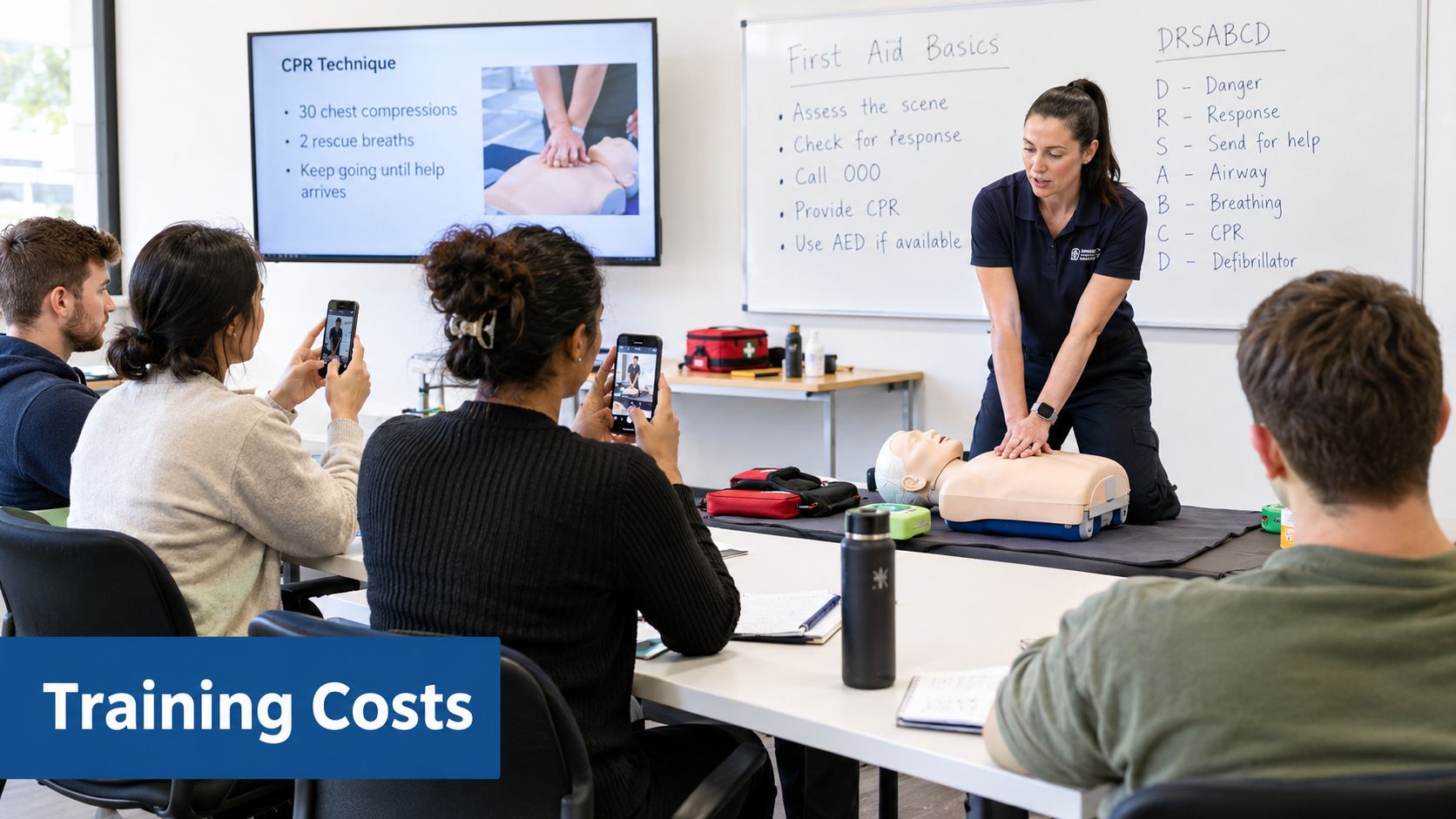
A short blended course may reduce classroom time by moving theory online. A fully attended course generally provides more direct interaction with the trainer, which may suit people who learn better through discussion and demonstration. Neither format is automatically the right choice. The correct option depends on what your employer, regulator or industry requires and how confidently you can complete the learning activities.
The fee may also reflect whether the provider supplies training materials, uses enough equipment for practical participation, issues the Statement of Attainment promptly and offers dates that fit around work. A price comparison is useful only when you're comparing like with like. The guide to first aid certification in Australia is useful when checking what a recognised course should involve.
Practical rule: Start with the qualification your role requires, then compare prices within that course category. Starting with the cheapest advertisement often creates the wrong comparison.
The real budgeting question
For an individual, the fee is only one part of the decision. Travel, unpaid time away from work, online pre-learning and the need to repeat a course that wasn't accepted can all change the actual cost. For an employer, the calculation also includes scheduling, coverage during training and the number of workers who need the qualification.
A sensible budget therefore has three parts:
- Course fee: The amount charged by the provider.
- Time cost: Travel, classroom attendance and any required online learning.
- Compliance fit: Whether the course is appropriate for the worker's role and renewal obligations.
Once those factors are clear, the broad price range becomes easier to interpret rather than something to fear.
Average Costs by First Aid Course Type
Different first aid courses solve different workplace problems. CPR-only training focuses on immediate resuscitation skills and is often selected for annual renewal. Provide First Aid covers a wider set of emergency responses and is commonly used when a worker needs a general workplace first aid qualification. Childcare first aid has a role-specific focus that makes it unsuitable to treat as a generic substitute.
The following figures provide practical market reference points from Australian course listings. They are guide prices, not fixed national fees, and providers can set different prices for different delivery models.
| Course Type | Average Cost Range (AUD) | Notes |
|---|---|---|
| CPR-only course | A$40 to A$50 | Often chosen for CPR renewal or a specific workplace requirement |
| Provide First Aid, HLTAID011 | A$89 to A$220 | Sydney and NSW listings sit at the lower end in some cases, while longer or fully attended offerings can cost more |
| Childcare first aid | A$105 to A$119 | Designed for childcare and education roles, with content relevant to children and infants |
| HLTAID011 national estimate | A$85 to A$350 | A broad national course-listing benchmark that reflects substantial provider and delivery variation |
Sydney listings for Provide First Aid commonly show prices around A$89 to A$97, while some Australian providers list the same unit at considerably more. CPR-only courses are commonly listed around A$40 to A$50, and childcare first aid is often listed around A$105 to A$119. These figures come from the Australian pricing references supplied for this guide, including NSW first aid course listings. The link is included as a market reference, not as an endorsement.
Why course type changes the fee
A CPR refresher has a narrower scope than a full first aid course. It usually suits someone whose workplace specifically asks for current CPR rather than the complete first aid unit. Paying for a full course in that situation may be unnecessary, but choosing CPR-only training when the role requires HLTAID011 creates a compliance problem.
Childcare training sits in a different category because the participant needs preparation for situations involving children and infants. The right course is determined by the work setting, not just by the lowest advertised number. The first aid training guide for Penrith can help Sydney workers compare course choices with their local training needs.
Read the table as a decision aid
Use the figures to identify an unusual quote, not to demand a particular price. A fee below the usual range may reflect a limited format or a promotion. A higher fee may include a longer classroom session, additional support or a timetable that saves significant work disruption.
Before booking, ask whether the listed amount includes assessment, learning materials, certification, practical equipment and any online component. That short check prevents a cheap booking from becoming an expensive correction later.
Key Factors That Affect First Aid Training Prices
The qualification itself isn't the only cost driver. Two providers can deliver the same nationally recognised unit at different prices because they organise the learning, facilities and assessment differently.
Delivery format and hands-on time
Blended learning can move some theory away from the classroom and give participants flexibility before the practical session. Fully attended training keeps the learning in one place and gives the trainer more opportunities to correct technique as participants practise. The lower-priced option isn't automatically better if a learner struggles with self-directed preparation or arrives without completing required work.
Australian NSW listings show Provide First Aid prices clustering around A$85 to A$97 for some short, blended or same-day certificate options, while traditional fully attended offerings can reach A$175 to A$220. The supplied pricing reference for Australian first aid course formats associates this difference with classroom time, pre-learning and assessment logistics rather than a change to the unit competency.
Location and facility costs
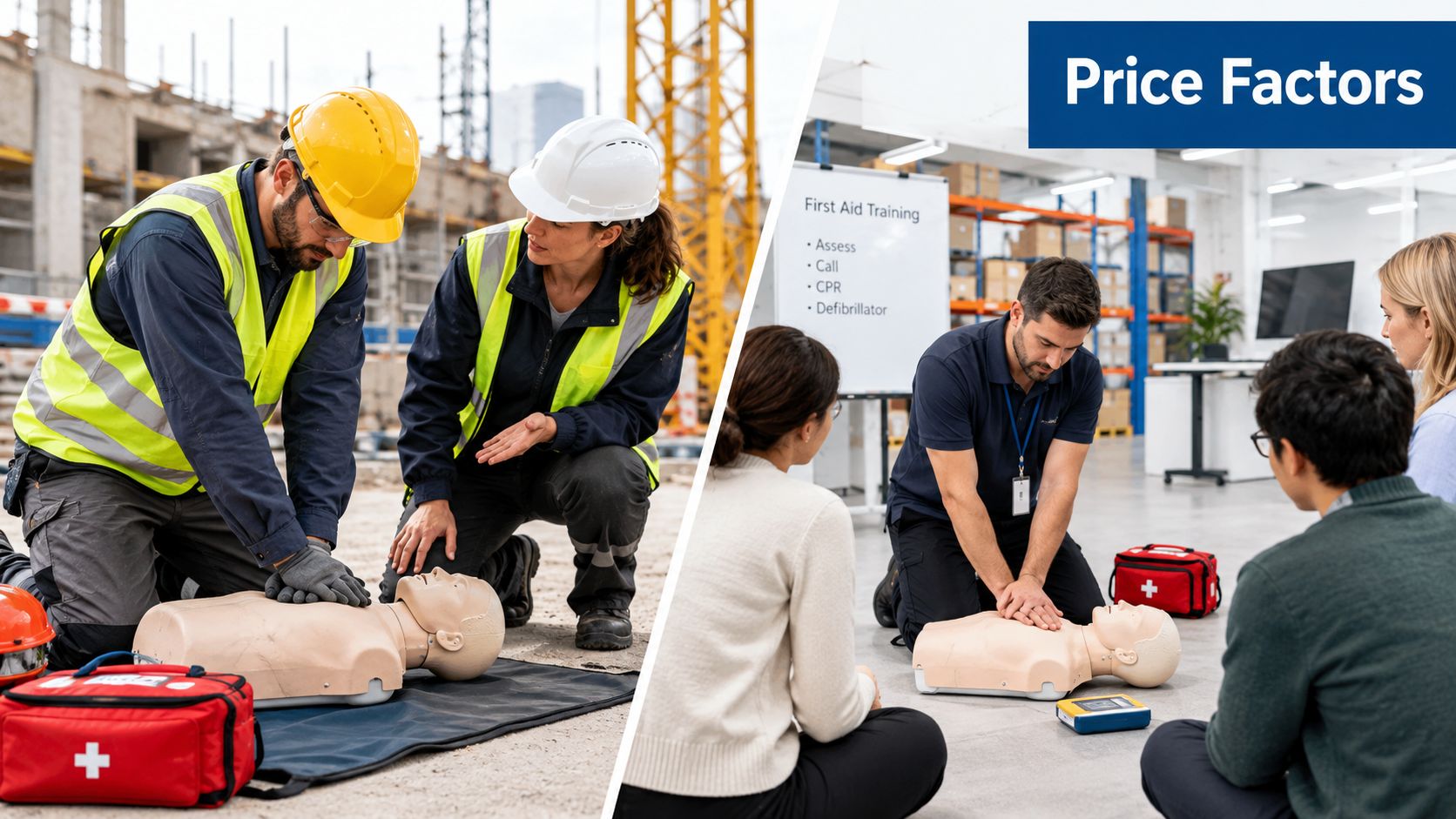
Sydney metro providers operate in a competitive market, which can keep public course prices lower. Regional delivery may involve different venue, staffing and travel arrangements. An employer choosing on-site training should compare the total project cost rather than looking only at the per-person fee.
For a single worker, a public class near home may be the most practical choice. For a team, a private session can reduce travel and make attendance easier, even if the quoted course fee looks higher at first glance.
Provider support and included resources
Fees can also reflect the equipment available during practice, the size of the class, trainer experience, booking administration and post-course support. A provider that supplies a mannequin for each practical group may offer a better learning experience than one where participants spend most of the session watching someone else practise.
Ask these questions before paying:
- What format is included? Confirm whether theory is online, in person or split between both.
- What happens if preparation isn't completed? Check whether rescheduling or extra administration attracts a charge.
- When is the certificate issued? Make sure the process fits your employer's deadline.
- Which renewal dates apply? The first aid training duration guide helps distinguish the course's learning commitment from its renewal cycle.
The cheapest provider can work well when the format, support and qualification match the learner. It doesn't work well when the low fee hides a mismatch between the course and the job.
What Is Typically Included in First Aid Course Fees
A transparent course fee should tell you what you'll receive before the booking is confirmed. Most reputable providers explain the learning format, assessment requirements and certification process in the course information rather than leaving those details until the day.
Core inclusions to check
First aid course fees commonly include:
- Learning materials: This may include online modules, learner resources or supporting documents needed for assessment.
- Practical equipment: Participants should have access to relevant mannequins, bandages, training aids and other equipment required for skills practice.
- Trainer instruction: The fee should cover the scheduled teaching and practical assessment, not just access to a video or a downloadable document.
- Certification: Successful participants generally receive evidence of completing the nationally recognised unit through the registered training organisation.
- Booking administration: Confirm whether changes to dates, attendance or completed pre-learning are handled within the original fee.
The precise inclusions vary. A low fee may cover only a public classroom booking, while another provider may include online preparation, flexible dates and reminders about future renewal. Compare the complete service, not just the number displayed beside the course name.
What isn't always included
Travel, parking, time away from work and replacement fees may sit outside the advertised price. Some providers also have conditions around late arrival or incomplete online learning. Those conditions aren't necessarily unreasonable, but you should know them before enrolling.
A useful booking message is: “Please confirm the total fee, course format, assessment requirements, certificate timing and any rescheduling charges.” That gives you a written record and makes different providers easier to compare. Information about the HLTAID011 first aid course can also help you identify the practical elements that should form part of your comparison.
Value means usable training
A certificate has limited value if the learner can't perform the required skills with confidence. A provider should give participants time to practise, receive feedback and demonstrate competence. Employers should also consider whether the training reflects the environment where workers may need to respond, such as a warehouse, office, childcare room or construction site.
Comparing Pricing Options and Available Discounts
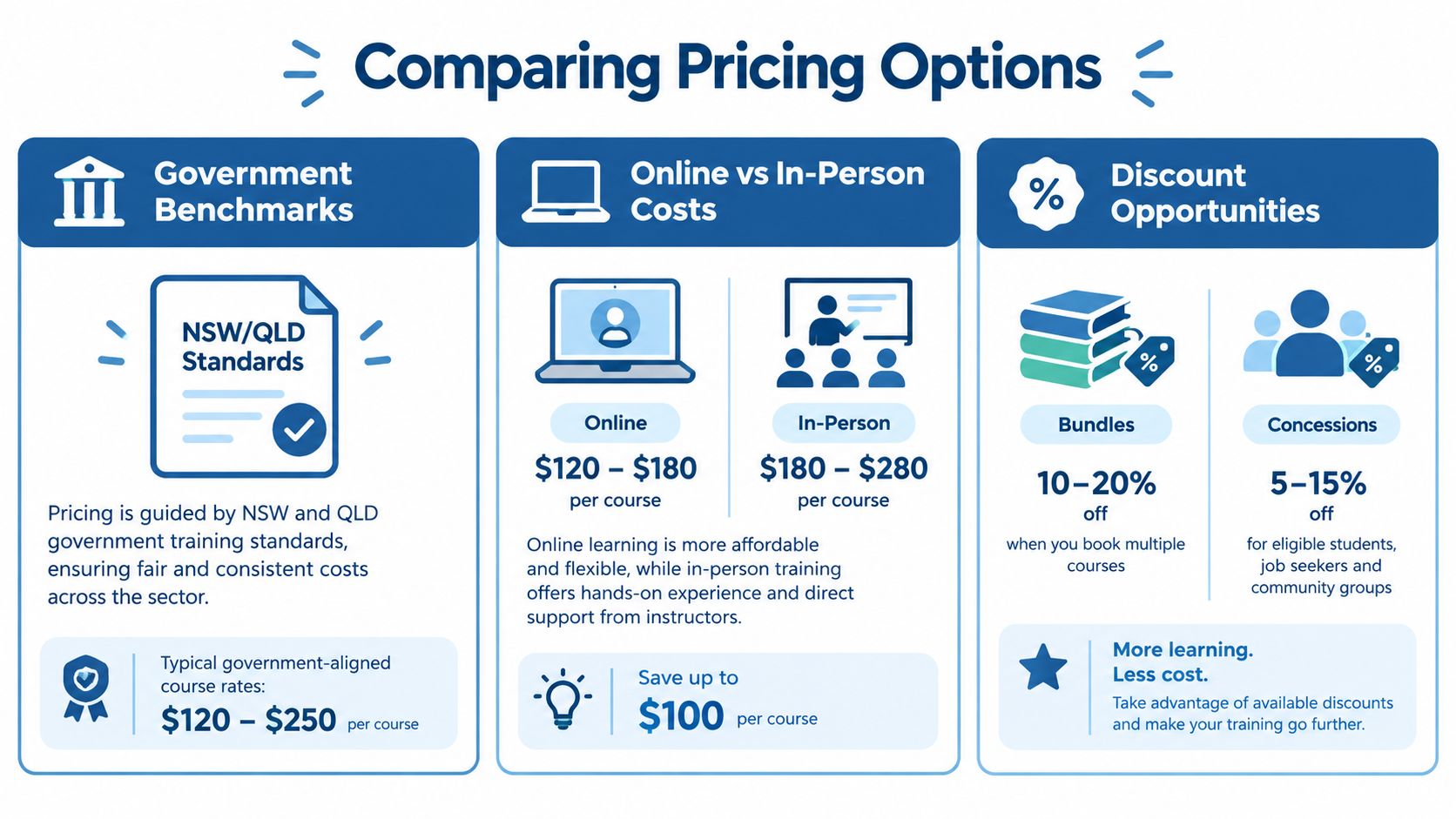
Price comparisons become more useful when you separate public benchmarks from private-market offers. A government-set public course fee may provide a stable reference point, while private providers may use competitive pricing, blended delivery or scheduled promotions to attract individual learners.
A Queensland Government public pricing schedule for Provide First Aid, HLTAID011, lists a 2026 to 2027 full fee of A$191.32. It also lists concessional pricing of A$181.75 for students and pensioners and A$172.19 for online bookings, showing that the published options can reduce the base fee by about 5% to 10%. Treat that schedule as a benchmark rather than a universal Sydney price. Public-sector course pricing and private metro pricing serve different operating models.
Three ways the final price can change
Public course benchmark: A scheduled government course can offer a clear reference fee and defined concessions. It may suit learners who value a published structure and have access to the relevant location and dates.
Private provider pricing: Private training organisations may offer a lower public-class price in a competitive area, particularly where they use blended delivery or run frequent sessions. Check the inclusions carefully before assuming two prices represent the same service.
Group and concession arrangements: Employers should ask about team bookings, on-site delivery and recurring renewal schedules. Individual learners can ask about student, pensioner, early-booking or online-learning concessions where those options are available.
A discount is useful only when the course still meets the worker's requirement and the learner can complete the assessment properly.
Compare the total, not the discount label
An early-booking offer may suit someone with a fixed schedule. A group rate may be more valuable to an employer because it reduces administration and keeps workers on a coordinated renewal cycle. A concessional rate may help an eligible learner, but it won't solve a course mismatch.
Before accepting an offer, confirm the qualification code, delivery model, certificate process and expiry expectations with the workplace or organisation requesting the training. Saving money on the wrong course isn't a saving.
How to Choose the Right-Priced First Aid Course
The right-priced course is the one that meets the role's requirements without buying training the worker doesn't need. That decision starts with the workplace, not the provider's promotional price.
Safe Work Australia's guidance says first aid must be accessible whenever workers are at work, including during night shifts and overtime. It also says a person conducting a business or undertaking must ensure enough workers are trained or that workers have access to trained first aiders (Safe Work Australia's workplace first aid code).
Use a role-first check
Ask the following in order:
- What does the role require? Confirm whether the worker needs CPR, Provide First Aid or a childcare-specific course.
- What does the workplace require? Ask the employer, placement coordinator or safety representative which certificate they accept.
- How will the worker renew it? CPR refresher training is generally recommended annually, while first aid qualifications are generally renewed every three years under the Safe Work Australia model code (model code guidance).
- Which format suits the learner? Choose blended delivery only if the participant can complete the online work and still receive the required practical assessment.
- What is the actual time cost? Include travel, work absence and the risk of rescheduling.
This framework often produces a different answer for different workers. Someone renewing CPR may need a shorter, role-specific option. Someone newly responsible for workplace first aid may need the broader Provide First Aid course. A childcare worker should follow the requirements set by the service, regulator or employer rather than substituting a cheaper general course.

Check workplace coverage, not just personal certification
Employers also need enough coverage across shifts and locations. Safe Work Australia's model guidance gives a practical benchmark of one first aider for every 50 workers in a low-risk workplace and one for every 25 workers in a high-risk workplace (workplace first aid staffing guidance).
That staffing context changes the budget. An employer may need more than one trained person so coverage remains available during leave, breaks, overtime and different shifts. The lowest individual course price won't create adequate coverage if only one person is trained.
Compare providers using evidence
Look for a registered training organisation, current course information, realistic practical assessment and clear certificate arrangements. Ask who will deliver the course, what equipment participants will use and how the provider handles missed or incomplete requirements.
Choose the lower price when the two options genuinely match. Pay more when the additional support removes a real barrier, such as difficult scheduling, poor learner confidence or the need for practical training at the workplace.
Next Steps – Booking Your First Aid Training
Once you've identified the required course, booking should be straightforward. The problems usually arise when people skip the verification step and discover later that the course format, certificate or renewal date doesn't meet the workplace requirement.
A practical booking sequence
Confirm the qualification first. Ask your employer or industry contact to name the required course. Don't rely on a general phrase such as “first aid ticket” if the role has a specific qualification or renewal condition.
Compare two or three complete quotes. Check the total price, delivery mode, course date, venue, learning materials, assessment, certificate and rescheduling policy. A short email can expose differences that aren't obvious on a booking page.
Check your availability. If the course includes online preparation, complete it before the classroom session. If it's fully attended, allow enough time for practical participation and assessment rather than booking it between two tight work commitments.
Prepare for practical learning. Wear comfortable clothing that allows you to kneel and move safely. Arrive ready to practise, ask questions and accept technique feedback. First aid skills become more useful when you understand how they apply to your actual workplace.
Record the renewal dates. Keep the certificate and note the relevant CPR and first aid renewal expectations. Employers should maintain their own register so they can organise coverage before certificates lapse.
For a worker in Parramatta who only needs CPR renewal, a CPR course guide for Parramatta may help with local planning. For an employer, ask whether a provider can coordinate several workers, deliver training at a suitable site or align renewal dates without compromising the required assessment.
The best first aid training cost is the one that leaves you with an accepted qualification, practical confidence and a renewal plan that doesn't become an emergency booking. Take the time to match the course to the role before you compare the final dollar amount.
TP Training offers nationally recognised first aid, CPR and childcare first aid courses across NSW training centres, including Penrith, Burwood, Auburn, Parramatta and Sydney CBD. Compare course options and book practical training through TP Training to find a suitable format for your role, workplace and budget.

You may also like

How Long Licence Crystalline Silica Prevention Last

White Card Validity NSW: A Practical Guide for 2026