
How Long Does CPR Certificate Last in Australia
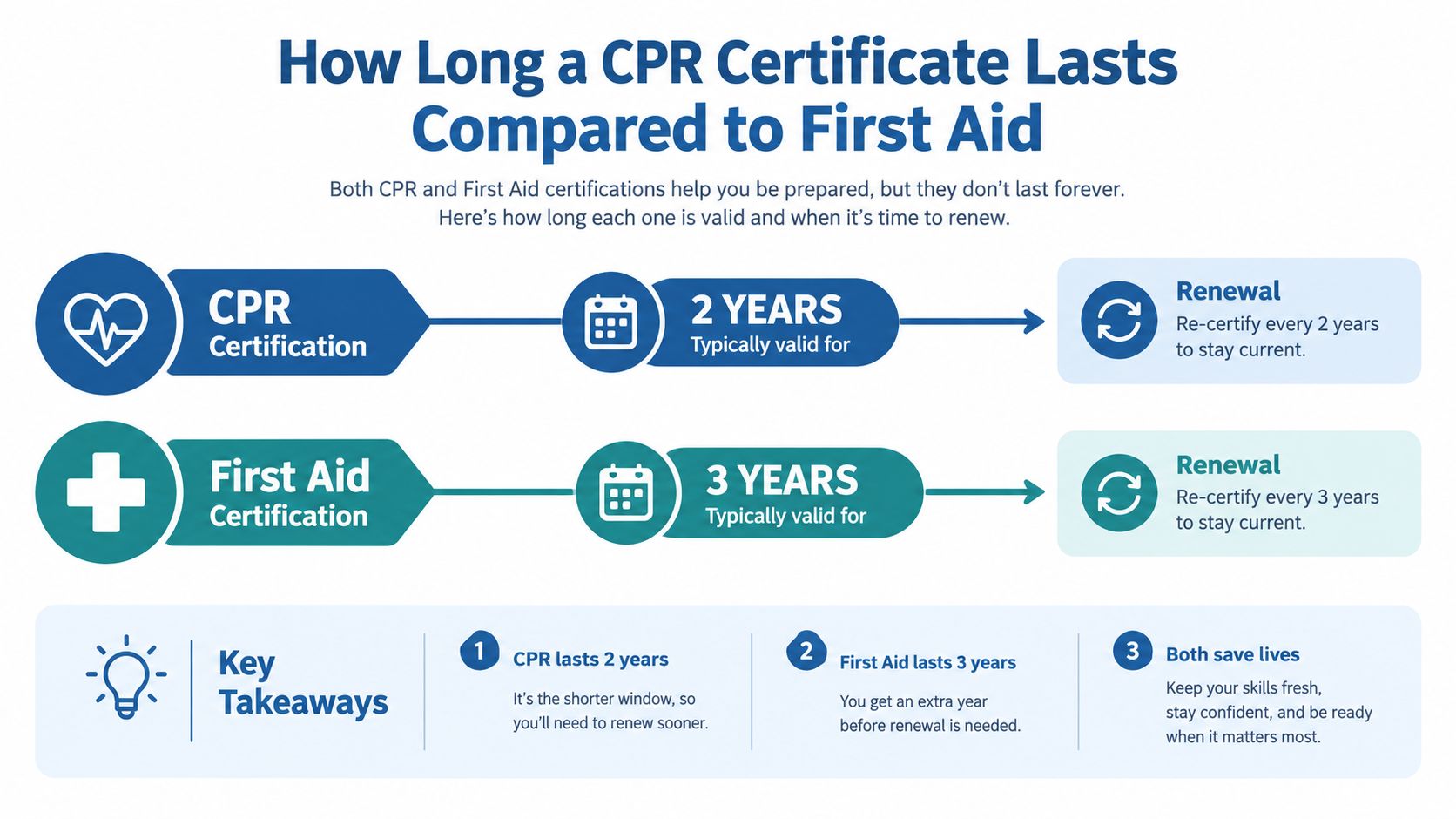
CPR certification is generally treated as current for 12 months in Australia, while full Provide First Aid certification is generally current for 3 years. That means CPR is usually refreshed three times during one standard first-aid certification cycle.
You might be checking your certificate before starting a new construction job, accepting a childcare shift, applying for hospitality work, or responding to an employer's compliance request. The document may still look recent, but the important question is whether the CPR component is current for your role today.
Table of Contents
- Introduction to CPR Certificate Validity in Australia
- How Long a CPR Certificate Lasts Compared to First Aid
- What Counts as Valid and When the Clock Starts
- Renewal Requirements for Different Workplaces and Roles
- How to Check Expiry and Renew Your CPR Certificate With TP Training
- Staying Current and Confident With Your CPR Skills
Introduction to CPR Certificate Validity in Australia
A worker in NSW opens a digital certificate before an early shift and notices two different dates. The first-aid qualification still appears to be within its usual currency period, but the CPR training was completed much earlier. That's a common source of confusion because CPR and first aid are often completed together, yet they don't follow the same renewal cycle.
In Australia, HLTAID009 Provide Cardiopulmonary Resuscitation is commonly treated as current for 12 months, while HLTAID011 Provide First Aid is generally current for 3 years, or 36 months. Australian training and workplace guidance reflects this distinction, including guidance from CBD College on first-aid certificate renewal.
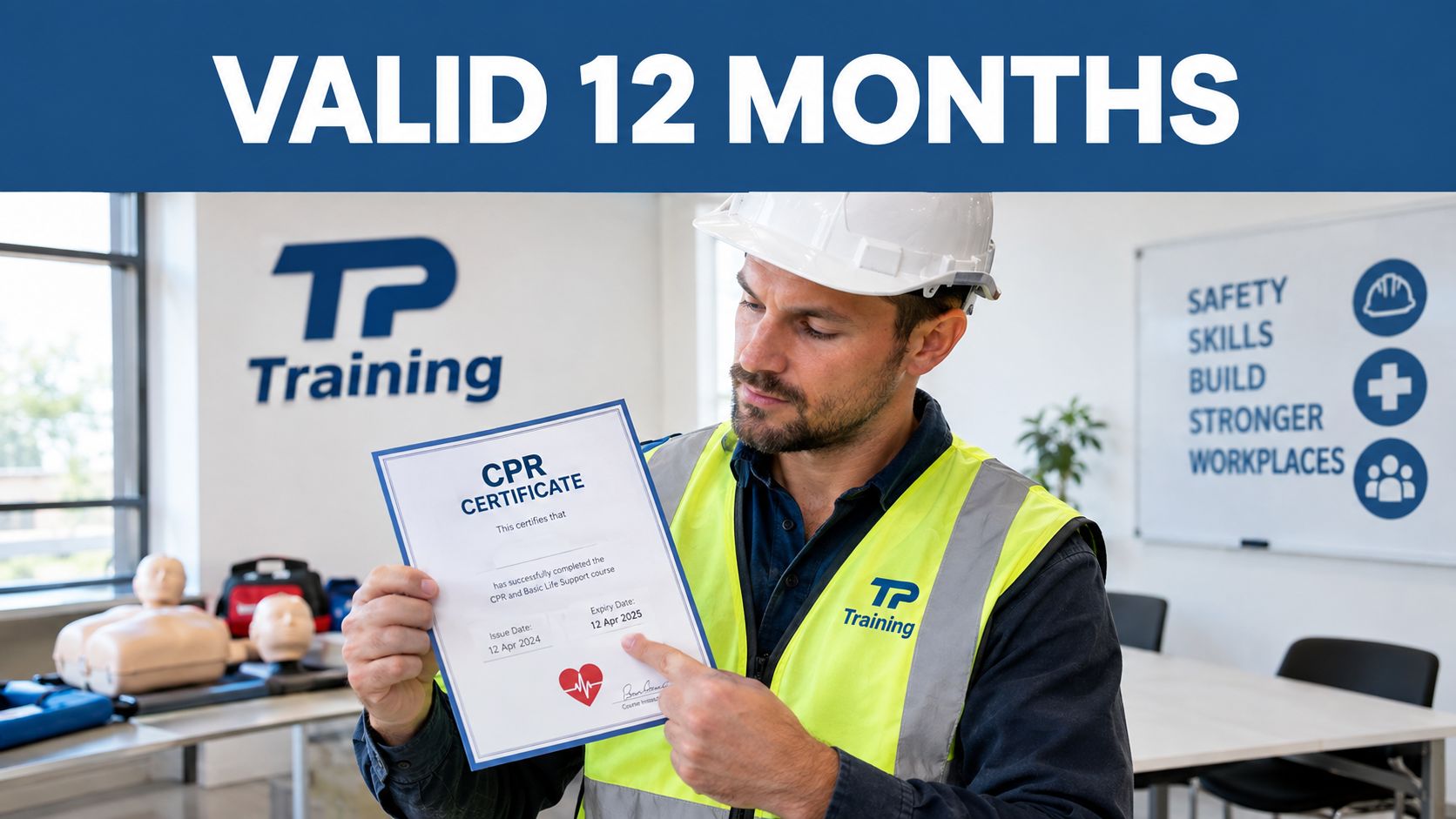
That timing matters because employers may need workers with current emergency-response skills, not just a recent-looking first-aid document. Construction, childcare, hospitality and general workplace safety roles can each apply their own compliance checks.
The question behind the question
People often ask, “How long does a CPR certificate last?” What they usually need to know is:
- Is my CPR unit still current?
- Which date starts the renewal clock?
- Does my job require an annual refresher?
- Can my first-aid certificate remain current after CPR expires?
The short answer to the last question is yes. Your broader first-aid qualification can remain within its normal period while the CPR component needs renewal. The sections below separate those two requirements and explain how to check your own position without relying on guesswork.
How Long a CPR Certificate Lasts Compared to First Aid
A combined first-aid qualification can have two separate maintenance dates. HLTAID009 Provide Cardiopulmonary Resuscitation generally requires annual renewal, while HLTAID011 Provide First Aid generally follows a three-year, or 36-month, cycle, as outlined in Australian first-aid renewal guidance.
The practical comparison is:
- CPR, HLTAID009: generally refreshed every 12 months.
- Full first aid, HLTAID011: generally renewed every 3 years, or 36 months.
- Combined training: may issue both units, but each unit has its own currency expectation.
A simple certificate timeline
For example, if you complete first aid and CPR in January 2025, CPR would generally be due for renewal 12 months later, while full first aid would generally be due 36 months later. Further CPR renewals may be needed before the broader first-aid qualification reaches the end of its usual cycle.
This is why CPR can expire before your first-aid certificate. The annual refresher keeps the CPR unit within the period expected for current resuscitation skills. It does not mean the complete first-aid qualification has expired.
Your Statement of Attainment lists the nationally recognised units you completed. It does not mean every unit on the document shares the same operational currency period. Check the unit codes and relevant dates, particularly when an employer requests current CPR rather than general first aid.
The distinction also applies when first aid is not the main focus of your role. For example, Provide Responsible Service Of Alcohol Course Rsa training addresses responsible service requirements, while CPR currency remains a separate workplace-safety matter where the role requires it.
For a broader explanation of the first-aid cycle, read TP Training's guide to how long a first-aid certificate lasts. Track CPR and first aid as two connected but separate dates, so an in-date first-aid qualification does not lead you to overlook an expired CPR unit.
What Counts as Valid and When the Clock Starts
The date that matters is generally the issue date shown on your certificate or Statement of Attainment, not the last day you practised compressions, used an AED, or helped someone revise a class exercise. Australian guidance commonly treats HLTAID009 as current for 12 months from the issued training record.
That creates an important difference between having paperwork and being considered current. You may still hold a document that lists both CPR and first aid, but an employer or regulator can look at the individual unit and ask whether its currency falls within the required period.
The practical rule: read the issue date for the CPR unit, then check whether your workplace requires that unit to be current within the previous year.
Why a recent certificate can cause confusion
Imagine completing combined training in January 2025. The first-aid component may remain within its usual three-year period, but the CPR component may need annual refreshers. If you show only the overall certificate without checking the unit dates, you could discover the gap when an employer reviews your documents or an audit checks staff records.
The expiry clock doesn't begin when you next use CPR skills. It also doesn't restart because you watched a refresher video or attended an informal practice session. Those activities may support confidence, but they aren't the same as completing the required nationally recognised training and receiving the relevant record.
Employers may also apply a stricter internal rule than the broad minimum. That's why you should check the role description, workplace policy and any industry-specific requirement before booking the course. TP Training's explanation of the HLTAID011 first-aid course can help clarify what the full unit covers, but your employer remains the right place to confirm its operational requirement.
Renewal Requirements for Different Workplaces and Roles
The phrase “12 months” is useful, but it doesn't operate identically in every situation. A workplace may expect annual CPR refreshers as part of its safety arrangements, education and care employers can require CPR to have been completed within the previous year, while personal users may not face a regulation that mandates renewal.
The relevant setting matters more than the certificate title alone.
| Setting | CPR Currency | First Aid Currency |
|---|---|---|
| General workplace safety | Commonly refreshed every 12 months, consistent with workplace practice | Generally 3 years, or 36 months |
| Education and care, including childcare | Must be current within the previous year under the applicable requirement | Generally remains within its 3-year currency period |
| Personal or community use | No universal regulation requires renewal solely for personal use, although refresher training supports confidence | Depends on the qualification and the organisation's expectations |
Workplace requirements
In many Australian workplaces, annual CPR refreshers are used to maintain a reliable emergency response capability. Safe Work Australia workplace practice is reflected in NSW training guidance, but the exact requirement can depend on the employer, worksite risk profile and designated first-aid arrangements.
A construction site, warehouse or hospitality venue may ask for current CPR even when the worker's broader first-aid qualification remains current. The reason is practical: the employer wants the person listed as an emergency responder to have recently maintained the hands-on CPR and AED skills relevant to that responsibility.
Childcare and education
Childcare is a setting where waiting for the full first-aid renewal can create a compliance problem. ACECQA-linked guidance requires education and care workers to have CPR current within the previous year, even when their broader first-aid qualification remains within its three-year window. The requirement became explicit from 1 October 2023, as explained in Australian first-aid guidance from CPR First Aid.
So, a childcare worker shouldn't assume that an in-date HLTAID011 certificate automatically proves current CPR. The employer may need the annual CPR evidence separately.
For a wider view of workplace credentials, TP Training also discusses CPR, first aid, White Card and workplace safety certifications. Always confirm the requirement with the organisation responsible for your placement, roster or licence.
How to Check Expiry and Renew Your CPR Certificate With TP Training
Start with the document, not your memory. Find the CPR unit, identify the issue date on the certificate or Statement of Attainment, and mark the corresponding annual review date in your calendar. If your workplace requires uninterrupted currency, arrange training before the due date rather than waiting for a manager to identify the gap.

A practical checking routine
- Locate the CPR unit. Confirm that the record refers to HLTAID009 Provide Cardiopulmonary Resuscitation, rather than only showing a general first-aid course title.
- Check the issue date. Use the date on the formal training record, not the date you last practised CPR.
- Confirm the workplace rule. Ask your employer whether it requires CPR to be current within the previous year or has another documented process.
- Set a calendar reminder. Give yourself enough time to find a suitable course and provide updated evidence to your workplace.
- Keep the new record accessible. Store the certificate digitally and follow your employer's process for submitting it.
TP Training delivers nationally recognised, practical HLTAID009 training with hands-on CPR and AED practice at NSW locations including Penrith, Burwood, Auburn, Parramatta and Sydney CBD. Bring your identification, any existing certificate or Statement of Attainment, and any workplace documentation your employer has provided. Check the course requirements before attending so you arrive prepared.
If you're comparing different providers' approaches to validity and expiry administration, you can also review the expiration policy from Premiere Education. For location planning, TP Training's guide to CPR courses near you may help you identify a convenient NSW training centre.
Renewal is more than a paperwork task. Repeating the practical sequence, working through AED use and completing the assessment gives you an opportunity to rebuild the calm, physical response you'll need in an emergency.
Staying Current and Confident With Your CPR Skills
Annual CPR maintenance works best as a routine, not a last-minute scramble. Keep the CPR record separate from the broader first-aid certificate, monitor the issue date, and check the rule attached to your job or placement.
Use this short checklist:
- Review your records: Find the CPR unit and its issue date.
- Check your role: Confirm whether your employer, regulator or placement requires current CPR within the previous year.
- Plan ahead: Book the next practical refresher before your current currency ends.
- Update your workplace file: Send the new Statement of Attainment or certificate through the required channel.
- Practise responsibly: Use approved training opportunities to maintain familiarity between formal courses.
A childcare worker, construction worker, warehouse employee and hospitality worker may all hold CPR training, but their organisations can apply the evidence differently. Personal use is different again, because there isn't a universal regulation requiring renewal solely for community use. The right decision depends on where you work, what responsibility you hold and what your organisation requires.
If you want to build broader emergency confidence alongside CPR, TP Training's information on a basic life-saving course provides another relevant starting point. Staying current protects your employability, but it also means you're better prepared to act when someone needs immediate help.
TP Training provides practical, nationally recognised CPR and first-aid training across NSW, including centres in Penrith, Burwood, Auburn, Parramatta and Sydney CBD. Visit TP Training to check the available course information, choose a suitable location and organise your next CPR refresher before your workplace certificate becomes a problem.

You may also like

Barista Course NSW: A Practical Guide to Getting Started