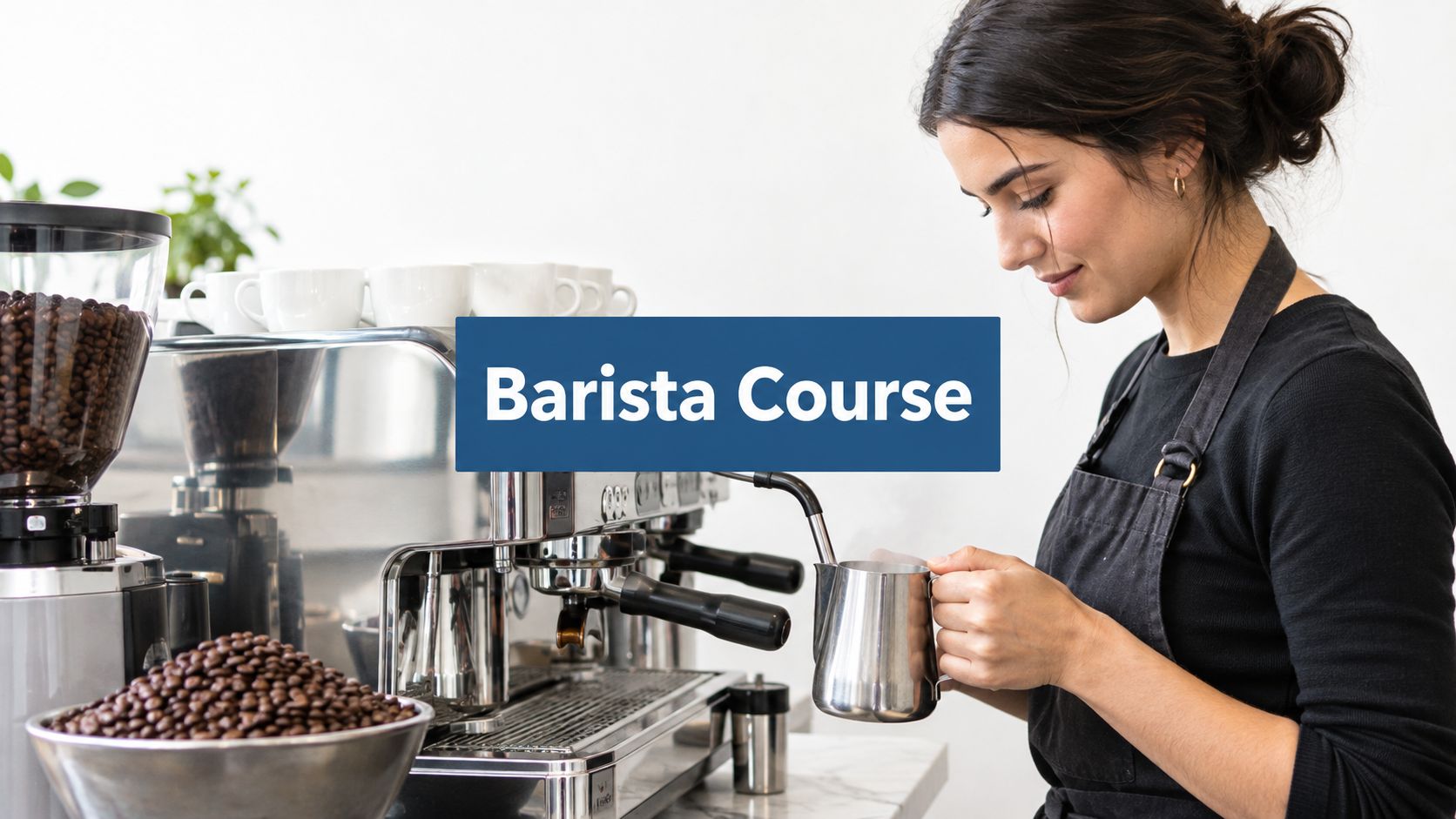
Barista Course NSW: A Practical Guide to Getting Started
You're standing behind a café counter in Sydney, watching the morning queue build while trying to decide whether a short barista course is a sensible career move or just an expensive weekend experiment. You might be a school leaver looking for a first job, a career changer wanting a practical skill, or an experienced hospitality worker hoping to move onto better coffee shifts.
A barista course can give you a useful starting point, but it won't turn you into a fast, reliable café worker overnight. The core question is what the course includes, how it fits the NSW hospitality qualification pathway, and what you'll still need to learn through supervised practice and employment.
Table of Contents
- Why a Barista Course in NSW Is on So Many Shortlists Right Now
- What a Barista Course Actually Teaches You
- Short Barista Course vs Full Hospitality Certificate in NSW
- Entry Requirements, Language Skills and Funding Rules in NSW
- Will a Barista Course Actually Get You a Job in NSW?
- A Practical Look at a Typical Training Day
- Food Safety and the NSW Supervisor Requirement
- Choosing Your Barista Course in NSW and Next Steps
Why a Barista Course in NSW Is on So Many Shortlists Right Now
A short barista course is often the first practical step because coffee work looks accessible from the customer side. You see the grinder, group heads, milk jugs and cups, then assume the job is mainly about remembering recipes. A busy shift quickly proves otherwise. You need to manage several orders, keep the bench clean, communicate with front-of-house staff and produce drinks that remain consistent when the queue is moving.
Workforce-planning data supports the idea that barista skills sit inside an established hospitality employment base. The 2024 Hospitality Workforce Planning Report lists ANZSCO 431112 Barista under Certificate II and Certificate III qualifications, with 46,252 enrolments and completions and a 7.2% share. It also says enrolments and completions across SIT hospitality qualifications have remained relatively steady over the past five years.
That doesn't mean every graduate walks into a café job. Employers still want people who can work at service speed, handle customers calmly and turn up when the business needs them. A course helps you demonstrate basic competency, but a café manager may still prefer someone with previous service exposure or a willingness to start across several hospitality duties.
What the NSW pathway looks like
In NSW, barista training usually sits inside broader hospitality education rather than operating as a completely separate profession. TAFE NSW's food and hospitality pathway lists Certificate II and Certificate III hospitality options that can lead towards roles including barista, waiter, bar attendant and front office attendant.
That structure matters. A short course can help you test whether café work suits you. A full qualification gives you a wider employment foundation across cafés, restaurants, clubs and hotels, with workplace learning and additional hospitality units.
Practical rule: Treat a short course as a skills entry point, not a guaranteed job offer.
The rest of your decision should come down to your target. If you want confidence using a commercial machine before applying for café work, a short course may be enough to begin. If you want a broader hospitality career, compare it with Certificate II or Certificate III training before enrolling.
What a Barista Course Actually Teaches You
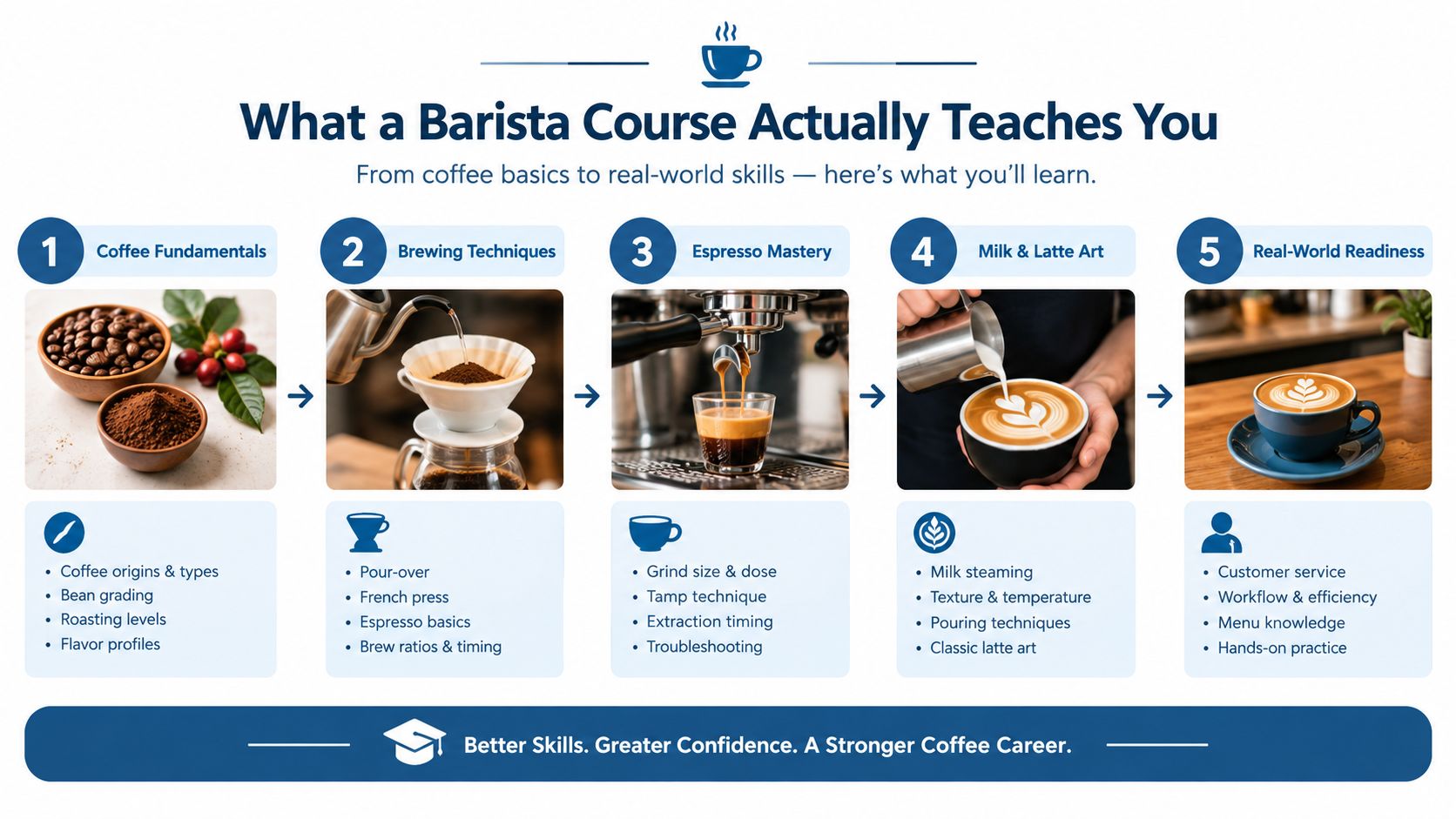
A useful NSW barista course starts with the relationship between the coffee dose, the water passing through it and the liquid collected in the cup. You'll learn that grind size controls flow. A coarse grind lets water pass too quickly and can produce a thin, sharp, under-extracted espresso. A fine grind slows the flow and can create an over-extracted, bitter drink.
Training materials commonly use a 25 to 30 second extraction window, with an ideal target around 27 seconds, and an extraction yield of 18% to 22% for a standard espresso shot, as explained in this SITHFAB005 barista learning guide. These aren't magic numbers, but they give a beginner a practical reference point when taste and timing don't match.
Espresso and grinder control
You'll practise dosing, distributing grounds, tamping evenly and locking the portafilter into the group head. The trainer should show you how to adjust the grinder instead of telling you to memorise a setting. Beans change with age, humidity and the café's recipe, so the ability to dial in matters more than remembering a particular number on a grinder collar.
The espresso unit commonly used in NSW training is SITHFAB025 Prepare and serve espresso coffee. TAFE NSW lists Basic Barista Skills as a short course linked to Certificate III in Hospitality, and the unit covers selecting and grinding beans, extracting espresso on commercial equipment, judging beverage quality and maintaining machines and grinders. You can read more about the broader barista training pathway in Australia.
Milk, hygiene and workflow
Milk texturing is a separate skill from espresso extraction. You'll learn how to introduce air at the beginning of steaming, create a fine texture, control temperature and pour without destroying the foam. A flat white, latte and cappuccino need different textural results, even though they may begin with the same espresso base.
A sound course also covers hand hygiene, cross-contamination, bench organisation and the cleaning of steam wands, baskets, group heads and grinders. Equipment care isn't an optional extra. Resources on how to train kitchen staff on equipment are useful because new workers need to understand both operation and maintenance.
You may also practise taking orders, communicating with the service team, restocking milk and cups, and completing a closing routine. Those habits separate a learner who can make one attractive latte from a worker who can contribute during a real shift.
For context, TP Training also provides practical, nationally recognised Cpccldg3001 Perform Dogging Licence Course And Training In Sydney training with experienced trainers and hands-on learning across NSW. That course belongs to a different industry, but the same training principle applies here: practical instruction should connect knowledge to safe, repeatable workplace performance.
Short Barista Course vs Full Hospitality Certificate in NSW
The biggest difference is not the coffee machine. It's the amount of supervised practice and the breadth of workplace capability you develop around it.
A typical short barista course may run in a compact format, sometimes over one day. It concentrates on espresso preparation, grinder use, milk work, cleaning and basic service. That can be appropriate for someone who already has hospitality experience and needs a focused introduction to commercial coffee equipment.
A full qualification takes a wider view. NSW Department of Education information states that hospitality VET includes a full Certificate II in Hospitality with 70 mandatory work placement hours, while school-delivered hospitality programs require 240 indicative coursework hours and at least 70 hours of placement. These requirements show why a certificate offers a different level of exposure from a short skills class. The vocational training pathway in Australia also helps explain how competency-based qualifications connect classroom learning with employment.
| Feature | Short barista course | Certificate II/III in Hospitality |
|---|---|---|
| Main focus | Espresso, milk, grinder and cleaning basics | Broader hospitality operations and role preparation |
| Delivery | Compact practical training, often one day for SITHFAB025 | Structured coursework, assessment and workplace learning |
| Practice | Supervised machine practice during the course | Extended practice and mandatory placement requirements |
| Units | May focus on SITHFAB025 and food safety content | Multiple SIT units across hospitality service |
| Best suited to | Beginners testing café work or workers adding coffee skills | Learners seeking a broader entry pathway into hospitality |
| Outcome | Basic operational confidence | A nationally recognised qualification with wider progression options |
TAFE NSW's 2025 career guide places barista within Certificate III in Hospitality, SIT30622, reinforcing that the role is embedded in a nationally recognised vocational pathway. A short course can help you decide whether coffee work feels right. It can't replicate the consistency, customer coordination and workplace habits developed across a full certificate and placement.
Choose the short option when you need a focused introduction and already understand the pace of hospitality. Choose the certificate when you want a broader foundation, more structured practice and a qualification that can support movement between cafés, restaurants, clubs and hotels.
Entry Requirements, Language Skills and Funding Rules in NSW
The phrase “easy barista course” can hide practical entry conditions. Providers may set different minimum ages, and many expect learners to read recipes, follow equipment instructions, understand safety signs and complete simple workplace calculations.
Language, literacy and numeracy checks are common because trainers need to know whether you can safely follow a recipe, record information, understand cleaning instructions and communicate with customers. Macquarie Community College's NSW barista and café skills information states that applicants may need an LLN assessment and intermediate English communication skills. The same information explains that NSW Government fee support depends on formal eligibility checks.
What to confirm before enrolling
Ask the provider these questions before you pay or attend:
- Eligibility: Does the course have an age, residency or employment condition?
- LLN assessment: Will you complete a short interview, written task or digital assessment?
- Funding: Is the course subsidised, and does the subsidy apply to this short skill set or only to a larger qualification?
- Documents: Do you need photo identification, a Unique Student Identifier, or concession evidence?
- Delivery: Is the course suitable for your visa status, and is CRICOS-registered delivery required for overseas students?
Don't assume that a government-supported Certificate II or III means every short barista class is free. A provider may offer instalments for an unfunded course, but that arrangement is different from a NSW subsidy.
Capability matters as much as eligibility
A learner can meet the formal entry conditions and still need support with workplace communication. You'll need to hear modifications to an order, clarify an allergy-related request, read a docket and respond quickly when a trainer changes the recipe.
If you need additional language support, TP Training's multilingual assistance information explains the availability of English, Mandarin, Korean and Vietnamese assistance. Ask providers what support is available before training starts, rather than waiting until the first practical assessment.
Will a Barista Course Actually Get You a Job in NSW?
A course gives you a skill. Employment depends on whether you can use that skill reliably in a commercial setting.
The workforce data points to sustained demand rather than a short-lived coffee trend. The hospitality workforce report identifies barista as a core role in the pipeline and describes hospitality enrolments and completions as relatively steady over the past five years. Jobs and Skills Australia has also projected that Australia will need an extra 21,400 hospitality workers, including baristas, waiters and bar attendants, from May 2023 to May 2028, as reported in the industry workforce update.
That projection doesn't remove the need to prove yourself. A café may ask whether you can work weekends, handle customer contact, clean correctly and move between barista and waiting duties. Some roles are coffee-focused, while others combine espresso preparation with register work, food running or table service.
| Pathway | Typical duration | Entry-level NSW roles targeted | Realistic placement signal |
|---|---|---|---|
| Short barista course | Compact practical format | Café assistant or junior barista | Shows basic machine exposure |
| Certificate II in Hospitality | Structured qualification with workplace placement | Hospitality trainee, café attendant or food-and-beverage worker | Shows broader supervised training |
| Certificate III in Hospitality | Structured qualification with role-specific units | Barista, waiter, bar attendant or hospitality team member | Shows a wider nationally recognised skill base |
| Barista plus food safety training | Depends on the units selected | Café or food-service worker with added compliance capability | Signals awareness of safe food handling |
For a school leaver, a short course can make the first application less intimidating, but an employer may still expect you to learn speed on the job. For a career changer, previous customer-service experience can make the transition easier because you already understand communication and service recovery. For a working holiday visa holder, check work rights and provider eligibility before enrolling.
A realistic outcome is improved confidence and a stronger application, not an automatic position. Apply for entry-level roles while your practical skills are fresh, and be honest about what you can do independently.
A Practical Look at a Typical Training Day
A practical training day should feel active from the first machine check. The trainer may begin with the espresso machine warming up, a quick safety briefing and a discussion of the day's assessment outcomes. You'll learn where to stand, how to move around the bench and how to prevent spills before the first order is made.
From grinder setup to shot assessment
The first station usually focuses on grinder adjustment and puck preparation. You'll grind, dose, distribute and tamp, then time single and double extractions. The trainer may use a tasting card to connect what you taste with what happened during extraction.
The practical reference is the espresso workflow covered in SITHFAB025. You may compare dose, yield, brew ratio and extraction time without sitting through a long theory lecture. If the shot runs too quickly, you'll consider a finer grind. If it crawls and tastes harsh, you'll investigate whether the grind is too fine or the recipe needs adjustment.

Milk practice and station rotation
Once the espresso routine is familiar, milk work becomes the next challenge. You'll practise stretching milk, creating a smooth texture and pouring drinks such as:
- Latte: Smooth microfoam with a thinner foam layer.
- Flat white: Fine texture and a more restrained foam profile.
- Cappuccino: A more pronounced foam texture.
- Piccolo: A smaller milk drink where balance matters because the milk volume is limited.
Rotating between the espresso machine, brew area and cleaning bench keeps everyone involved. One learner may prepare the shot while another textures milk, then both swap roles and assess the result.
Trainer's rule: If you can't clean the equipment properly, you haven't finished making the drink.
The day should close with backflushing, wiping the steam wand, emptying waste, cleaning baskets and checking the bench. Before sign-off, your checklist may include grinder adjustment, consistent puck preparation, shot assessment, milk texturing, drink assembly, customer communication and safe equipment cleaning.
Food Safety and the NSW Supervisor Requirement
Coffee preparation doesn't replace food safety training. Cafés handle ready-to-eat and potentially hazardous food, and NSW rules require certain businesses to appoint at least one trained Food Safety Supervisor, or FSS.
The NSW Food Authority says the requirement applies to businesses serving ready-to-eat, potentially hazardous food that isn't sold and served in its package. The list includes cafés, restaurants, takeaway shops, caterers, bakeries, pubs, clubs, hotels, temporary premises, mobile food vendors and supermarket hot-food sales. You can review the NSW Food Authority FSS program for the business categories covered.
A barista can work under a nominated supervisor without personally holding FSS status. However, food safety training can strengthen your practical understanding of allergen risks, temperature control, cleaning and safe handling. It also shows an employer that you recognise the compliance responsibilities attached to food service.
| Unit code | Focus area | Typical delivery | NSW relevance |
|---|---|---|---|
| SITXFSA005 | Use hygienic practices for food safety | Often included in hospitality or food-service training | Builds everyday hygiene capability |
| SITXFSA006 | Participate in safe food handling practices | Delivered and assessed through an approved RTO | One of the specified pathways for NSW FSS qualification |
| SIRRFSA001 | Handle food safely in a retail environment | Retail food context | Retail equivalent recognised for relevant FSS pathways |
To qualify as an NSW FSS, a worker must complete specified VET units through an approved RTO. The NSW Food Authority identifies SITXFSA005 and SITXFSA006, or the retail equivalent SIRRFSA001, for approved training and assessment. The NSW food safety supervisor certificate information explains how this requirement sits alongside hospitality training.
For businesses managing staff across several venues, systems for multi-location credential management can help organise evidence of completed training. A basic barista class may include hygiene content, but don't assume that it automatically makes you an FSS. Confirm the unit codes, assessment method and NSW Food Authority recognition.
Choosing Your Barista Course in NSW and Next Steps
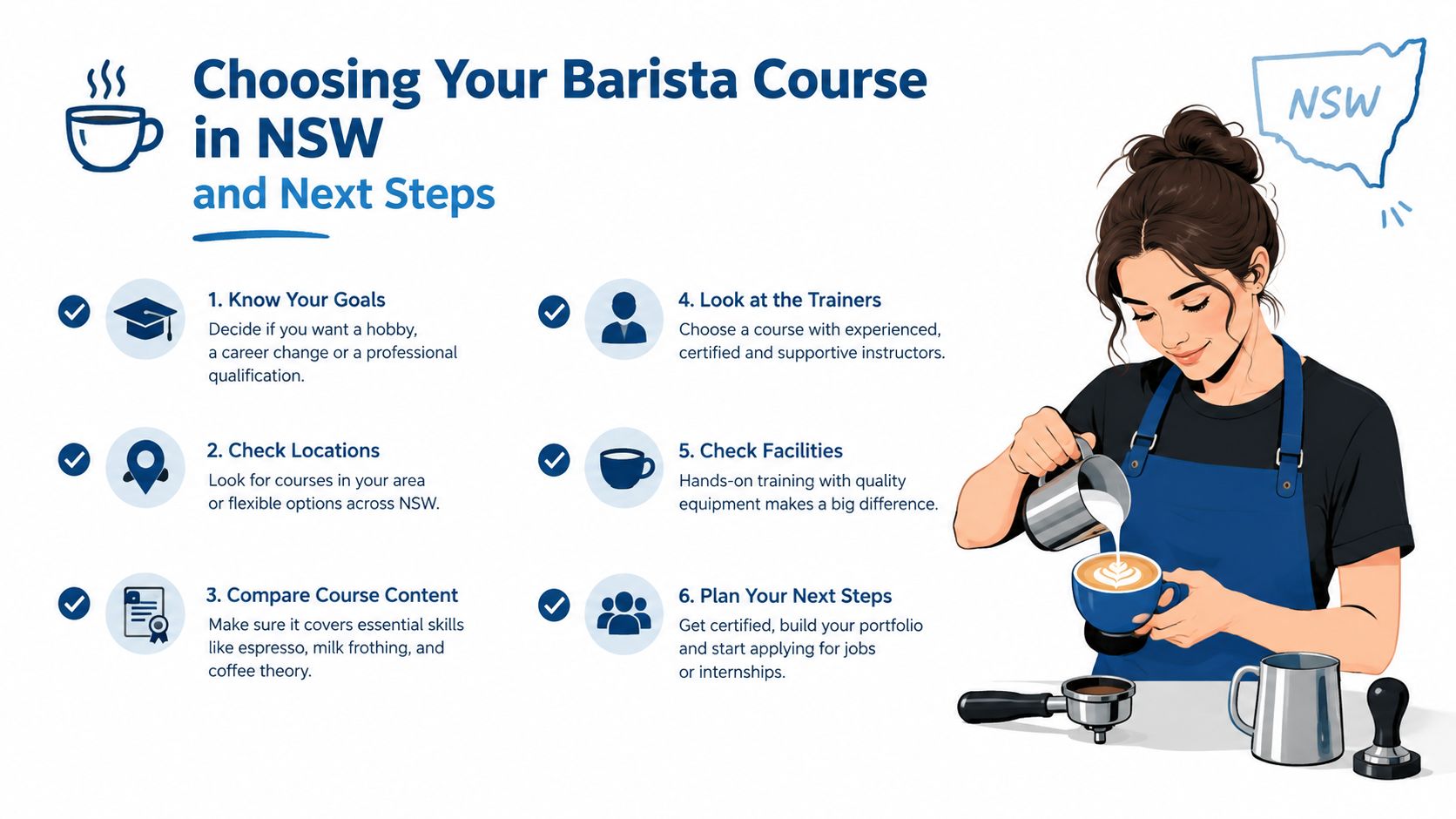
Start with the job you want, not the most attractive course title. Someone testing café work needs a different pathway from someone seeking Certificate III in Hospitality or an FSS credential.
Ask each provider for clear answers:
- Which units are included? Look for the relevant SIT code rather than a vague promise of “barista skills”.
- How much practical time is available? Find out how many learners share each espresso machine and grinder.
- Who delivers the training? Ask about the trainer's current hospitality experience and assessment approach.
- What happens after the class? Check whether you receive a statement of attainment, practical feedback or advice about further qualification pathways.
- Is the broader course subsidised? Confirm Smart and Skilled eligibility separately from short-course pricing.
- Where is delivery available? Location matters if you need to combine training with work, transport or family commitments.
Turn training into an application
Prepare a simple hospitality resume that states the equipment and tasks you've practised. A useful hospitality resume guide from StoryCV can help you describe transferable customer-service experience without exaggerating your café skills.
Then contact local cafés and ask whether they accept trainees for a short trial or entry-level shift. Don't present a one-day course as years of experience. Say what you can do, identify what you're still practising and show that you understand cleaning, customer service and reliable attendance.
TP Training delivers practical training across Sydney locations including Penrith, Burwood, Auburn, Parramatta and Sydney CBD. Its hospitality offerings sit alongside RSA, RCG and Food Safety Supervisor training, so learners can compare a focused barista option with other workplace credentials through the barista, RSA, RCG and FSS training information.
Choose the course that matches your next employment step. Before enrolling, confirm the units, entry requirements, funding position, practical equipment and evidence you'll receive at completion.
TP Training offers practical barista training across Sydney, alongside hospitality credentials such as Food Safety Supervisor, RSA and RCG training. Visit TP Training to compare the pathway that fits your experience and take the next step towards café work with realistic expectations.

You may also like