
Get Your Food Safety Supervisor Certificate NSW in 2026
You've got the roster to cover, the menu's set, and the doors are opening, but one compliance question keeps hanging over the day. If you're running a café, taking over a kitchen, or stepping into hospitality management in NSW, the Food Safety Supervisor certificate NSW is one of those documents that can't sit in the “sort it later” pile. The rules are specific, the paperwork has to be current, and the practical work doesn't end once the training is finished.
What catches new owners off guard isn't the course itself. It's what happens after you've qualified, where the certificate needs to sit, who must be trained, and how to stay ready if an inspector asks for proof on the spot.
Table of Contents
- Understanding Your FSS Obligations in NSW
- Choosing and Booking Your FSS Course
- What to Expect from Your FSS Training and Assessment
- After Your Course Receiving and Managing Your Certificate
- Maintaining Compliance Renewals and Ongoing Responsibilities
- Frequently Asked Questions About the NSW FSS Certificate
Understanding Your FSS Obligations in NSW
The first thing to pin down is whether your business needs a Food Safety Supervisor. In NSW, the national food standards say category one and two businesses must appoint a certified supervisor before engaging in a prescribed activity, and that person's certificate has to come from a registered training organisation or another organisation recognised by the relevant regulator. The supervisor must also be reasonably available to advise and supervise food handlers during that activity, which is a practical duty, not just a paper rule Food Standards Australia New Zealand.

What the certificate actually does
A Food Safety Supervisor certificate NSW shows that one person in the business has been trained to recognise and control the day-to-day risks that matter most in hospitality and retail food service. In practice, that means the supervisor becomes the person staff turn to when something looks off, a process needs correcting, or a compliance check is coming up.
That role matters because food safety is never just about the cooktop or the fridge. It's about supervision, habits, and repeatable systems. If a business has no one clearly responsible, the gaps usually show up in the busiest moments.
Practical rule: treat the FSS as the on-site compliance anchor, not as a badge you file away after training.
Which businesses need one
NSW guidance expects at least one trained FSS per premises, or per business for mobile caterers, and the certificate has to be current and available on site NSW Food Authority guidance. That makes the role especially relevant for cafés, takeaways, pubs, restaurants, caterers, and multi-site operators where the risk of staff turnover is real.
If you're also thinking about customer-facing systems like repeat visits and digital loyalty, a separate operational resource such as QR-based loyalty for restaurants can sit alongside compliance work, but it doesn't replace the need for an appointed supervisor. Loyalty tools help the business side. The FSS covers the legal side.
A useful comparison is responsible service in alcohol. The rules around training and accountability are similar in spirit, which is why many operators review their hospitality compliance together, including responsible service of alcohol, instead of treating each licence requirement as a separate headache.
Choosing and Booking Your FSS Course
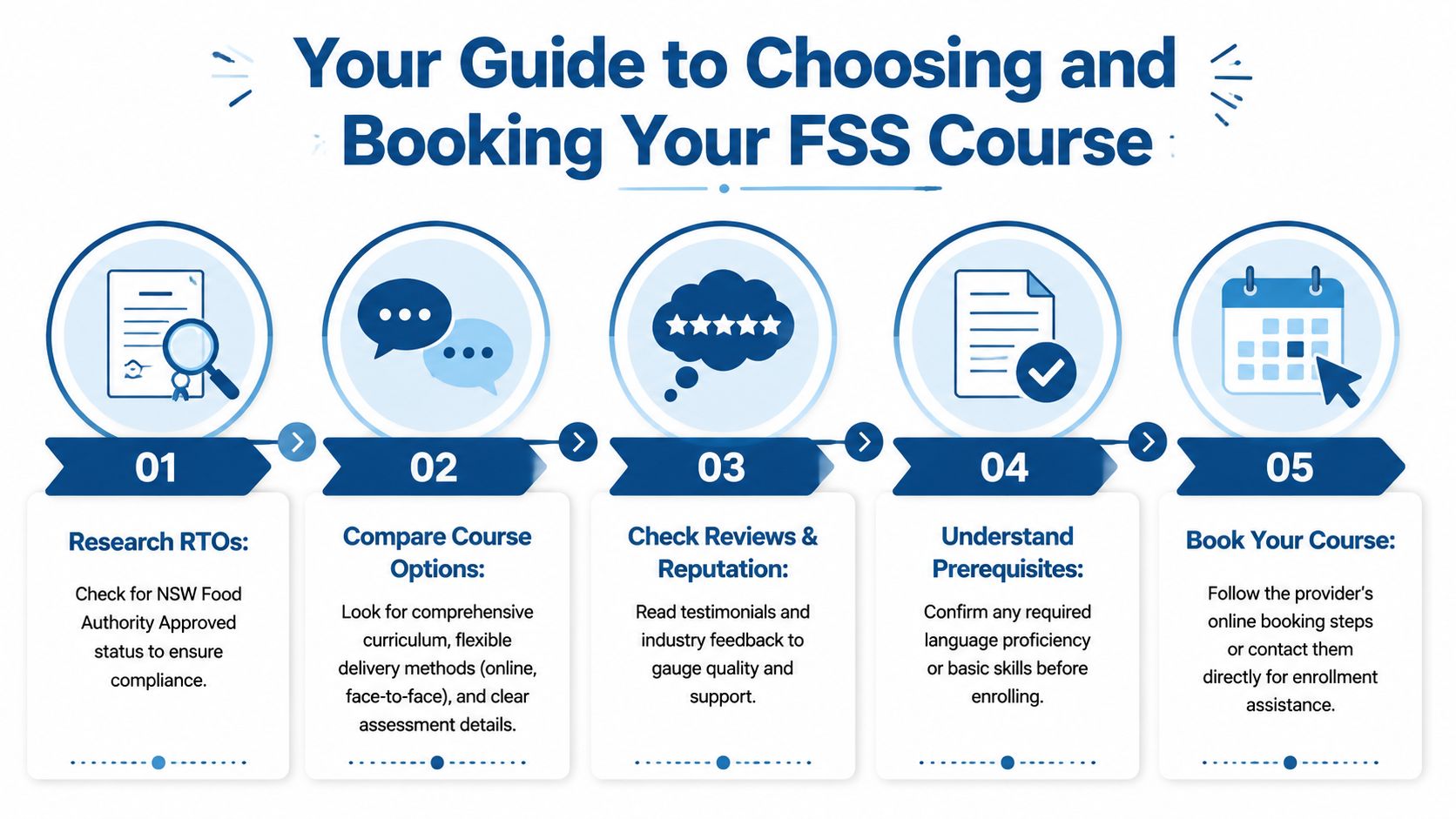
The best course choice starts with one question, not three. Can the provider issue training that matches NSW requirements? NSW guidance says the certificate process must flow through the right training pathway, and Service NSW requires the training to have been completed at an Australian RTO within the last 5 years for replacement or reissue requests Service NSW. That's the first filter, and it's the one people miss when they chase the cheapest booking.
What to check before you book
A proper shortlist should look like this:
- Provider recognition: confirm the RTO can deliver NSW-aligned FSS training and issue the right paperwork.
- Trainer experience: ask whether the trainer has actual hospitality or retail compliance experience, not just classroom credentials.
- Assessment process: check how the provider tests competency, especially if you prefer practical assessment rather than heavy reading.
- Course fit: make sure the format suits your week, because a manager who can't attend isn't really “booked”.
- On-site support: ask how they handle transcript or certificate documentation if you later need a reissue.
That's where a provider such as Food Safety Supervisor Course Fss can be a practical option, because the course is positioned as practical, nationally recognised training with experienced trainers and hands-on learning across NSW. Use that kind of description as a checkpoint, not a sales pitch. The ultimate test is whether the training lines up with your business needs and the documents you'll need later.
Face-to-face, online, or blended
Each format has a trade-off. Face-to-face works well if you learn faster by asking questions in the room and watching demonstrations. Online suits managers who need flexibility and can stay focused without a classroom. Blended often works best for busy operators because it splits theory and practical learning.
If you're based in Sydney, location can matter as much as format. TP Training lists training centres across Penrith, Burwood, Auburn, Parramatta, and the Sydney CBD, which makes it easier to fit compliance training around shift work and roster changes. For business owners trying to keep costs under control, NSW guidance also notes that RTOs cannot charge more than $30 to issue the NSW FSS certificate itself Campbelltown City Council guidance, and that detail is worth confirming before you pay.
A broader value point is convenience. If you're already organising other workforce training, a provider page such as affordable RSA, RCG, Food Safety Supervisor and barista training can help you compare training types without bouncing between separate providers.
What to Expect from Your FSS Training and Assessment
The NSW course isn't built around generic food hygiene talk. The Food Authority requires the training content to cover safe egg handling, allergen management, cleaning and sanitising practices, and Food Act offences NSW Food Authority training focus areas. That matters because the risks in a real kitchen are specific. Egg handling mistakes, poor allergen controls, and weak cleaning routines can all become compliance problems fast.

The core topics you'll actually work through
Expect the trainer to connect the legal standard to the workplace reality. Safe egg handling is about reducing contamination risk when menus use raw or lightly cooked eggs. Allergen management is about getting communication right with staff and customers, especially when the dining room is busy and shortcuts become tempting.
Cleaning and sanitising gets tested hard in training because it's one of the easiest areas for businesses to drift. If you're also brushing up on broader food handling, a plain-language guide to temperature control for food safety can help you understand why certain checks matter in a kitchen, although it's not a substitute for the actual FSS course.
Clean-looking equipment isn't the same thing as properly sanitised equipment, and busy service periods are where that gap shows up.
Assessment is about proving competence
Most providers assess both knowledge and practical understanding. That usually means answering questions, working through examples, and showing that you can apply the rule set in a real food environment. The point isn't to memorise trivia. It's to prove you can recognise risk and respond correctly when a staff member needs direction.
Some learners worry that the assessment will be designed to trick them. Good training doesn't work that way. It gives you the framework, then checks whether you can use it when the pressure is real. If you want a quick sense of how applied, workplace-based training feels, TP Training's barista training Australia page shows the same style of practical learning approach, even though the topic is different.
If your business also manages worksite compliance in other areas, you'll notice the same structure in Prepare Work Zone Traffic Management Plan Course Pwz Red Card, which is another practical, nationally recognised course delivered across NSW with hands-on learning. Different industry, similar training logic.
After Your Course Receiving and Managing Your Certificate
Once you finish the course, the paperwork matters just as much as the assessment result. Service NSW says replacement or reissue applicants must have completed the required units at an Australian RTO within the last 5 years, and they need certified documentation plus a payment. The NSW Food Authority guidance notes a $30 fee for some requests Service NSW.
Keep the right document in the right place
The business obligation isn't just to hold the qualification. NSW guidance says hospitality and retail food businesses must keep a copy of the certificate on the premises and produce it on request Campbelltown City Council guidance. That means the certificate has to be easy to find during an inspection, not buried in someone's inbox or locked in a drawer at home.
A simple filing habit solves most problems. Keep one copy in the compliance folder, one digital scan in the business drive, and make sure the manager on shift knows where the hard copy is stored. That's not overkill. It's the difference between smooth compliance and avoidable friction.
If the certificate can't be produced on request, the business is not audit-ready, even if someone technically completed the training months ago.
Statement of Attainment and supervisor certificate are not the same thing
The RTO's training paperwork and the NSW certificate serve different functions. One shows the student completed training. The other is the certificate businesses are expected to keep and rely on for compliance. Confusing those two documents creates delays when an owner tries to satisfy an inspection or replace missing records.
A lot of businesses only discover this during staff turnover. The trained supervisor leaves, the email trail is messy, and no one can immediately prove the current document is on site. That's why it helps to keep student identification and records clean from day one, including the process explained in 5 simple steps to create and manage your Unique Student Identifier.
Maintaining Compliance Renewals and Ongoing Responsibilities
The NSW FSS certificate is valid for 5 years from the date of issue, and the Food Authority says businesses must appoint at least one FSS per premises, keep the certificate on-site, and renew through recertification training every 5 years NSW Food Authority guidelines. That expiry date isn't a loose reminder. It's the point where your compliance file either stays current or starts drifting out of date.
Renewal is part of the role, not an admin afterthought
The practical mistake is treating renewal as something you sort when someone notices the date has passed. A better approach is to track the expiry date centrally, assign responsibility for the reminder, and book the recertification well before the deadline. That's especially important where one supervisor covers multiple sites or where shift changes make communication patchy.
The FSS also has an active workplace role. They're not there just to hold the certificate. They're there to supervise food handlers, reinforce safe processes, and become the first point of contact when a food safety issue appears.
A useful comparison is uniform discipline. If your team wears branded work aprons, the visual cue helps customers and staff recognise who is responsible. The link between role and accountability is the same as in food safety, which is why resources like branded work aprons are operationally relevant in hospitality, even though they're not a compliance control on their own.
What works in real businesses
The businesses that stay audit-ready usually do three things well. They keep a live register of certificate expiry dates, they store proof where managers can reach it fast, and they train a backup person so the business isn't exposed if one supervisor resigns.
They also stop thinking of compliance as a one-person job. The supervisor may be the named contact, but the kitchen team still needs repetition, supervision, and correction. That's why pairing FSS renewal with other workplace safety checks, such as the topics covered in CPR, first aid, White Card and workplace safety certifications, often makes sense for operators who run multiple risk-heavy environments.
Frequently Asked Questions About the NSW FSS Certificate
What happens if our appointed FSS leaves the business?
You still need the role covered. NSW guidance says businesses must have at least one trained FSS per premises, so if the named person leaves, the business should appoint someone else and make sure the certificate is current and available on site NSW Food Authority guidelines.
Can I use a Food Safety Supervisor certificate from another state in NSW?
Not safely as a default assumption. The national standard requires the certificate to come from a recognised training provider, and NSW has its own expectations around certificate currency and format. If you're relying on an interstate qualification, check that it aligns with NSW requirements before you treat it as compliant Food Standards Australia New Zealand.
What's the difference between a Food Handler certificate and an FSS certificate?
A Food Handler certificate shows someone has completed food handling training. The FSS certificate is different, because it supports the business's legal obligation to have a trained supervisor responsible for oversight, advice, and supervision. In a busy kitchen, those are not interchangeable roles.
Can the certificate just sit in head office?
No. NSW guidance says the certificate should be kept on the premises and produced on request. If the site manager can't show it during an inspection, that creates a compliance problem even if the training was completed earlier.
Does the FSS replace common sense on the floor?
No, and that's exactly why the role works best when the supervisor is visible. The certificate backs up the person who is already checking procedures, correcting staff, and keeping the business ready for inspection.
If you're opening a café, stepping into hospitality management, or cleaning up an old compliance system, book your training early, make the certificate easy to find, and build renewal tracking into your normal admin cycle. For direct course options and current training pathways, contact TP Training and lock the compliance side in before the next busy service period.

You may also like

Yellow Card NSW: Requirements, Units and How to Enrol

Construction Induction Training in NSW Explained