How to Get Your Food Safe Handlers Certificate in NSW
Your first shift is on the roster, your chef has already asked for your paperwork, and you're trying to work out whether the food safe handlers certificate is something you need before you step into the kitchen or something you can sort out after you've started. That's the point where many people feel the pressure. In NSW, the smart move is to treat the certificate as the entry point to safe work, not a box to tick once and forget.
For job seekers, hospitality newcomers, and support staff moving into food service, the question isn't just how to enrol. It's what the certificate proves, what employers will expect from it, and how to turn it into day-to-day competence on the floor. That's the practical lens here, because food safety training only matters if it changes what people do around unpackaged food, hygiene, and contamination control. A systematic review and meta-analysis found that food-safety training increased knowledge scores with a standardized mean difference of 1.24 and improved practices with an overall effect size of 0.65 (systematic review and meta-analysis). That's why the paperwork exists, but it's also why the paperwork alone isn't enough.
TP Training runs practical, hands-on training across NSW, including centres in Penrith, Burwood, Auburn, Parramatta, and Sydney CBD, so a lot of students can book around shift work instead of the other way around. The useful part is not the brochure language, it's the way a good course gets you from “I've been asked for a certificate” to “I can show I'm safe to work.”
Table of Contents
- Starting Out as a Food Handler in NSW
- What the Certificate Is and Who Needs It
- Choosing the Right Course Format for Your Situation
- From Enrolment to Certificate in Your Hands
- What Employers Actually Expect on the Floor
- Keeping Your Certificate Useful Beyond the First Job
- Common Questions From New Food Handlers
Starting Out as a Food Handler in NSW
The call usually comes at the worst possible time. A first-time cafe worker gets offered shifts, a hotel kitchen hand is told to bring proof before Friday, or an aged-care catering assistant is asked for a certificate before touching unpackaged food. That moment can feel bureaucratic, but it's a sign that the employer is trying to set a minimum standard before the pressure of service starts.
In NSW hospitality and food retail, that expectation makes sense. The Food Standards Code shapes food-safety regulation around hygiene, food-handling practices, and training expectations, so a certificate supports the legal duty to manage contamination risks rather than sitting there as a formal extra (Food Standards Code context). The practical reason is simple, safe food handling doesn't happen automatically just because someone has worked in a busy venue before. Field data on food handlers has shown that only 46.5% demonstrated good or adequate food-handling practices, which is a reminder that instruction and assessment still matter (study on food-handling practices).

What the first shift actually depends on
New starters usually think the certificate is about passing a quiz. Employers think about something else, whether the worker can be trusted with everyday controls like handwashing, cleaning sequences, and avoiding cross-contamination during peak service. That's why structured training keeps showing up in hiring conversations across cafes, restaurants, clubs, caterers, and kitchen support roles.
Practical rule: if you'll handle unpackaged food, wash boards and knives, top up salad items, or work near ready-to-eat food, the certificate becomes part of your basic onboarding, not an optional extra.
TP Training's NSW centres are useful here because they fit the reality of people entering work fast, moving between venues, or switching into hospitality from another job. If you're also sorting other workplace credentials, the overlap with broader job-ready compliance becomes obvious, and the same training mindset that applies to food safety shows up in courses like TP Training's food safety supervisor guidance. The point is not to collect paperwork for its own sake, it's to arrive at work with proof and confidence.
What the Certificate Is and Who Needs It
A Food Handler Certificate is basic proof of training. It shows that someone has completed food safety education relevant to handling, preparing, or serving food in a commercial setting. Under the Australian framework, the certificate matters because the Food Standards Code sets expectations around hygiene, safe handling, and training for food businesses, as outlined in the Food Standards Code context. For a worker, that makes the certificate part of legal duty and day-to-day risk control, not just a hiring document.
A Food Safety Supervisor (FSS) is different. The FSS role carries nominated supervision, more formal responsibility, and stronger workplace oversight. In NSW, that difference matters because some employers need the basic handler certificate for staff, while a trained supervisor is needed to oversee food safety systems and support compliance. TP Training also offers a Food Safety Supervisor Course Fss, which is relevant when a venue needs someone to carry the supervision burden rather than only complete entry-level training. If you want a broader explanation of the supervisor pathway, the NSW-focused overview at TP Training's FSS certificate article gives useful context.
| Aspect | Food Handler Certificate | Food Safety Supervisor (FSS) |
|---|---|---|
| Main purpose | Basic food-safety competence for day-to-day work | Nominated supervision and higher-level oversight |
| Typical user | Cafe staff, kitchen hands, catering assistants, food retail workers | Supervisors, venue leads, nominated compliance staff |
| Workplace use | Supports induction, verification, and safe handling tasks | Supports supervision, audits, and food-safety management |
| What it proves | Understanding of hygiene, contamination control, and safe handling | Ability to oversee and reinforce food-safety practice |
For event work, allergens add another layer that employers need to manage carefully. A practical checklist like use Creventa for allergen compliance can help event teams separate general food handling from allergen risk control, which is often where mistakes happen when orders are rushed.
The certificate is not a badge of seniority, and it does not replace supervision. It gives employers a baseline that staff know the core controls before they work independently around food.
Choosing the Right Course Format for Your Situation
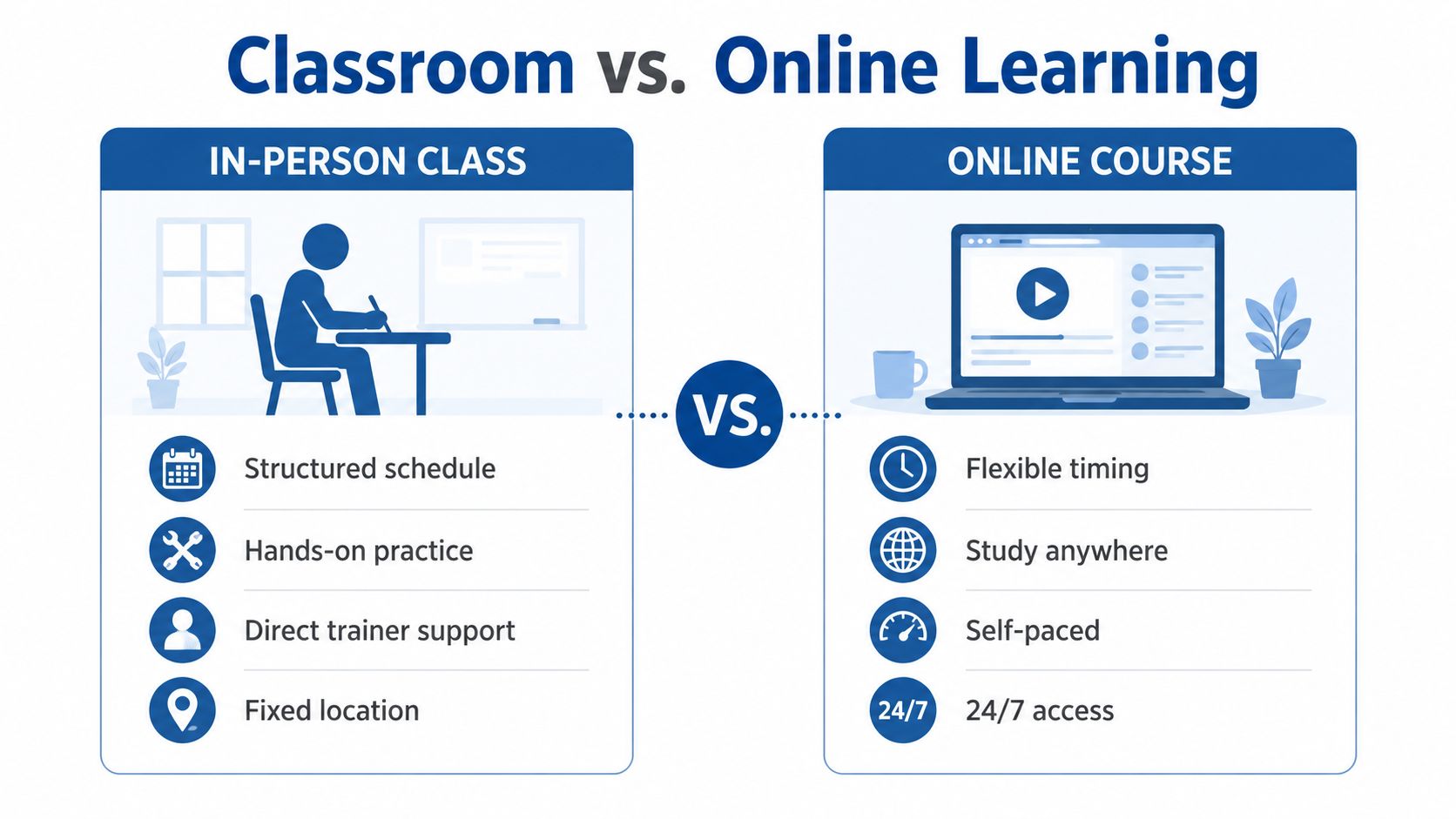
The right format comes down to how you learn under pressure. Some people do best when a trainer is in the room, the timetable is fixed, and they can ask questions in real time. Others need the flexibility of logging in around shifts, childcare, or travel from regional areas, and they'll stay engaged because the course fits their day rather than forcing them to take time off.
Classroom learning works best when you need structure
In-person delivery suits job seekers who want a set start time and a trainer watching what they do. It also helps people who are still building confidence with English, food terminology, or written assessment, because they can ask for clarification before misunderstandings turn into mistakes on the floor. That matters in hospitality, where a misunderstood instruction can lead to a cleaning step being skipped or a raw-food station being handled incorrectly.
Online learning works best when time is tight
Online courses are easier to fit around rotating shifts, split shifts, and last-minute rostering changes. They also make sense for experienced workers who already understand the environment and just need a documented refresher or a new employer file. The upside is convenience, but the trade-off is focus, if someone studies online while juggling messages, service prep, or family interruptions, they're more likely to skim the details and miss the practical logic behind them.
If you learn best by doing, choose a classroom. If you need flexibility and can stay disciplined, choose online.
Assessment should match the format, not fight it. A live session gives you direct feedback on practical demonstrations, while online training usually asks you to show that you understand the same hygiene controls through structured assessment. Either way, the test is whether you can apply the content at work, not whether you can rush through the modules.
For people comparing training options more broadly, the general Courses page is a useful reference point for seeing how food safety sits alongside other job-ready short courses. If you're moving from hospitality into bar work as well, the structure described in TP Training's barista training overview is a good example of how practical, skills-based learning is usually presented.
From Enrolment to Certificate in Your Hands
The smoothest enrolments are the ones where the student knows what to bring, what to expect, and why the course is arranged the way it is. Age, identification, and language support all matter, because a food-safety course is only useful if the learner can understand and apply it. That's why a good provider checks details early, confirms the booking properly, and makes sure the student can access the course content without being derailed by admin.
Booking usually starts online, then moves into the training session itself, whether that's in person or digital. The flow matters because NSW food businesses need more than attendance, they need evidence that the worker can demonstrate safe food handling, contamination control, cleaning and sanitising, and personal hygiene before they work with unpackaged potentially hazardous foods. That expectation is clear in the NSW Food Authority's Food Handler Basics program (NSW Food Authority Food Handler Basics).
What the training day feels like
A solid course day is practical, not theatrical. Students work through the core food-safety ideas, then show that they understand them in context. At TP Training, students also move through the admin side cleanly, and if you're managing your student identity records, the USI support guide is the sort of practical resource that saves time before enrolment gets stuck.
Useful benchmark: certificate issuance matters, but proof of competence matters more. Employers are looking for evidence that you can actually work safely, not just that you attended.
In NSW, many students want convenience as much as accreditation, so locations such as Penrith, Burwood, Auburn, Parramatta, and Sydney CBD make a difference when a shift roster is already crowded. The point is to move from booking to certificate without losing a week to avoidable admin. Once the assessment is complete, the student walks away with the proof their employer asked for, and the business gets a record it can keep on file.
What Employers Actually Expect on the Floor
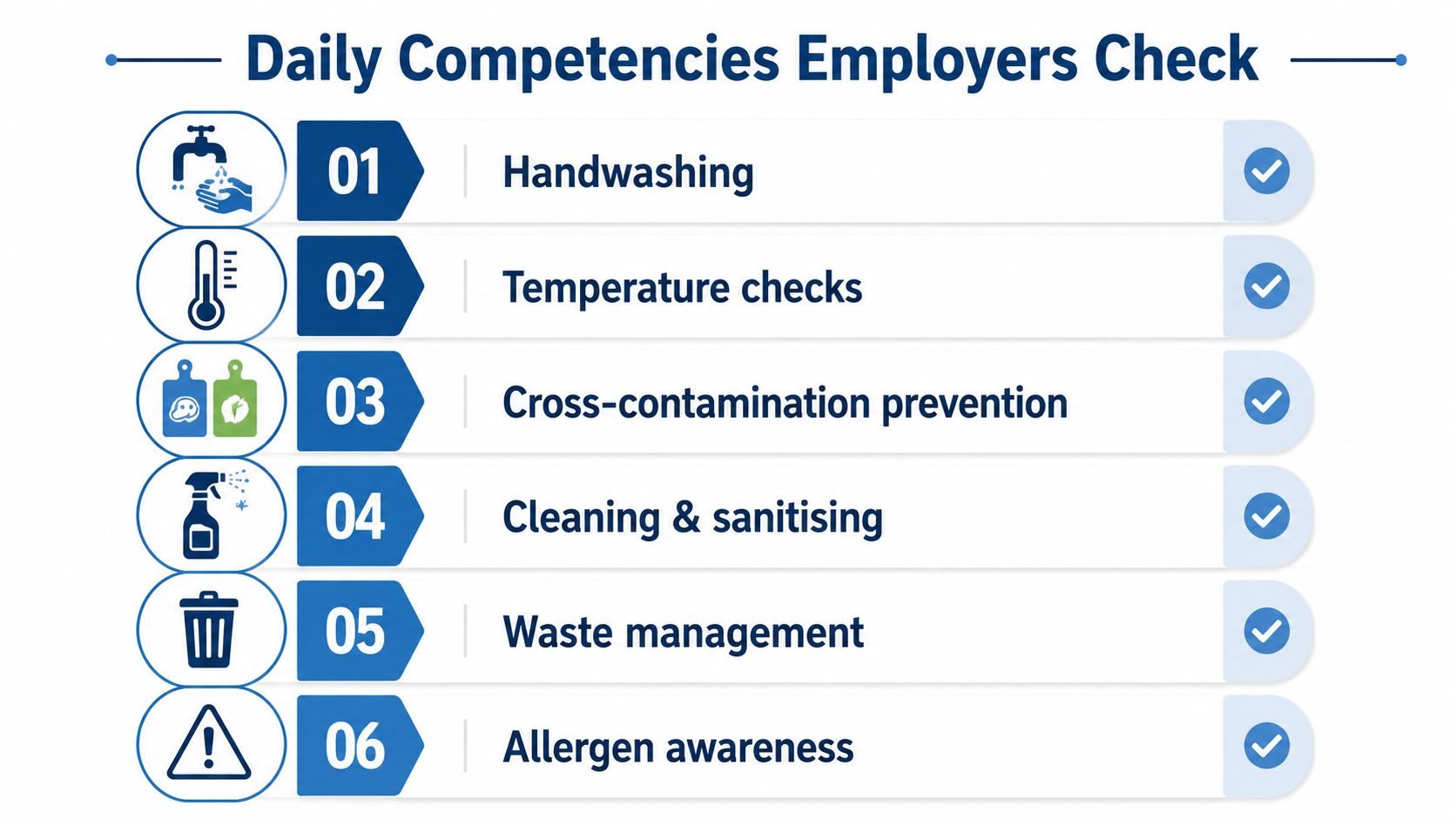
The certificate becomes real when the supervisor watches what happens during service. Employers aren't looking for a perfect memory of course slides, they're looking for habits that protect food during the busiest parts of the day. That means hand hygiene before prep, clean tools between tasks, and clear separation between raw and ready-to-eat food.
The controls that matter most
A certificate is really a shorthand for competence in control points that line up with HACCP-style thinking, hazard awareness, critical limits, monitoring, corrective action, verification, and documentation. In plain language, that means checking temperatures, keeping utensils separate, cleaning down properly, and knowing when to stop and fix a problem rather than pushing through service.
NSW-aligned materials emphasise immediate hygiene controls such as scrubbing hands for at least 15 seconds before rinsing and drying with paper towels, plus glove-change discipline and sanitation after each task to reduce cross-contamination risk (NSW-aligned hygiene controls). That's not a theory exercise. It shows up in real jobs when someone moves from raw chicken prep to salad assembly, or when a rushed staff member wants to keep the same gloves on because the line is busy.
What this looks like in a cafe or restaurant
A good supervisor checks the certificate, then uses a task-based induction checklist before allowing independent work with unpackaged high-risk foods. If the new worker can't follow the sequence for cleaning a bench after raw prep, can't explain how to avoid cross-contact, or ignores glove change discipline, they're not ready yet. The certificate may be filed, but the job isn't complete until the behaviour is visible.
One more thing catches people out. Many workers know the rules but fall apart during peak service. That's why a manager should watch the first few real tasks closely, especially around fridge checks, tool sanitation, and the transition between prep stations and service.
For venues that also serve alcohol, the same employer mindset shows up in responsible service of alcohol training, where compliance isn't just a document but a pattern of behaviour on shift. Food safety works the same way.
Keeping Your Certificate Useful Beyond the First Job
A certificate that disappears into a glove box or inbox isn't much use when a new employer asks for it, or when an audit comes around and nobody can find the file. NSW guidance explicitly expects proof of competence, not just course attendance, and the certificate-download support page makes it obvious that access to documentation is a practical issue for workers and businesses alike (proof of competence and certificate access). If you move between venues, that admin gap can slow onboarding fast.
The sensible approach is to store the certificate in more than one place. Keep a digital copy on your phone, email a PDF to yourself, and ask the employer to keep a staff file copy on site. If you're working across multiple venues, use a consistent naming system so the document is easy to find when a manager asks for it during induction.
Treat the certificate like working PPE, if you can't produce it quickly, it isn't really helping you.
Renewal and retraining should be planned, not reactive
A food handler certificate isn't something you should mentally file as “done forever”. Businesses change, menus change, and staff drift unless the training is refreshed. That's where ongoing retraining matters, especially in venues that handle high-risk foods, rotate casual staff, or rely on seasonal hires. A practical resource on how to stop cross contamination is worth keeping handy because cross-contamination habits are usually what fade first when a worker gets comfortable.
The logic is simple. If your certificate proves you understood the basics once, your record-keeping proves you can still produce that evidence later. For employers, that means keeping the file tidy. For workers, it means not waiting until the morning of a shift to look for a missing attachment.
If you're trying to keep your broader workplace compliance organised, the guide on CPR, first aid, White Card, and workplace safety certifications is a useful reminder that most certifications work best when they're tracked as part of a system, not treated as one-off events.
Common Questions From New Food Handlers
Do I need a Food Safety Supervisor certificate as well?
Not always. The basic Food Handler Certificate is for everyday food work, while the FSS pathway is for nominated supervision and higher responsibility. Your employer decides which role they need filled.
Will NSW employers accept an online course?
Often, yes, if the course matches the employer's compliance needs and the worker can still demonstrate real competence. The format matters less than whether you can apply the training properly on the job.
What if I lose my certificate?
Don't wait. Save the digital copy, ask for a reissue if needed, and keep a backup in your email and staff records. Proof of training is only useful if you can produce it quickly.
How long does the certificate last?
Employers usually expect refresher training when staff change roles, move venues, or start slipping on food safety habits. Even when a certificate is still on file, competence should be kept current through practice and supervision.
What if I'm just starting and haven't worked in a kitchen before?
That's exactly when the certificate helps most. It gives you the baseline language for hygiene, contamination control, and safe handling before the first busy service tests you.
If you need a food safety qualification that fits around work, book with TP Training and choose the NSW location or course format that matches your roster. Then keep the certificate on file, use it as your baseline for daily practice, and treat the first shift as the start of a proper food-safety routine, not the finish line.

You may also like

Yellow Card NSW: Requirements, Units and How to Enrol

Construction Induction Training in NSW Explained