

RSA Training Online in NSW That Employers Accept
RSA training online is valid in NSW only when a Liquor & Gaming NSW approved training provider delivers it, and the interim certificate issued after successful completion allows you to work for 90 days.
You've landed a casual job at a Sydney bar, and the manager wants your RSA sorted before Friday. A quick search brings up cheap certificates, instant checkout pages and courses advertised as nationally recognised. Before you pay, the important question isn't how quickly you can download something. It's whether that course will support the NSW competency card you need for the job.
Table of Contents
- What NSW Accepts for RSA Training Online
- Which RSA Course Matches Your Situation
- Online RSA Compared with Classroom Training
- How to Enrol and Finish the Course
- Interstate Bridging and the RSAT Mix-Up
- Questions to Settle Before You Pay
- Book an Approved RSA Course and Start Work
What NSW Accepts for RSA Training Online
Your manager needs evidence that you're eligible to perform alcohol duties, not a receipt showing you bought a course. Anyone who sells, serves or supplies alcohol must complete the required RSA training through a Liquor & Gaming NSW approved training provider and obtain a competency card.
Under the NSW Government's RSA guidance, workers new to the liquor industry, and those whose previous RSA training was completed more than five years earlier, must complete the full course; eligible existing workers can complete a refresher, and successful learners receive an interim certificate valid for 90 days while they arrange their competency card.

What you're learning to do
RSA prepares you for decisions that happen during ordinary service. You might need to check identification, recognise increasing intoxication, refuse another drink or respond when a patron appears unsafe. Online delivery changes where you learn, not the responsibilities you'll have behind the bar.
The course covers NSW liquor law, minors, intoxication, responsible service obligations, compliance, drink spiking and harm minimisation. Venue safety also means recognising situations that need a supervisor's attention rather than treating every problem as a question about another drink.
The NSW Government's update on safer hospitality venues states that more than 40,000 NSW hospitality workers completed the updated RSA course during the seven months after its introduction in June 2025, including content on preventing and responding to sexual harassment and sexual violence.
Keep separate hospitality requirements separate
A restaurant may also expect you to understand food handling, but that doesn't make a food safety certificate a substitute for RSA. Our guide to the food safe handlers certificate helps distinguish the food-handling side of the job.
For workplaces reviewing kitchen setup as well as staff training, Hospitality's guide to equipment choices for food safety compliance provides useful equipment context for New Zealand operations. It isn't guidance on NSW alcohol-service eligibility.
Before paying: Match the provider, the course and the NSW credential outcome. A polished checkout page doesn't establish regulatory approval.
Which RSA Course Matches Your Situation
Choosing the pathway by training history
Before you book, match your training history to the NSW RSA pathway. The right choice depends on whether you're new to alcohol service, your competency is current, or you need to check previous training.
| Your situation | Training required | When you can work | Watch-out |
|---|---|---|---|
| New to the liquor industry | Full RSA with an approved provider | On the interim certificate for 90 days | You still need to apply for the competency card |
| Previous RSA more than five years ago | Full RSA again | On a new 90-day interim certificate | An old card does not carry the duty |
| Competency still inside five years | RSA refresher if eligible | Only while the competency stays current | The clock uses the earliest competency date |
| Certificate from an unapproved provider | It won't support a NSW competency card | Don't start alcohol duties on that certificate | Confirm provider approval for the relevant course |
If you're starting your first alcohol-service job, a full approved course is the relevant starting point. The same applies when your earlier training falls outside the full-course eligibility threshold. An old certificate saved in your email does not confirm that your competency remains current.
Already hold NSW competency? Check its status before booking another full course. Eligible workers may need a refresher instead. The renewal clock follows the earliest date associated with the competency, not your most recent shift, a new employer's induction or the day you found your card.
A lapse can affect whether you're able to continue alcohol-related duties until you complete the required training. A manager adding you to the roster does not change the status of an expired competency.
Check your competency history before booking
Use your competency record to confirm your pathway. If you're unsure whether you remain eligible for a refresher, check your recorded competency dates and ask the approved provider before paying. That can help you avoid booking a full course when a refresher may apply, or choosing a refresher when your history requires full training.
If you're moving to NSW from interstate, check your eligibility separately. Your previous training may affect the pathway, so don't assume you must take a NSW refresher or repeat the full course without checking. TP Training offers RSA and RCG training, and its RSA and RCG Sydney CBD guide outlines these distinct workplace training needs.
Online RSA Compared with Classroom Training
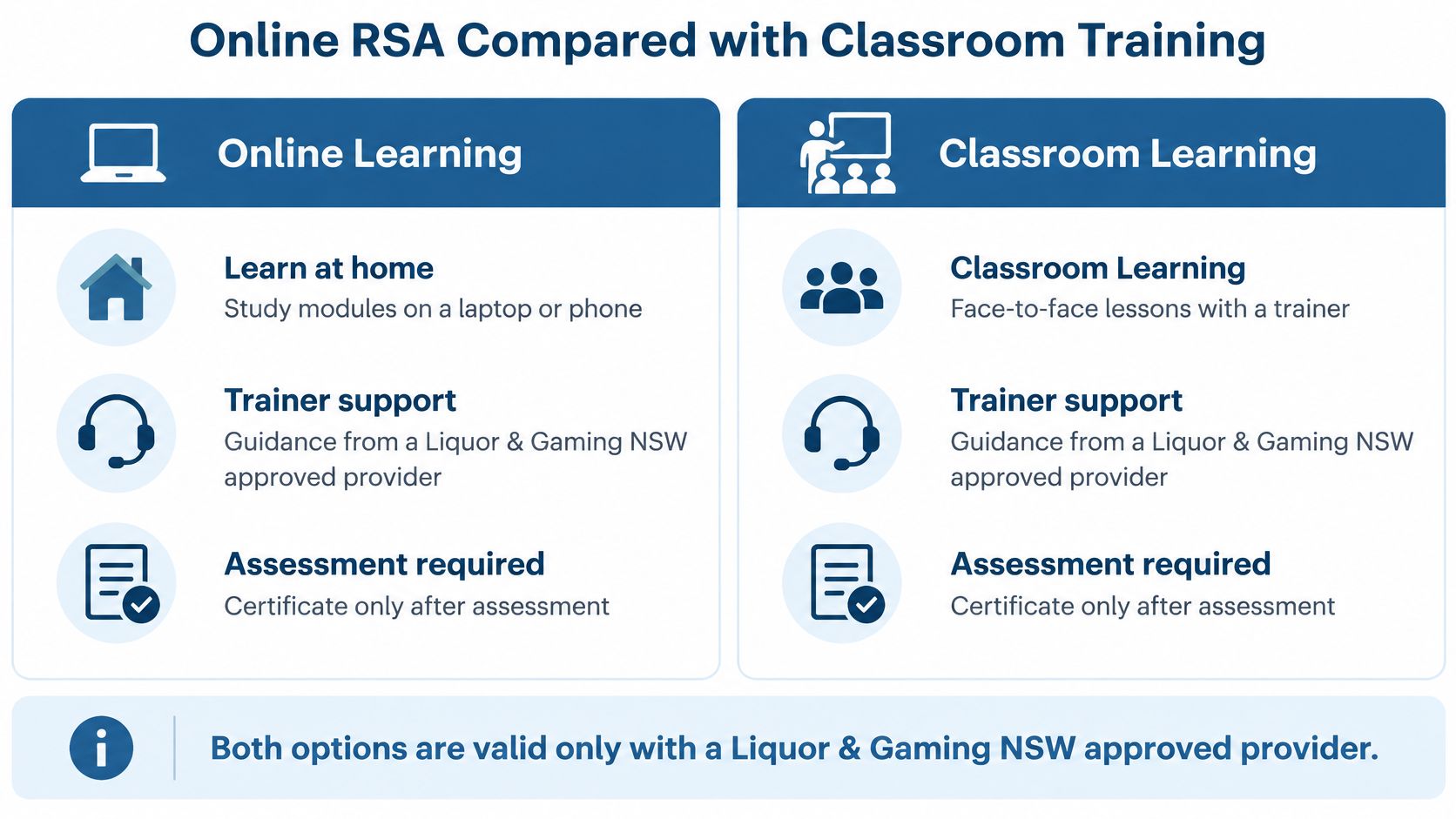
Approved online and classroom training aim at the same legal outcome. Both require assessment, and neither delivery format is itself a competency card.
Online RSA and classroom RSA
| Criterion | Online RSA | Classroom RSA |
|---|---|---|
| NSW recognition | Valid only with an approved provider | Valid only with an approved provider |
| Pace | Self-paced modules around a roster where that format is offered | Set class date and time |
| Typical materials | Presentations, activities and videos | Live discussion and trainer-led practice |
| Assessment | Required before a certificate | Required before a certificate |
| Best fit | Shift work, regional learners, existing jobs | Learners who want in-room refusal practice |
| Card outcome | Same interim certificate and competency-card process | Same interim certificate and competency-card process |
Check whether online means self-paced or live
Online isn't a single teaching method. A self-paced course lets you work through learning materials around other commitments. A live online class requires you to attend at the scheduled time, even though you're joining from home.
At TP Training, we deliver training both online and offline. Learners can attend our facility in person or participate online via Zoom. That distinction matters if you're planning study around a late finish, school pickup or another job: being online doesn't necessarily mean you can log in whenever you like.
You'll still need a suitable place to concentrate. Trying to study intoxication scenarios on a noisy bus may be convenient, but it's harder to practise a calm refusal or follow assessment instructions properly.
Choose the environment that helps you practise
Classroom learning suits people who want a trainer nearby while they work through uncertain situations. For example, you can rehearse how to refuse service without arguing about whether a patron feels drunk. You can also hear how other learners handle the same conversation.
Online learning can remove travel barriers and make attendance more manageable for regional learners or people with existing jobs. It works best when you're prepared to participate, read carefully and ask for clarification rather than click through unfamiliar material.
Our training uses presentations, class activities, videos and an end-of-day assessment. The purpose is to help you make appropriate decisions during service, not just recognise the correct phrase on a slide.
Choose the format in which you'll actually engage with the training. Convenience helps only if you can complete the learning and assessment properly.
If you're building broader café skills, the barista course NSW guide addresses a different part of hospitality work. Coffee preparation and alcohol-service competency may support the same job application, but they demonstrate different skills.
How to Enrol and Finish the Course
From course selection to assessment
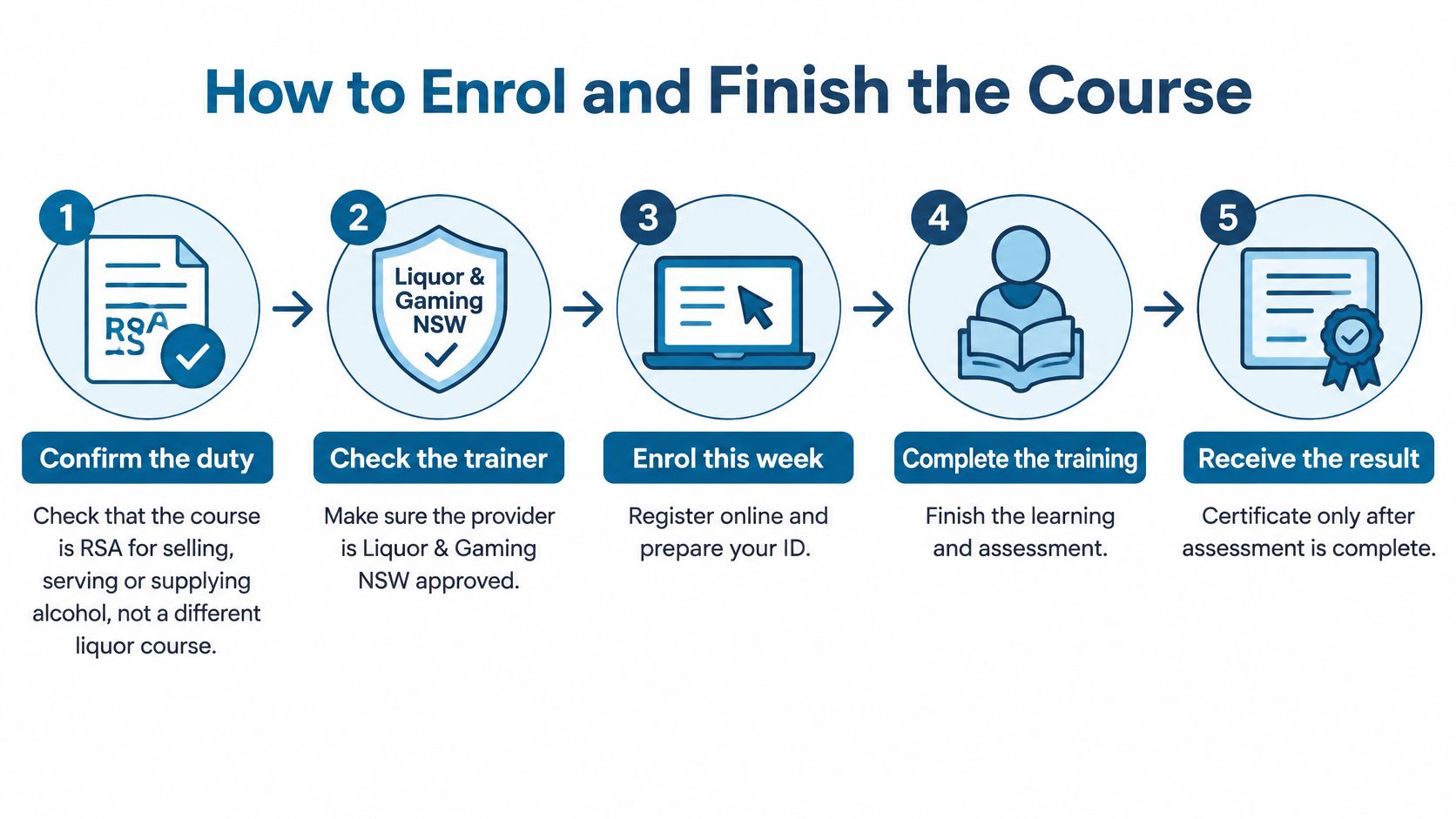
Confirm the duty. Check whether the role involves selling, serving or supplying alcohol. Read the position description and note any separate requirements before choosing a course.
Check the trainer before paying. Use the Liquor & Gaming NSW list of approved training providers, then match the provider and course approval. A convenient checkout is no guarantee of a recognised result: an unapproved provider's certificate may not support the NSW card application.
Choose your delivery format and book. Compare the available classroom, live online or approved self-paced options. Check the session details so you know what attendance and assessment involve.
Prepare your photo identification. Follow the identity instructions in your booking information and have the requested documents ready. Enrol under your correct legal name so the training record can be matched to your application.
Finish the paperwork as well as the learning
Complete the training content. Work through liquor law, signs of intoxication, minors, responsible service, harm minimisation, compliance and venue-safety responsibilities. Practise applying the material to a shift: what would you say, who would you notify, and how would you keep the situation calm?
Pass the assessment. Follow the assessment instructions and demonstrate the required knowledge and skills. Course completion depends on meeting the assessment requirements, not just attending or accessing the material.
Save your completion document. Download the file to the training folder you use for booking and identification documents, and keep a backup. This makes it easier to find if your employer asks for evidence.
Apply at the right point. Once you have the required completion evidence, proceed with the NSW competency-card application using the process explained earlier. Keep a record of the application and note when you need to arrange refresher training.
TP Training provides training materials and post-course assistance. Contact the provider if you need help understanding your course paperwork or locating the right completion document.
Before you consider the job finished, check:
- Approved provider: The provider and course match the NSW requirement.
- Assessment passed: You have a successful result, not just attendance.
- Completion document saved: You can find and provide the file if requested.
- Card application lodged: You have acted on the credential requirement.
Interstate Bridging and the RSAT Mix-Up
A permanent move to NSW isn't the same situation as renewing an existing NSW competency. Your interstate qualification may make you eligible for bridging, but it doesn't automatically establish that you can work under the NSW competency-card system.
Match your interstate documents to the bridging rules
The NSW Government's RSA bridging guidance generally requires eligible holders from Queensland, Western Australia, South Australia or Tasmania to have a national RSA Statement of Attainment issued within the previous five years, while holders from Victoria, the Australian Capital Territory or the Northern Territory generally need a national RSA Statement of Attainment or RSA refresher certificate issued within the previous three years.
| Where your qualification comes from | Document to locate before checking eligibility |
|---|---|
| Queensland, Western Australia, South Australia or Tasmania | National RSA Statement of Attainment |
| Victoria, Australian Capital Territory or Northern Territory | National RSA Statement of Attainment or RSA refresher certificate |
Find the actual qualification document rather than relying on an old employer's induction record. Check the issuing details and date, and make sure you can provide a legible copy.
Eligible workers complete the NSW RSA bridging course online at their own pace. They then apply for a NSW competency card through Service NSW with their course-completion certificate, proof of identity and interstate RSA certification.
Say you're moving from Brisbane to Sydney for a permanent restaurant role. Before purchasing a full NSW course, locate your Statement of Attainment and check whether bridging is available to you. Booking out of habit can mean paying for training you didn't need to repeat.
RSA and RSAT answer different questions
Responsible Supply of Alcohol Training (RSAT) is separate from Responsible Service of Alcohol (RSA). Similar names don't make the courses interchangeable.
RSA addresses the competency required for selling, serving or supplying alcohol. RSAT is a separately defined requirement for relevant liquor-supply activities. Where RSAT applies, holding RSA doesn't automatically satisfy that additional obligation.
The practical distinction is between your training history and your actual duties. Bridging deals with how an eligible interstate qualification connects to NSW requirements. RSAT deals with whether the particular supply activity requires a separate course.
A familiar acronym isn't enough. Match the full course name to the work you'll perform.
For employers, that means checking role requirements before sending everyone to the same booking page. For workers, it means explaining the actual duty when confirming the required training, rather than saying that the job involves alcohol.
Questions to Settle Before You Pay
Before checkout, confirm what you need to show your employer and what the assessment involves. A course login or payment receipt is not proof that you have completed the required assessment.
What evidence will I receive after assessment?
Ask what completion evidence the course provides and whether it supports the next step for your situation. Learning activities and assessment are separate parts of training, so check that you understand how the assessment is completed before enrolling.
What does the RSA training include?
Compare the course contents, not just the booking page. TP Training's RSA course includes PowerPoint presentations, class activities, videos and an end-of-day assessment. You can also review this guide to affordable hospitality training to compare hospitality courses and check that you are choosing the qualification relevant to your role.
What if my duties also involve RSAT?
Confirm whether the specific supply activity requires RSAT as well as RSA. They are separate courses, so check the duty and course requirement rather than assuming one covers the other.
Before paying, make sure the course name, assessment and completion evidence match your needs. This simple check can prevent enrolling in training that does not fit the work you plan to do.
Book an Approved RSA Course and Start Work
Once you've matched your situation to the right pathway, book training that fits it. If you qualify for a refresher or interstate bridging, check that option before choosing a full course.
TP Training is registered as RTO No 21488. Learners can attend in person or join online via Zoom.
Choose your location or join online
You can train at TP Training's Sydney locations, including Penrith, Burwood, Auburn, Parramatta and Sydney CBD, or participate online via Zoom. Choose a format that lets you attend, focus and complete the assessment.
The Provide Responsible Service of Alcohol Course (RSA) includes PowerPoint presentations, class activities, videos and an end-of-day assessment. Check the course page to confirm the booking matches your required pathway.
Keep staff training records consistent
For several staff, check each worker's existing competency before booking. Keep recognised completion evidence with staff training records so it can be checked when needed.
TP Training provides training materials and post-course assistance to learners. If a restaurant role also includes food safety duties, the NSW food safety supervisor certificate guide explains that separate qualification.
Choose the appropriate RSA course and arrange training that fits your NSW alcohol-service work. You can find course details through TP Training.

You may also like

RSA Training Sydney CBD: Rules, Course Details and Booking
Blue Card Training in NSW: How to Get Yours in 2026