LV Rescue Training Explained What It Covers and Who Needs It
You're standing beside a switchboard when a worker suddenly collapses against a live panel. The first instinct may be to pull them away, but touching the person before controlling the electrical danger could put you at risk as well. LV rescue training exists for this exact workplace problem. It teaches a controlled response to a person in contact with live low-voltage electrical apparatus, followed by CPR when required.
Table of Contents
- Introduction to LV Rescue Training and Why It Matters
- Understanding What Low Voltage Rescue Really Means
- Who Needs LV Rescue Training in Australian Workplaces
- Practical Skills and Assessment Criteria You Will Learn
- Safety Standards and Current Unit Codes Explained
- Booking Options Duration and Location Choices in NSW
- Applying LV Rescue Skills on Site and Staying Compliant
Introduction to LV Rescue Training and Why It Matters
Low-voltage rescue isn't first aid with an electrical label. A standard CPR course teaches life-saving responses after it's safe to approach a casualty. LV rescue adds the electrical rescue sequence, including identifying hazards, using rescue equipment, isolating power where possible, removing the casualty safely and then beginning CPR if needed. Current Australian training packages commonly combine UETDRMP018 Perform rescue from a live low voltage panel with HLTAID009 Provide CPR, although unit codes can vary across older and newer course information.
The practical difference matters during a real incident. A person may remain attached to the electrical source, and an untrained responder could become a second casualty. The safe response starts with the scene, not the casualty. You must understand what's energised, where isolation may occur and which rescue equipment is appropriate before moving in.
The central rule: Don't approach an electrical casualty until the electrical hazard has been controlled or the approved rescue procedure makes the approach safe.
This guide is designed for apprentices, electricians, solar workers, maintenance staff, contractors, FIFO crews, safety personnel and employers trying to match training to actual site exposure. It separates three questions that often get mixed together: what the law and electrical safety duties require, what a site policy demands, and which current unit code belongs on the training record.
It also covers what assessors look for, how face-to-face delivery is commonly organised, what the panel-only scope means and how to check whether a course suits your work. For broader workplace preparation, TP Training's workplace safety tips provide further practical context.
Understanding What Low Voltage Rescue Really Means
A worker collapses against a live switchboard. The first person nearby cannot safely pull them away by hand, because the worker and the electrical apparatus may still be connected. Low voltage rescue is the controlled response for that situation. Its purpose is to remove the casualty from live low-voltage equipment without making the rescuer a second casualty.
The process works like opening a jammed door with danger behind it. You first check what may cause harm, identify a safe release method and use the controls and equipment required by the procedure. LV rescue training develops that sequence for a panel or similar electrical work environment.
Rescue is not general first aid
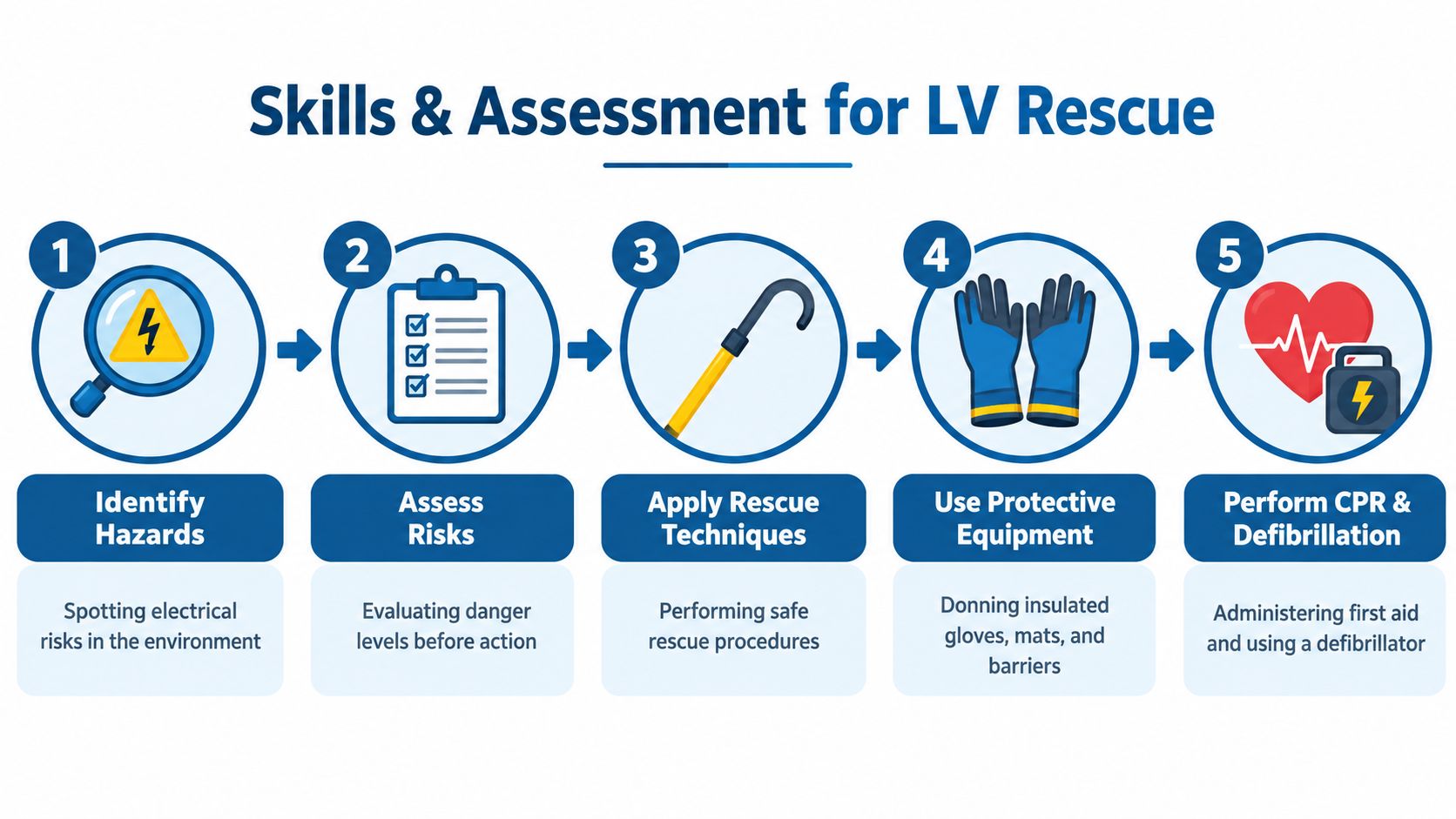
CPR starts only when the casualty can be approached safely. CPR training alone therefore does not cover the earlier decisions in an electrical panel incident. LV rescue training covers:
- Hazard identification: Recognise live parts, access risks and other dangers around the panel.
- Risk assessment: Decide what must be controlled before anyone approaches.
- Protective equipment: Use the equipment required by the procedure and scenario.
- Isolation and rescue: Isolate the supply where possible and carry out the approved removal technique.
- Post-rescue care: Provide CPR if required and follow the workplace emergency response.
The nationally recognised rescue unit relates to a defined panel rescue task, rather than general first aid. Current Australian course information for LVR describes the commonly paired rescue unit as applying to live low-voltage electrical apparatus in an electrical industry environment. The unit also has a specific panel scope. The full boundary and current unit-code differences belong in the safety standards section.
Why the panel boundary matters
A solar installer working inside a switchboard may face a different rescue task from a worker dealing with another electrical system. A maintenance technician repairing plant may need panel-based rescue competence, while a contractor crew may need to confirm that the selected training matches its assigned equipment and emergency plan.
Check three things before booking: the unit scope, the equipment used during practice and whether the assessment reflects the work performed on site. That check supports sound planning and complements the broader principles in TP Training's construction risk management guidance.
Work platforms at height create a separate training question. Electrical rescue knowledge should not be confused with work-platform rescue training. TP Training also provides practical, nationally recognised RIIHAN301E Operate Elevating Work Platform under 11m course training with hands-on learning across NSW.
Who Needs LV Rescue Training in Australian Workplaces
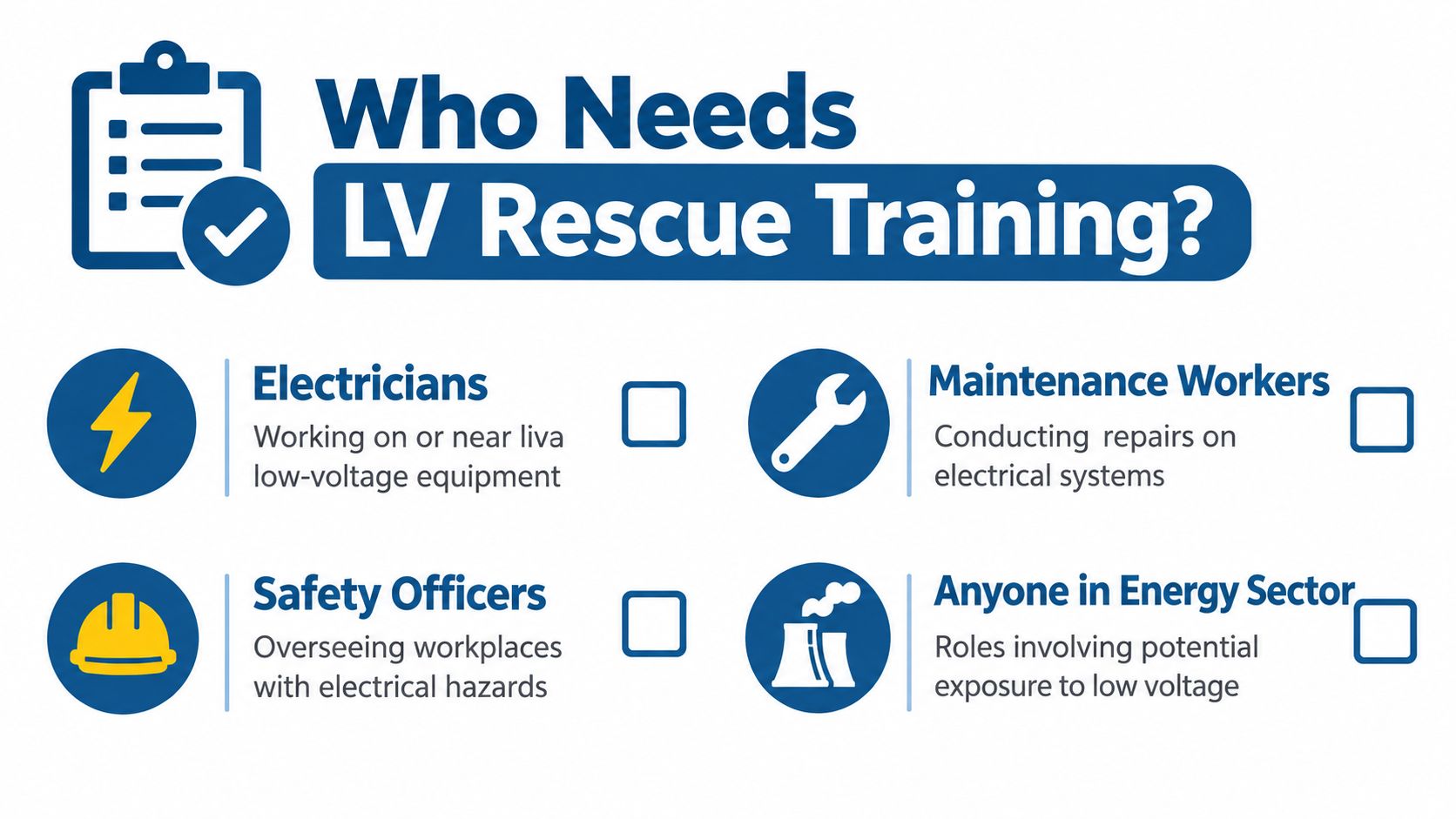
The clearest answer is based on exposure to live low-voltage installations and equipment, not job title alone. If your duties involve working on or near low-voltage electrical apparatus, your employer may need evidence that you hold the relevant rescue competency. A site may also require the competency for people who don't personally perform electrical work but could be appointed as a safety observer or expected to respond to an incident.
That creates three separate checks.
Legal duty and electrical exposure
The legal duty is about controlling workplace risk. Employers must provide safe systems of work, suitable information, instruction, training and supervision for the hazards workers may face. The stronger neutral reference point is the Australian standard for safe work on or near low-voltage and extra-low-voltage installations and equipment, AS/NZS 4836:2023, available through Standards New Zealand's catalogue entry.
For practical decisions, ask:
- Does the role work on or near live low-voltage equipment?
- Could the worker be required to act as a rescue person or safety observer?
- Does the workplace emergency plan nominate that worker to respond?
- Does the electrical risk assessment identify LV panel contact as a credible incident?
Electricians and apprentices are obvious candidates. The decision can also include solar installers, facilities and maintenance workers, industrial technicians, energy-sector personnel, construction crews working near switchboards, FIFO teams and contractors entering established sites.
Site policy can be stricter
A principal contractor or employer may require LV rescue training as a condition of induction, even where a worker's own task appears limited. That's common in workplaces where several contractors share plant, switchboards or maintenance areas. A site policy can set a higher entry requirement than the minimum competency needed for one isolated task.
Check the site safety management plan, electrical work procedures, induction checklist and emergency arrangements before booking. You can also use TP Training's guidance on confined space training as a reminder that site-specific hazards often determine which competencies employers expect from crews.
Role-based exposure deserves a plain-English check
A contractor who occasionally opens an LV panel may need the same rescue capability as a full-time electrical worker if the risk assessment and work method require it. A solar crew might need the training because its work involves low-voltage apparatus, while a general labourer who stays outside the electrical work area may have a different requirement.
The unit-code problem adds another layer of confusion. Training.gov.au lists UETDRMP007 Perform rescue from a live low voltage panel as superseded, with a first release date of 14 October 2022 in the official unit listing. Don't rely on an old search result or a course title alone. Ask the provider which current unit will appear on your Statement of Attainment and whether it matches the employer's requirement.
Practical Skills and Assessment Criteria You Will Learn
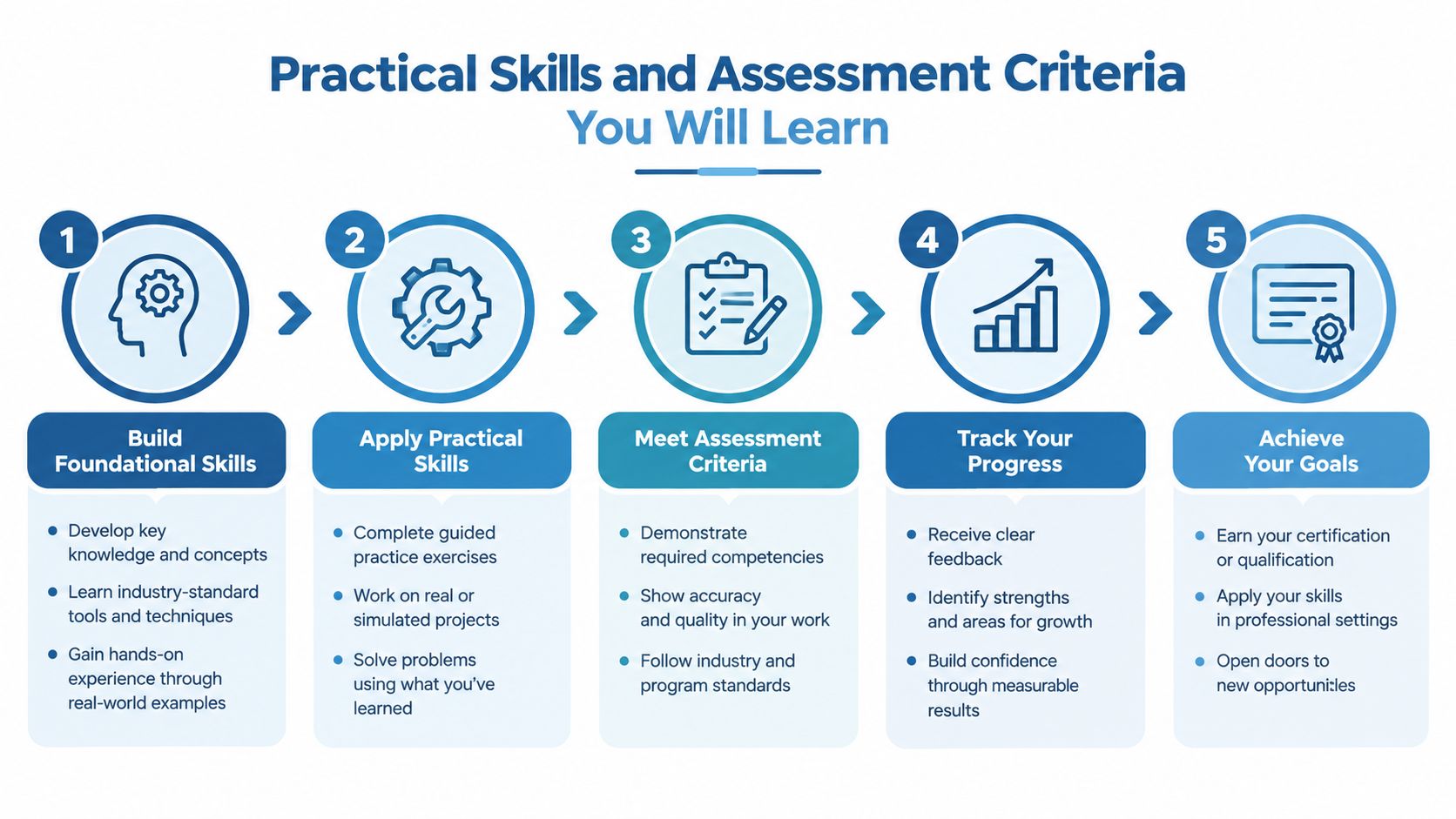
A sound course makes the rescue sequence visible and repeatable. You won't be assessed only on whether you can recite an electrical safety rule. You'll need to demonstrate that you can recognise the danger, select the right response and complete the rescue without creating another emergency.
Start with the scene
The first action is a deliberate hazard check. Look at the panel, the casualty's position, possible sources of supply, surrounding conductive materials, access routes and any immediate secondary hazards. The assessor is looking for controlled decision-making rather than speed for its own sake.
Risk assessment follows. You consider what can be isolated, which approach is safe, what protective equipment is required and how you'll communicate with others. A rescue should be coordinated, not improvised by several people reaching for the casualty at once.
Use the equipment correctly
Practical training gives you the opportunity to handle the rescue equipment used in the scenario. The assessment may include checking equipment condition, confirming that it's suitable and positioning it so the rescue can be completed safely. Protective equipment can include insulated gloves, mats, barriers and the approved rescue device for the panel setup.
The sequence normally builds towards safe isolation and removal. You must know where the isolation point is, operate it according to the procedure and confirm what happens next. If isolation can't immediately be achieved, the response must follow the approved rescue method rather than personal judgement or physical contact.
Complete rescue and CPR
After the casualty is safely clear of the electrical danger, you assess their condition and provide CPR if required. The CPR component is commonly delivered through HLTAID009 Provide CPR, while the rescue component covers the specialised panel procedure. The two skills belong together, but they aren't interchangeable.
A short employee training video guide can help employers think about how to reinforce procedures after the practical course. Video can support toolbox discussions and induction material, but it doesn't replace hands-on assessment of rescue equipment or the formal competency process.
Practical assessment focus: The assessor needs to see a safe sequence, not a rushed performance. Hazard control comes before contact with the casualty, and CPR comes after the electrical danger is managed.
Assessment requirements can also include checking emergency equipment and demonstrating that you can access and use the required rescue device. The nationally recognised UETTDRRF03 Perform EWP rescue unit provides a useful example of how rescue competence is treated as a formal standalone skill. Its requirements include inspecting emergency equipment, checking function, accessing the emergency lowering device, removing a victim from live apparatus where necessary, lowering the basket and performing CPR if required in the unit description.
That EWP unit is not the same as LV panel rescue, but the principle is important. Rescue training is assessed through practical actions, equipment checks and emergency decisions that workers must perform in the workplace. After completing CPR training, confirm the certificate status and employer expectations through TP Training's CPR certification guidance.
Safety Standards and Current Unit Codes Explained
Course names can be misleading because older unit codes remain visible in search results, provider pages and workplace records. The safest approach is to separate the unit code, the status of that unit and the scope of the rescue task.
The older unit UETDRMP007 Perform rescue from a live low voltage panel is listed as superseded by Training.gov.au. Current course materials commonly identify UETDRMP018 Perform rescue from a live low voltage panel as the rescue unit, often paired with HLTAID009 Provide CPR. Other course materials may show UETDRRF018, so employers should confirm the current training product and mapping with the RTO before enrolment.
Current and superseded LV rescue units at a glance
| Unit Code | Status | Scope and Notes |
|---|---|---|
| UETDRMP007 | Superseded | Older unit for performing rescue from a live low-voltage panel. |
| UETDRMP018 | Current course pairing identified in Australian provider materials | Rescue from live low-voltage electrical apparatus in an electrical industry environment, commonly paired with HLTAID009 Provide CPR. |
| UETDRRF018 | Current unit code referenced in national training listings | Confirm the exact scope and employer requirement with the RTO before booking. |
| HLTAID009 | CPR unit | Provides CPR competency and is commonly combined with LV rescue training. |
The code alone doesn't tell you whether the course suits your work. Ask whether the practical assessment uses a live low-voltage panel simulation, whether the provider explains exclusions such as overhead lines and underground cables, and which unit will appear on your Statement of Attainment.
Employers should also keep first aid and rescue records aligned with current workplace procedures. General guidance on first aid certification in Australia can help separate CPR evidence from broader first-aid requirements.
Booking Options Duration and Location Choices in NSW
Most Australian LV rescue training is delivered as a short, practical face-to-face competency session. One Queensland provider describes a combined LV rescue and CPR format of about 6 hours, while some NSW-delivered programs use 3 to 6 hour formats, depending on the delivery model and assessment design as outlined by St John Queensland.
That variation doesn't automatically indicate a better or weaker course. The important question is whether the session gives you enough practical time to inspect equipment, identify hazards, perform the panel rescue and complete CPR assessment. Confirm whether any theory must be completed before attendance and whether the course is delivered entirely face to face or through a blended model.
Check entry requirements before you enrol
Current course information may require evidence of a current electrical licence or CPR competency, along with prior WHS or electrotechnology knowledge. Some providers identify prerequisite units such as UEECD0007 or UETDREL006, and newer competency requirements from 2024 may affect what evidence you need to provide according to the training-provider summary.
Before paying or confirming a place, ask:
- Unit confirmation: Which current rescue unit will be issued?
- CPR pairing: Is HLTAID009 included, or must you already hold CPR?
- Prerequisites: Do you need an electrical licence, CPR evidence or prior electrical units?
- Assessment format: Will you perform the rescue on a panel-based practical setup?
- Equipment: Are the rescue tools and protective equipment supplied during training?
- Records: What document will show successful completion?
Choose a location that works for the crew
NSW learners may compare training hubs in Penrith, Burwood, Auburn, Parramatta and Sydney CBD. Location matters for rostered workers, apprentices and employers sending several contractors to one session, but practical suitability should come before convenience.
Give the provider your actual work context. A solar crew, maintenance team and electrical contractor may all need LV rescue training, yet their site procedures, access arrangements and evidence requirements can differ. The provider should be able to explain the course boundary without suggesting that panel rescue covers every electrical hazard.
Applying LV Rescue Skills on Site and Staying Compliant
A worker receives an electric shock beside a live panel. The certificate matters only if the crew knows who raises the alarm, who isolates the supply and who performs the rescue. Employers should connect LV rescue training with the electrical risk assessment, emergency plan, toolbox talks, site induction and nominated rescue roles. Workers also need to know where rescue equipment is stored and how emergency services will be contacted.
The same planning applies where an elevating work platform is used. Safe Work Australia's guidance calls for an emergency plan at each EWP workplace and training for operators and ground support workers in relevant rescue procedures in its guide to managing EWP risks. Apply that discipline to electrical work by assigning the rescue role, checking equipment and practising the response. EWP recovery procedures do not replace the panel-specific LV rescue sequence.
Use this compliance check before work starts:
- Check the unit: Confirm the record shows the current code required by the employer, rather than the superseded UETDRMP007 where UETDRMP018 or UETDRRF018 applies.
- Check the evidence: Confirm CPR, licence and prerequisite documents where required.
- Check the site: Complete induction and learn the local isolation and emergency procedures.
- Check the equipment: Know its location, condition and approved use.
- Check the practice: Include rescue response in toolbox talks and emergency drills.
For a suspended EWP worker who may take more than five minutes to reach, Safe Work Australia says the rescue process should begin while the worker is encouraged to raise their knees to reduce suspension trauma risk, as noted in the same EWP guidance. This advice belongs to EWP rescue, not panel rescue.
Solar, maintenance and contractor crews should confirm their work matches the unit's panel-only scope. Training supports a structured response, but site procedures and legal duties still apply. Employers should match the course, current unit framework and emergency plan before booking workers.
TP Training delivers practical safety and vocational training across NSW, including CPR and workplace-focused courses. Visit TP Training to review options and locations such as Penrith, Burwood, Auburn, Parramatta and Sydney CBD.

You may also like
Yellow Card Requirements in NSW: A Practical Guide
On Site Safety Guide for Construction and Civil Works