Affordable Traffic Controler Online Course: 2026 Guide
You've probably searched affordable traffic controler online course because you need a clear path into work, not a long sales pitch. Maybe you want a job on civil sites, maybe you're changing careers, or maybe you've already seen course ads that promise convenience but leave out the practical day you still have to attend. In NSW, the question isn't just which course is cheapest. It's which course gets you through training once, meets the rules, and leads to a qualification you can use.
Table of Contents
- What an Affordable Traffic Controller Online Course Looks Like
- Theory at Home and Practical on Site
- Blue Card and Yellow Card Outcomes Explained
- How Online Delivery Works Step by Step
- What Affordable Really Means in the Australian Market
- Why Pure Online Traffic Controller Training Does Not Exist in NSW
- Who Should Take This Course and Who Should Wait
- How TP Training Delivers the Affordable Online Plus Practical Model
What an Affordable Traffic Controller Online Course Looks Like
Many first-time learners entering NSW traffic control training assume “online” means they can sit at home, click through a few lessons, and finish without leaving the house. That is the part that causes the most confusion. The practical reality is clearer, and more useful. A legitimate affordable course usually combines online or pre-course theory with a supervised practical assessment, because the role itself is hands-on and safety-critical.
What “online” usually means in practice
The online part is where you do the study that does not require a live work zone. That normally includes the theory side of road safety, signage, site communication, and the basics of how traffic is managed around workers and equipment. It saves travel time and reduces pressure on your schedule, which is why blended learning has become a common entry point for learners who want a more affordable option.
What you are not buying is a purely self-paced certificate that skips competency checks. NSW regulation requires approved training pathways, so the value of an affordable course is that it trims unnecessary classroom time without stripping out the assessment that proves you can do the job. For a local example of how providers present this pathway, TP Training's overview of lowest-cost traffic control courses in Sydney shows how the conversation usually starts with online convenience but still ends with practical attendance.
Practical rule: if a course promises traffic control training with no in-person competency check at all, treat that as a warning sign, not a bargain.
Why the structure matters to a job seeker
A traffic controller job is not desk-based. You will be expected to stand in a work zone, communicate clearly, and show safe habits under supervision. That is why the course structure mirrors the work itself. The online portion gets you ready, but the practical day proves you can perform the task safely before anyone relies on you on site.
That distinction matters to affordability too. A course can look cheap at first glance and still become expensive if you discover later that you need to pay again for the practical side. An affordable option is the one that tells you upfront what is included, what still has to be assessed in person, and what credential you will walk away with.
Theory at Home and Practical on Site
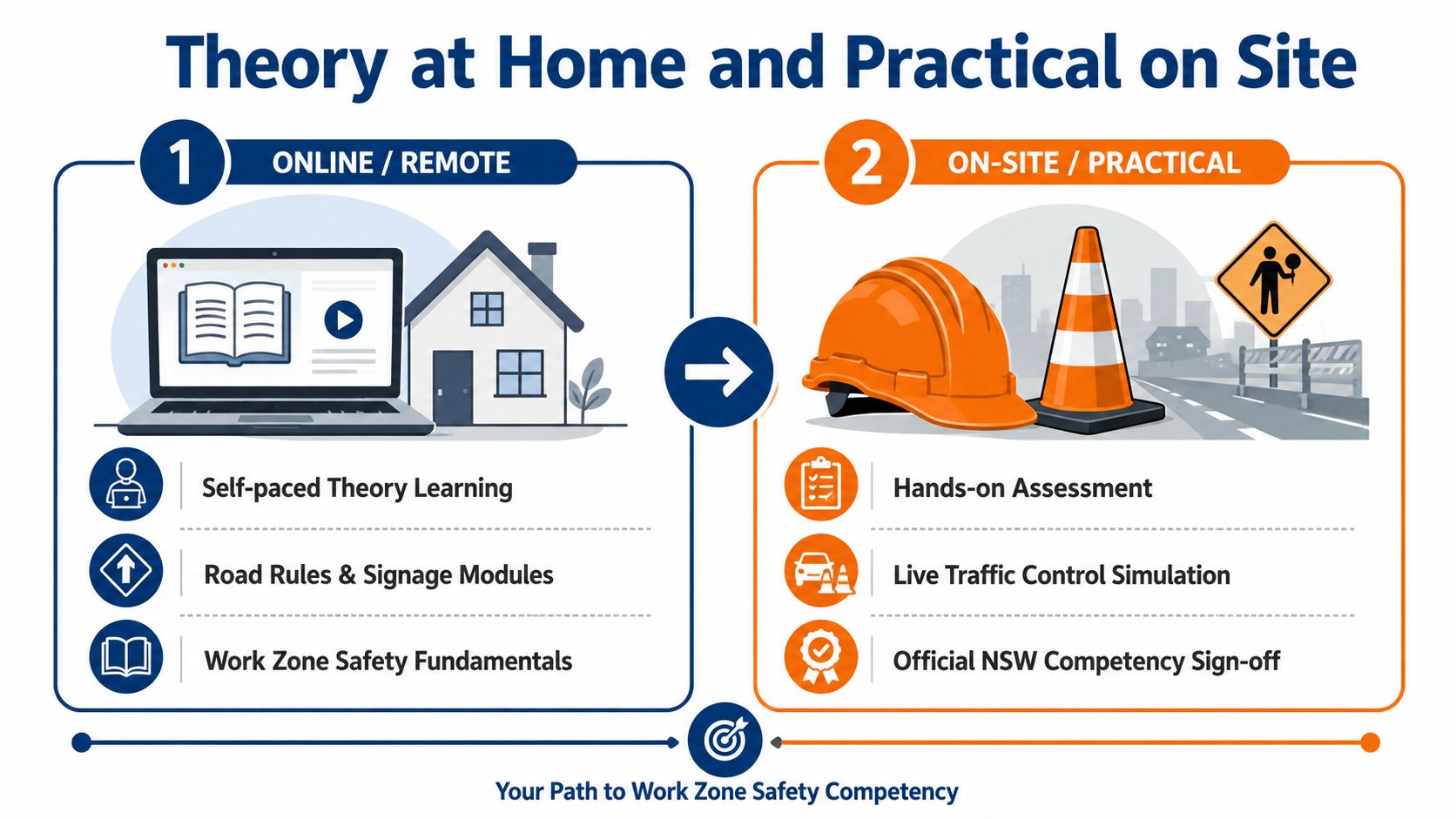
A real NSW traffic controller course is split into two parts for a reason. First comes the theory, then comes the practical demonstration that shows you can use that knowledge safely on site. The theory can often be completed before class, which is why providers describe the course as “online”. The practical part still has to happen in person, because someone must watch you carry out the task and sign off on the competency.
What belongs in the theory block
The theory block covers the knowledge you need before you handle equipment. That includes road rules, signage, work zone safety, and how a Traffic Management Plan works on the ground. Some providers explain this blended model clearly, with pre-attendance study, a day of theory and practical training, and a separate final performance assessment, along with 100 points of original identity documents before training begins.
That sequence makes sense if you compare it with learning to drive. You can study the handbook on your own, but an assessor still needs to see you behind the wheel. Traffic control follows the same logic. The online part prepares you for the rules, then the practical assessment checks whether you can use them under supervision.
Why the practical session exists
The practical day is where classroom knowledge becomes workplace readiness. You'll usually show stop-slow competence, communicate with an assessor, and complete tasks in a controlled setting that reflects real site conditions. For NSW training, that practical assessment sits within approved provider requirements, with SafeWork NSW setting the framework for who can deliver and assess Traffic Control Work Training (SafeWork NSW).
The practical session turns study into a usable workplace outcome.
That is the point to keep in mind before you compare prices. A course that leaves out supervised assessment may look cheaper at first, but it does not lead to the same result for work. A course that includes both parts gives you a training path that matches what happens on site, which is where the value of an affordable option starts to show.
Blue Card and Yellow Card Outcomes Explained
The two credentials people compare most often are the Blue Card and the Yellow Card. They belong to the same traffic control family, but they cover different work on site. If you are choosing between them, the question is simple. What job do you need to do on the worksite?
Blue Card for stopping and slowing traffic
The Traffic Controller Course Blue Card is the credential for the person who stands at the work zone and controls vehicle movement with a sign. TP Training provides practical, nationally recognised training with experienced trainers and hands-on learning across NSW, and you can read more on the Blue Card pathway. In plain English, this is the role many people picture when they think of traffic control, the person directing traffic safely around roadworks, lane closures, or other site activity.
A Blue Card suits workers who want direct site presence and a clear entry point into the industry. It is often the first qualification people pursue because it opens the door to front-line traffic control duties. For a beginner, that is a practical starting point because the task is visible, structured, and closely supervised.
Yellow Card for implementing traffic plans
The Yellow Card is for the worker who helps implement the traffic setup according to the plan. That means signs, devices, and layout support, not just standing at the line with a stop-slow sign. On a busy NSW civil site, the Yellow Card worker may be setting out equipment before work starts, checking placement, and helping the site team follow the Traffic Management Plan. The role focuses more on preparation and implementation than direct control of vehicles.
A useful way to separate the two is to follow the workday. The Yellow Card role often starts before traffic is moving, while the Blue Card role is used once vehicles need active control. Both are part of the same safety system, but they sit at different points in the workflow.
How the two roles work together on site
A simple jobsite example makes the difference clearer. A contractor starts road maintenance early in the morning. The Yellow Card worker helps set the signs and devices that match the approved plan. The Blue Card worker then manages live traffic movement while the work is underway. Both roles matter, and both require competence, but they sit at different stages of the job.
For many workers, the practical choice is to build both skills over time, especially if they want more flexibility across projects. If you are comparing courses and trying to decide where to start, begin with the card that matches the work you want right now.
How Online Delivery Works Step by Step
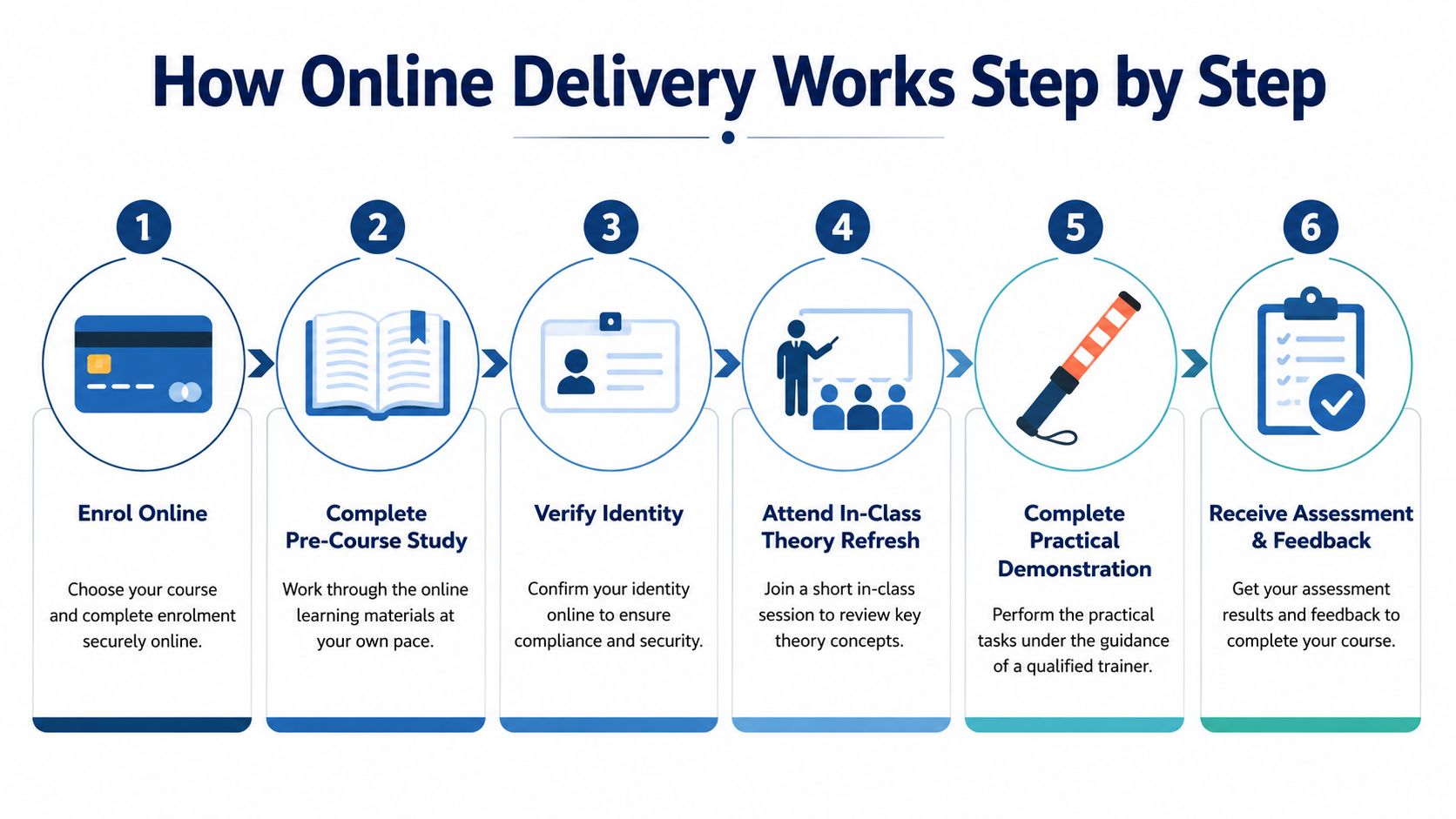
A lot of learners hear “online” and expect the whole course to stay at home. That is where the confusion starts. In NSW, the online part handles the study and preparation, while the practical side still has to happen face to face under assessment. It works like a gym class plan, you can read the instructions at home, but you still have to show the coach you can do the movement safely before you are signed off.
Step one through step three
You usually begin by enrolling online. After that, you work through the pre-course study so the practical session is spent on the parts that need hands-on checking, not on basic reading. Identity checks come next, and they are required. One NSW pathway requires at least 100 points of original documents, and another NSW course requires students to have a valid USI before the Statement of Attainment can be issued (NSW pathway details).
That admin has a job to do. Vocational training needs a clear paper trail, not just a name on a booking sheet. If your details are incomplete or your ID does not match, the certificate process slows down, and that can delay your ability to start work.
For a plain-language breakdown of how course costs are usually presented, see TP Training's traffic controller course price guide. It helps you compare the advertised fee with the full end-to-end cost before you commit.
Step four through step six
Once the paperwork is sorted, you move into the in-class theory refresh. That is where the earlier online study gets connected to the examples you will face on site, so the rules stop feeling abstract. After that, you complete the practical demonstration under supervision, then the assessor gives feedback and signs off what you have shown.
The sequence matters because some skills can be reviewed on a screen, while others have to be demonstrated in person around live vehicles and site controls. Reading about a stop-slow setup is one thing. Setting it out safely, checking it, and responding correctly under observation is another.
Learner tip: bring the right ID, finish the pre-study early, and treat the practical day like a real jobsite assessment, because that is exactly how the assessor sees it.
If you are comparing training paths, the online part gives you flexibility, but the practical day is where the job-ready decision gets made. That is also why an affordable course should be judged on the full pathway, not just the booking page, much the same way people checking budget-friendly driving instruction look beyond the headline price and ask what is included.
Once the assessment is complete, the course is no longer just a set of lessons. It becomes the evidence that shows you can move from study to safe on-site performance.
What Affordable Really Means in the Australian Market
A course looks affordable only when the full pathway stays reasonable from enrolment to assessment. In the Australian traffic control market, published prices sit in a sub-$300 to mid-$400 range for individual credentials, with one NSW provider listing a Traffic Controller course at $289 total, another provider listing comparable traffic controller and traffic-control-plan implementer courses at $272 each, and a combo option at $444 per person (market pricing). Those figures are useful, but only when you compare them against what the learner receives.
The real cost drivers
The first driver is course structure. If the fee covers theory and practical assessment together, the price is easier to judge because you can see the full pathway in one place. If the fee only covers the online theory, the learner may still need to book and pay for the practical component later. That difference decides whether the advertised price is straightforward or incomplete.
The second driver is the job pathway. A career guide for Australia reports that a full-time traffic controller generally earns $1,200 per week, or $62,400 per year before tax (career guide). That does not mean every graduate reaches that level straight away, but it does explain why a course fee can make sense when you compare it with the earning potential of the role.
The third driver is the extra logistics. PPE, travel to the practical site, and the time spent on pre-course work all affect the amount you pay out of pocket. If you need both Blue and Yellow Card pathways, a bundled option can save you from paying twice for separate enrolments.
A clean price breakdown helps here. A detailed traffic controller course pricing breakdown should make it obvious what is included before you commit.
A simple comparison
| Credential | Indicative Price (AUD) | Includes Practical? |
|---|---|---|
| Traffic Controller Course | $289 | Usually yes, if the course is legitimate and compliant |
| Traffic Controller Course | $272 | Usually yes, depending on provider structure |
| Traffic Management Implementer Course | $272 | Usually yes, depending on provider structure |
| Combo option | $444 per person | Yes, for both pathways |
That is the same buyer habit you see in budget-friendly driving instruction, people check what is included, what they will really pay, and whether the lower figure still gets them to the finish line.
An affordable traffic control course is the one that tells you the full story upfront, not the one that looks cheap until extra assessment costs appear later.
Why Pure Online Traffic Controller Training Does Not Exist in NSW
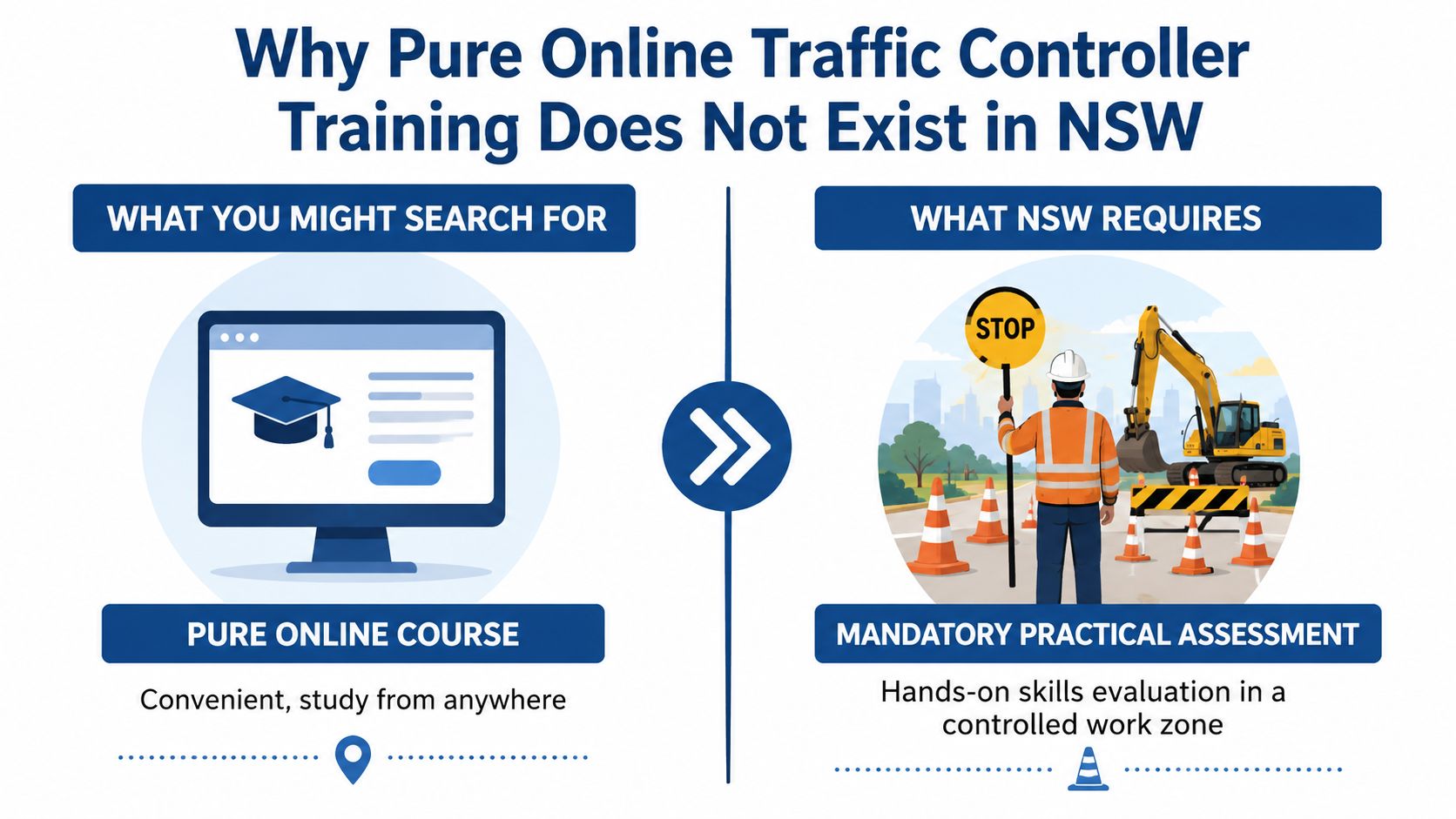
A learner can sit at home and study the theory, but that alone does not make them ready to work on site. In NSW, the practical side still has to be observed and assessed in person, because traffic control is a hands-on job where judgement, positioning, and communication need to be seen in real conditions. That is the part many people miss when they see the word “online” in a course title.
What the marketing promise misses
Some course listings sound like the whole qualification can be finished from a laptop. That sounds simple, but it mixes up two different parts of training, theory delivery and competency assessment. One Australian provider explains that its traffic controller and traffic management implementer course cannot be completed online because safety requirements require practical assessment, which is the part first-time buyers need to understand before they enrol (provider guidance).
That difference affects price as well as convenience. A theory-only package may look cheaper at the checkout, then require a separate practical booking later, which changes the actual cost. A course that includes the online study and the onsite assessment from the start gives you a clearer path through to completion, and it is easier to budget for.
Why NSW regulation changes the answer
NSW treats traffic control as a regulated work skill, not a simple online certificate. The training has to be delivered and assessed by approved RTOs with the correct scope, so the practical component is built into the model. That is why “fully online” is the wrong phrase for a compliant, work-ready course in this state.
The same principle shows up in other controlled road environments. The London Lorry Control rules exist because vehicle movement and road access have to be managed carefully to protect people on site and on the road. Traffic control training works on the same idea, the rules matter because the work affects real safety outcomes.
The practical takeaway is straightforward. Online delivery helps with study at home and keeps training more affordable, but it does not remove the need to show competence in person. In NSW, that is how the course is supposed to work.
Who Should Take This Course and Who Should Wait
A good fit for this course is someone who is ready for practical work and already has the basic paperwork in place. In NSW, that usually means being 16 years or older, having photo identification, holding a valid USI, and having the prerequisite CPCWHS1001 Prepare to Work Safely in the Construction Industry or equivalent. If you are also comfortable with basic English literacy and numeracy, you are more likely to move through the practical day without avoidable delays.
A good fit
A job seeker with a White Card, some construction exposure, and a willingness to stand outside on a training day is usually well matched to this course. That person can often handle the theory, understand site language, and complete the hands-on assessment without needing to repeat the course. For them, an affordable course is affordable because it is likely to be completed once, not twice.
A case for waiting or choosing another path
A school-leaver with no photo ID, no USI, or no prerequisite White Card should pause before enrolling. The same advice applies to someone who struggles with the physical side of practical training or does not yet have the literacy needed to follow site instructions confidently. A course can be low-cost and still be the wrong time if the learner is not ready to complete it successfully.
Good decision rule: if you cannot meet the entry requirements on day one, the cheapest course is not cheap anymore.
A lot of first-time buyers make the same mistake. They compare prices before they compare eligibility. The better order is the reverse. Check the requirements first, then compare cost, because affordability only matters if you can complete the pathway the first time.
If you are still unsure whether traffic control is the right entry point, read how to become a traffic controller and compare the entry requirements against your current documents and experience.
How TP Training Delivers the Affordable Online Plus Practical Model
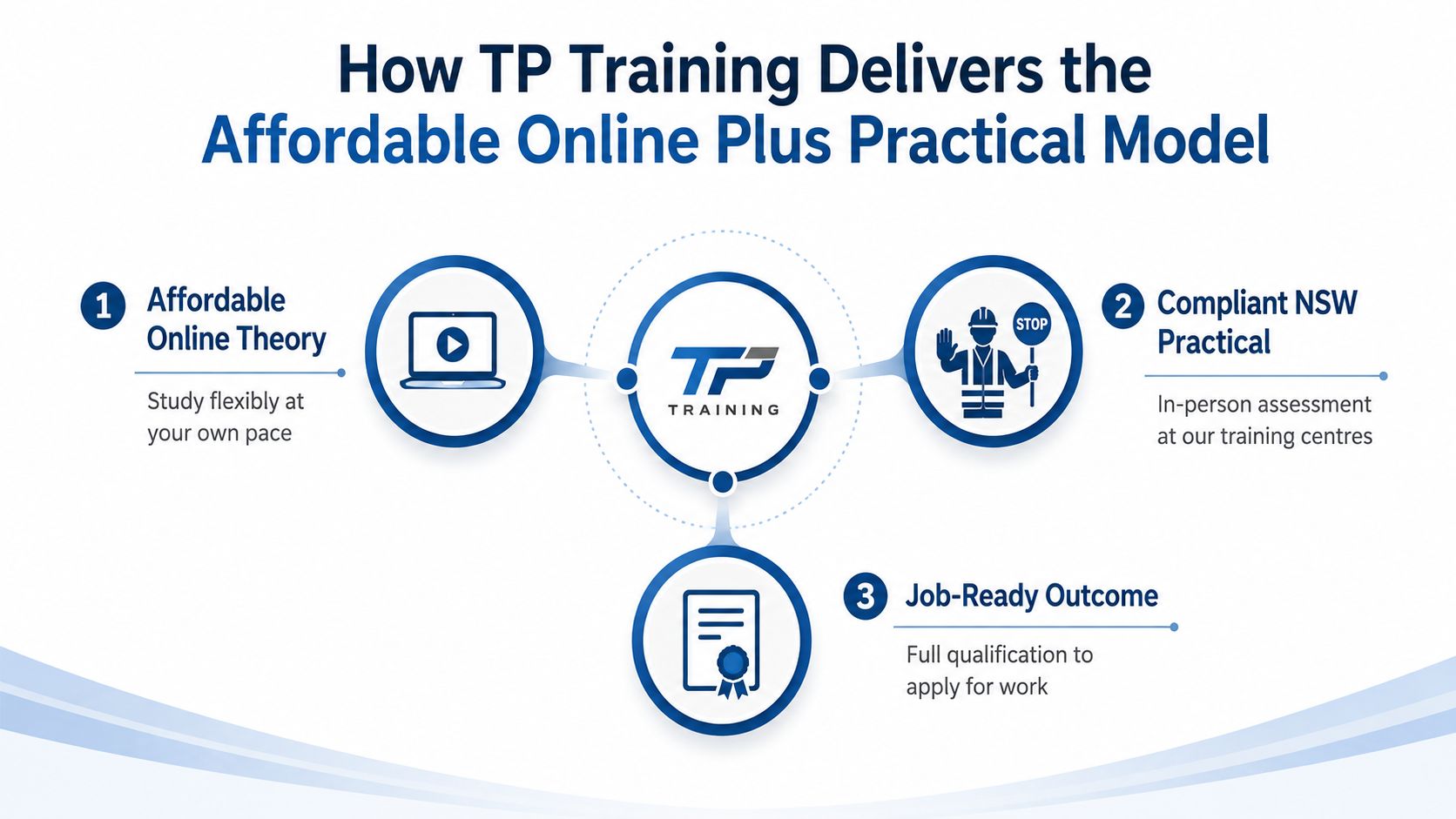
A learner who wants an affordable traffic controler online course usually needs two things at once. The theory has to stay flexible, and the practical assessment has to meet NSW rules. TP Training uses that blended approach across its NSW training centres, including Penrith, Burwood, Auburn, Parramatta, and Sydney CBD, with certification issued on the same day once assessment is complete. For someone enrolling for the first time, that means fewer wasted trips, less confusion, and a clearer link between the fee and the outcome.
Three pathways for three common goals
Front-line traffic control leads to the Blue Card pathway, while setting up and implementing traffic control plans points to the Yellow Card pathway. Workers who need both can choose the combo pathway, and the Traffic Control Combo Course details explain how the combined option fits people who want both skills without piecing the process together one class at a time.
The point is simple. Each pathway matches a different job outcome, so the right choice depends on the work you want to do. Affordable training only stays affordable when the learner picks the right pathway before enrolment, rather than paying for the wrong course and starting again.
Why the model makes sense for new learners
The online theory gives you room to prepare without giving up a whole week to classroom time. The practical assessment stays in person, because that is what NSW training expects and what real site work demands. That split is why first-time learners often ask for an “online” course, even though the job pathway is not fully online. They want less friction, not weaker standards.
The model works like a two-part check. You build the knowledge at home, then show the skill on site. That is also why the cost has to be judged end to end, not just by the headline course price. If the fee is low but the delivery is unclear, or the practical step is hidden until late, the course stops feeling affordable very quickly.
Look for clear pricing, practical assessment included in the pathway, and upfront PPE expectations. Those details tell you whether the course is a cheap listing or a useful route into work.

You may also like

Telescopic Materials Handler Training Guide for NSW

First Aid Training Penrith: Courses, Costs and Booking