
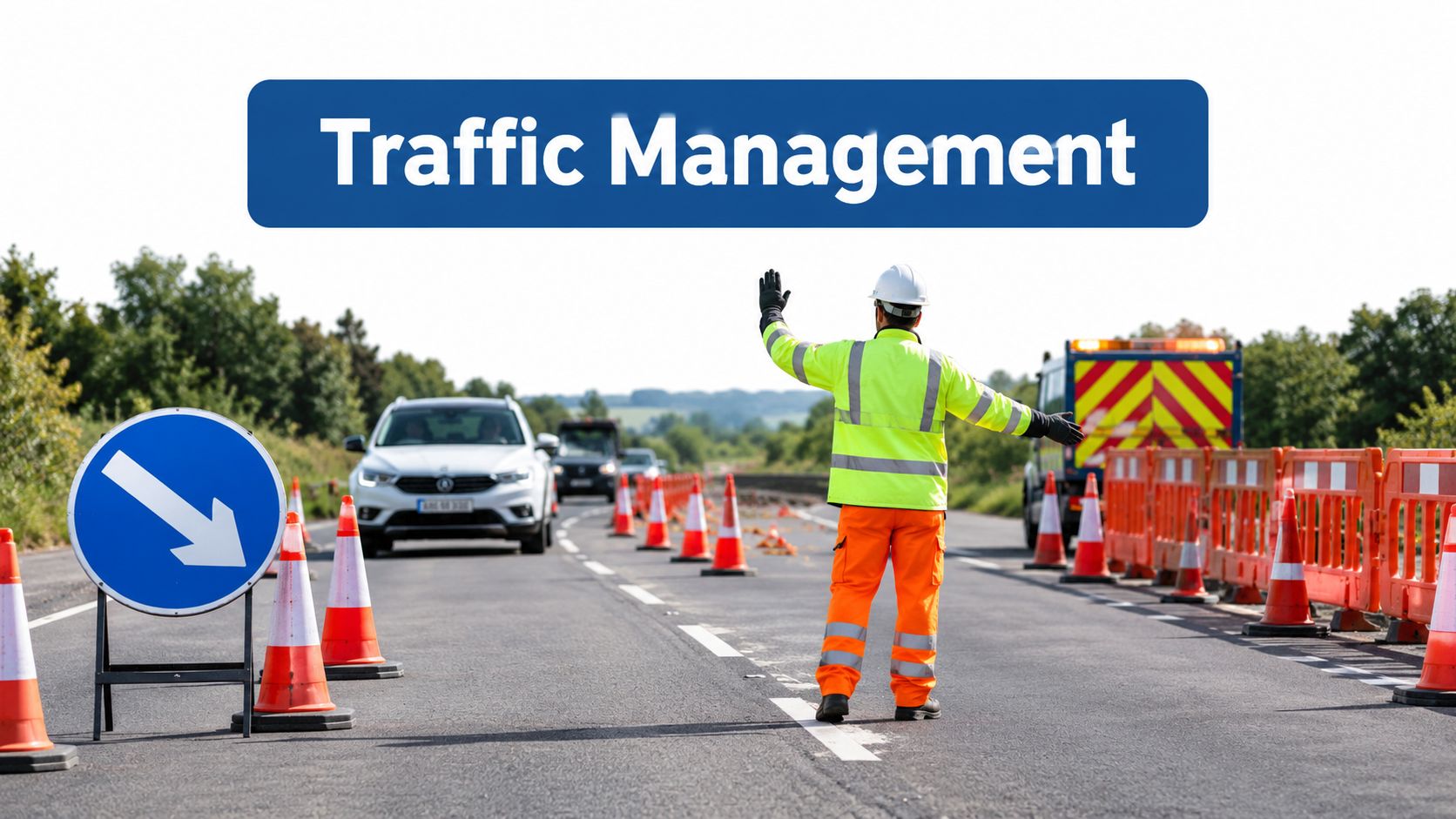
8 Traffic Management Examples: Real-World Plans for 2026
You're standing beside a two-lane arterial road with one lane closed for pavement repairs. Drivers are approaching at speed, a crew is working metres from live traffic, and two Traffic Controllers must know exactly when to hold vehicles and when to release them. A small delay in communication can create a queue, expose workers, or leave a driver facing an unclear path.
The best traffic management examples show more than cones, signs and barriers. They show the decisions behind the layout, the controls that keep people separated, and the people accountable for each stage. This article covers eight practical scenarios across roadworks, major events, freight movements and site yards. Each example identifies the plan author, who designs the arrangement, the implementer, who installs and checks it, and the controller, who manages movement during the work.
Use these examples as field references, not as substitutes for a site-specific assessment. Conditions change with road geometry, traffic demand, visibility, weather, nearby properties, public transport and the type of work being performed.
Table of Contents
- 1. Stop/Slow Traffic Control for Mobile Maintenance Works
- 2. Single-Lane Closure Using Portable Traffic Signals
- 3. Lane Shifts and Tapers on Multi-Lane Divided Roads
- 4. Night-Time Full Road Closure with Signed Detour
- 5. Pedestrian and Cyclist Diversion in Work Zones
- 6. Traffic Management for Major Public Events
- 7. Over-Dimensional Heavy Vehicle Escort and Route Management
- 8. Site Traffic Management for Construction and Warehouse Yards
- 8-Point Traffic Management Examples Comparison
- Turning Each Example Into Your Next Traffic Plan
1. Stop/Slow Traffic Control for Mobile Maintenance Works
A mobile stop/slow operation suits short-duration work that moves along a road. Line marking, pothole repairs and sign maintenance are common examples. A work vehicle and crew occupy part of the carriageway while two Traffic Controllers coordinate opposing traffic with Stop/Slow bats.
The plan author defines the operating limits. The plan needs clear stopping points, adequate sight distance, vehicle movement arrangements and a safe escape route for workers. The implementer positions the work convoy, warning signs and controllers in accordance with the approved arrangement. The controller maintains visual or radio contact, holds one approach while releasing the other, and stops the operation if queues or driver behaviour become unsafe.
A council crew completing line marking on a rural arterial road in regional NSW may use this arrangement because a fixed closure would take longer to install than the work itself. Utility crews repairing surface defects on suburban collector roads face a similar decision. The method reduces setup time, but it leaves less room for error because the work zone moves.
Controls that keep the convoy safe
Before starting, brief every controller and driver on the radio channel, emergency signal, convoy order and maximum operating speed. Controllers must be visible to approaching drivers without standing where a struck vehicle could trap them. Drivers must understand exactly when to move and where to stop if communication fails.
Practical rule: A mobile setup is only as strong as its sight distance. Re-check visibility after the convoy moves, not just when the first position is established.
The team should regularly review queue length, approaching speed, escape routes and changes in road alignment. Workers who want formal preparation can review the Blue Card traffic control course and consider the Traffic Controller Course Blue Card, which TP Training delivers with practical, nationally recognised training and hands-on learning across NSW.
2. Single-Lane Closure Using Portable Traffic Signals
Portable traffic signals are useful when one lane must remain closed for longer works and traffic needs to alternate through the available lane. Pavement rehabilitation, kerb construction, utility connections and bridge repairs can continue while each direction receives a controlled movement phase.
The plan author selects the signal locations, stopping points, warning distances and operating sequence. The timing must reflect the distance between signal heads, expected demand and the time vehicles need to clear the single lane. The implementer installs the signal heads, power supply, signs and cones, then tests visibility from each approach. The controller or nominated site representative checks that the signals operate correctly and reports queues, detector faults or unsafe driver behaviour.
This arrangement is common on Sydney arterial roads during utility upgrades and pavement works. It's also suitable for bridge deck repairs on regional highways where alternating traffic is preferable to repeated manual holds.
Make the first peak period a commissioning test
A traffic count before finalising the sequence gives the plan author a sound starting point. The implementer should then observe the first busy period and report whether queues clear within the planned cycle. If one approach consistently fills while the other sits empty, the signal timing needs review rather than passive acceptance.
Position every signal head so drivers can see it from the stopping point. Advance warning signs should appear far enough upstream for the operating speed and road environment. A responsible person should inspect the system at the start of each shift, after power interruptions and whenever the layout changes.
The weak approach is to install the signals and assume the programmed cycle will suit every period of the day. It won't. Demand changes, queues spill back, and road users may approach from an unexpected access point. A short commissioning record helps the team decide whether the setup is working or needs adjustment.
3. Lane Shifts and Tapers on Multi-Lane Divided Roads
A motorway lane shift beside median works can force traffic into a temporary alignment with little room for error. The taper gives drivers the visual and physical transition. If it is too abrupt, poorly positioned or hard to see, drivers may move late or brake heavily.
The plan author designs the temporary path, calculates the taper and selects channelising devices for the road environment. The implementer installs signs, devices and speed treatments in sequence, then checks the completed transition from an approaching driver's view. The controller monitors the work area, reports incursions and manages the response to incidents or changing conditions.
Taper dimensions should reflect design speed, lane width and the amount of lateral movement. Posted speed does not fully describe vehicle behaviour on a high-speed motorway. The plan author must also account for heavy vehicles, night visibility, wet pavement and the distance drivers have to read, decide and move.
Install and inspect the transition as a system
The Austroads traffic-control-device guidance sets out the installation sequence. Place warning and regulatory signs in the advance-warning area first, followed by intermediate signs and devices. Delineating devices then form the taper. Complete the work area and termination signs afterward. Cover signs installed before they are required.
The implementer should inspect the taper at the start of every shift and after any reported incident. Check that devices remain upright, visible and correctly spaced after rain or vehicle contact. For night work, inspect retroreflective surfaces and lighting. The controller records defects and stops or adjusts the operation when the transition no longer gives drivers a clear path.
Permanent and temporary pavement markings can also compete for attention. The plan author should specify whether old markings will be removed, covered or replaced, then confirm that treatment suits the staging. Teams can compare pavement marking materials before the implementer applies the selected treatment. A clear approach helps drivers follow the intended alignment. Guidance on traffic management signs also helps the team coordinate temporary signs with existing markings.
4. Night-Time Full Road Closure with Signed Detour
A full night closure is appropriate when workers need the entire road width or when a partial closure would expose people to unacceptable risk. Overhead gantry installation, bridge beam placement, major pavement replacement and rail-crossing works can all require a clean work area.
The plan author designs the closure limits, detour route, access arrangements and reopening process. The implementer installs advance signs, barricades, route markers and closure points before traffic reaches the work area. The controller checks the closure in real time, prevents vehicles entering the work zone and communicates with the supervisor if a detour becomes blocked or the work overruns.
A Sydney motorway closure may redirect traffic through another arterial route, while overnight rail-crossing works may send vehicles through local streets. The detour has to work for more than private cars. Emergency services, buses, freight operators, residents and businesses need usable access or timely notification.
Design the fallback before the closure starts
Publish closure times and detour maps through official NSW traffic information channels several days before the work where practicable. The plan author should verify bridge capacities, turning restrictions, clearance limits and heavy-vehicle suitability along the detour. A route that works for cars may fail when a truck cannot negotiate a turn.
The implementer should drive or inspect the detour before opening it, checking sign continuity at every decision point. The controller needs a clear escalation path for a displaced sign, blocked intersection, emergency access request or unexpected queue.
Night work also changes the human risk profile. Supervisors must plan breaks, fatigue controls, lighting and safe handover between shifts. A documented fallback reopening procedure prevents the crew from rushing to remove barriers when the work takes longer than expected. Guidance on preparing a work-zone traffic management plan reinforces why the arrangement must reflect the actual work and road environment.
5. Pedestrian and Cyclist Diversion in Work Zones
A footpath closure can be more difficult to manage than a vehicle lane closure because pedestrians and cyclists need a continuous, understandable and accessible route. Excavations, mobile plant, hoarding and live traffic can create several conflict points in a small area.
The plan author identifies the affected paths, selects an alternative route and specifies separation, lighting, accessibility and crossing controls. The implementer builds the diversion, installs barriers and signs, and tests the route before opening it. The controller manages crossings, monitors interactions with plant and reports damage, crowding or unsafe behaviour.
Inner-Sydney light rail and station upgrade works often require temporary pedestrian routes around construction zones. A school-zone road reconstruction creates another demanding scenario. Children may move in groups, carers may use prams, and people using mobility devices need a route without sudden steps, narrow gaps or unstable surfaces.
Test the route as a person using it
Walk the diversion before opening it. Better still, test it with a mobility device and check the route at the times when the surrounding area is busiest. The minimum clear path stated in the Traffic Management Plan must remain available, not just on the day of installation.
Useful controls include:
- Physical separation: Use barriers or hoarding to prevent people entering excavation areas or crossing into plant paths.
- Route continuity: Keep signs visible at each decision point so people don't have to guess where the path resumes.
- Low-light visibility: Add lighting and reflective markers where evening movement is expected.
- Daily inspection: Check barriers, ramps, covers and gaps for damage, displacement or trip hazards.
A diversion that moves vehicles efficiently but strands a wheelchair user or sends cyclists into live traffic has failed. Fatigue also affects the workers who install and monitor these routes, so supervisors should treat rest and handover as part of the control system. Teams can read about basic fatigue management when building broader site arrangements.
6. Traffic Management for Major Public Events
Major events create a temporary transport network. Sydney Harbour New Year's Eve operations, Vivid Sydney, city marathons and large festivals can combine road closures, pedestrian surges, public transport changes, emergency access and late departures.
The plan author creates the operating plan, closure map, crowd-flow arrangements and emergency access routes. The implementer installs signs, barriers, pedestrian channels and vehicle restrictions before the public arrives. The controller manages crossings, holds vehicles, directs people and escalates crowd or access problems to the event command structure.
Sydney's Olympic experience demonstrates the value of coordinated transport planning. On the opening-ceremony day, trains carried more than 55,000 spectators to Olympic Park before 4:00 p.m., while buses carried approximately 15,000. After the ceremony, more than 90,000 people left by train and a further 24,500 departed by bus. On the first full competition day, more than 900 train services passed through Olympic Park station, carrying 75,423 spectators by mid-afternoon, while buses carried 23,602. The busiest recorded day was Friday, 22 September, when 307,139 people had reached the stadium by 5:00 p.m., including 217,953 by train and 89,186 by bus. These figures and the wider Sydney transport response are documented by SBS's account of Olympic transport planning.
Give people a clear alternative
Crowd plans should identify choke points before the event. Controllers need briefings on emergency lanes, evacuation routes, lost-child procedures and public transport access. Staged messages work better than a single sign at the closure because people need direction before they reach the congested area.
The plan author should also define what triggers a change. Queue growth, a blocked pedestrian channel, a delayed train service or emergency vehicle movement may require a different holding point. After the event, the team should record what worked, where people hesitated and which access routes became overloaded. Event planning resources, including guidance on event planning for 180 guests, can help organisers think through movement, although the traffic plan still needs to be site-specific.
7. Over-Dimensional Heavy Vehicle Escort and Route Management
Moving a wind-turbine blade, mining component or large transformer is a route-management task, not a driving task. The load may need additional road space, controlled speeds, temporary removal of obstructions and protection at bridges, roundabouts and overhead services.
The plan author assesses the route, permit conditions, clearance requirements, stopping points and contingency arrangements. The implementer confirms the route is ready, positions escort vehicles and coordinates any temporary controls. The controller, often working from an escort vehicle or designated control point, warns road users, manages local traffic and communicates changes to the heavy-vehicle driver.
A wind-turbine component travelling to a regional NSW wind farm may need a different route from a large mining machine leaving a port for an inland site. The route assessment must consider current bridge and clearance data, road geometry, load height and width, traffic conditions and places where the convoy can stop safely.
Treat communication as a control
Before departure, confirm permits, escort qualifications, emergency contacts and the current route condition. The driver and escorts need one agreed communication protocol. Messages should cover approaching traffic, clearance concerns, stopping instructions, roadside hazards and any deviation from the approved route.
Keep a contingency route and emergency contact list in the vehicle. A route that looked suitable during planning may become unavailable because of roadworks, a crash, flooding or a changed access arrangement. The plan author should state who can approve a change and who must be notified.
Poor escort practice relies on warning lights alone. Good practice combines advance route knowledge, visible escort vehicles, clear radio calls and a controlled response at conflict points. Resources on Melbourne event logistics tips may be useful for broader movement planning, but heavy-vehicle route controls must follow the relevant permit and road authority requirements.
8. Site Traffic Management for Construction and Warehouse Yards
Public-road controls don't solve every traffic problem. Construction sites, warehouses and logistics yards bring forklifts, trucks, excavators, delivery vehicles and pedestrians into confined spaces. The plan needs to control movement inside the property, including loading, reversing, parking and access to work fronts.
The plan author designs the site circulation system, vehicle routes, exclusion zones, loading areas, pedestrian paths and speed controls. The implementer installs barriers, signs, line marking and gates, then checks that the arrangement matches the site's current layout. The controller or site traffic marshal manages movements at conflict points, coordinates deliveries and stops unsafe reversing or access.
A large Sydney construction site may separate concrete trucks from workers walking between buildings. A Western Sydney distribution centre may use one-way truck circulation and dedicated loading bays to reduce turning conflicts. The right arrangement depends on the site footprint, vehicle types, delivery schedule, visibility and ground conditions.
Physical separation beats a sign
Walk the site with drivers, plant operators and pedestrians before finalising the plan. They'll identify blind corners, informal shortcuts, doors opening into travel paths and loading areas that look safe on paper but fail under pressure.
- Separate people and plant: Use barriers, gates and dedicated routes wherever the layout permits.
- Control reversing: Require a spotter or banksman for reversing movements where the risk assessment identifies limited visibility or pedestrian exposure.
- Manage deliveries: Set booking, waiting and unloading areas so trucks don't queue across pedestrian paths or emergency access.
- Review changes: Update the plan whenever excavation, hoarding, storage, access gates or building stages alter the route.
The on-site safety guidance is relevant to teams managing these changing work environments. A plan that remains pinned to the site office after the driveway, loading bay or work face has moved is no longer a reliable control.
8-Point Traffic Management Examples Comparison
| Method | 🔄 Implementation Complexity | ⚡ Resource Requirements | 📊 Expected Outcomes | 💡 Ideal Use Cases | ⭐ Key Advantages |
|---|---|---|---|---|---|
| Stop/Slow Traffic Control (Mobile Maintenance) | Medium (🔄🔄), needs trained controllers and comms | Low (⚡), 2+ controllers, stop/slow bats, warning signs, vehicle lights | Short, rolling traffic holds; minimal set-up; possible queues on busier roads | Short-duration moving works on low–medium volume roads (line marking, potholes) | Quick setup, low cost, flexible deployment (⭐) |
| Single‑Lane Closure Using Portable Traffic Signals | Medium–High (🔄🔄🔄), signal timing design & monitoring | Medium (⚡⚡), signal units, power/batteries, signage, periodic checks | Predictable alternating flow; suited for days/weeks; reduces need for manual control | Extended lane closures on arterial roads (pavement, utilities) | Self‑regulating flow; improved safety vs uncontrolled single‑lane (⭐) |
| Lane Shifts and Tapers on Multi‑Lane Divided Roads | High (🔄🔄🔄), engineering design for tapers and sight lines | Medium (⚡⚡), cones/barriers, temporary markings, frequent inspections | Maintains capacity and worker separation; requires active inspection to prevent incidents | Widening, median/barrier or bridge works on high‑speed divided highways | Preserves throughput; standards-based and auditable design (⭐) |
| Night‑Time Full Road Closure with Signed Detour | High (🔄🔄🔄), multi‑agency coordination and public notice | High (⚡⚡⚡), detour signage, lighting towers, liaison with agencies | Minimal traffic conflict during works; faster completion; detour impacts possible | Complex/high‑risk tasks best done overnight (gantries, major pavement/bridge works) | Enables hazardous tasks with low traffic exposure; predictable closures (⭐) |
| Pedestrian & Cyclist Diversion in Work Zones | Medium (🔄🔄), accessibility and user‑flow planning | Medium (⚡⚡), barriers, hoardings, tactile indicators, lighting | Protects vulnerable users; may increase route length or congestion for pedestrians | Footpath/shared path impacts near schools, transport hubs, town centres | Improves accessibility and public safety; reduces liability (⭐) |
| Traffic Management for Major Public Events | Very High (🔄🔄🔄🔄), large‑scale planning, control rooms, multi‑agency ops | Very High (⚡⚡⚡⚡), staffing, police, transport coordination, monitoring tech | Manages very large crowds safely; resource‑intensive; potential local disruption | City festivals, marathons, New Year's Eve and other major gatherings | Enables safe crowd movement and strong public communication (⭐) |
| Over‑Dimensional Heavy Vehicle Escort & Route Management | High (🔄🔄🔄), permits, route assessments, clearance checks | Medium–High (⚡⚡⚡), escort vehicles, comms gear, permit admin | Safe movement of oversized loads; potential scheduling delays due to approvals | Transport of turbine blades, transformers, large mining equipment | Facilitates essential infrastructure moves with regulatory oversight (⭐) |
| Site Traffic Management (Construction & Warehouse Yards) | Medium (🔄🔄), dynamic layouts, supervision and enforcement | Low–Medium (⚡⚡), barriers, signage, spotters, segregation measures | Reduces vehicle–pedestrian collisions; improves productivity; needs updates as site changes | Construction sites, distribution centres, warehouse yards | Enhances workforce safety and operational efficiency (⭐) |
Turning Each Example Into Your Next Traffic Plan
Choose the scenario that most closely matches your next job. It might be a short mobile operation, a multi-week lane closure, a night closure with a detour, a pedestrian diversion, an event, an escorted load or a site yard with mixed vehicles and pedestrians. Don't copy the layout without checking the actual road, work method and people affected.
Start with the decision that controls the risk. Ask whether the work can move, whether one lane can remain open, whether traffic needs to alternate, whether the road should close completely, or whether the safer choice is to change the work time. The best traffic management examples show that a compliant diagram isn't enough. The arrangement must work for drivers, workers, pedestrians, cyclists, buses, freight, emergency services, nearby businesses and residents.
Write down each control measure and assign ownership before work starts:
- Plan author: Designs the layout, assesses alternatives, records assumptions and defines trigger points for changing the arrangement.
- Implementer: Installs the signs, barriers, signals, tapers, routes and separation devices, then verifies that the field setup matches the plan.
- Controller: Manages traffic and people on the day, maintains communication, responds to changing conditions and stops the operation when controls no longer work.
This division prevents a common failure. A plan author may assume the implementer will solve a visibility problem, while the implementer may expect the controller to compensate for a poor stopping position. Clear accountability closes that gap.
Use measurable field checks where the site allows them. Record queue length, signal operation, detour continuity, pedestrian-path condition, device displacement, incident response and access for emergency services. The NSW work-zone evidence shows why queue detection and rear-end-crash prevention deserve close attention. An analysis of 118,628 crashes recorded in NSW from 2013 to 2017 found that 14.3% were related to roadwork zones. Within those work-zone crashes, 40.3% were rear-end collisions, compared with 23% outside work zones, as reported in the Transport for NSW findings on work-zone end-of-queue crashes. That makes advance warning, queue observation and speed management practical priorities, not paperwork exercises.
Technology can support the same discipline, but it shouldn't replace it. The NSW M4 Smart Motorway provides a useful evaluation model. Compared with its 2016 pre-smart-motorway baseline, performance after two years showed total crashes down 30%, serious injuries down 25%, and travel time between Parramatta and the Blue Mountains improved by 20%. The NSW Government technology outcomes report presents these as network-level results, not guaranteed outcomes for an individual worksite. Apply the lesson by setting a baseline and reviewing safety and mobility together.
For teams considering connected warnings or digital traffic controls, modelling also needs careful limits. A Melbourne connected-vehicle study estimated that selected applications could reduce crashes by up to 78%. Separate modelling estimated congestion could fall by up to 11% if connected vehicles reached 30% of the fleet during peak periods, while a Melbourne CBD simulation found average travel speeds could rise by up to 10% when 20% of vehicles were connected. These are modelled planning benchmarks, not observed full-scale deployment results, as explained in the Australian intelligent transport systems submission. A responsible plan author should test assumptions about penetration, message delay, false alerts, compliance and vulnerable-road-user performance.
For your next plan, choose one example, list its controls and assign the three roles. Then walk the arrangement before the first vehicle enters the work area. That simple habit catches unclear signs, blocked escape routes, poor sight lines and pedestrian conflicts while the team can still fix them. Anyone preparing to design or implement these arrangements can begin with the Prepare Work Zone Traffic Management Plan, or Red Card, course.
TP Training offers practical, nationally recognised training for traffic controllers and traffic management professionals, including hands-on learning across NSW. Visit TP Training to explore courses that can help you build the skills to plan, implement and manage safer work-zone traffic arrangements.

You may also like

Asbestos Removal Requirements in NSW: The Complete Guide

What to Do if You Find Asbestos on Site