
Front End Loader Training Requirements: NSW Guide 2026
Search for advice on front end loader training in NSW and you'll hit the same line within a minute. No licence needed. Just get on the machine. That advice is technically accurate and practically useless, and it's the reason so many operators get caught out at the gate or in an incident review.
The absence of a government loader licence is not the absence of an obligation. It shifts the entire burden onto your employer, your site and, ultimately, you. Nobody hands you a card that proves you can run a loader. Somebody has to watch you do it, on that machine, with that bucket, and sign off that you did it safely more than once.
That's the gap worth understanding before you book anything. The licence question is easy. The competency question is the one that decides whether you keep the job.
Table of Contents
- What a Front End Loader Operator Actually Needs
- What the Assessment Must Prove and the Competencies Behind It
- When a Loader Needs More Than Loader Training
- Training Options and What They Cover
- Common Mistakes That Fail an Assessment or Audit
- Choose Your Training Provider and Book
What a Front End Loader Operator Actually Needs
A wheeled front end loader doing the earthmoving work it was built for does not require a high-risk work licence in Australia. Safe Work Australia's national excavation work code confirms that earthmoving machinery generally doesn't require a licensed operator when used for its original designed purpose, but the operator must still demonstrate competence for that specific type of plant and for any attachments fitted.
That word "specific" does a lot of work. Your mate's loader ticket from a different machine, or a course you did five years ago on a bucket that's since been swapped for a four-in-one, doesn't automatically cover you. The code defines a competent person as someone who has gained the knowledge and skills through training, qualification or experience, and it expects relevant workers to be trained in work procedures before the job starts. Training for one loader, with one attachment, on one site. Change any of those variables and the duty-of-care question opens up again.
Front end loaders also sit outside the standard national high-risk work licence classes that cover forklifts and cranes. The nationally registered unit for wheeled civil loaders states that no licensing, legislative or certification requirements apply to it at the time of publication. Treat that as the minimum. State and territory WHS duties, principal contractor rules, manufacturer instructions and traffic management controls can all demand formal training where no licence class exists.
The requirements at a glance
| Requirement | Status | Who verifies it |
|---|---|---|
| High-risk work licence for a wheeled civil loader | Not required for normal earthmoving use | No licensing authority class applies |
| RIIMPO321F wheeled front end loader operations | The standard nationally recognised competency employers ask for | Registered training organisation assessment |
| RIIHAN308F Load and Unload Plant | Prerequisite, or must be assisted by someone who holds it | RTO or employer |
| White Card (construction induction) | Required to enter and work on construction sites | RTO, verified at site induction |
| Employer or site authorisation | Required before unsupervised operation | Employer and site supervisor |
| Machine and attachment familiarisation | Required for each loader, bucket or attachment used | Employer, documented supervision |
| HRW licence or non-slewing crane competency for suspended loads | May apply when using a jib to crane-lift | WHS regulator and employer |
Two rows in that table do most of the damage in practice. The RIIHAN308F row trips up operators who can run the loader but can't get it onto a float, which means someone else has to stand next to them every time the machine moves between sites. The last row is where the everyday loader competency stops dead: the moment a jib or lifting attachment goes on and the load hangs in the air, you're in crane territory and a different licensing framework applies.
This is why the paperwork matters less than the proof behind it. A certificate of attendance proves you turned up. Proving you can load a truck without dropping a bucket on someone takes a proper assessment on the machine itself, and that's a harder standard to meet than most operators expect.
What the Assessment Must Prove and the Competencies Behind It
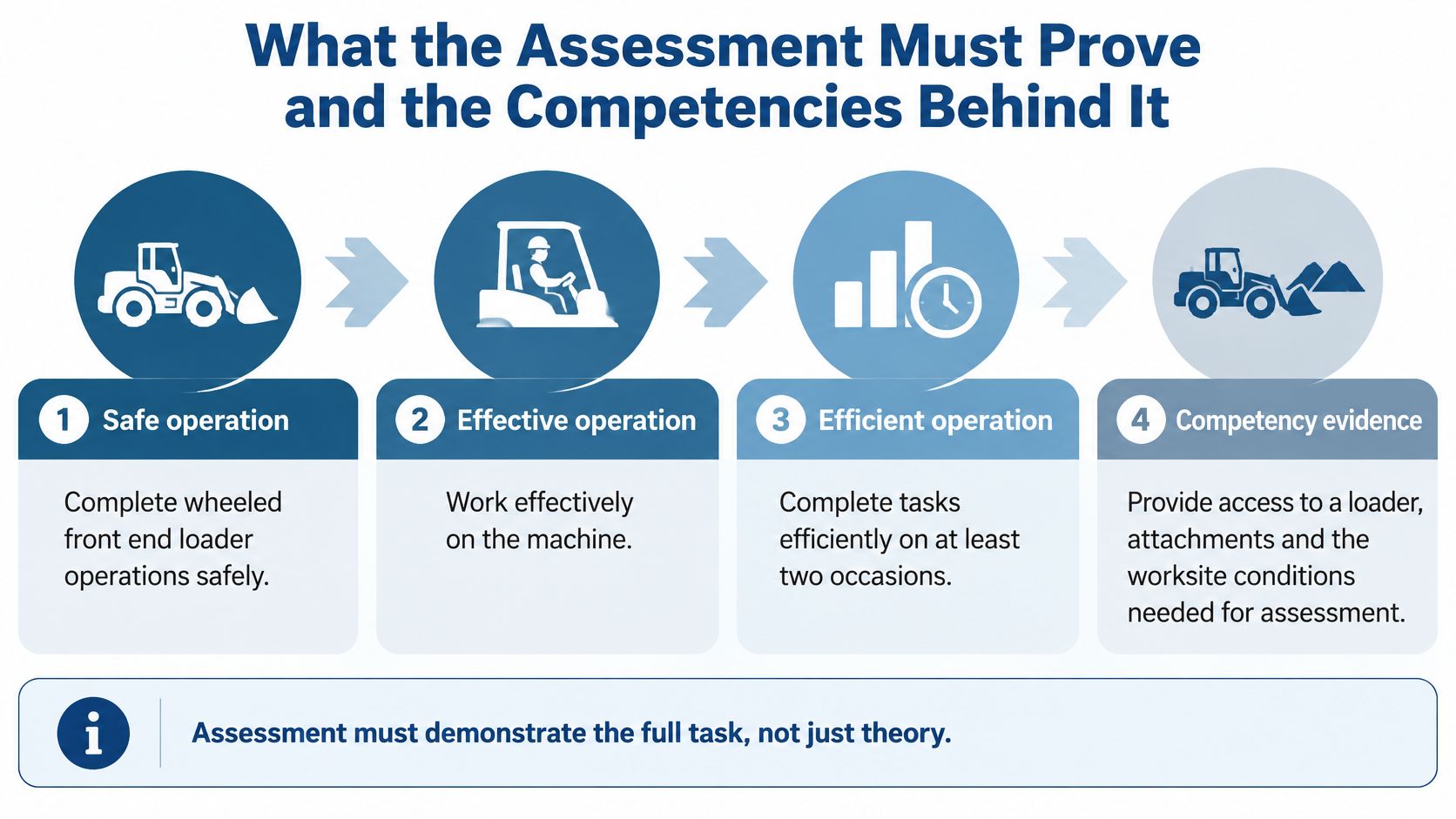
A typical course outline stops at "practical assessment". It leaves out the number of assessed occasions. The national assessment requirements for RIIMPO321F require evidence that the candidate has safely, effectively and efficiently completed wheeled front end loader operations on at least two occasions, covering pre-start checks, operating and adjusting technique for site conditions, and shutdown. The assessment must give the candidate access to a wheeled loader, materials to shift and the required PPE.
Two occasions is the minimum, not the goal. It exists so an assessor can see whether your performance holds up when the ground changes, the stockpile gets awkward or the truck spots somewhere different.
What the assessor actually watches
The RIIMPO321F unit details set out the competencies in a sequence that mirrors a real shift. An assessor works through them roughly in this order:
- Interpret the paperwork. Work instructions and operating documentation. If you can't read the plan you can't follow it.
- Find the hazards before they find you. Environmental risks, ground conditions, services, other plant, then implement the controls.
- Gear and signage. Select PPE, then establish the traffic management signage the site requires.
- Confirm the machine suits the job. Then complete pre-start and start-up checks properly, not as a box-tick.
- Report defects instead of driving around them. Recognising a fault and acting within your authority to rectify or report it is an assessed behaviour.
- Adapt to changing conditions. Travel and operating technique shift with load, terrain, visibility and traffic, all while staying inside the loader's capacity and monitoring indicators and alarms against manufacturer specifications.
- Load, place and stockpile. Then respond when the hazard picture changes mid-task.
- Shut down and secure. Prepare for relocation, park it properly, secure the machine and complete the records.
Day-to-day servicing and minor maintenance sit alongside that list rather than after it. Checking hydraulic hoses, oil levels and tyre condition is part of the pre-start, not a mechanic's job you wait for.
Practical rule: I would not treat a course as ready to book until the provider names the machine, the attachment and the materials the assessment will use. Without that, you cannot judge whether the evidence matches the work you will actually do.
The parts people forget
RIIMPO321F covers wheeled loaders. Tracked loader operations sit under a separate unit, RIIMPO322E, and both appear as distinct units inside Certificate III in Civil Construction Plant Operations. Book the unit that matches the machine you will be signed off on.
There's also the prerequisite. The operator must have completed RIIHAN308F Load and Unload Plant, or be assisted by someone who holds it. That's an operational control, not paperwork: it means someone on site can legally and safely load and unload your machine from a float.
A statement of attainment is not a substitute for site induction, manufacturer instructions or your employer's safe work procedures. It sits underneath them. If you want the broader picture of how structured training programs are managed inside a business, the HR Management 365 training guide is a useful read on how employers track competency and refresher cycles.
Employers who treat this as a record-keeping exercise rather than a verification exercise are the ones who end up explaining themselves after an incident. The workplace safety training resources cover how that verification loop is meant to work day to day.
When a Loader Needs More Than Loader Training
Ordinary earthmoving and crane-style lifting are two different jobs that happen to use the same machine. The boundary is sharper than most operators expect.
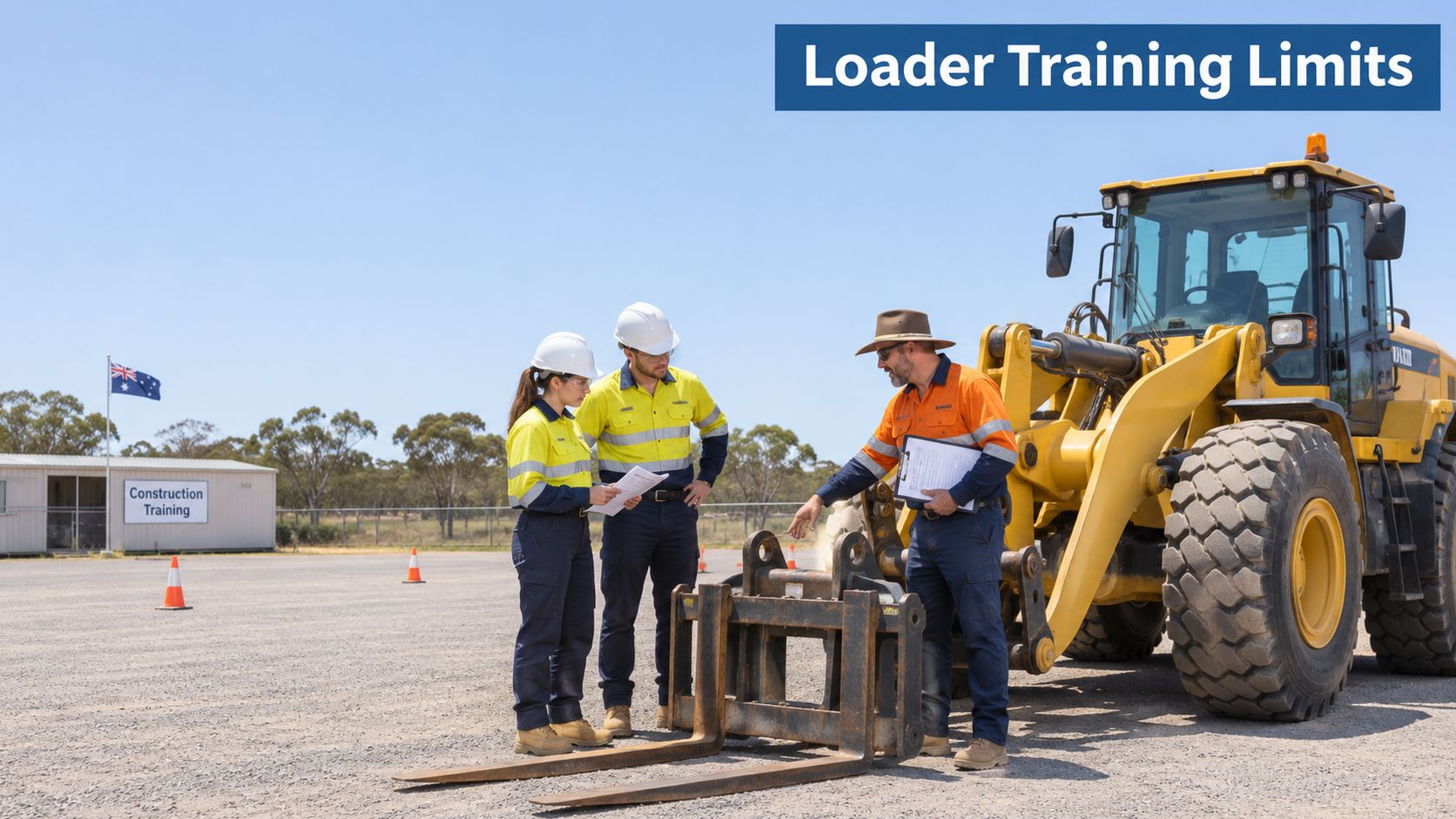
Safe Work Australia's information sheet on using powered mobile plant as a crane names front end loaders among the plant that may be used as cranes, then adds conditions. The operator must be trained and competent for that activity specifically, may need additional training in estimating loads and controlling lifting operations, and may need non-slewing mobile crane training or a relevant high-risk work licence depending on the equipment and lifting arrangement.
The guidance also sets one hard control: the operator must be able to see the load at all times during the lift. No exceptions, no "just this once, it's only a pallet of bricks".
Normal earthmoving versus suspended load
| Task | What the training must cover | Who signs it off |
|---|---|---|
| Bulk loading, stockpiling, excavation | RIIMPO321F and machine familiarisation | RTO and employer |
| Jib or attachment lifting a freely suspended load | Load estimation, lift control, visibility, possibly non-slewing crane competency | WHS regulator and employer |
| Specialised attachment changing machine behaviour | Attachment-specific instruction and supervised practice | Employer |
| Travel on public roads | Registration and road rules | State roads authority |
The plant code Safe Work Australia publishes requires businesses to provide information, training, instruction or supervision before plant is used, and it favours practical, hands-on programs pitched at the worker's actual experience and the machine's specific risks. That's why a single course can't cover everything. Training should separate ordinary loader work from attachment work and suspended-load lifting, with documented supervision for each extra task.
A pre-task checklist worth running past your supervisor
- Classify the task out loud. Ask whether it's ordinary earthmoving, attachment use or suspended-load lifting. Each one needs different documented training.
- Check the attachment against your training. A jib, a grab or a pipe layer changes the machine's behaviour and its risk profile.
- Confirm you can see the load. If you can't, the lift doesn't happen.
- Confirm the ground and the services. Overhead lines, excavations and soft ground all change the plan.
- Check site rules against the law. Principal contractors and site rules are frequently stricter than the national base.
- Know who to call. For NSW operators, SafeWork NSW is the regulator, and state WHS duties can sit above the national minimum.
If your work regularly crosses into high-risk territory, it's worth understanding how high-risk work licensing solutions fit around the standard civil units.
Training Options and What They Cover
A loader statement of attainment and a career on plant are different decisions. Choose the route that matches the job you can get.
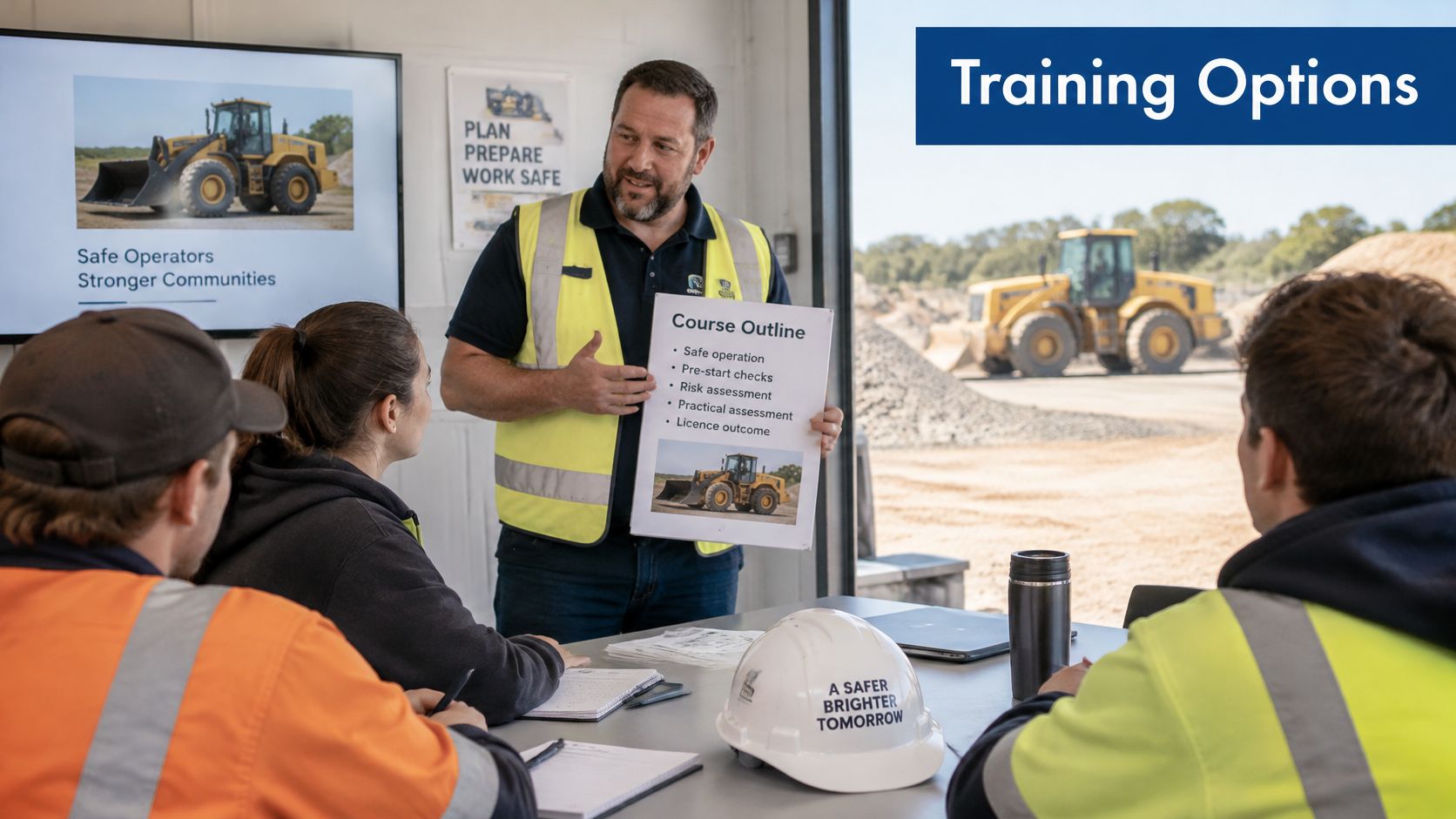
The direct route is the standalone wheeled loader course. At TP Training, the RIIMPO321F Conduct civil construction wheeled front end loader operations course runs two days and costs $520. That is the shortest nationally recognised path into civil wheeled loader work.
The combo route suits people who need to be useful on more than one machine. The related civil units, RIIMPO320F excavator operations and RIIMPO318F skid steer loader operations, each run two days at $520. Stacking them widens the machines you can be assessed on without committing to a full qualification. I would pay for the extra units only if the site runs those machines. An excavator unit you will never operate is a poor trade.
The career route is a Certificate III in Civil Construction Plant Operations. It bundles the wheeled loader unit with other plant units and gives a recognised qualification rather than a single statement of attainment. It takes longer and costs more. Take it if you are aiming at leading hand or supervisor roles, and skip it if you need to be productive on one loader next month.
Agricultural loader units and backhoe-loader units sit in a different context, with different evidence requirements. They are not interchangeable with the civil wheeled loader unit. A provider that treats them as the same ticket is not reading the training package closely.
Training pathways at a glance
| Pathway | Length | Cost | Best for |
|---|---|---|---|
| Standalone RIIMPO321F wheeled loader course | Two days | $520 | Direct entry into civil construction |
| Civil plant combo (RIIMPO321F, RIIMPO320F, RIIMPO318F) | Two days per unit | $520 per unit | Broader employability across loader, excavator and skid steer |
| Certificate III in Civil Construction Plant Operations | Set by the RTO's course structure | Quoted by the RTO at enrolment | Full career pathway including wheeled and tracked loader units |
| Employer-sponsored supervised training | Runs until the employer verifies competency | Employer-funded | Operators learning on the company's own machines and attachments |
If you're comparing credentials across machinery tickets more broadly, this guide to how to renew forklift certification explains how renewal cycles work for a related licence class, which is useful context for planning your own currency.
Before you enrol anywhere, ask four questions. What is the exact unit code? Which machine type and attachments does the practical cover? What are the assessment conditions? Does the employer still need to run a site induction afterwards? The answer to the last one is always yes.
The wheeled loader course above is a nationally recognised option, delivered with experienced trainers and hands-on learning across NSW. Compare the wider civil construction plant operations courses if you are weighing a combo against a single unit.
Common Mistakes That Fail an Assessment or Audit
Most failures aren't dramatic. They're small assumptions that compound.
Treating the certificate as the finish line. Skipping site induction because you've "done the course" is the classic. Fix: the employer runs documented, supervised familiarisation before unsupervised operation. Owner: employer.
Booking a wheeled loader course when the site runs tracked machines. Fix: match the unit code to the machine on site before you pay. Owner: operator.
Assuming the ticket covers a jib lift. Fix: treat suspended-load work as a separate task with its own documented training and verification. Owner: employer.
Continuing on a machine with a defect you should have reported. Fix: stop, report, record, rectify. Owner: operator and employer.
Training on a small loader, then stepping straight onto a much larger one with different controls and limits. Fix: familiarise on each machine and attachment before use. Owner: employer.
Relying on attendance rather than demonstrated performance. Fix: the provider assesses repeated hands-on performance under realistic conditions, verified by more than one assessment method. Owner: provider.
That last point has a regulatory basis. The earlier version of the wheeled loader unit required assessment evidence to be relevant to worksite operations and to cover the performance criteria, required skills, required knowledge and range statement, with practical application verified using more than one assessment method. It also flagged that a state or territory OHS authority licence may be required in some jurisdictions, and that wheeled loaders must be registered when driven on public roads.
Both of those obligations sit outside your training record. An operator can need to satisfy several requirements at once rather than relying on one certificate.
Employers carrying the verification burden should read up on the responsibilities of employers before the next audit cycle, because that's where the paper trail gets tested.
Choose Your Training Provider and Book
Hand over the fee only after the enrolment form names the unit and the machine you will be assessed on. I treat a booking as unfinished until those two details, plus the assessment conditions, are confirmed.
Run this checklist before you hand over money.
- Confirm the RTO. Check the organisation's details on training.gov.au. TP Training is registered as RTO No 21488.
- Confirm the exact unit code. The enrolment form should name RIIMPO321F. A generic "loader ticket" does not tell you what was assessed.
- Ask what the price includes. Machine time, attachments and assessment should be in the number, not added later.
- Ask which NSW locations run it, and what to bring. Wear closed-toe shoes and hi-vis, and expect to work in a yard.
- Ask what happens on your own site after the course. Build that step into the same week, because the course record covers the training machine, not every machine you will meet.
- Get your White Card first if you don't have one. You can't access a construction site without it, which makes loader work hard to demonstrate.

Employers have a parallel job: verify competence against your own machines and attachments after the course, in writing, before anyone operates unsupervised. A certificate from a provider who trained on a different loader model is only a starting point. If you're weighing up machine tickets generally, the reasoning in this breakdown of practical and affordable excavator training in NSW applies just as well to loaders.
Your next action this week: ring the provider, confirm the unit code, machine type and assessment conditions, then book.
The gap between "no licence required" and "no training needed" is where careers stall and incidents happen. TP Training builds the RIIMPO321F Conduct civil construction wheeled front end loader operations course around that gap, with hands-on machine time and assessment that reflects real site conditions. If you're ready to get signed off properly, visit TP Training to check dates and book your spot.

You may also like
First Aid Training Refresher: When and What to Renew

Asbestos Exposure: Risks, Symptoms and What to Do Next