
First Aid Training Refresher: When and What to Renew
CPR skills need refreshing every 12 months, and a full first aid qualification is renewed every three years. When those two dates fall apart, the earlier one sets your deadline.
Plenty of workers carry a certificate that is still in date and still feel uneasy about kneeling on a training room floor in front of colleagues. In 2024, 47% of Australians surveyed in Australia Wide First Aid's First Aid Proficiency Report named providing CPR as the most intimidating first aid situation (Australia Wide First Aid). That unease deserves a straight answer rather than a lecture about compliance.
The confusion usually starts with the word "expiry". Your statement of attainment records the date you were assessed as competent. It doesn't record what you've done since, and it doesn't tell you which of the two clocks is running out first. This guide sorts the rules by setting, so you know which date governs your role.
Table of Contents
- Renewal Rules for Each Qualification and Setting
- Why Certificates and Skills Drift Apart
- Refresher Versus Full First Aid Course
- What a Refresher Assessment Checks
- Prepare for Your Refresher Day
- Confirm Your Renewal Date and Book the Refresher
Renewal Rules for Each Qualification and Setting
Start with the renewal lookup, because that is where most mistakes begin. Check the earliest date across every credential you hold, then ask which setting that credential is being used in. A certificate date and a practical CPR date work like two clocks on the same wall. They may be set close together at first, then drift apart.
| Qualification | Recommended renewal | Source basis |
|---|---|---|
| CPR (HLTAID009) | Every 12 months | Safe Work Australia model Code of Practice |
| First aid qualification (HLTAID011) | Every 3 years | Safe Work Australia model Code of Practice |
| ALS Level 1 or 2 provider certificate | Recognised for 4 years; practical skills updated at least annually | Safe Work Australia model Code of Practice |
| Emergency life support and CPR in education and care | Completed within previous 12 months | ACECQA |
| Approved first aid in education and care | Completed within previous 3 years | ACECQA |
| Anaphylaxis management training | Every 3 years | ACECQA |
| Emergency asthma management training | Every 3 years | ACECQA |
The table is deliberately split. Workplaces generally use the national model as the baseline. Education and care adds its own currency test, so a person can meet one rule and still miss another. Treat the table as a set of separate checks, not one combined expiry date.
Read each credential on its own clock
A single course can create two deadlines. Renewing HLTAID011 refreshes CPR for that year, but the CPR clock restarts 12 months from the completion date, not from the first aid renewal. Add the three-year first aid date and you have two dates to watch, plus whatever your employer adds on top.
Reading rule: find the earliest date across every credential you hold and treat that as the one that needs action.
This is the same habit used in how continuing education credit hours work: record each unit by its completion date, not by the certificate title alone. A useful renewal record keeps the statement of attainment, the date the course was completed, and any workplace update record in the same place.
Three layers of rules, applied in order
Layer one, the national model. SafeWork NSW repeats the national workplace guidance that first aiders should regularly refresh their knowledge and skills, with CPR refreshed annually and first aid qualifications renewed every three years. For NSW workplaces this is the practical benchmark when reviewing first aid rosters, training records and certificate expiry dates. Track both deadlines independently, because a worker can hold a current three-year first aid qualification while their annual CPR refresher has lapsed without anyone noticing.
Layer two, the education and care test. ACECQA applies a stricter currency test: approved first aid qualifications are generally current when completed within the previous three years, but emergency life support and CPR training must have been completed within the previous year. ACECQA also sets a three-year renewal expectation for anaphylaxis management and emergency asthma management training. Anyone responsible for children should run separate annual and three-year checks rather than one combined reminder. The first aid certificate for childcare needs to be read against those education and care currency periods, not only against the general workplace clock.
Layer three, the employer or site rule. Refresher requirements can depend on regulatory authorities, industry standards, employer policies and jurisdiction, and CPR is commonly refreshed more often than full first aid (Safe Work Australia model Code of Practice). A construction site, a warehouse and a council depot can each set a stricter rule than the national model. The stricter rule is the one you're paid to meet.
A worked example
Say a childcare educator completed HLTAID011 in March 2026. On that plan, her first aid qualification would run to March 2029. Her CPR, however, would need refreshing by March 2027, because the CPR component inside that qualification carries its own 12-month window.
If she waits for the certificate date, she'll be two years past her CPR refresh and still holding a document that looks current. That is the trap: the paper looks tidy while the practical skill clock has already run out. Write both dates down at the time of completion, then set the reminder for the earlier one.
Where sources differ, follow the stricter date and confirm with your employer or the relevant NSW regulator before the deadline, not after it.
Why Certificates and Skills Drift Apart
A certificate records a moment of assessment. It says nothing about the two years since.
CPR is a sequence of time-critical actions: recognising cardiac arrest, calling emergency services, starting chest compressions, providing ventilations where trained, and using an automated external defibrillator. None of those steps improve with age. They fade the way any rarely used physical skill fades, gradually and without warning.
A driving licence works the same way. It stays valid for years, but a driver who hasn't gripped the wheel since the last test may stall at the first roundabout. A valid licence doesn't guarantee the skill behind it.
The four-year certificate and the annual skill
Australian resuscitation credentials can carry different validity periods from the recommended skills-refresh intervals. ARC Advanced Life Support Level 1 and Level 2 provider certificates are generally recognised for four years, while ARC materials still recommend updating practical skills at least annually (Australian Resuscitation Council).
A civil works crew lead can hold a valid ALS certificate while going three years without touching an AED. The document says competent. The hands say unpractised. In 2025, 67% of people surveyed by St John Ambulance Australia said they would feel confident administering CPR if needed, while only 19% felt strongly confident (St John Ambulance Australia). Confidence and capability are not the same measurement.
The trap: a certificate that stays current for four years can sit above hands that haven't practised in three.
ARC also treats refresher courses as revision for candidates who are already competent. Where an ALS2 certificate has expired, the candidate may need the full course rather than the one-day recertification pathway.
What a workable renewal cycle looks like
Employers should keep a register recording both certificate expiry and the most recent practical CPR refresher, then act on whichever comes first. These are two separate clocks, and the register fails if it tracks only one. The cycle that holds up combines annual CPR skill practice with periodic reassessment of first aid decision-making: hazard control, casualty prioritisation, bleeding management, airway problems and escalation. Compressions and defibrillation sit on the short clock. Judgement under pressure sits on the longer one.
Short, spaced practice works better than a single annual cram, which is the same principle behind VideoLearningAI microlearning retention strategies. Ten minutes on a manikin each quarter beats three hours once a year.
Workplaces that get this right build practice sessions into the first aid training in the workplace schedule rather than treating renewal as an administrative chore.
Refresher Versus Full First Aid Course
Both paths lead to a renewed document. Only one of them suits your situation.
| Feature | Full first aid course | Refresher course |
|---|---|---|
| Typical length | Usually one full day | Three-hour HLTAID011 refresher |
| Who needs it | New first aiders or lapsed qualifications | Current holders renewing before expiry |
| Content | Full first aid response from the start | Revision of skills with practical checks |
| Assessment | Practical and knowledge assessment across the unit | Practical CPR, AED and response assessment |
| Cost reference | Set by the provider and quoted at booking | From $95 (2025, Institute of Registered First Aid) |
| Expired certificate | Usually required once a qualification lapses | Only where the provider accepts it; check first |
In 2025, the Institute of Registered First Aid stated that first aid certificate renewal in Australia started at $95 for a three-hour HLTAID011 refresher course, with CPR updates required annually (Institute of Registered First Aid). Full course fees vary by provider, so ask for the current price rather than assuming it matches the refresher rate.
The decision rule
- Current and inside the renewal window: book the refresher. You're revising skills you already hold.
- Lapsed: book the full course. ARC treats a refresher as revision for candidates who are still competent, so an expired qualification usually means starting again.
- Unsure: ask your employer which unit they require and confirm with the provider before you pay.
A refresher must include practical assessment. A refresher built only on theory won't show whether you can actually perform compressions or operate an AED, and your employer's record won't be worth much either.
The 12-month CPR window runs from your completion date, not the calendar year. Queensland Government course guidance makes the point plainly: CPR refresher training is carried out annually, and the next one is planned from the training date so no more than 12 months elapse between updates (Queensland Government). Finish a course in November and your next one is due the following November, not in January.
Course length and cost only matter once the unit matches what your employer asked for. If you're weighing up the full qualification, the first aid course HLTAID 011 page sets out what the unit covers.
What a Refresher Assessment Checks
Assessment standards are published, so there's no reason to walk in blind. Two clocks run on every first aider: the certificate expiry date on paper, and the practical CPR currency underneath it. The assessor's job is testing the second one.
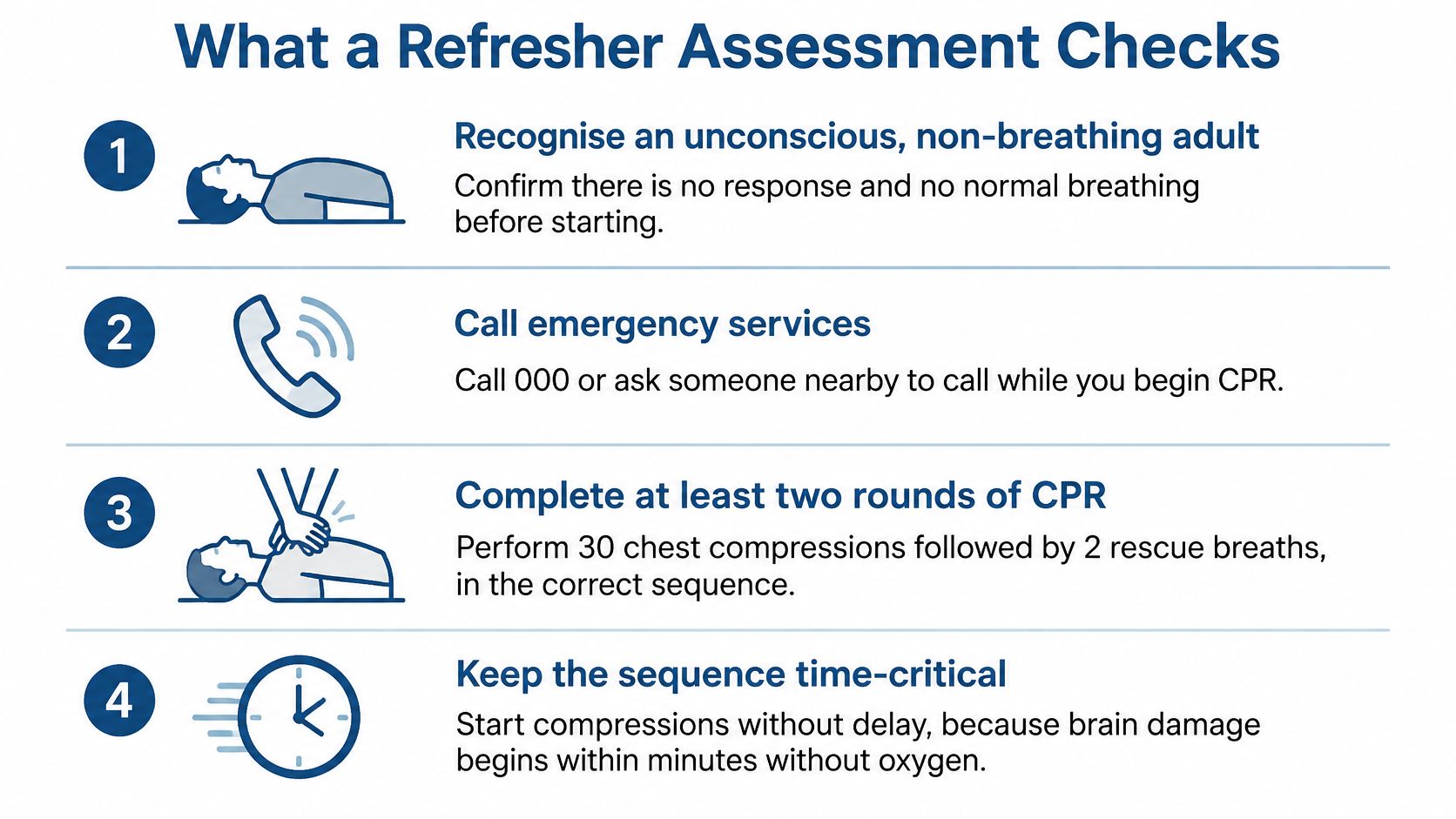
Current Australian competency requirements for CPR include recognising an unconscious, non-breathing adult, completing at least two minutes of uninterrupted single-rescuer CPR, using an AED to deliver a shock, rotating rescuers with minimal interruptions, and demonstrating CPR on both adult and infant manikins (training.gov.au). The unit applies across workplace and community settings and requires performance in line with Australian Resuscitation Council guidance.
Beyond the manikin work, an assessor watches the decision points. Scene assessment before you touch anyone. Calling emergency services or directing someone else to call. Handing over clearly to paramedics when they arrive. Each one is scored, and none of them involve technique.
The worries nobody says out loud
Returning learners ask the same questions every course. Infant CPR and ventilation. Gloves. Vomit. Working on a site they've never set foot on.
A good class handles each one directly. You'll practise on infant manikins in small groups, so the size of the casualty stops being a surprise. You'll run a mock scene, so the unfamiliar worksite becomes a checklist rather than a panic. Gloves and barrier devices get treated as routine tools you put on without thinking.
A short online review can refresh your recall. It can't give you feedback on compression depth, AED pad placement or how you manage fatigue in the third minute.
Interactive quizzes have a place here, and interactive audience quizzes work well for testing recall of the sequence before class. Hands-on practice is still where depth, timing and fatigue get measured.
Rehearse for NSW worksite hazards
Practise scenarios that match where you work: plant injuries, falls, crush incidents, burns, and the long wait for help on a remote site. If your workplace sits in Sydney's west, the CPR course in Parramatta shows how a session runs locally. For the full unit with experienced trainers, TP Training's Provide First Aid Course covers nationally recognised training across NSW.
Three self-checks before you walk in:
- Count compressions aloud for two minutes and see how far you get.
- Aim for 100 to 120 compressions per minute and hold it.
- Time how quickly you can switch rescuers without stopping compressions.
Prepare for Your Refresher Day
The week before matters more than the morning of. Six steps, each with a reason.
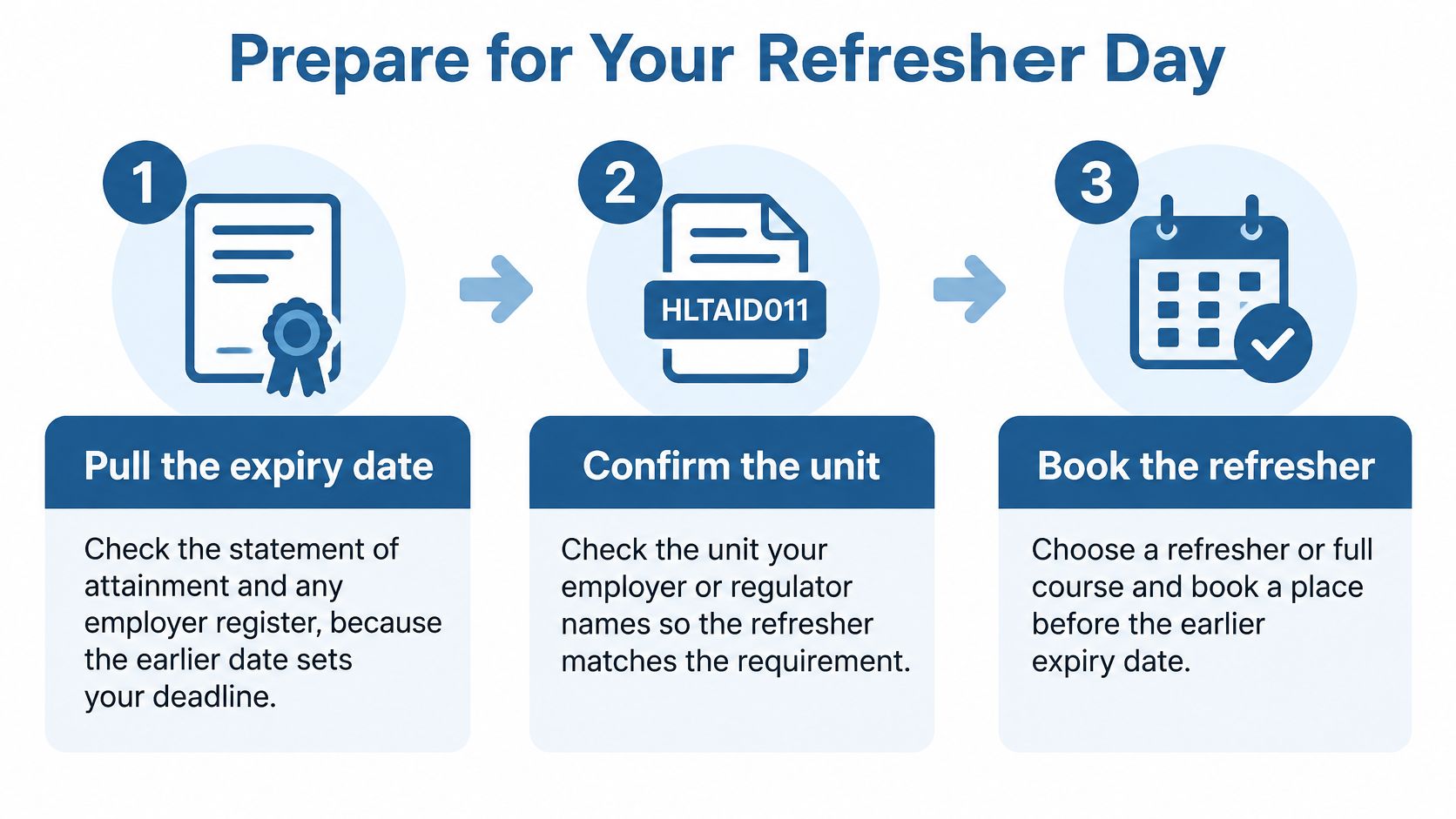
- Pull the expiry date from your statement of attainment and any employer register.
- Confirm the unit code your employer or regulator names. HLTAID011 for the first aid refresher, HLTAID009 if your role only requires CPR. Booking the wrong unit wastes the day.
- Read your workplace emergency procedure. Know where the first aid kit sits and what the escalation sequence is, because assessors ask about local arrangements and the answer isn't on any manikin.
- Run the compression self-check. Timing is the most common gap at the start of a session, and a short practice round on a cushion or firm surface tells you more than an hour of reading. If your arms tire early or your rate drifts, you know what to work on before class.
- Wear clothing you can kneel in. Shorts, leggings or work pants you don't mind putting on a floor. Bring any gear the provider asks for.
- Arrange cover for the time away and log the new completion date the day you finish. That single habit stops the next renewal from becoming a scramble.
What a passing performance looks like
Steady compressions at a consistent rate. Prompt AED use without fumbling the pads. Clear, loud calls to emergency services and a clean handover when help arrives. All of it shown without prompting from the instructor.
Each element maps to a moment in a real incident. Compressions keep blood moving to the brain. The AED only works if the pads land in the right place the first time. The handover decides whether paramedics start informed or start guessing. Assessors watch for these because casualties depend on them, so treat the assessment as a rehearsal for a day you hope never comes.
The test: could you do this on a factory floor tomorrow with no one talking you through it?
If the honest answer is "not yet", that's what the refresher day is for. Walk in with the gaps identified, and you walk out with them closed.
Confirm Your Renewal Date and Book the Refresher
Three checks decide the booking, and they run in order. Use the earlier preparation checks to settle the expiry date and unit code, then use this last check to choose the course type. If the qualification is current and inside the refresher window, book the refresher. If it has lapsed, book the full course. The two clocks still need separate attention, because a CPR date and a first aid certificate date rarely line up neatly.

Book before the deadline, not after
Book before the earliest date rather than after it lapses. Once a qualification expires, the refresher pathway may close and the full course becomes the safer choice.
If you're booking with TP Training, confirm with the team which unit the course covers and what pre-study is required before you enrol. First Aid courses require pre-study, and the course materials and pre-study modules are sent after enrolment, so leaving the booking until the week before means rushing the preparation. TP Training is an authorised provider recognised by ASQA, and the Provide First Aid Course runs 1 day and costs $90. TP Training's instructors cover First Aid training, along with White Card, Traffic Control, RSA, RCG and Food Safety training.
If you're not sure where to book, a session that covers CPR and first aid training near you puts you in front of an assessor before your date runs out.
Two calendar actions to finish today
- A CPR reminder 12 months from your completion date, with a second alert one month ahead of it.
- A first aid reminder at the three-year mark, again with a one-month warning.
Put both in the same calendar you use for work. The certificate in your drawer won't remind you, and neither will the certificate itself. If your CPR date is closer than your first aid date, book the refresher now and keep the two clocks from drifting apart again.

You may also like

Front End Loader Training Requirements: NSW Guide 2026

Asbestos Exposure: Risks, Symptoms and What to Do Next