
Asbestos Exposure: Risks, Symptoms and What to Do Next
You pull into a residential street for a routine morning job. Maybe you're chasing a cable behind an older meter box, lifting worn vinyl tiles in a laundry, or swapping out weathered eaves on a community hall. Nothing about the task looks like a major demolition, so asbestos barely crosses your mind until a chalky puff of dust drifts past your face.
Asbestos exposure on an ordinary Tuesday is the reality this article works from. The trades most likely to disturb suspect material are renovators, electricians, plumbers, painters, and council maintenance crews, because their work takes them into older buildings every week rather than to licensed removal jobs. An analogy helps here: suspect material in a wall works like a bees' nest in a cavity. You don't need to tear the wall apart to stay safe, but you do need to know it's there before you put a drill bit through it.
None of this calls for panic. A disturbance is an event you respond to, and the first hour after one follows clear, practical steps that limit how far fibres spread and who breathes them. Knowing those steps before you need them is what separates a controlled incident from a bad day.
Table of Contents
- What Asbestos Exposure Really Means
- Where Asbestos Hides and Which Tasks Release Fibres
- What to Do Immediately After a Suspected Exposure
- How Fibres Cause Disease and Why It Takes Decades
- Why Staying Under the Limit Is Not the Same as Safe
- Prevent Exposure Every Day and Book Asbestos Awareness Training
What Asbestos Exposure Really Means
Asbestos exposure means breathing in microscopic asbestos fibres released into the air when asbestos-containing materials are disturbed. Walking past an intact sheet of fibro or living in an older house doesn't count as exposure on its own, because the hazard only begins when those fibres break free and enter the air you breathe.
Say a tradesperson sets up a step ladder to drill mounting holes into a 1970s ceiling for a new light fitting. As the bit bites into the board, a faint cloud of pale dust drifts down across their shoulders and into their breathing zone. That brief cloud is where exposure happens, not from the ceiling sitting untouched overhead for forty years.
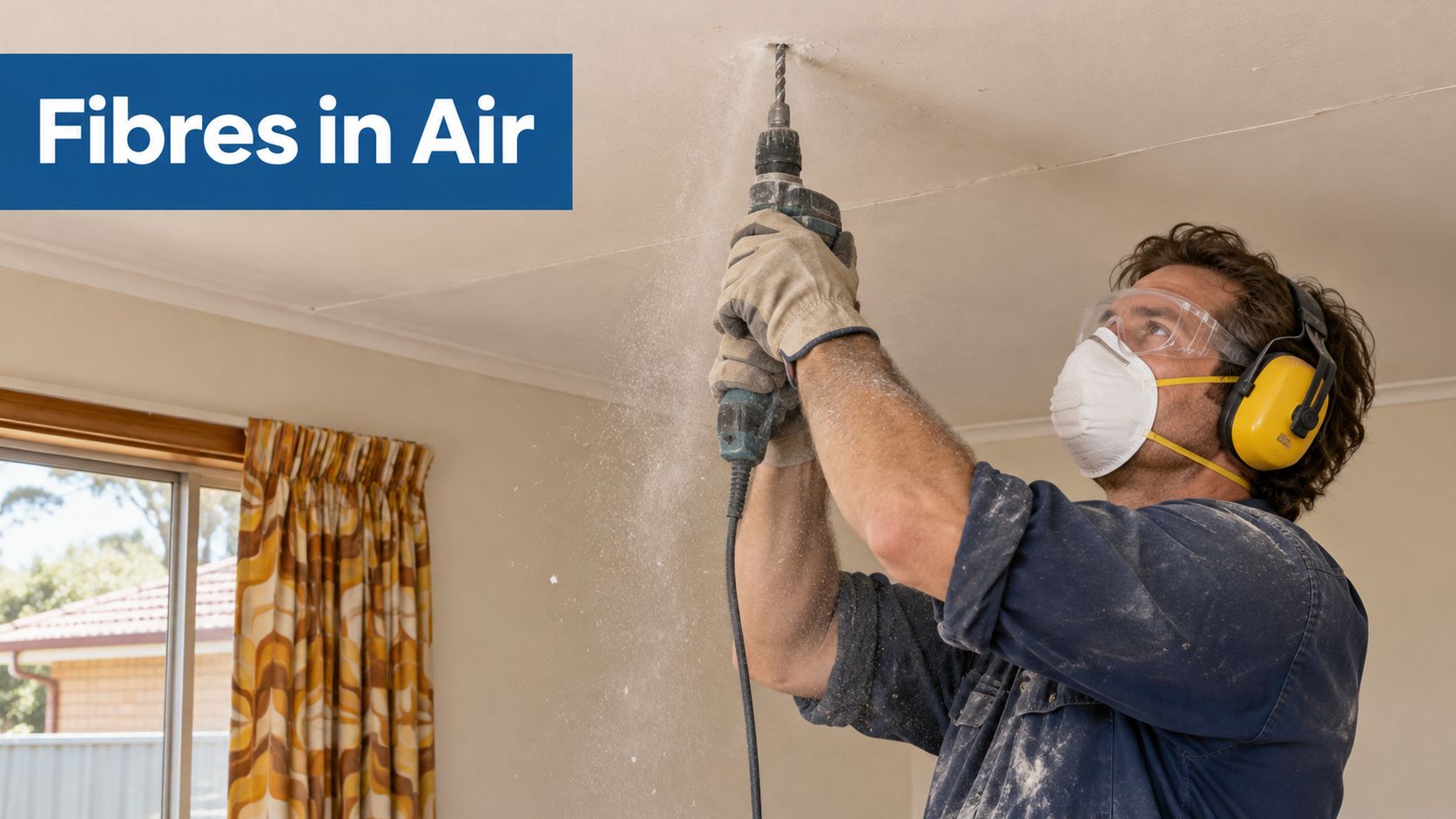
Picture asbestos fibres as microscopic splinters of glass hidden inside a bag of flour. While the bag stays sealed on a shelf, nobody gets cut. Rip the bag open and shake it, and those tiny splinters float in the air, invisible to the naked eye, ready to be inhaled and difficult for the lungs to clear once they settle.
Builders once mixed asbestos into cement sheeting, insulation, adhesives, and coatings because the mineral resisted heat, fire, and chemical breakdown while adding strength at low cost. When those asbestos-containing materials (ACMs) stay sealed, painted, and undisturbed, the fibres remain locked inside the product and present a very low risk. Trouble starts when someone sands, cuts, drills, scrapes, breaks, or demolishes them, or when age and water damage turn a once-solid product crumbly, a state explained further in our guide on what makes friable asbestos more hazardous.
Contact Is Not the Same as Disease
Inhalation is the main way asbestos harms the body. Swallowing stray dust carries far less risk than breathing fine fibres deep into the airways, which is why every Australian workplace control centres on stopping airborne dust before it forms.
It also helps to separate two terms that people often blur together: exposure and disease. Exposure is the moment of contact when fibres enter your breathing zone. Disease is a medical outcome that may or may not develop decades later, depending on the type of material, how many fibres were inhaled, and how often exposure occurred.
Quick site test: Before any tool touches a surface, ask one plain question. Is this material intact and staying undisturbed, or is my task about to release fibres into the air?
Where Asbestos Hides and Which Tasks Release Fibres
Knowing where ACMs commonly sit across older Australian homes, commercial buildings, and civil infrastructure lets you pause before the dust flies. The table below maps the materials trades meet most often and the specific actions that turn them into an airborne hazard.
| Material | Where it is often found | Risk when disturbed |
|---|---|---|
| Sprayed insulation and textured coatings | Ceilings, steel beams and older commercial buildings | High when sanded, scraped or drilled |
| Pipe and boiler lagging | Plant rooms, hot water systems and older pipework | High when cut or removed |
| Vinyl floor tiles and adhesive | Older kitchens, laundries and offices | High when sanded or ground |
| Fibre cement sheeting | Eaves, walls, fences and wet areas | Medium to high when cut, drilled or broken |
| Roof sheeting and gutters | Older sheds, warehouses and factories | Medium when cut, drilled or broken |
| Switchboard backing boards | Older electrical rooms and meter boxes | Medium when drilled or cut |
Reading the Risk by Condition and Task
Reading a table like this properly means looking at two things together: the condition of the material and the energy of the task. A material's name alone never tells the whole story. Friable products like loose pipe lagging or sprayed coatings crumble under light hand pressure and shed fibres with minimal movement, whereas bonded products lock fibres inside cement or resin until mechanical force breaks that bond.
Compare two everyday jobs with the exact same fence. Walking past an unbroken fibre cement boundary sheet carries virtually zero risk because the cement holds the fibres tight. Taking an angle grinder or circular saw to that same sheet blasts high-speed abrasive dust into the air, turning a low-risk bonded panel into a serious inhalation hazard within seconds. Hand tools that snap, drill, or scrape dry surfaces create less dust than power grinders, yet they can still liberate hazardous fibres if no wet controls are used.
Why Everyday Trades Still Face Exposure
Asbestos isn't just a chapter in Australian industrial history. According to Safe Work Australia's Australian Worker Exposure Survey, conducted between December 2025 and February 2026 among more than 6,600 workers, an estimated 2.6% of Australian workers (around 391,000 people) experienced some level of asbestos exposure in their current jobs. That same survey classified 0.8% of workers as facing high exposure and 0.6% as facing medium exposure.
Those numbers describe exposure conditions at work during the study period, not individual medical diagnoses or lifetime risk. Still, they show clearly why electricians drilling old switchboard backs, plumbers chasing hot-water pipes, roofers swapping corrugated sheets, painters scraping textured ceilings, and council crews repairing older depots need daily awareness just as much as licensed removalists.
Before starting any repair, renovation, or maintenance task, run through three quick checks:
- Age of the asset: Confirm whether the house, commercial site, shed, or civil structure is old enough to contain legacy building products.
- Site documentation: Ask to review the property's asbestos register in NSW or relevant state register so you know which materials have already been identified and where they sit.
- Task impact: Check whether your job will cut, drill, sand, grind, scrape, or break a suspect material, and stop before starting if it will.
What to Do Immediately After a Suspected Exposure
A single suspected disturbance isn't a medical diagnosis, and panicking won't clear the air. What you do in the first hour, however, controls how many fibres remain airborne and stops a localised slip-up from spreading across the whole site or back to your family car.
Think of disturbed asbestos dust like a jar of fine glitter dropped in a breezy workshop. If everyone starts pacing around, grabbing brooms, or blasting the bench with an air hose, that glitter ends up in every corner and on every shirt. Freezing movement and closing the room keeps the mess right where it fell so trained people can clean it safely.
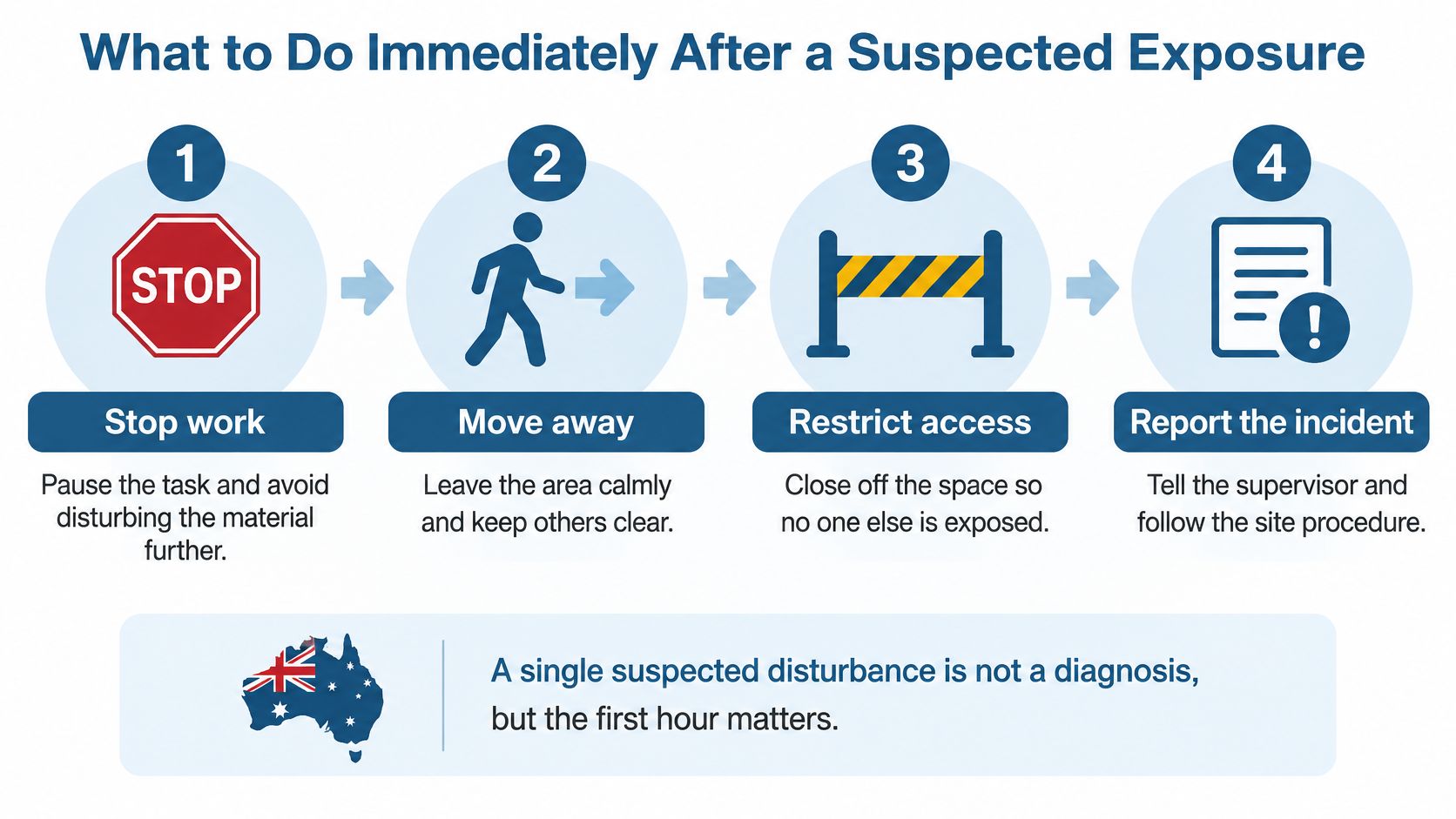
Follow these eight first-hour steps in order:
- Stop work immediately and move everyone out calmly. Putting tools down stops fresh fibres from being generated, and walking out at a steady pace avoids kicking settled dust back up into the air.
- Keep others out of the space. Shut doors, switch off fans or air conditioning that could circulate fibres into nearby rooms, tape off entryways, and place clear warning signs so another trade doesn't wander in unawares.
- Leave brooms, standard vacuums, and compressed air alone. Ordinary household or workshop vacuums don't trap microscopic fibres; they blow them straight back out the exhaust, and dry sweeping or air hoses turn settled dust back into a breathable cloud.
- Lightly mist the disturbed surface with water if it's safe. A gentle spray from a garden bottle weighs down loose dust so fewer fibres drift off, provided there are no live electrical circuits or slip hazards nearby.
- Notify your supervisor or the person conducting a business or undertaking (PCBU). Early reporting triggers site emergency procedures, and walking through what to do if you find asbestos on site ensures nobody re-enters before an assessment happens.
- Contain contaminated work clothes and wash up thoroughly. Remove dusty overalls or work clothes carefully without shaking them, seal them inside a heavy-duty plastic bag, and wash reusable garments separately from family laundry (or dispose of disposable coveralls as asbestos waste). Wash your hands and face with soap and water before eating, drinking, or touching your phone.
- Bring in competent identification and licensed removal before anyone returns. Never guess by eye whether a broken board contains asbestos. Where testing confirms licensed removal is required, Safe Work Australia's model code of practice for removing asbestos specifies that a licensed removalist must notify the regulator in writing at least five days before work begins, detailing the workplace type, notification date, planned start date and estimated duration, whether the material is friable or non-friable, enclosure arrangements for friable asbestos, estimated quantity, number of workers, and each worker's competency.
- Book a visit with your GP soon after the incident. Explain what happened, share your broader work history, and ask whether baseline or ongoing health monitoring makes sense for your role.
What a Useful Incident Report Includes
A rushed text saying "hit old fibro today" leaves the next shift guessing. Write down five concrete details while they're fresh: the exact date and time, the room or grid reference, the tool and task underway when the material broke, the material's appearance and condition, and the full names of everyone working nearby.
Hand a copy to your supervisor and keep one in your own files. Knowing how inhaled fibres affect the lungs over time makes it easy to see why a clear record from day one protects you even when you feel completely fine that evening.
How Fibres Cause Disease and Why It Takes Decades
Your airways have defences, including mucus and tiny hair-like sweepers that trap everyday sawdust and clear it when you cough. Asbestos fibres work like tiny needle-like splinters. Once breathed deep into the lungs or the pleura, the thin membrane lining the lungs and chest wall, those microscopic needles lodge in the tissue and cannot be coughed back out.
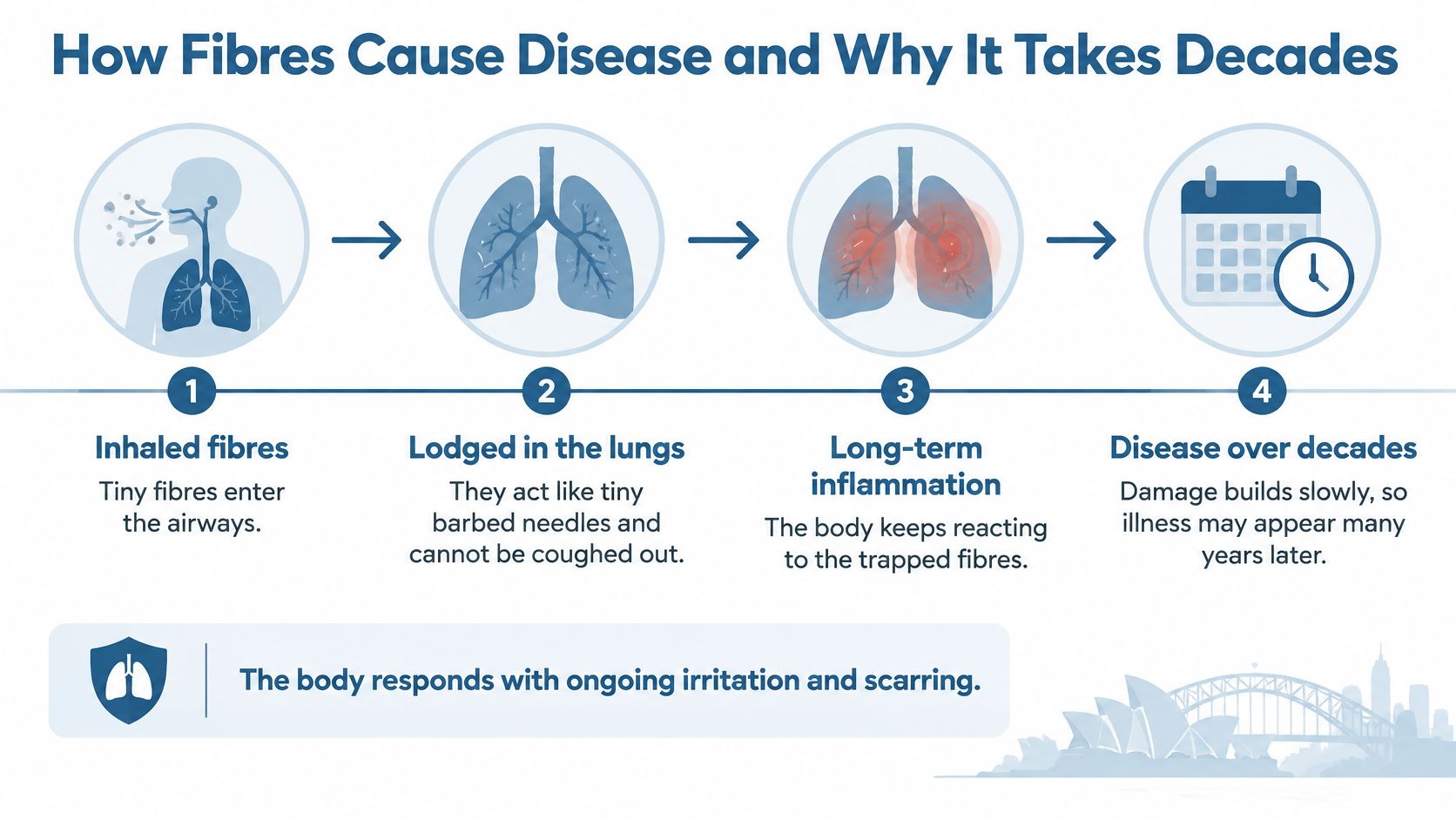
Think of a splinter under skin. The body tries to push it out, but if it stays embedded, the area remains irritated. Unable to expel trapped fibres, the immune system keeps responding year after year. According to Safe Work Australia's construction asbestos hazard guidance, prolonged irritation can lead to chronic inflammation and fibrosis, or scarring, and is linked with asbestosis, lung cancer, and mesothelioma.
The delay is what catches many workers out. A renovator who disturbed a wall lining, an electrician who drilled through old board, or a council crew that damaged an shed sheet may feel fine that night and still carry fibres deep in the lungs. Safe Work Australia's asbestos overview states that mesothelioma typically has a latency of 20 to 40 years after exposure, so symptoms can appear long after the job has faded from memory.
Disease does not always announce itself early. Pleural changes or scarring may be found only when imaging is done for another reason. That long quiet period explains why exposure records matter even when nobody has symptoms at the time.
The national picture shows the same lag. The Australian Institute of Health and Welfare mesothelioma report reports that pleural mesothelioma alone represented approximately 93% of Australian cases since 1982. AIHW Mesothelioma in Australia 2020 data records 701 deaths in 2020, showing that past exposures continue to shape present-day health outcomes. For a worker, the lesson is practical: a short disturbance can have a long tail, and the first hour of reporting and cleanup matters.
Conditions Linked to Inhaled Asbestos Fibres
Asbestos-related conditions can affect lung tissue, the lung lining, or the abdominal lining. Each has its own pattern, and the table below gives the shared reference for timing so the same ranges are not repeated throughout the text.
| Condition | What it is | Typical latency | Common signs |
|---|---|---|---|
| Asbestosis | Scarring of lung tissue | 20 to 30 years before symptoms | Shortness of breath, dry cough |
| Lung cancer | Cancer of the lung | 20 to 30 years before symptoms | Persistent cough, chest pain, weight loss |
| Mesothelioma | Rare, aggressive cancer of the lung or abdominal lining | 20 to 40 years (range 10 to 50, mean 37.4) | Chest pain, breathlessness, weight loss |
| Pleural plaques and thickening | Scarring on the lung lining, usually not cancer | Often 20 years or more | Usually no symptoms, found on imaging |
Smoking raises the risk of lung cancer for anyone who has also inhaled asbestos fibres. Tobacco smoke impairs the lungs' ability to clear dust and adds further damage to cells already under stress. Quitting smoking is one of the strongest health steps a worker with past exposure can take.
Why a Written Work History Protects You Later
An electrician may recall cutting into old ceiling board during a school refit, yet forget the name of the adjacent trade that was drilling overhead that morning. A note made at the time keeps those details together.
Keeping a simple notebook or digital log of older sites, trades performed, and suspected disturbances bridges that memory gap. If a persistent cough or chest tightness shows up years later, handing your GP an accurate work history helps them order the right scans faster and interpret pleural changes or scarring in context rather than treating them as a stubborn chest infection.
Why Staying Under the Limit Is Not the Same as Safe
A dry cut finishes, the air pump is set up, and the result comes back under the workplace exposure standard. The site can still have a problem. An air sample is a snapshot from one place and one time window. It records the air around the pump during sampling, while the worker, the wall cavity, the ceiling space, and the next trade's task all sit outside that small picture.
Under Safe Work Australia's asbestos health monitoring guidance, Australia's workplace exposure standard for asbestos is an eight-hour time-weighted average of 0.1 respirable fibres per millilitre of air (0.1 fibres/mL) measured in a worker's breathing zone. PCBUs must eliminate exposure wherever reasonably practicable. Where elimination isn't possible, they must reduce exposure as far as reasonably practicable and never allow it to exceed 0.1 fibres/mL. That same guidance states that health monitoring, including physical examination and pulmonary function testing, may be indicated when air monitoring detects exposure at or above half the standard (0.05 fibres/mL).
Post-removal work uses an even tighter verification number. As outlined in Safe Work Australia's WHS duties for asbestos, clearance air monitoring after visible asbestos is removed must record levels below 0.01 fibres/mL (10% of the exposure standard). For Class A removal, an independent licensed asbestos assessor must complete the clearance inspection and issue a clearance certificate before normal occupancy resumes.
| Benchmark | What it means |
|---|---|
| Eight-hour exposure standard | Time-weighted average in the breathing zone that exposure must not exceed |
| Health monitoring trigger | Monitoring may be indicated when air monitoring reaches half the standard or more |
| Post-removal clearance | Clearance benchmark used with inspection and documented controls, with no uncontrolled work allowed |
Safe Work Australia's guidance on interpreting workplace exposure standards reinforces that workers likely to be exposed must be informed of health risks and provided with health monitoring before starting work. It also stresses that an airborne standard offers no guarantee that a task was harmless. Knowing the legal boundaries around asbestos removal requirements helps teams plan proper containment and licensed removal before any air monitor even switches on.
Four Common Myths About Asbestos Limits
On active construction and maintenance sites, four assumptions trip workers up more than any others.
"The air test came back under the limit, so the job was safe." An air sample measures fibre concentration at one specific location and time window. Passing a test shows the air met a benchmark during sampling, yet it can't prove no fibres entered your lungs during an earlier dry cut or knocked-off gasket. Controls have to happen before dust forms, not after the pump runs.
"It was only a quick five-minute drill, so it doesn't matter." A short burst of dry mechanical abrasion on brittle material can throw a heavy spike of fibres straight into your breathing zone. Even when an eight-hour average looks small on paper, brief unprotected tasks add avoidable lifetime fibre load whose consequences may not surface for decades.
"I can't see any dust, so there are no asbestos fibres." Respirable asbestos fibres are far too fine for the human eye to detect. Clear-looking air inside a recently renovated room can still hold hazardous airborne fibres, which is why visual checks alone can never clear a work zone.
"I'm wearing a disposable dust mask, so I'm covered." Cheap paper masks leak around the nose bridge and jawline, especially over stubble, and do nothing to stop fibres settling on clothing or drifting to nearby workers. Respiratory protection sits at the very bottom of workplace controls, acting as a backup rather than a substitute for wet methods, enclosures, and licensed removal.
A limit works best as a check on your controls. Wet methods, enclosures, and clean work sequence keep fibres from becoming airborne in the first place. Air monitoring then shows whether those controls held. If you use the result as permission to relax, the same task can change from controlled to risky without any obvious sign on site.
How to use the standard properly: Treat airborne fibre benchmarks as proof that your containment and wet controls are holding, never as permission to strip away controls and work dry.
Prevent Exposure Every Day and Book Asbestos Awareness Training
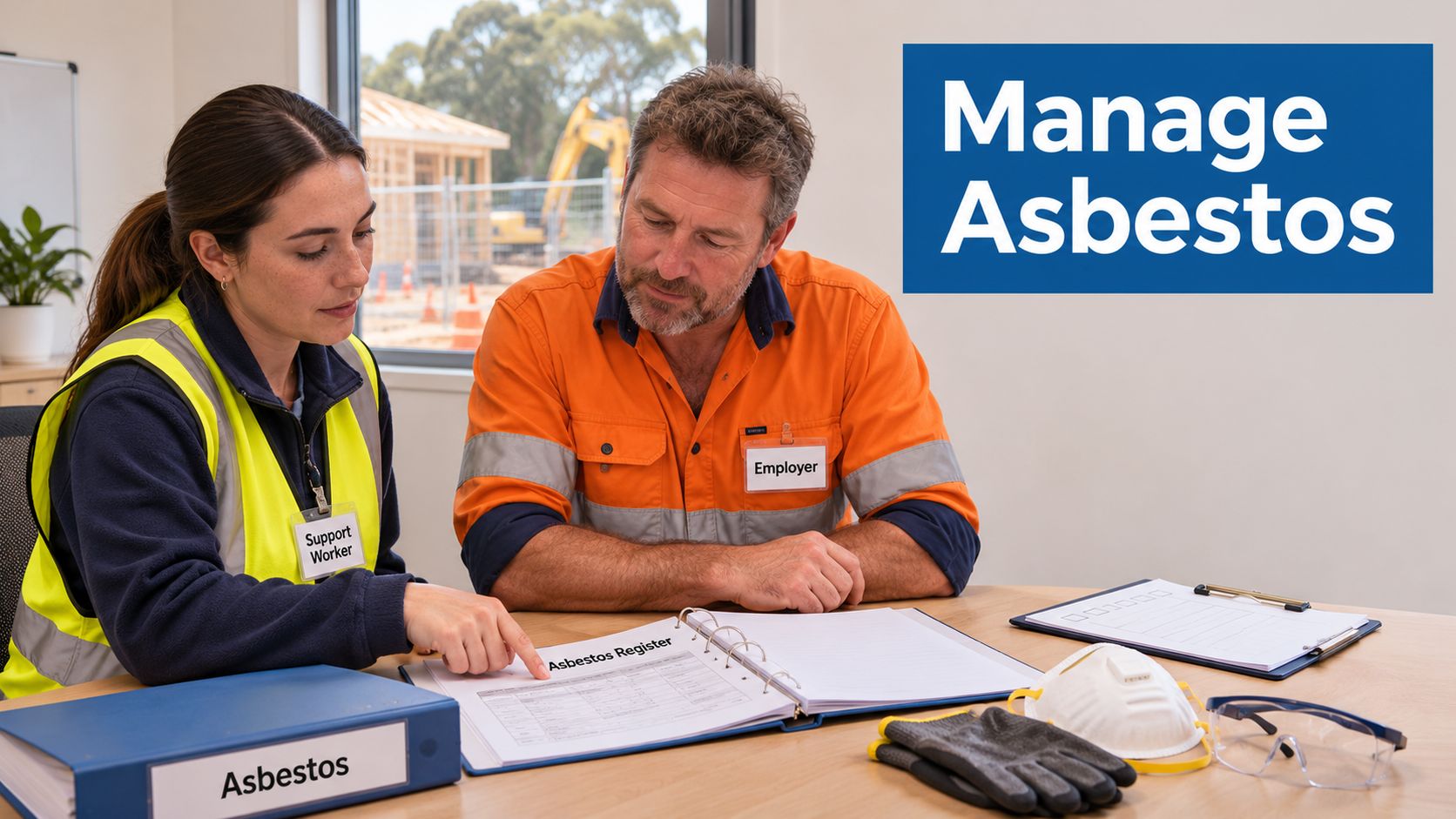
An electrician preparing to drill an older wall needs more than a cable route. The asbestos register works like a building's medical history: it records known material locations and conditions that can change how a job proceeds. Read it before choosing where to drill, cut, or open a surface.
Safe Work Australia's managing asbestos risks framework sets out an ongoing process: identify asbestos-containing materials, record relevant findings, assess the risk of fibre release, apply controls, and review whether they remain effective. For the person conducting a business or undertaking (PCBU), this means managing the hazard throughout the work, rather than treating paperwork as the finished job.
Ranking Controls From Strongest to Weakest
Re-routing a cable around asbestos-containing sheeting removes the need to disturb it. That is the practical starting point for the hierarchy of controls: choose measures that prevent exposure at its source before relying on individual behaviour or protective equipment.
Use the following layers when planning work. The appropriate combination depends on the material, the task, and what work is permitted.
- Eliminate or remove safely: Avoid disturbance by re-routing cables or pipes, or engage a licensed removalist to remove the hazard before refurbishment.
- Suppress dust at the source: For permitted work, use appropriate wet methods, dedicated dust suppression, or suitable H-class extraction equipment. These measures do not make an otherwise prohibited task acceptable.
- Isolate and enclose the work zone: Use barriers, sealed sheeting, and negative-pressure enclosures where required to prevent fibres spreading into adjoining areas.
- Decontaminate and contain waste: Plan wash-down facilities, labelled asbestos waste bags, and damp tool cleaning before work begins. Avoid dry-brushing contaminated equipment.
- Train and supervise workers: Explain the recorded material locations and approved work boundaries before tools come out. Maintain supervision near known asbestos-containing materials.
- Use correctly fitted PPE as the final layer: Use fit-tested respiratory protective equipment and disposable coveralls as backup to the other controls.
A crew briefing should turn the register into clear work boundaries. A supervisor can use the floor plan to show subcontractors which rooms contain bonded sheeting, where planned work approaches it, and which areas remain closed. An electrician then knows whether a cable route needs changing; a council crew can resolve concerns about weathered eaves before scheduling gutter replacement.
Keep the instructions specific to the job.
Everyday Actions and Training Options
Like a shared site map, a common understanding helps different trades make consistent decisions. Formal asbestos awareness training helps workers recognise suspect materials, understand when to stop, and know when an assessor or removalist is needed. Awareness training supports safe decisions; it does not replace the controls or authorisation required for the work.
Keep this combined checklist in your van or tool locker:
- Ask for the asbestos register during job preparation, then connect its entries to the actual surfaces and work locations.
- Stop if unsure about an unmarked sheet, gasket, vinyl tile, or textured coating. Resolve the uncertainty before disturbing it.
- Maintain a personal work log recording dates, sites, tasks, and any disturbance, so your work history remains available for future medical discussions.
- Complete recognised asbestos awareness training so workers and supervisors share a clear understanding of task limits and escalation.
If a disturbance occurs, the planned controls should make the first-hour response easier: workers know who supervises the job, which boundaries apply, and how to keep others away while the concern is escalated.
TP Training offers an online Asbestos Awareness course for workers fitting study around site shifts. For tradespeople who also work with concrete, bricks, and stone, its 10830Nat 11084Nat Crystalline Silica Exposure Prevention Asbestos Awareness Combo Courses take 1 day and cost $510.
Choose training that matches your tasks, then apply that learning during job preparation and crew briefings. Visit TP Training to explore asbestos awareness and combined workplace safety training options.

You may also like

Front End Loader Training Requirements: NSW Guide 2026

First Aid Training Refresher: When and What to Renew