
Responsible Service of Alcohol Course NSW: What You Learn
You're applying for a hospitality job, and the employer asks whether you've got your RSA. You want to know what the course costs, how long it takes and when you can start work. Those are sensible questions, but the harder part comes later, when a customer wants another drink and you need to decide whether serving it is safe and lawful.
A responsible service of alcohol course prepares you for that decision and what follows. Refusing a drink isn't the end of the job. Staff still need to communicate, check the patron's welfare, manage the immediate risks and leave a clear record of their actions.
Table of Contents
- Course Length, Cost and Credentials at a Glance
- Who Needs the RSA Course and Which Pathway Applies
- Enrol, Train and Get Your Competency Card in NSW
- What the Course Teaches About Intoxication and Standard Drinks
- What to Do After You Refuse Service
- Cumulative Risk and Mistakes That Undo Responsible Service
Course Length, Cost and Credentials at a Glance
Responsible Service of Alcohol course quick reference
| Item | Detail | Why It Matters |
|---|---|---|
| Course length | 6 hours, excluding breaks | Plan a full day, not a short session |
| Price (SITHFAB021) | $190, reduced from $220 | Includes the NSW RSA Competency Card fee |
| Unit of competency | SITHFAB021, formerly SITHFAB002 | The code listed on your Statement of Attainment |
| Credential on completion | Nationally recognised Statement of Attainment | Evidence of training for employers and licensees |
| Provider approval | Liquor & Gaming NSW approved, ASQA accredited | Confirms the course meets NSW requirements |
TP Training is approved by Liquor & Gaming NSW and accredited by the Australian Skills and Quality Authority to deliver this nationally recognised training. The practical distinction is between learning the required skills, receiving evidence of competency and completing the credential process needed for your work.
RSA is a risk-control system for licensed venues, not just a customer-service skill. It works like a smoke alarm in a building, not a receipt for the kitchen: its purpose is to help staff catch a developing problem before someone gets hurt, rather than merely prove that a transaction happened.
What the training prepares you to do
The course brings together connected responsibilities:
- Alcohol laws and industry regulations, so you know when service is prohibited and when you need to escalate.
- Harm minimisation and managing intoxication, including observing patrons and responding before a situation deteriorates.
- Safe service practices and refusal, so your decisions translate into clear, consistent action.
Commercial arrangements don't change those responsibilities. Understanding how bottle service minimums work can help staff recognise the spending expectations attached to a booking, but a customer's minimum spend never determines whether further alcohol service is appropriate.
If you're comparing entry-level qualifications, our guide to short courses in NSW can help you organise your training choices. Before booking RSA, establish whether you need initial training or qualify for a renewal pathway.
Who Needs the RSA Course and Which Pathway Applies
In NSW, anyone who sells, serves or supplies alcohol to the public in a licensed venue must complete the required RSA training before undertaking those duties. This covers bar, restaurant, club and event staff, not just managers and licensees.
Match your circumstances to the right pathway
Liquor & Gaming NSW's RSA guidance requires approved training and the appropriate competency card or endorsement, with certification renewed every five years; its guidance distinguishes full training, including for people whose previous training is more than five years old, from eligible refresher training.
Which RSA pathway applies to your situation
| Your Situation | Course You Need | Why |
|---|---|---|
| New to the liquor industry or never completed RSA | Full RSA course | Required before alcohol-service duties in NSW |
| Bar, club, restaurant or event staff, not managers | Full RSA course before starting if you haven't already qualified | The requirement applies across alcohol-service roles |
| Previous RSA training more than five years old | Full RSA course | The renewal framework requires current competency |
| Recent training and card still valid | Refresher course when eligible for renewal | Eligible workers may renew without repeating the full course |
| Card expired | Full RSA course unless refresher eligibility is confirmed | Expiry doesn't automatically mean you remain eligible for refresher training |
Our enrolment rule is specific: if your competency card expired more than 28 days ago, or you've never completed RSA, you must attend the full course. If it expired within the last 28 days, you can complete the online refresher through Liquor & Gaming NSW instead. Confirm your eligibility and renewal window before paying for training.
Before booking: Find your existing card and check its expiry date. Don't choose a course based on what a colleague needed.
What employers need to check
Renewal makes RSA a recurring compliance milestone, not a qualification you file away permanently. Employers need to check that workers are appropriately credentialed before assigning alcohol-service duties, rather than relying on an applicant saying they completed training sometime in the past.
The scale of alcohol use explains why frontline decisions matter: the State Library of NSW's alcohol information reports that more than 85% of Australians aged 14 and over had consumed alcohol in their lifetime, according to the 2022–2023 National Drug Strategy Household Survey.
For job seekers exploring hospitality jobs in Sydney, RSA belongs in the preparation stage, not on the list of things to sort out after starting. The practical test is your duties: if you'll sell, serve or supply alcohol in a NSW licensed venue, establish your valid training and credential pathway before your first alcohol-service shift.
Enrol, Train and Get Your Competency Card in NSW
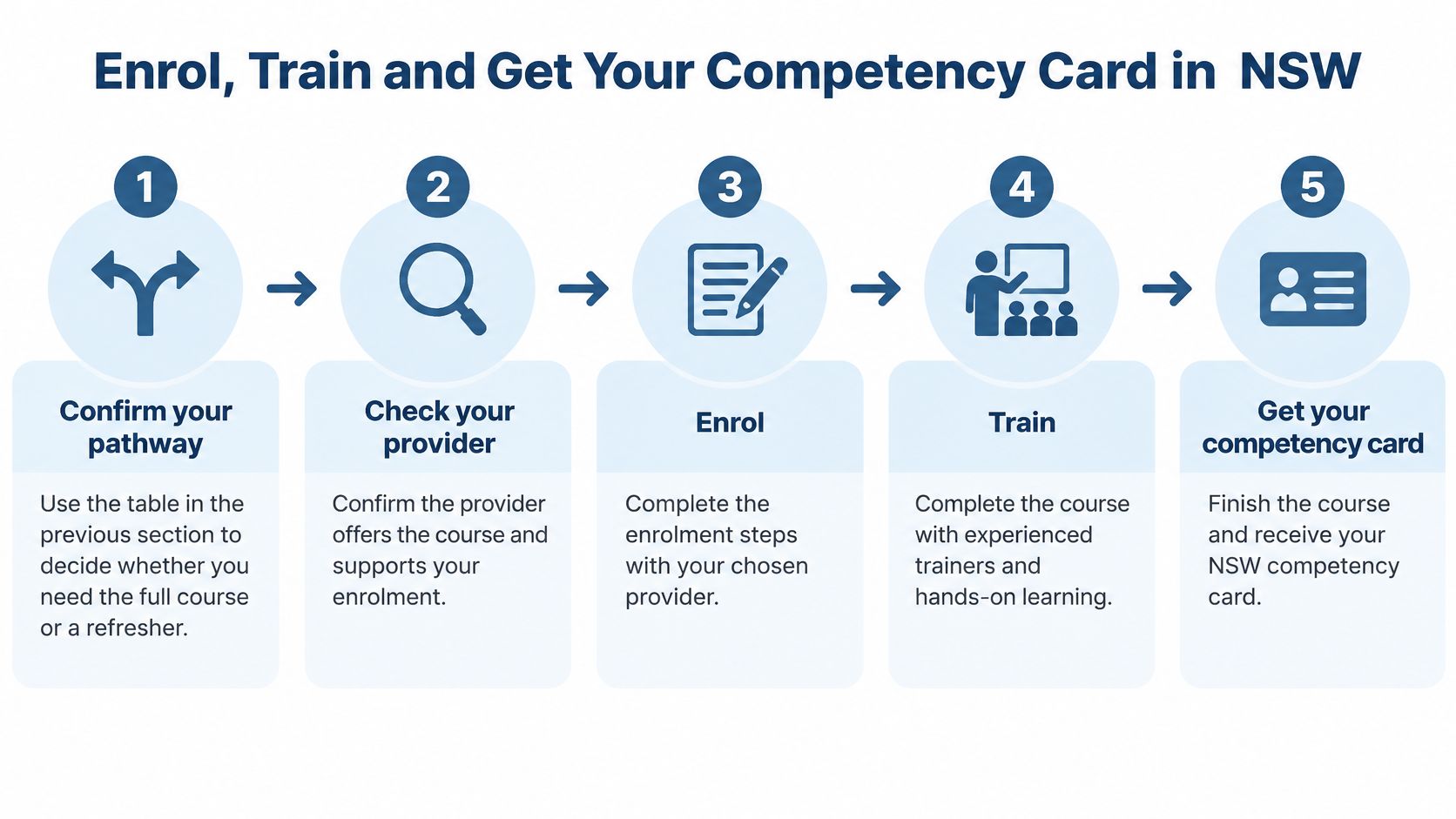
Enrolment works best when you treat the booking, training, assessment and card steps as one sequence with clear hand-offs. Missing one step can leave you trained but still unable to show the credential an employer needs before alcohol-service duties begin.
The process below provides a practical overview, while the checklist helps you avoid common delays.
Before you attend
Check the session, not just the course name. TP Training offers the Provide Responsible Service of Alcohol Course RSA, and the listing is the booking point for the practical, nationally recognised course. Check the session details you are selecting, including the stated location and any instructions sent with the enrolment confirmation.
Plan for the full training commitment. The RSA course runs for 6 hours, excluding breaks. Arrange transport, work cover and personal timing around the session length. The avoidable mistake is turning up as if this were a short appointment, then rushing the scenarios or leaving before questions are resolved.
Bring the details that make your record accurate. Bring any previous competency card or its details so your circumstances can be checked accurately. Read your enrolment communications carefully and confirm what identification, paperwork or other preparation you need before travelling. If your role also involves handling food, keep that requirement separate. The food safe handlers certificate guide helps you distinguish food-handling preparation from alcohol-service training, so you don't assume that completing either qualification covers both responsibilities.
During training and after assessment
Practise decisions under pressure. Training connects the rules with service decisions, including alcohol laws and industry regulations, harm minimisation and managing intoxication, and safe service practices and refusal of service. Focus on how you explain a refusal when a patron challenges it. Refusal starts the incident management task, because you still need to communicate the decision, stop further supply and keep the situation calm.
Complete the assessment requirements. Expect to show your understanding of the law and your judgement in service situations, including when and how to refuse alcohol. Confirm the current assessment format before enrolling. Attendance alone does not establish competency.
Receive your Statement of Attainment. Successful completion gives you a nationally recognised Statement of Attainment for SITHFAB021, known as SITHFAB002. Check your personal details and keep an accessible copy for employment checks. Frontline employers may ask for the record before they roster you into alcohol-service duties.
Complete the competency card application process. The listed fee is $190, reduced from $220, and that fee includes the NSW RSA Competency Card fee. You still need to follow the application instructions and confirm that the required credential is in place. Leaving this until an employer offers an immediate start can delay your first alcohol-service shift.
Keep copies of the Statement of Attainment and your competency card details where you can retrieve them quickly. They serve different purposes, and both matter when an employer checks readiness.
What the Course Teaches About Intoxication and Standard Drinks
Under the Liquor Act 2007, staff must not sell or supply alcohol to an intoxicated person, and venues must take proactive steps to prevent intoxication, as explained in NSW's guidance on managing intoxicated patrons. Those duties require more than waiting for a customer to become disruptive.
The course connects legal knowledge with observation and action. Knowing the rule is necessary, but you also need to notice the change in a patron, communicate it to colleagues and stop further supply when required.
Legal duties include protecting minors
NSW Police's alcohol guidance explains that selling or supplying alcohol to a minor on licensed premises is prohibited; for unlawful supply, an on-the-spot penalty of $1,100 may apply, while a court can impose a fine of up to $11,000 and/or up to 12 months' imprisonment.
The same guidance distinguishes unlicensed premises, where supply must come from a parent, guardian or person authorised by them and remain consistent with responsible supervision. Supplying an intoxicated child can never meet that supervision standard.
For venue staff, the practical response is to follow the approved identification procedure and watch who receives the drink. An adult paying for a round doesn't remove the need to consider whether alcohol is being passed to someone who cannot lawfully receive it.
Recognise impairment without making assumptions
Observable signs include slurred speech and unsteady balance. Look at the patron's behaviour, how it changes and the surrounding circumstances, rather than labelling someone from appearance alone.
Say a patron has become difficult to understand and is struggling to remain steady while reaching for a payment terminal. Another drink isn't the appropriate response while staff debate whether the person will become troublesome. Stop the transaction, communicate your observations and involve the duty manager according to the venue's procedure.
A disability or medical condition can affect speech or movement. Ask respectful questions and seek support where needed, rather than assuming every unusual behaviour is caused by alcohol.
A serving isn't a standard drink
NSW Government's alcohol and health guidance defines an Australian standard drink as 10 grams of pure alcohol and recommends that healthy adults consume no more than 10 standard drinks a week and no more than four on any day to reduce harm.
Approximate standard drinks in common servings
| Serving | Approximate Standard Drinks | Staff Watch-Out |
|---|---|---|
| Nip of spirits, 30 ml at 40 percent | About 1 | Measure spirits by volume, not by glass shape |
| Double spirit, 60 ml at 40 percent | About 2 | A double counts as approximately two standard drinks |
| Standard wine, 150 ml at 13 percent | About 1.5 | Generous pours push this higher |
These are rounded serving examples, not a replacement for the product's standard-drink information. Check labels, recipes and actual measures, especially when a cocktail combines several alcoholic ingredients.
Product strength matters for beer too. Background reading on full strength beer percentage in Australia can help staff understand the terminology, but the product in front of you is what determines the alcohol content.
Use approved measures, learn the house recipes and make water, food and appealing non-alcoholic options easy to obtain. Health guidelines aren't a service allowance: a patron doesn't become eligible for another drink merely because your rough count appears below a guideline.
What to Do After You Refuse Service
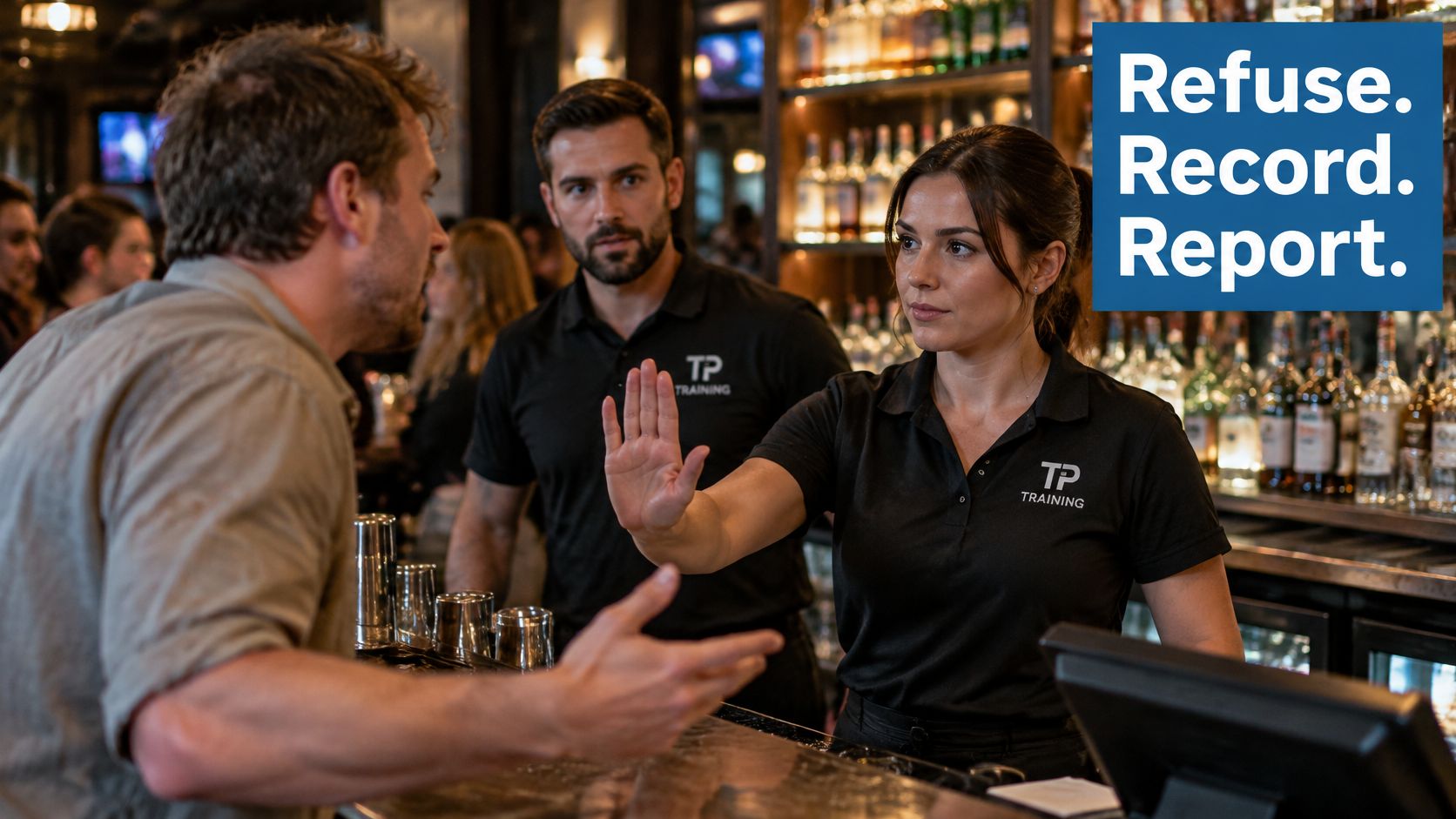
The bartender puts the bottle back on the shelf and says no. The patron, slurring their words and swaying at the counter, raises their voice. What happens in the next few minutes decides whether the situation de-escalates or becomes a reportable incident.
Once the bartender refuses, the incident is just starting, and the team's next actions matter most. The team still needs to prevent further supply, support the staff member and assess whether the patron needs help.
Move from refusal to a coordinated response
- State the decision calmly. Explain that you can't provide more alcohol and can help with water or a safe way home. Keep the message brief; don't turn the conversation into a public argument about whether the patron is drunk.
- Bring a colleague into the response. Notify the duty manager and other service staff so the patron can't order elsewhere. Maintain personal space and an unobstructed exit for staff.
- Check welfare before assuming defiance. Ask whether the person is with someone they trust. Sudden deterioration, reduced responsiveness or suspected drink spiking calls for a welfare-focused response and medical escalation where needed.
- Arrange support and transport. Explain available transport options and establish who will monitor the patron while arrangements are made. Involve security if behaviour creates a safety threat, and emergency services for urgent medical danger.
- Write a factual record. Note observed behaviour, the refusal, staff involved, assistance offered and the outcome. Describe what happened rather than using insults or unsupported diagnoses.
Water and food can be useful offers. Neither reverses intoxication, and neither makes further alcohol service appropriate, so a well-intentioned gesture must not become a reason to resume supply.
Refusal doesn't automatically mean immediate removal
Liquor & Gaming NSW's March 2025 guidance update added drink-spiking guidance, recommended recording actions and interactions involving intoxicated patrons, and recognised discretion to keep a patron on premises where needed for medical assistance or safe transport.
That discretion carries conditions: a managed decision, appropriate oversight and no further alcohol supply.
A refusal is a service decision. Safe management is the work that follows.
Immediate ejection may move a vulnerable person out of staff view without resolving their risk. Keeping someone in a crowded service area without supervision isn't a welfare plan either. The manager needs to weigh medical needs, behaviour, staff safety and transport arrangements.
The practical test is simple: could you explain every action you took in a written record?
Cumulative Risk and Mistakes That Undo Responsible Service
The costly mistake is judging every order as an isolated transaction. A patron can receive drinks from the bar, a table server and friends buying rounds, while each staff member sees only part of the evening.
The NSW Chief Health Officer's report states that 26.2% of NSW adults exceeded the Australian Alcohol Guidelines in 2025, rising to 33.1% among people aged 18 to 24. Those population figures don't tell you whether a particular patron is intoxicated, but they reinforce why prevention cannot depend on a single glance at the counter.
Fix the gaps between transactions
- Mistake, treating the card as permanent. Fix it by recording renewal reminders alongside staff credential checks and confirming refresher eligibility before expiry. Don't wait until the roster depends on someone whose credential needs attention.
- Mistake, observing patrons only when they order. Fix it through floor observation and clear handovers. Tell colleagues which patron concerns you, what you observed and what action has already been taken, rather than saying only that a table is getting rowdy.
- Mistake, assuming digital or table orders are low-risk. Fix it by assessing the person receiving the drink, not merely accepting that the ordering system processed payment. Apply the same service judgement to QR orders, table service and rounds bought by someone else.
- Mistake, judging alcohol content by glass size. Fix it with measured pours, known recipes and product information. A short cocktail can require closer attention than a much larger non-alcoholic drink.
Event teams need the same coordination even when staff are temporary or working across separate service points. Resources such as corporate event bartender staffing tips can help with planning, but the operational priority is a named supervisor, clear escalation arrangements and staff who share relevant observations.
Make the handover useful
A useful handover identifies a patron without embarrassing them, explains the concern and assigns the next action. Someone needs responsibility for checking on the person; a message sent to a group doesn't establish that anyone has acted.
Unexpected impairment also deserves attention beyond a routine refusal. Treat suspected drink spiking as a welfare concern, involve the manager and document observations and assistance without claiming to know the cause.
Hospitality workers may carry other safety responsibilities during the same shift. Our guide to what a food safety supervisor does helps separate that role from RSA duties, so employers can allocate responsibilities clearly.
Strong compliance results can still leave individual patrons at risk. The measure that matters during service is whether staff notice developing problems, communicate effectively and intervene before the next avoidable incident.
TP Training offers practical, nationally recognised RSA training with experienced trainers and hands-on learning to prepare you for lawful service, refusal and patron management. Visit TP Training to check course options, confirm your pathway and organise training before starting alcohol-service duties.

You may also like

Front End Loader Training Requirements: NSW Guide 2026
First Aid Training Refresher: When and What to Renew