
Absolute Owner Builder NSW: Permits, Rules and Duties
In New South Wales, an absolute owner-builder is a landowner who supervises or carries out residential building work directly instead of engaging a licensed builder, and a permit is needed when the work exceeds AUD 10,000 including labour and materials. Cross AUD 20,000 and approved owner-builder education sits on top of that permit, not in place of it.
So here's the question most renovators never ask: if you hire every trade yourself and no builder ever signs a contract for your job, who answers when the waterproofing fails? Plenty of owners assume that paying a licensed plumber and a licensed electrician separately spreads the responsibility around. It doesn't. You become the responsible party, and the permit, the education and the insurance rules are one compliance path rather than three unrelated chores.
Table of Contents
- What an Absolute Owner-Builder Means in NSW
- Owner-Builder Thresholds at a Glance
- Responsibilities You Take On as an Owner-Builder
- Permit, Approvals and Education Steps
- Contractor Licences, Insurance Gaps and Owner-Builder Limits
- Confirm Your Permit Path Before You Build
What an Absolute Owner-Builder Means in NSW
Think of a football team. A supporter buys a ticket, watches the game and complains about the result. A head coach picks the players, sets the plays, manages the bench and owns the scoreboard. An absolute owner-builder is the coach, not the supporter.
The NSW Government owner-builder guidance describes the role as a landowner taking direct responsibility for supervising or carrying out residential building work rather than engaging a licensed builder to supervise the project, and it sets the trigger at a reasonable market value above AUD 10,000, including labour and materials. That value is the market worth of the work, not just your cash outlay. If you supply the timber yourself and a mate helps on weekends, the value of that labour and material still counts towards the threshold.
The work the role covers
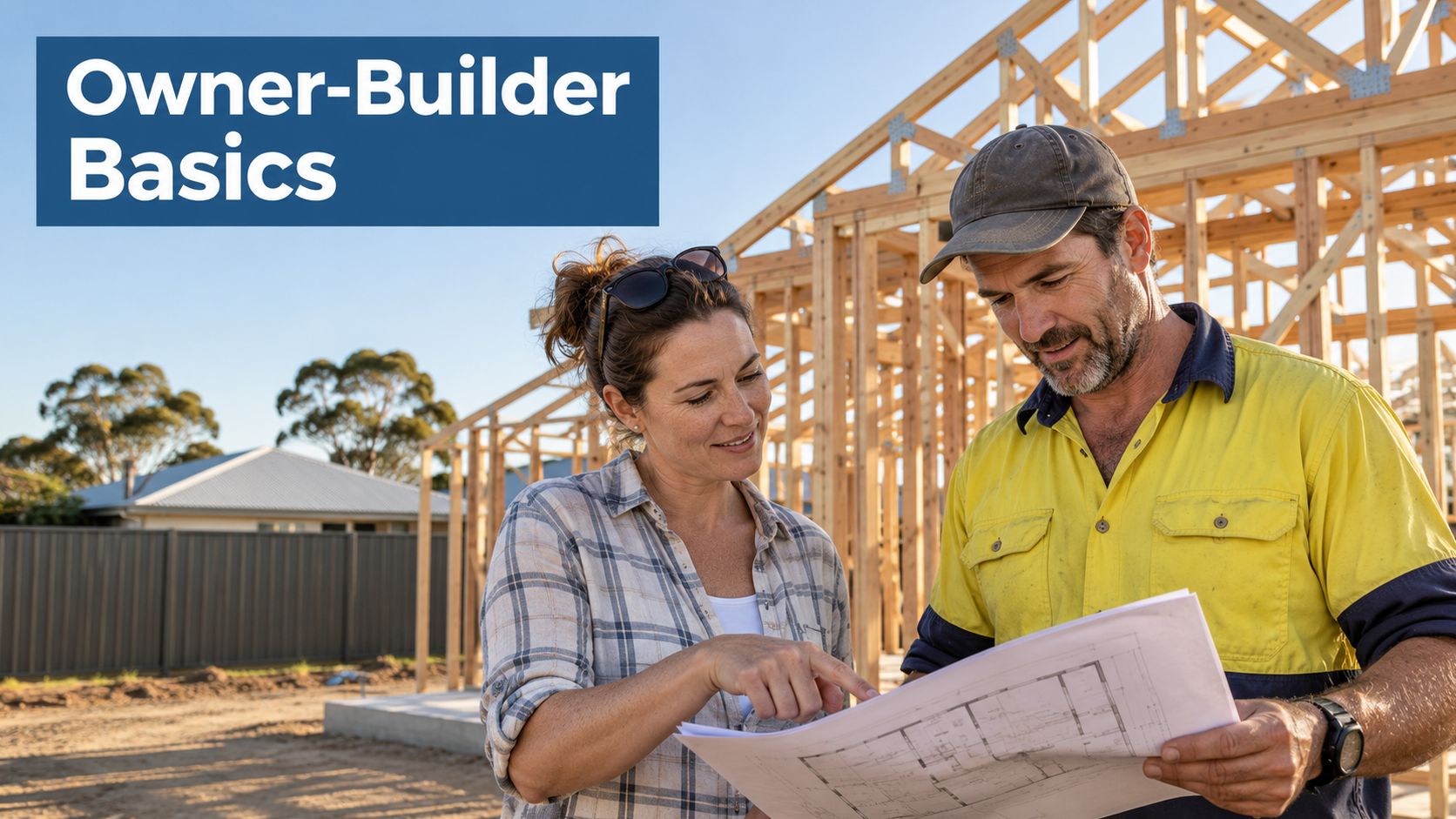
The same guidance applies the rule to construction, alterations, repairs or additions involving a single dwelling, dual occupancy or certain secondary dwellings, provided the project holds the required development approval or complying development certificate. A granny flat at the back of a suburban block can qualify. A commercial fit-out or a block of units isn't the same pathway.
Client or coach
Say you're adding a bathroom and a deck. If you sign one contract with a licensed builder who supervises the job, you stay a client: you approve variations, you pay progress claims, and the builder carries the coordination and site duties. If you engage the waterproofer, the tiler, the carpenter and the electrician yourself, you've taken the whistle. You now select the trades, sequence them, check their licences against the trade licensing requirements that apply across Australia, and answer for the result.
Self-check: Do you own the land, is the work worth more than the permit threshold, and will you supervise it yourself? Three yeses means you're the coach.
Run those three questions before you order a single sheet of plasterboard. Owners who answer them late usually discover the problem at the certifier's office, not at the drawing board.
Owner-Builder Thresholds at a Glance
| Requirement | Threshold or rule | Applies to |
|---|---|---|
| Owner-builder permit | Work valued above AUD 10,000 including labour and materials | Single dwelling, dual occupancy or certain secondary dwellings with development approval or complying development certificate |
| Additional owner-builder education | Project value above AUD 20,000 | Approved competency units or recognised equivalent qualifications and experience |
| White Card | Mandatory for every application | Every NSW owner-builder permit, regardless of project value |
| Trade licence for tradespeople | Home-building work above AUD 5,000 in labour and materials | Trade contractors engaged by the owner-builder |
| Permit frequency | One permit in any five-year period | Most applicants |
| Minimum age and ownership | At least 18 years old and owner or joint owner of the land, or meet lease or company-shareholding conditions | Individual applicant |
How to read the two dollar lines
The first line is the gate. Below it, you're doing ordinary renovation work. Above it, you're in a regulated role with a permit number attached to your project. The second line doesn't replace the first, it stacks on it: a bigger job needs the permit and proof that you've been trained to run a site. Owners often assume the education requirement is the "real" licence and the permit is paperwork. It's the reverse. The permit is the authority, the education is the competence evidence supporting it.
The White Card row has no dollar figure at all, and that's deliberate. Induction training is about whether you understand a worksite, not about how much you're spending, so a modest bathroom job and a full extension both require it.
Using the table on your own project
Work out the reasonable market value first, with every trade quote and material allowance included. Then tick each row that applies to you, and note the eligibility rows carefully: the age and ownership conditions catch joint owners and company or lease arrangements, and the frequency limit means an owner who has already permitted a project can't line up the next unrelated property. Finally, list the documents each ticked row demands, because that list becomes your application file.
Responsibilities You Take On as an Owner-Builder
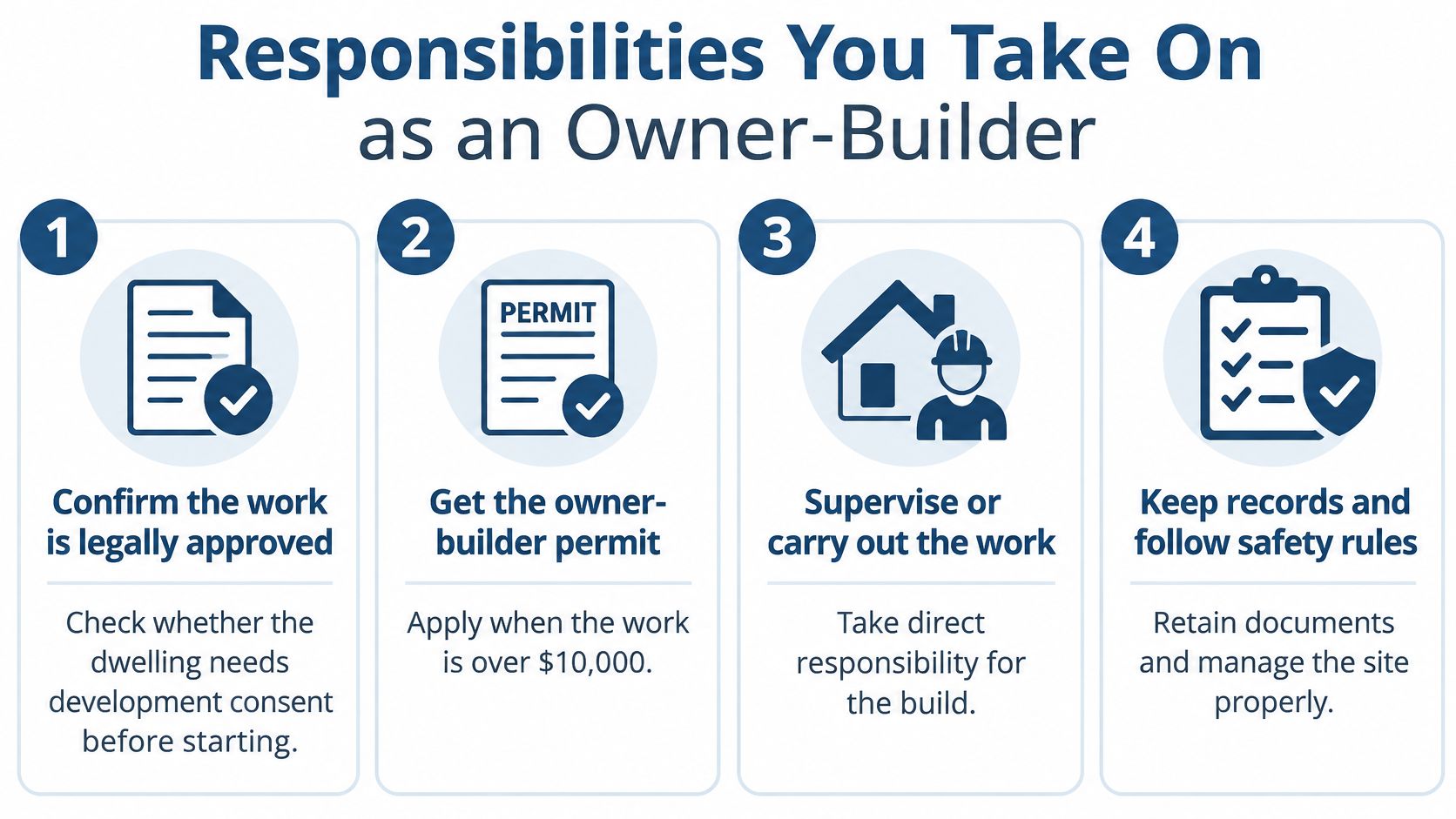
Start with the approval check, not the shopping list. Confirm whether your dwelling needs development consent or a complying development certificate, and confirm it through the NSW Planning Portal before anyone sets up a trestle. A permit authorises you to run the work; it doesn't authorise the work itself.
The NSW owner-builder working guidance makes the shift explicit: the permit holder is responsible for coordinating approvals, ensuring the work complies with applicable building laws, managing financial and insurance requirements, and maintaining a safe workplace under the Work Health and Safety Act 2011. You carry duties comparable to a builder even if you never lay a brick.
Five duties, five practical consequences
- Coordinate approvals and building compliance. Book the mandatory inspections at the right stages. Sheeting over a frame before the frame inspection means pulling the sheets back off.
- Manage finances and insurance. Keep a payment schedule tied to completed work, not to a tradie's cash flow. Paying ahead of progress removes your only bargaining power.
- Verify every trade licence before engagement. Check the licence number covers the actual task, not just a related category, and save a screenshot with the date.
- Document contracts and scopes. Write down what's included, what's excluded and who supplies materials. Most disputes start with an unwritten assumption about rubbish removal or waterproofing.
- Keep the site safe. You control the hazards, so you control the controls, the same way an employer does. Our guide to the responsibilities of employers explains the duty of care logic that sits behind this.
Hazards you now own
The working guidance names falls from height, electrical work, mobile plant, silica dust and asbestos. Practically: edge protection or scaffold on any raised deck, a licensed electrician for all wiring, exclusion zones around excavators and loaders, on-tool water suppression or dust extraction with a P2 respirator when cutting concrete or engineered stone, and a check for asbestos-containing material before any demolition in an older home. TP Training delivers the nationally recognised 11084Nat Asbestos Awareness Training Course with experienced trainers and hands-on learning across NSW, which covers identification and safe response rather than removal.
Before day one on site, tick these: approval confirmed, permit issued, certifier appointed, licences sighted, contracts signed, insurance evidence filed, site controls in place.
Permit, Approvals and Education Steps
Order matters more than speed here. The steps below run in sequence, and skipping ahead is what creates rework.
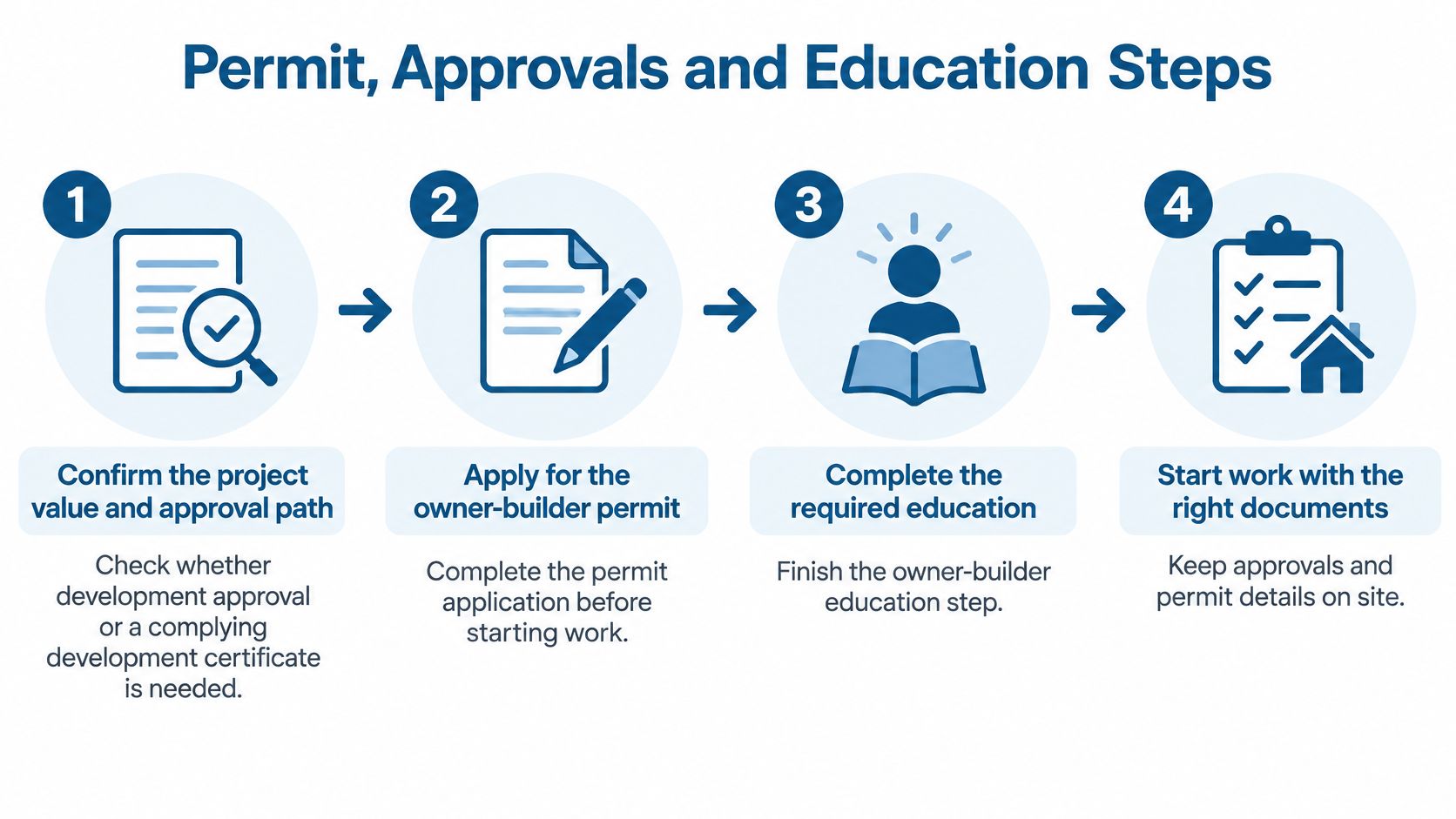
- Confirm the project value and the approval path. Add every quote and material allowance, then establish whether the job needs development approval or a complying development certificate.
- Apply for the owner-builder permit before work begins. Not while the slab is being poured, and not after the first trade has been booked in.
- Appoint the principal certifier only once the permit is in place. The certifier needs to see your authority to run the job.
- Complete the education step if the value requires it. The NSW owner-builder application guidance requires approved owner-builder education units, or recognised equivalent qualifications and experience, where the project value exceeds AUD 20,000.
- Hold a current White Card. The same guidance makes a general construction induction training card mandatory for every NSW owner-builder permit application, regardless of project value. Our White Card NSW guide covers what the induction involves.
- Start building only when the file is complete. Approvals, permit, certifier, education evidence, induction card, contracts and licence checks all sitting in one folder.
What the five competency areas actually teach
The required education covers five areas, and each maps to a job you'll do on a real site:
- Construction work health and safety: spotting the hazard before the trade arrives, and choosing a control that doesn't rely on someone remembering to be careful.
- Reading plans and specifications: finding the set-down detail on a bathroom drawing so the tiler doesn't tile straight over an unwaterproofed slab.
- Planning and organising work: sequencing rough-in, inspection, then sheeting, so no trade turns up to a wall that isn't ready.
- Workplace communication: running a clear pre-start briefing and giving instructions in writing when a scope changes.
- Prescribed construction-industry requirements: the industry knowledge that underpins the rest, including how licensing and site rules fit together.
A Unique Student Identifier (USI) is mandatory for all accredited courses in Australia, and we can't issue certificates without one, so create yours before you book rather than after you've finished the class.
The licensing line you can't cross
NSW guidance also states that tradespeople performing home-building work costing more than AUD 5,000 in labour and materials must hold the relevant licence. Managing the project yourself doesn't let you hand licensed work to an unlicensed mate. The permit changes who supervises, not who's allowed to do the work.
Contractor Licences, Insurance Gaps and Owner-Builder Limits
The protection gap is the part owners discover last and regret most. According to SafeWork NSW's home building compensation information for owner-builders, owner-builders cannot obtain home building compensation cover for work they perform themselves, and the scheme also doesn't provide cover for work performed by their contractors under the owner-builder project.
Read that twice. The safety net many homeowners assume exists, the one that responds when a builder disappears or work is defective, isn't available for your own work or for the trade work sitting under your owner-builder project.
Where the contractor's own obligation sits
There's a separate duty on the trade side. The same SIRA guidance states that a licensed contractor who contracts directly with an owner-builder for residential building work priced above AUD 20,000 including GST must generally hold the required home building compensation insurance. So an eligible contractor carries its own statutory insurance obligation, while your overall responsibility for quality, coordination, defects and site safety stays exactly where it was.
Splitting a build into six trade contracts doesn't create six responsible parties. It creates six invoices and one coach.
A worked example
Say you engage a plumber and an electrician separately on a bathroom and laundry renovation. Each needs their own licence evidence and, where the contract value triggers it, their own insurance certificate on your file before they start. Now say the shower leaks and the damage reaches a power circuit. The plumber blames the screed, the electrician blames the wet area, and neither contract covers the other's work. You're the one who has to establish what happened, engage an independent inspector, and fund the fix while the argument runs.
Written evidence before engagement, not after the first invoice. A licence number and an insurance certificate cost nothing to collect and everything to chase retrospectively.
The file and the budget
Build a project folder with each contractor's licence check, insurance certificate, signed scope, variations and invoices. Add independent inspections at the stages that matter, particularly waterproofing and structural work, and hold a genuine contingency fund, because you're the insurer of last resort on your own work. Ancillary compliance items belong in the same folder. Pool barriers, for instance, are a regulated detail owners routinely underestimate; the XTREME EDEALS pool fence guide is a useful illustration of how prescriptive barrier rules can be, though your NSW requirements come from your approval conditions and certifier. Older properties add another layer, and our notes on asbestos removal requirements explain why removal is licensed work rather than a weekend task.
Then respect the limits. The permit frequency cap and the restricted dwelling types mean this pathway isn't a rolling business model. If your structure is complex, your approval status is unclear, or your value sits close to either dollar trigger, get advice from the relevant NSW authority or a qualified professional before you commit.
Confirm Your Permit Path Before You Build
Confirm the pathway before you buy materials or sign a contract, because that's the order that keeps your options open.
- Write down the reasonable market value, labour and materials included.
- Compare it against both dollar triggers.
- Confirm approvals through the NSW Planning Portal, since Service NSW's owner-builder permit transaction states a permit is needed for work worth more than $10,000 on a dwelling where development consent is required.
- Check your age, land ownership and permit history against the eligibility rules.
- Plan your induction and any education your project value requires.
Our White Card (Construction Induction) course runs 7 hours and costs $95, and our trainers are experienced industry professionals who can explain where it fits in the owner-builder pathway. For site hazard knowledge, we also deliver the nationally recognised 10830Nat 11084Nat Crystalline Silica Exposure Prevention Asbestos Awareness Combo Courses with hands-on learning across NSW, and our NSW asbestos register guide covers the records side.
If your value sits near a threshold or the approval status is unclear, confirm it with the relevant NSW authority first. The permit comes before the certifier and before day one on site.
Running your own project means carrying builder-level duties, and the training side is the part you can prepare for in advance. TP Training delivers White Card, asbestos awareness and crystalline silica training with experienced industry trainers across NSW centres including Penrith, Burwood, Auburn, Parramatta and the Sydney CBD. Visit TP Training to check course dates and book the induction you'll need before your owner-builder application goes in.

You may also like

Painting and Decorating Course: What You Will Learn

What Is TAE in Australia? Training and Assessment Guide