

Painting and Decorating Course: What You Will Learn
Can you finish a painting and decorating course on Friday and legally quote your own painting jobs on Monday? Not necessarily. Learning the trade, earning a qualification and being authorised to contract independently are related, but they aren't the same thing.
A useful course teaches you to assess surfaces, select compatible coatings, work safely and produce a finish you can explain and defend. Before enrolling, you also need to understand how assessment works, where workplace experience fits and which legal checks belong to you rather than your training provider.
Table of Contents
- What a Painting and Decorating Course Covers
- Qualification, Entry Rules and Legal Readiness
- Safety, Materials and Waste Skills Employers Expect
- Career Pathways and What the Trade Pays
- Assessment and Learning Support
- Choosing a Provider and Your Next Step
What a Painting and Decorating Course Covers
What will you learn? Expect practical work that connects surface condition, product selection and application technique, rather than lessons about colour alone.
Core skill areas in a painting and decorating course
| Skill area | What you practise | Unit reference |
|---|---|---|
| Surface preparation and repair | Assessing, cleaning, filling and sanding surfaces before coating | Relevant preparation units within the qualification |
| Protective coating systems | Primer and topcoat compatibility, application control and defect prevention | CPCCPD3030 Apply protective paint coating systems |
| Lead-painted surfaces | Identifying and controlling lead hazards during renovation work | CPCCPD3031 Work safely with lead-painted surfaces |
| Materials and chemical handling | Following safety data sheets, managing solvents, fumes and VOCs | CPCCPD2011A provides historical materials-handling guidance |
| Paint waste and disposal | Disposing of water-, latex- and solvent-based paint and paint sludge under state rules | CPCCPD2011A provides historical waste-handling guidance |
| Decorative finishes and wallpapering | Applying decorative finishes and hanging wallpaper | Relevant decorative finishing and wallpapering units |
| Construction site induction | Working safely on active construction sites | CPCCWHS1001 Prepare to work safely in the construction industry |
The historical reference in the table isn't a substitute for checking the current course units. A provider should identify the actual units you'll enrol in, rather than presenting an older materials-handling document as a current qualification requirement.
Learn to read the surface first
Think of the wall as a skin. Preparation provides the foundation, while the topcoat is the last layer people see. Painting over grease, loose material or unresolved moisture doesn't fix the underlying problem, and the coating can peel instead of bonding properly.
You'll practise inspecting the substrate, protecting nearby fittings, cleaning, filling and sanding. For example, a repaired plasterboard wall needs smooth transitions around the patch, dust removal and an appropriate primer before the finish coat.
Protective coating work adds another question: will the selected products work together on this surface? Learners need to distinguish a decorative finish from a coating system intended to protect its substrate.
Develop control, not just coverage
Brushes, rollers and wallpapering tools require different handling. Practising cutting-in, maintaining a wet edge, aligning wallpaper patterns and checking the finish under side lighting helps you recognise defects rather than cover an area.
Lead-related work requires a different mindset from ordinary preparation. Suspected hazardous coatings aren't an invitation to start sanding and see what happens.
Practical rule: A neat finish isn't evidence of competent work if the preparation or hazard controls were wrong.
For a service-level comparison, Alex Trend Painters' explanation of what Dublin painters and decorators do offers an overseas perspective on the work customers associate with the trade. It isn't guidance on Australian qualifications.
Use the table as a provider-comparison checklist, including storage, PPE and equipment cleaning, not only the appearance of the finished coat.
Qualification, Entry Rules and Legal Readiness
The CPC30620 Certificate III in Painting and Decorating is a nationally recognised qualification designed for a trade outcome in residential and commercial construction. The national qualification listing on training.gov.au specifies 29 units, comprising 26 core units and 3 electives, with no formal entry requirements for the qualification itself.
No formal entry requirements doesn't mean no preparation is needed. You'll still need to understand instructions, handle tools safely and supply evidence that you can complete the required work.
What the qualification demonstrates
Competency means showing that you can perform the work and explain the decisions behind it. Attendance alone doesn't establish that you can prepare a substrate, choose an appropriate coating or recognise an unsafe task.
The protective-coating core unit, CPCCPD3030 Apply protective paint coating systems, connects practical application to substrate preparation, primer and topcoat compatibility, application control and defect prevention. A learner should be able to explain why a product suits the substrate, not merely identify the tin used during a demonstration.
The core unit CPCCPD3031 Work safely with lead-painted surfaces in the painting industry addresses a recognised renovation and maintenance hazard. Its inclusion is a reminder that painting training involves decisions that affect workers and occupants, not just decoration.
Construction induction is a separate requirement. Anyone carrying out construction work must complete general construction induction, and the qualification listing identifies CPCCWHS1001 Prepare to work safely in the construction industry as meeting that requirement. Our White Card NSW guidance explains the construction-induction pathway for learners planning to enter building sites.
Why a certificate isn't a contractor licence
Jobs and Skills Australia's painter occupation profile classifies painting as a Skill Level 3 occupation and notes that licensing or registration may be required in some circumstances. The applicable rules turn on the jurisdiction and the work involved.
A qualification records a training outcome. A licence or registration concerns permission to undertake particular work or operate in a particular capacity. Insurance, business registration and an employer's site requirements answer different questions again.
An overseas comparison can help you recognise the range of compliance topics contractors consider. The Painters North Shore compliance guide provides a New Zealand perspective, but it shouldn't be used to decide what you're authorised to do in NSW.
A legal-readiness checklist for NSW learners
Before accepting work, establish the following with the relevant NSW authority and, where appropriate, your prospective employer or insurer:
- Work category: Describe whether the proposed job is residential or commercial and exactly what painting services you'll provide.
- Employment arrangement: Confirm whether you'll work as an employee under supervision, subcontract or contract directly with a customer.
- Licence requirements: Check whether your intended work requires a contractor licence, what qualifications are accepted and whether other evidence is needed.
- Insurance and business setup: Identify the cover and registrations appropriate to your proposed business activities.
- Employer requirements: Confirm the induction evidence, competency records and site permissions expected before starting.
Legal readiness: Don't accept a customer's deposit on the assumption that a training certificate authorises independent contracting.
What can you legally do on Monday after graduating? You can pursue work that your actual qualifications, permissions and employment arrangements allow. If you haven't confirmed the rules for independent contracting, don't quote as an independent contractor yet.
Safety, Materials and Waste Skills Employers Expect
An employer needs to know that you can organise a safe work area, recognise a hazardous product and clean up without creating another problem. A smooth wall doesn't compensate for uncontrolled dust, poorly stored solvents or contaminated wash water.

The national painting materials-handling training document requires handling materials according to safety data sheets and regulatory requirements, identifying hazardous materials for separate handling by authorised personnel, and disposing of waste safely under state and territory rules. It's historical training material, but it makes the breadth of these practical responsibilities clear.
Turn product information into controls
A safety data sheet helps you identify hazards, handling precautions, storage needs and emergency measures. Read it before opening the product, not after a spill.
The knowledge areas include:
- Job planning: Job safety analysis and safe work method statements.
- Chemical hazards: Solvents, lead, chemicals, fumes and gases.
- Airborne exposure: Volatile organic compounds, along with ventilation and suitable exposure controls.
- Waste streams: Paint sludge and water-, latex- and solvent-based paint disposal.
PPE must match the task and product. Consider eye protection against splashes, suitable gloves for handling chemicals and respiratory protection selected for the exposure, rather than assuming any disposable mask is adequate.
Our guide to dangerous goods Class 3 flammable liquids provides related background for understanding flammable-liquid hazards. Don't assume every painting product has the same storage classification.
Clean equipment without shifting the hazard
Keep waste streams separate and use an approved collection or disposal route under the applicable local rules. Water-based paint isn't permission to empty a roller tray into a stormwater drain.
Set up a controlled cleaning area and labelled waste containers before starting. Keep product containers closed when they're not in use, and organise ventilation so you aren't relying on smell to judge exposure.
By the end of training, you should be able to explain:
- Your product checks: Where you find handling and emergency information.
- Your stop-work decision: When suspected hazardous material needs authorised handling.
- Your cleanup method: How you collect residues and prevent contaminated discharge.
Career Pathways and What the Trade Pays
Painting trade snapshot in Australia
The following figures are reported in Jobs and Skills Australia's ANZSCO 3322 Painting Trades Workers profile.
| Measure | Reported figure |
|---|---|
| People employed in the occupation | Approximately 50,000 |
| Median weekly earnings | $1,379 |
| Median age | 39 |
| Part-time share of workforce | 14% |
| Women's share of workforce | 8% |
| Reported annual employment change | Approximately negative 2,300 positions |
These are occupation-wide figures, not a graduate salary offer or a forecast for your suburb. Painting is an established skilled trade covering paint, varnish, wallpaper and other finishes used to protect, maintain and decorate buildings and structures.
Read the figures as context, not promises
Median weekly earnings aren't starting pay. Your actual offer will reflect the role, employment arrangement, experience and conditions, so compare written job offers rather than building a household budget around an occupation median.
The workforce is predominantly full-time and male-dominated. That describes its composition, not who can succeed in it, and it doesn't tell you whether a particular employer offers a supportive workplace.
The reported employment decline makes regional demand worth checking. Look at local vacancies, ask employers what work they have available and distinguish a genuine apprenticeship opportunity from a general labouring position.
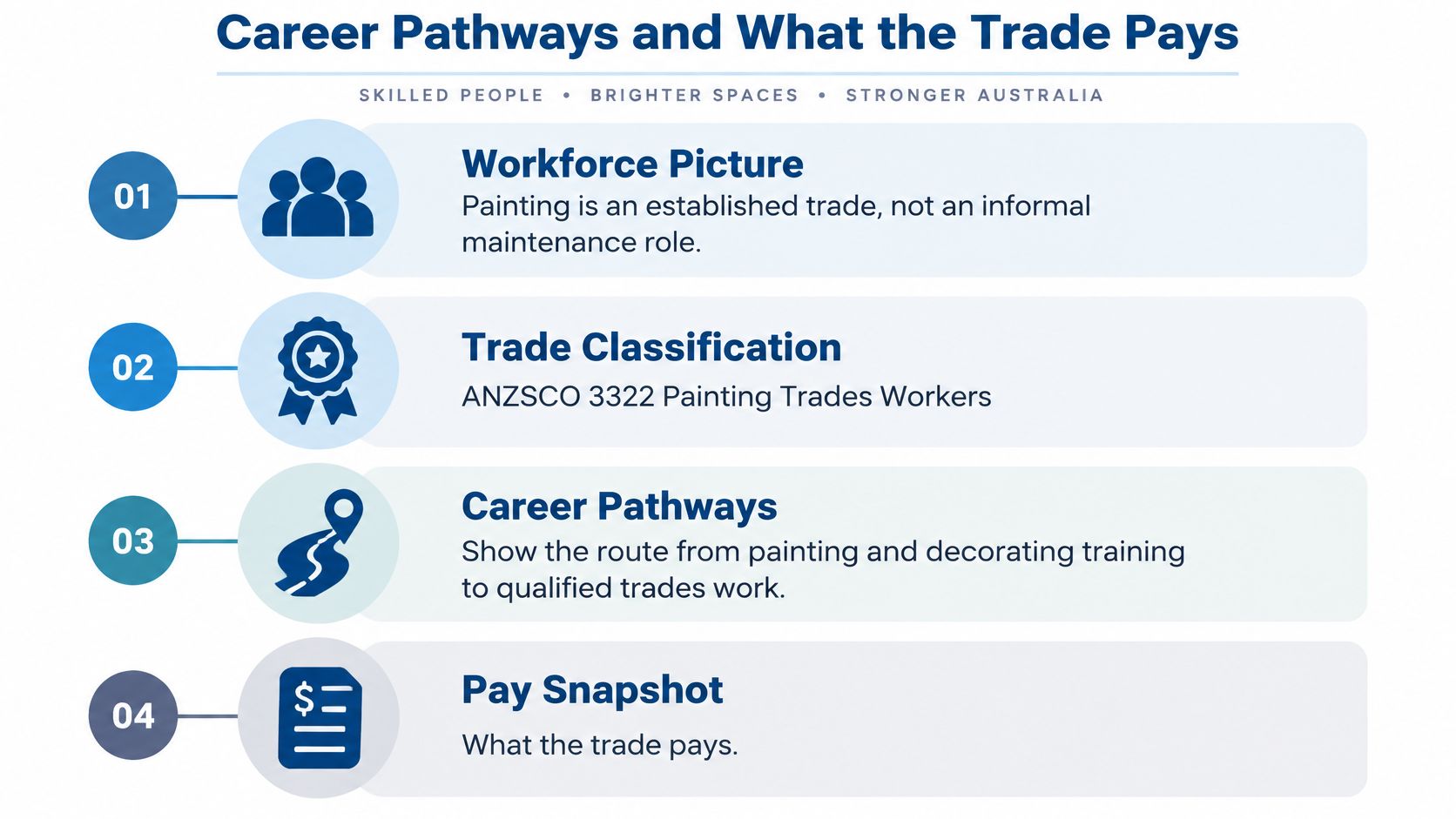
This pathway visual summarises the relationship between training and trade work.
Choose an employment route deliberately
Jobs and Skills Australia's construction industry analysis identifies apprenticeships and traineeships as the primary entry pathway into construction-dominant trades and describes painting's pipeline as smaller than those of electricians and carpenters and joiners. That isn't proof of a shortage, but it does make employer connections and suitable workplace learning important.
The occupation guidance associates Certificate III-level preparation with at least two years of on-the-job training, rather than treating classroom completion as the whole pathway. Supervised experience gives you opportunities to practise sequencing, estimating material needs and solving problems on different substrates.
Possible routes include:
- Apprentice or trainee: Develop trade skills alongside structured workplace learning.
- Employee painter: Work within an employer's systems, building confidence across preparation, application and finishing tasks.
- Self-employed painter: Take responsibility for customers, scope, pricing and business obligations once the applicable requirements are satisfied.
If you're exploring an initial construction role, our construction labourer jobs guide can help you understand that adjacent pathway. General site experience can be useful, but it shouldn't be confused with assessed painting-trade competence.
Assessment and Learning Support
Say you're asked to repaint a practice wall with damaged areas and an existing coating. An assessor shouldn't only inspect the final colour. They need evidence of how you assessed the surface, chose the preparation method, controlled hazards and applied the coating.
A painting and decorating course should make its assessment expectations clear before you start. Practical tasks, knowledge checks and any workplace evidence should connect to the actual unit requirements.
What useful assessment looks like
You should expect opportunities to demonstrate skills on suitable surfaces, including preparation, coating application, decorative work and wallpapering where required by the units. Knowledge checks can test whether you understand safety data sheets, waste handling and the reasons behind your product choices.
Useful questions include:
- Practical evidence: What tasks will the assessor observe, and what finished work must you produce?
- Workplace records: If workplace evidence is required, who verifies it and how is it recorded?
- Assessment decisions: How will you know which requirements you've met?
- Reassessment: What happens if your evidence doesn't yet demonstrate competency?
For example, a learner might produce an acceptable finish but be unable to explain the safe handling of the product used. The assessor needs to address that knowledge gap rather than treating appearance as proof of every required skill.
A sound assessment decision explains what you demonstrated, not simply how long you attended.
Arrange support before training starts
Students with a disability, learning difficulty or other special needs should notify TP Training at booking. We can arrange extra time for assessments, specialised equipment or individualised learning support.
Early notice gives us the opportunity to organise support around the learner's needs. If written instructions, communication or equipment access may be difficult, explain the specific barrier rather than waiting until an assessment becomes stressful.
Our multilingual support information explains the assistance available. Clarify the support arrangements for your chosen training and assessment before attending.
Support should help you demonstrate the required skills without removing essential safety or competency standards. Assessment quality, not attendance alone, is what makes a certificate meaningful to a prospective employer.
Choosing a Provider and Your Next Step
A convincing course page should show you what you'll practise, how you'll be assessed and what outcome you'll receive. Attractive workshop photographs aren't enough if the page leaves the qualification, delivery arrangements or assessment process unclear.
Read it as a future worker, not just as a shopper comparing fees. You need to know whether the training fits the work you intend to do.
Compare the details that affect your learning
- Check practical delivery. Look for preparation, coating and wallpapering work on suitable surfaces, not a description built entirely around theory.
- Look for trade experience. Trainers need relevant industry understanding as well as the ability to explain and assess work.
- Check the training scope. Confirm the qualification and unit coverage, including lead-related work, materials handling and waste responsibilities.
- Separate training from permissions. Establish how the course relates to your state's licensing pathway and whether construction induction is included or arranged separately.
A customer's perspective is useful too. Tony Painting's guide to how to hire Dublin decorators offers an overseas view of contractor selection, not Australian licensing advice.
Think about what happens when a customer asks you to explain the proposed preparation, protect occupied rooms and describe what's included in a quote. Your training choice should help you develop the knowledge needed for those conversations, not just a certificate to mention in them.
Match the next step to your work goal
For residential or commercial employment, identify a suitable trade-training route and the construction-induction requirements for the workplace. For self-employment, investigate the relevant licensing, insurance and business-registration obligations before accepting responsibility for a customer's job.
Use a simple decision sequence: confirm the qualification code CPC30620 and your state's rules, match the training to your employment goal, then book. Our vocational training courses guidance can help you place a training decision within a broader career pathway.
At TP Training, enrolment has three steps: choose a course and check its details, book and confirm a training date online, then submit your details and complete training. Students receive a nationally recognised certificate after completing training, but confirm the exact credential attached to the particular course you select.
Don't assume a construction safety short course awards a painting trade qualification. Check the named outcome before paying.
Before placing a deposit, write down three questions: What practical work will I demonstrate? What qualification or certificate will I receive? What further permissions or experience will I need for my intended job?
TP Training offers practical, nationally recognised safety and vocational training, including construction induction for people preparing to enter building sites. Visit TP Training to check suitable course options, discuss learning support and plan the safety-training component of your pathway into painting and decorating.

You may also like

What Is TAE in Australia? Training and Assessment Guide

7 Hospitality Jobs Sydney 2026: Roles and Qualifications