

What Is TAE in Australia? Training and Assessment Guide
In Australia, TAE means Training and Education, the national Training Package for vocational education and training, and its key qualification is TAE40122 Certificate IV in Training and Assessment.
If you know your trade, does that automatically mean you can teach it, or does completing TAE let you teach any trade? Neither assumption is right. A capable trainer needs both subject expertise and the ability to help someone else learn, practise and demonstrate that expertise safely.
For construction workers, plant operators, traffic controllers and workplace safety professionals, understanding that distinction is the starting point for choosing a useful training pathway.
Table of Contents
- What TAE Means in Australian Vocational Training
- What the Training and Assessment Qualification Covers
- Why Industry Skills Come Before TAE
- How Assessment Works in a TAE Course
- Careers and Trainer Demand With TAE
- Checking Your TAE Version and Assessor Pathway
- Confirm Your TAE Pathway Before You Enrol
What TAE Means in Australian Vocational Training
TAE is a training package, not a single course. It contains qualifications, skill sets and units of competency used in Australia's vocational education and training system, usually shortened to VET.
When people ask, “What is TAE?”, they're usually asking about the Certificate IV in Training and Assessment. The National Training Register's TAE listing identifies the package behind this qualification, with its key qualification details summarised below.
TAE40122 at a glance
| Item | Detail |
|---|---|
| Qualification | TAE40122 Certificate IV in Training and Assessment |
| First released | 8 December 2022 |
| Replaces | TAE40116 Certificate IV in Training and Assessment |
| Number of units | 12 units of competency, core and elective |
| Typical duration | Six months to two years |
| Target audience | Entry-level VET teachers, trainers and assessors |
| Prerequisite | Vocational competence in the area being taught |
The typical duration describes the volume of learning, not a promise that every provider will use the same timetable. Before enrolling, distinguish the scheduled classes from the broader work involved in practising, preparing resources and completing assessment.
Think of TAE as a teaching toolkit that sits beside your trade skills. The distinction is similar to the difference between driving safely and instructing a learner driver. Knowing how to do a task matters, but teaching it also requires explanation, observation, feedback and sound judgement.
That distinction applies across civil construction, hospitality, first aid and other vocational fields. A trainer needs to translate workplace knowledge into learning that another person can follow and demonstrate.
For a broader explanation of how workplace skills connect with recognised qualifications, our guide to vocational training in Australia provides useful context. The important starting point is that TAE develops the teaching and assessment side of the role, rather than replacing technical expertise.
What the Training and Assessment Qualification Covers
Say an experienced forklift operator needs to teach a new worker how to conduct pre-start checks. Performing those checks confidently isn't the same as preparing someone else to perform them without prompts.
The operator must decide what the learner needs to achieve, demonstrate the process clearly, check understanding and collect appropriate evidence. The TAE Training Package implementation guidance describes the package's coverage of training design, delivery, assessment and validation, alongside requirements for the people delivering and assessing TAE products.
From workplace knowledge to a learning plan
Training design starts with the outcome. For the forklift example, the trainer would identify the relevant requirements, select suitable manufacturer information and workplace procedures, and organise a safe demonstration area.
They'd also consider the learner. Someone unfamiliar with equipment terminology may need labelled photographs before handling an inspection checklist. An experienced operator learning a different machine may need more attention to unfamiliar controls and reporting procedures.
Training delivery means helping the learner move from watching to doing. The trainer might explain a check, demonstrate it, ask the learner to describe what they noticed, then supervise practice. Reading the checklist aloud wouldn't establish whether the learner understands what an unsafe condition looks like.
Assessing evidence and checking decisions
Assessment involves deciding whether the learner has demonstrated the required competence. The trainer plans what to observe, what questions to ask and how to record the evidence, rather than relying on a general impression that the learner seems confident.
Validation involves reviewing assessment practices and judgements with other appropriately skilled people. For example, reviewers might check whether an inspection task captures the required evidence or whether an assessment tool leaves important conditions unclear.
Teaching principle: A learner repeating your explanation isn't the same as a learner demonstrating the task.
The qualification combines common requirements with elective choices that help shape the learning towards relevant work. Those choices should make sense for the intended role, not just produce the easiest timetable.
A useful analogy is cooking. Industry competence is knowing how to cook; TAE develops the method for writing, demonstrating and checking a recipe so someone else can reproduce the result.
Our explanation of vocational training courses can help distinguish industry qualifications from educator qualifications. Also check the applicable regulatory requirements: people delivering TAE products must meet the relevant registering body's requirements and the assessment conditions of the units involved.
Why Industry Skills Come Before TAE
TAE isn't a licence to teach any subject. A person who can plan an excellent lesson still needs genuine expertise in the work being taught.
The TAE40122 qualification entry requirements require applicants to demonstrate vocational competence in their intended training and assessment area, described as broad industry knowledge and experience that may include a relevant unit of competency or qualification.
Teaching competence and vocational competence
These are related but separate capabilities:
- TAE competence: Designing learning, facilitating practice, collecting evidence and making assessment judgements.
- Vocational competence: Understanding and performing the actual work, including current equipment, procedures and industry expectations.
Consider a traffic controller who wants to deliver traffic control units. Their teaching pathway needs to account for relevant credentials and current field experience, not just their ability to speak confidently to a class.
A civil plant operator intending to teach excavator operation should be ready to document machine experience and relevant unit evidence. Likewise, someone intending to deliver nationally recognised first aid units needs current first aid competence and must satisfy the applicable delivery and assessment requirements.
Build an evidence folder before choosing a course
Gather documents that show what you can teach credibly:
- Current licences or tickets: Include relevant credentials and check their status.
- Dated work records: Use work logs, employer statements or task records that describe actual responsibilities.
- Unit statements: Collect statements of attainment and qualification records.
- Industry history: List the industries, equipment and work environments you've worked in.
A job title alone rarely explains the full scope of someone's expertise. A site worker may have substantial experience in one activity but limited involvement in another, even when both happen on the same project.
Our guide to construction labourer jobs can help you identify practical responsibilities worth documenting.
Toolbox talks and informal on-site coaching also aren't automatically the same as delivering nationally recognised training. Choose your intended subject and training context first, then work out which educator credential fits.
How Assessment Works in a TAE Course
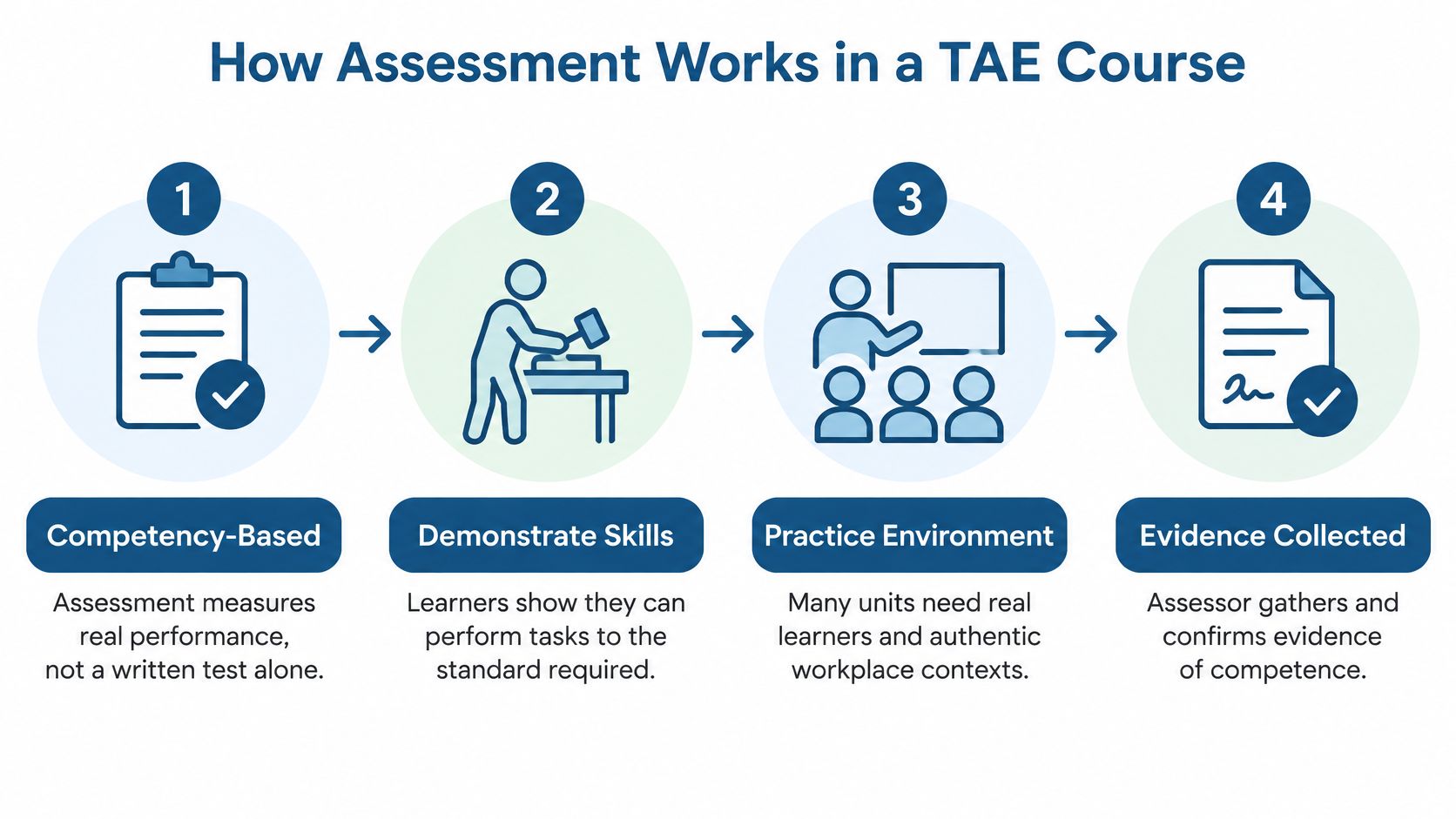
TAE assessment is competency-based. Candidates need to demonstrate performance, not just recall terminology in a written test.
The TAE implementation guide explains the need for authentic practice environments and gives a specific TAEDEL301 benchmark: at least three training sessions for at least two different individuals or small groups, using different learning objectives and a range of delivery and communication techniques.
The assessment process combines practical performance with evidence collection.
What the practical process looks like
Consider a candidate delivering a working-at-heights induction in a training yard. The activity should demonstrate teaching practice in a controlled setting, not be mistaken for proof that the candidate can deliver every height-safety qualification.
Plan the session. Set clear learning objectives, select resources and identify the yard's hazards. Record the required PPE and controls before learners enter the activity area.
Deliver the opening session. Explain the task and demonstrate the relevant checks in the prepared yard. Keep equipment positioning and learner access consistent with the safety plan.
Observe interaction and understanding. Ask learners to explain a control or demonstrate a check rather than merely asking whether they understand. Notice whether instructions are audible, terminology is clear and everyone can see the demonstration.
Repeat with different learners and objectives. Complete the delivery required by the relevant unit, changing the learning focus appropriately. For example, another session could address recognising and reporting unsuitable equipment.
Record feedback and evidence. Retain session plans, resource records, observation notes and learner feedback. Document how you responded when a learner needed a different explanation or additional practice.
Have the evidence assessed. The assessor reviews performance against the unit requirements and assessment conditions. A polished presentation won't compensate for missing practical evidence or unsafe delivery.
What to look for in a provider's assessment plan
Many units require interaction with real learners, VET practitioners and authentic learning contexts. Where a real workplace is unavailable, an appropriate simulated environment must still allow performance to be judged against workplace conditions.
Teacher Planner's guide on how to plan CBC lessons offers a supplementary way to think about connecting objectives, activities and evidence. Always use the Australian unit requirements as the assessment reference.
Repeated delivery and varied learner interaction provide stronger evidence than a presentation performed once.
Our guide to workplace safety training adds context for the safety responsibilities surrounding practical instruction.
Careers and Trainer Demand With TAE
Is TAE worth it? The most useful answer starts with the work you want to do, rather than an assumption that the qualification will automatically produce a teaching job.
A prospective employer needs to understand what you can teach, how current your industry practice is and whether you can assess fairly. Your ability to support learners with different literacy, numeracy and digital needs also matters when translating technical work into accessible instruction.
Training roles can involve workplace presentations, practical demonstrations and individual feedback.

Career outcomes and what each needs
| Outcome | Typical situation | What is needed |
|---|---|---|
| Existing workplace trainer | Delivering nationally recognised training inside your current employer | TAE plus documented current vocational competence |
| Industry to RTO | Moving from site or operational work into a registered training organisation | TAE, current industry evidence and assessment capability |
| Operational worker | Adding occasional compliance training to an existing job | Current vocational competence; check whether the training must be nationally recognised |
A site supervisor might use TAE to take on structured training responsibilities within an employer's recognised training arrangements. Their preparation should include identifying which units they'll deliver and how training time fits around operational duties.
A civil plant operator moving into an RTO needs to demonstrate more than machine handling. Preparing assessment records, explaining decisions and responding constructively to learner mistakes become part of the job.
An operational worker adding occasional compliance instruction should clarify the employer's purpose before enrolling. An internal refresher on a workplace procedure may involve a different credential pathway from training that results in a nationally recognised statement of attainment.
Choose the outcome before pursuing the credential
Use your industry evidence folder to test each option against your actual experience. Then examine the role's practical expectations: learner contact, assessment paperwork, travel, equipment access and opportunities to maintain technical practice.
TAE is an educator credential, not an employment guarantee. Identify whether you want to train within your current job, move into an RTO or add a limited training responsibility to an operational career.
Checking Your TAE Version and Assessor Pathway
Version codes work like model years on a car: they tell you which release of the qualification you hold, and employers read them closely.
TAE versions compared
| Version | Units | Status |
|---|---|---|
| TAE40110 Certificate IV in Training and Assessment | 10 | Earlier version naming roles such as enterprise trainer and RTO assessor |
| TAE40116 Certificate IV in Training and Assessment | 10 | Superseded by TAE40122 |
| TAE40122 Certificate IV in Training and Assessment | 12 | Current equivalent, first released 8 December 2022 |
The TAE40116 qualification record sets out the earlier pathway's packaging rules and its replacement. Older codes still appear in employment records and job advertisements, so check the actual credential requirements rather than assuming an old code is either automatically acceptable or automatically unusable.
The separate assessor pathway
Here is the confusion worth naming early: assessing and training are different jobs. The full Certificate IV builds teaching and assessment capability on top of the industry competence you already hold, while the assessor skill set covers only the assessment half.
The TAESS00019 Assessor Skill Set listing identifies a pathway for conducting assessments independently in VET and specifies three units:
- TAEASS412 Assess competence: Develops the capability to assess candidates against the relevant requirements.
- TAEASS413 Participate in assessment validation: Addresses participation in reviewing assessment practices and judgements.
- TAEDES411 Use nationally recognised training products to meet vocational training needs: Covers working with the training products underpinning vocational programs.
The listing identifies this skill set as meeting the minimum education requirement for assessors operating without supervision where applicable legislation, frameworks or standards apply. An assessor pathway prepares you to judge evidence, while delivering training calls for the broader teaching skills in the full qualification, so match the credential to the actual role.
Maintaining capability continues after the certificate arrives. The TAE package's currency guidance describes current industry knowledge, familiarity with relevant competency standards and continuing knowledge of assessment requirements. Your industry competence is the foundation the credential sits on, so keep both sides current.
For teaching-resource development, Kuraplan's latest feature releases for Australian teachers can help you explore planning tools. Software features don't establish regulatory eligibility.
Before choosing: Confirm the credential code, establish whether you'll deliver training or assess, then select the matching pathway.
Confirm Your TAE Pathway Before You Enrol
Verify the provider before paying fees. Check its registration and relevant scope on the national register, then confirm that the advertised qualification is available through that organisation.
We're registered as TP Training, RTO No 21488. A provider may deliver industry courses in your field without offering TAE, so don't infer a TAE offering from its construction, traffic control or safety courses.
Make your enrolment decision practical
Write down your intended teaching area. Name the work you want to teach and assemble evidence of current competence. Be specific about equipment, tasks and industry settings.
Check the qualification code and unit list. Review the national register entry and compare it with the enrolment information. Clarify any mismatch before committing.
Match the credential to the role. Establish whether you need the full training and assessment qualification, the TAESS00019 assessor skill set or a combination appropriate to your responsibilities.
Confirm the delivery arrangements. Check how classes, practical activities and assessment fit together. Our students can complete training in person at the TP Training facility or online via Zoom, but you should confirm the arrangements for the particular course you're considering.
Resolve entry and prior-evidence questions. Ask how existing qualifications and workplace evidence will be assessed, and what additional evidence you'll need. Don't assume experience automatically removes assessment requirements.
If you're comparing vocational teaching with English-language teaching, ELTica's CELTA entry requirements check is a separate eligibility resource, not a substitute for checking TAE requirements.
Prepare your enrolment administration too. Our guide to creating and managing your Unique Student Identifier explains that process.
Today, write a short pathway statement covering your industry area, your supporting evidence and your intended training or assessment role. Use it to guide your first provider conversation and keep the discussion focused on the credential you need.
TP Training offers practical vocational and safety training delivered by experienced industry professionals. Visit TP Training to explore our courses, and call 1800 577 301 or contact us by email to discuss your industry training goals and confirm the course options available.

You may also like

7 Hospitality Jobs Sydney 2026: Roles and Qualifications

4 Construction Jobs Sydney Workers Can Start in 2026