
Construction Induction Training in NSW Explained
You've got a White Card. Can you walk onto any NSW construction site and start the job you were hired to do? Not necessarily. Construction induction training gives you a national safety baseline, but it doesn't replace a site's induction or prove you can perform every task safely.
Table of Contents
- Why Construction Induction Training Matters Before Site Access
- What the White Card Actually Proves
- NSW Duties the Card Does Not Replace
- Course Content and How You Are Assessed
- How to Choose a Legitimate White Card Course
- Who Needs Training and What Comes Next
- Enrol at a TP Training Centre in Sydney
Why Construction Induction Training Matters Before Site Access
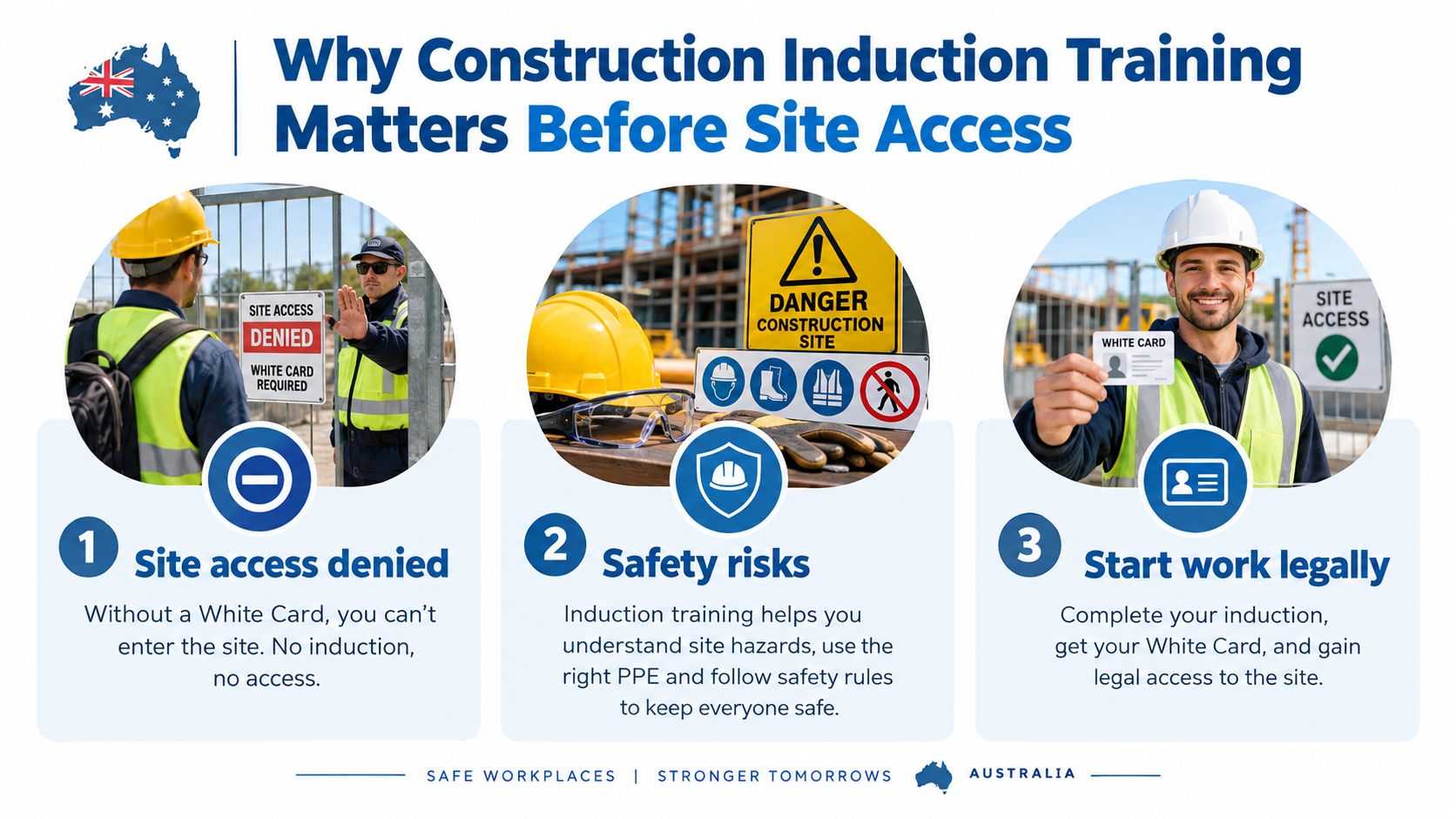
A labourer turns up for a first shift and is told to wait at the gate because they haven't completed construction induction training, commonly known through the White Card pathway. That requirement isn't just an entry formality. It gives workers a shared starting point for recognising hazards, reporting problems and understanding basic safety responsibilities before they begin construction work.
The risk remains real even as injury rates have declined. The Australian Bureau of Statistics' latest work-related injury release records a national work-related injury rate of 6.4% in 2005–06, 4.3% in 2013–14 and 3.5% in 2021–22. In 2021–22, 497,300 people among 14.1 million who had worked during the previous year experienced a work-related injury or illness.
The occupation figures matter to people heading into construction and civil work. Machinery operators and drivers recorded a rate of 6.5%, labourers 5.7%, and technicians and trades workers 5.3%. Lifting, pushing, pulling or bending was the most commonly reported cause nationally, accounting for 24% of work-related injuries or illnesses. Among affected workers, 66% took time off and 31% received workers' compensation. These figures describe a continuing safety challenge, not a guarantee that any particular site or task is unsafe.
What the baseline is for
Before a first shift, a new worker needs to know how to notice a hazard, who to tell, what protective equipment may be required and how to respond if an emergency happens. A short site briefing can't cover the national baseline on its own, and a White Card doesn't explain the particular hazards at the gate the worker is standing at.
The distinction matters to visitors too. Anyone planning to tour an unfinished home should understand that an active construction area has hazards even when work appears quiet. These precautions when touring your unfinished home offer useful context for approaching a building site carefully.
For a practical look at everyday controls and safe behaviour, TP Training also outlines on-site safety practices. The important point for a new starter is simple: induction is preparation for recognising predictable hazards before exposure, not a form to collect and forget.
What the White Card Actually Proves
The White Card is commonly associated with the national unit CPCCWHS1001 Prepare to Work Safely in the Construction Industry. This construction induction training is a prerequisite for undertaking construction work. It establishes baseline knowledge and practical behaviours, rather than certifying someone for every tool, machine or specialised task they might encounter.
It's comparable to a learner driver's permit. It shows you've developed basic road sense, but it doesn't authorise you to operate every vehicle. In the same way, the card shows that you've completed general construction induction. It doesn't prove job-specific competence.

Knowledge that must show up in practice
Competency involves doing and explaining, not just recognising terms on a screen. In a simulated workplace, a learner needs to identify and orally report at least two construction hazards, then explain how each risk could be eliminated or reduced. They also need to select suitable personal protective equipment, interpret required safety signs and symbols, and explain emergency procedures that involve fire equipment.
The unit also checks whether learners understand why key safety documents and roles exist. That includes the purpose of job safety analyses, safe work method statements and safety data sheets, as well as the responsibilities of supervisors, first-aid officers, WHS representatives and WHS committees.
A practical test: If you can name a hazard but can't explain who needs to know or what control might reduce the risk, you haven't yet turned the rule into a usable response.
What the card doesn't contain
General training can't give you the traffic plan, plant layout, excavation controls or emergency route for a particular project. Those details change between sites, so site-specific induction is still required before work begins. A worker starting at a new project needs to learn that site's arrangements even if they already hold a White Card.
For further context on training for specialised work, TP Training discusses high-risk work requirements. The essential distinction remains: the White Card establishes a general foundation; the site and task determine what else a worker must know or demonstrate.
NSW Duties the Card Does Not Replace
A White Card doesn't mean “ready for any job”. Anyone carrying out construction work, including managers, engineers, supervisors, surveyors, labourers and tradespeople, must complete general construction induction before starting. The person conducting a business or undertaking, or PCBU, still has to provide workplace-specific induction and ensure workers are trained for the work they'll perform.
Consider a worker who holds a card and moves from one NSW project to another. The card travels with them. The new site's emergency route, traffic arrangements, plant checks, local reporting process and supervision arrangements don't. A principal contractor needs to make sure the worker understands those local controls before the job begins.
Separate the three layers
| Requirement | What it proves | What it does not replace | Evidence to keep |
|---|---|---|---|
| General construction induction | Baseline construction safety training has been completed | Site-specific procedures or task competence | White Card or valid interim certification |
| Site induction | The worker has been briefed on that project's hazards and procedures | Training or verification for a particular task | Site induction record |
| Task training and verification | The worker has been trained or assessed for the work assigned | General induction or the site's local briefing | Separate competency or task evidence |
Keep these records together where practical. A worker may be asked to show the White Card or qualifying interim evidence, confirm that they've completed the site induction and provide evidence of competency for a particular task.
Avoid false confidence
A White Card doesn't prove competence to operate machinery, manage traffic, work at heights or control silica and asbestos risks. Those activities may require additional task training, licences, procedures or supervision, depending on the work and applicable rules.
That's why treating the card as a job-readiness credential can create a dangerous gap. The division of employer responsibilities is part of the wider safety picture, but workers should also ask what induction, verification and supervision apply to their own role. When in doubt, don't assume the card answers a site or task question.
Course Content and How You Are Assessed
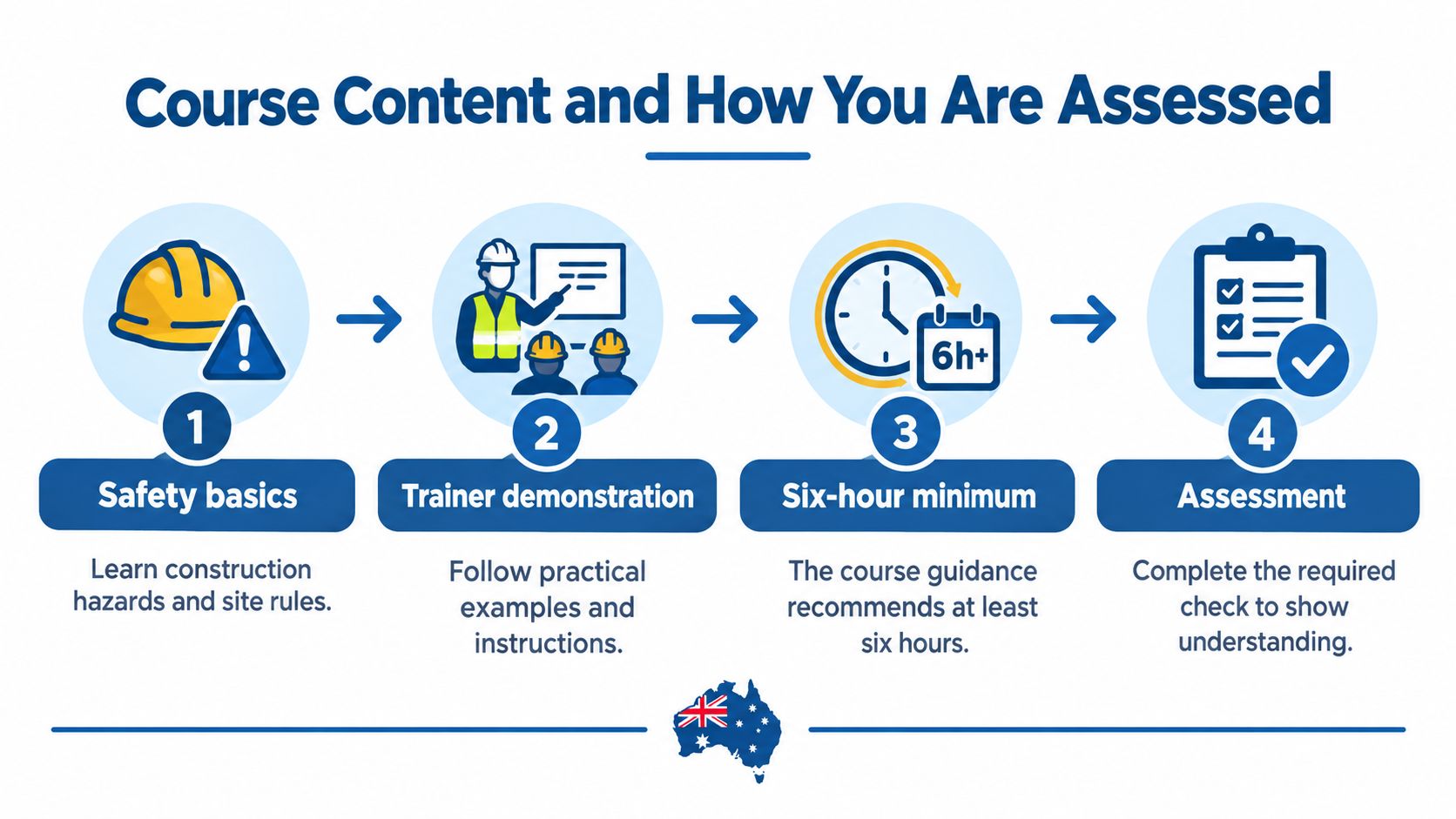
The national unit's companion guidance recommends a minimum of six hours for training and assessment. The unit doesn't prescribe one delivery mode, but the assessment should take place in a simulated construction workplace because the unit can't be assessed in an actual workplace. That gives the trainer a controlled setting to see how a learner identifies hazards and communicates a response.
A central method is the risk-management sequence. Follow it in order: identify the hazard, assess the risk, consult and report, control the hazard, then review. Personal protective equipment matters, but it isn't automatically the first or only answer. Learners need to consider the hazard and risk, communicate with the right people, and apply suitable controls before deciding what PPE is also needed.
Use the sequence on a real example
The training scope includes high-consequence hazards such as asbestos, confined spaces, electrical risks including powerlines and equipment, excavations and trenches, and underground services. For example, a learner might encounter an open excavation where underground services could be present.
The learner should identify the excavation and possible service strike as hazards, assess the exposure, and say who must be notified. They then need to describe suitable controls, select relevant PPE, and explain how the controls will be checked or reviewed. The exercise tests whether they can communicate a safe response, not merely repeat a safety phrase.
Know what remote delivery requires
For connected real-time delivery, the guidance requires at least six hours of training time, excluding administration and learner-verification activities, and completion within two weeks. An assessor must directly observe performance, either in person or through real-time audio-visual media. State and territory WHS regulators set their own policies for RTO engagement and delivery, so providers need to meet both the national unit requirements and the rules that apply where they operate.
Before enrolling, ask how the course will assess participation and practical understanding. A workplace safety training overview can help orient you to why active learning matters, but the course provider should be able to explain its assessment arrangements clearly.
How to Choose a Legitimate White Card Course
A cheap online ad promising a White Card "in under an hour" deserves a hard second look. Real construction induction has to prove you understood the material, and that takes a genuine assessment. Before you pay for anything, check two things: who delivers the training, and what unit it covers. The provider should be a Registered Training Organisation, and the course should be CPCCWHS1001 Prepare to Work Safely in the Construction Industry, delivered in Australia.
Then ask how the enrolment runs. How does the provider check your identity? How does it record attendance and confirm you participated, rather than just logging in? A White Card course works like a licence test: sitting in the room is not the same as being assessed. A certificate emailed after a session is not automatically the same thing as a regulator-issued White Card, so ask what evidence you receive on completion, how the card application works in the state where you plan to work, and whether a valid interim document covers you while the card is processed. Keep the card or qualifying interim certification available for inspection.
Compare the learning experience, not just convenience
Remote access suits shift workers and people who live far from a training centre. Convenience alone is a weak test, though, if the format lets someone sit passively through slides or click through a quiz without showing understanding. Ask whether an assessor observes your performance, how you participate during the session, what happens if the technology drops out and what identification you need on the day.
Face-to-face training puts you in a room with a trainer, where you can ask questions and work through site examples with other learners. Either format can work. What matters is getting clear answers on identity checks, genuine attendance, active participation, assessment and the card process, since state and territory rules affect which delivery arrangements are accepted.

A practical Sydney option
TP Training describes its White Card delivery as nationally recognised, practical training with experienced trainers and hands-on learning across NSW. It operates training centres in Penrith, Burwood, Auburn, Parramatta and Sydney CBD. You can confirm the provider's current operating history and course details on its White Card Training Course page.
When comparing local options, ask each provider to explain its assessment and card process for your circumstances. Choose on clear evidence of legitimate delivery and a format that gets you participating, rather than on a promise that sounds easy while leaving your questions unanswered.
Who Needs Training and What Comes Next
A school leaver is offered a labouring role and asked to complete construction induction training before the first shift. A career changer is preparing for civil work and finds that experience in a warehouse doesn't replace the required construction baseline. An engineer or supervisor may not be swinging a tool, but still needs general construction induction before carrying out construction work.
The common thread is the work, not the worker's job title or previous industry. Experience can help someone recognise workplace hazards, but it doesn't replace the general induction requirement. And holding a White Card doesn't automatically qualify someone for the machinery or specialist tasks on a project.
Build qualifications in the right order
A worker who later operates an excavator or skid steer may need separate, nationally recognised training for that equipment. As possible later steps, TP Training offers civil pathways including RIIMPO320F Conduct Civil Construction Excavator Operations and RIIMPO318F Conduct Civil Construction Skid Steer Loader Operations. These are distinct from general construction induction.
Traffic control, first aid, working-at-heights style high-risk licences, silica awareness and asbestos awareness are also separate courses with their own requirements. Which one applies depends on the worker's duties and the worksite.
Keep the sequence straight: General induction first, the project's site induction on the day, then the separate qualification or verification needed for the machine or task.
If you're weighing up future vocational options, this guide to trade courses in Sydney may help you think through possible pathways. Treat each course as a separate step, and check the current requirements for the actual work you'll be doing.
Enrol at a TP Training Centre in Sydney
If you're ready to complete construction induction training, start by checking the White Card course details with TP Training. Its Sydney-area centres are in Penrith, Burwood, Auburn, Parramatta and Sydney CBD. Use the business website to check the course and arrange a place online or by phone.
Before the course day, confirm the practical details directly with the provider:
- Bring photo identification: You'll need it for learner identity verification.
- Check the course code: Confirm that the training is for CPCCWHS1001.
- Confirm the session format: Ask whether your booked session is face to face.
- Ask about your evidence: Check how the White Card or qualifying interim evidence will be issued for the state where you plan to work.
Keep your card or interim evidence accessible for site entry. Once you begin a job, expect the principal contractor or site operator to provide a separate site induction covering local procedures and hazards.
A trainer-led course is a starting qualification for construction and civil work in NSW, not the whole career. Use the day to build confidence with hazard recognition, safety signs, PPE and emergency response before you face those decisions on a live site.
TP Training provides practical, nationally recognised White Card training with experienced trainers and hands-on learning across NSW. Visit TP Training to check the White Card course and find a Sydney centre that suits you.

You may also like
CPR Training Face Shields: A Practical Australian Guide

Civil Construction Plant Operations Courses Explained