Safety & Health Policy: A Guide for Australian Employers
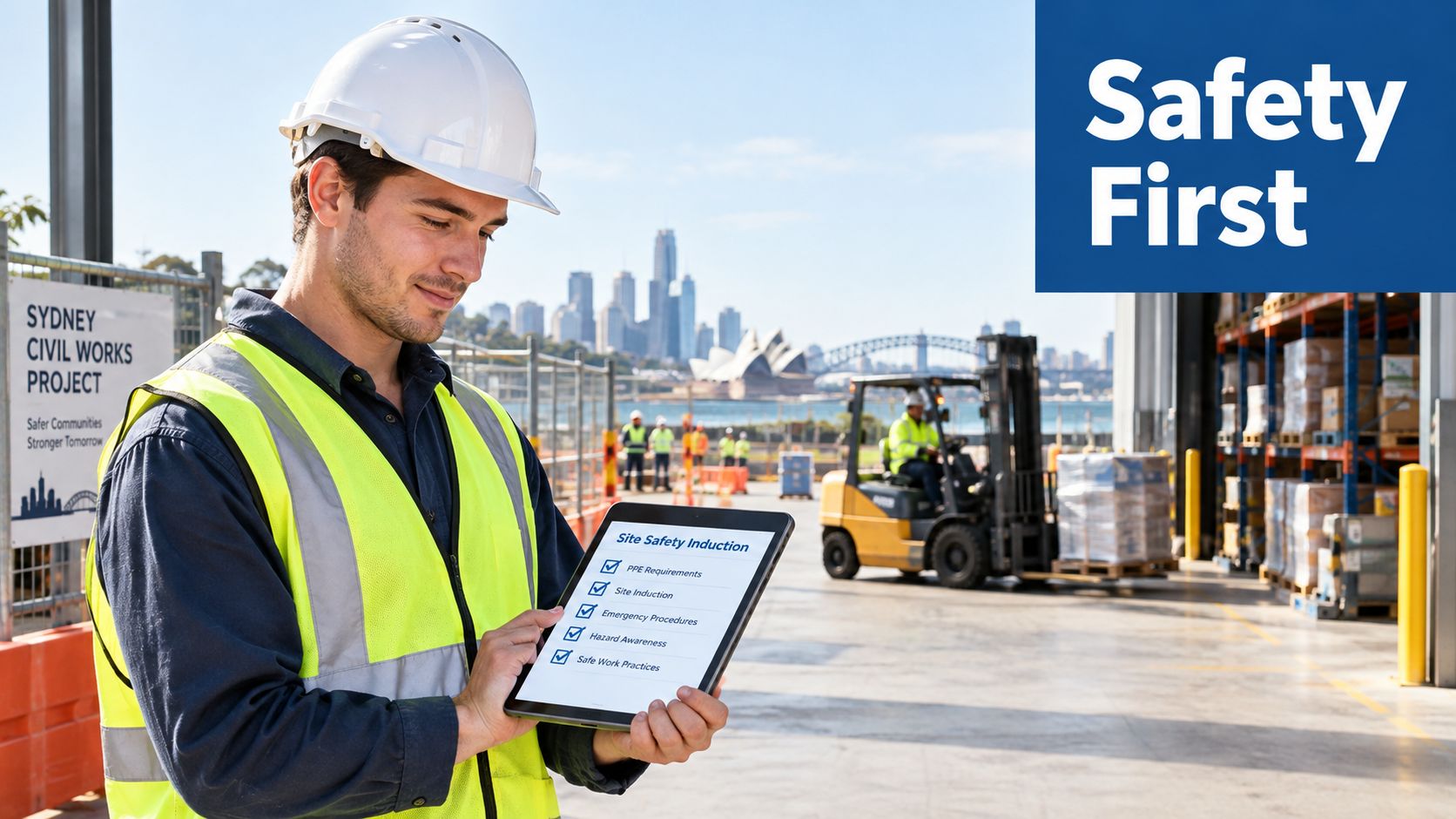
A young worker arrives at a Sydney civil site ready to start, but nobody has confirmed whether their induction is complete or which tasks they're authorised to perform. Nearby, a supervisor is trying to keep plant moving and workers clear of traffic. When the rules depend on who happens to be supervising that day, the problem isn't just an unchecked form. It's the absence of a safety and health policy that turns legal duties into consistent site practice.
A workable policy gives the PCBU, supervisors and workers a shared basis for decisions before the shift gets busy. It sets expectations for inductions, licences, hazard controls, consultation and incident reporting, then connects those expectations to the procedures and training used on site.
Table of Contents
- Why Every Australian Workplace Needs a Written Safety & Health Policy
- Legal Duties Behind the Policy in Australia
- Core Components Every Safety & Health Policy Must Include
- Industry-Specific Policy Extensions for Construction, Civil and Warehousing
- Onboarding, Licensing and Verification Procedures That Make the Policy Work
- Psychosocial Hazards and Traffic-Interface Risks the Policy Must Address
- Reviewing, Auditing and Updating the Policy
Why Every Australian Workplace Needs a Written Safety & Health Policy
A safety and health policy is the organisation's documented commitment to protecting workers and others affected by its operations. It should explain who is responsible for what, how workers raise concerns, and how the business will identify and control risks. Procedures, safe work method statements (SWMS), inductions and training then put that commitment into practice.
That distinction matters on a small job as much as on a large one. A policy that says “work safely” doesn't tell a supervisor whether to stop a task when a worker's licence hasn't been checked, or what to do when a cutting method creates uncontrolled dust. A useful policy gives supervisors decision rules they can apply across crews and sites, rather than leaving each person to make up a process under pressure.
Turn the commitment into repeatable practice
Safe Work Australia reported 200 workers fatally injured by traumatic incidents at work in 2023, compared with an annual average of 191 fatalities from 2019 to 2023. The 2023 rate was 1.4 deaths per 100,000 workers. Those figures show why safety decisions can't depend on memory or individual preference. Safe Work Australia's 2024 key WHS statistics also highlight why fatality rates matter alongside totals: workforce size affects how annual counts should be interpreted.
A written policy won't prevent an incident by itself. It can, however, make it clear that a supervisor must verify the right credentials before allocating a task, that workers can report hazards without being ignored, and that an unsafe job must pause while controls are restored.
Practical rule: If a supervisor can't use the policy to decide what happens next, the wording is too vague.
Inspectors may ask how the business manages safety, and a signed policy helps show the system behind its site procedures. Treat it as the foundation for the practical documents workers rely on, not as a substitute for risk assessments, SWMS or competent supervision.
Legal Duties Behind the Policy in Australia
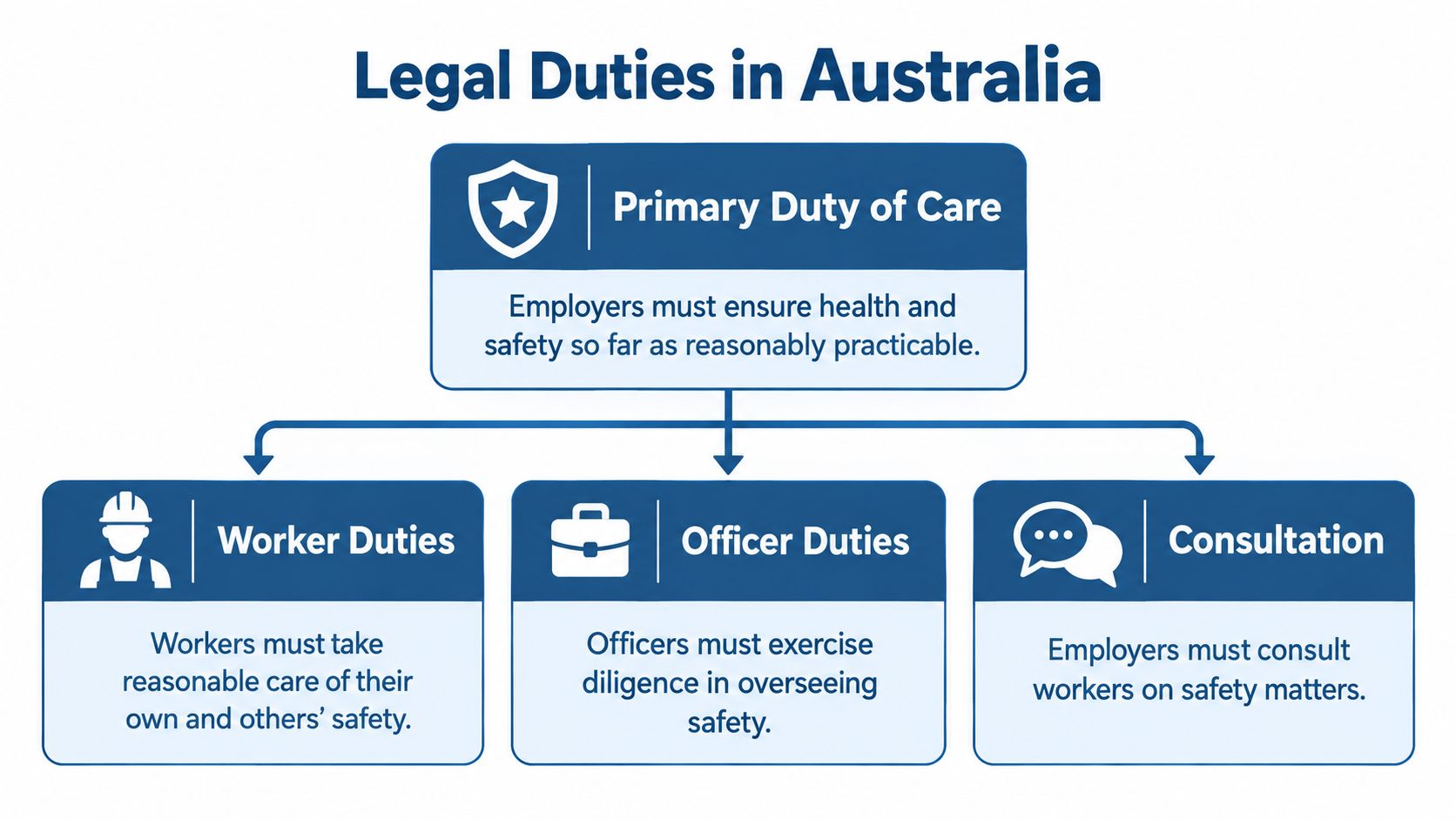
Australian WHS duties are shared, but they aren't interchangeable. Under the model WHS Act, a PCBU must ensure, so far as is reasonably practicable, the health and safety of workers it engages or influences, and ensure that its work doesn't put other people at risk. Officers must exercise due diligence to check that the business has suitable resources and processes. Workers must take reasonable care, follow reasonable instructions and cooperate with safety procedures.
Consultation is part of the duty, not a courtesy added after a policy is written. PCBUs must consult with workers who are, or are likely to be, directly affected by a safety matter, and involve health and safety representatives (HSRs) where relevant. The policy should say how that consultation happens, how feedback is recorded and who responds when workers raise a concern.
Make reasonable practicability concrete
“Reasonably practicable” requires a PCBU to consider the likelihood and severity of a risk, what is known about the hazard and ways to control it, the availability and suitability of controls, and cost after those factors have been weighed. It doesn't mean choosing the cheapest option by default. For a warehouse, that may mean separating pedestrians from forklifts rather than relying on workers to stay alert. For dusty cutting, it means considering wet methods or extraction before treating a respirator as the primary answer.
The model WHS Regulations add task-specific rules. They cover matters such as high-risk work licensing, hazardous substances, incident notification and silica controls. A policy should direct workers and supervisors to the relevant site procedures, rather than trying to reproduce every regulation in one document.
Non-fatal harm also carries a significant human and financial burden. Safe Work Australia estimated an average of 623,663 work-related injuries and illnesses a year in 2021–22, with an average health-system cost of $5,482 per case and average annual expenditure of $3.4 billion. These estimates are reported in Safe Work Australia's key WHS statistics analysis. A practical policy therefore needs to address recurring injuries and illness, not only catastrophic events.
For a plain-language outline of how employer responsibilities fit together, see TP Training's guide to employer responsibilities. Use it as a prompt for drafting, then check the final policy against the work your business performs and the laws that apply in its jurisdiction.
Core Components Every Safety & Health Policy Must Include
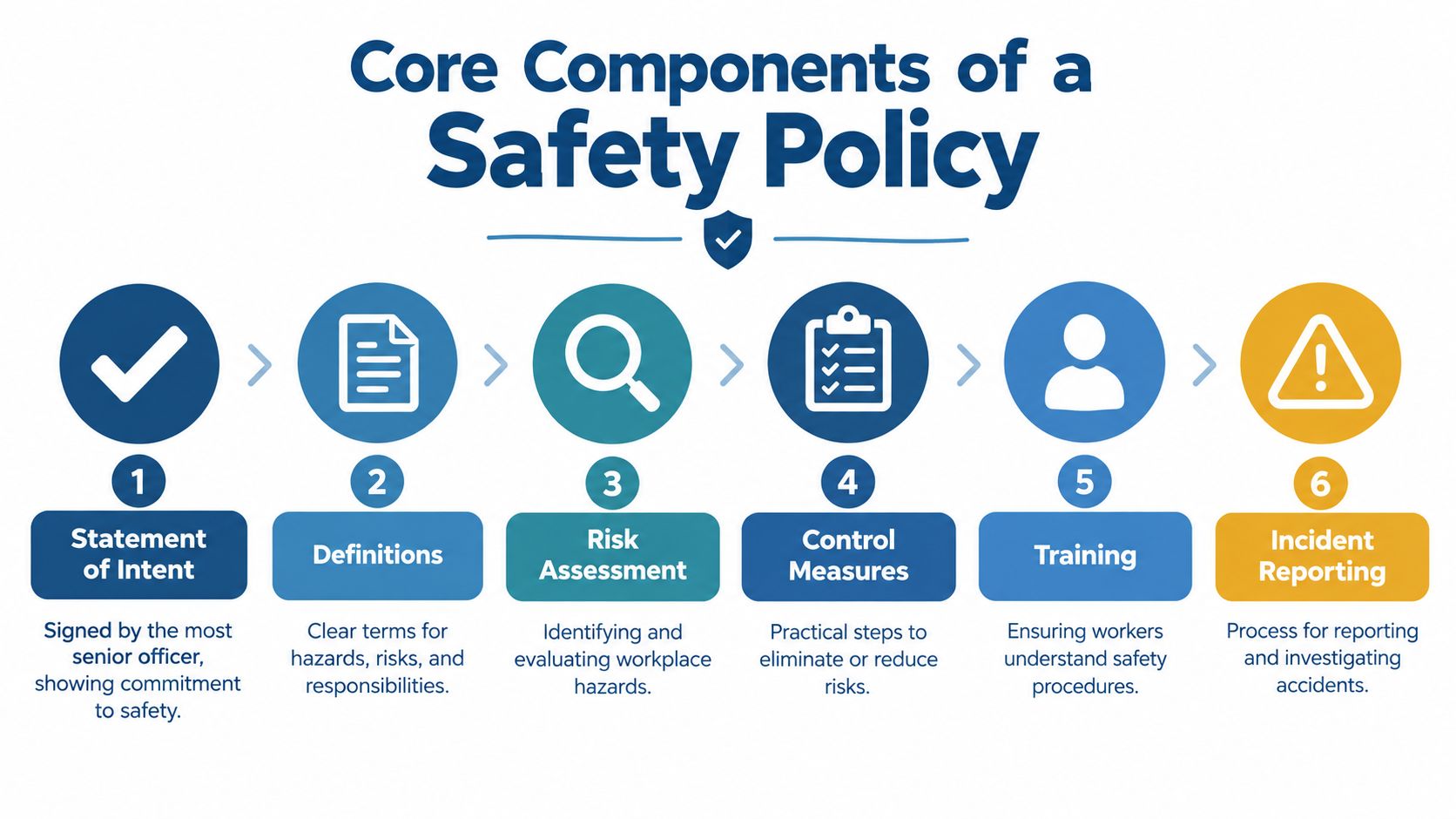
Start with a direct statement of commitment, signed by the most senior officer. It should say that the business will provide and maintain, so far as is reasonably practicable, a safe working environment, safe systems of work, suitable information and training, and a process for consultation and improvement.
Then define who and what the policy covers. Name the PCBU, officers, workers, contractors, labour-hire workers and visitors, and state whether the policy applies across all sites and activities. Spell out any exclusions and explain which documents govern specialised work. A contractor shouldn't have to guess whether the policy applies to them.
Draft the operating commitments
Keep the organisation's objectives specific enough to review. For example: “We will identify hazards before work starts, consult affected workers, assign trained and authorised people to tasks, and track corrective actions until they're closed.” Avoid promising a zero-incident outcome. It can encourage under-reporting instead of honest hazard identification.
Set out how the business selects controls. The hierarchy of controls should guide decisions, starting with eliminating the hazard where reasonably practicable, then reducing risk through substitution, isolation or engineering controls before relying on administrative measures and PPE. Name who approves controls and who checks they remain in place.
Your policy should also cover consultation, incident reporting, training and supervision. The Australian Bureau of Statistics reported that lifting, pushing, pulling or bending was the most commonly reported cause of work-related injury in its 2021–22 survey, accounting for 24% of cases, and 66% of affected people took time off work. ABS work-related injury and illness data supports the case for specific manual-handling controls, such as task planning, mechanical aids and safe load handling, rather than a general instruction to “lift correctly”.
Drafting test: Name the person responsible, the action they must take, and the record that proves it happened.
Make the policy usable on site
Include emergency arrangements, first aid, incident escalation, investigation and corrective action. Explain how workers report near misses and hazards, who reviews reports, and how the business communicates lessons back to crews. Add document control: owner, approval, version, review trigger and where workers can find the current copy.
If your work includes potential exposure to blood or other bodily fluids, the BacteriaFAQ.com bloodborne pathogen guide can help inform training and exposure-response procedures. Keep that guidance connected to your own emergency arrangements and the duties relevant to your workplace.
Industry-Specific Policy Extensions for Construction, Civil and Warehousing
A base policy can set common responsibilities for consultation, training, emergency response and incident reporting. Sector appendices then explain the controls that vary by work. That approach is easier to manage than maintaining separate, inconsistent policies for every site.
| Policy Area | Construction | Civil Construction | Warehousing & Logistics |
|---|---|---|---|
| Site access | Verify construction induction before work or entry into a construction area. | Verify induction and site-specific access requirements, including for changing work fronts. | Induct employees, contractors and visiting transport operators on site rules. |
| High-risk work | Check the licence class before assigning licensed work such as dogging, rigging or specified crane operation. | Match plant tasks to the worker's competency, authorisation and any required licence. | Verify forklift and other applicable high-risk work licences before allocating tasks. |
| Work planning | Require SWMS for high-risk construction work and make sure crews understand the controls. | Address plant movements, ground disturbance and work near services in task planning. | Plan vehicle movements, loading, storage and pedestrian routes. |
| Traffic and plant | Control plant and vehicle movements within the work area. | Set traffic controls around live roads and define exclusion zones for excavators, rollers, loaders and dump trucks. | Separate pedestrians from mobile plant and manage loading-bay interfaces. |
| Physical risks | Address falls, dropped objects, materials handling and changing site conditions. | Include dust controls, ground conditions and plant interaction. | Include manual handling, racking condition and safe access to stored goods. |
| Contractors | Coordinate responsibilities between the principal contractor and subcontractors. | Coordinate contractors working across mobile or changing work zones. | Agree safe systems with transport, cleaning and maintenance contractors. |
Construction arrangements need to connect the principal contractor's coordination role with the controls each subcontractor must follow. For high-risk construction work, the relevant SWMS should match the actual job and be available to the workers doing it. A white card and a high-risk work licence address different requirements, so site access checks shouldn't treat one as a substitute for the other.
Civil work adds moving plant and changing boundaries. An excavator working near a spotter, a roller moving through a work zone or a truck entering a live-road interface needs defined communication, separation and stop-work arrangements. TP Training's construction risk-management guidance offers a relevant starting point for reviewing site-specific controls.
Warehouses need clear pedestrian routes, well-managed loading areas, suitable racking inspection processes and task controls for goods handling. Cleaning and maintenance can also affect floor condition and access routes, so coordinate those tasks with operations. For practical context on warehouse cleaning activities, see Arelli Cleaning's warehouse cleaning information. The policy should still identify who authorises the work and how hazards are communicated to workers.
Onboarding, Licensing and Verification Procedures That Make the Policy Work
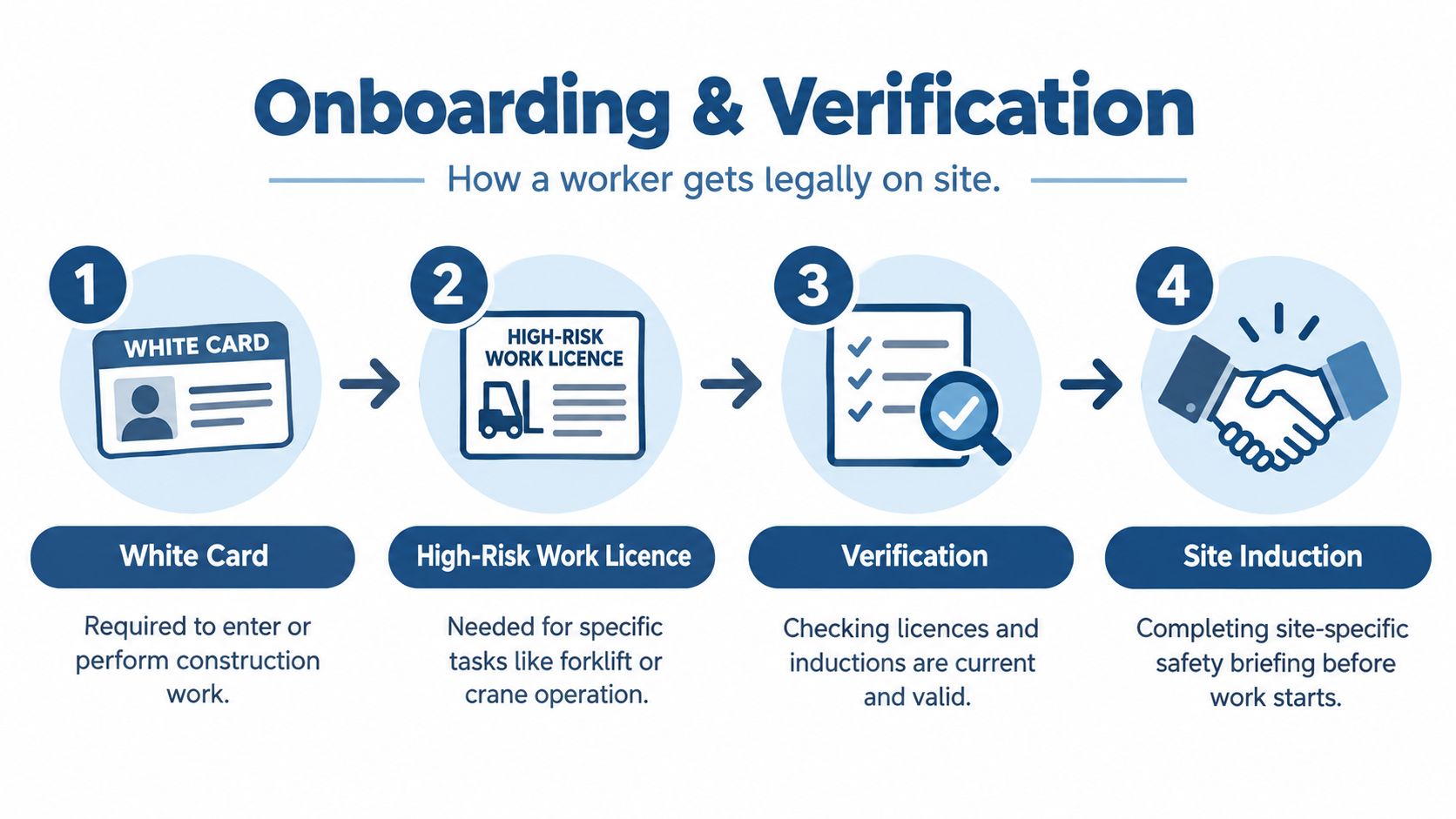
Onboarding fails when employers treat every card as proof that a worker can perform every task. In NSW, a white card is the general construction induction credential for people carrying out construction work. A high-risk work licence is separate and applies to specified classes of work. A worker may need both, depending on the site and task.
Under the model WHS Regulations, workers must hold the relevant high-risk work licence before performing licensed work such as forklift operation, dogging, rigging, specified crane work or reach-stacker operation. The licence generally expires five years after it is granted. Safe Work Australia's model WHS Regulations set out the licensing rules. The PCBU should sight written evidence, confirm the class covers the task, record expiry dates and prevent allocation of work outside the worker's authorisation.
Build a single onboarding flow
For silica-related work, the flow needs a task-specific branch. First identify whether materials contain crystalline silica and whether the work involves processing them. The applicable risk assessment should consider whether airborne respirable crystalline silica (RCS) is reasonably likely to exceed half the exposure standard. Where required, the business needs a silica risk control plan, and processing must stop if it isn't being carried out in accordance with that plan.
Controls should be practical for the material and equipment: wet cutting, on-tool extraction, local exhaust ventilation, isolation of dusty work and suitable decontamination. Where respiratory protection remains necessary, specify a compliant, fit-tested respirator. NSW's silica requirements also create a direct administrative task: from 1 October 2025, PCBUs must notify the Silica Worker Register about workers undertaking high-risk crystalline-silica processing within 28 days of the work starting. Workers must receive relevant crystalline-silica training.
A small contractor can use this sequence before assigning work:
- Confirm identity and site access. Check the worker's white card where construction work requires it.
- Verify task credentials. Sight the relevant high-risk work licence, check its class and record its expiry.
- Complete the site induction. Explain local hazards, emergency arrangements, traffic routes and stop-work expectations.
- Assign role-specific training and supervision. Make sure the worker understands the controls for their actual task, including silica controls where relevant.
Exposure assessment should connect to health monitoring where exposure creates a health risk. A record of course attendance isn't proof that the process is controlled. For guidance on connecting instruction to workplace practice, see TP Training's workplace safety training resource.
Psychosocial Hazards and Traffic-Interface Risks the Policy Must Address
A worker can hold the right licence and still be placed in an unsafe situation. Fatigue, time pressure, bullying, poor communication or an unclear work boundary can undermine controls around reversing plant and public traffic. The policy must address how the work is organised, not just what an individual worker remembers from training.
NSW's WHS changes strengthened the requirement to manage psychosocial risks through the hierarchy of controls. That means looking at workload, task design, supervision and workplace relationships, not relying only on resilience or awareness courses. Principal contractors also have duties to manage traffic in the vicinity of a construction workplace where the work may affect it.
Construction recorded 41 worker fatalities nationally in 2025, almost one in five worker fatalities, up from 35 in 2024, according to NSW's WHS regulatory information. These figures make traffic and plant controls a serious operational concern, but a fatality count alone doesn't explain why a particular site is unsafe. Supervisors need to examine how work conditions interact.
Replace awareness-only fixes with system controls
Another course can help workers understand a hazard. It won't fix a roster that leaves a traffic controller too fatigued to concentrate, a radio protocol that creates confusion, or an exclusion zone that changes without a clear briefing. Those problems call for changes to the way work is planned and supervised.
A policy should require pre-start briefings that cover the work area, traffic changes, plant movements, communication method and who can stop the job. Define exclusion zones, check radio communication before work begins, and set an escalation process when traffic conditions or fatigue make the planned controls unreliable. Supervisors should have authority to pause work and arrange a safer method.
Site test: If the plan depends on a worker staying alert through an unsafe workload, change the workload or redesign the task.
For managers reviewing workload and wellbeing practices, this resource explains how to spot burnout warning signs. It can complement, but not replace, the employer's risk assessment and controls. For examples of how traffic arrangements can be made explicit, consult TP Training's traffic management examples.
Reviewing, Auditing and Updating the Policy
A policy needs a planned review process and a clear owner. Review it at least annually, and sooner after a notifiable incident, a significant change to work, plant or materials, or a change in applicable requirements. Consult workers and HSRs before revisions are approved, especially when a change affects the way crews perform a task.
Track measures that show whether the system is working, rather than counting paperwork for its own sake. A small PCBU can monitor induction completion, licence-expiry alerts, silica register notifications, near-miss reports, corrective-action closure and training currency. If the figures reveal gaps, assign an owner and deadline for corrective action.
Keep an audit trail that matches the work
A coherent record set usually includes the signed policy and revision history, inductions, training and licence checks, SWMS, risk assessments, incident reports and evidence that corrective actions were completed. For RCS air monitoring, records must be retained for at least 30 years; where exposure creates a health risk, the PCBU must arrange and pay for health monitoring. Build those requirements into the records process rather than relying on someone to remember them later.
Use a workplace inspection as an opportunity to compare written controls with site conditions. TP Training's workplace inspection checklist can help structure that review. If the policy says pedestrians are segregated from forklifts, walk the route and check whether barriers, markings and operating practices support that rule.
A signed document on a shelf won't manage risk. Put the current policy where workers and supervisors can access it, record who approves changes, and follow up when inspections or reports show that a control isn't working.
TP Training provides practical, nationally recognised courses in areas including construction induction, high-risk work, civil construction, traffic management and workplace safety across NSW training centres. If your team needs training that supports the procedures in its safety and health policy, visit TP Training to explore available courses and locations.

You may also like
Asbestos Removal Requirements in NSW: The Complete Guide
What to Do if You Find Asbestos on Site