Working at Heights Training Online: A Complete Guide For
You're on a roof, up a ladder, or standing beside a mezzanine edge, and someone has just told you, “You need your working at heights ticket.” The next question is usually the same one, whether you're a worker, a foreman, or the person signing the timesheet, can an online course count, or is it just a faster way to buy a certificate?
That confusion is normal. In Australia, working at heights training online usually means the theory is delivered flexibly, but the question is whether the course also proves you can do the job safely when equipment, weather, time pressure, and site rules are all in play. For NSW workers, that difference matters.
Table of Contents
- Why More NSW Workers Are Searching for This Course
- What Working at Heights Training Actually Covers
- Online vs Blended Delivery Compared
- Is Online Working at Heights Training Accepted in NSW
- Why Theory Alone Is Not the Same as Site Competence
- Who Needs This Course in NSW
- Duration, Cost and Entry Requirements to Expect
- How to Enrol with TP Training and Complete the Practical
Why More NSW Workers Are Searching for This Course
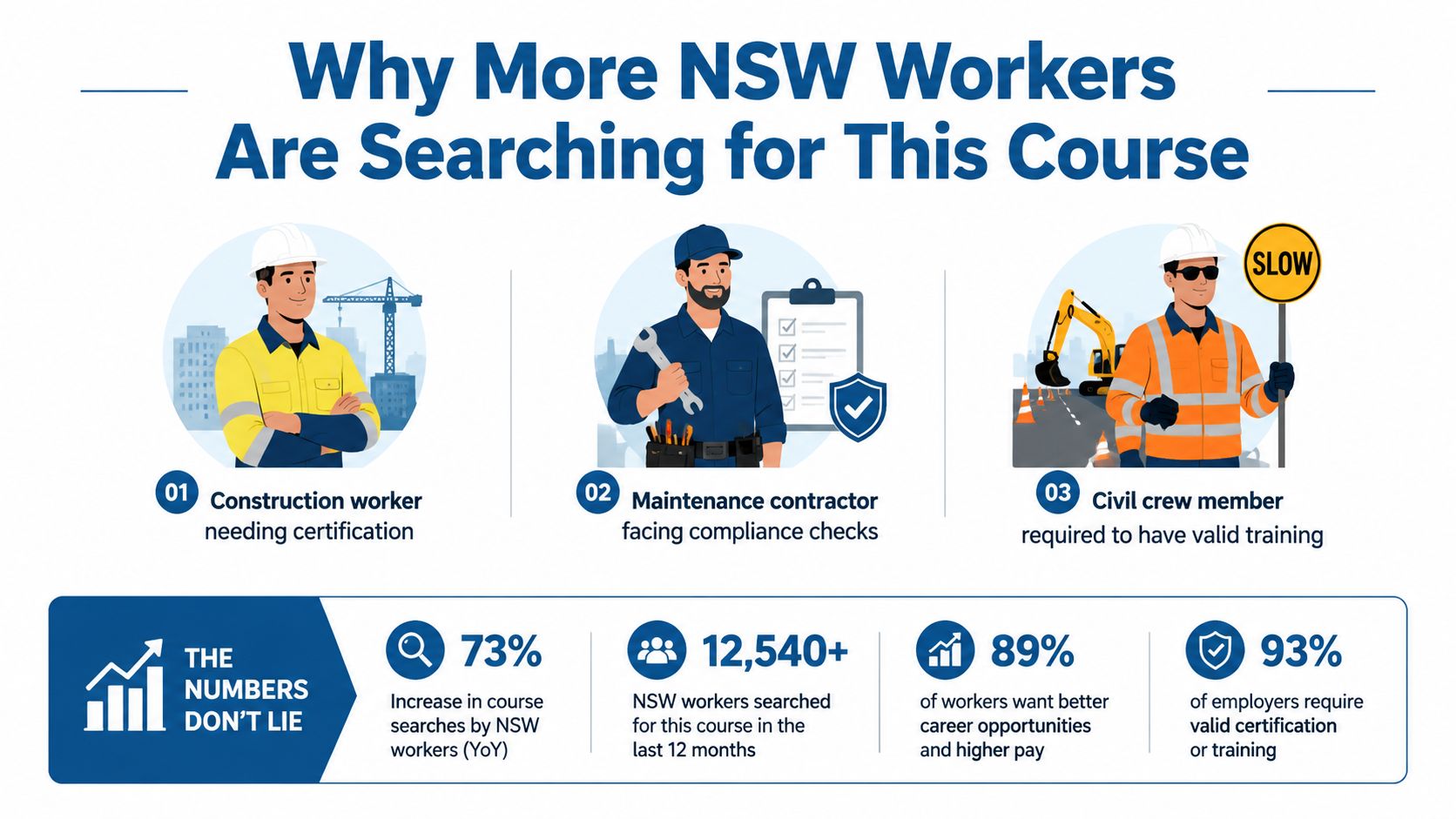
A Sydney contractor gets told on Monday morning that the job starts Wednesday, but the site won't let anyone near the edge without proof of training. A civil crew member hears the same thing after a pre-start meeting. A maintenance worker gets sent home until they can show the right evidence. The search begins because no one wants to lose a shift over a missing document.
That's part of why online delivery has become so important in Australia. The ABS reported that 4.4 million Australians aged 15 to 74 years did work-related training in 2020–21, and 55% of those learners completed their most recent course online, up from 19% in 2016–17. The same release says classroom delivery fell from 69% to 37%, which shows how strongly the market has shifted toward flexible learning for compliance and safety topics, including high-risk work education like fall prevention and site readiness. You can see the broader safety context in TP Training's note on risk management in construction.
Why the search usually starts with three questions
Don't begin with a deep dive into standards. Start with three plain questions.
- Is it legal? They want to know if online learning is accepted in NSW.
- Is it enough? They want to know if the course will satisfy a supervisor or principal contractor.
- Is it cheaper and faster? They want to know whether they can keep working while they train.
The short answer is that online learning helps with access, but it doesn't erase the competency requirement. That's where the rest of the topic gets misunderstood, because online is often used as shorthand for the theory portion of a much bigger safety process.
What Working at Heights Training Actually Covers
Working at heights training isn't just “how to wear a harness.” It's a structured safety unit that teaches workers how to recognise fall risks, choose controls, and respond when the work environment changes. In Australian training, that's commonly delivered as a nationally recognised unit such as RIIWHS204E Work Safely at Heights, with theory and practical competency built around the same real-world decisions.
The content usually includes hazard identification, hierarchy of controls, equipment selection, harness and lanyard inspection, anchor-point awareness, and emergency response. That mix matters because a worker isn't just memorising rules, they're learning how to make safer choices before climbing, while working, and after something goes wrong. If you want a simple analogy, it's closer to learning the rules, tactics, and safety checks of a high-risk sport before you're allowed on the field than reading a handout in an office.
Practical rule: if a course only teaches the theory and never asks you to fit equipment, inspect it, or explain a rescue step, it's teaching knowledge, not full job-ready competence.
What good training helps you do on site
A proper course should help a worker answer questions like these without guessing:
- Can this task be avoided? If there's a safer way to do the job from the ground, that should come first.
- What controls come before PPE? The worker should think in terms of safer access, physical barriers, or other controls before relying on fall-arrest gear.
- Is the gear ready to use? Harnesses, lanyards, and anchor points need inspection and correct selection, not casual handling.
- What happens if someone falls? Rescue planning isn't optional thinking, it has to be part of the job plan.
For a practical homeowner-facing example of harness use on a roof, a clear explanation is available in roof harness safety for homeowners. That kind of plain-language resource helps people understand the basic idea, but site work still needs proper training, supervision, and proof of competence.
The same operational focus is why some workers also compare other nationally recognised safety courses, such as Prepare Work Zone Traffic Management Plan Course Pwz Red Card, which TP Training describes as practical, nationally recognised training delivered by experienced trainers across NSW. Different hazards, same principle, workers need to know what to do, not just what the slides said.
Online vs Blended Delivery Compared
The biggest confusion in this space is simple. People hear “online course” and assume they can sit at home, click through a module, and walk onto a job site fully cleared. That's not how safety competency works for height-related tasks.
A fully online course usually means theory only. It can cover rules, hazard awareness, equipment terminology, and planning concepts, but it won't let a trainer watch you fit a harness, choose an anchor, or respond to a simulated rescue problem. A blended course adds a practical session after the online theory, which is where a trainer can see whether you can apply the knowledge.
If you've ever compared medical study formats, the difference is similar to the one explained in ProMed Certifications online courses. Reading and demonstrating are not the same thing, especially when a bad decision can put someone over an edge.
| Feature | Fully Online | Blended (Online + Practical) |
|---|---|---|
| Learning format | Theory modules only | Theory online, practical session in person |
| Equipment handling | No live interaction with gear | Hands-on harness and equipment work |
| Competency proof | Knowledge-focused | Knowledge plus observed practical ability |
| Best suited to | Awareness and refresher-style learning | First-time learners and site-ready competency |
| Site acceptance | Limited by employer and role | Commonly aligned with practical assessment needs |
What each format is really for
Fully online delivery works best when the goal is knowledge transfer. It can suit workers revising terminology, checking their memory, or learning the language of fall prevention before attending a practical session. It's useful, but it's not the whole answer.
Blended delivery is the safer default for first-time learners and for many NSW site requirements. If a supervisor needs to know you can fit the harness properly, identify anchor points, and understand rescue steps under supervision, that can't be proven by clicking through slides. That's why the online portion is best seen as the foundation, not the finish line.
For readers comparing training styles across industries, TP Training has also published affordable traffic controler online course, which reflects the same broader pattern, theory can move online, but practical proof still matters where the job is safety-critical.
Is Online Working at Heights Training Accepted in NSW
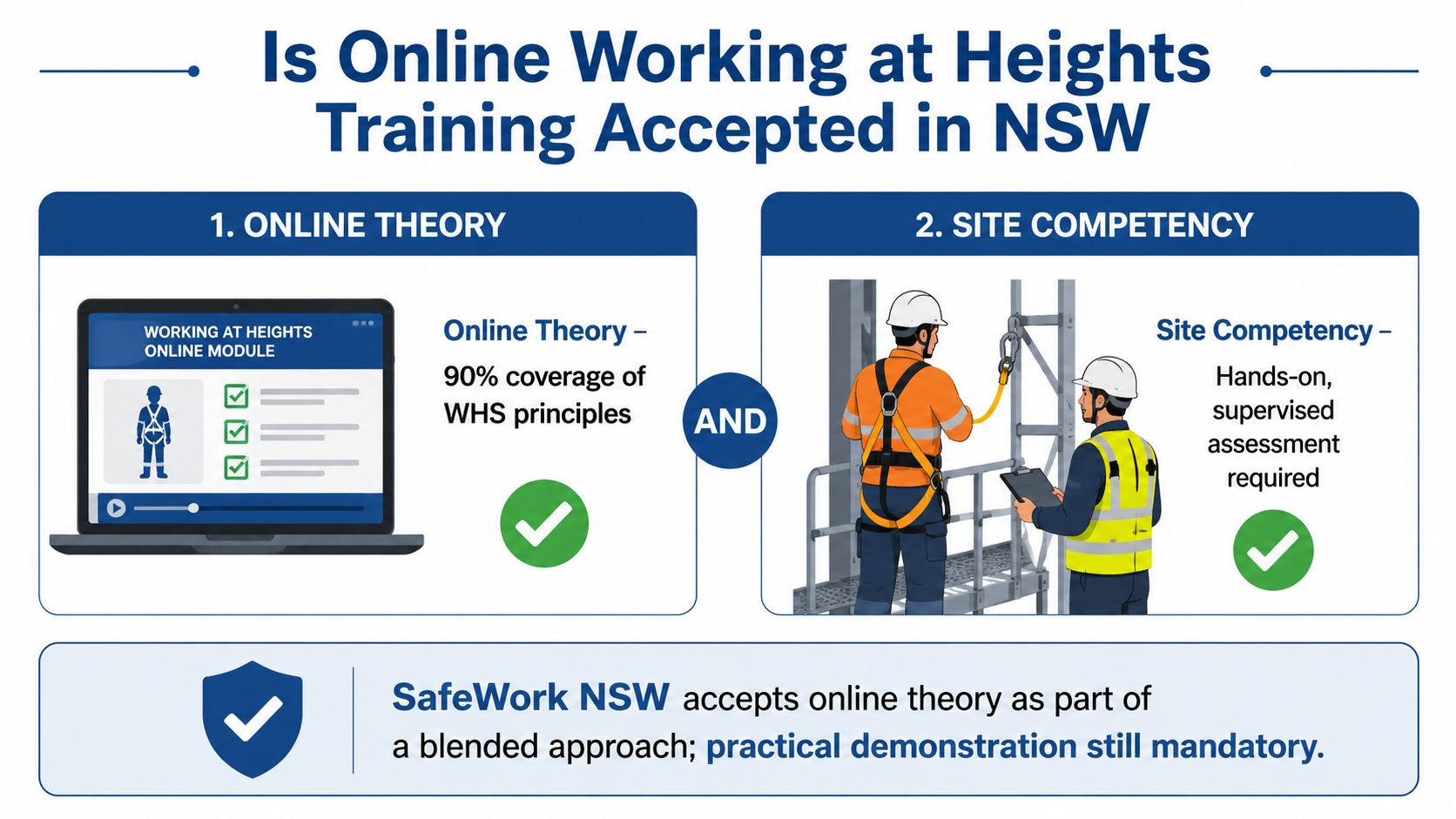
NSW doesn't treat online theory as the whole story. The compliance question is whether the worker is competent, not merely informed, and that's where the line gets drawn in practice. Online delivery can support learning, but it doesn't automatically satisfy the need for task-specific, site-verified ability.
Australian fall-arrest training also has a standards layer. AS/NZS 1891.4 expects training to cover the selection, use, inspection, maintenance, and storage of fall-arrest systems. NSW regulators also expect workers to have site-specific instruction and practical competence, which means a general course can't stand in for on-site understanding when the task, the anchor points, or the rescue arrangement changes from one workplace to the next.
A valid USI, or Unique Student Identifier, also matters for nationally recognised training. A NSW-based provider states that a USI is mandatory for all nationally recognised training, and learners can apply online if they don't already have one. That makes enrolment and certification traceable, which is very different from a casual awareness session that leaves no nationally recognised record behind.
| Component | Accepted Online | Requires In-Person |
|---|---|---|
| Theory about hazards and controls | Yes | No |
| Site-specific practical competency | No | Yes |
| Harness fitting and tie-off demonstration | No | Yes |
| Equipment inspection practice | Limited at best | Yes |
| Rescue planning discussion | Yes | Often assessed in person |
The legal line most people miss
A lot of buyers assume that if a course mentions heights, a certificate is enough. It isn't. The practical issue is whether the course gives the employer something defensible if a worker is asked to climb, anchor, or rescue in a real environment. That's why online theory is generally accepted as part of learning, but not as a substitute for the in-person demonstration many NSW employers and principal contractors expect.
A useful comparison point is the way how to get a White Card is often explained, because construction induction also has a defined compliance pathway rather than an open-ended “learn it however you like” approach. Different ticket, same lesson, official recognition depends on the structure of the training, not just the topic name.
Online theory can support compliance. It can't prove hands-on safety by itself.
Why Theory Alone Is Not the Same as Site Competence
A certificate can make a worker feel ready before they've clipped into anything, lifted a lanyard, or checked a rescue plan under pressure. That's the trap. In height work, the danger usually appears in the gap between knowing the rule and physically carrying it out correctly.
The hierarchy of controls is the clearest way to see why. First, you try to eliminate the hazard. If that's not possible, you use engineering controls, then administrative controls, and only then do you rely on fall-arrest PPE. A training module that jumps straight to harnesses without walking through that logic is skipping the decisions that reduce risk.
Ontario's mandatory Working at Heights evidence base is a useful benchmark here. Researchers found the lost-time workers' compensation claim incidence rate for targeted falls was 19% lower in 2017–2019 than in 2012–2014, with an incidence rate ratio of 0.81 and a 95% confidence interval of 0.75 to 0.87. The Ontario government also reported 220,640 learners completed Working at Heights training in 2022–23, including 131,849 full-course learners and 88,791 refresher learners, up from 190,631 in 2021–22. That scale matters because it shows how structured, standardised training can reach large numbers of workers while still being tied to injury reduction and refresher pathways. See the Ontario government's working-at-heights evidence base for the full context: Ontario Working at Heights 2022 to 2023 objective 2.
What a certificate can't prove
Theory-only delivery can't show whether someone can do the job when the task is awkward. A trainer can't see whether the harness straps are adjusted properly, whether the anchor choice makes sense, or whether the worker understands how the rescue plan fits the site layout.
That's the reason practical assessment matters. It's not a marketing add-on. It's the part that turns information into usable site behaviour.
The issue is especially important for a single course to solve every height-related task. A worker might also be qualified in other areas, such as the most practical and affordable excavator training course in NSW, but that doesn't change the need for task-specific proof where fall risk is involved. Different machines, different hazards, different proof of competence.
Who Needs This Course in NSW
This course isn't for “anyone who ever looks up.” It's for people whose actual work puts them near a fall hazard and whose site rules require documented training. In NSW, that usually includes construction workers, civil construction crews, roofers, scaffolders, riggers, dogging and crane crews, EWP operators, maintenance technicians, warehouse workers on mezzanines, solar installers, sign fitters, and event riggers.
A subcontractor can run into a second layer of pressure, because compliance problems often spill into claims and paperwork after an incident. A plain explanation of that issue is available through subcontractor workers comp claim filing, which is relevant because poor documentation can create headaches long after the job is finished.
First-time learners versus refresher candidates
First-time learners usually need the full theory-plus-practical pathway. They need to learn the equipment, the site logic, and the supervised performance checks that show they can work safely.
Refresher candidates are different. One online provider states that learners enrolling in a refresher must provide evidence of previously completing the Working at Heights unit of competency. That means the refresher isn't an open-entry beginner course, it's a maintenance pathway for people who already hold the underlying qualification.
Basic entry gates people overlook
- English literacy and numeracy: Workers need to read signage, complete JSAs or SWMS, and understand hazard instructions.
- A modern device and internet access: Online modules don't work well on outdated phones or unstable connections.
- Physical capability: Some providers require the learner to be able to climb ladders or work above 2 metres.
- Proof of prior completion for refreshers: If you're renewing, have the evidence ready before you enrol.
If the job needs you to demonstrate harness work on site, then the course needs to match that reality. Buying the wrong format is where most disappointment starts.
Duration, Cost and Entry Requirements to Expect
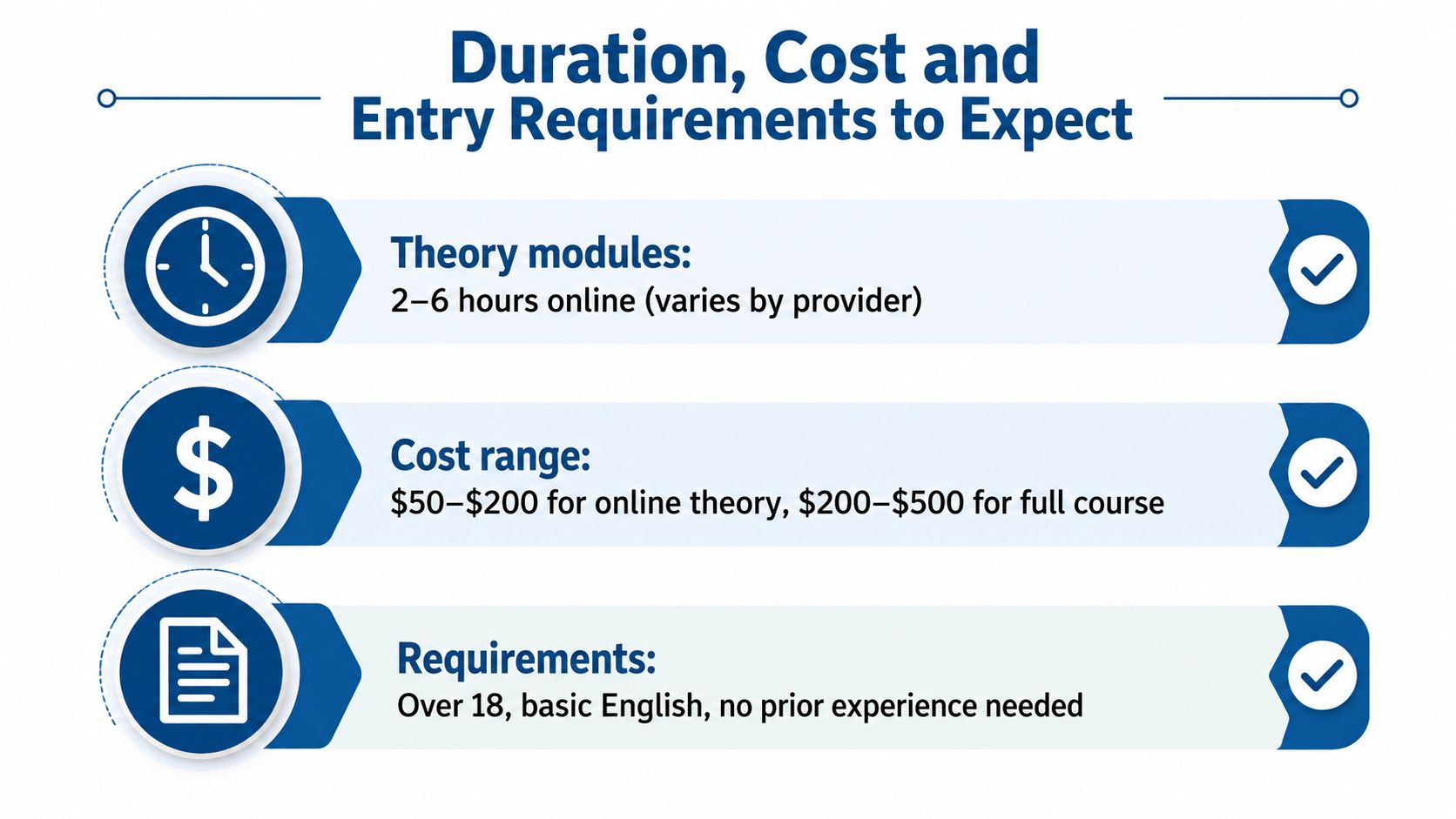
People like certainty on this question, and the honest answer is that the numbers vary by provider and by whether the course includes practical assessment. For planning purposes, online theory modules commonly take a few hours, while the practical component for first-time learners is usually scheduled as a separate in-person block. If you're comparing providers, check whether the fee covers theory only or the full blended pathway with assessment and a nationally recognised outcome.
The main entry requirements are straightforward, but they're easy to ignore until enrolment day. A valid USI is required for nationally recognised training, and one NSW-based provider says learners can apply online if they don't already have one. Providers also commonly expect basic computer skills, stable internet, and enough English literacy and numeracy to handle safety documents and instructions.
How to self-screen before paying
If you're unsure whether you're ready to enrol, use this quick check.
- Do you already have a USI? If not, set that up first.
- Can you read and complete safety paperwork comfortably? If not, get help before booking.
- Do you need theory only, or a full competency pathway? Site requirements usually decide that.
- Can you attend a practical session if the course requires one? That's the step many people miss when they buy too quickly.
A nationally recognised provider should issue a USI-linked record, not just a casual “certificate of completion.” That distinction is important because employers and principal contractors usually want proof that the training sits inside the formal vocational system, not just an attendance note.
How to Enrol with TP Training and Complete the Practical
Start with the course page, then sort out your USI before you do anything else. If you do not have one yet, this guide to creating and managing your USI explains the basic steps. After that, work through the online theory at your own pace, then book the in-person practical at a NSW training centre such as Penrith, Burwood, Auburn, Parramatta, or Sydney CBD. That order matters because the online part covers the knowledge, while the practical checks whether you can use it safely in real conditions.
The practical session is where a trainer looks for actions, not memorised phrases. A good session usually includes harness fitting, inspection routines, anchor selection, tie-off practice, and a short rescue scenario so the trainer can see whether you understand the sequence, not just the terms. If PPE is supplied, bring the right footwear and arrive ready to move through the exercises properly.
A few questions people usually ask
Is online theory-only enough for a NSW site? Usually not if the job requires shown height competence. The theory builds understanding, but most site controllers want practical proof as well.
How long does it last before a refresher is needed? Refreshers are usually tied to evidence of prior completion rather than a completely new enrolment. If your document trail is missing, treat that as an enrolment issue, not a minor admin problem.
Does one course cover every height task, including EWP work? Not automatically. EWP operation, harness use, and height access can overlap, but they are not always the same competency requirement.
Is it accepted outside NSW? Sometimes yes, depending on the employer and jurisdiction, but do not assume a NSW training record solves every interstate rule set.
TP Training's blended model joins online theory with a booked practical session across its NSW centres. If you want a clear enrolment path and a practical session that matches the job, review the course flow and choose the training format that fits your work at height requirements.

You may also like
High Risk Work Solutions in Australia: A Practical Guide
Basic Fatigue Management Course Guide for NSW Workers