Traffic Control Refresher Course: Renew Your NSW
You're on site, your Blue Card or Yellow Card is close to expiry, and the supervisor wants to know whether you can keep working next week. That's the moment a traffic control refresher course stops being a nice-to-have and becomes a compliance decision that affects your roster, your income, and your ability to stay on the road legally. In Australia, the rules aren't identical everywhere, and that's where people get caught out, especially in NSW, where card renewal and work eligibility are tied closely to training and registration requirements. The good news is that the refresher pathway is usually shorter and more focused than full certification, so if you act early, you can stay current without losing time on site.
Table of Contents
- Introduction to Traffic Control Refresher Needs
- Understanding Traffic Control Refresher Courses
- Legal Requirements for Refresher Training in NSW
- Course Content and Learning Outcomes
- Refresher Training Versus Full Certification
- Duration Pricing and Prerequisites
- Enrolling with TP Training in NSW
- Key Takeaways and FAQs
Introduction to Traffic Control Refresher Needs
A traffic controller I once spoke with had a simple problem. His card was due to expire, the crew needed him on a live lane closure, and he assumed renewal would be a quick admin task. It wasn't, because in Australia, refresher rules sit inside a regulated licensing system, and once a credential lapses, the path back can change depending on the state or territory.
That's why jurisdiction matters. The Northern Territory, for example, requires learners to apply through an NT-approved provider and complete mandatory local content, so a refresher for one region can't be treated as a universal template. In NSW, the compliance picture is even tighter because card eligibility is linked to authorised training and active work status.
Practical rule: check your card before your supervisor checks the roster.
If you wait until the last minute, you may lose the short renewal pathway and be forced into a longer reset. That's the difference between keeping your place on site and sitting out while paperwork catches up.
How to become a traffic controller
Understanding Traffic Control Refresher Courses
A traffic control refresher course is not a full beginner class repeated in a lighter mood. It's a targeted update that revisits the skills, safety expectations, and compliance obligations you're expected to keep using on real roadsides, work zones, and traffic interfaces. If you already hold the relevant card, the refresher is there to keep that competence current rather than rebuild everything from zero.
For most workers, the refresher sits on top of the core nationally recognised pathway. TP Training notes that the Blue Card and Yellow Card are the core qualifications for this kind of work, so the refresher is really the maintenance layer above the original certification structure. That's why people often compare it to a licence renewal, not to learning to drive for the first time.
If you're new to the field, Traffic Controller Course Blue Card is the kind of starting point that leads into later renewal cycles. Once you're already in the system, the refresher keeps you aligned with current practices, updated signage expectations, and safer decision-making around moving vehicles and pedestrians.
A useful way to think about it is this. The original course teaches you how to do the job. The refresher checks that you can still do it safely, legally, and in line with the current rules.
Legal Requirements for Refresher Training in NSW
NSW is where many people first realise that a traffic card is more than a plastic credential. SafeWork NSW requires workers on or adjacent to public roads to hold a Traffic Control Work Training Card and to train with an authorised RTO, which means the training pathway is tied directly to work eligibility. In practical terms, if your card lapses, you're not just delaying paperwork, you may be losing the legal basis to keep working in that environment.
The renewal window matters because it changes your next step. NSW cards expired for more than three months require a full re-assessment, while cards lapsed within three months can renew via a half-day refresher with practical simulation and assessment. That cut-off is the sort of detail that catches workers off guard, especially when they assume any recent expiry can be renewed the same way.
If you miss the renewal window, you don't just book a shorter class later, you can be pushed back into full retraining.
That is why credential tracking is part of site management, not just personal admin. A supervisor may understand that you've got experience, but the NSW process still asks whether the card is current, whether the renewal sits inside the shorter window, and whether the training route matches the legal requirement.
Traffic Control Combo Course Blue Yellow Card can be a useful reference for people who want to understand the broader qualification stack before renewal decisions are made.
Course Content and Learning Outcomes
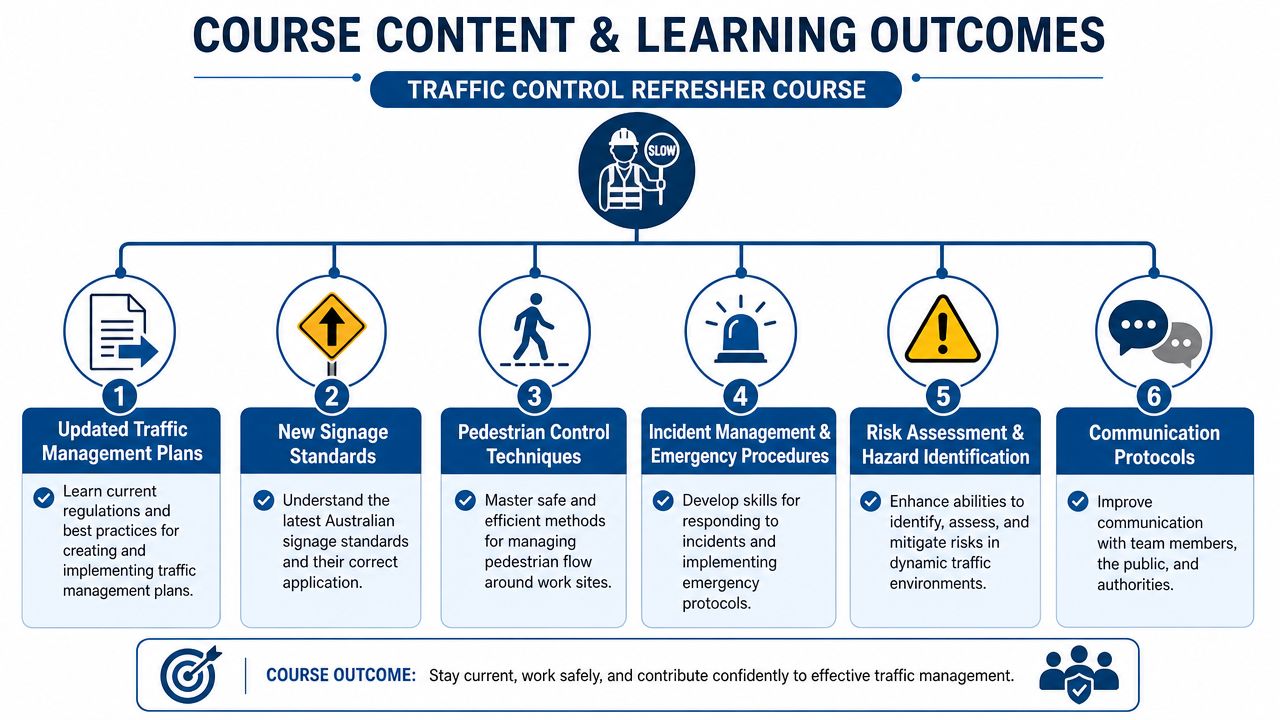
A refresher works best when it feels like a live site review, not a lecture hall replay. The strongest programs focus on the parts of the job that change fastest, like traffic management plans, signage application, and the way crews coordinate around pedestrians, plant, and vehicles. That's also why short refresher delivery is common, because the point is to update competence, not start from the ground up.
What the course usually revisits
- Updated traffic management plans: you revisit current site controls, work zone layouts, and how plans are implemented in the field.
- New signage standards: you review how signs should be placed, read, and followed so directions stay clear to road users.
- Pedestrian control techniques: you practise safe movement management where foot traffic crosses with vehicles or machinery.
- Incident management and emergency procedures: you refresh response steps so you're not improvising when a situation changes quickly.
- Risk assessment and hazard identification: you re-check how to spot moving hazards before they become an incident.
- Communication protocols: you strengthen radio calls, hand signals, and instructions to the crew and the public.
Those modules matter because traffic work lives in motion. A sign, a spotter call, or a pedestrian diversion can change in seconds, and a refresher should help you act with the same discipline you'd use on a busy live lane.
The learning outcome is simple. You leave with sharper judgement, clearer communication, and a practical reminder of how to work safely when conditions are messy. For course preparation tips, prepare work zone traffic controller is a useful starting point for what to expect before class.
Refresher Training Versus Full Certification
A refresher and a full certification can look similar at first glance, but they serve different stages of a worker's card cycle. The refresher is the shorter path for someone who already holds the right card and needs to renew current competence within the NSW renewal window. Full certification is the longer path for someone whose card has moved past that window or who is entering the field for the first time.
| Aspect | Refresher | Full Certification |
|---|---|---|
| Scope | Updates current skills and compliance obligations | Covers foundational learning for the role |
| Duration | Shorter | Longer |
| Assessment | Practical check and current competency review | Broader theory and practical assessment |
| When it applies | Recent expiry or renewal eligibility | Longer expiry gaps or first-time entry |
The difference matters because the renewal window affects the training path you are allowed to take. In NSW, if a card has been expired for too long, the shorter refresher route is no longer available, so the learner must complete the full course again. If the expiry is still within the renewal period, the refresher keeps the process lighter and faster, which means less time away from site and less pressure on scheduling.
For students who are unsure which card path applies to them, the yellow card traffic controller course details help show how regulated training is tied to a specific competency and renewal status. That is the same principle behind other carded courses. You first check whether you are renewing an existing skill set or starting again, then you choose the course that matches that status.
Duration Pricing and Prerequisites
For practical information, a one-day traffic management refresher course in Australia is generally priced at $250 + GST, and the format is designed as a focused compliance update rather than a full initial qualification as noted by TMT Training. That short format is what makes the refresher useful for workers who need to get back to site quickly without repeating the entire original training path.
| Aspect | Details |
|---|---|
| Typical duration | Half-day to one day, depending on renewal status |
| Typical fee | Around $250 + GST for a one-day refresher |
| Prerequisite | Current card or evidence of prior certification |
| Purpose | Targeted compliance update, not full beginner training |
| Practical need | Keep eligibility current and avoid a full retake |
The hidden issue is readiness. If your card has already drifted past the renewal window, the shorter option may no longer be available, so checking your expiry date early is smarter than relying on a last-minute booking. For a broader pricing context, traffic controller course price helps compare the refresher with full qualification planning.
Enrolling with TP Training in NSW
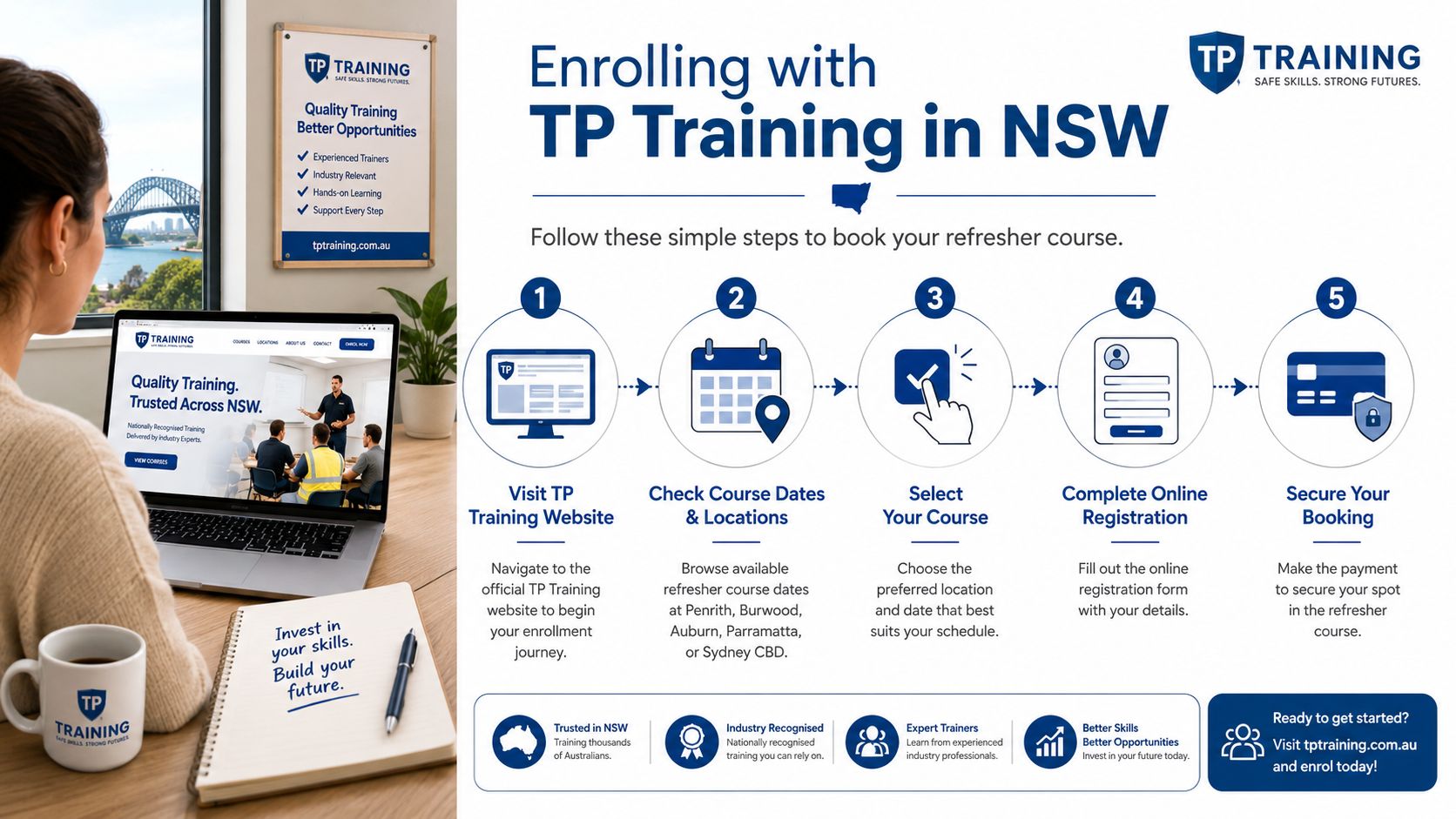
Booking should feel orderly, not stressful. The easiest way to approach enrolment is to treat it like any other compliance task, gather your proof first, then choose the closest date and location that fits your roster. TP Training runs NSW centres across Penrith, Burwood, Auburn, Parramatta, and Sydney CBD, which makes it easier for workers and employers to plan around shift patterns.
Step-by-step booking flow
- Check the course listing. Look for the refresher date that matches your expiry window and work schedule.
- Choose your location. Pick the site that keeps travel simple for the day you're booked in.
- Upload or prepare proof. Bring evidence of your prior certification so the admin team can confirm you're on the right renewal pathway.
- Attend with your PPE. Arrive ready for practical participation, because the session isn't just paperwork.
- Complete the training and assessment. Once you finish the required activities, the course provider can finalise the outcome.
The phrase to remember is prepare before you arrive. That saves time at reception, reduces delays on the day, and helps you avoid a missed session because a document was left in the ute or on a phone you can't access.
If you want a broad view of the organisation before you book, TP Training's own site is the place to start, and the practical value here is simple, you can move from eligibility check to enrolment without guessing what comes next.
Key Takeaways and FAQs
A traffic control refresher course exists for one reason, to keep qualified workers legally current and site-ready. In NSW, the renewal window is the detail that matters most, because crossing the three-month expiry threshold can turn a short refresher into a full reassessment. In other parts of Australia, the renewal pathway can differ, so workers need to treat card management as a jurisdiction-specific task, not a one-size-fits-all checklist.
Key takeaways
- Stay ahead of expiry: early action keeps you in the shorter renewal pathway when it's available.
- Know your card type: Blue Card and Yellow Card roles sit inside the regulated pathway.
- Treat local rules seriously: NSW, the NT, and other jurisdictions can require different training mechanics.
- Use the refresher as a work tool: it's a compliance reset, but it also sharpens practical safety habits.
FAQ
Can I do a refresher if I trained interstate?
Possibly, but the answer depends on the state or territory rules, the type of card you hold, and whether the local authority accepts your prior training.
What if I miss my renewal date by a little bit?
In NSW, the length of the lapse matters. Once the expiry moves beyond the allowed window, you may need full re-assessment instead of the shorter refresher route.
Do refresher courses cover theory only?
No. Good programs combine updated compliance content with practical simulation, because traffic work is judged in live conditions, not just on paper.
Why do employers care so much about the card date?
Because current credentials affect whether you can legally step onto the job and stay productive without delays.
If your card is nearing expiry, don't leave it to chance. Check your renewal window, gather your proof of prior training, and book with TP Training so you can stay compliant and keep working without an avoidable break in your traffic control duties.

You may also like
Yellow Card NSW: Requirements, Units and How to Enrol

Construction Induction Training in NSW Explained