Responsible Service of Alcohol NSW: Get Certified 2026
You've just landed a shift at a bar, pub or restaurant in NSW. The manager says, “Have you got your RSA?” You nod politely, but you're still working out what that means, why it matters, and what you're expected to do when a customer has had too much.
That's a normal place to start. Responsible Service of Alcohol is one of the first professional skills hospitality workers need in New South Wales. It isn't just a certificate for your file. It's the daily practice of serving alcohol safely, spotting risk early, and protecting customers, co-workers, the venue, and yourself.
For job seekers, RSA opens the door to bar, floor and venue work. For new staff, it gives you a clear standard to follow when things get busy and decisions need to be made quickly. If English isn't your first language, support can also make the process easier, including multilingual student assistance options.

Table of Contents
- Your Guide to Responsible Service of Alcohol in NSW
- Understanding the Core Principles of RSA
- Who Legally Needs an RSA Certificate in NSW
- What You Will Learn in an RSA Course
- How to Get Your NSW RSA Certification with TP Training
- Applying RSA in the Real World Scenarios and Compliance
- Common RSA Questions and Next Steps
Your Guide to Responsible Service of Alcohol in NSW
In hospitality, RSA usually comes up fast because it affects ordinary tasks. Pouring a beer. Delivering wine to a table. Clearing drinks from a function. Answering a customer who wants “one more” when they're already unsteady. You don't need legal training to handle those moments, but you do need the right habits.
Responsible service of alcohol means serving within the law and acting with care before a problem grows. That includes checking who can legally be served, noticing when someone is becoming affected by alcohol, and stepping in early rather than waiting for obvious trouble.
Many people get confused because RSA sounds like a rulebook. In practice, it's a job skill. Good RSA looks professional. It's calm, consistent and respectful. Staff who apply it well don't just avoid trouble. They help create a safer venue and a better experience for everyone else in the room.
Practical rule: If you wait until a patron is clearly out of control, you've usually waited too long.
A new bartender often asks, “What am I responsible for?” Start with this short list:
- Service decisions: You decide whether to serve, delay service, or refuse service.
- Observation: You watch for changes in speech, balance, mood and judgement.
- Communication: You speak clearly with patrons and update your supervisor when needed.
- Record keeping: You follow venue procedures when an incident needs to be documented.
That's why RSA training matters from day one. It gives you a practical framework for real shifts, real customers and real pressure.
Understanding the Core Principles of RSA
The easiest way to understand RSA is to think of hospitality staff as a community safety gatekeeper. You're not there to police every customer. You are there to make sound decisions at the point where alcohol is supplied. That role matters because the effects of poor service don't stay inside the venue.
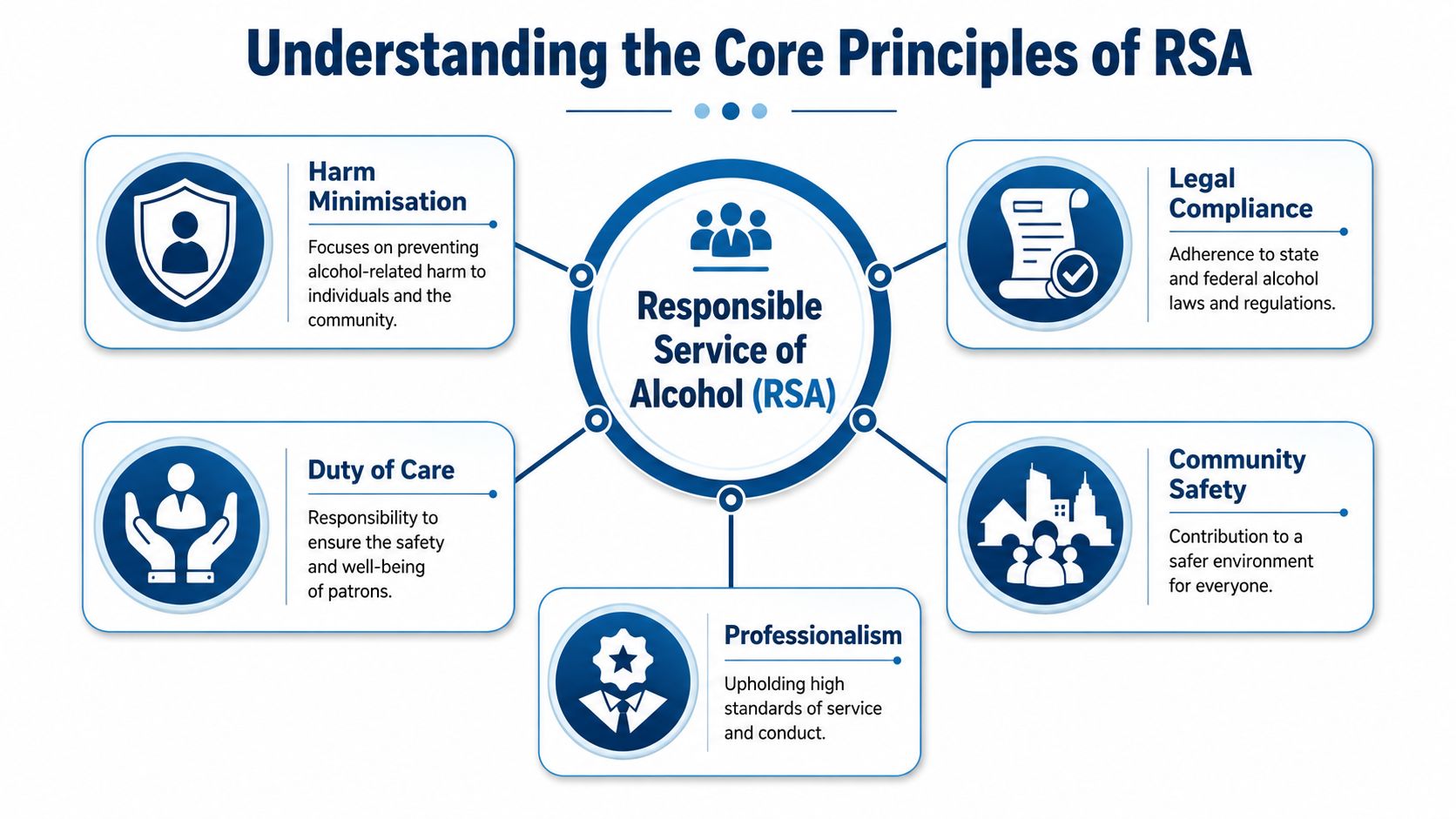
RSA is built on a small set of ideas that are easy to remember when the venue is busy.
Harm minimisation
Alcohol service isn't just about selling drinks. It's about reducing the chance of harm. That can mean slowing service, offering water, or stepping in before a customer becomes unsafe.
Duty of care
Your decisions affect real people. A patron who looks fine at first can become vulnerable quickly. Duty of care means paying attention and responding early, not after an argument, fall or unsafe departure.
Legal compliance
The law sets the minimum standard. Staff need to follow venue procedures and the legal rules around alcohol service, minors and intoxication. That's one reason many workers also build broader workplace safety knowledge through training such as first aid, CPR, White Card and safety certifications.
Community safety
What happens in a licensed venue can affect streets, transport, homes and workplaces later that night. RSA supports a safer environment beyond the bar itself.
Professionalism
Customers notice how staff handle pressure. Calm refusals, measured pours and consistent standards show that alcohol service is a skilled part of hospitality, not an afterthought.
A practical way to remember the day-to-day focus is this:
| Core RSA focus | What it looks like on shift |
|---|---|
| Minors | Ask for valid ID before service |
| Intoxication | Notice signs early and respond |
| Safe venue | Reduce risk before conflict starts |
| Impending intoxication | Slow things down before refusal becomes necessary |
NSW's experience shows these practices can change staff behaviour over time. Between 2002 and 2011, the provision of RSA to patrons showing signs of intoxication increased from 10% to 19%, and interventions for highly intoxicated individuals rose from 4% to 12% by 2011, according to the NSW Criminal Justice Bulletin report on RSA initiatives.
Who Legally Needs an RSA Certificate in NSW
This is the question most job seekers ask first. If your work involves the sale, service or supply of alcohol in NSW, RSA usually applies to you. The legal standard named for NSW is SITHFAB021 Provide Responsible Service of Alcohol, and staff involved in those duties must hold a valid NSW competency card with an RSA endorsement, as outlined in this NSW RSA laws summary.
For a new worker, the safest approach is simple. If alcohol is part of your job in any direct way, assume you need RSA and confirm with your employer before your first shifts.
Roles that commonly need RSA
- Bartenders and bar staff: If you pour, open, mix or hand over alcohol, RSA applies.
- Waitstaff and floor staff: Table service counts when you deliver or supply alcoholic drinks.
- Supervisors and managers: Oversight roles still carry responsibility when alcohol service is part of operations.
- Event and function staff: Weddings, private events and pop-up service still require compliant alcohol service.
- Promotional staff: If your role includes supplying alcohol samples or managing alcohol distribution, RSA matters.
- Security or support staff with service involvement: If the role crosses into supply or service, RSA can apply.
One area that confuses people is timing. In NSW, staff must obtain the required certification and RSA endorsement within the timeframe set by the state framework after starting work. If you're comparing requirements elsewhere, it helps to see how different jurisdictions handle alcohol service responsibilities. For example, this 2026 guide for Oregon managers shows how another market approaches licensing and management expectations.
If you're not sure whether your duties count as “service or supply”, ask before your shift, not during an incident.
Some employers also prefer applicants who already hold related hospitality skills. Someone applying for café and venue work may pair RSA with barista training pathways in Australia, especially when the role mixes coffee, food and licensed service.
If you need the qualification itself, Provide Responsible Service Of Alcohol Course Rsa is a nationally recognised course delivered by TP Training with experienced trainers and hands-on learning across NSW.
What You Will Learn in an RSA Course
Most new students expect RSA to be a list of laws to memorise. A good course is more practical than that. It trains you to observe, judge risk, communicate professionally and act in ways that are lawful and defensible on shift.
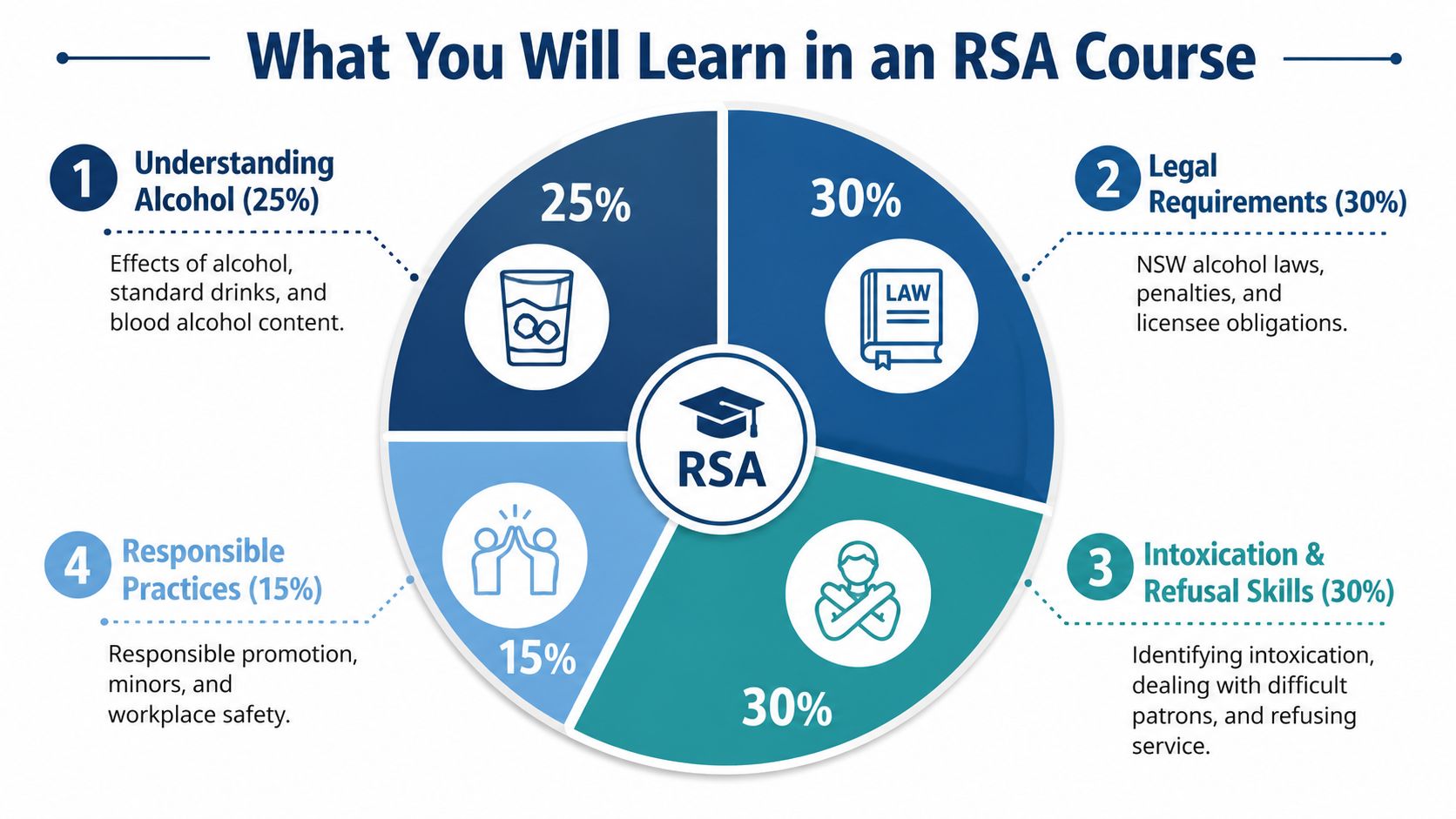
Identifying intoxication
This is usually the skill students worry about most. They want a perfect formula, but real service doesn't work that way. Instead, you learn to notice patterns in behaviour and presentation.
You might look for changes in:
- Speech: Slower, louder, repetitive or less clear than earlier
- Movement: Swaying, poor coordination, difficulty handling money or glassware
- Behaviour: Aggression, overconfidence, confusion, inappropriate comments
- Judgement: Ordering rapidly, pushing boundaries, buying for someone who appears affected
The key point is that you're assessing what you can observe, not diagnosing someone medically.
Standard drinks and measured service
RSA also covers how alcohol is measured and why that matters. In the Australian framework, spirits are served in fixed quantities of 15 ml or 30 ml, and wine service uses marked pour lines so drinks can be served in measurable standard amounts, as described in the Queensland RSA learner guide.
That matters because unmeasured pours can contain 2 to 3 standard drinks in a single serving in some cases, which makes it easier for a patron to become intoxicated before staff respond. Once you understand measured service, “just a generous pour” stops sounding harmless.
Reasonable belief and legal decisions
One of the most important legal ideas in RSA is reasonable belief. The accredited RSA course trains staff to form a reasonable belief of intoxication based on observable signs, which allows refusal of service without medical proof, according to the Queensland business guidance on RSA certification.
Here's what that means in plain language. You do not need a breath test, doctor's opinion or confession from the patron. If the person's condition and behaviour give you reasonable grounds to believe they're intoxicated, you can and should act.
A patron doesn't need to agree that they're intoxicated for your decision to be valid.
That's why practical training matters. Many hospitality courses focus on applied skills, and TP Training delivers nationally recognised training with experienced trainers and hands-on learning across NSW.
Refusal of service and difficult situations
This part of the course is often the most useful once you start work. You learn how to refuse service professionally, avoid arguments where possible, and involve support staff or managers when needed.
Common course practice includes:
- Choosing calm words: Short, respectful explanations work better than lectures.
- Offering alternatives: Water, food, coffee or time to pause can lower tension.
- Calling for support: You don't need to manage every difficult patron alone.
- Protecting the venue: Incident procedures matter as much as the spoken refusal.
If you're exploring training options across hospitality, RSA, RCG, food safety supervisor and barista pathways often sit together because venues need staff who can work safely across several service responsibilities.
How to Get Your NSW RSA Certification with TP Training
Getting certified is usually straightforward when you break it into a few practical steps. The main mistake people make is waiting until the last minute, then rushing to understand both the training and the follow-up paperwork.
Step 1 Find an approved course
Start with a provider that delivers the nationally recognised RSA unit required in NSW. Check that the course is the correct NSW pathway and that you understand what identification or enrolment details you need before attending.
For people based in Sydney, location matters too. TP Training delivers nationally recognised, practical training across Penrith, Burwood, Auburn, Parramatta and Sydney CBD, which can make attendance easier if you're balancing work or job interviews.
Step 2 Book and prepare
Once you choose a course date, book your place and read the joining instructions carefully. Bring the documents the provider asks for, arrive on time, and treat the session like the start of your hospitality career, not a casual appointment.
If you still need help with student administration, it's worth sorting out your Unique Student Identifier in five clear steps.
Step 3 Attend the face-to-face training
During training, expect practical discussion, examples from licensed venues and assessment around real service decisions. Ask questions when something feels unclear. The best time to clear up confusion about intoxication, refusals or legal responsibility is in the classroom, not on a Friday night shift.
Step 4 Use your certificate correctly
After successful completion, follow the provider's guidance on your next steps for recognition and workplace use. Keep your records organised, tell your employer when your training is complete, and make sure you understand any venue-specific house policies before you begin serving.
A certificate is the starting point. Your confidence comes from applying the training consistently once you're on the floor.
Applying RSA in the Real World Scenarios and Compliance
The shift gets busy. Music is up, orders are stacked, and someone you've seen all night wants another round. Here, RSA stops being theory and becomes judgement, language and timing.
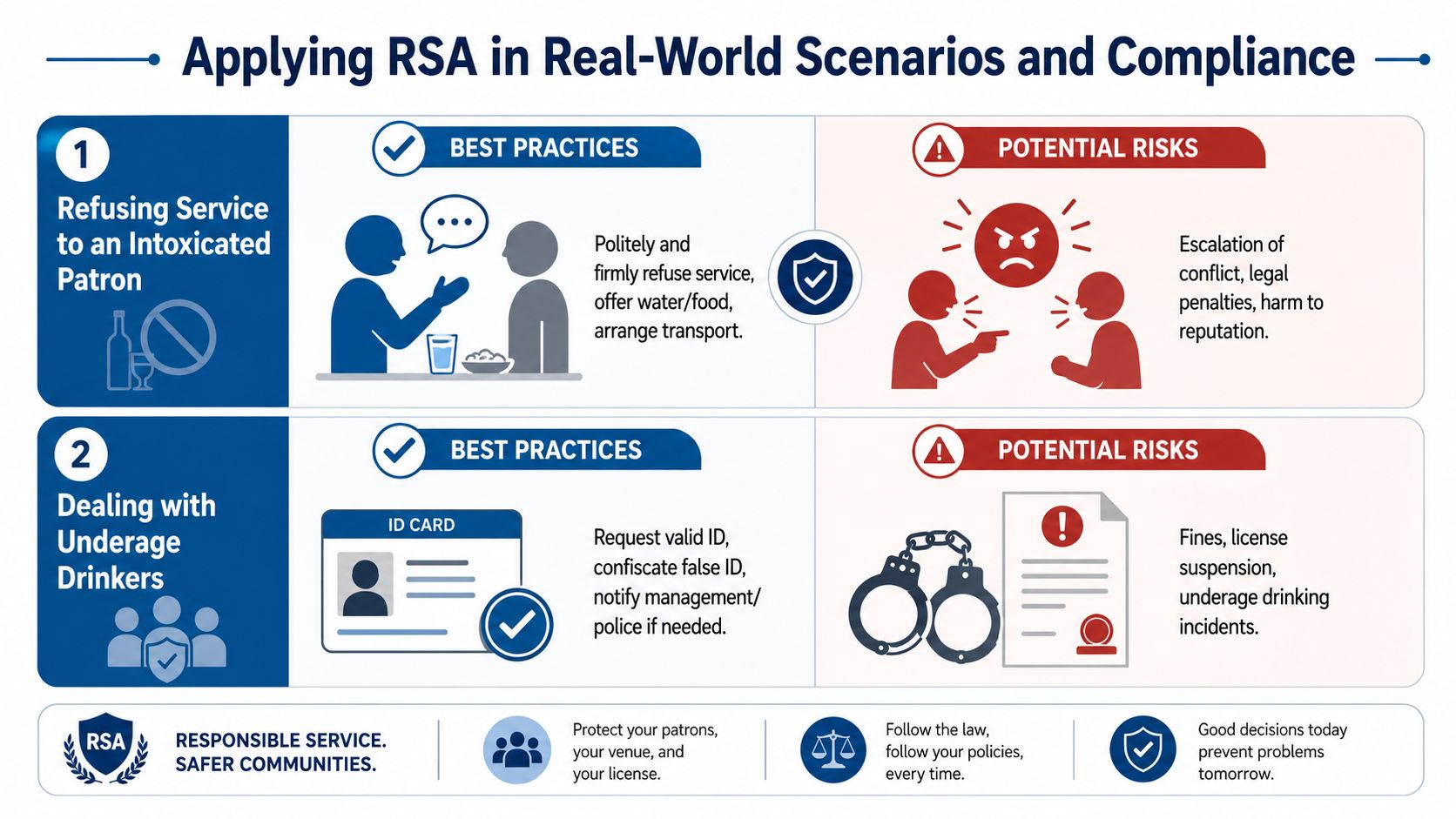
The regular customer who has had too much
This is one of the hardest situations for new staff because the patron may know your name, tip well, and act friendly right up until you refuse service. In NSW, 72% of interventions occur with known patrons, which helps explain why staff often hesitate, according to the BOCSAR alcohol bulletin on interventions and known patrons.
The wrong approach usually sounds like this: “You're drunk. I'm cutting you off.” It may be true, but it's blunt, public and likely to trigger an argument.
A better approach is calmer and more controlled. Move the conversation slightly away from the crowd if you can. Speak clearly and keep it short.
“I can't serve another alcoholic drink right now. I can get you some water or a soft drink, and we can help you sort out your next step.”
That's often called a soft refusal. You're still refusing service, but you're reducing confrontation. You aren't debating. You aren't shaming the person. You're setting a limit and offering a practical alternative.
The friend who tries to buy for someone intoxicated
This one catches out a lot of new workers. You refuse the affected patron, then their friend walks up and orders two drinks. One is obviously intended for the person you've just stopped serving.
The wrong response is to ignore it because “the friend seems sober”. RSA doesn't work if staff allow the same drink to reach the same person by a different path.
The better response is direct and steady. You can say:
- Acknowledge the order: “I understand what you're asking for.”
- State the boundary: “I can't serve alcohol that may be passed to someone who has already been refused.”
- Offer another option: “I can do water, soft drink or food instead.”
- Get support if needed: If the group pushes back, involve the supervisor or security early.
This is one of those moments where professionalism protects everyone. A quiet, consistent refusal is stronger than a long explanation.
The compliance habit many new staff forget
Service decisions are only part of RSA. Venues also need systems. In NSW, incidents involving refusal of service, intoxication or minor supply must be recorded in the liquor incident register within 24 hours and kept for at least three years, with required details including the type of incident, actions taken, witness details and police involvement, according to the NSW RSA participant workbook guidance.
New staff often think the hard part is saying no. Often, the part they miss is what comes after.
A solid venue process usually includes:
| After an incident | Why it matters |
|---|---|
| Record what happened | Creates a clear factual account |
| Note actions taken | Shows the staff response was measured |
| Inform the supervisor | Keeps decisions consistent across the team |
| Follow the house policy | Supports legal and operational compliance |
When teams do this well, RSA becomes less personal and more procedural. That makes difficult moments easier to handle.
Common RSA Questions and Next Steps
How long does a NSW RSA certificate last and how do I renew it
Your employer or training provider should guide you on current NSW renewal and competency card requirements. Because administrative rules can change, check the current state process before assuming an older card or certificate is still enough for work.
Can I use my NSW RSA in another Australian state
Not always. RSA rules are state and territory based, so recognition can differ. Before taking interstate work, confirm the local requirement with the relevant liquor authority or employer.
What are the fines for not following RSA rules
The financial risk is serious. In NSW, an employee serving an intoxicated person can face fines of up to $11,000, while the licensee can face up to $22,000, as noted in this analysis of Australian RSA penalties and enforcement.
What if I feel nervous about refusing service
That's common, especially early on. Most staff don't struggle because they don't care. They struggle because the moment is awkward, the patron may be known to them, and the room may be watching. Good RSA practice helps because it gives you a script, a process and a reason for your decision.
What should I do next if I want hospitality work
If you're an individual job seeker, get your RSA sorted before you start applying widely for licensed venue roles. If you're an employer, make sure every relevant staff member is properly trained and follows house policy, incident recording and supervision procedures. If your role may extend into gaming areas, responsible gambling training may also be relevant alongside RSA.
If you're ready to work in a licensed venue or need to keep your team compliant, TP Training offers nationally recognised, practical training across NSW with experienced trainers and hands-on learning in hospitality and workplace safety.

You may also like
Safety & Health Policy: A Guide for Australian Employers
Asbestos Removal Requirements in NSW: The Complete Guide