
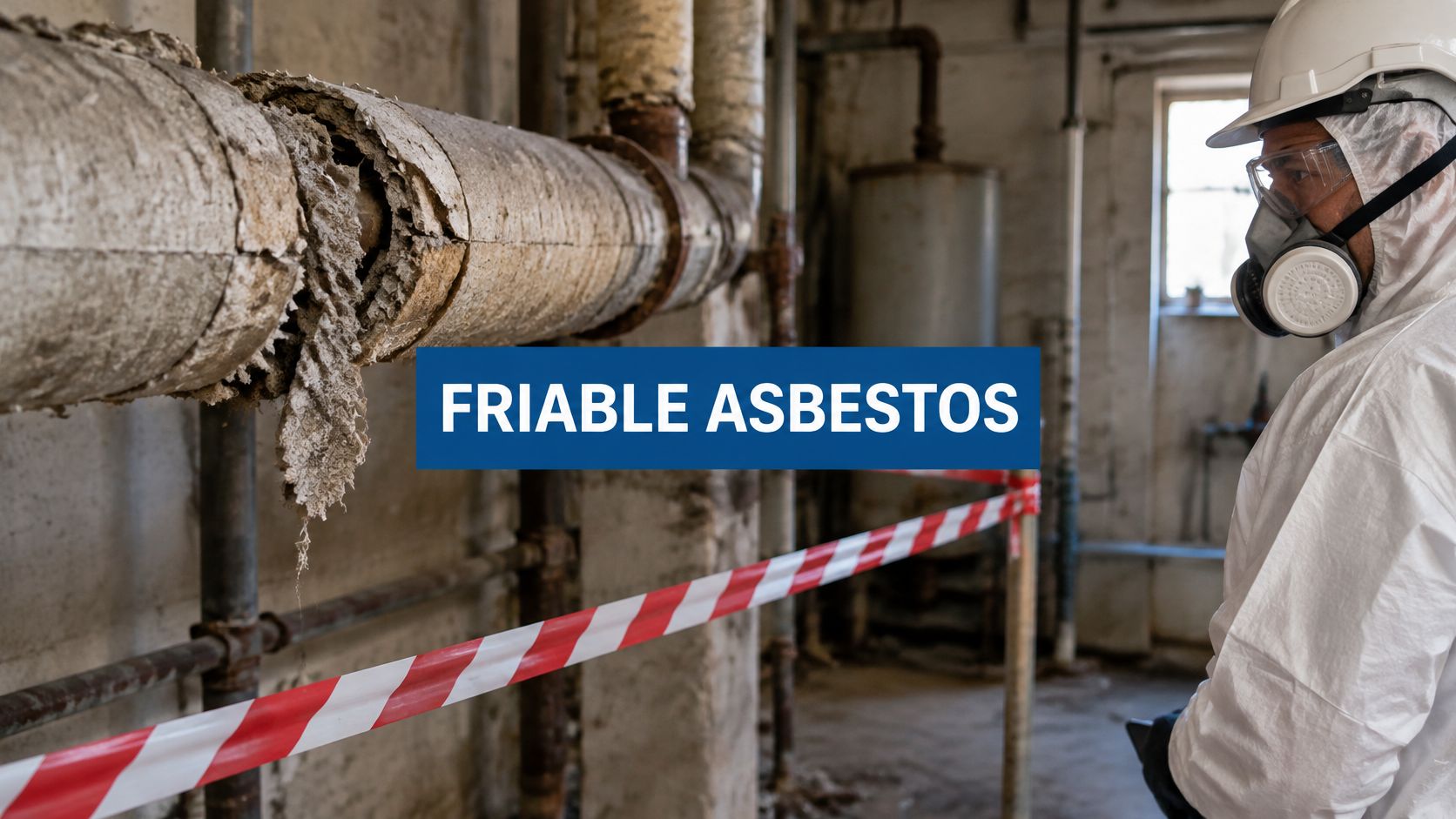
What Is Friable Asbestos? Risks, Examples and Rules
What could turn an apparently solid ceiling into a source of airborne asbestos, and why might a room still need checking after visible waste has been removed?
In Australia, friable asbestos is asbestos-containing material that can be crumbled, pulverised or reduced to powder by hand pressure when dry. The national prohibition on manufacturing, importing, supplying and using asbestos took effect on 31 December 2003, and legacy material remains in older buildings.
Friable status depends on the material's condition and the activity disturbing it. A ceiling sheet may appear intact, but grinding it during renovation can break down its surface and release dust. Weathering can also affect a material's condition. Removing visible waste does not confirm that the air is safe for reoccupation.
Workers and property owners need to know what friable asbestos is, where it may be found, which licence applies, and when to stop work and contact a licensed assessor.
Table of Contents
- Friable Asbestos Defined and How It Differs From Bonded Asbestos
- Why Friable Asbestos Causes Serious Disease
- Common Friable Materials and How to Spot Them
- Australian Rules for Friable Asbestos by Licence Class
- How to Manage Suspected Friable Asbestos Safely
- Removal Controls and Clearance Before Reoccupation
- Confirm a Licensed Removalist Before Any Work Starts
Friable Asbestos Defined and How It Differs From Bonded Asbestos
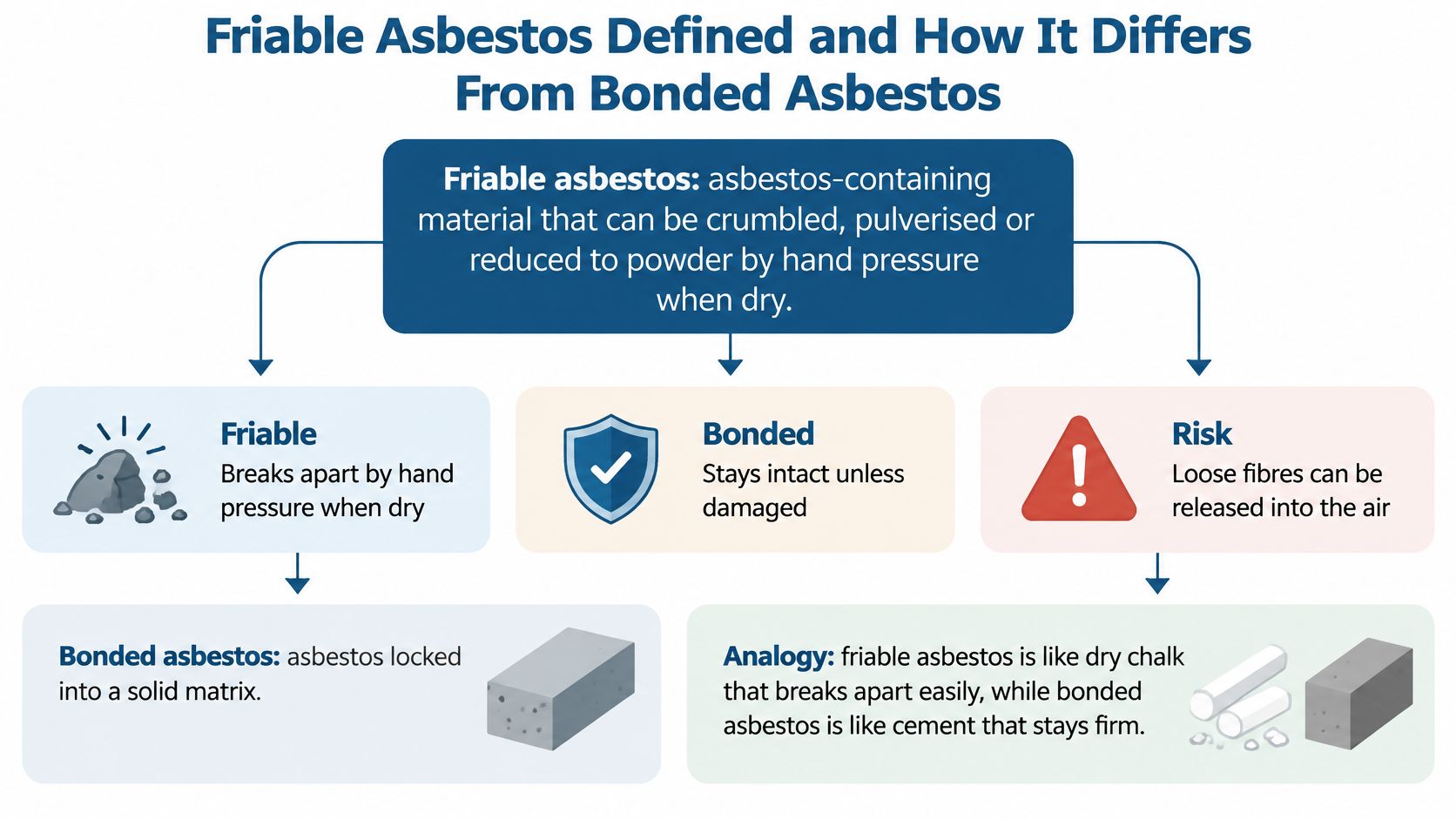
Friable asbestos is asbestos-containing material that can be easily crushed, crumbled or reduced to powder by hand pressure when dry. Safe Work Australia defines friable asbestos by this property. Disturbing friable material can release microscopic fibres into the air.
A biscuit and a handful of sand
Bonded asbestos is like a biscuit: fibres are held together by a binder, such as cement or resin. Loose-fill insulation is more like dry sand, with particles that separate readily. The analogy is only a guide; a bonded product can become friable if its condition changes or the work being done makes it crumble under hand pressure when dry.
That distinction matters during repairs and renovations. A sheet may stay intact while undisturbed, yet crack or break during work and release fibres. Classification depends on the material's condition and how the planned activity affects it, not on what the product is called.
Friable materials include insulation, sprayed coatings, lagging and loose-fill insulation. Bonded materials include fibre cement sheeting, cement pipes and vinyl floor tiles.
| Property | Friable asbestos | Bonded (non-friable) asbestos |
|---|---|---|
| Hand pressure when dry | Crumbles or reduces to powder | Cannot be crumbled by hand when dry |
| Fibre binding | Fibres are not held in a solid binder | Fibres are held in cement or resin |
| Fibre release | Can readily release fibres when disturbed | Fibres are generally contained unless the material is cut, drilled or damaged |
| Typical products | Insulation, sprayed coatings, lagging, loose fill | Fibre cement sheeting, cement pipes, vinyl floor tiles |
The rule that stops guesswork
Treat suspected friable asbestos as hazardous. Keep people away and avoid disturbing it; ask a licensed professional to assess the material and advise on work under the relevant state or territory rules.
Practical rule: If you cannot confidently identify the material and its condition, leave it undisturbed and have a qualified person assess it. Visible removal alone does not confirm that an area is safe to reoccupy.
Why Friable Asbestos Causes Serious Disease
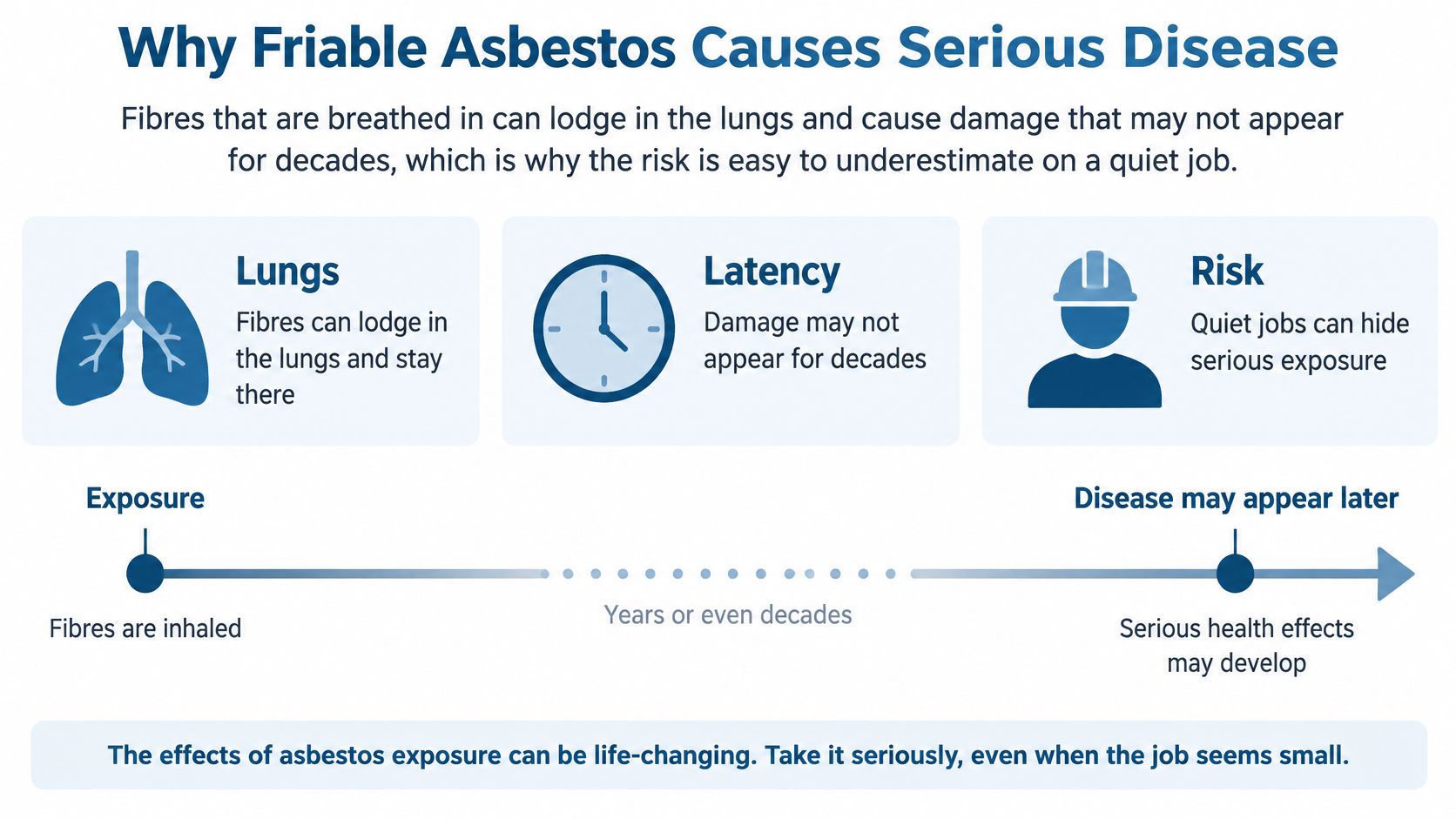
Why can a brief job create a health risk that remains hidden for decades? Inhaled asbestos fibres can lodge in the lungs, and disease may take many years to appear. Fibres are too small to see or smell, so the absence of visible dust or an immediate cough cannot show whether exposure has occurred.
The main asbestos-related diseases are mesothelioma, asbestos-related lung cancer and asbestosis. Manage the risk by preventing fibres from escaping into the air. Friable material can release fibres readily, and tasks that disturb it can increase the chance of inhalation.
What the national figures actually show
The figures below come from Safe Work Australia's asbestos-related disease indicators:
- 156 new mesothelioma cases in 1982, the first year of nationally available data, according to Safe Work Australia's asbestos-related disease indicators.
- 674 cases in 2007, followed by 667 in 2010, according to Safe Work Australia's asbestos-related disease indicators.
- 690 new cases in 2011, the highest figure in that series, according to Safe Work Australia's asbestos-related disease indicators.
- Registered mesothelioma deaths rose from 416 in 1997 to 606 in 2011, according to Safe Work Australia's asbestos-related disease indicators.
- About 82% of new mesothelioma cases in 2006 were men, according to Safe Work Australia's asbestos-related disease indicators.
These national figures cover asbestos-related disease generally, not disease caused by friable material alone. They also do not mean that every exposure leads to illness. They show why work that may release fibres needs competent assessment and appropriate controls.
Why today's job is not a history lesson
Asbestos-related disease can take many years to develop. That long delay means work on an older building can still expose people to asbestos installed decades ago. A task that disturbs material may put the person doing it, and others nearby, in the exposure path.
People who worked around insulation and sprayed coatings feature in the history of occupational asbestos exposure. For workers who need to recognise asbestos hazards, TP Training offers an online asbestos awareness course that can be taken with crystalline silica exposure prevention.
Invisible fibres can remain a concern after a job. A clear-looking room does not verify that fibres have been removed or that the space is safe to reoccupy.
Common Friable Materials and How to Spot Them
Friable asbestos is often found in older buildings and plant where insulation or fireproofing was applied as a loose coating or wrap. Common examples include:
Loose-fill in roof and wall cavities can look like fluffy grey or white residue. Because the fibres are not held in a solid binder, movement nearby, such as a cable pull or a step on a ceiling joist, can disturb the material and spread dust through the cavity.
Sprayed fireproofing and textured coatings may cover steel beams or old ceilings. A rough, flaking or water-damaged surface can signal deterioration. Do not probe it with a screwdriver.
Pipe and boiler lagging forms a soft covering around hot plant. Cutting or disturbing damaged lagging can release fibres. Dust below a flange is a warning sign that the area needs assessment, not routine cleaning.
Older insulation that crumbles when touched may have deteriorated from a firmer state. Its current condition and how the planned work may disturb it affect whether it is friable.
Condition plus the job you are doing
NSW asbestos removal guidance defines friable asbestos as material that can be crumbled, pulverised or reduced to powder by hand pressure when dry. Whether a material is friable depends on its condition and the activity involved. Cutting, drilling, water blasting, deterioration or demolition can release respirable fibres. An intact sheet beside a worker presents a different disturbance risk from one being ground or broken.
Some material is concealed until work begins:
- Under-floor areas: lagging on old heating pipes, or dust settled on bearers.
- Behind wall linings: offcuts or sprayed coating exposed when plasterboard is removed.
- Contaminated soil and storm or fire debris: fibres mixed through dirt after a damaged building has been disturbed.
Surface appearance alone cannot confirm whether asbestos is present or whether it is friable. A damaged cement sheet may look chalky, while loose-fill and deteriorated insulation can be difficult to identify by sight. Check the site's NSW asbestos register for recorded asbestos locations and condition.
How can I tell whether a material is legally friable?
Do not test it by hand. Identification and condition assessment should be carried out by appropriately qualified professionals. In NSW, any quantity of friable asbestos requires removal by a Class A licensed removalist. The removal work requires controls such as enclosure, negative pressure, wet methods and air monitoring. If material's status is uncertain, stop work and seek a professional assessment.
Australian Rules for Friable Asbestos by Licence Class
Australia's asbestos prohibition stopped new asbestos products from entering supply. Existing buildings and plant may still contain asbestos, and work health and safety rules are administered by each state and territory. In NSW, the licence threshold for non-friable asbestos follows the model code's 10 m² limit, as set out in the model code of practice for asbestos removal work.
The licence class depends on the material and, for non-friable asbestos, the amount being removed. Class A covers friable asbestos in any quantity. Class B covers non-friable asbestos above 10 m². A competent person may remove non-friable asbestos in quantities of 10 m² or less, following the applicable code of practice.
| Asbestos type | Amount | Licence or competence required | Who may remove it |
|---|---|---|---|
| Friable | Any amount | Class A licence | Licensed Class A removalist only |
| Non-friable | More than 10 m² | Class B licence | Licensed Class B removalist |
| Non-friable | 10 m² or less | No licence; competent person required | Competent person following the code of practice |
What the person who books the job must check
A hand-sized patch of lagging remains friable. Its small area does not make it eligible for removal by a competent person. Friable asbestos requires a licensed Class A removalist.
Before work begins, the person commissioning it should check that the removalist's licence class matches the material and quantity. A Class B licence authorises removal of non-friable asbestos above the threshold, not friable asbestos.
The booking also sets the requirements for completing the job. The removalist must carry out the work under the controls for the relevant licence class, and visible removal alone does not confirm the area is clear for reoccupation. Arrange the required independent assessment before anyone returns to the area.
If you cannot name the licence class on the quote, you are not ready to sign it.
How to Manage Suspected Friable Asbestos Safely
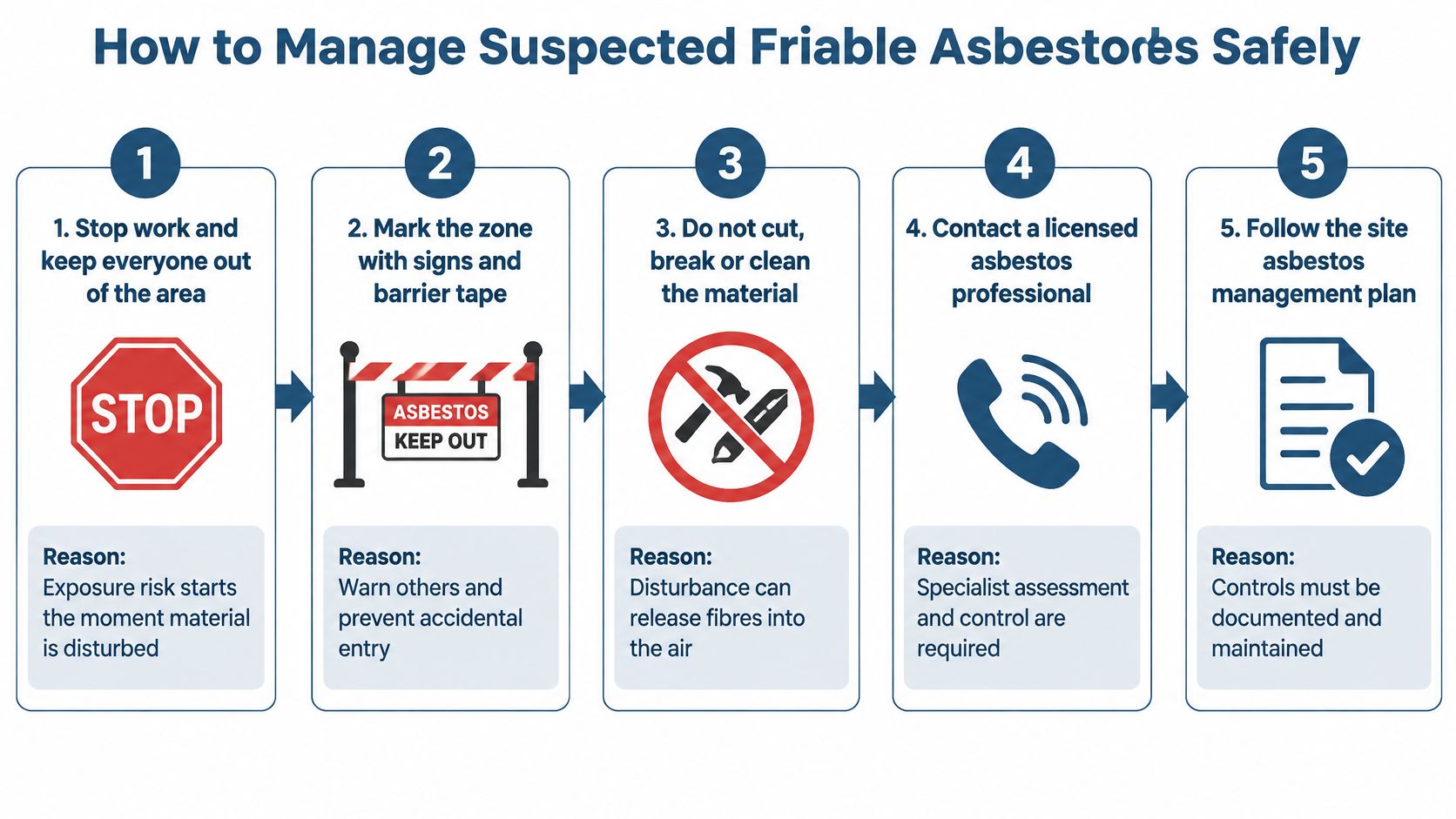
A material's friability depends on its condition and how it may be disturbed. If suspect material is damaged or work could release dust, stop and keep people away while it is assessed. For practical steps after discovering possible asbestos, follow this guide to what to do if you find asbestos on site.
- Stop work and keep people out. Put down tools, leave the area and prevent others from entering to inspect.
- Mark the zone. Use signs and barrier tape so incoming workers know the area is closed.
- Leave the material undisturbed. Do not sweep, use compressed air, drill, sand, break or water blast it. These actions can release fibres into the air.
- Switch off nearby fans and air movers if you can do so without entering the affected area. This helps avoid spreading dust through corridors or air returns.
- Record what you observed. Note the location, the apparent extent of the material and what activity was under way. Take photos from outside the restricted zone.
- Notify the site supervisor or building manager. Arrange for a licensed asbestos assessor to assess and, if needed, sample the material.
- Keep the area closed while the assessment is arranged. If anyone may have been exposed, report it to the employer and seek medical advice.
Class A removal controls
If the material is confirmed as friable asbestos and must be removed, Class A work requires specialist controls. The Australian model code describes measures including enclosure, negative pressure after leak testing and wet methods, so far as reasonably practicable. The specific enclosure and pressure values are covered in the removal controls section.
Your immediate role is to secure the area, record what you observed and notify the responsible site contact. Do not attempt to clean up suspected material or treat visible removal as proof that the area is safe.
Removal Controls and Clearance Before Reoccupation
After asbestos removal, the assessor must determine whether the area is suitable for reoccupation. Air monitoring and a clearance inspection check for contamination that may not be visible, including in adjoining rooms or ceiling voids. Under the SafeWork NSW code for safely removing asbestos, a licensed asbestos assessor carries out the required checks and issues the clearance certificate. Where air monitoring forms part of the clearance inspection, respirable asbestos must be below 0.01 fibres/mL. During removal, readings above 0.02 fibres/mL require work to stop and SafeWork NSW to be notified.
| Control or check | Required value or action | Purpose |
|---|---|---|
| Enclosure sheeting | Polyethylene at least 200 micrometres | Keeps fibres contained |
| Negative pressure in enclosure | At least 12 Pa water gauge | Limits fibres escaping |
| Removal air monitoring | Respirable fibres below 0.01 fibres/mL | Checks whether exposure is controlled |
| Work stop threshold (NSW) | Stop work and notify SafeWork NSW above 0.02 fibres/mL | Requires action when readings exceed the threshold |
| Clearance certificate | Issued by a licensed asbestos assessor after the enclosure is dismantled | Records the clearance decision |
The order that actually protects the next trade
The enclosure is built and negative pressure is checked before removal begins. Wet methods limit dust, while air monitoring runs before and during the work. Where reasonably practicable, the enclosure is decontaminated before dismantling. The licensed assessor then inspects the area and issues the certificate needed for reoccupation.
A room may look clean while contamination remains beyond the removal area. For example, debris can be removed from a ceiling void while an adjoining room remains affected. The clearance inspection and its documented result establish whether people can return; appearance alone cannot answer that question. Employers should arrange health monitoring for workers at risk from asbestos exposure.
For a bathroom strip-out, include asbestos controls and clearance in the project budget. A Modern Bathrooms demolition cost breakdown can help with ordinary demolition costs, which are separate from licensed asbestos work. Keep the clearance certificate on file and check that it identifies the area people are due to re-enter.
Confirm a Licensed Removalist Before Any Work Starts
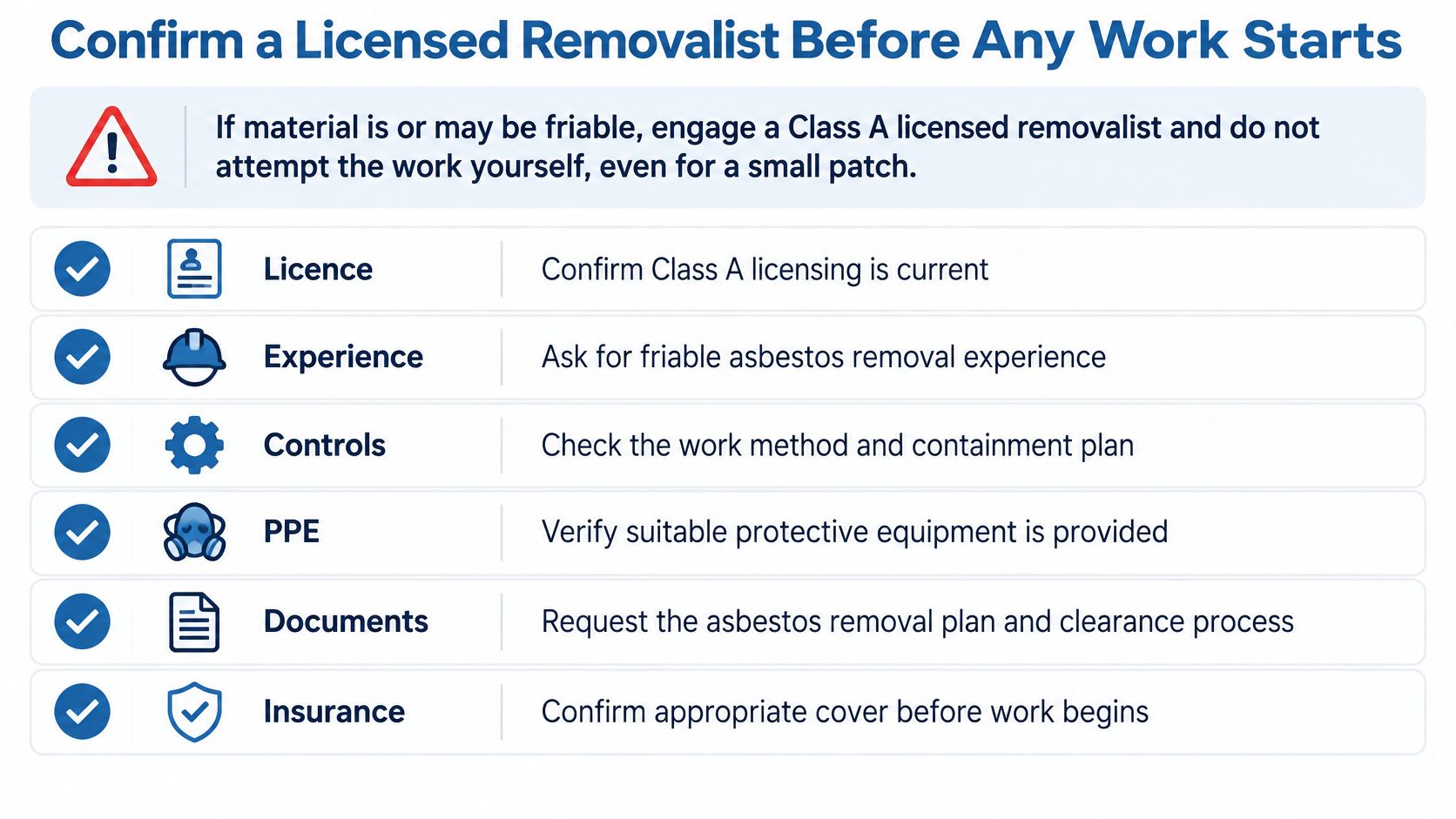
If asbestos may be friable, engage a Class A licensed removalist. Do not try to remove it yourself, even if the affected area looks small.
Before signing, confirm these details:
- Licence match. Check the removalist's current licence on the relevant register.
- Written removal plan. Ask for the proposed enclosure, negative-pressure controls and wet methods in writing.
- Air monitoring. Confirm that monitoring is arranged before and during the work, and identify the provider.
- Independent assessor. Arrange for a licensed asbestos assessor to conduct the clearance assessment.
- Written clearance terms. Make the clearance requirement part of the contract before work begins.
- Licensed disposal. Confirm the waste will go to a licensed facility and that disposal records will be provided.
- Handover. Agree how the documented hand-back to the owner or employer will be tied to the clearance certificate.
Use this list when you see crumbling insulation, dust after damage, debris from a storm or fire, or suspected asbestos during renovation, demolition or work on contaminated soil. Put in writing who pays for clearance and who makes the reoccupation decision. For general contractor questions, consult a homeowner's guide to interviewing remodelers. For local context, read about asbestos removal in Geelong, then check the requirements that apply where the work will take place.
Workers who may encounter asbestos can learn to recognise the hazard before a job starts. TP Training offers an Asbestos Awareness Online Course, as well as an online Crystalline Silica Exposure Prevention course.
Book the licensed assessment before work begins, and ensure the quote covers the required controls, independent assessment and written clearance. Visible removal alone does not verify that an area is safe to reoccupy.
TP Training offers asbestos awareness training for workers and employers who may encounter asbestos during renovation, demolition or maintenance. Visit TP Training to learn about its online course.

You may also like
Test and Tag in Australia: Rules, Intervals and Records
Dangerous Goods Class 3 Flammable Liquids: Rules and Risks