Different Classes of Fire Extinguishers: A Workplace Guide
You're standing near the workplace kitchen when a chip pan catches fire. There's an extinguisher beside the door, but is it the right one for burning oil? The cylinder's size won't answer that question, and neither will the colour of the flames.
Understanding the different classes of fire extinguishers starts with identifying what's burning. Then you need to read the extinguisher's suitability label, understand its capacity and recognise situations, particularly battery failures, where evacuation matters more than choosing an agent.
Table of Contents
- Identify Your Fire Class by What Is Burning
- Matching Extinguisher Types to Each Class
- Reading Ratings Beyond the Class Letter
- Electrical Fires and Lithium-Ion Batteries
- How to Choose the Right Extinguisher for Your Site
- Keeping Extinguishers Ready to Work
- Audit Your Extinguishers This Week
Identify Your Fire Class by What Is Burning
That burning chip pan is a Class F fire because the fuel is cooking oil or fat. A burning cardboard carton beside it would be Class A. Being in the same room doesn't make them the same type of fire.
Australia's system identifies six fire classes by the burning material, and Fire and Rescue NSW's portable extinguisher guidance makes the fuel central to extinguisher selection. Water is appropriate for many ordinary combustible fires, but it must never be used on energised electrical equipment.
Australian fire classes by fuel
| Class | What Burns | Common Examples |
|---|---|---|
| A | Ordinary combustibles | Timber, paper, textiles, plastics, coal |
| B | Flammable or combustible liquids | Petrol, oil, paint, alcohol |
| C | Flammable gases | LPG, propane, butane, LNG, acetylene |
| D | Combustible metals | Magnesium, aluminium, potassium |
| E | Energised electrical equipment | Switchboards, motors, power tools |
| F | Cooking oils and fats | Deep fryers, commercial woks |
The important distinction is fuel, not flame appearance. A small liquid fire and a large timber fire still belong to different classes.
Use this visual guide to practise making that first distinction.
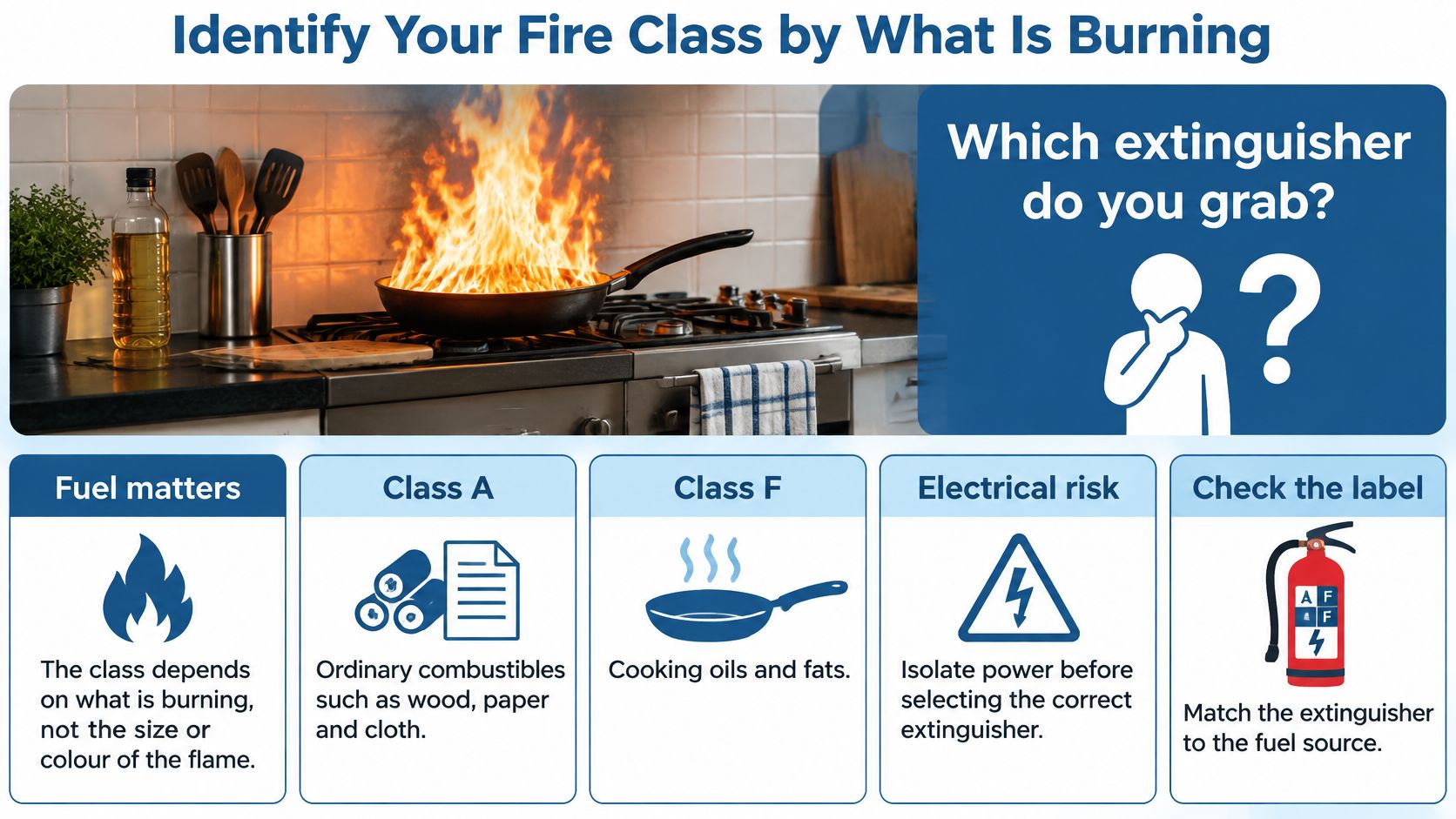
Match the letter to a workplace example
An office wastepaper bin gives you a straightforward Class A example. A spilled tin of flammable paint that ignites is Class B, while burning gas escaping from an LPG bottle is Class C.
A machine shop handling magnesium swarf needs to recognise a Class D hazard. A motor burning while still energised presents a Class E electrical hazard, and oil burning inside a commercial fryer is Class F.
Be careful with everyday words. Cooking oil belongs in Class F, not in the same category as every other liquid described as oil. Likewise, a gas cylinder that's leaking but hasn't ignited is a dangerous leak, not yet a Class C fire.
Practical rule: Identify the fuel before thinking about the extinguisher. If you can't identify the hazard safely, withdraw and raise the alarm.
For welding, cutting and grinding activities, include nearby fuels in your hot work permit checks. Sparks can ignite materials beyond the immediate workpiece.
Name the three most likely fire types on your site, then write each class beside its location on your hazard list.
Matching Extinguisher Types to Each Class
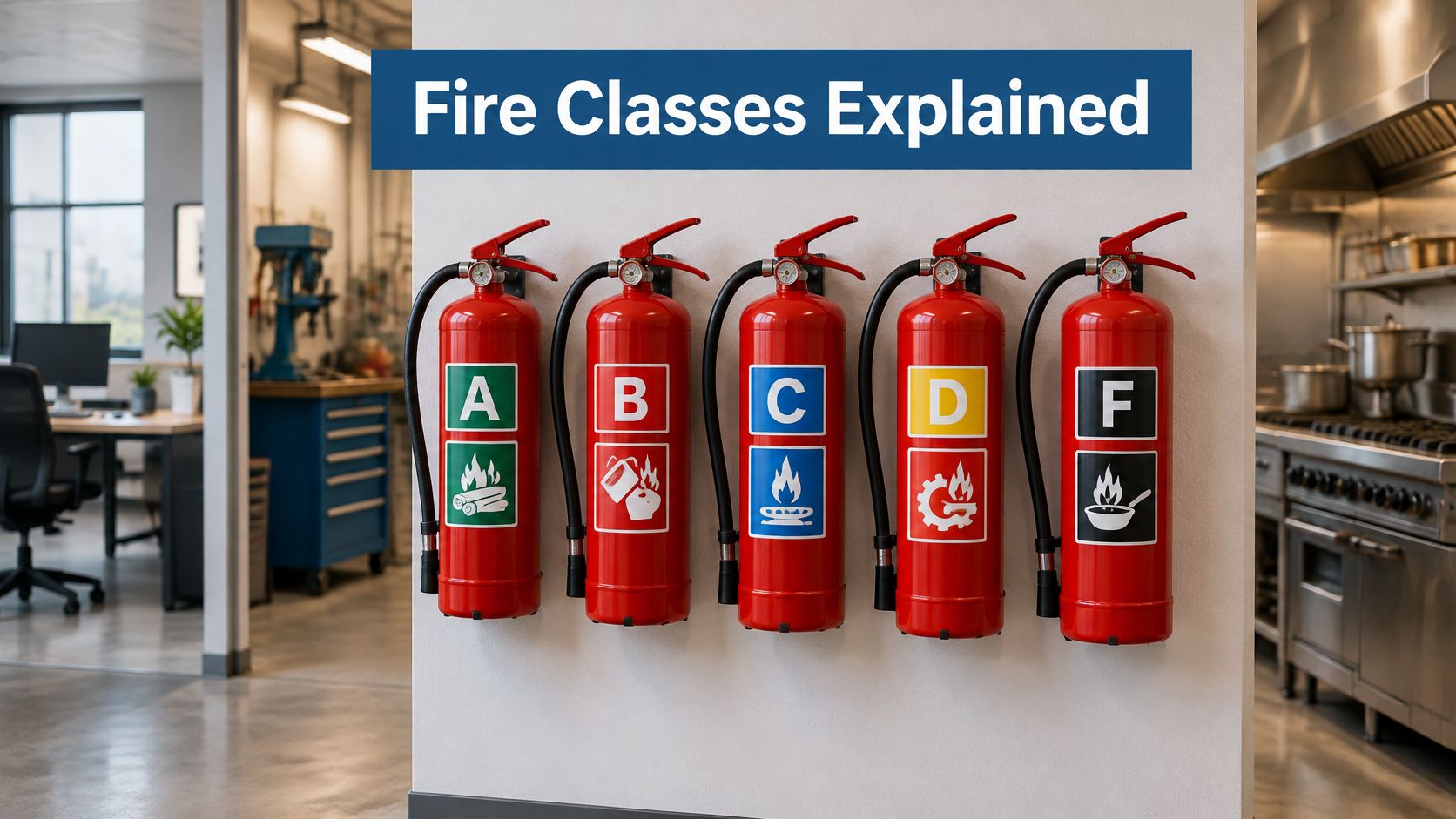
An extinguisher's agent is the material it discharges. Its label tells you which fire classes the complete appliance is suitable for. These aren't interchangeable ideas: knowing that a cylinder contains powder doesn't tell you whether it's general-purpose dry chemical or a specialist metal-fire product.
Extinguisher type suitability by fire class
| Extinguisher | Suitable For | Limited or Not Suitable For |
|---|---|---|
| Water | Class A | Classes B, C, D, E (dangerous), F |
| Foam | Classes A and B | Classes C, D, E, F |
| ABE dry chemical powder | Classes A, B, C, E | Class F |
| BE dry chemical powder | Classes B, C, E | Class F (limited), Class A |
| Carbon dioxide (CO2) | Class E (primary) | Classes A, B, F (limited) |
| Wet chemical | Classes F and A | Class E (dangerous) |
| Special dry powder | Class D, metal-specific | Not a general-purpose substitute; water, foam and CO2 can be ineffective or hazardous on metal fires |
| Vaporising liquid | Only the classes printed on the particular appliance's Australian label | Any class not expressly included on its label |
The CFA extinguisher suitability guide distinguishes ABE and BE powder, identifies carbon dioxide primarily for electrical fires, and identifies wet chemical for cooking oils and fats. Limited effectiveness isn't the same as a preferred choice, particularly for hot cooking oil that can reignite.
Dangerous mismatches to remember
- Water on energised equipment: You can expose yourself to electric shock. Don't assume an appliance is isolated because it has stopped operating.
- Water on burning oil: Water can cause violent splashing and spread burning oil beyond the pan or fryer.
- Wet chemical on live electrics: A kitchen-suitable extinguisher isn't automatically suitable for nearby energised appliances.
- General-purpose agents on burning metal: A Class D hazard needs powder selected for the particular metal, not whatever powder cylinder is closest.
An ABE extinguisher can be a practical choice for a workshop containing timber packaging, flammable liquids and energised machinery. A commercial kitchen with deep fryers needs a suitable wet-chemical extinguisher for its cooking-oil hazard. Neither choice removes the need to assess other risks in the room.
Gas introduces another condition: don't extinguish burning gas until its supply has been safely isolated. Knocking down the flame while gas continues escaping can leave an explosive atmosphere. Workers shouldn't approach a leaking cylinder or valve unless their training and the emergency procedure support that action.
After a powder discharge, keep affected electronics isolated until they've been assessed. Eagle Restoration's guidance on handling extinguisher dust on electronics is a useful recovery resource, not a reason to delay evacuation or choose an unsuitable agent.
Match the extinguisher to the likely fire, then check the actual label before buying.
Reading Ratings Beyond the Class Letter
Two extinguishers may carry the same class letter and still perform differently. The letter identifies the fire hazard; the number shows performance against a defined test fire. On site, read both parts of the label.
Australian extinguisher labels use class letters and numerical ratings to identify suitability and tested performance. Compare numbers only within the same class. A higher number indicates greater capacity against that class's test fire, not how long the extinguisher will discharge or how safely a person can approach a fire.
Numerical ratings by fire class
Use the rating printed on the extinguisher rather than relying on a general range. Ratings vary by product and class, so the table shows what to check on the label rather than prescribing universal numerical ranges.
| Class | Rating on the label | What the rating means |
|---|---|---|
| Class A | Numerical rating, if shown | Tested performance against a Class A test fire |
| Class B | Numerical rating, if shown | Tested performance against a Class B test fire |
| Class F | Numerical rating, if shown | Tested performance against a Class F test fire |
| Classes C, D and E | Check the printed classification and suitability | The class identifies the hazard; confirm the extinguisher is suitable for it |
Rating describes tested performance; it doesn't authorise riskier firefighting. Cylinder size and agent colour can help identify equipment, but suitability comes from the complete label and the site's hazard assessment.
Australian and overseas labels differ
A letter can mean different things in different countries. In Australia, Class E means energised electrical equipment. US labels generally use Class C for electrical hazards, while Australian Class C refers to flammable gases. An Australian 5B:E label therefore differs from a US 5B:C label.
This distinction matters when equipment is bought online or brought onto an Australian site. Read the local classification and suitability information rather than translating letters from memory. Include label reading in workplace safety training so staff can identify what the markings mean on the equipment they use.
Before purchase:
- Confirm the class: Match the printed classification to the likely fire.
- Compare ratings: Compare numerical ratings within the same class.
- Read the full label: Check the stated suitability, not just the cylinder size or agent colour.
Electrical Fires and Lithium-Ion Batteries
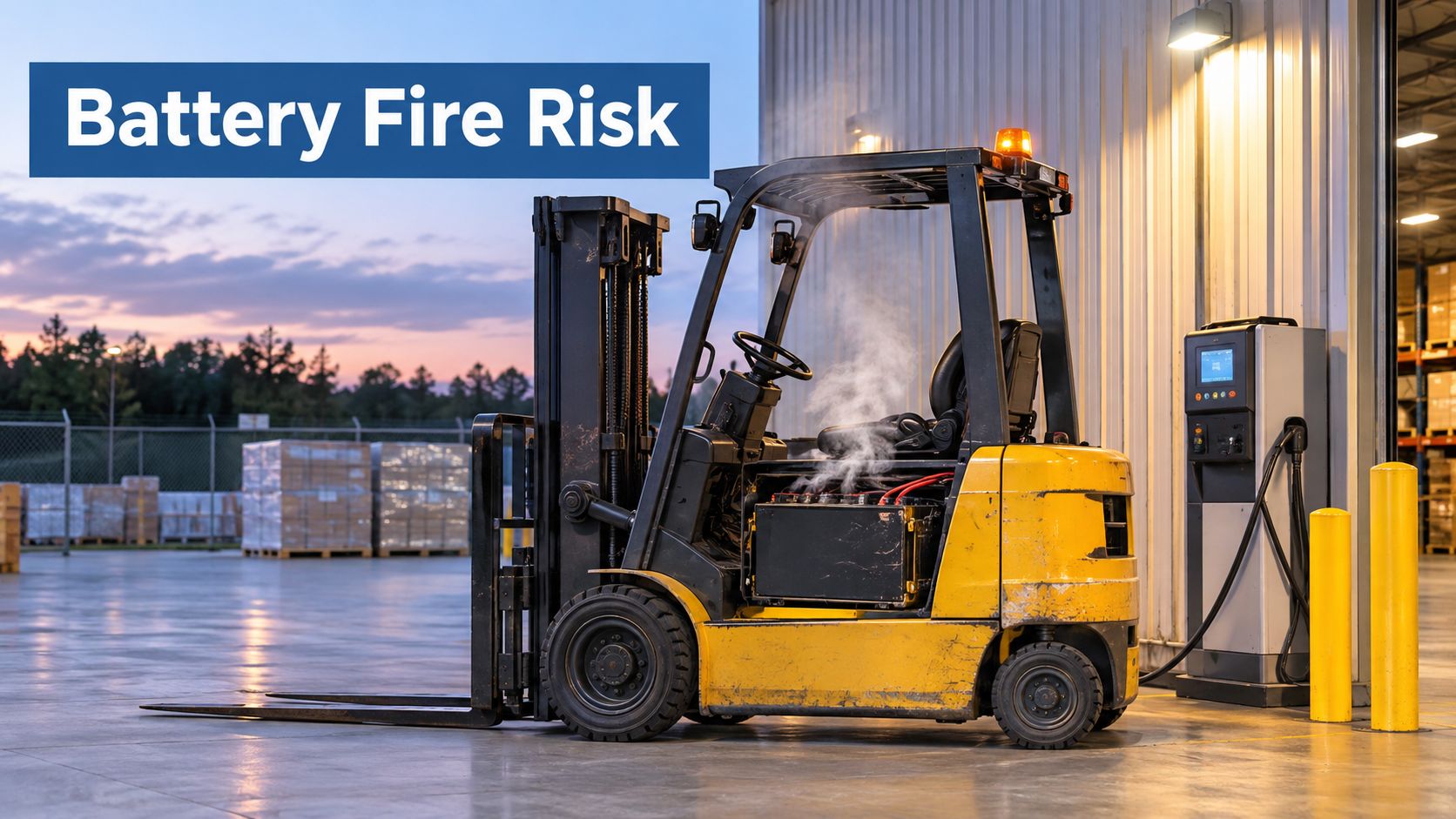
A worker notices smoke coming from a forklift at its charging station after hours. Before treating it as an ordinary electrical-equipment fire, the site needs to know what battery technology the forklift uses. A damaged lithium-ion battery creates a different operational problem from an energised motor or cable.
Thermal runaway can continue inside battery cells after visible flames disappear. A failing pack can release toxic smoke, develop fire rapidly and reignite. Disconnecting the charger doesn't necessarily stop the internal failure.
A charging bay needs an emergency procedure that accounts for those conditions.
Why Class E doesn't settle the decision
NT WorkSafe's Electrical Safety Week guidance records Fire and Rescue NSW's 318 lithium-ion battery fires in 2024, compared with 272 in 2023 and 165 in 2022, plus 25 in NSW by 10 February 2025; it also identifies 417 lithium-ion-related fires in Queensland between 1 July 2023 and 30 June 2025.
The workplace concern extends beyond e-scooters. Power tools, power banks, handheld devices and other rechargeable equipment can introduce battery hazards into warehouses, offices and construction sites.
A Class E marking tells you about suitability around energised electrical equipment. It doesn't demonstrate that an extinguisher can stop thermal runaway in every battery pack. Knocking down external flames with powder or carbon dioxide may leave the underlying failure unresolved.
Response rules for a suspected battery failure
- Distinguish the hazards: Establish whether the problem involves energised equipment, a failing battery pack or both. This means distinguishing them in the assessment, not physically separating a smoking pack.
- Isolate only from safety: Use a safely accessible isolation point if the emergency procedure allows it. Don't approach a venting battery to unplug it.
- Evacuate on warning signs: Swelling, venting, smoke or rapid heating calls for withdrawal, raising the alarm and contacting emergency services.
- Keep people out: Prevent workers entering enclosed charging or storage areas to investigate smoke or retrieve belongings.
Include clear withdrawal triggers in staff briefings. DLG Electrical's explanation of when to evacuate an electrical fire can support those discussions, but the site's emergency plan should govern the response.
Prevention starts with compatible chargers, protected charging areas and a process for removing damaged batteries from normal use. Don't return a dropped, swollen or overheating pack to charge because it still powers the tool.
Write a battery rule for your site that names the warning signs, the alarm procedure and who keeps others away.
How to Choose the Right Extinguisher for Your Site
Begin with a walk-through of each area and mark the activities in it. Take a floor plan, record the credible fire hazards and include temporary work, contractor equipment and charging arrangements, not just permanent machinery.
Classification and performance rating are determined through AS/NZS 1850 testing, as described in the Australian Business Licence and Information Service entry. Keep in mind that the class letter is only the starting point. The printed rating tells you how much fire the unit can handle, and any battery-charging area needs the specialist treatment the previous section described.
Use this workflow to organise the assessment.
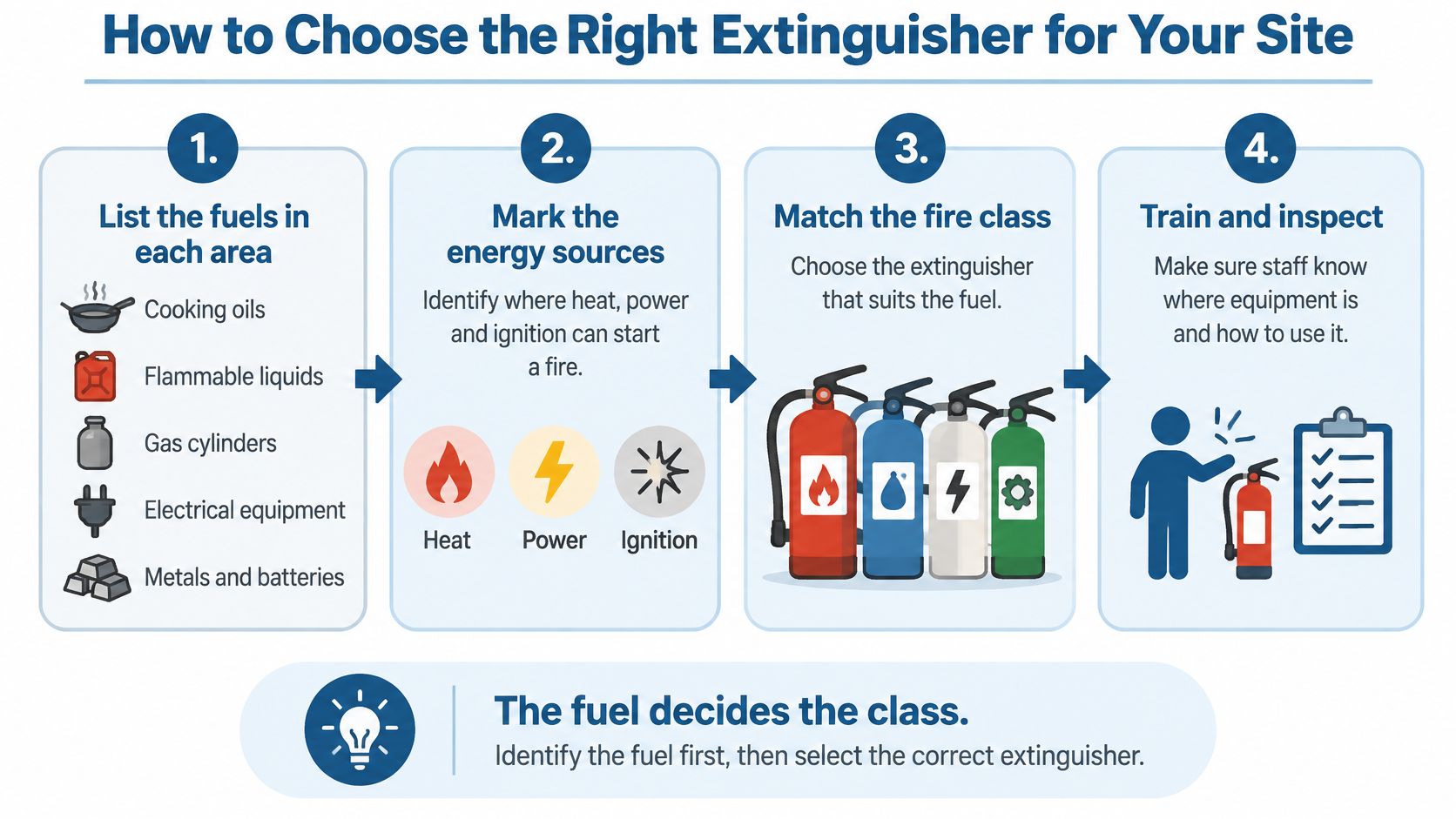
Build a selection record
- List the fuels in each area. Record cooking oils, flammable liquids, gas cylinders, ordinary combustibles, electrical equipment, metals and batteries. Include what workers store and use in practice.
- Mark energy sources and isolation points, including switchboards, gas lines and charging points. Record whether workers can reach the controls without entering the hazard.
- Prioritise the assessment. Start with areas where an incident could develop rapidly or obstruct escape. A charging bay or fuel store may need attention before a low-hazard meeting room.
- Use the extinguisher suitability table to shortlist agents. Treat metal processing and battery charging as specialist assessment tasks rather than extensions of ordinary office protection.
- Check the printed Australian classification and rating before purchase. Record the proposed unit's details beside the hazard it will protect.
- Have a competent fire-protection practitioner confirm the quantity and locations against AS 2444. The National Construction Code requires installations to follow its relevant sections. Workers should be able to reach equipment without passing through the fire.
- Update the site fire plan. Show equipment, exits, isolation points and any restricted-response areas, then assign responsibility for keeping that information current.
For construction workplaces, connect this record with your risk-management process. Changes in trades, materials and temporary power can change the fire-protection requirement.
A worked example: one record applied to a mixed site
Consider a small depot containing an office, a charging bay for cordless tools and a store of aerosol cans and solvents. The walk-through lists paper combustibles and a server in the office, lithium-ion packs in the charging bay and flammable liquids in the store. Energy-source marking identifies the switchboard feeding the charging bay and confirms workers can isolate it without reaching past the bay. The charging bay is prioritised because a battery failure can develop faster than the office hazard, and because powder knocked down externally may not resolve the underlying fault. Shortlisting follows the matching table for the office and store, while the charging bay goes to a specialist assessment. The printed rating is checked before ordering, a practitioner confirms quantity and placement against AS 2444, and the fire plan marks the charging bay as a restricted-response area with its alarm procedure attached.
Apply the method across workplace zones
| Workplace zone | Selection decision to assess |
|---|---|
| Office | An ABE unit may address paper-based combustibles and energised equipment, subject to the required rating and distribution. |
| Commercial kitchen | The agent match was settled in the matching table; the decision here is the rating needed for the fryer line and whether staff can reach the unit without crossing the hazard. |
| Workshop | Assess protection for paints, solvents and machinery, and treat any combustible metal swarf as a specialist decision that calls for dedicated assessment. |
Treat these rows as prompts for the assessment. The finished design comes from the practitioner's placement check in step six.
Selection check: Every proposed extinguisher should have a clear answer to “Which hazard does this protect, and can workers reach it safely?”
Keeping Extinguishers Ready to Work
The correct extinguisher can still fail the workplace if it's blocked, damaged, partly discharged or no longer matched to the activity nearby. A refit can make an old selection unsuitable without anyone moving the cylinder.
Treat a routine visual check as a way to detect problems early, not as a substitute for professional maintenance. Workers should report defects rather than dismantling valves, testing discharge or attempting repairs.
A monthly workplace visual check
- Pressure indication: Where fitted, check that the gauge or indicator is in its operating zone. Not every extinguisher has a pressure gauge.
- Pin and tamper seal: Confirm they're present and intact, with no sign the extinguisher has been used.
- Cylinder condition: Look for dents, corrosion, leakage or other visible damage.
- Hose and nozzle: Check for obstruction, cracking or damage without taking the appliance apart.
- Access: Remove stored stock, trolleys and equipment that prevent someone reaching the extinguisher.
- Signage and identification: Make sure workers can identify its location and read its class label.
- Hazard match: Confirm that equipment, materials and activities nearby haven't changed.
- Service record: Check that the maintenance tag is present and escalate overdue or unclear records.
Use a workplace inspection checklist to record the location, defect, responsible person and corrective action. “Checked extinguishers” isn't a useful record if nobody can tell which unit had the damaged hose.
Professional maintenance and used equipment
Arrange maintenance by a competent person under the applicable AS 1851 service schedule. Include the annual service, but don't assume an annual visit alone satisfies the schedule, since other routine service activities may also be required.
Have the technician update the service tag and record the work in the site's maintenance logbook. Keep corrective actions open until someone confirms they're resolved.
Any extinguisher discharged, even briefly, needs assessment for servicing, recharging or replacement. Don't return it to the wall because the cylinder still feels heavy or appears to contain agent.
Common warning signs are easy to overlook: a unit behind new stock, a missing maintenance tag, a kitchen that changed fryers without reviewing protection, or a workshop that added lithium-ion charging.
Assign the monthly visual inspection to a named person at each site, with a backup for leave and a clear reporting route for defects.
Audit Your Extinguishers This Week
Make the audit a practical job with an owner and a completion date. A folder of equipment records won't protect workers if the appliances on the wall don't match the hazards on the floor.
Turn the walk-through into corrective action
- Walk the site with the class and suitability tables and your area-by-area hazard list. Include temporary storage and contractor work areas.
- Compare each extinguisher's class, rating and location with the hazard record. Flag unsuitable units, blocked access and unclear or overdue maintenance.
- Arrange corrections. Have unsuitable equipment replaced and locations reviewed by a competent practitioner. Confirm the label before purchasing replacements.
- Post battery-charging rules at the charging area, including safe isolation arrangements and evacuation triggers.
- Brief workers on the appliances relevant to their work and the conditions that require them to leave instead of attempting extinguishment.
- Book the routine maintenance schedule, including annual servicing, and assign the workplace visual checks.
- Sign off the audit with the date, responsible person and a review date twelve months ahead. Review sooner if equipment, layout or activities change.
A usable plan also needs recognisable locations. Mappedin's guide to accurate building maps for emergency preparedness offers useful context for keeping layouts understandable and current.
Keep unresolved actions visible to management as part of employers' workplace safety responsibilities. Don't mark the audit complete while a critical replacement or access problem remains unresolved.
TP Training offers practical workplace safety education across construction, first aid, hospitality and high-risk work. Visit TP Training to explore relevant training for your team, then include your site's fire hazards, evacuation rules and equipment locations in their workplace induction.

You may also like

White Card Ballarat: Face-to-Face Course Steps for 2026

Childcare First Aid Training: What Services Need in 2026