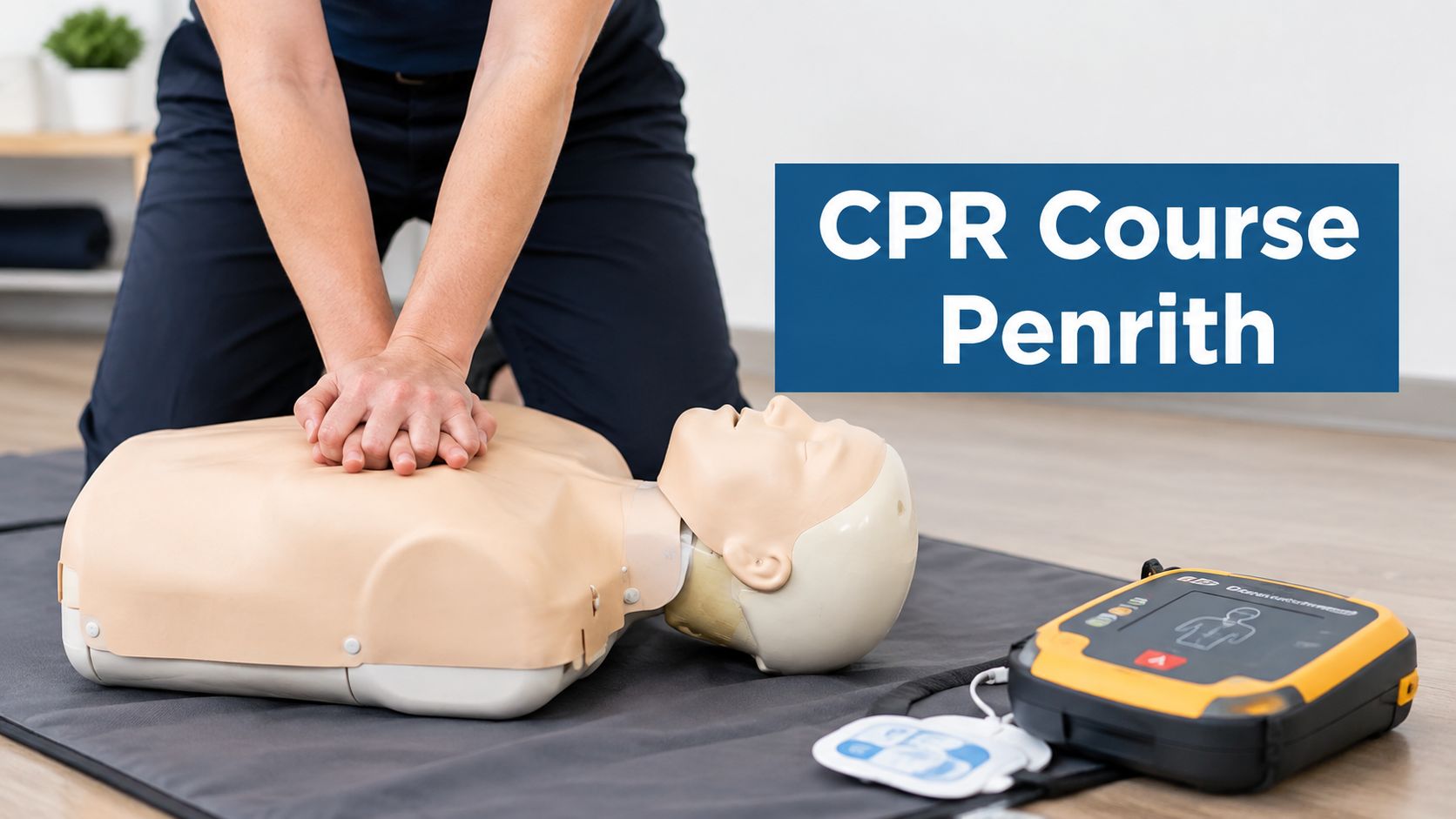
CPR Course Penrith: Book Your Training Today
Your manager has asked for a current CPR qualification before your next shift, or a new job has listed HLTAID009 as a prerequisite. Either way, you need to know what the course involves, whether CPR-only training is enough for your role, and how to book a session that fits around work.
For Penrith workers and employers, CPR training is more than a box to tick. It's a practical workplace safety control, especially across construction, warehousing, civil works, traffic management, hospitality and retail. A good CPR course in Penrith should leave you ready to recognise an emergency, call for help, perform CPR and use an AED, not just answer questions in a classroom.
Table of Contents
- Why Penrith Locals Are Booking CPR Training Right Now
- Understanding HLTAID009: What the Course Covers and How You Are Assessed
- SafeWork NSW Ratios and Your Compliance Position
- CPR Only Versus Combined First Aid Options
- What Happens on the Day in Penrith
- Why Rapid CPR and AED Use Change Survival Rates
- Booking Your Penrith Session, Pricing and What to Bring
- Your Next Step and the Annual CPR Cycle
Why Penrith Locals Are Booking CPR Training Right Now
People booking CPR training have a clear reason. Their employer needs trained responders on site, a new role requires a current unit, or their annual refresher is due. For some, it's a job-readiness step before starting in construction, childcare, traffic control or another role where emergencies can happen.
In New South Wales, employers must provide suitable first-aid equipment and facilities and, where required, trained first-aiders. SafeWork NSW says the number of trained first-aiders should reflect workplace risk, which makes training relevant to both the person attending and the employer organising cover. Its First Aid in the Workplace Code of Practice also recommends annual CPR refresher training.
Penrith's mix of workplaces changes what a responder may face. An office worker may have quick access to colleagues and a first-aid kit, while a civil crew, warehouse team or traffic-control group may be spread across a larger work area. In every setting, responders need to act safely and follow an organised sequence rather than hesitate while deciding what comes next.
If your role is construction-related, it's useful to think about CPR alongside the hazards and responsibilities of the job. TP Training's guide to first aid training for construction workers explores that workplace context.
Start with your employer's requirement: Confirm the exact unit they need, whether your role requires CPR-only or a broader first-aid qualification, and when your current training expires.
The right session should give you practical preparation for the work you do. Check the unit code, assessment requirements and training format before booking. Then you can arrive knowing what you'll practise and why it matters on a Penrith worksite.
Understanding HLTAID009: What the Course Covers and How You Are Assessed
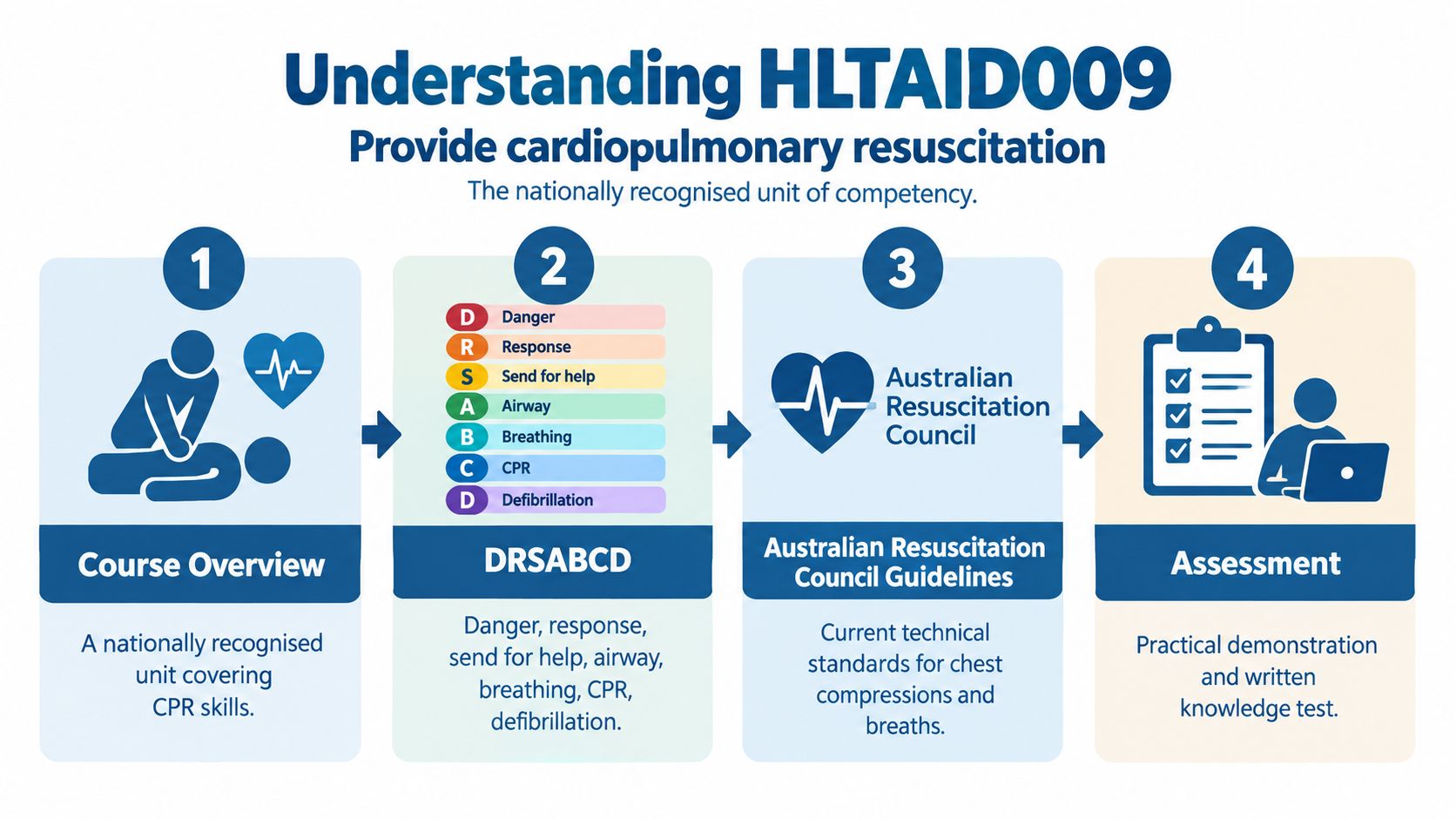
HLTAID009 Provide cardiopulmonary resuscitation is Australia's nationally recognised CPR unit. It applies to anyone who may need to provide CPR in a workplace or community setting, and it covers the knowledge and practical skills required to respond in line with Australian Resuscitation Council guidance. The HLTAID009 training specification sets out the unit's scope and assessment requirements.
The response sequence starts with recognising an emergency, checking scene safety for the responder and casualty, and contacting emergency services. From there you perform CPR and operate an automated external defibrillator (AED) following the device manufacturer's instructions. Expect floor-based manikin work, a simulated emergency call and hands-on AED practice during the session.
Expect a practical assessment
This is a performance-based unit. Candidates must demonstrate at least two minutes of uninterrupted single-rescuer CPR on an adult manikin, equivalent to five cycles of compressions and ventilations, and follow AED prompts to deliver at least one shock. Assessors watch compression rate, ratio, depth, ventilation and AED use, as specified in the HLTAID009 unit requirements.
For Penrith workers in construction, civil operations, warehousing and traffic control, the floor-based format matters. You may need to start compressions at ground level, in work gear, while a coworker calls Triple Zero or retrieves the site AED. A slide-heavy session will not prepare your body for that.
Ask the provider how much of the session is spent on floor-based practice versus presentations. A course that devotes most of its time to manikin repetitions and AED drills will leave you better prepared than one that front-loads theory. You should walk out knowing the full sequence, how to run an AED, and what the assessor marked you on.
SafeWork NSW Ratios and Your Compliance Position
The SafeWork NSW Code of Practice cited earlier sets planning ratios in its first-aid planning table: one first-aider per 50 workers in a low-risk workplace, one per 25 workers in a high-risk workplace, and one per 10 workers where access to medical or ambulance services is delayed. Employers work from that table when they assess how many trained responders a site needs.
| Workplace profile | Recommended planning ratio | Example headcount |
|---|---|---|
| Low risk, such as an office | 1 first-aider per 50 workers | A 100-person office would generally plan for at least 2 |
| High risk, such as construction or warehousing | 1 first-aider per 25 workers | A 100-person site would generally plan for at least 4 |
| Remote high risk, with delayed access to emergency services | 1 first-aider per 10 workers | Assess staffing against the site's risk and access conditions |
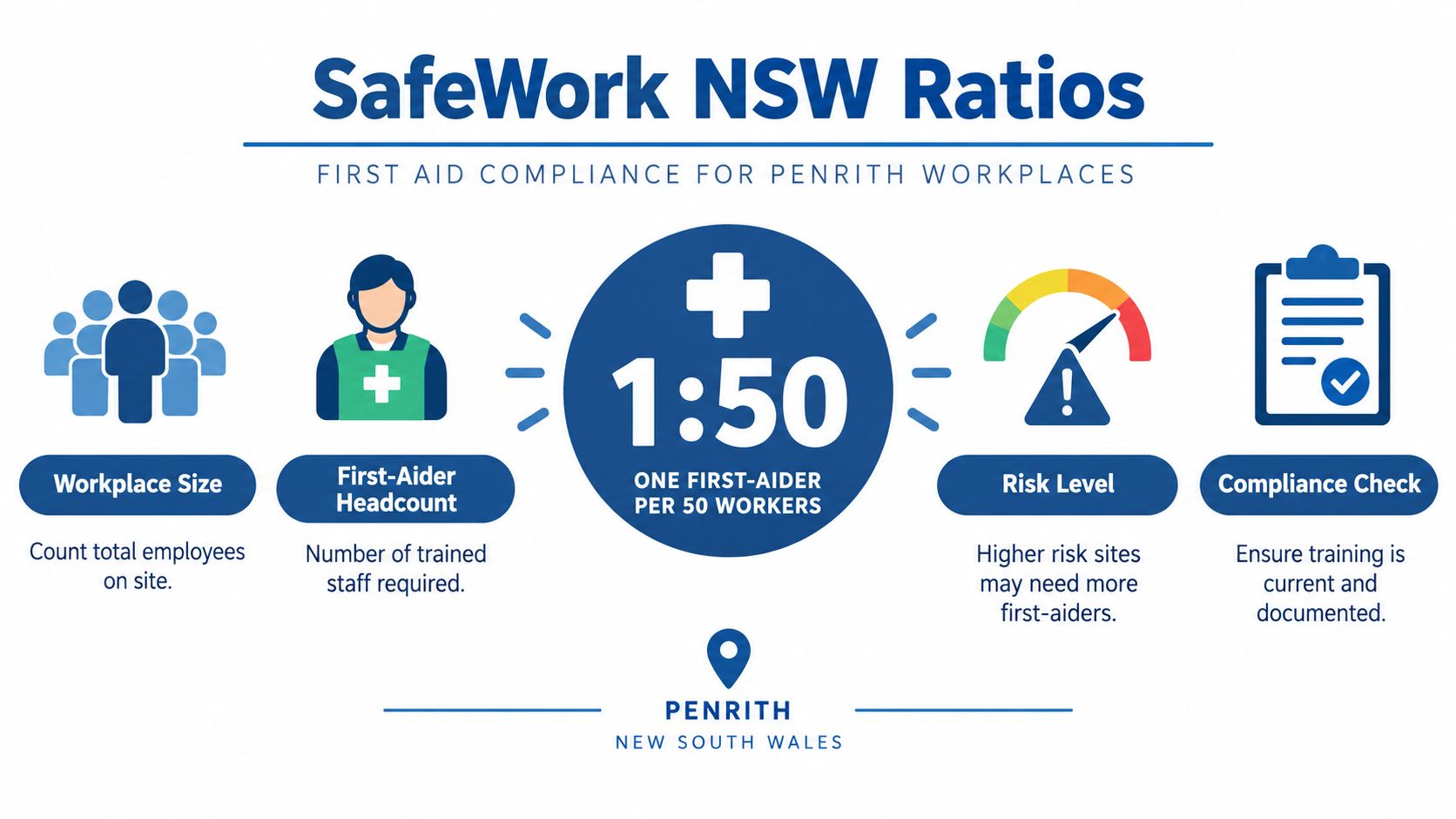
Apply the ratio to a specific site
Treat those numbers as a starting point, then weigh the site itself. A Penrith construction employer needs to account for the tasks being done, the hazards on each stage, the site layout and how quickly an ambulance can reach a worker at the back of a subdivision under development. A warehouse operator should check where crews work and whether a trained responder is reachable on every shift.
That coverage question catches workplaces out. First-aid equipment and trained people need to be accessible whenever work happens, including night shifts, weekends and overtime, and the arrangement still has to hold when trained staff are on leave. TP Training's overview of employer first-aid responsibilities sets out what that duty looks like in practice.
The Code of Practice recommends first-aiders hold a nationally recognised qualification from a Registered Training Organisation, with CPR refreshed annually and broader first-aid qualifications renewed every three years. Diarise those dates. Book refreshers before currency lapses, and your first-aider count stays honest instead of looking good on a spreadsheet while people's cards expire.
CPR Only Versus Combined First Aid Options
The right choice depends on what your employer or role requires. HLTAID009 is the standalone CPR unit. HLTAID011 Provide First Aid covers a broader range of first-aid responses and includes CPR, so it suits roles where staff are expected to manage more than a cardiac emergency.
A construction labourer whose workplace already has designated first-aiders may only need an annual CPR refresher. A traffic controller should check the qualification specified by their employer or role, rather than assume CPR-only training is enough. A childcare educator should confirm whether HLTAID012 Provide First Aid in an education and care setting is required.
| Feature | CPR Only (HLTAID009) | Combined First Aid (HLTAID011) |
|---|---|---|
| Main focus | CPR and AED response | CPR plus a broader range of first-aid responses |
| Typical use | CPR refresher or role-specific CPR requirement | Designated workplace first-aiders and roles requiring broader coverage |
| Assessment emphasis | Practical CPR and AED demonstration | First-aid knowledge and skills, including CPR |
| Best next step | Confirm that your role accepts CPR-only | Check workplace or industry requirements for the full unit |
An office team may decide that a designated first-aider holds the broader qualification while other workers maintain CPR competency. That's a practical way to match training to responsibilities, provided the employer has checked its workplace needs and applicable requirements.
Don't choose based on the shorter-sounding course name. Ask your manager, recruiter or industry contact for the exact unit code. TP Training's Penrith first-aid training guide can help you compare the broader option with CPR-only training.
What Happens on the Day in Penrith
Arrive ready to take part, not just listen. The trainer will welcome the group, confirm enrolment details and check identification before introducing the course structure. You'll cover the emergency response sequence and the steps for recognising a casualty, calling for help and responding safely.
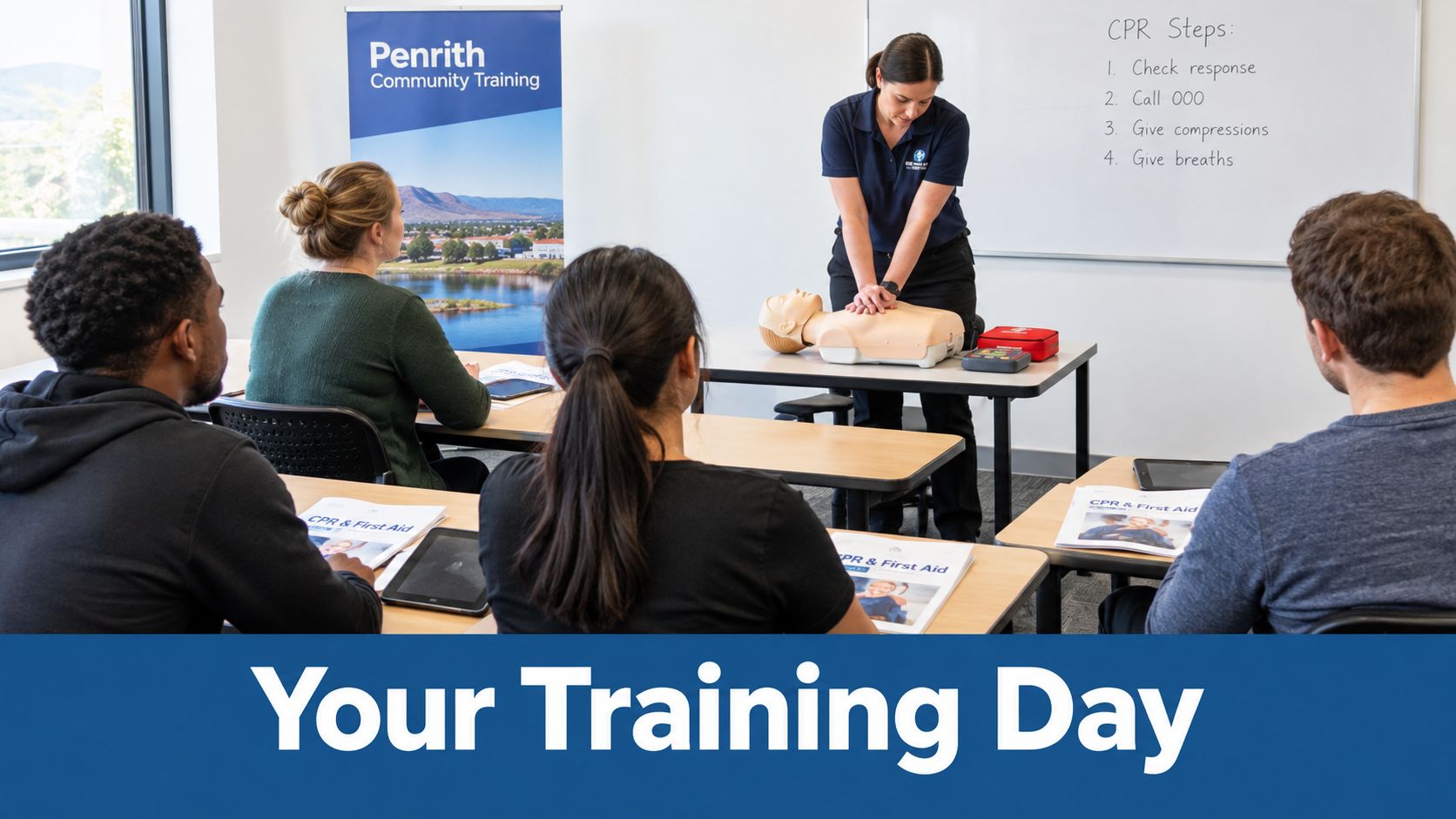
From instruction to hands-on practice
The practical session moves to the manikins. You'll practise CPR on an adult manikin placed on the floor, so you can work on positioning, compressions and ventilations in the same posture required during assessment. Trainers may also demonstrate infant manikin techniques, depending on the course delivery and learning activities.
AED drills help you become familiar with the prompts and the sequence around analysis and shock delivery. The trainer can also simulate emergency communication, so you practise describing the situation and getting help while another responder works with the casualty. If you're curious about how structured rescue skills are taught in another setting, this resource on rescue diver skills explained provides useful context on coordinated emergency response.
The observed assessment is practical. You'll demonstrate the required CPR performance and AED use while the trainer checks your technique against the unit requirements. Dress in comfortable clothing that lets you kneel and move on the floor, and wear closed-in shoes. Confirm any venue-specific details in your booking information, including what to bring and whether equipment or protective items are supplied.
Don't assume every provider uses the same schedule, group size or certificate process. Check those details when booking, especially if you need documentation by a particular date. The key expectation is straightforward: you'll learn the sequence, practise it with training equipment, and show the trainer that you can perform the required skills.
Why Rapid CPR and AED Use Change Survival Rates
A cardiac arrest needs an immediate, coordinated response. NSW Health reports that more than 8,500 people experience out-of-hospital cardiac arrest in NSW each year, with only about 12% surviving. Its cardiac-arrest consumer guidance recommends calling Triple Zero (000), beginning forceful compressions in the centre of the chest and using an AED as soon as one is available.
NSW Ambulance states that for every minute without CPR, the chance of survival decreases by approximately 7–10%. That makes speed and sequence more than classroom details. A responder needs to recognise suspected cardiac arrest, activate emergency services, start compressions without avoidable delay, and use the AED as soon as it reaches the casualty.
The useful skill isn't memorising a list. It's being able to begin the response, communicate clearly and keep working through the AED instructions.
On a construction site, a crew may be working across separate areas. In a warehouse, the nearest first-aider or AED may not be beside the casualty. At a traffic-control workplace, workers may be positioned along a wider work zone. Those conditions make it important to know who calls 000, who begins CPR, and how someone retrieves the AED while the response continues.
A Penrith CPR session should help build that automatic sequence through hands-on practice. You can't control where an emergency happens, but you can arrive with a rehearsed response and a clear understanding of what to do first.
Booking Your Penrith Session, Pricing and What to Bring
Start by confirming the unit your employer needs, then choose a Penrith session that fits your roster and gives you enough time to complete the practical assessment. TP Training offers nationally recognised training through its NSW training centres, including Penrith. Check the current booking details directly before selecting a date, and confirm what the advertised fee covers rather than assuming every course or provider uses the same pricing structure.
Before booking, check the enrolment requirements and whether you need to complete any pre-course work. Have your photo identification and enrolment details ready. Wear comfortable clothing that allows floor-based practice, plus closed-in shoes.
Prepare for a practical session
Use this checklist to avoid a last-minute scramble:
- Confirm the unit: Make sure you need HLTAID009, not a combined first-aid qualification.
- Check the venue and session details: Verify the location, arrival time, course format and any pre-course requirements in your confirmation.
- Bring what you need: Take photo ID and wear clothing suitable for kneeling and practical exercises.
- Ask about group training: Employers can enquire about arranging training for a Penrith crew at a suitable workplace or centre.
Ask the provider what training equipment and materials are supplied, and how successful candidates receive their Statement of Attainment. If you're comparing providers, TP Training's first-aid training cost guide can help you think through course costs and what to check before paying.
Choose a booking that gives you a realistic opportunity to practise and complete the assessment. The certificate matters, but the practical capability is the reason to attend.
Your Next Step and the Annual CPR Cycle
Before you book, confirm whether your role requires CPR-only or a broader first-aid qualification. Check when you last refreshed CPR, assess your workplace risk and first-aider coverage, then select a Penrith session that fits your schedule. You can review the recommended CPR refresher cycle as part of that check.
Keep the training cycle on your calendar: CPR refreshers are recommended annually, while broader first-aid qualifications should be renewed every three years. Don't leave the decision until an employer or roster forces it. Book while you have time to prepare, practise the skills and confirm your documentation.
TP Training offers practical, nationally recognised CPR training for workers and employers who need current skills for Penrith workplaces. Choose a session, confirm the unit your role requires, and visit TP Training to take the next step toward booking.

You may also like
Safety & Health Policy: A Guide for Australian Employers
Asbestos Removal Requirements in NSW: The Complete Guide