

Basic Fatigue Management Course Guide for NSW Workers
You're on site before sunrise, checking barriers while the traffic crew waits for the first vehicle movement. The previous shift ran late, your alarm came early, and the night ahead may bring more roadwork. You may feel capable of continuing, yet a missed instruction, delayed reaction or poor decision around moving plant can turn tiredness into a serious workplace event.
That's why a basic fatigue management course treats fatigue as a WHS risk, not a personal wellbeing issue. It helps workers, supervisors and employers recognise fatigue hazards, plan practical controls and understand when general awareness sits apart from regulated heavy-vehicle compliance.
Table of Contents
- Introduction to Basic Fatigue Management Training
- Understanding Fatigue as a Workplace Safety Risk
- Who Needs a Basic Fatigue Management Course in NSW
- What You Will Learn Inside the Course Syllabus
- Assessment Compliance and Record Keeping Explained
- Course Duration Renewal and Staying Compliant
- Where to Complete Your Training with TP Training in NSW
Introduction to Basic Fatigue Management Training
Fatigue can build. A construction worker may start with an early delivery, spend the day around machinery and traffic, then accept overtime because a pour or road closure needs to finish. A warehouse worker might rotate between early starts and late finishes, while a traffic controller stays alert in changing conditions for hours at a time. In each case, the risk comes from the relationship between sleep, working time, task demand and the surrounding hazards.
Safe Work Australia's model Code of Practice on managing the risk of fatigue at work provides a formal approach for identifying fatigue hazards, assessing risks, controlling them and reviewing those controls. The 2025 edition says workers should have at minimum a 30-minute break every 5 hours, a practical benchmark for linking breaks and scheduling with safe performance.

What the course is designed to do
A basic fatigue management course isn't a promise that a certificate alone will remove risk. It gives learners a working method they can apply before a shift, during a demanding task and when conditions change.
You'll learn to:
- Recognise warning signs: Notice reduced alertness, repeated mistakes, slower responses and unsafe shortcuts.
- Connect fatigue with hazards: Understand why tiredness matters more when a job involves traffic, machinery, heights, chemicals or other safety-critical work.
- Use practical controls: Apply breaks, recovery periods, roster checks, reporting processes and fitness-for-work decisions.
- Separate pathways: Identify when general WHS awareness is suitable and when heavy-vehicle BFM or AFM requirements apply.
The subject is relevant across NSW construction, civil works, traffic control, warehousing, logistics and transport-adjacent roles. For broader workplace context, TP Training's guidance on workplace safety tips reinforces the same practical mindset, workers should identify hazards early and act before an incident.
By the end of this guide, you'll be able to judge what type of training fits your role, understand the main learning areas, read standard work and rest limits, and prepare for training that supports defensible workplace decisions.
Understanding Fatigue as a Workplace Safety Risk
Fatigue is a hazard because it can reduce a person's ability to stay alert, react promptly and choose the safest option. Think of attention as a torch. When you're rested, the beam is steady and reaches the detail you need. As fatigue grows, the beam becomes weaker and more likely to miss a signal, instruction or changing condition.
The risk isn't identical in every job. A tired worker doing a low-risk administrative task faces a different exposure from someone operating a forklift, directing vehicles through a work zone or handling plant near other people. Safe Work Australia notes that fatigue can interact with machinery, hazardous substances and other safety-critical tasks, increasing the likelihood of error.
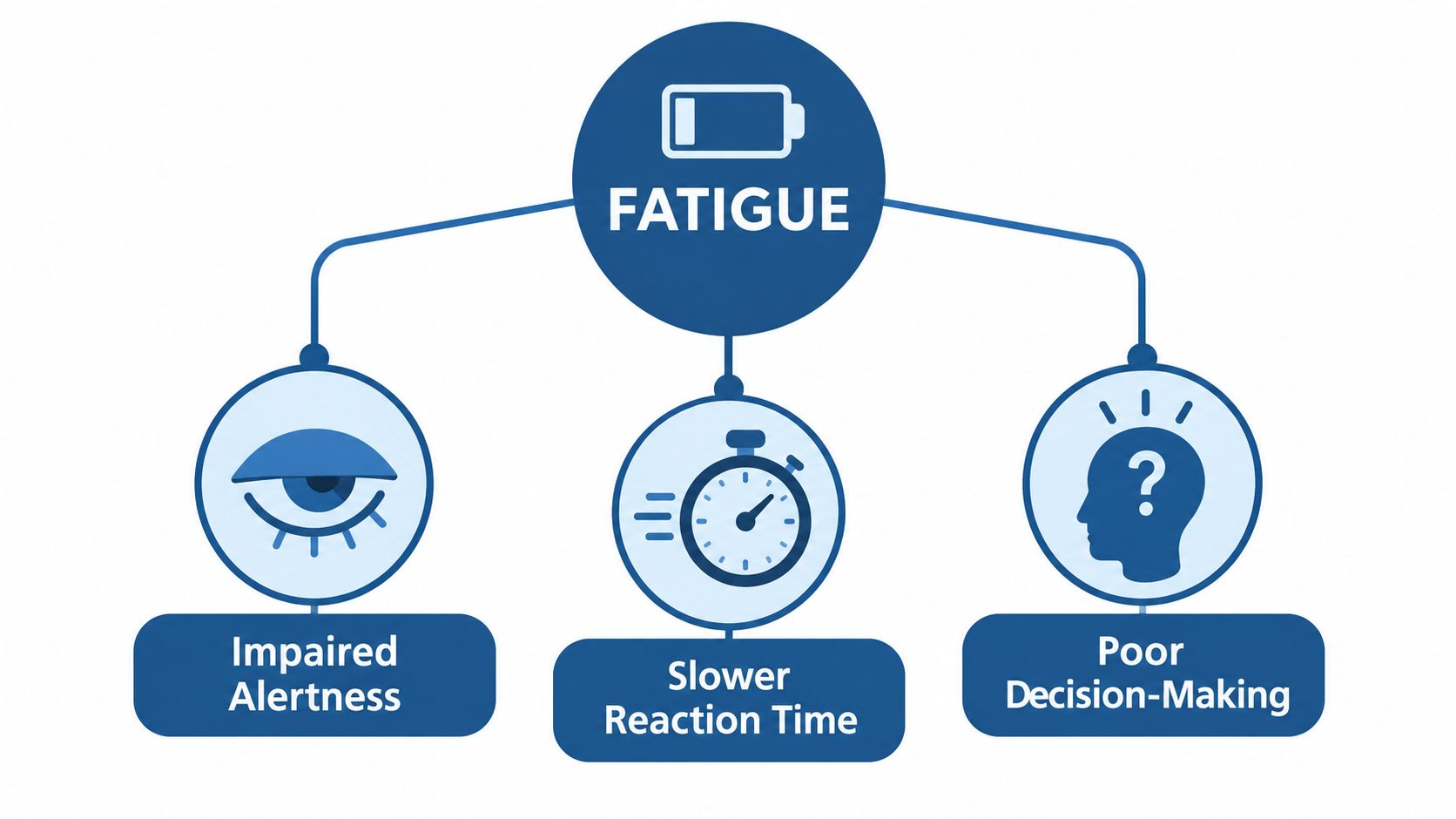
The risk-management cycle
A practical course usually turns the safety process into four questions:
- What could create fatigue? Look at early starts, night work, long shifts, repetitive tasks, travel, demanding workloads and insufficient recovery.
- How serious could the result be? Consider the task, the equipment, nearby workers, traffic and consequences of a delayed response.
- Which controls will change the exposure? Review roster design, break timing, task allocation, supervision, reporting and recovery arrangements.
- Did the controls work? Check whether workers rested, whether schedules were realistic and whether near misses or complaints show a pattern.
Safe Work Australia's guidance on managing fatigue risks includes controls such as limiting shift length, allowing at least 12 hours recovery between shifts, avoiding work during normal sleep windows and establishing fatigue-reporting and fitness-for-work checks. It also identifies 2am to 6am and 2pm to 4pm as low body-clock periods that should be considered when scheduling safety-critical work.
Practical rule: A break isn't a control if the roster, workload or work environment makes it impossible for the worker to recover.
Workers must report when fatigue affects safe performance, but employers and supervisors must also design work so that reporting isn't the only safeguard. Scheduling demanding activities for the middle of a shift, rather than a body-clock low, can support safer attention. Guidance on risk management in construction provides useful context for applying the same hazard-control logic to changing worksites.
For transport teams, practical scheduling advice can also be useful when adapting controls to different routes. The resource on reducing driver fatigue in middle-mile is relevant when planners are considering route demands, handovers and driver alertness.
Who Needs a Basic Fatigue Management Course in NSW
The right pathway depends on the work being performed, not just the job title printed on a uniform. A traffic controller, warehouse operator or civil worker may need strong fatigue awareness without falling under the heavy-vehicle accreditation system. A driver or scheduler working under regulated heavy-vehicle arrangements may need specific competence and records in addition to general WHS knowledge.
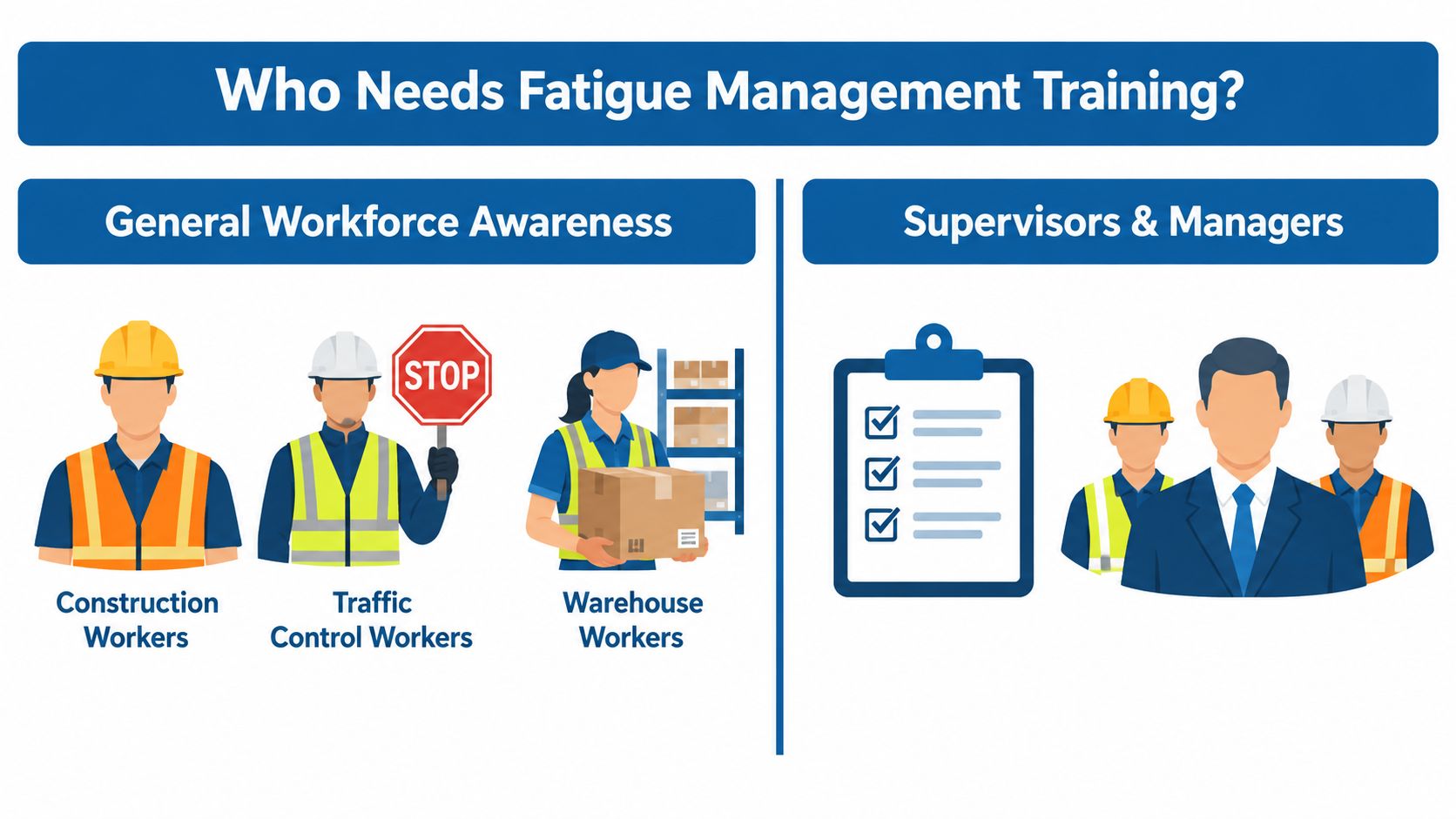
General workforce awareness
For construction, civil, traffic control and warehouse workers, the focus is usually practical hazard recognition:
- Construction and civil crews: Identify fatigue before operating plant, working near live traffic or completing physically demanding tasks.
- Traffic controllers: Manage alertness during extended periods of observation, changing traffic conditions and unusual hours.
- Warehouse and logistics teams: Recognise how early starts, repetitive handling and vehicle movements affect safe decisions.
- Supervisors: Use fatigue checks, roster reviews and task changes when a worker reports they aren't fit for a safety-critical activity.
This type of training can be valuable even where a particular legal pathway doesn't require a formal fatigue unit. The National Transport Commission's review notes that drivers operating under standard hours don't need fatigue management training, unlike some Western Australian, rail and aviation contexts. That distinction can confuse workers, because training not being mandatory doesn't mean fatigue controls are unnecessary.
Heavy-vehicle BFM and AFM pathways
Heavy-vehicle operators work within the Heavy Vehicle National Law framework. The available regulated options include standard hours, Basic Fatigue Management and Advanced Fatigue Management. BFM and AFM are not awareness labels. They involve operating limits, record keeping, responsibilities and, for NHVAS accreditation, demonstrated competence.
The NTC paper reports that standard hours account for 94.74% of heavy-vehicle work, while BFM accounts for 5.14%. These figures show why many workers encounter fatigue controls without holding a formal BFM pathway.
Job seekers should ask whether the target role involves regulated heavy vehicles, roster administration or accreditation obligations. Employers should identify whether workers need general awareness, driver competence, scheduler competence or a combination. A separate traffic-planning qualification, such as Prepare Work Zone Traffic Management Plan Course Pwz Red Card, addresses work-zone planning and should not be confused with heavy-vehicle fatigue accreditation.
For a broader view of vocational pathways, NSW learners can also review vocational training in Australia.
What You Will Learn Inside the Course Syllabus
A well-organised basic fatigue management course should move from recognition to action. Learners first understand what fatigue is, then identify how it appears at work, and finally practise choosing controls that fit the job.
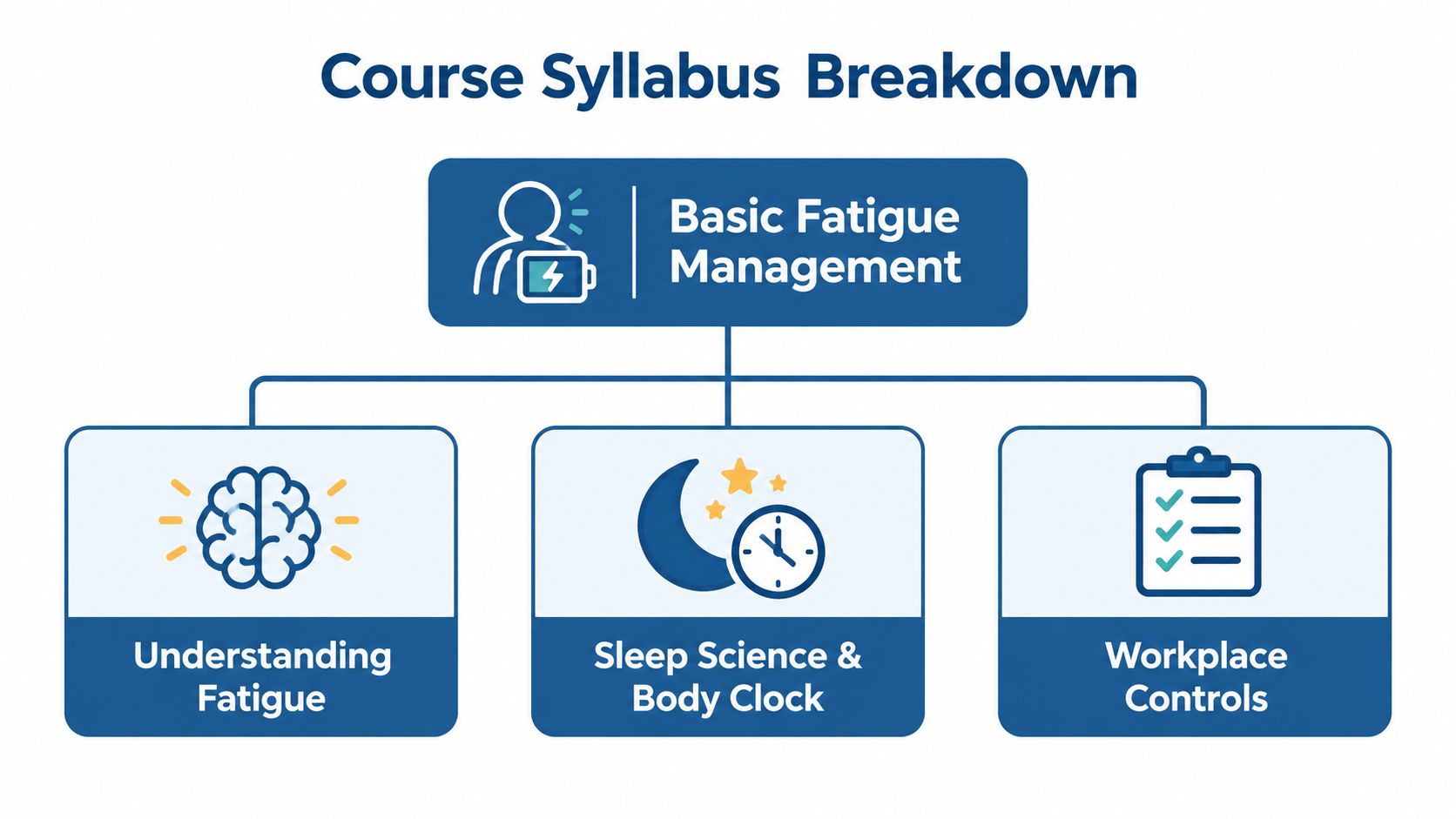
Understanding fatigue and its warning signs
The opening material usually covers common causes, including inadequate sleep, long shifts, early starts, night work, monotonous duties and changing rosters. It also separates feeling tired from being able to work safely. A worker may insist they can continue, while their responses, concentration or judgement have already changed.
Warning signs can include frequent yawning, heavy eyes, missed radio calls, repeated errors, irritability, drifting attention and difficulty following a familiar process. Supervisors should treat these signs as information, not as a character flaw.
Sleep science and the body clock
Learners don't need to become sleep scientists. They do need a useful mental model. Sleep supports recovery, while the body clock influences alertness across the day. Working through a normal sleep window or arranging a high-concentration task during a natural alertness low can increase exposure.
A practical example is a night roadwork crew. The team may be experienced and properly equipped, yet the combination of darkness, traffic, repetitive monitoring and a body-clock low requires stronger planning. The course should help learners ask whether a task can be moved, shared, paused or supervised differently.
Workplace controls
Controls translate knowledge into worksite decisions. They can include:
- Roster design: Limit excessive shift length, avoid unnecessary consecutive demanding shifts and allow recovery between shifts.
- Break planning: Schedule breaks before attention deteriorates, rather than waiting for a worker to become visibly impaired.
- Task timing: Place higher-demand activities in the middle of shifts where practical, and avoid safety-critical work during low body-clock periods.
- Fitness for work: Give workers a clear process for reporting fatigue and supervisors a defined response.
- Accommodation and recovery: Make sure travel, sleeping arrangements and between-shift time support genuine recovery.
- Supervision: Use pre-start discussions and task checks to identify changing fatigue risk.
A practical scenario might involve a forklift operator who has completed an early shift, worked through a busy loading period and is then asked to continue during a late delivery window. The control isn't just “try harder”. The supervisor may need to review the roster, reassign the task, provide recovery time or stop the activity.
Safe Work Australia's model approach expects controls to be reviewed over time. That means a course should teach learners to look for patterns, such as recurring overtime, repeated fatigue reports or near misses at a particular point in a shift, and bring those patterns into operational planning.
Assessment Compliance and Record Keeping Explained
Assessment normally checks whether learners can apply fatigue principles, not merely repeat definitions. Depending on the delivery arrangement, this may involve written questions, scenario responses, practical discussions, roster exercises or evidence that the learner can interpret work and rest requirements.
For heavy-vehicle roles, the paperwork matters because compliance must be verifiable. Drivers and record keepers may need to track work and rest time through rosters, trip schedules and timesheets. Records must be kept for three years, and drivers travelling more than 100 km from base are generally required to carry and complete a National Driver Work Diary, as outlined in NSW heavy-vehicle fatigue guidance.
Standard hours work and rest limits
The NHVR table provides the following standard-hours thresholds:
| Time Period | Maximum Work and Minimum Rest Required |
|---|---|
| Within 5½ hours | Up to 5¼ hours work, followed by 15 minutes rest |
| Within 8 hours | Up to 7½ hours work, followed by 30 minutes rest |
| Within 11 hours | Up to 10 hours work, followed by 60 minutes rest |
| Within 24 hours | Up to 12 hours work, with 7 continuous hours stationary rest |
These limits come from the NHVR work and rest hours table. A roster may appear reasonable at a glance but still fail if breaks aren't recorded correctly or if the worker's total time is calculated inaccurately.
A compliant schedule needs both the right pattern of work and reliable evidence that the pattern occurred.
Units and provider checks
For NHVAS fatigue accreditation, drivers operating under BFM or AFM must demonstrate competence in TLIF0005, Apply a fatigue risk management system. Schedulers under BFM or AFM must demonstrate competence in TLIF0006, Administer a fatigue risk management system.
NHVR states that approved training must be delivered by an NHVR-approved Registered Training Organisation, with current approved RTOs delivering face-to-face training and some also endorsed for online delivery. Before booking, verify the unit, the delivery approval and whether the course matches the employer's accreditation pathway.
Learners should also organise their student administration early. TP Training's guide to creating and managing a Unique Student Identifier can help students understand that requirement before enrolment.
Course Duration Renewal and Staying Compliant
Course length depends on the training product, delivery method, learner preparation and the evidence required. A short awareness session may focus on recognising hazards and applying everyday controls. An accredited BFM pathway can require more detailed work and rest knowledge, role-specific competence and documentation.
Ask the provider what the day includes before you enrol. Useful questions cover the start and finish times, assessment format, materials supplied, identification requirements, unit codes and whether the training is intended for general awareness or NHVAS-related compliance.
Awareness is not the same as ongoing control
A certificate doesn't replace a roster review. Fatigue risk changes when a project moves from day work to night work, when staffing changes, when a delivery schedule tightens or when a worker's recovery time is reduced by travel.
Employers should keep fatigue controls current by:
- Reviewing rosters: Check shift length, breaks, early starts, night work and recovery time.
- Checking the workplace response: Make sure workers know who to contact and what supervisors will do after a fatigue report.
- Maintaining records: Keep relevant diaries, timesheets, schedules and assessment evidence in an organised system.
- Refreshing expectations: Revisit controls after incidents, near misses, operational changes or repeated complaints.
- Supporting personal planning: Encourage workers to protect sleep and raise concerns before a safety-critical task.
NHVR guidance for alternative compliance shows how specific these obligations can become. Under Alternative Compliance Accreditation, solo drivers cannot work more than 15.5 hours in any 24-hour period and must include at least 7 hours of continuous rest, according to the NHVR ACA fatigue requirements.
The practical lesson is simple. Complete the training, then keep using the system. Competence is visible in decisions, records, conversations and roster changes, not just in the document issued on the day.
Where to Complete Your Training with TP Training in NSW
NSW learners should choose training based on the work they need to perform, the pathway their employer recognises and the location that fits their schedule. TP Training delivers practical vocational and safety training through centres including Penrith, Burwood, Auburn, Parramatta and Sydney CBD.
A convenient centre can make attendance easier, but location isn't the only consideration. Ask whether the delivery includes realistic scenarios, experienced trainers, suitable facilities and enough opportunity to connect fatigue controls with your work environment. A construction worker may want examples involving plant, early starts and site access. A traffic professional may need work-zone and night-operation scenarios. A warehouse worker may benefit from roster and vehicle-movement examples.
Choosing a suitable training option
Use these checks before booking:
- Match the course to your role: Confirm whether you need general fatigue awareness, BFM driver competence or scheduler competence.
- Confirm the unit or outcome: If your employer mentions TLIF0005 or TLIF0006, ask the provider to confirm the exact training product.
- Check the delivery setting: Make sure the format suits your learning needs and any employer or accreditation requirements.
- Plan travel realistically: Choose Penrith, Burwood, Auburn, Parramatta or Sydney CBD based on your shift pattern and transport options.
- Ask about support: Clarify entry requirements, identification, assessment arrangements and what happens if you need help with course work.
Fatigue training can complement other safety pathways in construction, traffic control, civil construction and logistics. It shouldn't be treated as a substitute for role-specific licences or work-zone qualifications. Learners who need communication support can also review information about TP Training's multilingual support before selecting a course.
Check current dates, entry requirements, delivery details and booking options directly with the provider, because course arrangements can change.
TP Training offers practical safety and vocational training across NSW, helping workers connect fatigue awareness with construction, traffic control, civil construction and workplace safety responsibilities. Visit TP Training to check the current course options, locations, dates and enrolment requirements for your next step.

You may also like
Silica & Asbestos Courses Cost Guide for NSW Workers
Asbestos Awareness Online Course Cost and Time