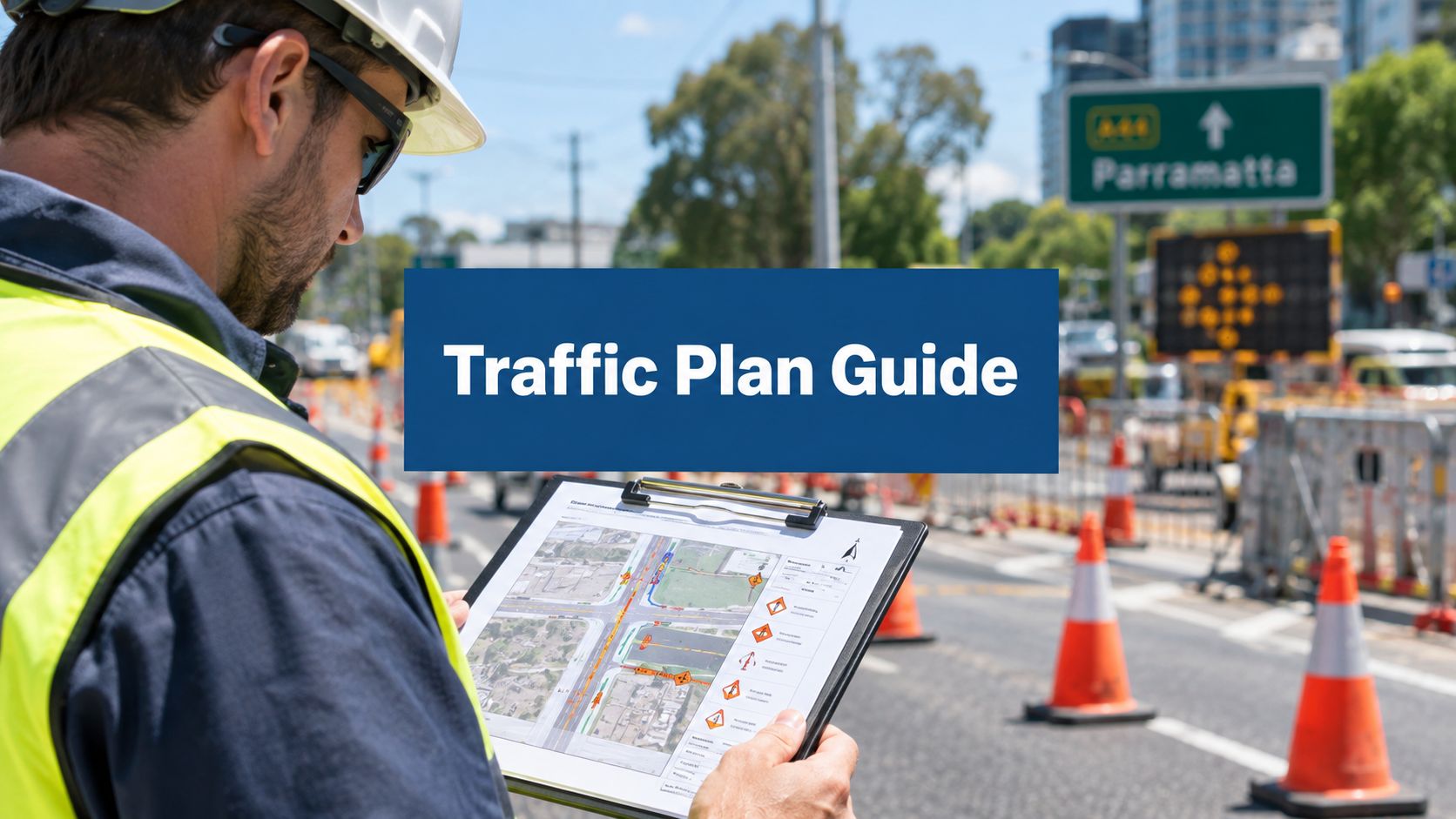
Basic to Advanced RIIRIS402E, RIICWD503E Traffic Management Plan Course Guide
You're a leading hand in Parramatta or Sydney, and the next stage of a kerb replacement project is ready to start. The principal contractor asks for a properly designed Traffic Management Plan, not a copied template. You hold a Blue Card, you know how to implement controls on site, but you're unsure whether that's enough to prepare and sign off the design.
That situation is common because traffic management implementation and traffic management design are different responsibilities. The RIIRIS402E, RIICWD503E Traffic Management Plan Course is best understood as a pathway decision for people moving into design, supervision, review, or approval work, not as a course about filling in a document.
The key question is practical: does your role require you to design work-zone traffic arrangements, and can you demonstrate the experience that sits behind the designer pathway?
Table of Contents
- Why the RIIRIS402E and RIICWD503E Pair Exists
- What a Traffic Management Plan (TMP) Actually Does in NSW
- Inside the Two Units and the Designer Skill Set
- The Safety Reason TMP Design Is Now Formalised
- Entry Requirements and How the Course Runs at Parramatta
- Red Card Versus Blue Card and Yellow Card Pathways
- Location, Schedule, Pricing and Booking at TP Training Parramatta
- Common Misconceptions and Your Next Step
Why the RIIRIS402E and RIICWD503E Pair Exists
A Blue Card can help a worker implement an existing traffic management plan, but it doesn't automatically give that person the competence to create one. In the Parramatta kerb replacement example, the supervisor may understand how to position devices, brief workers, and monitor the work area. The principal contractor is asking for something different, a plan based on the specific road, traffic conditions, work stages, risks, and controls.
RIIRIS402E addresses the risk management and implementation side of temporary traffic management. It focuses on understanding the plan in practice, managing hazards, and ensuring that site controls are applied appropriately. RIICWD503E addresses the design side, including the preparation of Traffic Management Plans and Traffic Guidance Schemes for civil construction work. The official RIICWD503E unit record identifies it as the nationally recognised unit titled “Prepare traffic management plans and traffic guidance schemes”, and records that it replaced RIICWD503D.
Two different skill gaps
Taking only one unit can leave a clear weakness:
Risk knowledge without design ability: You may identify hazards and supervise controls, but still lack the competence to draft the TMP and TGS.
Drafting knowledge without implementation understanding: You may produce a drawing, but struggle to judge whether the arrangement can be safely installed, monitored, and adjusted on site.
A combined pathway: You develop the design and delivery understanding needed for work-zone traffic management responsibilities.
Austroads maps RIIRIS402E and RIICWD503E together in the RIISS00063 Traffic Management Designer Skill Set. The framework separates the risk-management function from the TMP and TGS design function, while recognising that a competent designer needs both skill areas.
Practical rule: A copied generic plan isn't evidence that you can design a compliant arrangement for a changing work site.
The pairing matters because a TMP affects real workers, road users, plant operators, pedestrians, and emergency access. It also gives employers a clearer way to identify whether a worker is ready to move from following a plan to taking responsibility for how that plan is designed.
What a Traffic Management Plan (TMP) Actually Does in NSW
A Traffic Management Plan is not a written description of a roadwork job. Transport for NSW describes a TMP as a tool for considering the work type and road environment so the risks and controls needed to perform the work safely can be identified. TfNSW also states that a TMP must be developed for temporary traffic management works on Transport work sites, including maintenance sites, as explained in its traffic engineering guidance for TMP planning.
A properly prepared plan connects the job to its traffic environment. It can address the work scope, staging, signage, delineation, traffic movements, pedestrian arrangements, detours, speed management, worker protection, contingencies, and arrangements for changes or completion. The plan needs to explain why the controls suit the particular site, rather than relying on a diagram that was created for a different road.
TMP and TGS are not interchangeable
A Traffic Guidance Scheme, or TGS, is usually the scaled drawing or layout that shows how the controls will be arranged for a particular work area or stage. The TMP is broader. It records the risk-based approach, the work activities, the traffic environment, the selected controls, and the conditions under which the arrangement may need to change.
| Document | Purpose | Format | Who uses it |
|---|---|---|---|
| Traffic Management Plan | Sets out the overall risk controls and traffic management approach | Written plan with supporting documents | Designers, supervisors, contractors, clients, and approval personnel |
| Traffic Guidance Scheme | Shows the physical layout for a specific site, stage, or shift | Scaled drawing or site layout | Implementers, supervisors, traffic controllers, and site crews |
TfNSW templates explain that a TMP should detail the work, identify associated traffic-management risks, and list accepted control measures to eliminate or reduce those risks. Supporting documents can include the risk assessment, TGS, and Vehicle Movement Plan. A useful comparison with how traffic control services are described in another market is available through UK traffic management services, but NSW students must work from the Australian framework that applies to their project.
For a practical introduction to work-zone planning terminology, students can also review Prepare Work Zone Traffic Management Plan Course information. The central lesson is simple: the TMP is the decision-making record, while the TGS shows how those decisions will appear on the road.
Inside the Two Units and the Designer Skill Set
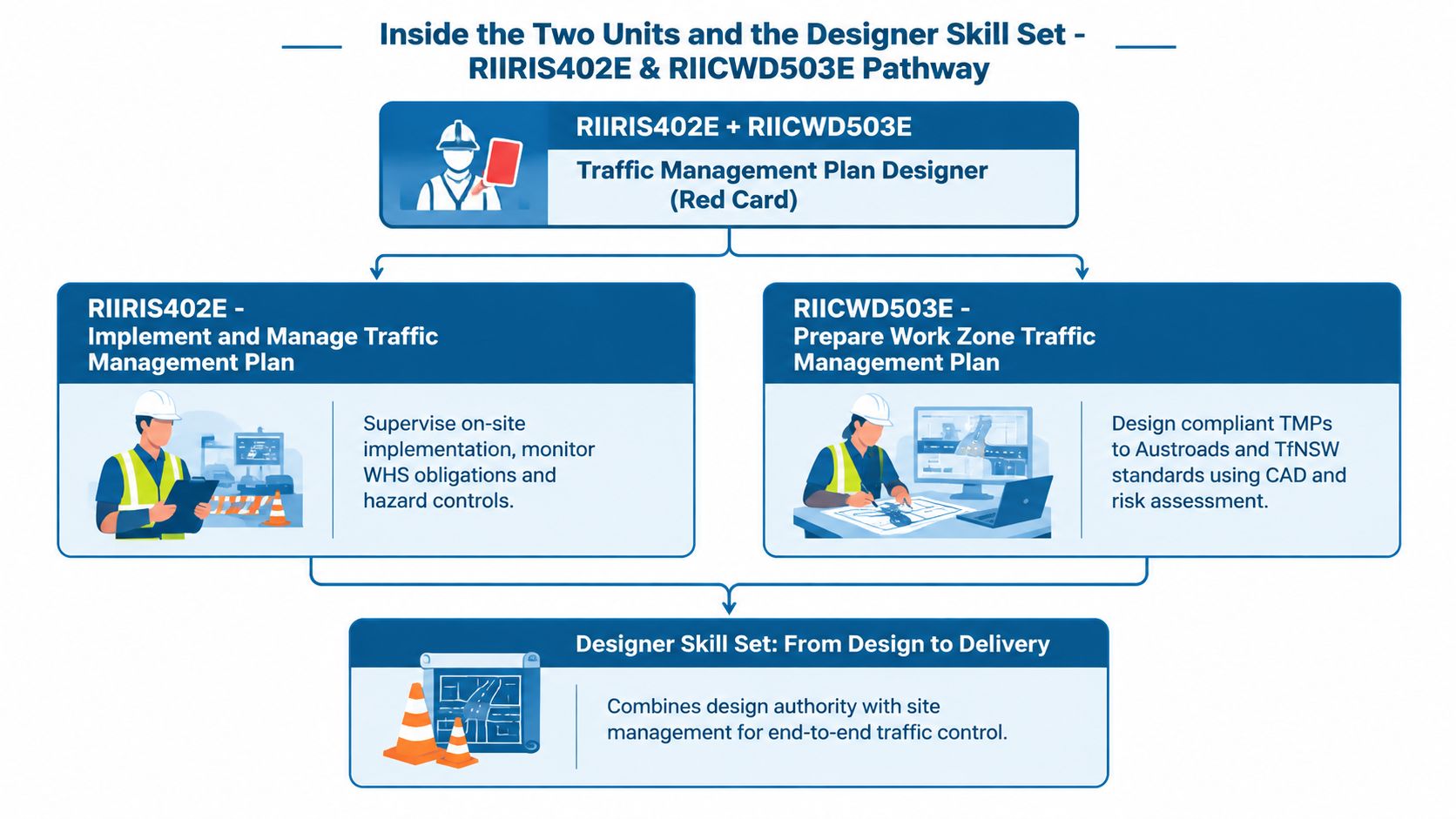
RIIRIS402E and RIICWD503E should be studied as related but distinct competencies. One asks whether the traffic management arrangement can be implemented and managed safely. The other asks whether the arrangement has been designed appropriately for the work and environment.
RIIRIS402E and site delivery
RIIRIS402E, Implement and manage traffic management plan, is concerned with applying the plan in the field. A learner may work through hazard identification, risk controls, supervision, site checks, compliance with the relevant Traffic Control at Worksites requirements, and the management of variations when conditions differ from the approved arrangement.
That can include noticing that parked vehicles reduce sight distance, a pedestrian route has become blocked, plant movements conflict with public traffic, or the work stage no longer matches the original plan. The important capability is knowing how to respond within the approved control framework and when a change requires review or escalation.
RIICWD503E and design work
RIICWD503E, Prepare traffic management plans and traffic guidance schemes, is the design unit. It involves interpreting project information, understanding the road environment, selecting appropriate signs and devices, considering geometry and visibility, and producing the written TMP and associated TGS drawings.
The designer must connect the risk assessment to the physical arrangement. That means the drawing isn't an isolated graphic. It needs to reflect the work stages, traffic paths, worker access, plant movement, pedestrian needs, and the controls described in the written plan.
Austroads places both units within the RIISS00063 Traffic Management Designer Skill Set. The Austroads designer pathway also requires successful completion of the two units and practical experience applying the relevant skills across at least two different traffic management plan design types. Examples might include a low-speed urban street and a high-speed rural road, although the evidence must reflect the requirements of the applicable pathway.
The Prepare Work Zone Traffic Management Plan Course Pwz Red Card is one training option that provides practical, nationally recognised training with experienced trainers and hands-on learning across NSW. Completion of the units is necessary, but students should also organise work-sample evidence and a practical experience log.
Training alone doesn't turn every completed assessment into a designer record. The pathway combines statements of attainment with evidence that the learner has applied the skills in real design contexts. Students moving toward equipment or work-zone responsibilities can also review attenuator training information where it relates to their broader site role.
The Safety Reason TMP Design Is Now Formalised
Traffic management plans exist because roadwork zones create changing interactions between vehicles, workers, pedestrians, barriers, signs, and mobile plant. A design that looks acceptable on paper can become unsafe when queues form, sight lines change, a work stage moves, or a vehicle needs to enter or leave the site.
NSW roadwork literature cites research covering 118,628 crashes, with 14.3% related to roadwork zones. Of those work-zone crashes, 40.3% were rear-end crashes, compared with 23% in non-work-zone crashes. These figures are reported in the Transport for NSW end-of-queue study literature review.
National temporary traffic management guidance also reports an average of 18 fatal worksite crashes and 245 serious injury crashes per year over a ten-year period, with work zones accounting for about 1.5% of national road fatalities. The figures show why traffic management isn't only a matter of placing cones in a familiar pattern.
What formal design controls
The relevant framework brings together the Transport for NSW Traffic Control at Worksites Manual, the Austroads Guide to Temporary Traffic Management, workplace health and safety duties, and project-specific approval requirements. Designers need to consider road classification, traffic assessment, work staging, hazards, treatment options, and the communication and review process.
Austroads describes TMP planning as a lifecycle that includes identifying project parameters, breaking the project into stages, conducting traffic and risk assessments, evaluating treatment options, documenting the selected treatment, and continuing with communication, consultation, monitoring, and review. That lifecycle means a plan isn't finished merely because the document has been saved or printed.
| Indicator | Figure |
|---|---|
| Crashes examined in NSW roadwork research | 118,628 |
| Share related to roadwork zones | 14.3% |
| Rear-end share among work-zone crashes | 40.3% |
| Rear-end share in non-work-zone crashes | 23% |
| Average fatal worksite crashes per year over the cited period | 18 |
| Average serious injury crashes per year over the cited period | 245 |
| Approximate share of national road fatalities attributed to work zones | 1.5% |
For workers who only need to control traffic under an existing plan, a Traffic Controller Course Blue Card may be relevant. A designer, however, carries a different responsibility. TMP design is a safety control that must stand up to the actual road environment, not a box-ticking exercise.
Entry Requirements and How the Course Runs at Parramatta
The right student for this pathway is usually already close to the work. That may be a civil construction supervisor, a plant operator moving into planning, a council project officer, or an engineer or supervisor working for a larger contractor. The course makes more sense when your next role involves preparing, reviewing, coordinating, or explaining traffic management arrangements.
Training providers may set practical entry expectations before enrolment. At Parramatta, prospective students should confirm requirements directly, including:
Age and identification: Be at least 18 and bring acceptable photo identification.
Language and literacy: Have functional English literacy consistent with ACSF Level 3, so you can read project information, complete written assessments, and answer questions about controls.
Construction access: Hold a current White Card, CPCCWHS1001, where required for the learning and work environment.
Site mobility: Have a valid NSW driver licence if site visits or practical activities require travel between locations.
Work evidence: Be ready to discuss previous work and collect examples that can support the practical experience component.
Students who need to check the construction induction requirement can use this White Card guide before contacting the training centre.
What learning looks like
A face-to-face program can combine classroom theory, trainer explanation, group work on TMP drawings, and practical activities. Learners may examine a work scenario, identify hazards, discuss controls, build a signage schedule, and then explain how the design would be implemented at a simulated site.
Assessment commonly requires more than a multiple-choice test. Depending on the provider's assessment strategy, students may complete a written TMP project, a risk assessment, a signage schedule, and oral questioning. A practical activity can require the learner to brief a simulated work site and explain the reasons behind the selected arrangement.
The practical experience logbook is important because the designer pathway isn't limited to classroom completion. Ask the provider what evidence format it accepts, who can verify your work, and how your examples will demonstrate different TMP design types.
Bring questions about evidence, not only questions about the classroom timetable. The course is meant to support a workplace design responsibility.
Red Card Versus Blue Card and Yellow Card Pathways
The three card pathways describe different traffic management responsibilities. They aren't interchangeable, and holding one doesn't automatically prove competence for the next.
The Yellow Card, associated here with RIIWHS205D Control traffic with stop-slow bat, is generally the entry-level traffic controller pathway. The worker controls traffic movements using a stop-slow bat and follows the site's approved arrangements. The role is operational and depends on clear communication and disciplined positioning.
The Blue Card, associated here with RIIWHS302D Implement traffic management plan, is focused on implementing traffic management on site. A Blue Card holder may help establish, operate, supervise, or monitor arrangements under a designer-prepared plan, depending on the role and project requirements.
The Red Card pathway is associated with the RIIRIS402E and RIICWD503E designer units. It suits people who prepare, review, or take responsibility for Traffic Management Plans and Traffic Guidance Schemes, including senior supervisors, engineers, and specialist traffic-management personnel.
Choose the pathway that matches the job
| Pathway | Main responsibility | Typical work position |
|---|---|---|
| Yellow Card | Control traffic with a stop-slow bat | Traffic controller |
| Blue Card | Implement and manage an existing traffic management plan | Implementer, supervisor, or site crew member |
| Red Card | Prepare and manage TMPs and TGSs | Designer, reviewer, senior supervisor, engineer, or consultant |
Some workers progress from Yellow to Blue and then toward Red as their responsibilities grow. Others arrive at the designer pathway with supervisory, civil construction, engineering, or project experience and may discuss recognition of prior learning with a provider.
The traffic control combo course can be relevant to people building operational traffic-management skills, but it doesn't replace the separate designer requirements. Students should also be cautious with advertised price ranges and refresher claims. Costs, scheduling, currency expectations, and project requirements can vary, so confirm those details with the provider and the relevant NSW worksite authority.
Location, Schedule, Pricing and Booking at TP Training Parramatta
Before enrolling, ask for the details that affect whether you can complete the practical work properly. Parramatta is a practical base for students travelling from Western Sydney, but transport access, parking, venue facilities, and any site activity arrangements should be confirmed with the training centre before the intake begins.
Course dates can differ between weekday and weekend delivery. Confirm the total duration, daily start and finish times, break arrangements, classroom location, practical venue, and whether any design work must be completed outside scheduled hours. A designer course needs enough time for learners to interpret drawings, develop a risk-based plan, and respond to trainer questioning.
Confirm the full cost before paying
Don't rely on a headline course price if the advertised information doesn't explain what is included. Ask whether the fee covers learning resources, drawing materials, PPE, assessment, reassessment arrangements, and statement-of-attainment issuance. Also ask whether any separate TfNSW statements, cards, application costs, or administrative charges apply.
| Logistics item | Detail |
|---|---|
| Training location | TP Training Parramatta, confirm the current classroom and practical venue |
| Transport | Check public transport connections from your starting suburb |
| Parking | Confirm available parking and any site restrictions before arrival |
| Delivery | Ask whether the intake is weekday, weekend, classroom, workshop, or blended |
| What to bring | Photo ID, USI details, White Card evidence, suitable work clothing, and any requested documents |
| PPE | Confirm what the provider supplies and what students must bring |
| Assessment outcome | Ask how and when statements of attainment are issued after successful assessment |
| Changes to enrolment | Request the current rescheduling and cancellation terms in writing |
Prepare your USI before enrolment if you don't already have one. On day one, wear practical clothing and enclosed footwear, and bring the identification and evidence requested by the provider. If a practical assessment involves a simulated work site, follow the centre's PPE instructions rather than assuming ordinary classroom clothing is sufficient.
For booking guidance and questions about course costs, students can review traffic control course booking information. Students ready to enrol can also go straight to the Prepare Work Zone Traffic Management Plan Course booking page. The usual process is straightforward: make an enquiry, confirm prerequisites and the next intake, complete online enrolment, select an available payment method, receive written confirmation, and attend the Parramatta venue with your evidence ready.
Common Misconceptions and Your Next Step
Myth one, the course can be completed entirely online. Design knowledge can be discussed digitally, but the competency pathway includes practical application. You need to produce and explain work, respond to questions, and show that your decisions suit a real or simulated work environment.
Myth two, a White Card or Blue Card is enough. A White Card supports construction-site access, while a Blue Card relates to implementation. Neither replaces the separate RIIRIS402E and RIICWD503E units or the practical design evidence associated with the RIISS00063 pathway.
Myth three, every worker on a NSW roadwork site must hold the designer units. The requirement depends on the person's role. Workers implementing controls under an approved plan have different responsibilities from the person preparing, reviewing, or approving the TMP and TGS.
Myth four, a generic traffic-control course teaches you to author a TMP. Operating under a plan and creating the plan are different jobs. Design work requires risk assessment, traffic assessment, staging decisions, documented controls, and a drawing that matches the actual site.
Before you book, write down the role you want next. Then check your current tickets, confirm the entry requirements, identify two suitable design examples or work contexts for your evidence, and ask the provider how the practical logbook will be assessed.
TP Training provides practical, nationally recognised traffic-management training across NSW, including the RIIRIS402E and RIICWD503E pathway for learners preparing for TMP design responsibilities. Visit TP Training to confirm the Parramatta intake, check prerequisites, and book your place with the identification and work evidence you'll need for the practical design component.

You may also like
Yellow Card NSW: Requirements, Units and How to Enrol

Construction Induction Training in NSW Explained