
8 Workplace Inspection Checklist Essentials
A supervisor starts the morning walk-through before the first truck moves. Workers are collecting tools, a civil crew is setting out plant, traffic controllers are checking visibility, and overnight weather has changed the ground conditions. In a warehouse, a forklift may be charging; in hospitality, a wet floor and hot equipment may already be part of the shift; in an office or training room, blocked access and damaged leads can be just as relevant.
A useful workplace inspection checklist does more than record defects. It identifies the location and condition, assigns an owner, sets a timeframe, confirms the control and creates evidence that someone followed up. SafeWork NSW recommends using a checklist to keep inspections thorough and consistent, while also requiring serious hazards and unsafe work practices to be fixed immediately because that is a legal obligation. SafeWork NSW guidance on conducting an inspection supports a program that includes equipment checks, start-up inspections, mobile-equipment walk-arounds and supervisor reviews.
The eight essentials below turn broad inspection categories into an Australian workflow. Adapt them for construction, civil works, traffic control, hospitality, offices and training environments, then use the wording examples and frequency guidance to make each record useful.
An unchecked action isn't a completed control. It remains an open risk until someone fixes it and the result is verified.
Table of Contents
- 1. Personal Protective Equipment Inspection
- 2. Electrical Safety and Equipment Inspection
- 3. Hazard Identification and Risk Assessment
- 4. Machinery, Tools and Equipment Inspection
- 5. Fire Safety and Emergency Procedures Inspection
- 6. Housekeeping and Environmental Conditions Inspection
- 7. Incident Investigation and Corrective Action Inspection
- 8. Worker Training and Competency Verification Inspection
- 8-Point Workplace Inspection Checklist Comparison
- Turn Inspection Findings Into Safer Work
1. Personal Protective Equipment Inspection
PPE should be checked before it becomes the last barrier between a worker and a hazard. A construction supervisor can inspect hard hats, safety glasses, high-visibility clothing, gloves, steel-capped boots and hearing or respiratory protection during the pre-start. On a civil site, the inspection should also cover harnesses, lanyards and other fall-protection equipment before use and at the frequency set by the site's risk assessment and manufacturer guidance.
The inspector needs to check more than whether PPE is present. Look for cracks, distortion, contamination, worn straps, damaged buckles, poor fit and equipment that doesn't match the task. A traffic controller's high-visibility garment must be suitable for the work and traffic environment, while a warehouse worker's gloves and boots need to be free from damage that could reduce protection. Workers should be asked whether the equipment is comfortable enough to wear correctly, because an unused control has no practical value.

Make the record specific
Use a visual checklist with photographs of acceptable and unacceptable condition where workers need to make quick decisions. Tag equipment clearly, remove damaged items from service and connect the inspection to a replacement or maintenance record. The supervisor should own the inspection process, but each worker remains responsible for reporting damage and storing PPE properly.
Useful wording includes:
- Hard hat: “Shell inspected before site entry. No visible damage. Suspension fitted and serviceable.”
- Harness: “Webbing shows abrasion near the waist connection. Remove from service, tag red and refer to the competent person.”
- Traffic vest: “High-visibility garment is faded and torn at the side seam. Replace before deployment.”
Build the inspection frequency around risk. A site may need a pre-start check for PPE used every shift, a focused monthly review of stores and condition, and a weekly check of fall-arrest equipment where the work demands it. Keep records by item or asset where traceability matters. Workers completing asbestos awareness training should also understand that PPE selection is task-specific and never a substitute for stronger controls.
Where lifting and suspended loads are involved, Cpccldg3001 Perform Dogging Licence Course And Training In Sydney is relevant to competency verification, not a replacement for checking the condition and suitability of PPE.
2. Electrical Safety and Equipment Inspection
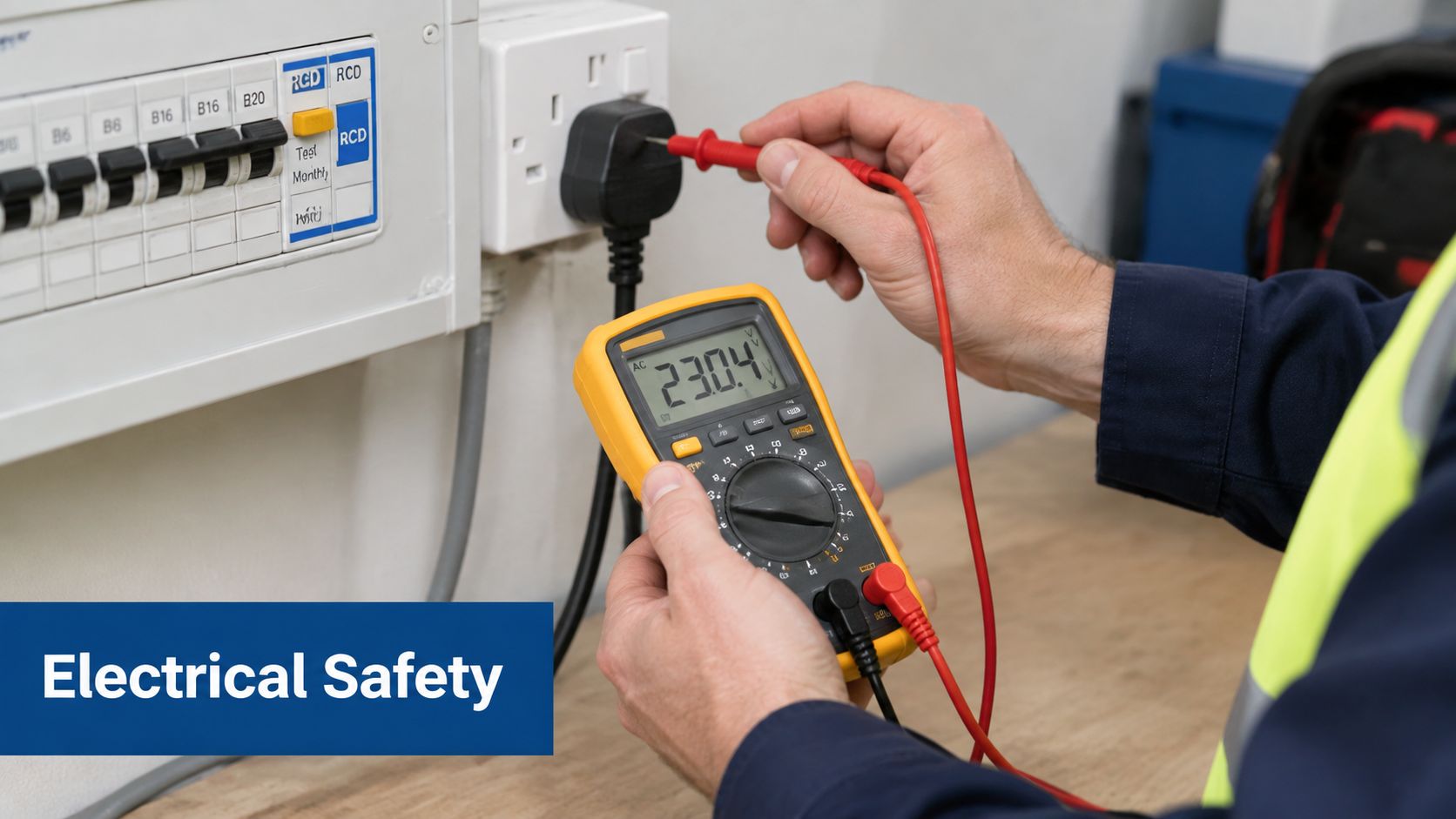
Electrical checks should separate what a supervisor can identify visually from what requires a qualified electrical person. During a construction pre-start, inspect portable tools, extension leads, plugs, switches, temporary power boards and RCD protection for obvious damage, moisture or unauthorised modifications. In an office or training facility, check appliances, power leads and access to outlets. In a warehouse, include charging areas and fixed equipment within the site's maintenance program.
A damaged cord, loose connection, exposed conductor or equipment showing heat damage should trigger immediate removal from service. Don't rely on a test sticker alone. The register should identify the asset, location, condition, last service or test information and the person who made the decision. A supervisor can report a defect, isolate equipment and notify maintenance, but electrical testing and repairs must be handled by an appropriately qualified person.
Use an escalation rule
Set a clear inspection cadence based on use, exposure and the site's electrical safety arrangements. Portable lighting should be checked before deployment. High-use tools may require more frequent formal testing than occasional office equipment. RCDs should be tested using the device's test button according to the workplace procedure, with the result recorded and faults escalated immediately.
A practical entry might read: “Portable grinder in workshop bay, lead sheath split near plug. Unplugged, tagged out and placed in quarantine. Maintenance coordinator notified. Replacement or repair required before next use.” That wording tells the next person what happened and prevents a vague “faulty” note from being ignored.
Supervisors should receive basic hazard-identification training, not electrical repair duties. A central register helps maintenance teams find overdue items, while incident and near-miss records can reveal recurring problems such as damaged leads in a wet area or overloaded temporary boards. For a broader prevention approach, use this guide to workplace shock prevention alongside the site's electrical procedures.
3. Hazard Identification and Risk Assessment
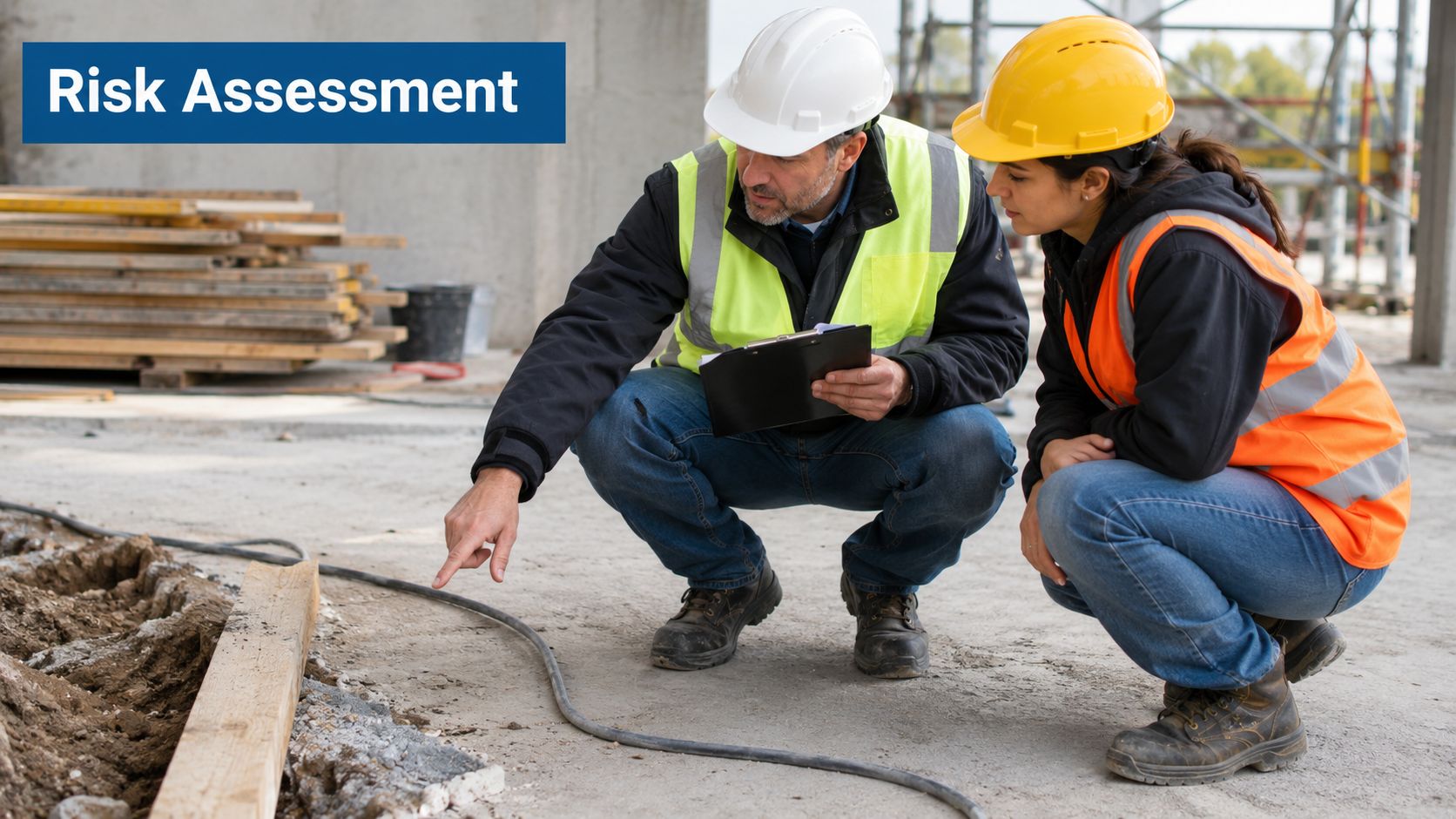
A checklist that only asks whether a control exists can miss how work is performed. Walk with the people doing the task. Ask a traffic controller how vehicle movements change during peak periods, ask a civil operator what happens when ground conditions shift, and ask a hospitality worker where spills usually occur during service. Their answers can expose hazards that a manager won't see from a desk.
Inspect physical, chemical, biological, ergonomic and psychosocial conditions. Construction examples include falls from height, moving plant, hand tools and struck-by exposure. Civil works may involve excavators, dump trucks and underground services. Warehouses need to consider forklifts, manual handling and unstable stacking. Offices may need attention to prolonged sitting, repetitive work and workstation setup.
Record the risk, not just the hazard
Use a JSA or task hazard analysis where the work involves changing steps, plant or conditions. Record the hazard, who may be exposed, existing controls, the additional control required and the person responsible. Review the assessment after an incident, near miss, change in equipment, change in location or change in the way the task is carried out.
Comcare advises that an Australian inspection should be adapted to workplace hazards and developed with workers, managers and health and safety representatives. It should consider the environment, including noise, vibration, lighting, temperature and ventilation, the equipment, including tools and materials, and the work process, meaning how workers interact with those elements. Comcare's workplace inspection guidance also says the inspection should cover the whole workplace, including parking, building access, rest areas, storage and amenities.
Use direct report wording: “Excavator reversing path crosses pedestrian access at the northern gate. Existing cones are inconsistent. Install a separated route, nominate a spotter during delivery movements and brief the crew before work resumes.” Link the assessment to risk management in construction when reviewing construction controls, but keep the site register as the working record.
4. Machinery, Tools and Equipment Inspection
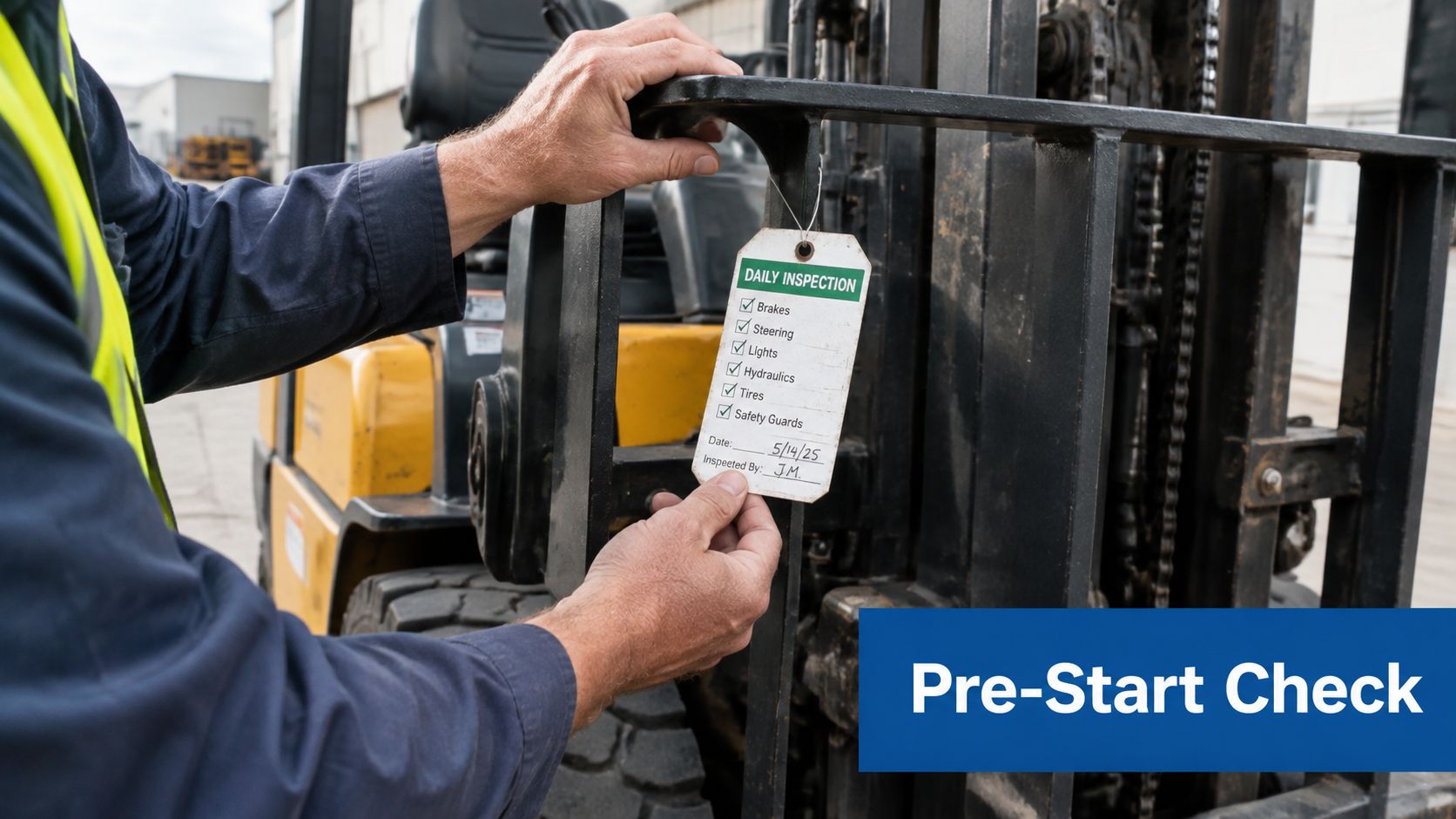
A machine can look clean and still be unsafe. The operator should complete a pre-start before using an excavator, loader, forklift, roller, crane or powered hand tool. The check should follow the equipment's own requirements and include guards, emergency stops, controls, tyres or tracks, attachments, hydraulic lines, alarms, lights, seat belts and visible leaks where relevant.
For a forklift, the operator might identify a damaged fork heel, faulty reversing alarm or leaking hydraulic hose. For an angle grinder, the inspection may find a missing guard, damaged lead or unsuitable disc. A traffic-control crew should check portable traffic lights, signs, stands and batteries before loading the vehicle. A hospitality team needs a different list for slicers, mixers and commercial cooking equipment.
Match frequency to the asset
SafeWork NSW recommends that inspection programs include daily equipment inspections, initial start-up inspections, walk-arounds of mobile equipment before use and supervisor inspections. Weekly or monthly departmental inspections can add a broader review. SafeWork NSW's workplace inspection resources also reinforce the need to assign, track and report actions.
Use a colour-coded status only if everyone understands it. Green can mean safe to use, yellow can mean restricted use with a documented condition, and red can mean out of service. The tag must link to a defect record, not replace one.
A useful entry reads: “Forklift 04, left fork has visible deformation. Operator stopped use, key removed and red tag applied. Fleet coordinator to arrange assessment. Release only after repair and post-repair verification.” The close-out should identify who inspected the repair and when. Keep maintenance logs with the asset, record manufacturer servicing requirements and provide refresher instruction when a machine returns after major repair. For testing programs that depend on reliable measurement, distinguish equipment inspection from professional fitness testing accuracy, because each requires its own competent process.
5. Fire Safety and Emergency Procedures Inspection
Emergency arrangements fail when people discover gaps during the emergency. Walk the evacuation route, open the exit where appropriate, check that access is clear and confirm that workers know where to assemble. A construction site may need a changing assembly point as work areas move. A remote civil crew needs a reliable communication method. A hospitality venue must ensure staff can act while customers are present.
Inspect extinguishers, fire detection arrangements, emergency lighting, exit signs, evacuation maps, first aid kits and AED supplies within the responsibilities assigned to the workplace. Check that equipment is accessible, identified and not blocked by stock, plant or temporary materials. Don't mark an emergency plan as complete because it is displayed. Ask a worker to explain what they would do and where they would go.
Assign people, not just equipment
Nominate wardens, assembly-point coordinators and first aid responsibilities. Record drills, participation and issues, then assign actions such as updating a map, clearing an exit or briefing new starters. Emergency procedures should be reviewed when occupancy, layout, work activities or site access changes.
A monthly visual check can identify missing signage or blocked routes. A broader review should test whether the procedure still works for the actual site. Fire equipment servicing and emergency systems need to follow the applicable building, fire and workplace requirements, as well as the equipment provider's instructions.
Use precise wording: “South exit partly obstructed by delivery cartons. Cartons removed during inspection. Warehouse supervisor to brief receiving staff and verify the route remains clear during the next shift.” If hot work is undertaken, the permit process must connect with the emergency plan. Review hot work permit requirements when deciding who authorises work, what controls are checked and how the permit is closed.
6. Housekeeping and Environmental Conditions Inspection
Housekeeping is an operating control, not a cosmetic exercise. A clear walkway prevents a trip, correctly stored materials reduce falling-object risk and controlled waste reduces fire, contamination and manual-handling problems. On a construction site, inspect access routes, material stacks, dust controls and equipment parking. On a civil site, include fuel storage and the movement of plant around laydown areas.
The same principle applies elsewhere. A warehouse needs marked storage zones and clear aisles. A hospitality kitchen needs clean floors, controlled food storage and an orderly waste process. An office needs sensible cable management, usable workstations and clear access. A training facility needs practical areas arranged so students can move safely around equipment.
Look beyond clutter
Inspect lighting, ventilation, temperature, vibration, noise, dust and the condition of floors and surfaces. Comcare specifically identifies environmental conditions such as noise, vibration, lighting, temperature and ventilation as inspection considerations. Keep the wording observable: “Dust visible on the cutting table and adjacent walkway. Stop task, clean area, review wet-cutting or extraction control and brief workers before restart.”
A daily supervisor walk-through should address immediate disorder. A weekly focused inspection can review storage, waste segregation, hazardous substances and cleaning standards. A monthly review can examine recurring findings and whether the layout still suits the work.
Use online crystalline silica exposure prevention course content where silica-generating tasks are relevant, but don't let training replace the physical inspection. The record should state the substance or condition, location, exposed work group, immediate response, longer-term control and close-out evidence.
7. Incident Investigation and Corrective Action Inspection
A forklift nearly strikes a pedestrian at a loading area. Record the event as more than “operator careless”. Inspect the route, visibility, signage, physical separation, delivery timing, supervision and traffic plan. For a hospitality slip, check the surface, spill response, footwear, layout and whether staff can isolate the area safely.
Preserve relevant information and speak with workers and witnesses separately where appropriate. Establish what happened, then examine why the conditions allowed it. Supervisors can lead straightforward investigations. Escalate serious events under the organisation's procedure and applicable reporting obligations. Use the Paradigm International Inc. investigation guide to structure evidence gathering and follow-up.
Make corrective actions testable
Assign every action an owner, due date and verification method. “Improve safety” cannot be inspected. A useful entry states: “Install a physical pedestrian barrier at the loading-bay crossing, brief all forklift operators and observe the route after installation.”
Safe Work South Australia's workplace safety guidance highlights regular checks, equipment maintenance, incident and hazard reporting, analysis of incident information and action where practicable. Its maintaining a safe workplace guidance also links emergency planning and notifiable-incident reporting with practical workplace controls.
Set investigation frequency by risk. Review near misses at the next supervisor meeting, check assigned actions weekly until closed, and examine recurring causes during the monthly safety review. The close-out inspection should confirm that the control was installed, workers understand it and the original risk has reduced.
Record evidence such as a photograph, revised traffic plan, observation note or signed briefing. Share relevant learning through a toolbox talk, pre-start or safety meeting without blaming individuals. If the action changes the task, equipment or layout, update the JSA, procedure and training record.
8. Worker Training and Competency Verification Inspection
A training record proves that an activity was recorded. It doesn't automatically prove that a worker can perform the task safely. Verify the person, role, required competency, training date, expiry where applicable, trainer and practical assessment. Then observe the worker carrying out the task under normal conditions.
On a construction site, access controls may require a current White Card. A traffic-management business may need to verify the relevant Blue Card and Yellow Card qualifications for assigned duties. Civil operators may need the competency and licence appropriate to the machine. A warehouse should verify forklift competency before allocating forklift work. Hospitality examples include RSA and food safety training, while first aid teams need current CPR and first aid capability.
Inspect performance as well as paperwork
Create a role-based matrix that lists the task, required training, evidence location, refresher trigger and supervisor responsible for verification. Check new starters during induction, review records before assigning high-risk work and schedule refresher training before a critical credential lapses. Competency should also be reviewed after a procedure change, equipment change, incident, extended absence or observed performance gap.
A practical record might say: “Worker assigned to operate EWP. Training evidence sighted. Pre-start method explained correctly. Worker completed practical positioning task under supervision. Supervisor to review independent operation after site-specific induction.” That is stronger than ticking “licensed”.
Use recognised training providers and retain evidence centrally, but keep the inspection connected to the actual workplace. CPR, first aid, White Card and workplace safety certifications can support capability planning across construction, traffic control, civil works, hospitality and first aid. Training doesn't remove the need for supervision, equipment checks or task-specific controls.
8-Point Workplace Inspection Checklist Comparison
| Inspection Category | Implementation Complexity 🔄 | Resource Requirements ⚡ | Expected Outcomes 📊 | Ideal Use Cases 💡 | Key Advantages ⭐ |
|---|---|---|---|---|---|
| Personal Protective Equipment (PPE) Inspection | Low–Medium, routine visual checks; needs trained supervisors | Moderate, inspector time, replacement costs, tagging/documentation systems | Fewer PPE failures; documented compliance; reduced injury risk | Construction, civil works, warehouses, traffic control | Prevents serious injuries; legal compliance; worker confidence |
| Electrical Safety and Equipment Inspection | Medium, requires qualified electricians and PAT testing | High, specialist testers, meters, possible downtime, certification | Reduced electrocution/fire risk; improved equipment reliability | Sites with portable tools, switchboards, charging stations, workshops | Prevents electrical incidents; lowers liability; insurance benefits |
| Hazard Identification and Risk Assessment | High, systematic process, structured methodologies (JSA/Risk Matrix) | High, skilled assessors, time for surveys, documentation & reviews | Proactive hazard control; prioritized risk reduction; systemic improvements | All workplaces, especially complex or high‑risk operations | Prevents incidents; engages workers; informs control hierarchy |
| Machinery, Tools, and Equipment Inspection | Medium–High, mechanical and functional checks; manufacturer rules | High, skilled maintenance, spare parts, scheduled downtime | Fewer breakdowns; extended equipment life; safer operations | Construction machinery, forklifts, plant, workshops, training centres | Prevents equipment failures; reduces downtime; compliance |
| Fire Safety and Emergency Procedures Inspection | Medium, system testing, drills and plan reviews; external certs may be needed | Moderate–High, servicing, replacement parts, training, evacuation drills | Faster emergency response; reduced damage; life safety ensured | Large warehouses, public venues, offices, construction sites | Saves lives; reduces property loss; regulatory compliance |
| Housekeeping and Environmental Conditions Inspection | Low–Medium, routine checks and standards enforcement | Moderate, cleaning resources, storage solutions, environmental monitoring | Fewer slips/trips/fires; improved hygiene and productivity | Warehouses, kitchens, offices, training facilities | Reduces common hazards; improves morale and efficiency |
| Incident Investigation & Corrective Action Inspection | High, requires root‑cause analysis skills and timely investigations | Moderate–High, trained investigators, time, tracking and follow‑up systems | Recurrence prevention; organisational learning; verified corrective actions | After incidents or near‑misses across all industries | Identifies root causes; drives continuous improvement |
| Worker Training & Competency Verification Inspection | Medium, record checks, practical assessments and audits | High, training delivery, qualified trainers, record management systems | Competent workforce; fewer skill‑related incidents; compliance | High‑risk roles: machinery, traffic control, EWP, forklift operations | Ensures competence; legal compliance; workforce development |
Turn Inspection Findings Into Safer Work
The completed checklist should tell a practical story. It should show where the issue was found, what condition existed, who was exposed, what immediate control was applied, who owns the remaining work, when it is due and how someone confirmed completion. If the record only says “action required”, the next supervisor has to start the investigation again.
Start by recording the location and condition. “Damaged lead in workshop bay three” is useful. “Electrical issue” is not. Then assign a responsible person who has the authority and resources to act. Set a due date that reflects the risk. A serious hazard or unsafe work practice needs immediate attention, while lower-risk improvements can be scheduled and monitored.
SafeWork NSW expects inspection programs to combine repeated checks with follow-up. Its guidance includes daily equipment inspections, initial start-up inspections, mobile-equipment walk-arounds before use and supervisor inspections, with broader departmental inspections included in a full program. The same guidance says hazards should be fixed immediately where serious, while other actions should be assigned, tracked and reported back to workers and HSRs.
Choose the right template
Keep separate versions for different inspection jobs rather than forcing every task into one oversized form.
- Daily walkthrough: Cover access, housekeeping, PPE, visible hazards, emergency routes and changing site conditions. The supervisor or nominated competent person should complete it with workers.
- Weekly focused inspection: Select one risk area such as mobile plant, electrical equipment, traffic separation, storage, dust control or first aid. Include a deeper review of records and recurring findings.
- Monthly compliance review: Check registers, training evidence, emergency arrangements, open corrective actions, consultation records and whether the checklist still reflects the workplace.
- Equipment pre-start: Use an asset-specific form completed by the operator before use. Include a clear safe-to-use, restricted-use or out-of-service decision.
- Site handover: Record unfinished work, temporary controls, open hazards, plant status, access arrangements, emergency information and the person accepting responsibility.
Comcare recommends tailoring the checklist to the workplace, consulting HSRs, managers, workers and other interested people, and inspecting the whole workplace, including parking, access, rest areas, storage and amenities. That makes the checklist a risk-management workflow rather than a generic compliance form.
Printable inspection record
Use the following fields in a paper or digital form:
- Date and time
- Site or work area
- Inspector and role
- Inspection type
- Item or asset
- Status
- Finding and exact location
- Immediate control
- Required corrective action
- Action owner
- Due date
- Evidence attached
- Close-out date
- Verification completed by
- Inspector sign-off
- Worker or HSR consultation record
Write findings so another person can understand them without asking for clarification. “North access gate, pedestrian route narrowed by stored pipe. Pipe relocated immediately. Site supervisor to mark a permanent exclusion zone and verify during the next daily walkthrough.” This records the condition, response, owner and verification point.
Use the completed inspection at the next pre-start or handover. Review overdue actions, look for repeated findings and update the checklist when equipment, processes, occupancy or work locations change. A checklist is most valuable when it changes what people do, not when it produces another file.
TP Training can support capability needs across construction, civil construction, traffic control, hospitality, first aid and workplace safety through practical training delivered at NSW locations including Penrith, Burwood, Auburn, Parramatta and Sydney CBD. Visit TP Training to connect relevant competency development with the controls your workplace needs to inspect and verify.
TP Training delivers practical, nationally recognised training for construction, civil construction, traffic control, hospitality, first aid and workplace safety roles. Review the available courses and visit TP Training to find training that supports safer work and stronger inspection follow-up.

You may also like

Construction Induction Training in NSW Explained
CPR Training Face Shields: A Practical Australian Guide