How Long Does First Aid Certificate Last
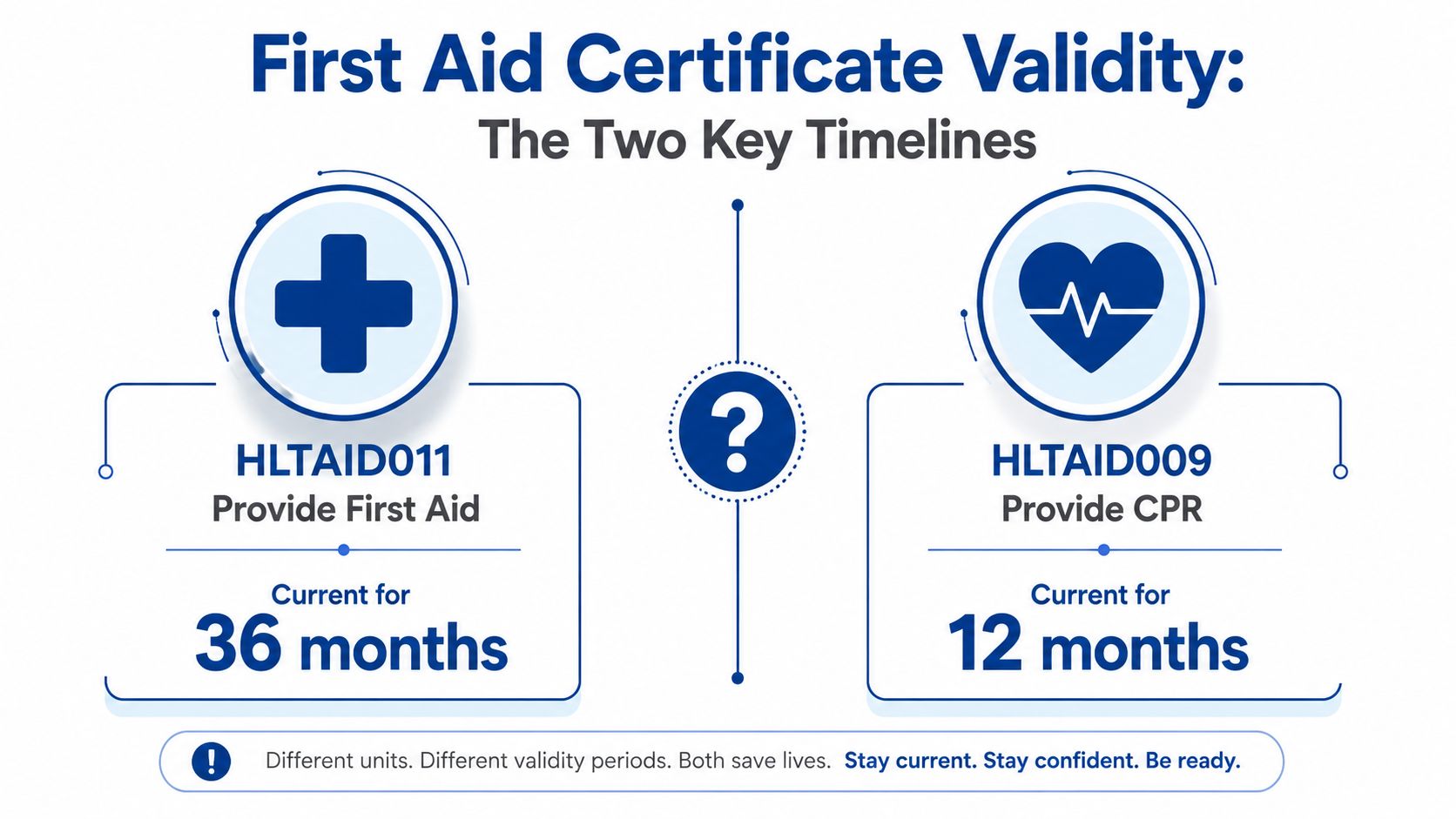
In Australia, the standard first aid certificate, HLTAID011 Provide First Aid, is generally treated as current for 3 years, while the CPR component, HLTAID009 Provide CPR, must be refreshed every 12 months. That means one course can involve two different renewal clocks.
So, how long does a first aid certificate last if your certificate shows a three-year date but your employer asks about annual CPR? The confusion usually comes from treating first aid as one single qualification with one expiry date. In practice, Australian training uses a dual-currency model. Your broader first aid training is usually managed over a three-year cycle, while CPR currency is checked annually.
A first aid certificate typically has a validity period, much like a vehicle registration that runs for several years. While the main registration is valid for that term, a required safety inspection must be checked annually. The vehicle remains registered, but the safety check still needs attention. First aid certification works in a similar way, although your workplace, regulator, licensing body, or employer may apply a stricter rule.
Table of Contents
- Understanding How Long a First Aid Certificate Actually Lasts
- The Two Certificates Inside One Qualification
- What Australian Workplaces Expect from Your Certificate
- Industries That Set Their Own Stricter Renewal Rules
- Common Misconceptions About Expired Certificates
- Renewing Your Certificate with TP Training in NSW
- Keeping Your Skills Current and Your Records Ready
Understanding How Long a First Aid Certificate Actually Lasts
The simple answer and the two clocks
HLTAID011 Provide First Aid is generally treated as current for 36 months, while HLTAID009 Provide CPR is expected to be refreshed every 12 months. Safe Work Australia's Model Code of Practice for first aid in the workplace separates these two expectations, recommending annual CPR refresher training and renewal of first aid qualifications every three years.
That doesn't mean the whole certificate suddenly becomes meaningless when the annual CPR date arrives. It means the practical CPR skill needs a more frequent check because workplaces and training guidance expect resuscitation skills to remain current more regularly than the broader first aid content.
Practical rule: Read your certificate as having a broad first aid date and a separate CPR currency date.
What “current” means in practice
People often use the word “expired” as if it describes a legal switch that turns off at midnight. In everyday workplace administration, the more useful question is whether your qualification is recognised as current for the role you're performing.
A certificate can show that you completed training, but an employer may still require evidence that your CPR component has been refreshed within the annual window. Industry rules can also be stricter. For example, NSW Police/SLED guidance says security licence holders must keep first aid current and renew it every three years, as outlined in the first aid renewal guidance.
This is why there isn't one universal expiry date for every person. Your answer depends on:
- The unit completed, such as HLTAID011 or HLTAID009.
- The date of issue shown on your Statement of Attainment.
- Your workplace policy, which may ask for earlier renewal.
- Your industry regulator, especially in childcare, security, maritime, or other regulated work.
The rest of the renewal decision becomes much easier once you identify which clock your employer is checking.
The Two Certificates Inside One Qualification
HLTAID011 as the umbrella
HLTAID011 Provide First Aid is the broad first aid unit. It covers a range of emergency situations, including asthma, anaphylaxis, bleeding, fractures, shock, and resuscitation skills. It gives you a wider set of responses than a CPR-only course.
The easiest way to understand it is as an umbrella. The umbrella covers the wider first aid response, while CPR is one important skill underneath it. The umbrella is commonly treated as current for 36 months, but the CPR skill is expected to be refreshed every 12 months, based on Australian workplace guidance and the Australian first aid certificate validity explanation.
HLTAID009 as the annual skill check
HLTAID009 Provide Cardiopulmonary Resuscitation focuses on CPR and resuscitation technique. Training commonly includes the DRSABCD action plan, chest compressions, rescue breaths where appropriate, and the use of an automated external defibrillator in the training environment. Many people call this a CPR refresher, although the formal unit code is HLTAID009.
Some workers complete HLTAID009 on its own because their role only requires current CPR. Others complete it as the annual update connected to their broader first aid qualification. A CPR-only course doesn't replace HLTAID011 when a workplace requires full first aid coverage.
| Feature | HLTAID011 Provide First Aid | HLTAID009 Provide CPR |
|---|---|---|
| Main purpose | Broader first aid response | CPR and resuscitation skills |
| Common currency cycle | 36 months | 12 months |
| Typical content | Medical emergencies, injuries, shock, asthma, anaphylaxis, bleeding and CPR | DRSABCD, CPR technique and resuscitation equipment |
| Common use | Workplace first aider or general first aid requirement | Annual CPR currency or CPR-only role requirement |
Your Statement of Attainment may list both units, especially when CPR forms part of the full first aid training. Check each unit name and issue date rather than relying only on the course title. The TP Training article about HLTAID011 Provide First Aid can also help you understand the unit name attached to your training record.
If you need the broader qualification, the Provide First Aid Course is a practical, nationally recognised option delivered with experienced trainers and hands-on learning across NSW.
What Australian Workplaces Expect from Your Certificate
Safe Work Australia provides a clear workplace benchmark. Its Model Code of Practice says first aiders should refresh their skills regularly, with CPR refresher training carried out annually and first aid qualifications renewed every three years. The guidance is especially useful because it separates the practical resuscitation update from the broader first aid qualification.
The Model Code is not automatically the same thing as binding legislation in every Australian jurisdiction. Each state and territory applies work health and safety laws through its own regulator and legal framework. Employers therefore need to consider the rules that apply in their location, the hazards at their site, and the work being performed.
Why employers track both dates
A workplace may have a first aid register that records:
- The unit name, such as HLTAID011 Provide First Aid.
- The CPR update date, linked to HLTAID009.
- The Statement of Attainment, stored in a personnel or training file.
- Any site-specific requirements, such as defibrillator practice or remote-area procedures.
This record-keeping helps managers check whether designated first aiders are current before an incident occurs. It also gives the business a clear way to review training needs when staff change roles or move between sites.
A certificate proves training was completed. A current skills record helps an employer show that the right people remain prepared for the work environment.
A PCBU, meaning a person conducting a business or undertaking, must provide reasonably practicable measures to protect workers and others affected by the work. Training is one part of that responsibility. A construction site, warehouse, office, or traffic work zone may also need additional site induction, emergency planning, or equipment training beyond the baseline first aid units.
For example, a worker involved in a work zone may complete first aid training alongside a Prepare Work Zone Traffic Management Plan Course Pwz Red Card. That traffic management training doesn't change the first aid renewal cycle, but it shows why employers often review several separate competencies together.
Industries That Set Their Own Stricter Renewal Rules
The general Australian model is useful, but it isn't the final word for every job. A childcare service, security licence holder, and maritime worker may all hold first aid training while facing different evidence and recency requirements.
Comparing the overlays
| Industry / Sector | Baseline Expectation | Common Stricter Rule | Example Reference |
|---|---|---|---|
| Childcare and education | Full first aid is commonly managed on the broader renewal cycle, with CPR checked annually | Services may require annual CPR and current anaphylaxis-related training | Employer or service policy, plus applicable education and care requirements |
| Security | First aid is commonly renewed on the three-year cycle | Licence holders must maintain current first aid for licensing purposes | NSW Police/SLED FAQ |
| Maritime | General first aid currency may follow the Australian workplace model | AMSA may require a new certificate when the existing certificate expires within 90 days of a certificate-of-competency application | AMSA equivalent first aid guidance |
| Construction and high-risk work | Workplace first aid and annual CPR expectations apply | Site rules may require earlier checks, extra emergency drills, or additional response training | Employer, principal contractor, or site emergency plan |
Childcare workers should be particularly careful not to assume that a general HLTAID011 certificate covers every service requirement. A centre may ask for specific training related to children, anaphylaxis, or emergency response. The service's policy and applicable regulator guidance should decide what evidence you need.
Security workers should check the licensing conditions attached to their role. Maritime workers also need to look beyond the printed certificate date. AMSA's 90-day expiry window demonstrates that a certificate can become a licensing issue before a worker reaches the ordinary renewal point.
These differences are discussed in guidance about continuing education for nurses, where professional roles may involve additional employer or registration expectations. TP Training delivers relevant refresher units nationally, but the correct course combination still depends on the role and governing requirements.
Common Misconceptions About Expired Certificates
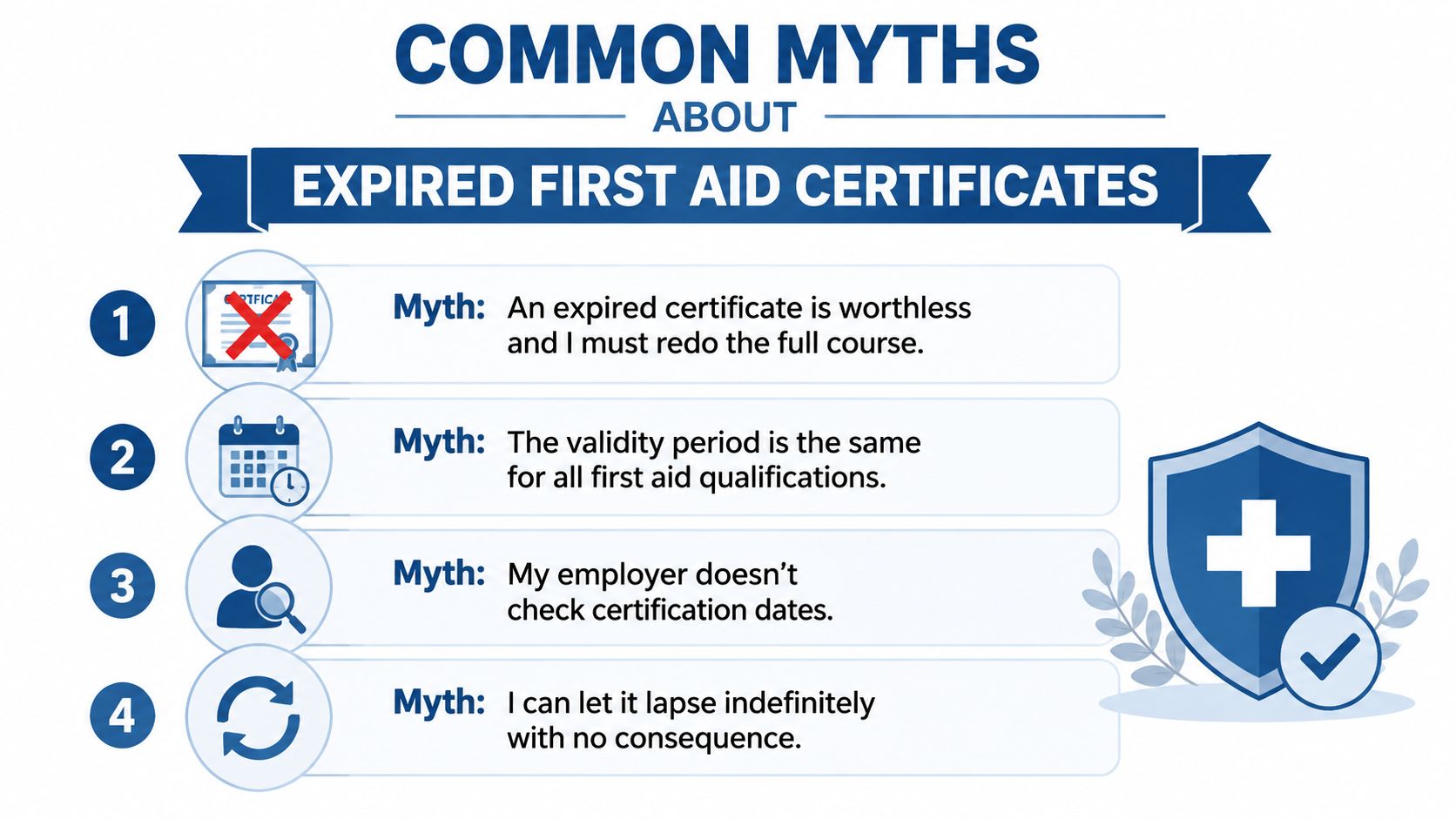
An expired date doesn't answer every question
An expired or soon-to-expire certificate needs attention, but it doesn't automatically tell you that every element must be repeated from the beginning. Training providers and employers may distinguish between renewing the broad first aid unit and completing an annual CPR update.
A refresher is designed to update knowledge and practical performance. Whether you can take a refresher, or need a full re-issue, depends on the unit, the time since training, your employer's policy, and any industry rule. Don't assume that a lapsed document has only one possible pathway.
Online completion isn't automatically accepted
A purely online CPR activity may not satisfy a workplace that requires practical demonstration and competency assessment. CPR is a hands-on skill, so many employers and licensing bodies expect face-to-face assessment using appropriate training equipment.
Before enrolling, ask who will accept the result and what delivery format they require. The TP Training guidance on CPR and first aid training is a useful starting point when you're comparing course options near your workplace.
Unit codes can change
Unit codes aren't permanent labels. Older records may show HLTFA311A, while newer Australian training records use HLTAID codes such as HLTAID009 and HLTAID011. A change in code doesn't automatically make an old record unusable, but it can make an employer's verification process more involved.
Record check: Match the unit code, issue date, delivery format, and workplace requirement before booking.
A tidy record also helps when a certificate is missing. Keep your Statement of Attainment in a secure digital folder and retain a printed copy if your workplace uses paper files. If your employer has a specific form or register, update it when you complete the renewal instead of waiting until a compliance review.
Renewing Your Certificate with TP Training in NSW
Renewal becomes straightforward when you start with the document rather than the course name. Pull out your Statement of Attainment, identify the units listed, and check the issue dates.
Follow the dates first
- Find HLTAID011. If the broader first aid unit is approaching the three-year point, ask whether you need a full first aid renewal.
- Find HLTAID009. If your first aid certificate remains within its broader period but your CPR date is older than the annual currency expectation, you may need a CPR update.
- Check your workplace rule. Childcare, security, maritime, and high-risk work settings can add requirements.
- Confirm the delivery format. Ask whether your employer requires face-to-face practical assessment.
- Bring identification and records. Take the identification requested at enrolment and your previous training evidence if available.
Don't book a CPR-only course when your employer needs the broader first aid unit. Conversely, don't repeat a full first aid course without checking whether an annual HLTAID009 update is the immediate requirement.
Prepare before the training day
Most first aid courses include theory, practical demonstrations, skills practice, and competency assessment. Your provider will explain any pre-course theory requirements, what identification to bring, and how certificates are issued after successful completion. Course duration and certificate timing can vary by the specific course and assessment process, so confirm those details directly before enrolment.
TP Training delivers practical first aid training through NSW locations, including Penrith, Burwood, Auburn, Parramatta, and Sydney CBD. Its trainers can help you identify whether your role calls for HLTAID009, HLTAID011, or an industry-specific first aid course before you enrol.
Language support may also matter when you're checking assessment instructions or learner documentation. TP Training outlines multilingual support for English, Mandarin, Korean and Vietnamese assistance.
Ask the training team about digital certificate issue timing, replacement records, and the exact evidence your employer wants. A clear answer before the class prevents a mismatch between the course you complete and the qualification your workplace needs.
Keeping Your Skills Current and Your Records Ready
The dual-currency model becomes easier to manage when you treat renewal as two calendar tasks, not one. Plan the HLTAID009 CPR update annually, and plan the broader HLTAID011 first aid renewal every three years, while checking whether your industry requires an earlier date.
Use one simple record system
Create a training entry on your phone or computer with:
- Unit codes: Record HLTAID011 and HLTAID009 separately.
- Issue dates: Copy them exactly from your Statement of Attainment.
- Reminder dates: Set a calendar alert 30 days before each relevant renewal date.
- Evidence location: Save a digital copy and keep a printed copy if your workplace needs one.
- Employer contact: Note who confirms the role-specific requirement.
If you lose the original document, contact the training provider or learner support team about reissued records. TP Training issues nationally recognised certification and can support learners with reissued certificates where records are available.
Your certificate is only one part of preparedness. Between courses, reread the DRSABCD action plan regularly and use reputable short skills videos to revisit the sequence. These habits won't replace formal competency assessment, but they can help keep the response familiar rather than leaving every practical detail until renewal day.
The Unique Student Identifier, or USI, is also part of maintaining organised Australian training records. TP Training's guide to creating and managing your Unique Student Identifier can help if you're unsure how to handle that record.
Seek confirmation before relying on a soon-to-expire certificate if you work in childcare, education, security, maritime operations, or another regulated setting. Your employer, industry body, licensing authority, or local TP Training coordinator can confirm whether the general renewal window applies or whether your role has a stricter requirement.
TP Training provides practical, nationally recognised first aid training with experienced trainers and hands-on learning across NSW. Check your HLTAID011 and HLTAID009 dates, confirm the course your workplace requires, and visit TP Training to choose the next step.

You may also like

Government Fund Courses in Australia: A Practical Guide

Workplace Safety Training: A 2026 Guide for Australia