CPR and First Aid Training Near Me: Complete 2026 Guide
Only 56% of Australian adults have ever completed CPR training, and just 22% had current training within the previous 12 months, according to national survey data reported in the Australian CPR training research. Searching for “CPR and first aid training near me” should therefore lead to more than the closest course calendar. You need the qualification that matches your role, your workplace risk, and your renewal obligations.
For NSW workers, the practical decision is straightforward. Choose HLTAID009 Provide Cardiopulmonary Resuscitation when you need current CPR certification, HLTAID011 Provide First Aid when your role requires broader workplace first aid, and HLTAID012 Provide First Aid in an Education and Care Setting when you work with children in education or care. Then confirm how many trained first aiders your workplace needs and book before your current CPR currency expires.
Table of Contents
- Why CPR and First Aid Skills Matter Right Now
- Choosing the Right Course for Your Needs
- Meeting Workplace Compliance Requirements
- Booking Your Training at a Local TP Training Centre
- Understanding Renewal Requirements and Skill Maintenance
- Common Questions About CPR and First Aid Training
Why CPR and First Aid Skills Matter Right Now
Australia records more than 32,000 out-of-hospital cardiac arrests each year, approximately one every 21 minutes, while overall survival is around 1 in 10, as reported in Australian CPR history and public-health guidance from St John Ambulance Tasmania. The situation becomes more urgent when you look at what happens before an ambulance arrives. Only about 40% of people who suffer cardiac arrest in Australia receive CPR from a bystander, according to the Heart Foundation data summarised in the national CPR training study.
That gap isn't caused only by a lack of interest. CPR training isn't mandatory nationwide, and many people who trained once haven't practised recently. A Victorian survey found that 68% of adults had completed CPR training at some point, but only 28% had refreshed it during the previous year, demonstrating the difference between historical exposure and current ability.
Why local access changes behaviour
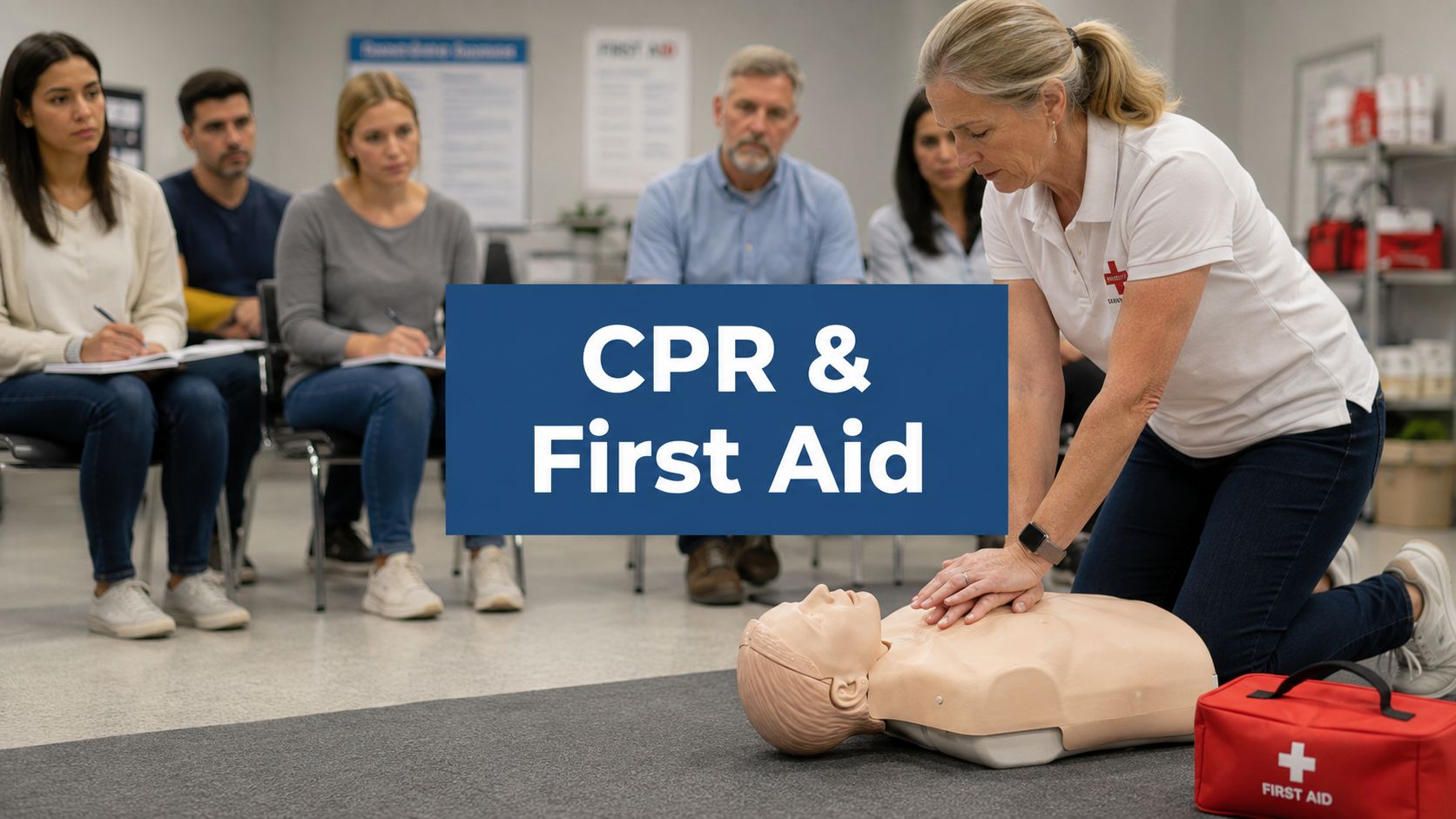
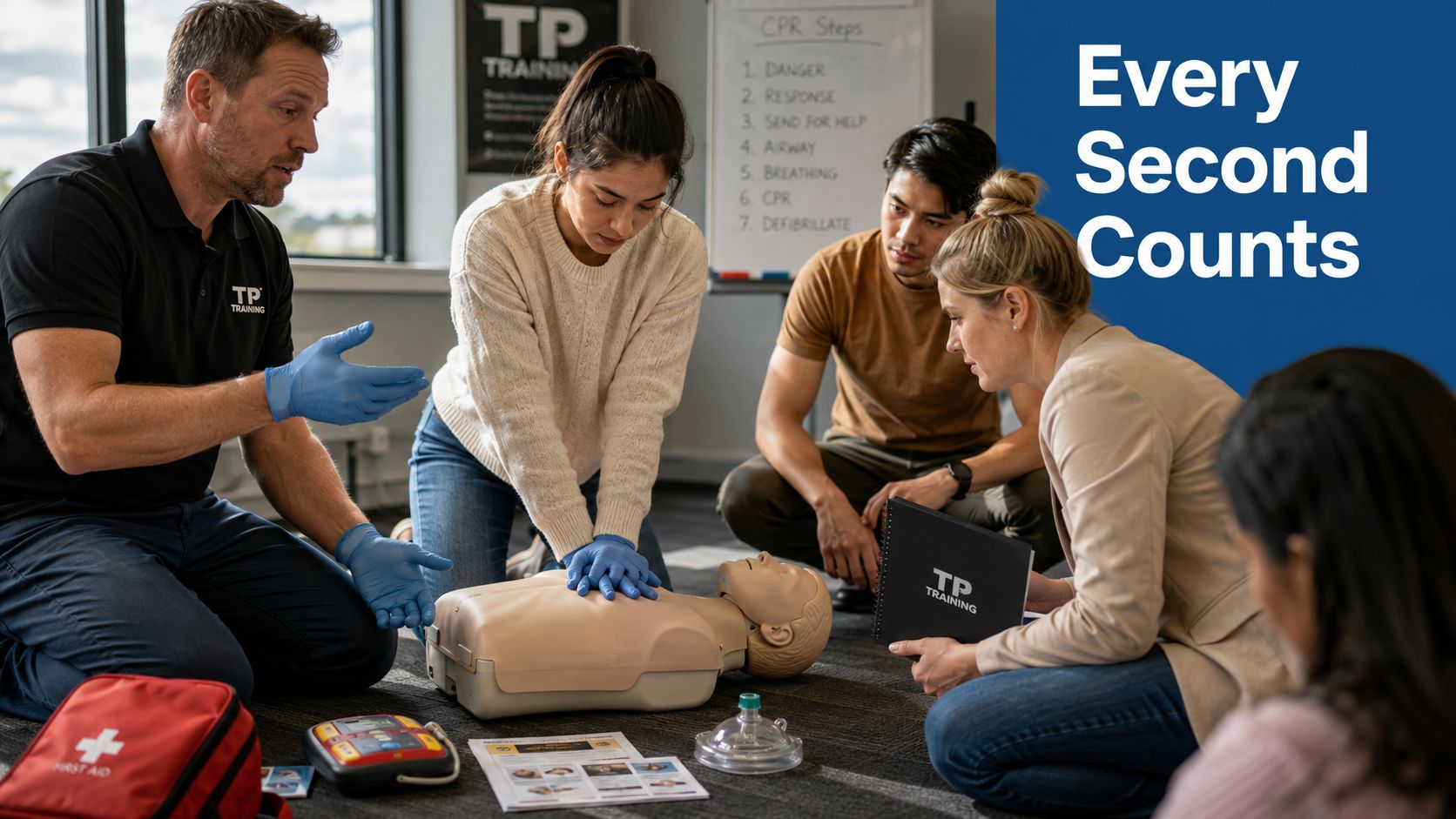
CPR is a physical skill. You must recognise an emergency, check safety, assess the person, call emergency services, begin compressions, and continue until help arrives or the person starts breathing again. Reading instructions can't replace practising on a mannequin, coordinating compressions and breaths, or handling an AED under instructor supervision.
That's why accessible training centres across Sydney and NSW matter. A course close to your workplace or home makes it easier to attend an annual refresher, replace an expired qualification, or train a group of employees without turning travel into the main obstacle. Practical workplace guidance is also useful alongside formal training, particularly the workplace safety tips from TP Training.
CPR also needs to be adapted to the person involved. Adults, children, infants, and workplace colleagues may require different approaches, so families and carers looking for infant-specific guidance can use the Bornbir guide to infant CPR as a supplementary resource. It shouldn't replace nationally recognised workplace training, but it can help parents and carers understand why age-specific preparation matters.
What current CPR training teaches
HLTAID009 training aligns with Australian Resuscitation Council guidance. The method includes 30 chest compressions followed by 2 breaths, use of an AED according to the manufacturer's instructions, and a compression rate of approximately 100 to 120 compressions per minute, based on Healthdirect's CPR instructions.
Chest compressions are the most important part of CPR. The skill you need isn't theoretical confidence. It's the ability to act promptly, keep compressions effective, follow the AED prompts, and continue until professional help takes over.
Choosing the Right Course for Your Needs
The most common mistake I see is booking a course because the title sounds familiar. Start with the unit code your employer, regulator, or industry body requires. A CPR-only course isn't a substitute for full first aid, and a general first aid course may not meet the specific needs of an education and care setting.
Compare the recognised units
| Course Code | Course Name | Who It Is For | CPR Renewal | Full Course Renewal |
|---|---|---|---|---|
| HLTAID009 | Provide Cardiopulmonary Resuscitation | Workers who need current CPR and AED skills | Every 12 months | Not applicable |
| HLTAID011 | Provide First Aid | Workers responsible for broader workplace first aid | Every 12 months | Every 3 years |
| HLTAID012 | Provide First Aid in an Education and Care Setting | Workers in childcare, education, and care environments | Every 12 months | Every 3 years |
The renewal cycle in the table reflects Australian first aid training guidance, including the Australian first aid renewal information. Treat the dates as working obligations, not paperwork you can ignore until an employer asks for proof.
Match the unit to your workplace
Construction, civil work, warehouses, and industrial workplaces generally need broader first aid capability because the work environment can involve machinery, vehicles, tools, remote areas, and higher physical hazards. If your employer requires a workplace first aider rather than CPR-only currency, HLTAID011 is the sensible choice.
Childcare and education workers should confirm whether their employer requires HLTAID012. This unit is designed for education and care settings, where first aid responses may involve children and specific workplace procedures.
Office, retail, and hospitality workers still need to follow the employer's risk assessment. Some employees may only need HLTAID009, while designated workplace first aiders may need HLTAID011. Hospitality staff may also need separate industry credentials, such as RSA, but RSA doesn't replace first aid training.
The Provide First Aid Course is a practical, nationally recognised option with experienced trainers and hands-on learning across NSW. Before booking, check the exact unit code on the course page and compare it with your employer's written requirement.
Trainer's rule: If your job description says “first aider”, don't assume CPR-only training is enough. Ask which unit your workplace has nominated.
Hands-on practice is the deciding factor. Resources on practical hands-on training tips can help reinforce safe learning habits, but formal certification still depends on completing the required training and assessment. You can also review basic life-saving course guidance before selecting a class.
Meeting Workplace Compliance Requirements
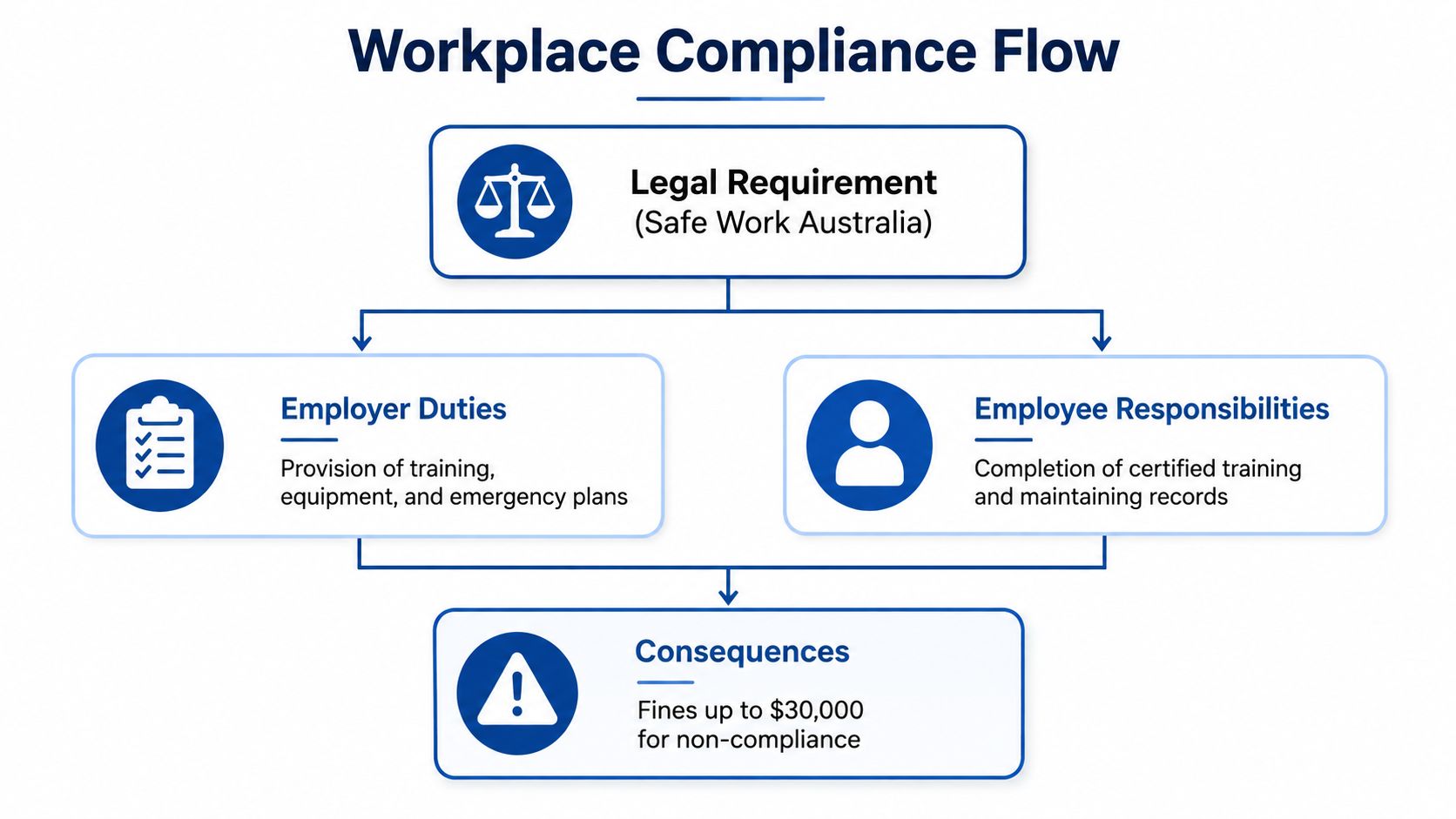
Employers shouldn't begin with the question, “Which course is cheapest?” They should begin with the workplace risk assessment. Safe Work Australia guidance expects workplaces to provide access to trained first aiders, appropriate first aid equipment, and emergency arrangements that reflect the work performed, the location, the workforce, and the hazards present.
For staffing, the guidance identifies approximately one first aider per 50 workers in a low-risk workplace and one per 25 workers in a high-risk workplace, as summarised in Australian workplace first aid statistics from First Aid Network Australia. Construction is specifically treated as high-risk in workplace guidance, so employers should plan around the higher level rather than applying an office-based assumption.
A practical compliance check
- Classify the workplace risk. Consider machinery, construction activities, hazardous substances, traffic exposure, isolated work, remote locations, and the likely severity of injuries.
- Count the workers who need coverage. Include the people present across operating hours, shifts, leave periods, and areas where one first aider may not be immediately available.
- Select the right unit. Use HLTAID009 for current CPR requirements and HLTAID011 for broader workplace first aid. Education and care employers should verify whether HLTAID012 is required.
- Plan for absence. A single trained worker won't provide reliable coverage if that person is on leave, working remotely, or assigned to another area.
- Check equipment and communication. First aid kits, emergency contacts, site access, and AED arrangements must support the response rather than leave the trained worker searching for equipment.
AED readiness belongs in the plan
An AED can guide a responder through the defibrillation process, but only if workers know where it is, can reach it quickly, and understand how to follow the device prompts. AED readiness means checking access, signage, battery status, pads, and workplace emergency procedures. It also means training staff to combine AED use with continuous CPR, rather than treating the machine as a replacement for compressions.
For construction managers, site supervisors, and safety officers, risk management in construction provides useful context for connecting training decisions with broader site controls. Keep certificates and renewal records organised, but don't confuse an orderly file with an effective emergency system. Compliance is the minimum. The test is whether a trained person, equipment, and an emergency plan are available when an incident occurs.
Booking Your Training at a Local TP Training Centre
Searching by suburb is sensible, but convenience should serve compliance. TP Training has centres in Penrith, Burwood, Auburn, Parramatta, and Sydney CBD, giving workers and employers several location options across Sydney. Choose the centre that reduces travel from your workplace or home, then confirm that the course code matches your requirement before enrolling.

Use this booking sequence
Start with the certificate. Check whether you need HLTAID009, HLTAID011, or HLTAID012. If your employer sent you a training request, copy the unit code exactly rather than relying on a course nickname.
Choose the centre. Penrith may suit workers in western Sydney, while Burwood, Auburn, Parramatta, and Sydney CBD can be more practical for other commuting patterns. Employers booking several staff should consider the location that creates the least disruption across the team.
Read the enrolment requirements. Confirm the scheduled date, attendance expectations, identification requirements, and any pre-course learning. Don't book a course until you understand whether you must complete online work before attending practical training.
Prepare for physical practice. Wear comfortable clothing that allows movement and kneeling. CPR assessment requires you to work at floor level with a mannequin, so restrictive clothing, loose jewellery, and unsuitable footwear can make the practical component harder.
What happens on the day
Expect an instructor-led session covering emergency recognition, safety, assessment, CPR, AED use, and relevant first aid responses. You'll practise the skills rather than just listen to a presentation, and the trainer will observe your technique during practical assessment.
Bring identification, any enrolment information, and the details of the workplace requirement if you're attending on an employer's instruction. If you have a medical condition or physical limitation that may affect kneeling, compressions, or other practical activities, discuss it with the training provider before the course.
TP Training also provides multilingual support in English, Mandarin, Korean, and Vietnamese. That support can help learners understand instructions clearly, but every participant still needs to demonstrate the required skills safely and consistently.
Certification follows successful completion of the required learning and assessment. Ask the provider how certificates are issued, especially if your employer needs evidence promptly. Keep your certificate accessible and record the next renewal date before you leave the course.
Understanding Renewal Requirements and Skill Maintenance
A certificate can remain in your email while your practical confidence fades. The national survey gap is clear: 56% of adults had undertaken CPR training at some point, but only 22% had current training within the previous 12 months, according to the Australian CPR training research. That isn't a reason to avoid training. It's a reason to treat renewal as routine.
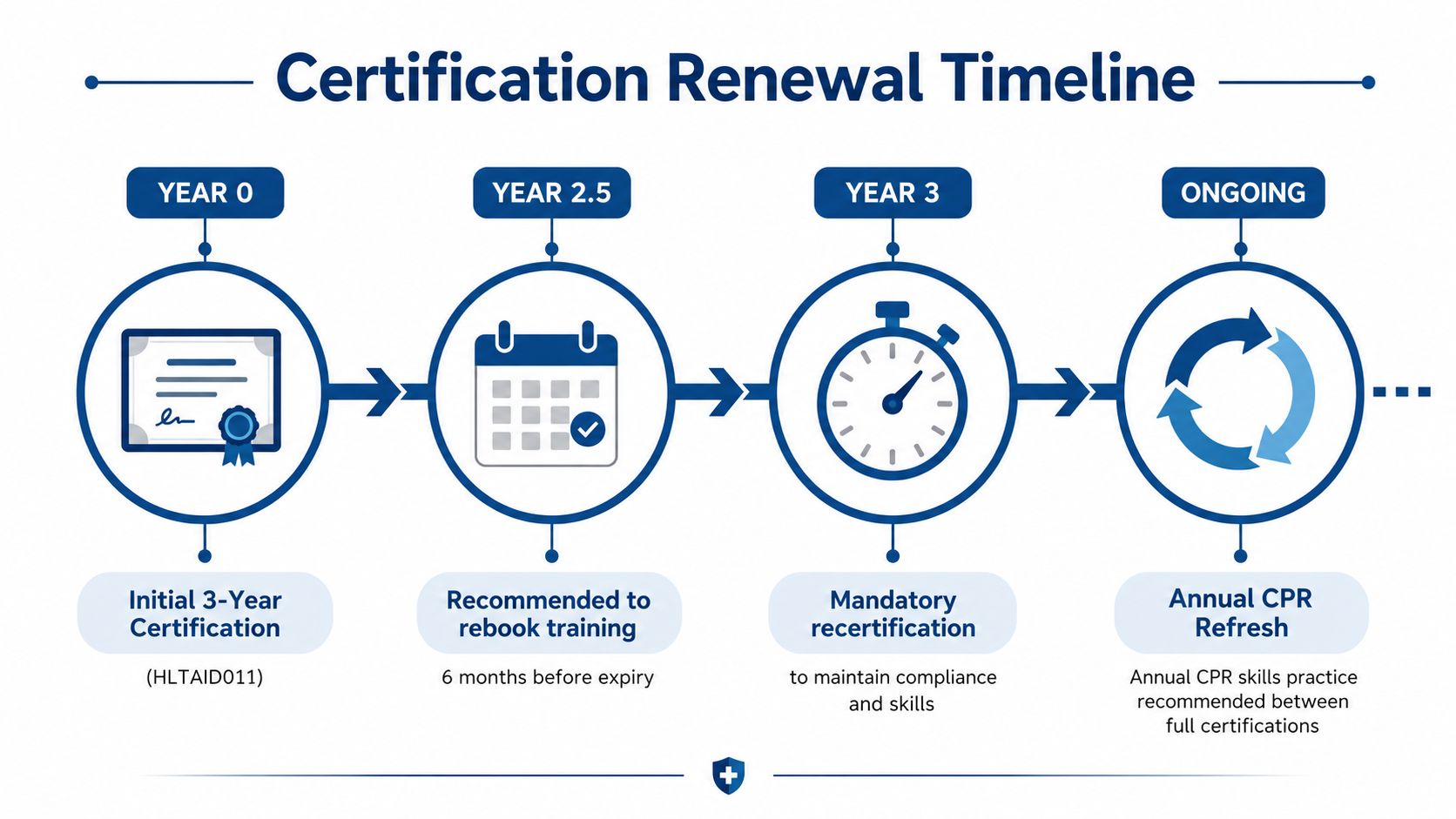
Australia uses a split cycle. HLTAID009 CPR currency is renewed every 12 months, while HLTAID011 Provide First Aid is treated as valid for 3 years, based on Australian first aid training guidance from IRFA. Your employer or industry regulator may impose additional expectations, so always check the workplace policy rather than assuming the qualification date answers every question.
Check your status before booking
Find the certificate or statement of attainment and identify the unit code, completion date, and any expiry or currency information. If you can't locate the record, contact the original training organisation or your employer's safety representative before enrolling in a replacement course.
Use a simple workplace register with:
- Unit code: Record whether the worker holds HLTAID009, HLTAID011, or HLTAID012.
- Completion date: Store the date shown on the training record.
- CPR renewal date: Set a reminder for the annual CPR requirement.
- Full first aid date: Track the three-year cycle for HLTAID011 or the applicable education and care unit.
- Coverage status: Confirm that enough current first aiders are available across shifts and work areas.
Don't wait until the day before a job starts. Book the next CPR refresher while your certificate is still current, and rebook full first aid before the three-year point arrives. The Australian first aid certification guidance can help workers understand the difference between first aid qualification currency and annual CPR maintenance.
Why annual practice matters
CPR depends on sequence, rhythm, pressure, coordination, and decision-making under stress. A worker who remembers attending a course years ago may still hesitate over when to call emergency services, how to position their hands, or how to use an AED. Regular refreshers keep the response familiar and reduce the risk that a workplace relies on an outdated assumption about someone's competence.
Keep the calendar simple: Annual CPR renewal is a professional maintenance task, not an admission that your original training failed.
Common Questions About CPR and First Aid Training
Is an online-only CPR course enough?
For Australian workplace certification, don't assume an online-only course meets the requirement. CPR involves practical demonstration and assessment, including compressions, breaths, and AED use. Choose training that clearly identifies the nationally recognised unit and includes the practical component required for your workplace.
How long does certification take to arrive?
That depends on the provider's assessment and certificate process. Ask before booking whether the certificate is issued after successful completion, how you receive it, and what happens if administration or outstanding assessment evidence delays release. If you need proof for a new job, raise that requirement during enrolment.
Will an employer accept my certificate?
Employers usually need the exact unit they nominated, not any document containing the words “CPR” or “first aid”. Give your supervisor or safety officer the course code before enrolling. A certificate for HLTAID009 may not satisfy a role requiring HLTAID011, and general first aid may not meet an education and care workplace's HLTAID012 requirement.
What happens if I don't pass the practical assessment?
Tell the trainer where you're struggling and use the feedback to correct your technique. Training providers should explain their reassessment process, so ask what additional practice or assessment is required before you leave. Don't treat an unsuccessful attempt as a reason to abandon the qualification. It identifies the skill that needs more work.
Which extra training might my industry require?
Construction workers may need a White Card as well as first aid training, depending on their role and site requirements. Childcare workers should check whether HLTAID012 is required for their setting. Hospitality workers may need RSA alongside first aid. These credentials serve different purposes, so one doesn't automatically replace another.
The national training register identifies HLTAID011 Provide First Aid as the current Australian unit of competency, with a first release date of 16 October 2020, as shown on training.gov.au. Verify the unit code before payment, keep your records organised, and book the course that matches the work you do.
TP Training provides practical, nationally recognised CPR and first aid training with hands-on learning across NSW, including centres in Penrith, Burwood, Auburn, Parramatta, and Sydney CBD. Check the course requirements, choose the unit that matches your workplace, and visit TP Training to find a suitable training option and take the next step towards current certification.

You may also like
Responsibilities of Employers: A Complete NSW Safety Guide
First Aid Training Cost: A Complete Guide for Sydney Workers