Neonatal Resuscitation Course: The Complete 2026 Guide
A delivery room can look calm right up until it isn't. A baby arrives, the cord is cut, and the team waits for that first cry. If breathing doesn't start, everyone moves fast, because the first minutes after birth are where neonatal resuscitation matters most.
That's why a neonatal resuscitation course is so focused. It isn't general first aid with a newborn theme. It's a structured way to teach clinicians how to recognise trouble early, start the right steps in the right order, and work as a team when seconds count. In Australian practice, that focus makes sense because most babies breathe on their own, but a small, time-critical group needs immediate help. Queensland Health's neonatal resuscitation guidance places those proportions at about 85% breathing on their own, 10% responding to drying and stimulation, around 3% needing positive-pressure ventilation, and about 2% needing intubation support, which is exactly why training centres on rapid assessment and escalation in the first minutes after birth (Queensland Health neonatal resuscitation guidance).
Most readers who start looking for this course are already in a practical mindset. They want to know what gets taught, who needs it, how assessment works, and whether the certificate will satisfy workplace expectations. That's the right way to think about it, because this training is built around performance, not theory alone.
A Birth That Stops Everyone in the Room
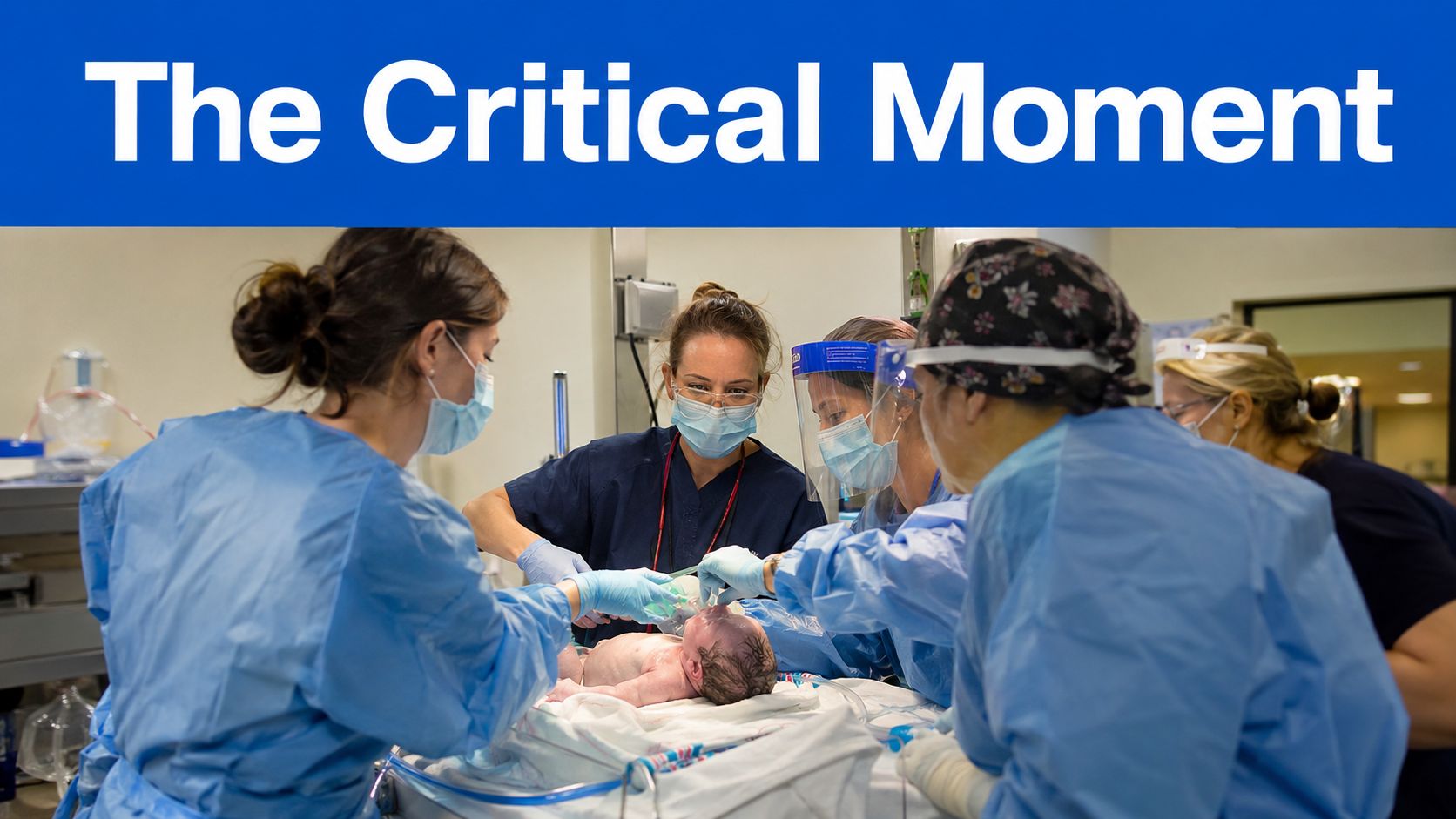
The baby is on the resuscitaire now. The warmer is on, someone is drying the infant, and another clinician is watching the chest for movement. The room becomes quiet in the focused, clinical way that appears when everyone knows the next few actions matter.
That moment is why a neonatal resuscitation course exists. It teaches people to move from observation to action without hesitation, and it does that by linking newborn physiology to a clear sequence of interventions. Australian practice focuses on this small but time-sensitive group because most newborns transition without help, while a smaller group needs immediate support to start breathing effectively. That is the part of birth the course prepares for, the point where recognition, equipment, and team communication have to come together quickly. For a broader look at nearby training pathways, learners often also compare options such as CPR courses near me, especially when they are choosing training that fits workplace requirements.
Why the first minutes matter
Newborn transition is a pressure test of teamwork. If breathing is ineffective, the priority becomes ventilation, not waiting, not guessing, and not filling the space around the cot with low-value activity. The learner has to recognise the pattern, reach for the right equipment, and respond in sequence.
The core habit is simple. Assess quickly, ventilate effectively, and escalate early if the heart rate does not recover.
Australian learners also benefit from the fact that this field has long been standardised. The Neonatal Resuscitation Program was first introduced in 1987, then underwent major updates in 2006 and 2010, which helped shape the course model used internationally into something repeatable and simulation-driven (AAFP overview of neonatal resuscitation training). That structure matters in practice because the team cannot improvise from scratch in a delivery room.
A good way to understand the course is as a checklist performed by real people under real pressure. It prepares learners to assess, ventilate, communicate, and escalate in a way that matches the newborn's condition, not a memorised script. For many learners, that shift from knowing about resuscitation to being able to do it is the whole point.
What a Neonatal Resuscitation Course Is
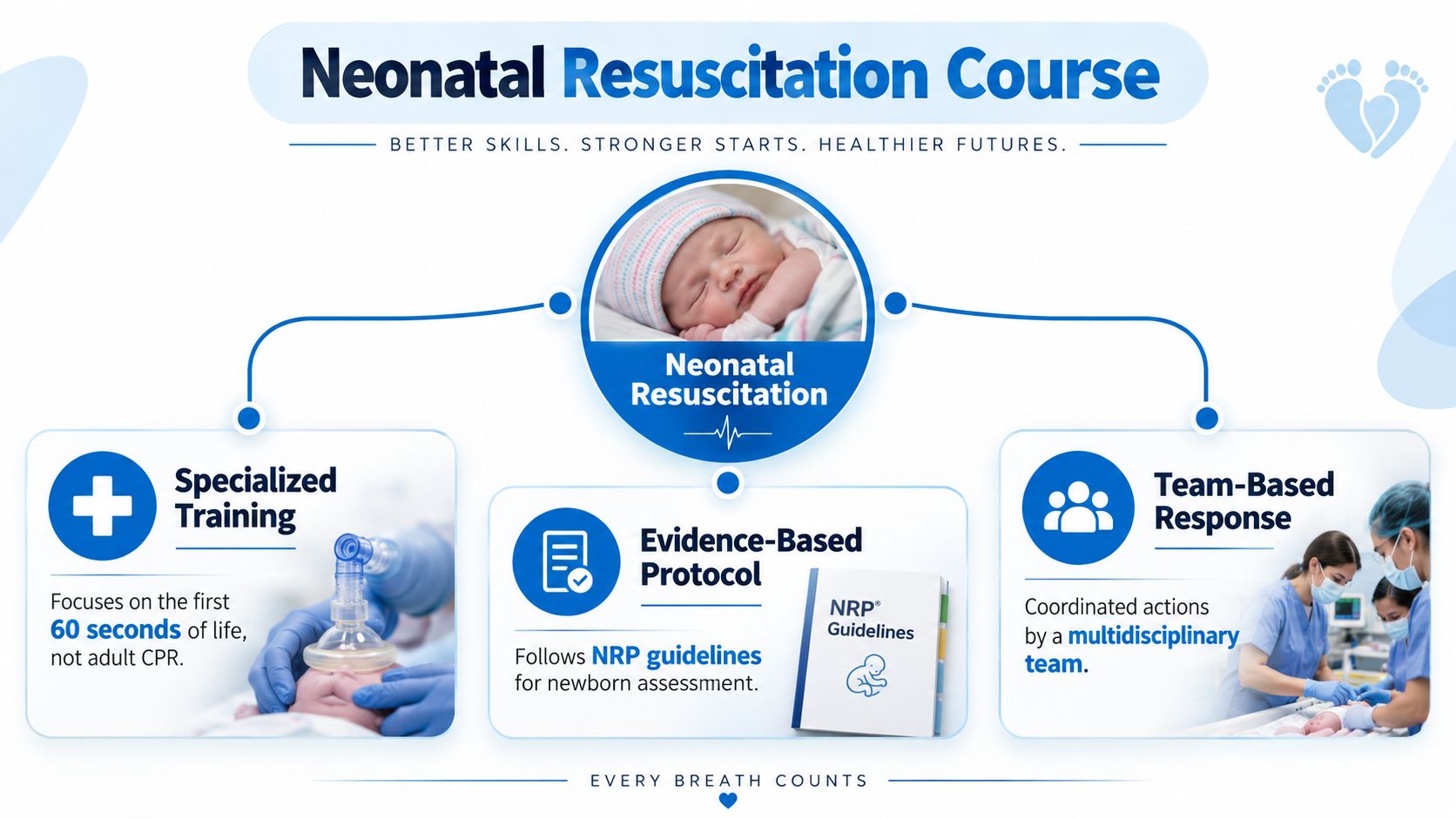
A neonatal resuscitation course teaches the sequence used when a newborn does not move through the normal transition to breathing well after birth. It is not adult CPR in smaller form. The focus is on reading the baby's condition, supporting the airway, starting ventilation when needed, and working in a coordinated way until the baby responds. The teaching is built around standardised programmes such as NRP and NLS, which is why the course content and assessment style tend to look similar across hospitals and training providers.
A checklist for newborn transition
A cockpit checklist is a useful comparison. Pilots do not rely on memory alone when the order of safety checks matters, and neonatal resuscitation training uses the same logic. Learners are shown a repeatable pathway, initial steps, positive-pressure ventilation, airway escalation, and team communication, because the main problems in newborn resuscitation usually appear quickly and in a fairly predictable sequence.
The RCPCH standards for newborn resuscitation training make the practical emphasis clear, learners need practical, experiential learning, repeated practice, and simulation, along with hands-on familiarisation with resuscitaire equipment and airway and ventilation skills (RCPCH induction to newborn resuscitation standards). Practical newborn resuscitation training is built around doing the steps, not just hearing them described. For a wider view of nearby life-saving training options, the CPR courses near me guide gives a clear starting point.
The course is designed to make the first response automatic, so the team can think clearly when the baby's condition changes.
The first few minutes after birth are where the course matters most in real practice. That short window is enough time for problems to appear, and enough time for early action to change what happens next. Training therefore stays tightly focused on recognition, action, and feedback after each attempt.
For learners choosing a provider, the right fit is a course that works like a skills workshop, not a lecture series. TP Training provides practical, nationally recognised training through its Courses page, with experienced trainers and hands-on learning across NSW, which matches the style of learning this topic requires.
Skills You Will Be Taught to Perform
A newborn resuscitation course focuses on the moments that matter when a baby does not make the expected transition after birth. In Australia, that training reflects the reality that only a small proportion of newborns need help, so the course concentrates on the checks, interventions, and teamwork that change what happens in those first minutes. Learners practise the actions they are most likely to perform, then repeat them until the sequence starts to feel familiar.
The strongest courses do not stop at “know the steps.” They place you in front of a manikin, give you a scenario, and ask you to perform while someone watches your hands, your timing, and your communication. That is where the learning becomes real.
From first assessment to effective ventilation
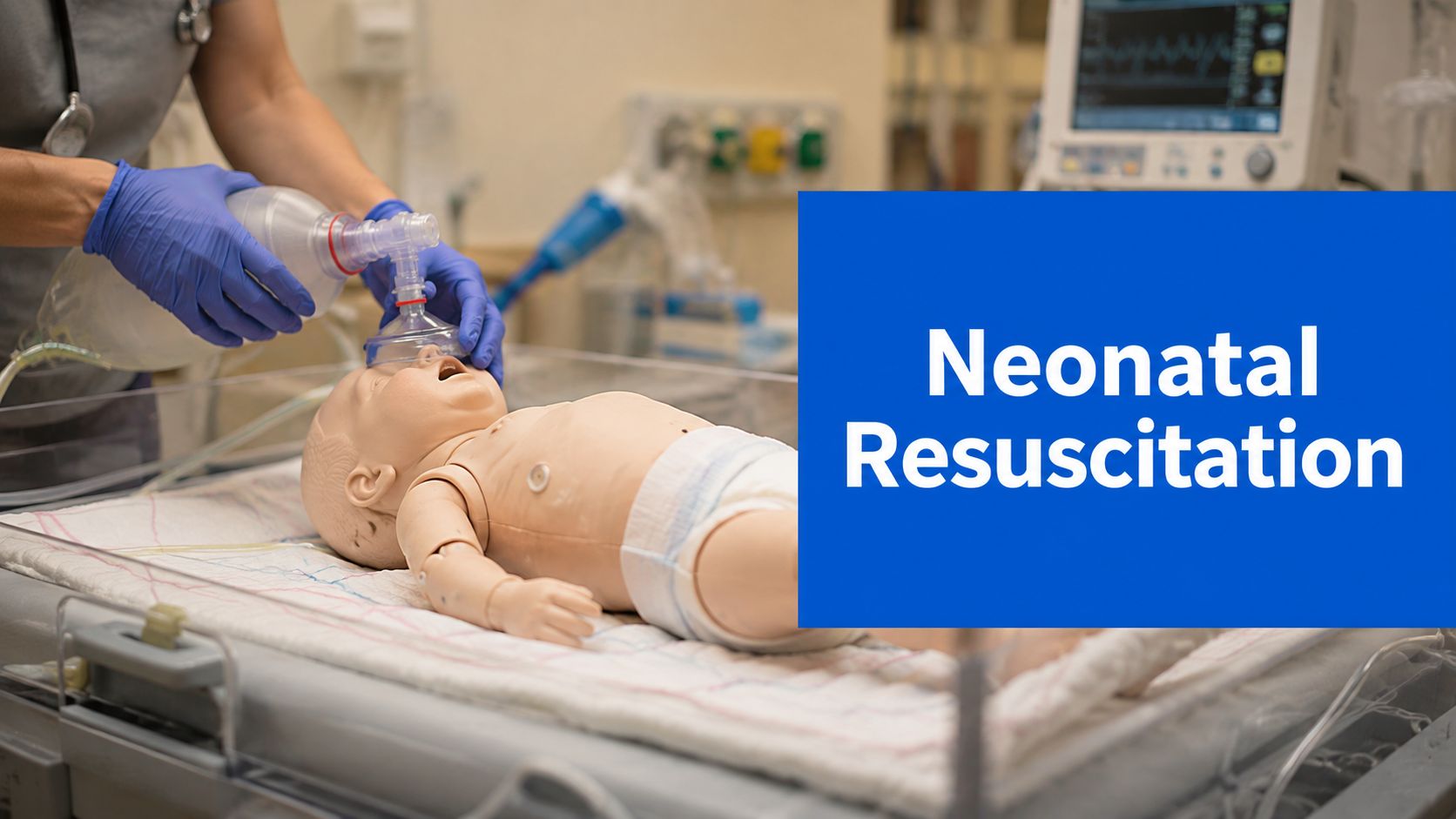
A learner usually starts with the basics, checking whether the baby is breathing, looking at tone, and noting the heart rate. Then comes the simple but important work of warming, drying, and stimulation, followed by airway positioning and suction only when it is needed. If breathing still is not effective, the next move is positive-pressure ventilation, usually with a bag-mask or T-piece device, and the learner has to show visible chest rise, because that tells the team the lungs are being inflated properly.
The oxygen piece often confuses people. In Australian practice, 21% oxygen is used for term infants and 21% to 30% oxygen for preterm infants under 35 weeks, then titrated to preductal saturation targets (PMC neonatal resuscitation guidance). The reason is straightforward, the baby's response guides the next step, not guesswork.
When the response has to escalate
If the heart rate remains low after effective ventilation, the course moves into chest compressions, usually with the two-thumb encircling-hands method. The standard advanced response uses a 3:1 compression-to-ventilation ratio, delivering 90 compressions and 30 breaths per minute to make about 120 events per minute (AHA neonatal resuscitation guidance). That is a lot of coordination, which is why teams rehearse it instead of trying to invent it under pressure.
If the chest is not rising, the team does not wait. It corrects the airway, mask seal, or device choice immediately.
Learners also practise airway adjuncts, intubation, and sometimes supraglottic airway use, depending on the curriculum and local scope of practice. Medication preparation is usually taught as part of the advanced pathway, along with post-resuscitation care and the handover that follows a difficult birth. A typical syllabus breaks these same areas into assessment, ventilation, airway adjuncts, compressions, medications, teamwork, and special situations such as preterm birth or meconium exposure (neonatal resuscitation course syllabus).
For clinicians comparing course formats, a practical place to start is the basic life saving course overview, which helps readers see how hands-on emergency training is usually organised. It is useful context, especially if you are weighing convenience against the need for direct assessment in a newborn setting.
Who the Course Is Designed For
The best way to think about the audience is not by title alone, but by whether the person might be in the room when a newborn needs help. Midwives, neonatal and paediatric nurses, junior medical officers in maternity or emergency settings, paramedics who attend births, GP obstetricians, and allied health staff supporting birthing services all fall into that group. Some career changers, return-to-practice clinicians, and overseas-trained staff also take the course because Australian workplaces expect a local, structured approach to newborn transition.
Clinical role matters more than job label
A clinician who never attends births doesn't need the same depth of practical rehearsal as someone who works routinely in labour ward, emergency, or special care settings. That's why many programmes distinguish between people who need awareness and people who need active competence. The course is designed for the second group, the people who may have to ventilate, compress, call for help, and hand over care.
Pre-reading matters here for the same reason theory matters before a driving lesson. You wouldn't get into a car for the first time and expect to learn the road rules from the instructor while reversing out of the driveway. In the same way, most neonatal resuscitation programmes expect some combination of pre-reading or online theory before the face-to-face workshop, so the practical session can focus on performance.
The RCPCH standards also make it clear that learners need to know how to call for help and how local escalation works, not just the algorithm itself (RCPCH induction to newborn resuscitation standards). That's important because a good response is rarely solo work. It depends on who is available, how quickly extra hands arrive, and whether everyone knows their role.
If you're already working near birthing families, the course is less about adding information and more about turning knowledge into a usable response.
For learners who work across language backgrounds or need extra support while settling into an Australian workplace, TP Training's note on multilingual support is worth a look. It's not a clinical feature, but it can make the enrolment and learning process easier for people adapting to new systems and terminology.
How ProMed Certifications Can Help
A baby can look fine at first and then need help within moments. That is why a neonatal resuscitation course is built around quick recognition, clear roles, and the first actions the team takes while everyone is still settling into the room. In Australia, most newborns transition without major intervention, so the course content stays focused on the smaller group who do need support, and on the actions that matter most in those early minutes.
ProMed Certifications fits learners who need self-paced study, instant access, and retake-friendly testing. For healthcare professionals who want to review the material on their own time, that format can remove the scheduling pressure that often gets in the way of study, while still giving them a structured way to work through the clinical content.
It offers certifications across ACLS, PALS, BLS, Neonatal Resuscitation, and CPR, with an approach built around convenience, unlimited retakes, and no time restrictions. That can suit clinicians who want to revisit the material before a workplace workshop, or who need a fast way to update a certification record without waiting for a fixed class date. For a team that also has to manage identity and enrolment details, the USI guidance for students can be useful background on the administrative side of training access.
Where it fits, and where it doesn't
An online certification platform can help with theory review and documentation. If your role also requires observed practical assessment, you will still need a hands-on component somewhere in the pathway. That distinction matters because newborn resuscitation is not complete until the learner can perform the steps under observation, with equipment, timing, and communication all visible to an assessor.
ProMed says its courses are developed with medical experts and aligned to current AHA guidance, and it also offers a group portal for organisations managing staff credentials. That makes it a practical option for teams that want one dashboard for multiple clinicians, especially when managers need to keep records organised. If you are comparing formats, the neonatal resuscitation course page shows how the online pathway is presented before you decide whether it meets your training needs.
Use ProMed when you need flexibility, self-paced revision, or a quick certification workflow. Choose a practical workshop when you need assessment in the room, team simulation, and direct feedback on airway, ventilation, and compression technique. Many learners use both, one for the knowledge side and one for the observed skills side.
How the Day Is Structured and How You Are Assessed
Most learners want to know the same thing before they book. What happens on the day, and how do you know you've passed? The answer is reassuringly structured, because the course is designed to test what you can do, not how well you can talk about it.
A realistic course day
The day usually begins with pre-reading or an online theory component completed before arrival. That frees the face-to-face time for skill practice, equipment familiarisation, and scenario work. The Canadian NRP practice resource reflects this model clearly, requiring pre-reading, successful completion of the online examination before the workshop, skills development or validation, an individual Integrated Skills Station Assessment, and simulation plus debriefing exercises (Canadian NRP practice resource).
The practical stations usually focus on airway positioning, ventilation, compressions, and intubation. After that, the team runs a fuller megacode scenario, where timing, communication, and escalation get assessed together instead of one skill at a time. That matters because newborn resuscitation is not performed in neat little boxes in real life.
A useful way to think about the assessment is this. The instructor isn't asking, “Do you know the algorithm?” They're asking, “Can you perform the algorithm while the baby's condition changes and the team is relying on you?”
Assessment is about competence under observation, not about getting through a written quiz and hoping the rest comes later.
The NRP provider structure makes competency demonstration a formal requirement, not an optional extra. That is one reason the course feels intense even when the content is familiar, because the aim is to verify that the learner can act safely in sequence, with clean technique and clear communication. For anyone who works in a delivery setting, that's the right standard.
The 5 simple steps to create and manage your unique student identifier guide can help with the administration side if your provider asks for it before enrolment. It won't help with bag-mask technique, but it can prevent paperwork from getting in the way of attendance.
Certification, Validity, and Why Refresher Timing Matters
A certificate only matters if your hands still remember the sequence when a newborn needs help breathing. That is why refresher timing matters so much in a neonatal resuscitation course, and why renewal is treated as part of patient safety, not just filing.
Why repetition beats one-off learning
Newborn resuscitation education keeps pointing to the same practical problem, people can learn the steps, then lose confidence or speed if they do not revisit them. The broader training literature also links newborn resuscitation teaching with better outcomes, including lower deaths from birth asphyxia in settings where training is repeated and applied in practice, as noted in the AAFP overview of neonatal resuscitation training. That is why refresher sessions keep coming up in the course material and in clinical conversation.
The AHA neonatal resuscitation guidance also notes the frequency and format of refresher training as a knowledge gap, which tells educators that a single course is not meant to carry a clinician indefinitely (AHA neonatal resuscitation guidance). In day-to-day terms, that means short drills, in-service simulation, and scheduled recertification are part of normal practice, not a sign that the original workshop failed.
A fire drill is a useful comparison. The drill matters because people remember the route and the response when the alarm sounds. Neonatal resuscitation works the same way. Repetition turns a sequence of actions into something you can carry out under pressure, without stopping to rebuild the steps in your head.
A certificate has a use-by date in practical terms, even when the paper still looks current. If the skill has gone cold, re-doing the theory and practising the hands-on stations again is the safer path before the next shift that could include a birth.
For workplace planning, the CPR, First Aid, White Card and workplace safety certifications page is a useful reminder that many qualifications sit inside a broader renewal calendar. Neonatal skills belong in that same pattern of regular renewal, documented competence, and repeated practice.
Duration, Cost, and Choosing the Right Course
A baby arrives, the room settles for a moment, and then the team has to work quickly because the first minutes after birth do not always go to plan. That is why people compare neonatal resuscitation course options carefully. You are not just paying for a class, you are paying for the theory, the workshop time, the simulation practice, assessor feedback, and the chance to show competence in a controlled setting. Duration and cost still vary by provider, location, in-house delivery, and whether a group booking is involved.
Compare the course, not the brochure
Many programmes use a structure that pairs online learning with a half-day to full-day practical workshop. That arrangement makes sense because the theory can be worked through beforehand, while the hands-on skills need face-to-face coaching, correction, and repetition. If a provider does not clearly explain how much of the course is online and how much is observed practice, that is a warning sign.
The better comparison is about what you will do on the day. Look at the assessment method, whether the course includes airway and compression stations, whether simulation debriefing is built into the session, and what happens if you do not pass a station on the first attempt. Good providers explain that process before enrolment, so learners know what to expect and assessors can judge skills consistently.
| Criterion | What to look for | Why it matters |
|---|---|---|
| Content | Newborn assessment, ventilation, compressions, airway escalation | The course should match what happens in real delivery-room care |
| Assessment | Observed skill stations and scenario-based simulation | Competence has to be demonstrated, not assumed |
| Pre-reading | Online theory or reading before class | Frees workshop time for practice |
| Feedback | Debrief after scenarios | Helps you correct errors while the lesson is fresh |
| Support | Clear enrolment and identification requirements | Prevents delays before attendance |
If you are comparing delivery options in NSW, TP Training delivers practical, nationally recognised training with experienced trainers and hands-on learning across multiple NSW centres including Penrith, Burwood, Auburn, Parramatta, and Sydney CBD. That gives a clear example of how a training provider can spread access across locations, even though the exact neonatal format may differ by programme.
The practical questions matter too. What should you bring? Usually a notebook, your pre-reading completion, and whatever identification the provider asks for. What should you wear? Comfortable clothes you can move in, because you will be practising on the floor, at a cot, or around equipment. What happens if you do not pass a station? Ask about the re-attempt or remediation pathway before you leave, because a clear process is part of a good course.
Practical Preparation Tips and Common Questions
The night before the course should be boring. That's a good thing. Read the pre-course material, charge your phone if your provider uses digital attendance or assessment tools, and make sure you know where the venue is so you're not rushing in late and flustered.
Small things that make the day easier
Wear clothing that lets you kneel, bend, and reach without thinking about it. Bring water, a pen, and whatever documents your provider says are needed for enrolment or check-in. If you're balancing this with a current clinical role, try to arrive with the mindset that you're there to practise, make mistakes safely, and correct them quickly.
Calm preparation makes the practical session easier, because you can spend your attention on the baby scenario instead of on your bag, your parking, or your paperwork.
A common question is whether online theory counts towards the whole qualification. It usually counts as part of the learning pathway, but it doesn't replace the face-to-face skills component when the course requires practical assessment. That distinction matters because newborn resuscitation is a hands-on clinical skill, and the workshop is where that skill gets observed.
Another common concern is what happens if a station doesn't go well on the first try. In a well-run programme, you'll be told the issue, coached on what to change, and given a chance to demonstrate the skill again according to the provider's process. That's not a failure of the course, it's the course doing its job.
If you're wondering how this interacts with AHPRA registration or workplace credentialing, treat the certificate as one piece of the puzzle. Your employer, hospital, or credentialing body may set its own requirements for current practice, supervised application, or refreshers, so it's smart to check those details before expiry rather than after it.
The safest next move is to choose a course that matches your setting, read the pre-work thoroughly, and book early enough that you're not renewing under pressure. If you work in maternity, emergency, neonatal, or pre-hospital care, a current neonatal resuscitation course isn't just another certificate. It's the rehearsal that helps your team act well when a newborn needs help to breathe.

You may also like
Responsibilities of Employers: A Complete NSW Safety Guide
First Aid Training Cost: A Complete Guide for Sydney Workers