
Elevated Work Platform Risk Assessment Guide for NSW
You're standing beside an EWP before the morning prestart. The machine looks suitable, the operator has used similar equipment before, and the work appears routine. Then someone notices the ground falls towards an excavation, pedestrians will pass behind the machine, and the boom will travel close to an overhead structure. The risk assessment now has a job to do. It must change the setup, the equipment, the controls, or the decision to proceed.
A work platform at height risk assessment isn't a form to complete after the machine has been selected. In NSW, it's a site-based control decision that helps determine whether the EWP is appropriate, how it will be operated, and whether the residual risk is low enough to continue. The useful assessment is the one that makes a supervisor stop, redesign, isolate, or brief the crew before someone is exposed.
Table of Contents
- Why an Elevated Work Platform Risk Assessment Matters
- The Four-Step Process Behind Every EWP Risk Assessment
- Common EWP Hazards You Must Identify on Every Job
- Scoring Risk with a Practical EWP Risk Matrix
- Applying the Hierarchy of Controls to EWP Hazards
- Exclusion Zones, Rescue Plans and Day-of-Job Controls
- Inspections, Maintenance, SWMS and Review Cycles
Why an Elevated Work Platform Risk Assessment Matters
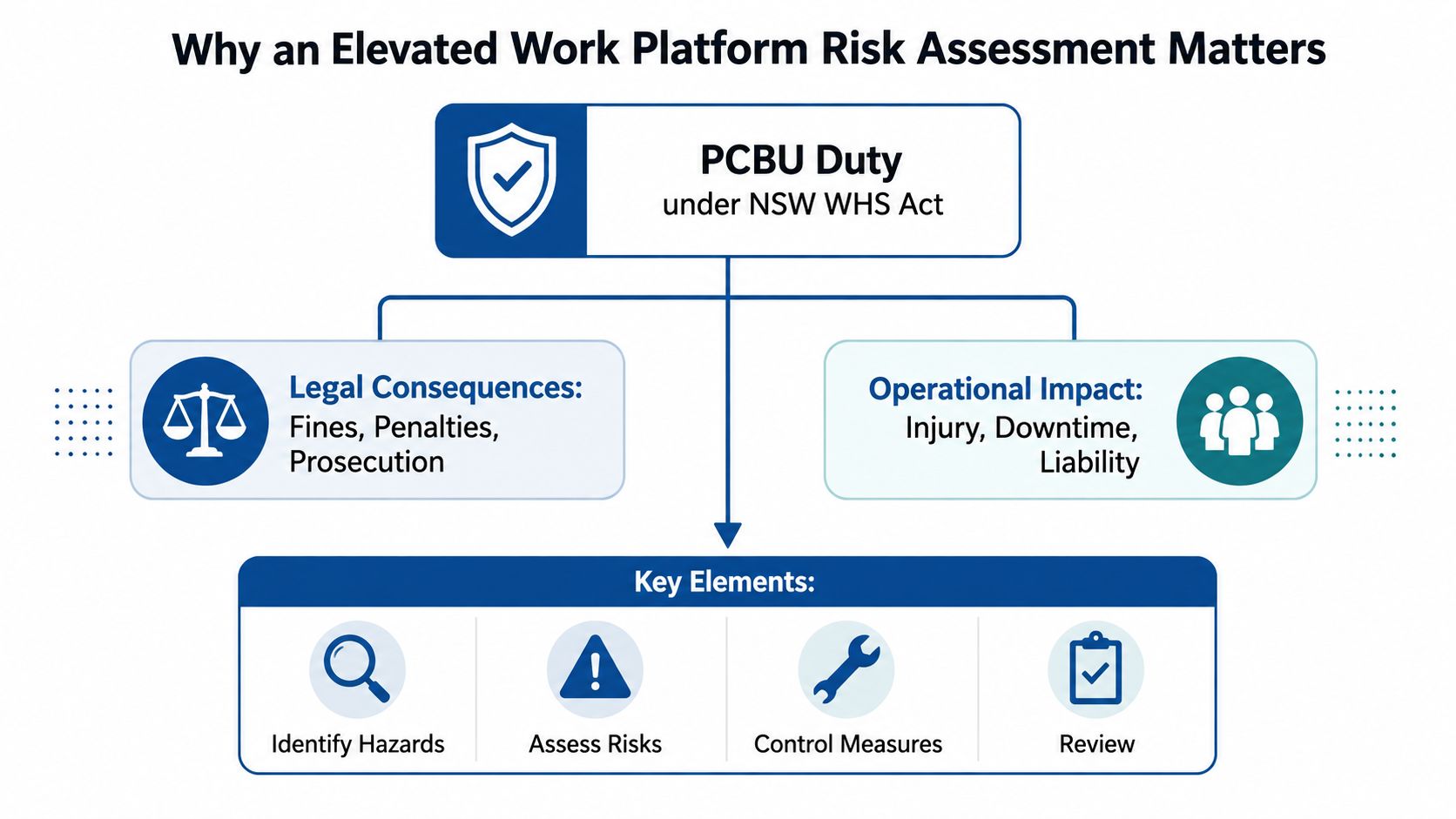
A PCBU, meaning a Person Conducting a Business or Undertaking, must manage risks to workers and other people affected by the work under the NSW work health and safety framework. For EWP operations, that duty applies to more than the person in the basket. It can cover ground workers, pedestrians, traffic controllers, other plant operators, contractors, visitors, and anyone who could be struck by a falling object or involved in a collision.
The assessment should therefore answer practical questions:
- Which EWP is suitable: Is a scissor lift enough, or does the task require a boom-type platform with a different reach and access arrangement?
- Where the machine can operate: Can the ground support it, and are excavations, drop-offs, traffic routes, structures, or electrical hazards nearby?
- How people will be separated: What barriers, spotters, traffic controls, and exclusion zones will prevent interaction with the machine?
- Whether the task proceeds: Has the residual risk been reduced to an acceptable level, or does the job need redesign?
Safe Work Australia reported at least 9 fatalities and 355 workers' compensation claims from EWP incidents during 2015–2019, which places overturning, falls, and contact hazards at the front of the assessment rather than at the end of a checklist. The figures appear in the NSW elevating work platforms code of practice.
What regulators look for
An inspector won't be impressed by a completed template if the machine is sitting on unsuitable ground, workers are walking through its operating area, or the rescue plan exists only in someone's head. They'll want to see that the PCBU identified foreseeable hazards, selected controls using the hierarchy of control, communicated those controls, and reviewed them when conditions changed.
A useful assessment also records who checked the controls and what evidence supports the decision. That might include supplier information, ground or floor-loading verification, a site inspection, the EWP logbook, operator authorisation, or a traffic plan.
For operators and supervisors building the right foundation, high-risk work licence training in NSW should be connected to the actual class of equipment and the hazards recorded in the assessment. Competence doesn't replace site planning, but the assessment shouldn't assume competence that hasn't been verified.
The Four-Step Process Behind Every EWP Risk Assessment
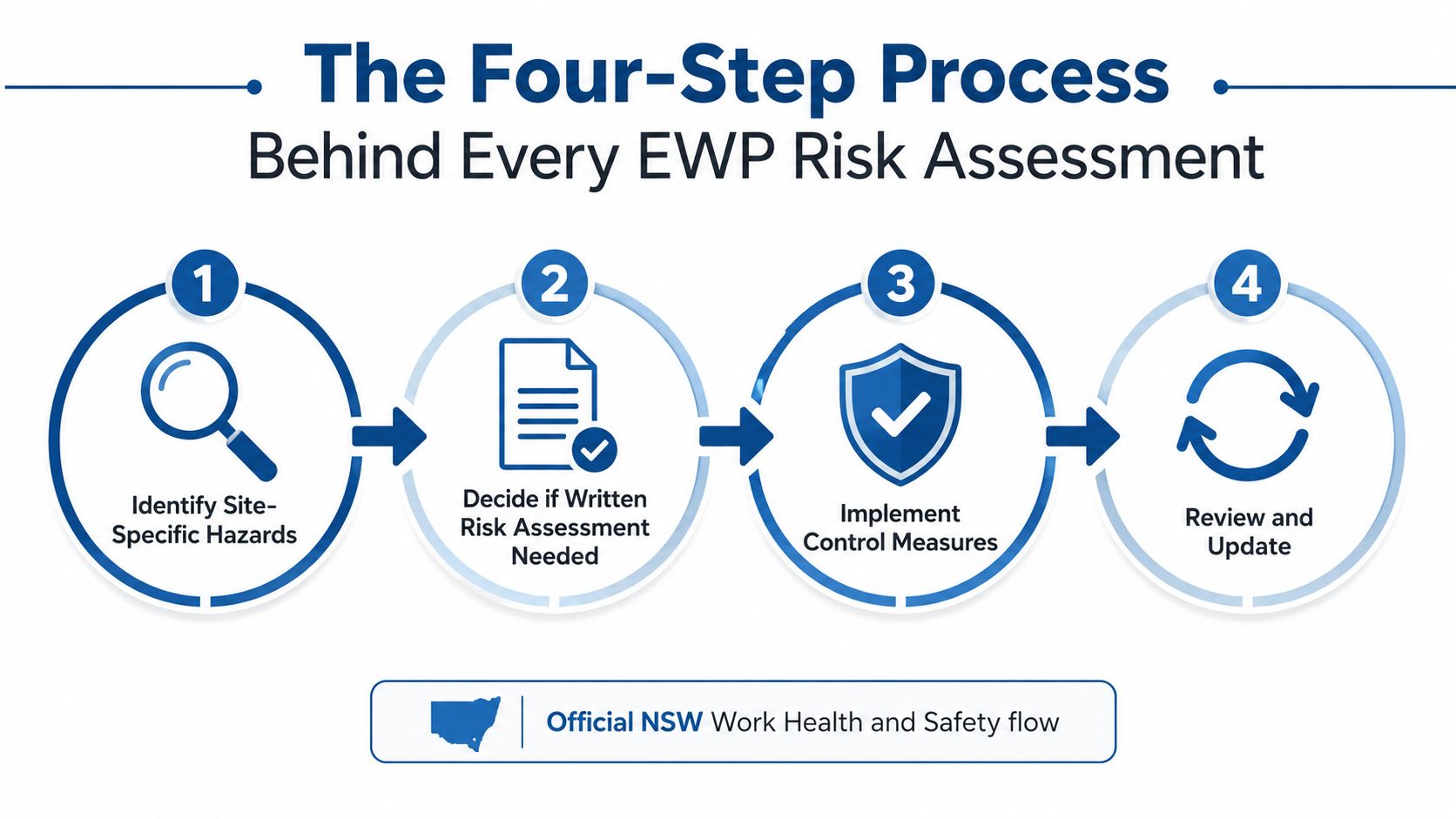
The assessment earns its place when it changes the job. NSW guidance sets out a four-step system: identify hazards, assess risks where necessary, eliminate or control risks using the hierarchy of control, then monitor and review the controls. The Safe Work Australia EWP guide also explains that a separate assessment may not be required where the risk and controls are already known.
That does not justify reusing yesterday's paperwork without checking the site. Reassess when the work area, machine, operator, access route, weather, ground, load, or nearby activity changes. A familiar task can present a different risk after a delivery vehicle arrives, an excavation opens, or the work moves closer to a structure.
Four decisions at the workface
Identify hazards by walking the route and operating position. Check above, below, beside, and behind the machine. For example, installing services beside a building may involve entrapment, unstable ground, falling objects, and interaction with other plant, even if the task has been completed before.
Assess the risk if necessary by asking what could happen, who could be harmed, and whether the existing controls suit the current conditions. The assessment should explain why the controls remain suitable, or show what must change before work starts.
Controls must alter the plan
The third step is eliminating or controlling the risk. The decision may require ground-level work, another access method, a scissor lift rather than a knuckle boom, a new machine position, electrical isolation, or a closed traffic lane. Each option carries trade-offs, including reach, access, production time, and exposure to other hazards. Select the option that controls the actual risk, not the option already available.
The fourth step is monitoring and review. The operator, supervisor, and spotter need clear stop-work triggers. Rain, wind, a changed load, a vehicle entering the zone, or a near miss can make the original decision unreliable.
Practical rule: If the controls do not change the equipment, location, sequence, separation, or go/no-go decision, the document may be recording the job rather than controlling it.
Operators and supervisors can reinforce this process through EWP training in Sydney, particularly where equipment selection, prestart checks, and emergency procedures affect the site decision.
Common EWP Hazards You Must Identify on Every Job
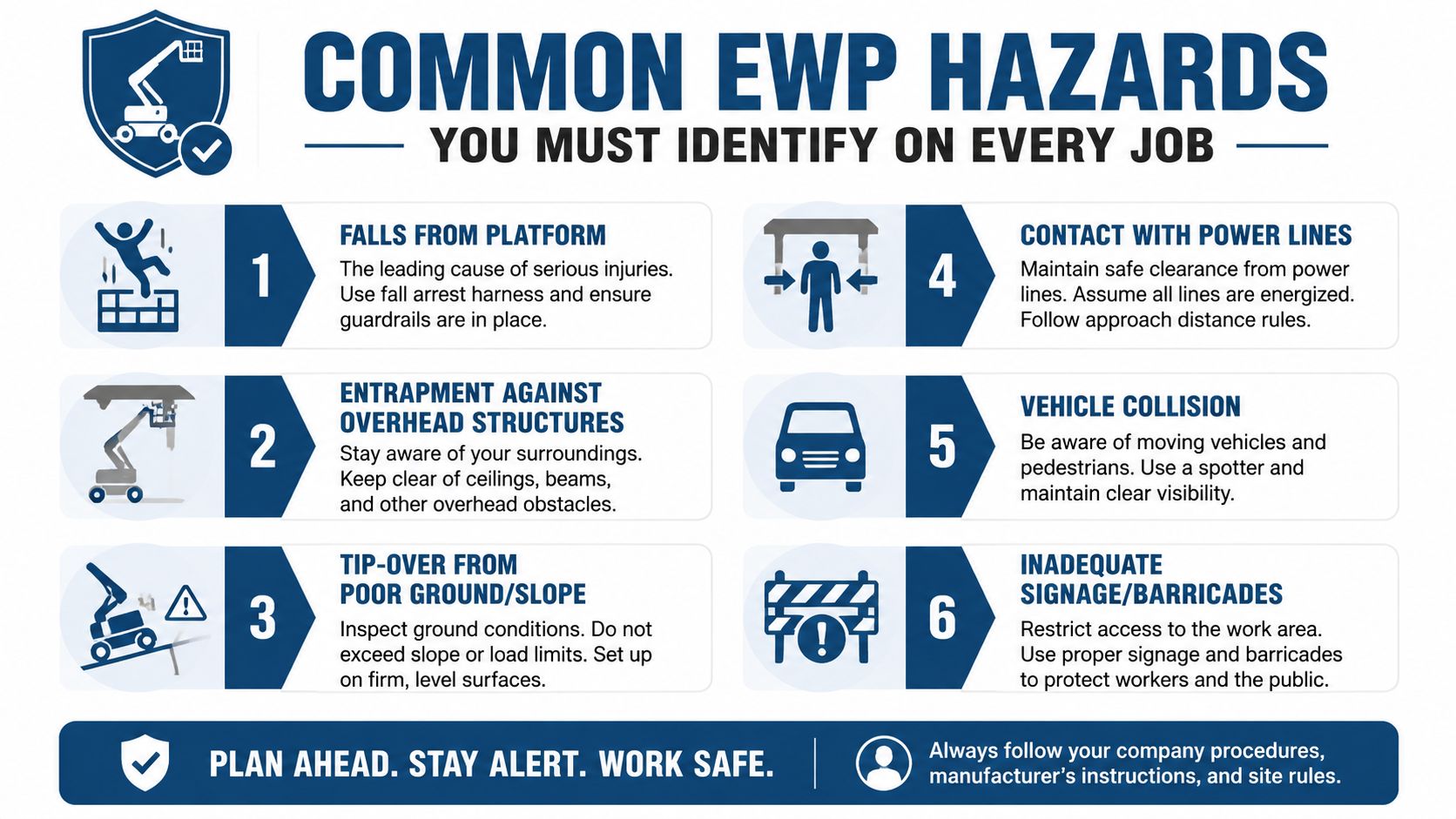
The hazard walk-through should be physical, not theoretical. Stand where the machine will work, trace the boom's intended path, identify who can enter the area, and check what can change during the shift. Safe Work Australia lists unsuitable EWP selection, unstable loads, poor maintenance, ground hazards, collision and crush injuries, overhead hazards, traffic hazards, environmental hazards, falling objects, and work at height among common EWP hazards. The official EWP hazard guidance provides the broader reference point.
Look for the failure before the incident
- Falls from the platform: Check the platform entry, guardrails, gates, anchor points, and the planned work position. Boom-type EWP operations require a considered fall-arrest or restraint decision, not an assumption that the basket alone prevents a fall.
- Entrapment against structures: Identify beams, ceilings, walls, pipework, roof edges, and other overhead or side obstructions. A worker can be crushed when the platform is driven into a structure while attention is focused on the task.
- Tip-over from ground or slope: Inspect soft fill, trenches, voids, edges, slopes, covers, kerbs, and floor transitions. The machine's position and wheel loads must suit the surface, not merely fit within the available space.
- Contact with power lines: Treat overhead electrical hazards as a planning issue before the EWP arrives. Safe Work Australia advises considering how the machine interacts with fixed structures, including overhead electric lines.
- Vehicle or plant collision: Mark reversing paths, delivery routes, pedestrian crossings, and blind spots. A machine can be stable and well maintained yet still expose people if traffic is allowed into its operating envelope.
- Falling objects and poor barricading: Identify tools, materials, loose components, and people below. Inadequate signs or barriers often indicate that the work area hasn't been designed around the EWP's full movement.
For teams comparing access equipment or planning specialist work, Phoenix aerial lift rental services can provide useful context about the type of access equipment available, but the final selection still has to be based on the NSW site, task, load, and hazard profile.
Scoring Risk with a Practical EWP Risk Matrix
A risk matrix helps turn a long hazard list into a decision. Use the site's approved definitions for likelihood and severity, then record why the rating was selected. The matrix should support judgement, not hide it behind a colour.
Consider a boom EWP working beside a busy road, with one wheel position close to a kerb and pedestrians moving near the work area. The initial assessment might rate a tip-over or vehicle interaction as high because the consequences could be severe and exposure is credible. The control discussion then becomes specific: can the machine be relocated, can traffic be separated, can a physical barrier prevent entry, and has the surface been checked for support?
EWP Risk Matrix Snapshot
| Likelihood Severity | Minor | Moderate | Major | Catastrophic |
|---|---|---|---|---|
| Rare | Low | Low | Moderate | High |
| Unlikely | Low | Moderate | High | High |
| Possible | Moderate | Moderate | High | High |
| Likely | Moderate | High | High | Extreme |
| Almost certain | High | High | Extreme | Extreme |
The labels in this example must match the matrix adopted by the PCBU. Don't change a rating just because the job is behind schedule. Rate the initial risk, apply controls, then rate the residual risk. If the residual risk remains unacceptable, the correct action is to stop and redesign the task.
Safe Work Australia recorded 29 worker fatalities from falls from a height in 2023, representing 15% of all worker fatalities. That national benchmark is set out in the Key WHS statistics 2024 report. It's a reminder that a low likelihood rating cannot erase a catastrophic consequence.
A high or extreme rating may require a SWMS or higher-level authorisation, depending on the PCBU's system. For a practical explanation of how risk controls connect with construction work planning, use this risk management guidance for construction, then document the reasoning that led to the final go or no-go decision.
Applying the Hierarchy of Controls to EWP Hazards
The hierarchy of controls matters because not all controls have the same reliability. A sign telling pedestrians to stay clear is weaker than a physical barrier. A harness is important in the right boom-EWP application, but it doesn't fix unstable ground or an unplanned traffic route.
Begin with the strongest realistic option
Eliminate the exposure where possible. Could the component be installed from ground level, prefabricated before lifting, or accessed from a permanent platform? If the task at height is removed, so does the EWP exposure.
Substitute the method or machine when elimination isn't workable. A scissor lift may suit a level indoor task with vertical access, while a boom platform may be necessary for horizontal reach. The right decision depends on the task, surface, access, obstruction, load, and movement required.
Engineer the work area with controls that don't depend entirely on memory. Use barriers, traffic separation, edge protection, suitable access routes, ground support measures, and physical limits around structures. For floor or pavement work, obtain static wheel loads from the supplier and compare them with the engineer's maximum floor loading. Never rely on appearance alone.
Add administrative controls and PPE last
Administrative measures include a prestart briefing, authorised operators, a spotter where needed, a defined travel path, weather monitoring, exclusion-zone checks, and a clear stop-work trigger. Record each control in the assessment and identify who verifies it.
For boom-type EWPs, the Australian guidance also calls for a fall-arrest or restraint system where required by the operating conditions and equipment instructions. PPE supports the control system, but it must be compatible, inspected, correctly connected, and included in the rescue plan.
A control is not complete when it's written down. It's complete when someone has checked it at the work position and the operator knows what will happen if it fails.
For workers who need structured instruction in fall protection and high work planning, working at heights training can support the competence assumed by the risk assessment. It still needs to be matched with equipment-specific familiarisation and employer authorisation.
Exclusion Zones, Rescue Plans and Day-of-Job Controls
The platform may be safe to operate in isolation, but the job can still fail around it. SafeWork NSW's incident information about an 11-metre fall from an EWP highlights controls that must be checked before operation: don't exceed rated capacity, complete a prestart inspection, verify the logbook, stay within the wind-speed limits on the compliance plate, and establish exclusion zones separating the EWP from pedestrians, workers, traffic, and other mobile plant. The SafeWork NSW incident release provides the incident-specific reference.
Build the zone around movement
A good exclusion zone follows the machine's operating envelope, not just the footprint of the chassis. Include the platform, boom, load, falling-object area, access points, and any place where a person could be trapped or struck. Use barriers that people can see and respect, and nominate someone to maintain the boundary when the site is busy.
At prestart, brief the crew on:
- Entry control: Who can enter the zone, and who gives permission?
- Traffic separation: Which route keeps vehicles and mobile plant away from the EWP?
- Communication: What hand signals, radio calls, or stop signals will everyone use?
- Wind limits: Where is the compliance plate, and who monitors conditions?
- Capacity: What is the rated capacity, and what people, tools, and materials are included in it?
- Stop-work triggers: What happens if a barrier moves, a pedestrian enters, the weather changes, or the ground deteriorates?
Plan the rescue before raising the boom
A rescue plan should identify the likely emergency, the person who raises the alarm, the method of emergency lowering, access for responders, first aid arrangements, and how the area will be kept clear. A fallen or trapped operator may be unable to reach controls or communicate, so the plan can't depend on the operator solving the problem alone.
The crew's broader emergency readiness can be supported through CPR, first aid, White Card and workplace safety certification information. Where the work involves suspended loads or coordinated exclusion zones, Cpccldg3001 Perform Dogging Licence Course And Training In Sydney is described by TP Training as practical, nationally recognised training with experienced trainers and hands-on learning across NSW.
Inspections, Maintenance, SWMS and Review Cycles
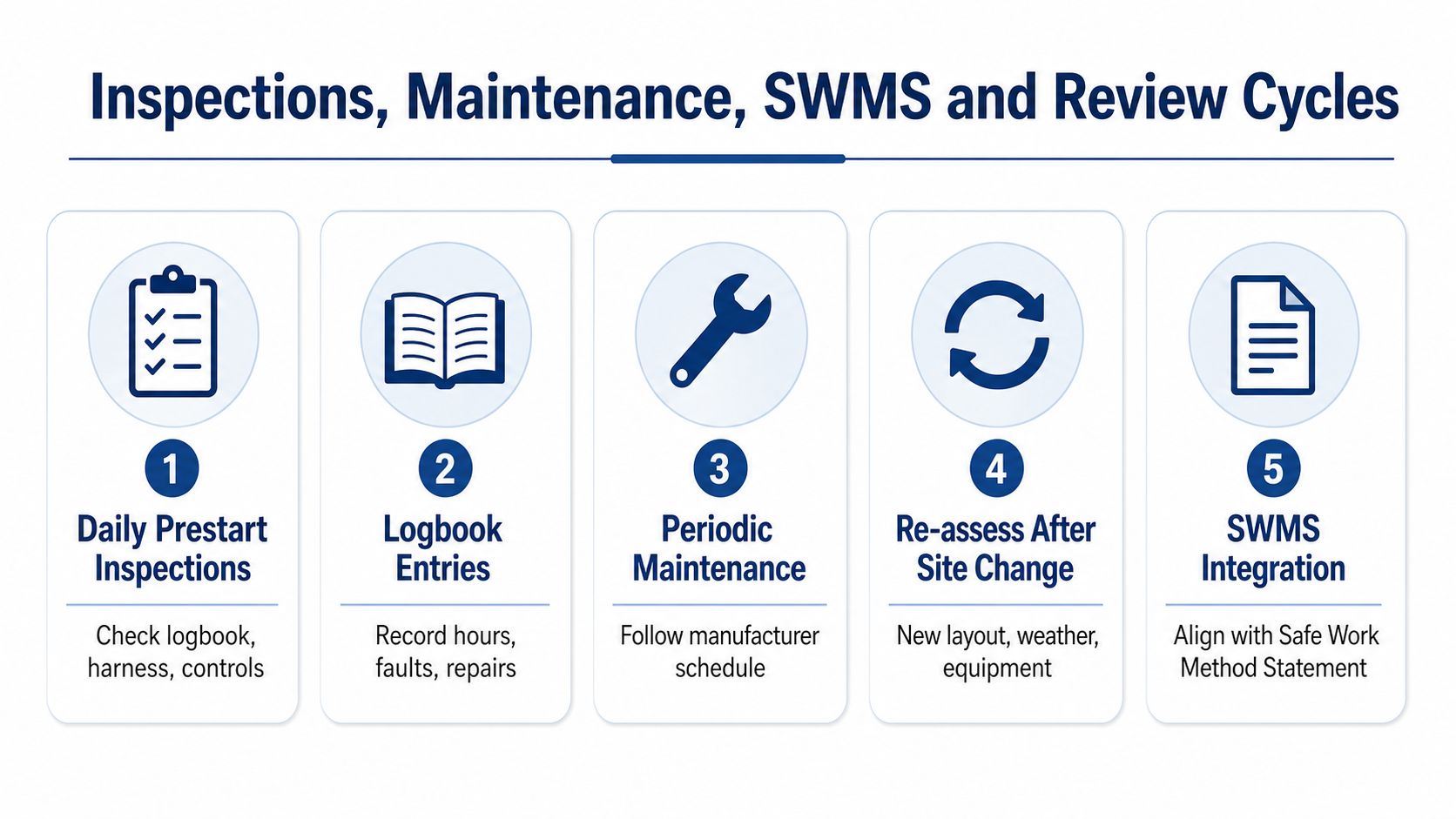
A work platform risk assessment must survive contact with the machine. That means connecting the written plan to prestart inspections, logbook entries, maintenance records, operator competence, the SWMS, and the actual conditions at the workface.
The daily prestart isn't a ceremony. The operator should inspect the controls, emergency systems, tyres or tracks, guardrails, gates, alarms, hydraulic components, visible damage, leaks, attachments, harness equipment where applicable, and the logbook. Any fault that affects safe operation should be reported and managed before the EWP is used.
Use the logbook as a control record
The logbook should show what was found, what was reported, and what action followed. A signature without useful detail doesn't help the next operator understand whether a fault was repaired, isolated, monitored, or still awaiting attention.
SafeWork NSW specifically advises completing a prestart inspection and verifying the logbook. That makes the logbook part of the go or no-go decision, not merely an administrative record.
Maintenance must follow the manufacturer's requirements and the PCBU's inspection system. A clean machine isn't necessarily a serviceable machine. Look for recurring faults, damaged safety devices, unusual operation, overdue servicing, and repairs that may have changed the machine's configuration.
Connect the assessment to the SWMS
Where the work is high-risk construction work, the SWMS should reflect the controls that govern the EWP task. The documents shouldn't contradict each other. If the risk assessment requires a physical exclusion zone, the SWMS should state how it's established, who maintains it, and when work stops.
A useful review rhythm looks like this:
- Before the shift: Confirm the machine, operator, work area, weather, ground, load, access route, and emergency arrangements.
- During the task: Monitor the exclusion zone, interactions with other plant, changing weather, surface conditions, and operator feedback.
- After a change: Reassess when a new machine, operator, layout, load, access route, weather condition, or nearby activity changes the exposure.
- After an event: Review immediately after a near miss, equipment fault, contact, uncontrolled entry, ground movement, or failure of a control.
- At planned intervals: Review the assessment when the job stage changes or the site team identifies a weakness, even if no incident has occurred.
For a broader workplace perspective on how ensures job site safety, compare the site's EWP controls with the wider safety system covering supervision, emergency response, maintenance, and worker communication.
Check the licence and competence assumption
SafeWork NSW states that a boom-type EWP high-risk work licence is required when the boom length is 11 metres or more. It explains boom length using the longer of the vertical distance from the support surface to maximum platform height, or the horizontal distance from the boom rotation centre to the platform edge at maximum reach. The SafeWork NSW high-risk work licence information should be checked when classifying the equipment.
Shorter-boom work still requires suitable training, familiarisation, authorisation, and site controls. TP Training provides practical, nationally recognised Riihan301E Elevate Work Platform Course Operate Boom Under 11M Yellow Card Ewp training with experienced trainers and hands-on learning across NSW. For an EWP at or above the licensing threshold, the assessment should be matched with the applicable high-risk work licence pathway rather than treated as a standard operator induction.
Monday morning checklist
Before the first lift, confirm:
- Equipment: The EWP suits the reach, height, load, ground, access, and surrounding structures.
- People: The operator is competent, authorised, and licensed where the boom length requires it.
- Site: Ground, floor loading, excavations, drop-offs, electrical hazards, traffic, and pedestrians are controlled.
- Machine: The prestart is complete, the logbook is verified, and faults are managed.
- Controls: Exclusion zones, barriers, communications, fall protection, and weather limits are understood.
- Emergency: Rescue, emergency lowering, first aid, and access for responders are briefed.
- Review: Everyone knows which change or near miss requires work to stop and the assessment to be reopened.
A sound assessment doesn't guarantee that nothing will go wrong. It does give the PCBU and crew a defensible way to identify hazards early, apply stronger controls, and stop a job before a familiar task becomes an unfamiliar emergency.
TP Training provides practical, nationally recognised EWP training, including boom-type EWP pathways for work under and at or above the NSW licensing threshold, with experienced trainers and hands-on learning across NSW. Visit TP Training to connect your operator competence with the risk assessments, prestarts, and site controls your work requires.

You may also like
First Aid Training Cost: A Complete Guide for Sydney Workers
How Long Licence Crystalline Silica Prevention Last