
Scaffolding Safety Procedures: 2026 Guide for Worksites
SafeWork NSW found that nearly 50% of Principal Contractors allowed access to unsafe or incomplete scaffolds, while over 40% of sites were missing mid-rails and 30% were missing handrails. That's the starting point for scaffolding safety procedures on Australian worksites, because the weak point is often not the scaffold frame itself, it's the decision to let people use it before it's complete and checked [SafeWork NSW Scaff Safe 2022 findings].
Those findings line up with what inspectors keep seeing on live sites, missing components, unsafe gaps, and incomplete edge protection. They also explain why a good scaffold procedure isn't paperwork for the filing cabinet, it's the control system that stops crews from stepping onto a platform that still has defects, loose access, or unverified alterations. On Australian sites, that matters at short heights too, because serious falls don't wait for a tower to get tall [SafeWork NSW Scaff Safe 2020 report].
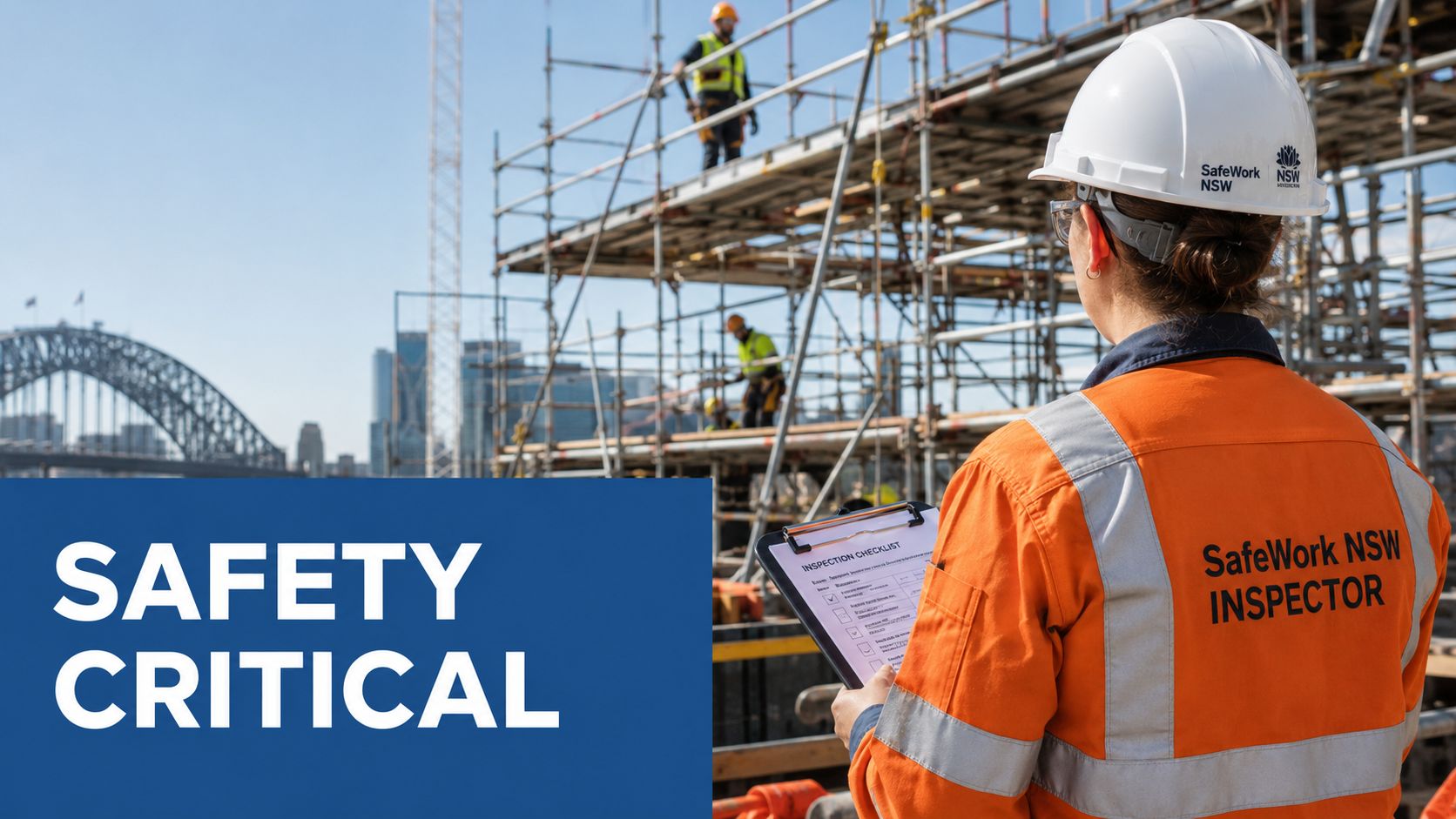
If you want to understand what keeps crews safe, the focus has to stay on the gap between compliance on paper and what's happening on the deck. The practical basics are simple, verify the scaffold is complete, keep unauthorised people off it, inspect before use, and don't treat a half-finished platform like a work area. For a broader look at managing site risk before work starts, see risk management in construction.
Table of Contents
- Why Scaffolding Safety Procedures Matter on Australian Sites
- Conducting a Pre-Start Risk Assessment
- Step-by-Step Scaffold Erection Sequence
- Daily and Periodic Inspection Checklists
- Common Scaffolding Hazards and Control Measures
- Roles, Responsibilities, and Training Pathways
Why Scaffolding Safety Procedures Matter on Australian Sites
The New South Wales inspection figures make one thing plain, scaffold risk is usually a use problem, not just a build problem. SafeWork NSW found missing components, unsafe gaps, and incomplete edge protection on a lot of live sites. That means the procedure has to control what happens after erection as much as what happens during erection.
Premature access is the main failure mode
A scaffold can look mostly finished and still be unsafe to use. That is why the safest procedure treats access as the final step, not the starting point. If the frame is incomplete, if the guardrails are not in, or if the platform gaps are not compliant, the right answer is simple, no access until sign-off.
Practical rule: if a scaffold still needs pieces before it is safe, it is not ready for work, even if the crew is under pressure to keep moving.
Low-height work is where crews often get caught out. Serious fall-related incidents do not wait for a tower to get tall, and that is why a “short scaffold” should never be treated as low risk. People step onto a low platform, assume the risk is minor, and then skip the controls that would normally slow them down.
What this guide is built to do
The useful part of scaffold procedure is not theory. It is the chain of checks that keep people off incomplete platforms, keep components compatible, and keep inspection visible to the whole crew. If a site runs on habit instead of verification, the scaffold becomes a moving target.
For teams tightening up their pre-start process, risk management in construction is a useful place to compare scaffold checks with the rest of the site controls. introducing the 10830Nat 11084Nat Crystalline Silica Exposure Prevention Asbestos Awareness courses at TP Training also shows the same point from another angle, site control starts before anyone climbs.
Conducting a Pre-Start Risk Assessment
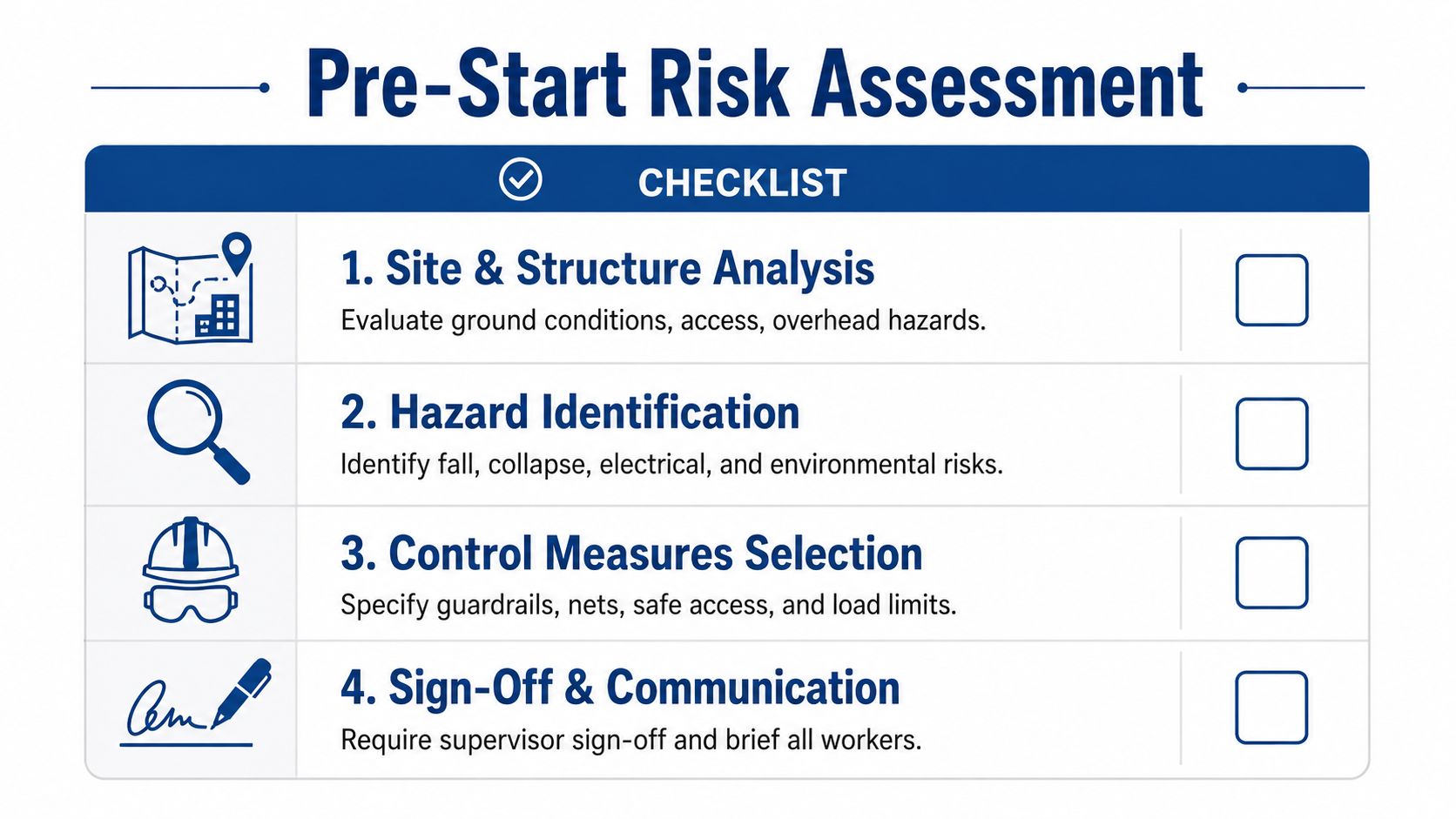
A pre-start risk assessment has one job first, decide whether a scaffold is the right access solution for the work. If the ground is unstable, the space is tight, overhead services are active, or the scaffold would need awkward workarounds, that needs to be settled before the first piece goes up. Good planning saves more time than rushed rework ever will.
Check the site, not just the task
Start with the surface. Look at ground level, load-bearing capacity, nearby excavations, drainage, overhead services, wind exposure, and how people and materials will move through the area. A scaffold that seems acceptable on a quiet morning can become a poor choice once material storage, weather, or vehicle movement changes during the shift.
Define the intended use clearly. Ask how many workers will be on it, what tools they will carry, where materials will be staged, and whether the scaffold is for access, loading, or both. If those answers change during the job, the assessment has to change with them.
Bring in the right competence early
Some decisions need a competent person before the scaffold is even ordered. Load planning, compatibility questions, and any call that affects structural behaviour or access design should be checked early. That keeps field improvisation from turning into the site plan.
Write the assessment so it still makes sense two days later, after weather, deliveries, and crew changes. If the document cannot guide the next shift, it is not doing its job.
For a practical training reference, Working at Heights course is one pathway workers look at when access and fall-risk control are part of the job.
Make the assessment match site conditions
Paperwork only helps when it reflects what is on site. If the scaffold is going near live traffic, changing trades, or uneven staging areas, those conditions need to be written into the assessment, not left to memory. A supervisor should be able to read the form and know what will stop work, what will trigger a recheck, and who has the authority to pause the job.
That is where a few sites fall short. The risk assessment is completed, signed off, and filed away, then crews keep working under changed conditions because nobody has updated the control measures. The safest sites treat inspection as an ongoing discipline, with the assessment used as a live reference rather than a box to tick.
The same approach applies to nearby hazards that can be easy to ignore during a busy shift. Plant movement, overhead work, access routes, and weather changes all affect whether the scaffold remains suitable. If those factors are changing, the pre-start review has to stay active instead of becoming a one-off form.
Step-by-Step Scaffold Erection Sequence
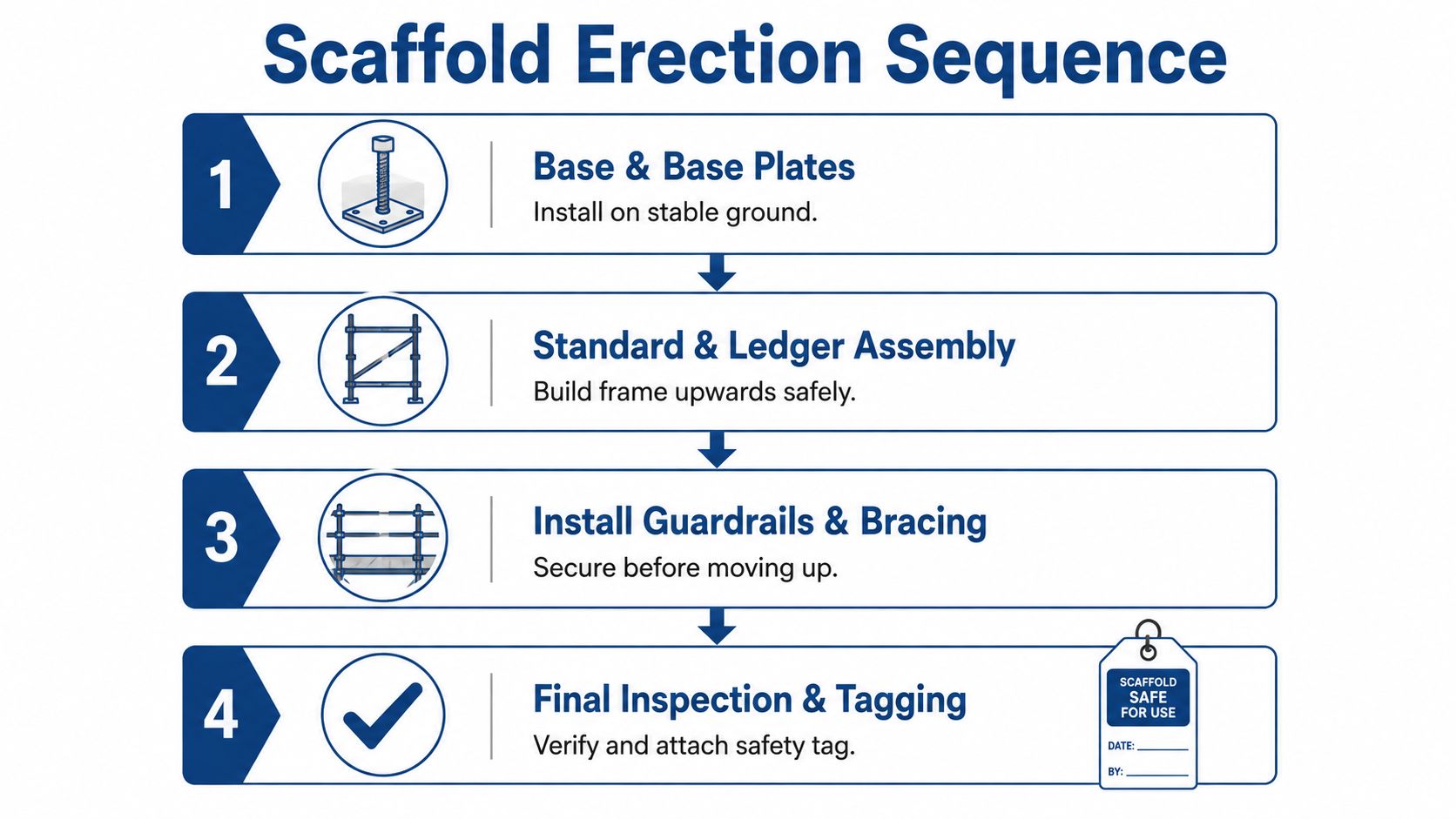
SafeWork NSW's erection sequence for prefabricated steel modular scaffolding is built to keep structure, access, and fall protection in the right order. That sequence matters because crews can't be allowed to use a scaffold before the first lift is protected and verified. The dangerous habit is treating the scaffold as usable while it's still being assembled.
Build the base first
Begin by basing out the scaffold, then erect the base lift and first lift. Keep unauthorised people out while the scaffold is still open and incomplete. One scaffolder holds the standards while another places transoms and ledgers, then the screw jacks are adjusted so the structure is level before the deck is advanced.
Lock in the first lift before access
Once the frame for the first lift is in place, planks are erected from below. Access comes after that, not before it. Then the edge protection goes on, guardrail, mid-rail, and toeboard or mesh panels, so the first lift is protected before anyone is expected to use it.
Compatibility matters here. Safe Work Australia warns not to mix scaffolding from different manufacturers unless a competent person has verified compatibility [Scaffold guide]. That issue gets underestimated on site because parts can look interchangeable even when they aren't. A mixed system can compromise bracing, fit, and stability even when the scaffold appears tidy.
Verify before anyone climbs
The job isn't ready when the last part is fitted, it's ready when the scaffold has been checked and access has been controlled. That's the point of the erection sequence, it separates load-bearing work from use. If the scaffold is still in build mode, it stays out of service.
For workers looking at formal training pathways, how to get a White Card is a useful starting point for site entry and construction induction knowledge.
Daily and Periodic Inspection Checklists
Inspection has to be routine, because scaffold conditions change fast. A scaffold that was fine in the morning can be affected by wind, rain, movement of materials, or a small alteration that someone thought was harmless. The safest sites treat inspection as a habit, not a reaction.
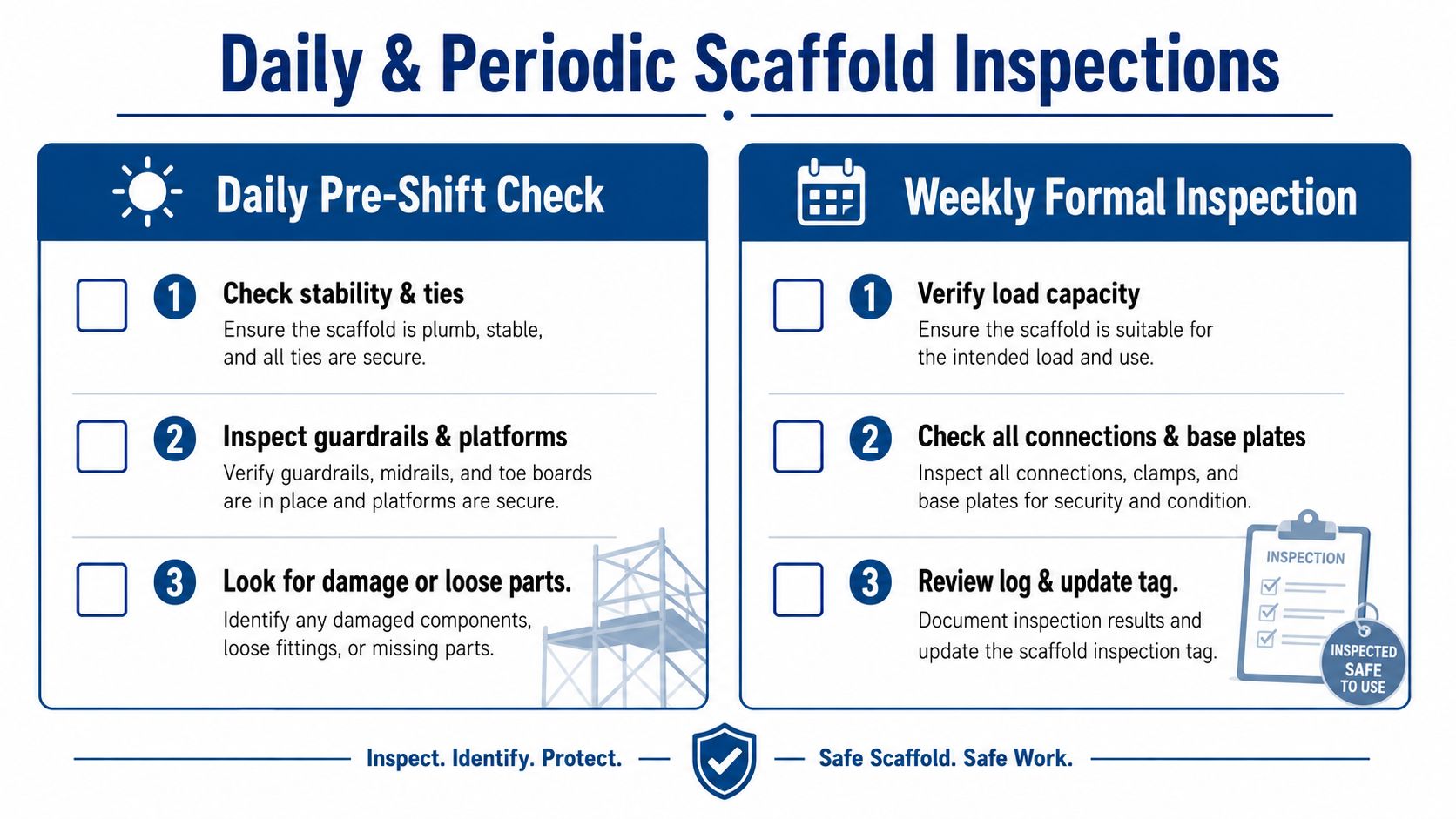
Daily pre-shift check
- Guardrails and mid-rails: confirm they're in place on all open sides and not loose or damaged.
- Platform condition: check for visible gaps, poor decking, missing planks, or boards that have shifted.
- Access and alterations: confirm ladders, stairways, and any field changes are still safe, and stop use if the scaffold has been altered without verification.
Periodic formal inspection
A competent person should look deeper at the structure itself. That means checking foundation stability, ties, base plates, connections, and load-bearing components, then comparing the scaffold's current state with how it was originally set up. If anything has moved, cracked, bent, or been overloaded, the scaffold needs correction before use.
Site rule: if an inspection finds a problem, don't work around it. Tag it out, fix it, then re-check it before access resumes.
Inspections must happen before each work shift and after events that could affect structural integrity. The common triggers are weather, impact, or any change that could shift the frame or loosen a component. Queensland's scaffolding guidance also treats inspection as part of a written control plan, not as an optional extra [Scaffolding Code of Practice 2021].
Common Scaffolding Hazards and Control Measures
Most scaffold incidents come from the same few failure modes, and the controls are well known. The problem on site is rarely a lack of theory, it's people skipping the check that would have caught the issue before access was given. That's why the control has to be simple enough to enforce under pressure.
The hazards crews keep repeating
Incomplete scaffolds are still being used before final sign-off, and that lines up with the NSW inspection findings on missing components and unsafe access. Missing edge protection remains a major issue, because a scaffold without full guardrails, mid-rails, and where needed toeboards, leaves workers exposed at the point where they trust the platform most. Component incompatibility is another quiet risk, because a scaffold can look aligned while mixed parts weaken the system underneath.
Access and egress are also a real problem when people are not coming from ground level or a protected landing. Workers may improvise with the nearest convenient route, but convenience isn't a control measure. If the access design isn't right, the scaffold design isn't finished.
Controls that actually work
- Restrict access during erection: stop anyone from using the scaffold until the first lift is fully protected and signed off.
- Keep edge protection complete: use guardrails, mid-rails, and where required, toeboards or mesh panels, not just a top rail.
- Verify compatibility: don't swap parts from different systems unless a competent person has checked them.
- Plan access and egress early: ladders, stair towers, and landing points need to suit the scaffold configuration, not be added as an afterthought.
For smaller access jobs, a basic resource like ladder safety requirements for homeowners helps show how access discipline matters even outside major projects. The principle carries straight into construction, if the access point is unsafe, the work platform isn't safe either.
For crews working near other confined or restricted areas, confined space training can also sharpen the habit of controlling entry before exposure.
Roles, Responsibilities, and Training Pathways
Scaffold safety breaks down fast when nobody is clear about who signs off, who inspects, and who stops work. Principal contractors need to control access on the site. Scaffolders need to build to the approved configuration. Workers need to stay inside the limits of the scaffold and report anything that looks wrong.
Who does what
A competent person is the one who can assess compatibility, verify modifications, and carry out inspections when the scaffold needs formal checking. That role matters most when something has changed, because field changes are where assumptions get dangerous. If a scaffold has been altered, the person checking it needs enough knowledge to know whether the change is acceptable or whether the scaffold should come out of service.
Workers also need proper training, not just a quick briefing. OSHA's scaffold summary states that workers on scaffolds must be trained by a qualified person to recognise the hazards tied to the scaffold type they're using and how to control them [OSHA scaffold summary]. That's a U.S. standard, but the practical lesson is the same, training has to be specific to the scaffold and the hazard.
Training pathways that suit real work
The basic entry point on Australian sites is construction induction, then scaffold-specific training and supervised experience. For people building a career around access systems, that progression matters because the job gets more technical once modular systems, inspection, and component compatibility enter the picture.
TP Training's Courses provide practical, nationally recognised training with experienced trainers and hands-on learning across NSW. That kind of training is useful when a site needs workers who can recognise scaffold risks early, not after the scaffold has already been used.
A good scaffold team isn't built by paperwork alone. It's built by clear roles, credible competence, and the habit of stopping work when the scaffold isn't ready.
If you want practical scaffold and safety training that fits real site conditions, visit TP Training and look at the courses that match your role, your site, and the type of work your crew does every day.

You may also like

First Aid Training Cost: A Complete Guide for Sydney Workers

How Long Licence Crystalline Silica Prevention Last