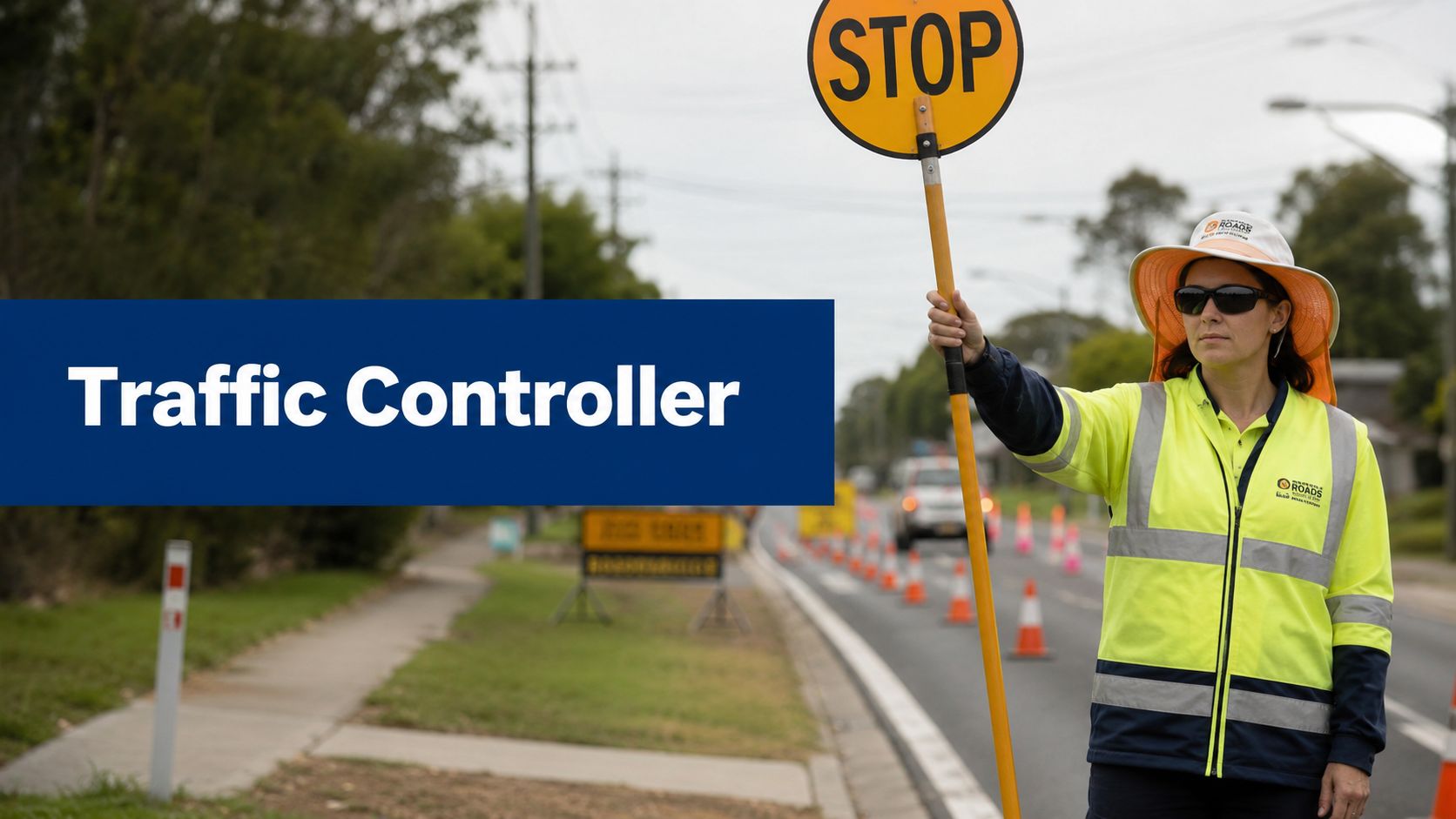
Traffic Controller Course TAFE: NSW Guide for 2026
TAFE NSW does offer traffic controller training through some campuses and partner pathways, but the NSW Blue Card, TC1 / RIISS00058, is also delivered by private RTOs like TP Training, which often run shorter, more job-focused courses. If you're trying to work out which option fits your situation, the question isn't just “does TAFE have it?”, it's “which provider gets me job-ready in the least confusing way?”
A lot of people start by searching traffic controller course TAFE and end up comparing apples with oranges. TAFE sits inside a much larger vocational system, with 5.1 million students enrolled in nationally recognised VET in 2024 and 866,055 students in government-funded training in January to June 2025 (VERIFIED DATA source). That tells you the market is huge, but it doesn't tell you which course format is easiest to understand for NSW traffic control.
If you're trying to make a sensible decision, think like a job seeker and not like a brochure reader. Start with the role you want, then match it to the card, the road category, and the provider that explains those details properly. A clear primer on the legal and safety side of the job can also help, and a useful starting point is the WHS Act 2011 guide when you're figuring out how traffic control sits inside broader workplace duties.
Table of Contents
- Does TAFE Offer the Traffic Controller Course in NSW
- What the Blue Card Actually Covers and How the Skill Sets Work
- TAFE NSW vs Private RTOs Like TP Training
- Prerequisites, ID and What to Bring on Day One
- A Typical Training Day From Sign-In to Certificate
- Blue Card vs Yellow Card and Where the Pathway Leads
- What the Blue Card Actually Gets You on NSW Worksites
- Common Misconceptions About the Traffic Controller Course TAFE
Does TAFE Offer the Traffic Controller Course in NSW
Yes, but not always in the neat, single-course way people expect. In NSW, you'll find traffic control training through TAFE-related pathways and partner providers, yet many learners still book the Blue Card through a private RTO because the private option is often simpler to schedule, easier to book, and more clearly tied to the specific job they want.
The practical choice underneath the search result
If you search for a traffic controller course TAFE, you're usually asking one of three things. You want a nearby campus, you want government support, or you want to get onto a worksite quickly. Those are different goals, and they don't all point to the same provider.
The TAFE route suits people who want a broader training environment and don't mind checking intake dates, campus availability, and course structure. The private RTO route suits people who already know they need the NSW Blue Card and want a straight line from enrolment to practical assessment.
Practical rule: if your goal is immediate job readiness for NSW traffic control, don't just ask who offers the course. Ask who explains the card, the road category, and the next step without making you decode the whole system yourself.
For NSW learners, it helps to separate the training brand from the qualification itself. The credential is what employers and regulators recognise. The provider just determines how you get there, how quickly you can book, and how much hand-holding you need along the way. A useful local overview of one pathway is the Traffic Controller Course Sydney, which can help you compare what a direct-provider model looks like against a campus-based option.
What the Blue Card Actually Covers and How the Skill Sets Work
The easiest way to think about TC1 and TC2 is as two rungs on the same ladder. TC1 is the entry point, it covers lower-speed, lower-volume sites, while TC2 moves you up into more complex conditions. Austroads says TC1 (RIISS00058) is for urban streets and low-volume rural roads only, and it sits within Category 1 temporary traffic management, meaning roads with a speed limit under 60 km/h and traffic volumes between 3,000 and 10,000 vehicles per day (Austroads factsheet).
The three skills that make up the Blue Card
The Blue Card course is built around three core competencies. They are workplace communication, stop/slow-bat control, and portable traffic control devices and temporary signs (Austroads factsheet). That mix matters because traffic control isn't just waving a bat around. You're coordinating with a crew, reading site conditions, and putting the right device in the right place for the road category you're on.
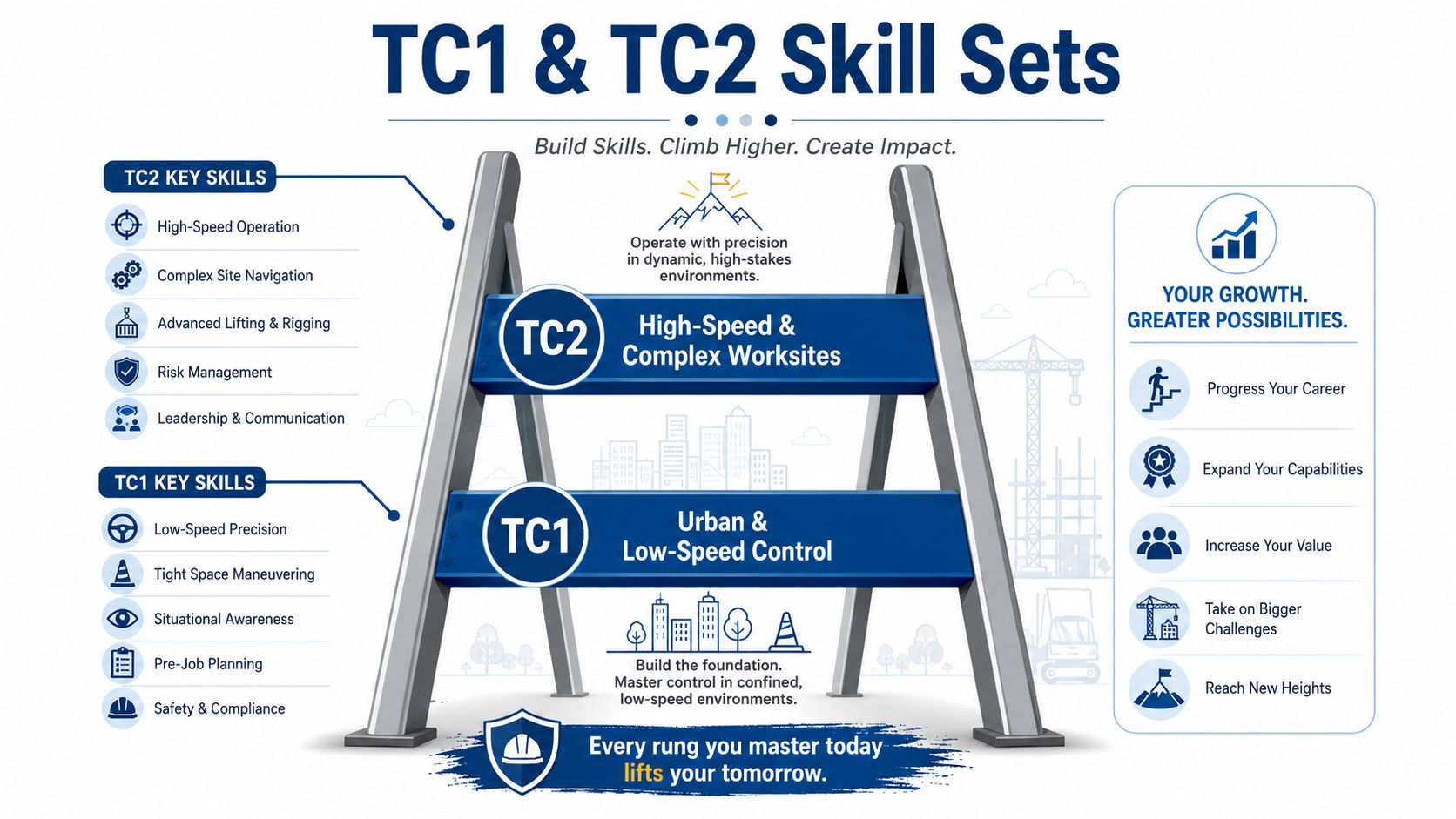
A lot of learners get tripped up because the card sounds broader than it is. The Blue Card is not a universal licence for any road, it's a qualification for a specific operating envelope. Once you understand that limit, the course makes more sense, because the practical assessment is testing whether you can manage that lower-risk environment consistently and safely.
For a plain explanation of the Blue Card pathway, this Blue Card traffic control overview is a useful reference point. It's also a reminder that the wording on course pages can be clearer than the wording in a search result.
TAFE NSW vs Private RTOs Like TP Training
The comparison isn't “TAFE or not TAFE”. It's breadth versus speed, campus structure versus direct booking, and general training pathway versus job-focused ticket. TAFE NSW sits inside a wider education system and can be a strong fit for people who want a public-provider environment. Private RTOs are usually sharper on immediate enrolment, practical delivery, and short-course convenience.
| Criterion | TAFE NSW | Private RTO (e.g. TP Training) |
|---|---|---|
| Duration | Can involve broader course structures and campus scheduling | Often shorter, more focused delivery |
| Cost clarity | May depend on subsidy and intake conditions | Usually presented as a direct course booking |
| Campus choice | Broader public-provider network | Multiple NSW training locations, including localised options |
| Booking speed | Can depend on semester or intake timing | Often faster to book for a near-term start |
| Job-readiness focus | Strong general training environment | More direct focus on the exact job ticket |
For people comparing providers, campus access matters. NSW learners often look for convenient locations such as Penrith, Burwood, Auburn, Parramatta, and Sydney CBD, because getting to class is part of the cost even when tuition is subsidised. That's where a private provider can feel easier, especially if they're already juggling work, family, or shift schedules.
Useful test: if you need the course booked quickly, and you want the training framed around one qualification instead of a bigger campus pathway, a private RTO may fit better. If you want the broader TAFE environment and you're comfortable with the intake process, TAFE can still be a good option.
One useful factual snapshot is the Traffic Controller Course Blue Card, which is described as practical, nationally recognised training with experienced trainers and hands-on learning across NSW. That kind of wording is exactly what many job seekers are looking for when they already know they need the Blue Card, not a generic study pathway.
Prerequisites, ID and What to Bring on Day One
NSW is more straightforward than some other states at the enrolment stage. SafeWork NSW says there are currently no prerequisites for the traffic control training course overview, so in NSW you can usually enter the course without a prior formal qualification requirement under that overview (SafeWork NSW).
The checklist most people should prepare
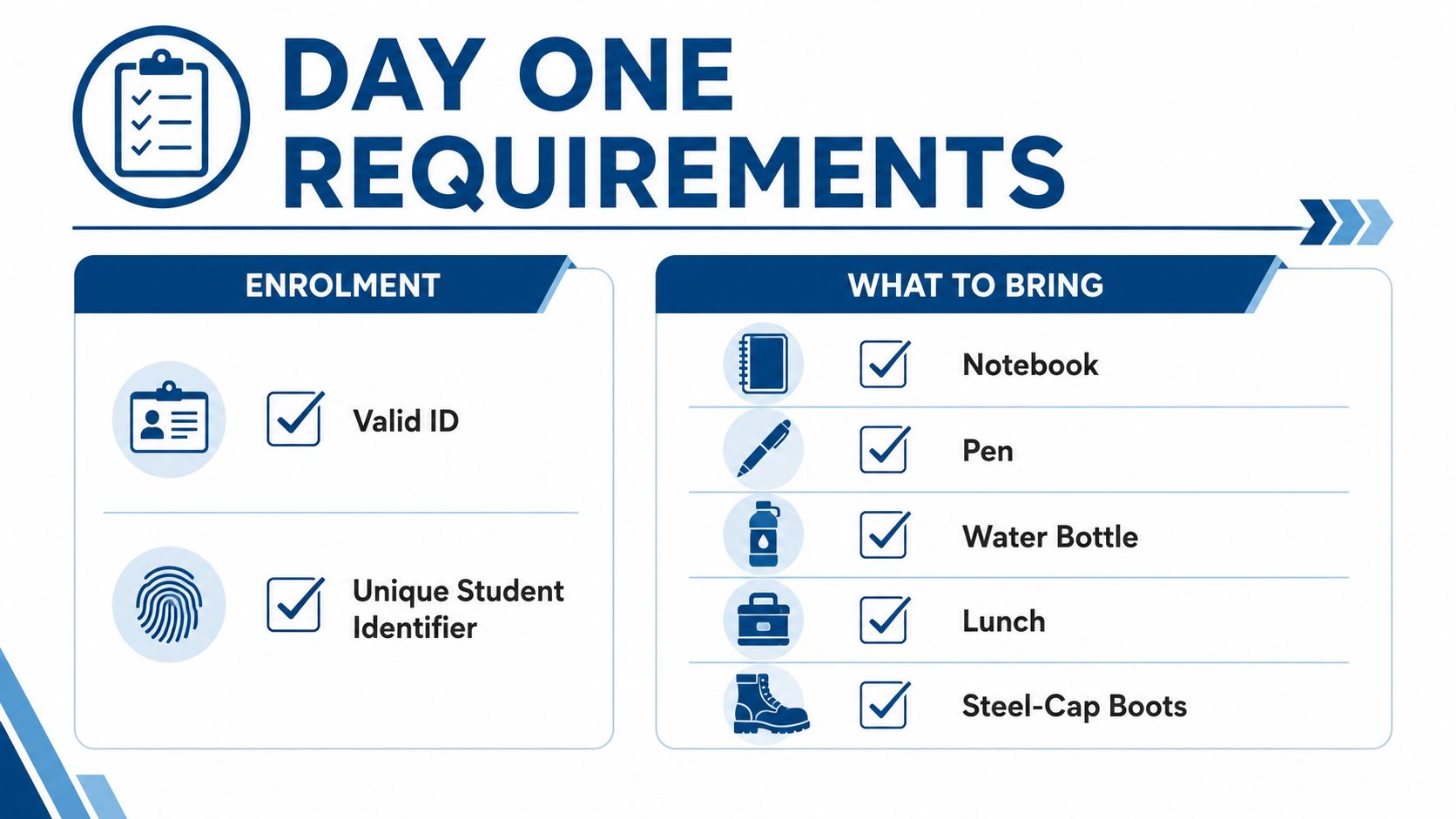
Before you turn up, make sure you've got the basics sorted.
- Valid ID: providers commonly verify identity on arrival, so keep your photo ID ready.
- USI: you'll need your Unique Student Identifier, and if you're still sorting that out, this USI setup guide is a practical place to start.
- Workable language and numeracy: Queensland requires applicants to show sufficient literacy and numeracy for the task, and while that's not an NSW enrolment rule, it's a good reality check for anyone who wants to handle stop and go decisions confidently.
- Closed-in safety footwear: bring sturdy footwear, because practical training usually includes outdoor movement and site-style setup.
- Hi-vis clothing or readiness to use supplied PPE: some providers supply gear, but it's safer to assume you'll need to turn up prepared.
- Water and a snack: outdoor practicals can run long enough that small basics matter.
Queensland also asks for an open or provisional driver licence within the last 5 years for traffic controller accreditation, but that is not the NSW entry rule under the SafeWork NSW overview (Queensland TMR). Don't bring interstate assumptions with you, because they cause more confusion than they solve.
This course suits people who can follow site instructions, stay alert, and work comfortably in a practical training environment. A related hands-on option in another area is the Food Safety Supervisor Course Fss, which shows how short vocational courses often combine compliance with workplace readiness.
A Typical Training Day From Sign-In to Certificate
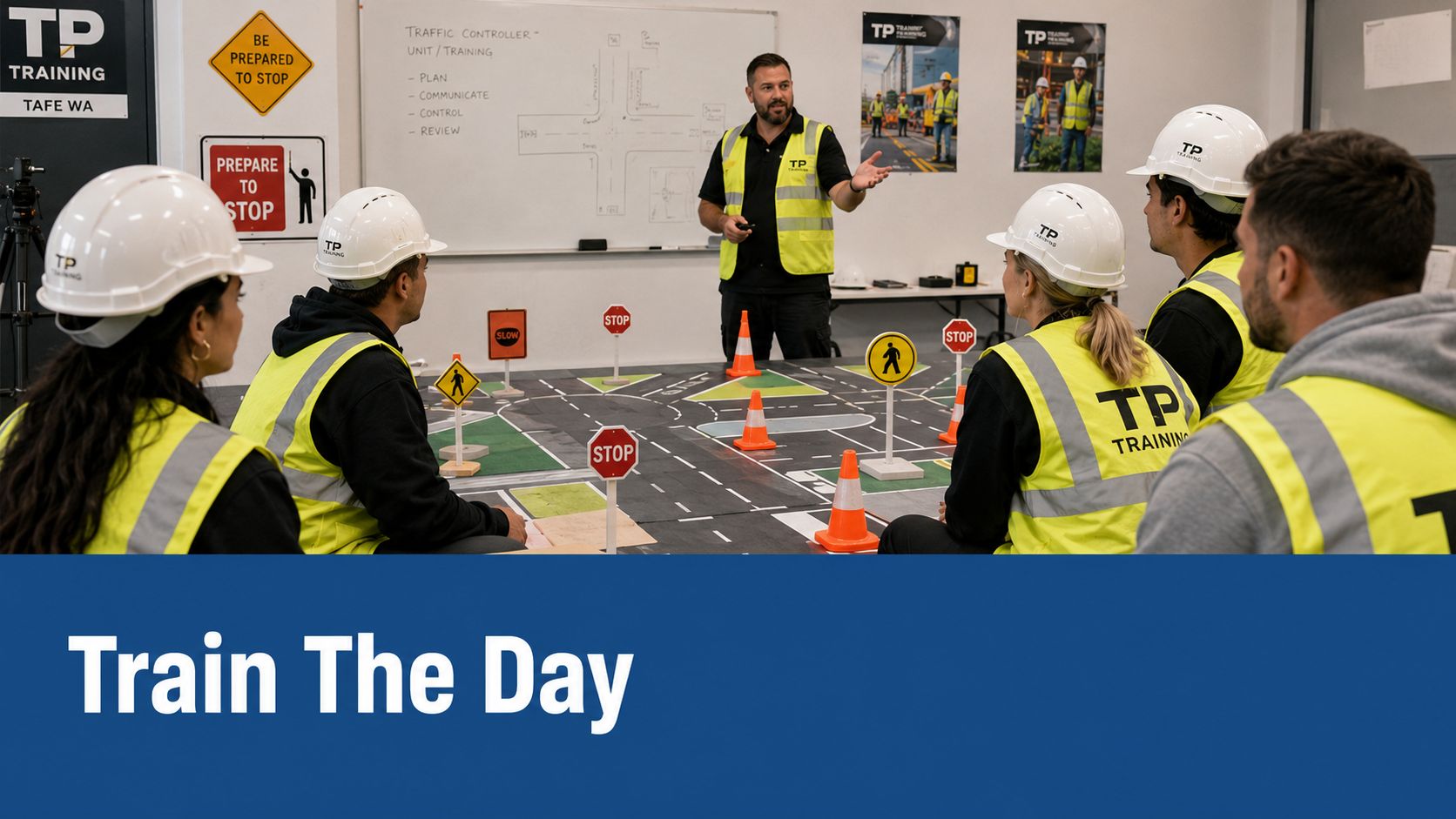
Most learners start with a simple check-in. Staff confirm identity, collect paperwork, and make sure everyone has the right gear before the class moves into the theory room. The atmosphere is usually practical rather than academic, because the goal is to get you thinking like a worker on a site, not a student sitting an exam hall.
The classroom part usually covers the meanings of signs, how to communicate on site, and how the stop/slow bat fits into the job. The tricky part for many people isn't the vocabulary, it's the timing, because traffic control is full of small decisions that need to be made cleanly and without hesitation.
Listen to the trainer's phrasing carefully. Most errors happen when a learner knows the rule but says the instruction awkwardly or too late.
Then comes the practical setup. Learners step outside, stand in position, and practise stopping and releasing simulated traffic while keeping eye contact, using clear bat movement, and staying consistent with the direction they've been given. The moments that catch people out are usually the same ones every time, radio call phrasing, choosing the correct bat side, and not rushing the release too early.
A private RTO often ends the day with the certificate process as soon as the assessment is complete, while the learner is still fresh in the trainer's mind. That's one reason short-course providers are popular with job seekers who want a quick move from training to applications.
If you want to read a learner-style account of a related NSW traffic management pathway, the article on Traffic Management Designer Red Card training in NSW gives you a sense of how practical training is framed at the coalface. The exact ticket is different, but the format, trainer guidance, and workplace focus will feel familiar.
Blue Card vs Yellow Card and Where the Pathway Leads
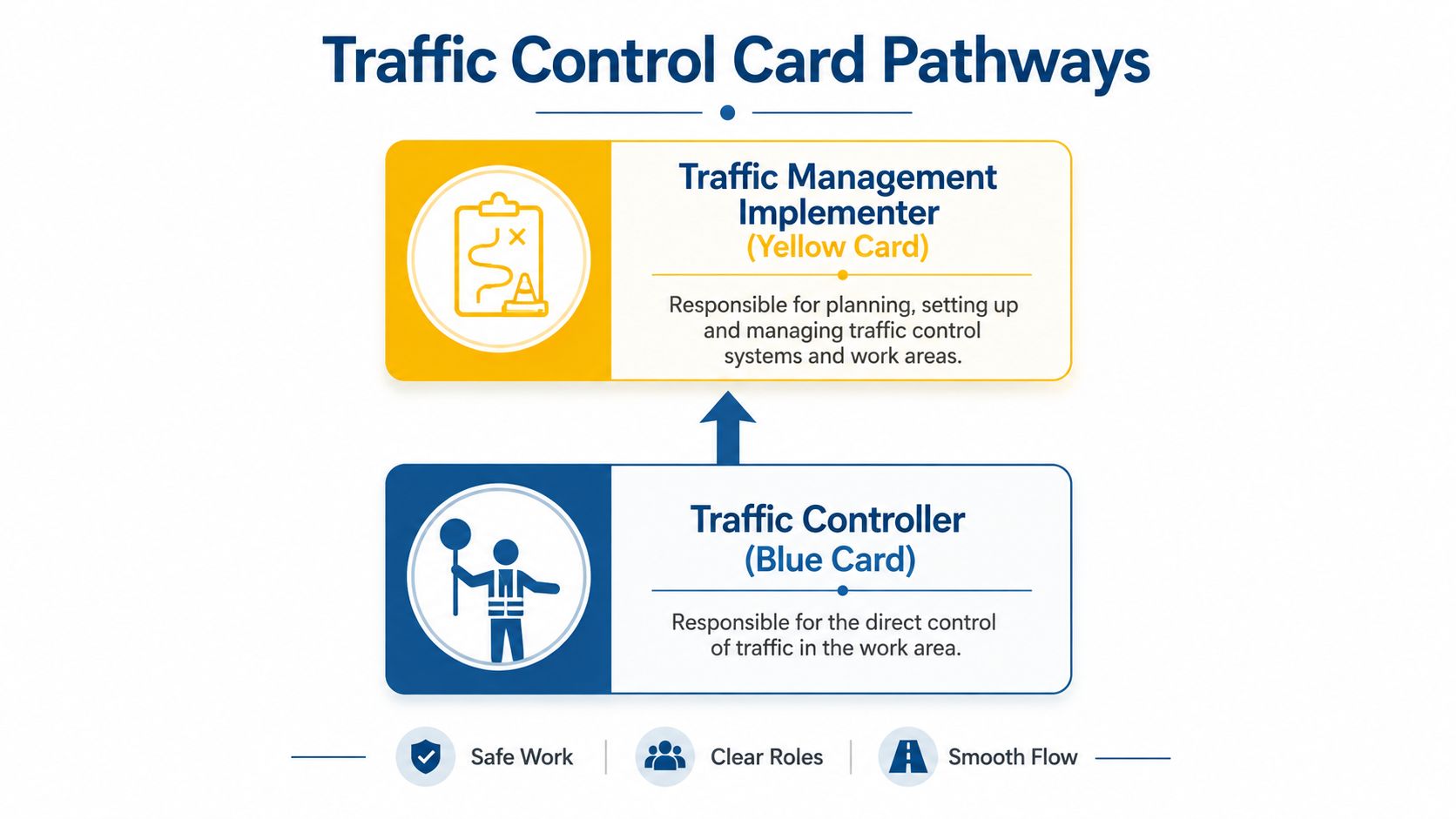
People often use the card colours as if they were interchangeable. They're not. The Blue Card is for direct traffic control, while the Yellow Card is for traffic management implementation, which means more setup, more planning, and more responsibility on the worksite.
The unit-level difference
The Blue Card pathway focuses on stopping and directing traffic and using portable traffic control devices. The Yellow Card pathway adds the work of planning, setting up, programming devices, and applying risk management. That difference matters because it changes what you're trusted to do before the traffic starts moving.
The simplest way to think about it is this. Blue Card gets you onto the site in a direct control role. Yellow Card starts moving you into the person who helps build and manage the traffic setup itself. For someone looking at career progression, that's a meaningful step, not just a different-coloured card.
Career move rule: don't collect cards blindly. Choose the next unit set that matches the type of work you actually want to be doing six months from now.
If you're putting certifications on a job application or resume, presentation matters as much as the qualification itself. A helpful guide on placing licenses on a resume can show you how to list the card clearly so employers can see the right ticket straight away. That's especially useful in traffic control, where recruiters often scan for the exact qualification before anything else.
What the Blue Card Actually Gets You on NSW Worksites
A new Blue Card holder is usually looking at direct entry roles on active NSW worksites, not office-based planning jobs. That can include road resurfacing, utility works, council projects, and civil construction sites where traffic needs to be held, released, or directed safely around work zones.
The card is strongest when it's paired with other tickets employers recognise quickly. A White Card is the most obvious companion, and many job seekers also stack First Aid and, later, Yellow Card training so they're easier to place and easier to roster across different crews.
The demand side matters too. Traffic control is a real occupation with a distinct workforce profile, and Jobs and Skills Australia reports 1,600 employed Air Traffic Controllers, with a median age of 41, 17% part-time participation, and 17% female representation, which shows the occupation exists as a defined labour segment rather than an informal side task (Jobs and Skills Australia profile). It's a different field from road traffic control, but it reinforces the point that traffic-related roles are established and specialised.
For job seekers, the practical takeaway is simple. The Blue Card gets you into the entry lane. Other tickets widen the lane. If you want more employability, stack qualifications that sit close to the worksite, not far away from it.
Common Misconceptions About the Traffic Controller Course TAFE
Three myths keep turning up in search results, and they're the ones that waste the most time.
Myth one, TAFE is always the cheapest option
Sometimes it is. Sometimes it isn't. If a learner qualifies for a subsidy and can wait for the next intake, TAFE can be a good-value route. If the person needs a near-term booking, a clear timetable, or a course that lines up with work commitments, the cheaper option on paper may not be the cheaper option in practice.
Myth two, one day means fully qualified for any road
That's false. Austroads is clear that TC1 is limited to Category 1 conditions, which means roads under 60 km/h and traffic volumes between 3,000 and 10,000 vehicles per day (Austroads factsheet). A one-day course can get you started, but it doesn't erase the difference between a low-speed site and a more complex one.
Myth three, any traffic control certificate works in NSW
That also causes headaches. States regulate differently, and a Queensland or Victorian ticket doesn't automatically operate the same way in NSW. SafeWork NSW's overview shows that NSW entry conditions are their own thing, and Queensland's accreditation rules add extra licence-history requirements that aren't the same as the NSW pathway (SafeWork NSW), (Queensland TMR).
The cleanest way to think about the choice is this. TAFE NSW can suit people who want breadth and possible subsidy. A private RTO like TP Training can suit people who want speed, flexibility, and same-day certification across NSW training centres. If you're ready to act this week, check your ID and USI, choose the provider that fits your location and schedule, and book the course that matches the exact ticket you need. Then look at the next sensible steps, like White Card, First Aid, Yellow Card, or Red Card, so traffic control becomes a pathway instead of a one-off purchase.
If you want the fastest, clearest way to compare NSW traffic controller options, start with your location, your schedule, and the exact card you need. TP Training offers practical traffic control training across NSW, and you can visit TP Training to check the course path that fits your next job step.

You may also like
High Risk Work Solutions in Australia: A Practical Guide

Basic Fatigue Management Course Guide for NSW Workers