How to Find a Traffic Control Job in Sydney Quick and Easy Guide for 2026
You're staring at Sydney listings before sunrise, half convinced traffic control is either the fastest way into civil work or just another ticket that won't get you hired. It's simpler. In 2026, the candidates who move quickest aren't the ones with the fanciest brochure promise, they're the ones who show up site-ready, flexible, and easy to roster.
Table of Contents
- Why Sydney Traffic Control Jobs Are Still a Smart Move in 2026
- Traffic Controller Employment and Pay in NSW: What to Expect
- The Ticket Stack Sydney Employers Filter For
- What Gets No-Experience Applicants Hired Faster Than Their Peers
- A Practical Job Search Playbook for Sydney Traffic Control Roles
- Choosing the Right Traffic Control Course With TP Training
- Your First Month on Site and Common Questions Answered
Why Sydney Traffic Control Jobs Are Still a Smart Move in 2026
A lot of people start this search the same way. They're up at 6am, scrolling jobs on their phone, comparing traffic control with warehousing, labouring, or hospitality, and wondering whether the work is still worth the early starts and weather exposure. That's the right question to ask before you spend money on training.
Traffic control still makes sense in Sydney because NSW holds the biggest share of the occupation in Australia, with 30.1% of Road Traffic Controllers based in New South Wales and 16,100 employed workers nationally, according to Jobs and Skills Australia (occupation profile). The role also skews practical rather than academic, with only 1.4% holding postgraduate qualifications and much larger shares coming through Certificate III/IV, Year 12, or Year 10 and below pathways, which tells you the hiring market rewards readiness more than theory.
That's why the job keeps acting as an entry point into construction and civil work. It suits people who can handle a cold morning, follow instructions, and stay alert around live traffic and site crews. If you want a blunt read on whether the work feels right before you jump in, the honest career notes in these traffic controller job insights are worth a look.
Sydney demand also tracks with the city's broader infrastructure and airport pipeline. If you want a practical local lens on where jobs are flowing around Western Sydney, the Western Sydney Airport 2026 jobs data is a useful market read, because traffic control follows the same civil and transport build-out that creates the rest of the work.
Traffic Controller Employment and Pay in NSW: What to Expect
Sydney traffic control is a real labour market, not a side project. It supports people looking for casual income, part-time hours, and a way into construction work that starts on site rather than in an office. Jobs and Skills Australia shows 52% of Road Traffic Controllers work full-time and 48% part-time, with a median age of 43 and a 33% female share (occupation profile). That mix shows a settled occupation with room for new entrants who can show up ready to work.
What the Sydney pay picture looks like
For Sydney, the clearest live benchmark is Indeed, which lists average base pay for a traffic controller in Sydney NSW at $37.23 per hour, based on 34 salaries reported and updated on 1 March 2026 (salary page). Use that figure when you compare offers. It reflects current job seeker behaviour, not stale course-brochure numbers.
ABC has also reported that traffic control earnings can rise under penalty structures, including a base rate of $48.93 per hour under an EBA model, a 2024 BPIC base hourly rate of $51.96, and a base annual salary of $89,786.88 for that financial year. It also noted casual non-residential construction site rates of $35.04 per hour, rising to $63.07 on Sundays and $77.08 on public holidays. That is where the better money sits in this industry, in shifts with penalties attached, not just in the ordinary hourly rate.
Practical rule: Judge a traffic control job by the shift pattern, the penalty structure, and whether you can access the higher-paid work.
If you are deciding whether the pay suits your life, use the Sydney benchmark for ordinary hours and keep the ABC figures in mind for penalty shifts. The better fit is usually for people who can handle early starts, variable hours, and work where availability matters as much as experience. For a broader breakdown of earning potential, the Sydney salary guide for traffic controllers is worth reading alongside the live job boards.
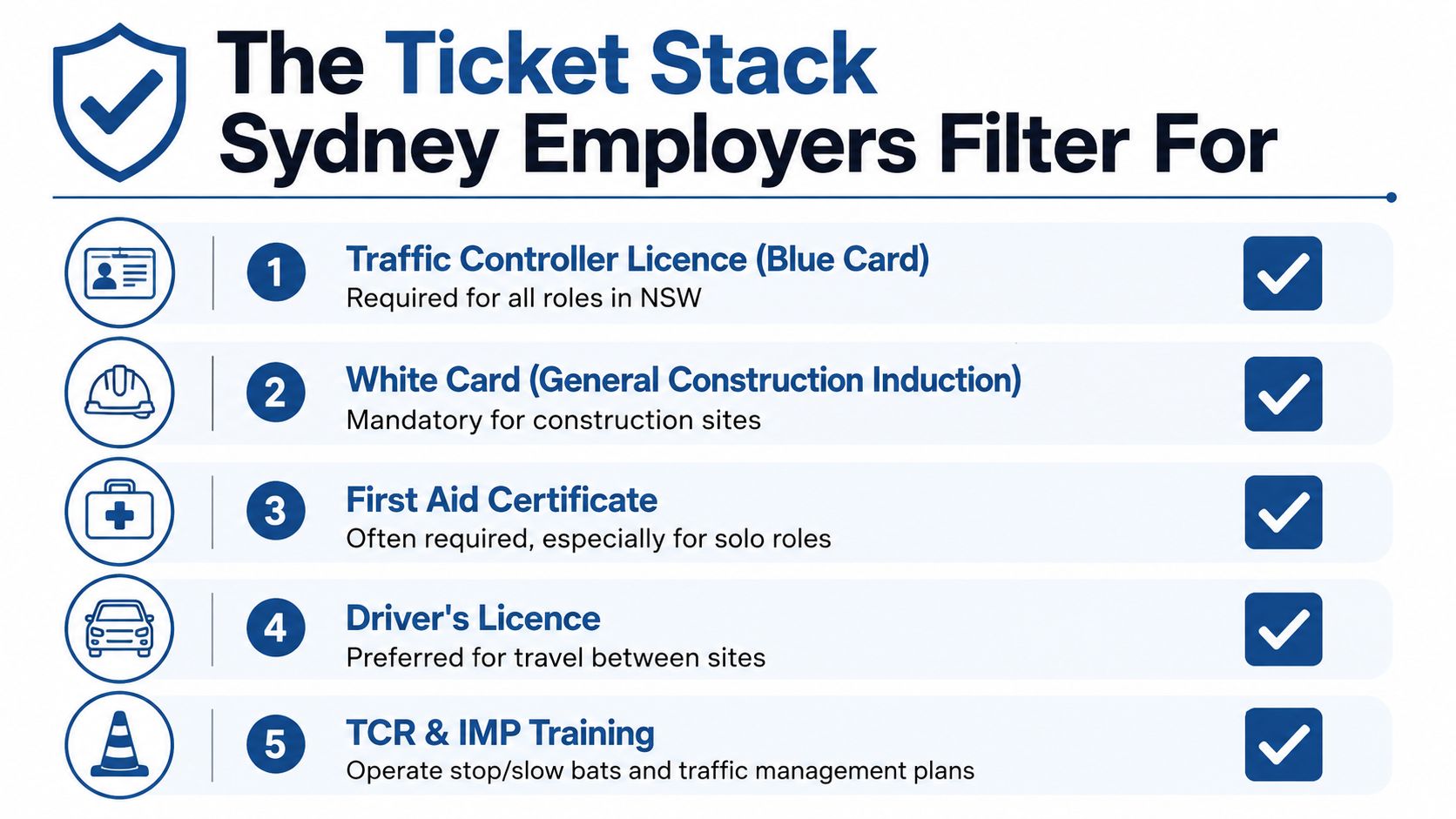
The Ticket Stack Sydney Employers Filter For
Sydney employers screen the full package. If your paperwork looks thin, your application usually drops out before anyone gets to your work history.
Start with the construction base, then add the traffic-specific cards
A published NSW guide says traffic control work sits on or around construction and civil worksites, so workers need the general construction induction unit CPCWHS1001 Prepare to work safely in the construction industry, usually called the White Card, before moving into traffic management training. The same guide says a common first entry step in NSW is TC1, the entry-level traffic controller skill set used for lower-risk road environments. That staged pathway matters because a White Card alone does not make you site-ready for traffic work, and a traffic ticket without the construction induction still leaves a gap in compliance (NSW guide).
The card stack is only part of the picture. In Sydney job ads, employers commonly ask for a White Card, Blue Card, Yellow Card, unrestricted driver licence, reliable transport, and availability for nights, weekends, and call-outs. One Sydney listing also asks for a Red Card for team leaders, which tells you higher-responsibility roles can need extra planning credentials beyond entry-level traffic control (Sydney job ad examples).
If you want a course example that lines up with that reality, TP Training's Traffic Control Combo Course Blue & Yellow Card and Traffic Controller Course Blue Card are presented as practical, nationally recognised training with experienced trainers and hands-on learning across NSW. That kind of offer matches what employers screen for, because they want people who can work on site and fit the roster, not just collect another certificate.
Don't ignore the practical extras
Sydney listings also ask for all PPE, including a hard hat and radio, plus a solid grasp of job briefs, two-way radio use, and strict safety procedures. Another vacancy says controllers must work unassisted, stay punctual, and handle early starts and weekend work, which is a very different test from holding a card (no-experience Sydney listings).
Site-ready is the filter that matters. Employers want people who turn up with the right tickets, the right gear, the right licence, and a serious attitude to safety. Anything less slows you down.
What Gets No-Experience Applicants Hired Faster Than Their Peers
The biggest mistake new applicants make is assuming the card is the finish line. It isn't. Once dozens of people all hold similar tickets, employers start separating them by who looks reliable, flexible, and ready to move between sites without hand-holding.
Transferable experience beats blank resumes
Sydney job ads often ask for prior experience in traffic, transport, logistics, warehousing, or customer-facing roles when they're screening no-experience applicants. That makes sense, because those jobs already prove you can turn up on time, follow instructions, stay calm under pressure, and work around other people's movements. If you've loaded trucks, handled deliveries, worked front counter, or coordinated stock, say it plainly on your resume and in your cover note.
Employers rarely hire the person with the longest story. They hire the person who makes the least risk.
The same goes for availability. If a listing starts at 5:00am, that's not decoration, it's a test. If you can't do early starts, night shifts, or rotating metro locations, say so directly. If you can, lead with it, because flexibility often matters more than years of unrelated work history.
Show the small things that signal reliability
A lot of candidates undersell the basics. They write that they're “keen to learn” and forget to prove they're already ready to work. Sydney employers notice the workers who can show up with transport, PPE, a clean communication style, and enough discipline to follow a job brief without drama.
Use your resume to state the obvious. Put your ticket status near the top, mention your driver's licence, note that you have your PPE, and spell out that you're open to early starts, weekends, and casual call-outs. If you've worked unassisted before, say that too, because it reads as trustworthiness in a safety-critical role.
The applicants who get hired fastest are usually not the loudest. They're the ones who look organised, mobile, and ready to stand on a roadside at short notice.
A Practical Job Search Playbook for Sydney Traffic Control Roles
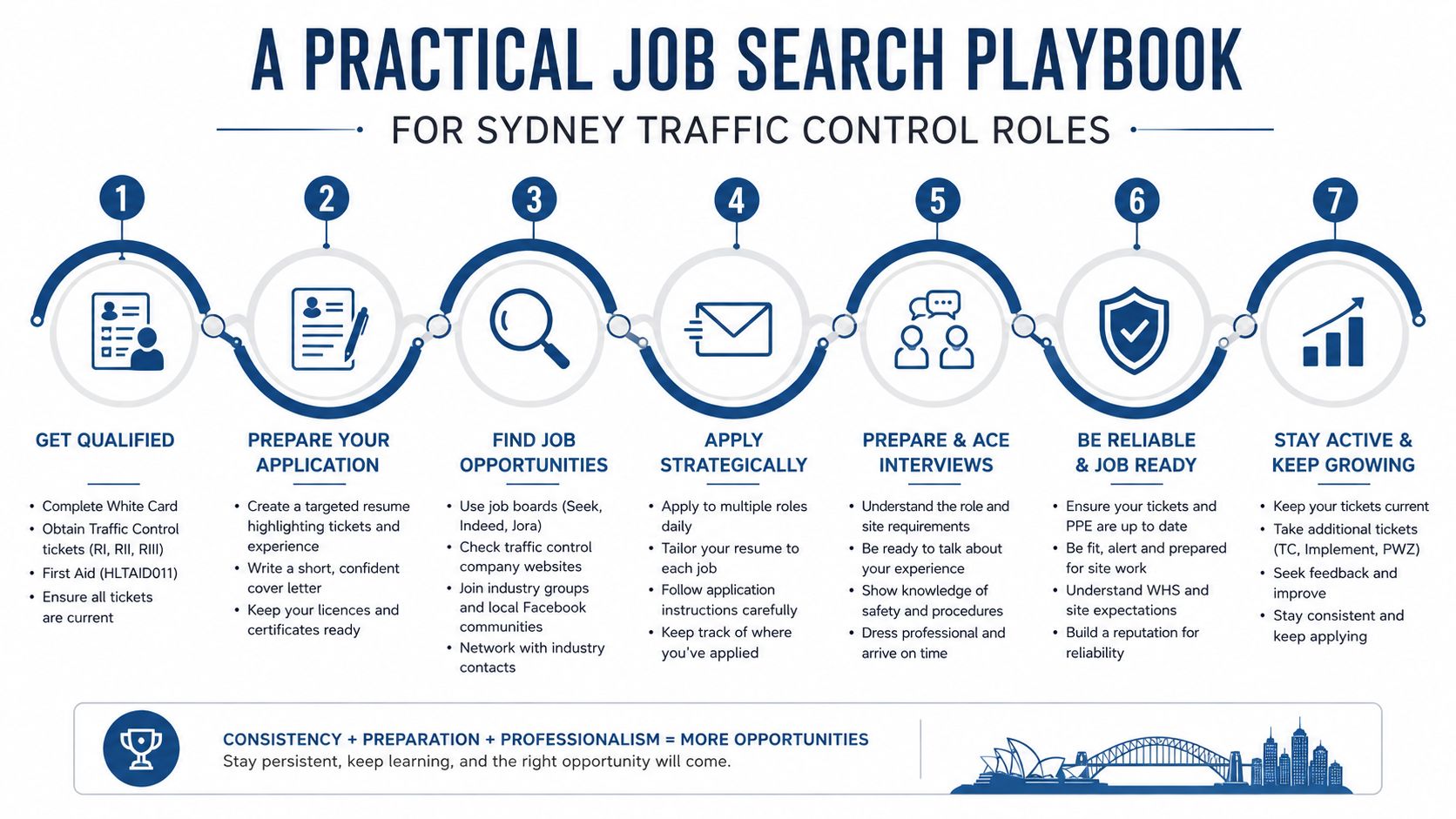
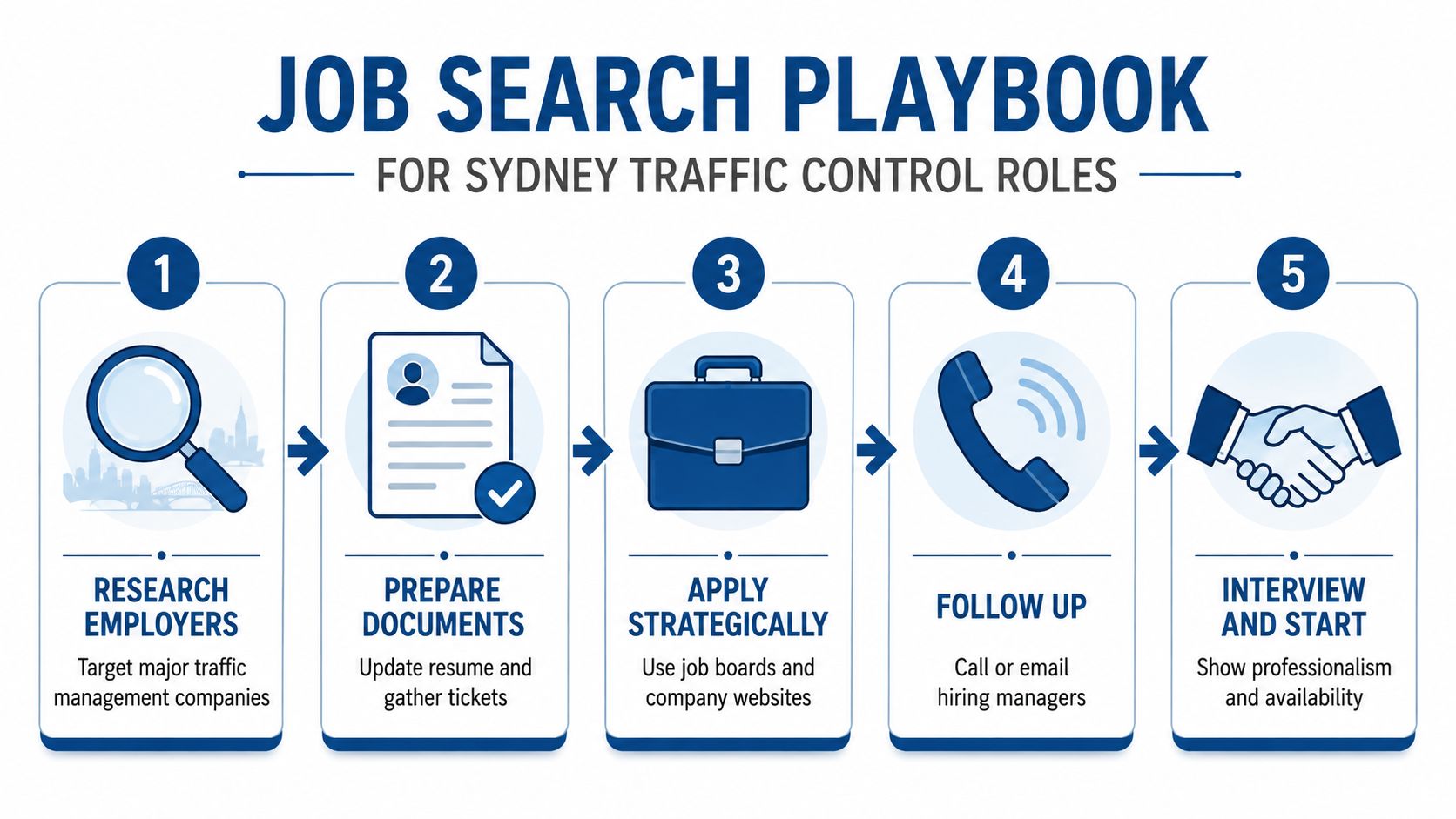
Start with the employers, not the job boards. The traffic management companies that run Sydney sites care more about whether you can work tomorrow than whether your resume looks fancy, so your search should focus on direct applications, company career pages, and referrals from people already in the field.
Build a site-ready application
Your first paragraph needs to do the heavy lifting. Put your tickets, licence status, PPE, and availability in the opening lines, then keep the rest short and direct. If you've got previous work in warehousing, transport, customer service, or labouring, connect it to reliability and safety, not to a vague claim that you're a “team player”.
When you're comparing job ads, watch for phrases like immediate start, casual, early starts, rotating locations, and weekend work. Those are usually the jobs where employers are trying to fill shifts quickly, not build a long recruitment pipeline. If a post reads like it needs someone tomorrow, respond like someone who can turn up tomorrow.
Use your training network like a job channel
Training providers and referrals can cut through the noise. Your trainer, classmates, and anyone already working roads or civil sites can point you to crews that hire quickly, especially when they know you've already done the paperwork. If you want a realistic comparison point for blue-collar shift searching, the way people chase removalist jobs Sydney is similar, they chase active shifts, not polished career pages.
Best move: Apply, then follow up. A short phone call or email to the hiring manager beats sitting in a generic applicant pile.
If you're planning your cash flow, don't expect a magical overnight hire. The fastest candidates usually move from course completion to first paid shift once they've got the right tickets, a clean resume, and real availability. If you want a more structured roadmap, the 7 powerful steps to become a traffic controller in 2025 still maps well to how Sydney hiring works in 2026.
Choosing the Right Traffic Control Course With TP Training
If your goal is to get onto site quickly, start with the course that gets you job-ready without wasting time. The Traffic Control Course Blue Card is the cleanest entry point for fast-moving applicants. If you want broader employability, the Traffic Control Combo Course Blue Yellow Card gives you more scope, including the implementer side of the work that opens more roster options across traffic management.
Match the course to the job you want
A new entrant who has never worked construction usually needs the White Card first, then the traffic-specific path. Someone already working in civil or construction can often move faster because they already understand site rules, tool discipline, and safety language. Employers notice that difference straight away. It is the practical edge that gets candidates through the first screen.
TP Training's traffic control course options are built around practical delivery in NSW, with experienced trainers and hands-on learning. If you want a local overview of how the course is set up for Sydney candidates, see the traffic control course Sydney guide. For a parallel in how people want fast access to information before they commit, the prefetch and prerender API details show how systems can make information available sooner.
Pick the option that matches your timeline
Choose the Blue Card path if you want to get moving quickly and start applying for entry-level controller work. Choose the Blue and Yellow route if you want more flexibility on future shifts and you are thinking beyond the first role. If you are already in construction, the wider traffic pathway usually makes more sense because it fits the way Sydney employers roster crews.
The right course is the one that gets you to a usable job, not the one that sounds most impressive. That is the standard that matters.
Your First Month on Site and Common Questions Answered
Your first month is usually less dramatic than people expect. You'll get early site briefings, radio checks, instruction from more experienced crew members, and a lot of repetition around where to stand, when to speak, and when to stay quiet. That's normal, because traffic control is safety work, not a place for improvisation.
What your first shifts usually feel like
Most new starters spend their first shifts learning the site rhythm. You'll work under a Traffic Management Plan, use the radio properly, and get corrected if you drift too far into your own habits. The best workers in week one are the ones who listen, stay visible, and don't try to look clever.
If the roster is casual, you may get a mix of early mornings, short calls, and odd days before the pattern settles. Part-time work is realistic here because the occupation already has a large part-time share in the national profile, and Sydney job ads clearly support mixed shift patterns (Jobs and Skills Australia profile).
The questions people keep asking
Do penalty rates matter? Yes. They're often the difference between an ordinary shift and a worthwhile one, especially on Sundays and public holidays, as the ABC figures show.
Can I start part-time? Yes, and plenty of people do. That fits the structure of the occupation and the way Sydney crews are rostered.
How do people move up? They usually start with Blue Card work, then add Yellow Card capability, and later move into Red Card or team leader responsibilities if they want more planning and supervisory work. The hiring ladder is practical, not glamorous.
The first month rewards people who are punctual, quiet, and consistent. You do not need to impress anyone. You need to be trusted.
If you want a quick action list, get your tickets in order, update your resume, list your availability, and apply directly to the crews that are already filling Sydney shifts. That's the fastest way to stop browsing and start working.
If you want a straight path into Sydney traffic control work, TP Training gives you the practical tickets and hands-on training that employers recognise. Start with the course that matches your situation, then move quickly into applications with a site-ready resume and real availability. Visit TP Training and get your traffic control pathway sorted properly.

You may also like
High Risk Work Solutions in Australia: A Practical Guide

Basic Fatigue Management Course Guide for NSW Workers