
How to Get a Skid Steer Ticket in Australia (2026 Guide)
Job seekers searching for a skid steer ticket are often asking the wrong question. Australia doesn't hand out a forklift-style licence for skid steer work, and that's exactly where a lot of people waste time, book the wrong course, and turn up confused on day one. What matters on NSW civil sites is proof of competency, machine familiarity, and the ability to work safely around plant, people, slopes, and attachments.
That distinction matters because skid steer work sits inside the broader Australian construction sector, which employed about 1.3 million people in 2024 [as set out in the verified training brief]. The industry needs operators who can show they understand the machine, not people who can just talk their way through a booking form. If you want to get hired, you need the right paper, the right habits, and the right site-readiness, in that order.
Table of Contents
- What a Skid Steer Ticket Really Means in Australia
- Who Can Enrol and What You Need Before Training Day
- Inside the RIIMPO318F Course Content and Assessment
- Duration, Scheduling and How Fast You Can Get Qualified
- TP Training Locations Across Sydney and Western NSW
- Costs, Required Documents and How to Book Online
- Career Pathways and Real NSW Use Cases
What a Skid Steer Ticket Really Means in Australia
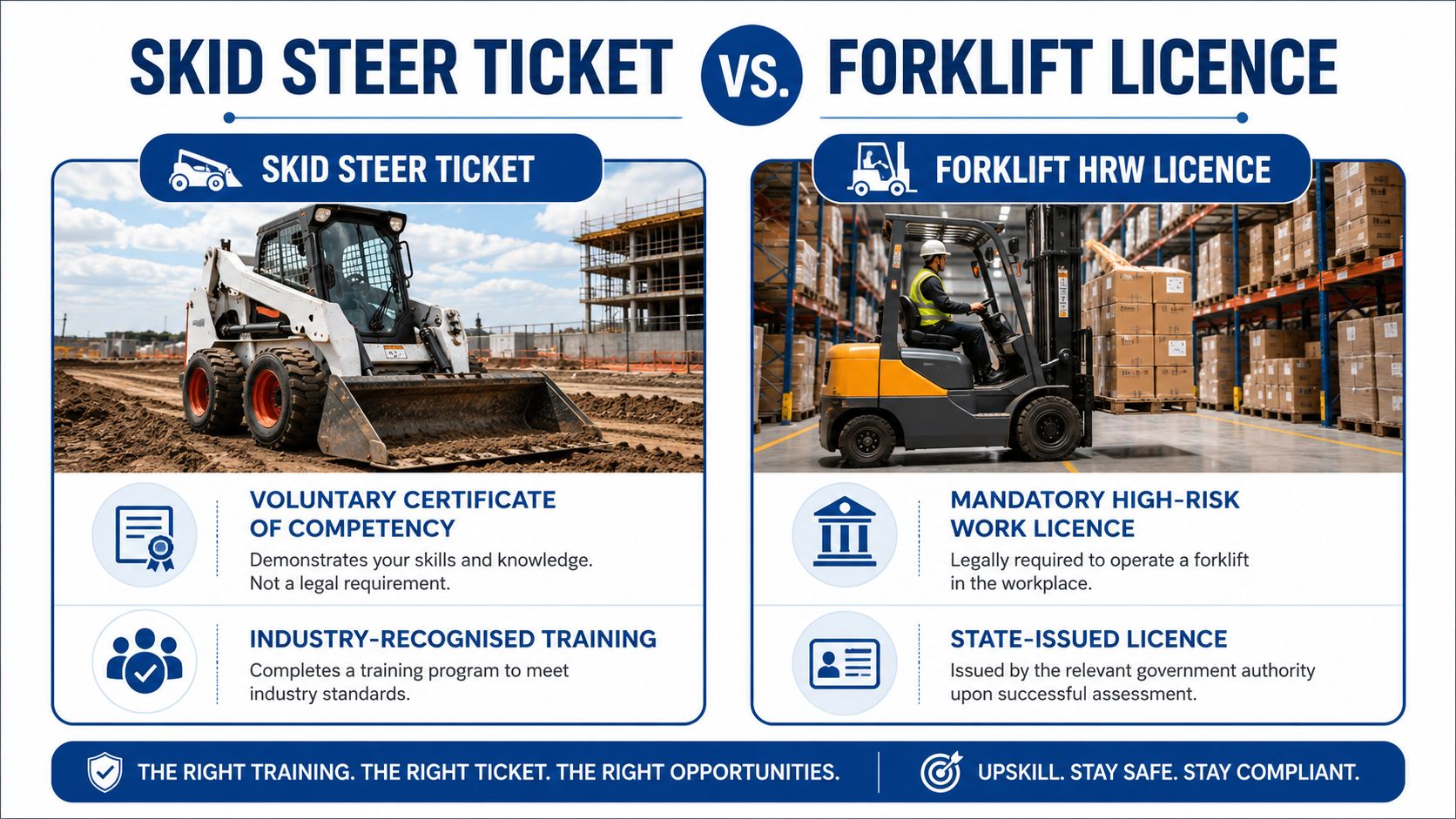
A skid steer ticket in Australia is not a government licence in the way people usually mean that phrase. In practice, it's competency-based training, and the Australian framework separates training from legal licensing. That's the part most search results gloss over, and it's the first thing I'd correct before anyone spends money on the wrong pathway.
The right credential is usually a Statement of Attainment for the relevant civil construction unit, commonly framed around skid steer loader operations in the RII training family. Employers accept that because it shows structured assessment, documented machine handling, and site-relevant training. If the machine is being used for ordinary civil and construction work, that's the paper that matters.
Where the licence line actually gets drawn
The line gets drawn when the machine is used in a lifting function that changes the legal category of work. A skid steer becomes high risk work when it's used to lift loads as a forklift-style device or as a crane or hoist, and then the relevant high risk work licence applies instead of general machine familiarity. That's a function-based rule, not a brand-based one.
Practical rule: don't book a forklift licence if you need skid steer competency for civil site work. Book the plant course, then check whether your job role includes any lifting function that triggers a separate HRW requirement.
If you want a concise regulator-style discussion of the licence split, TP Training has a useful overview on high risk work licence NSW. For machine mechanics and attachment behaviour, the hydraulic and linkage discussion in industrial hydraulics from MA Hydraulics is a good technical reference point, especially if you're trying to understand why lift-path and flow class matter more than marketing language.
| Credential | Type | Typical Use | Issued By |
|---|---|---|---|
| Skid steer competency course | Unit-based training and assessment | Civil construction plant operation | RTO |
| Forklift HRW licence | Mandatory high risk work licence | Forklift operation | State licensing system |
| White Card | Construction induction | General construction access | RTO |
| Site verification | Employer or principal contractor check | Site-specific machine clearance | Employer or site controller |
Who Can Enrol and What You Need Before Training Day
If you can read signs, follow instructions, and show up in the right gear, you're already partway there. The main barrier is usually not ability, it's preparation. Students get tripped up because they book first and sort the basics later, which is backwards.
Entry checks you should sort early
- Age and readiness: In NSW, plant courses are commonly taken by people who are at least 17 and ready to work around live plant. If you're still unsure about site maturity, you probably need more time before you're on a loader.
- Language, literacy and numeracy: You need enough LLN skill to read safety signage, understand load instructions, and complete paperwork without guessing.
- Photo ID and USI: Bring your photo identification and your Unique Student Identifier. If you don't have a USI, sort it before you book, not after.
- PPE: Closed-in footwear is mandatory. Bring the PPE your provider asks for, because plant training isn't a classroom-only exercise.
- Medical considerations: If you have a condition that affects alertness, movement, or balance, disclose it before training. Hidden issues create avoidable risk in the cab.
A White Card is often expected by employers even when the skid steer course itself doesn't demand it. If you're new to construction, the White Card Training Course gives you the construction-induction foundation many NSW sites ask for in practice.
What sensible students do before they book
Show up ready to learn, not ready to ask what PPE means.
The strongest candidates treat training day like the start of a site job, not a casual workshop. They arrive with paperwork done, boots on, and a realistic view of the physical side of the work. If you're still building your construction basics, TP Training's guide on how to get a White Card is the right place to start before you stack machine tickets.
Inside the RIIMPO318F Course Content and Assessment
The course is not a video and a tick-box quiz. A proper skid steer program puts you in front of the machine, checks whether you can read the risks, and then makes you prove it under observation. That's what employers want, and that's what assessors look for.
The classroom side still matters
Students usually start with a safety briefing covering WHS obligations, operator responsibilities, machine parts, hydraulic principles, and attachment selection. The good trainers don't bury people in theory, but they do make sure you understand why the machine behaves the way it does. That matters because skid steer problems are rarely mysterious, they're usually operator errors that could've been predicted.
The practical sequence normally starts with a walk-around, then moves to pre-start checks, ROPS and FOPS inspection, seat belt use, control familiarisation, and auxiliary hydraulics. After that, you get seat time in a clear area at low speed. That early handling stage is where most bad habits get corrected, because the trainer can see whether you're smooth, rushed, or too heavy on the controls.
For a broader plant-op pathway that often gets paired with skid steer work, TP Training's page on Riimpo318F Skid Steer Loader Bobcat Operations Conduct Civil Construction is the relevant course reference.
What the assessor is really marking
The assessment is about judgement, not just movement. You'll be watched on whether you match the attachment to the machine, keep the load low, travel safely, and shut the machine down correctly. Rated operating capacity, lift-path behaviour, and hydraulic fit are the practical checkpoints that separate a pass from a shaky run.
A good operator doesn't show off with speed. A good operator keeps the bucket low, keeps the machine stable, and finishes the day without drama.
The comparison with telescopic handler training is useful here, because different machines demand different licence logic and lifting habits. TP Training's overview of telescopic handler licence makes that distinction easier to see if you're stacking plant tickets.
Duration, Scheduling and How Fast You Can Get Qualified
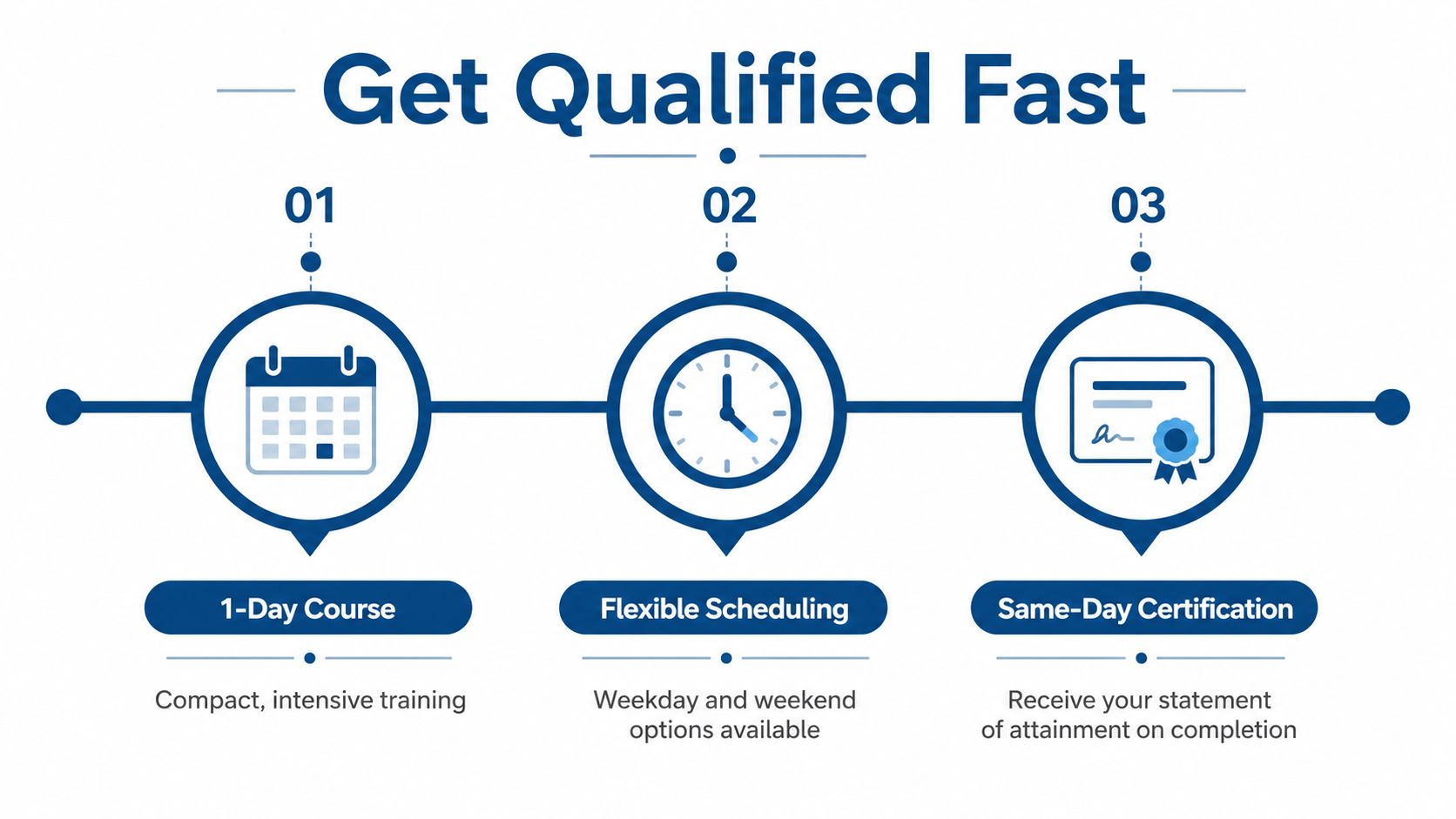
Skid steer training is attractive because it's compact. Most providers compress it into a single day, with theory and practical run back-to-back, then assess you once you've shown enough control to justify the sign-off. That's the right model for job seekers, because nobody wants to sit through days of fluff when the goal is site readiness.
What the timetable usually looks like
A solid course usually starts with a morning briefing, moves into machine familiarisation, and then spends the rest of the day on actual operation and assessment. If you perform competently, certification is often issued the same day or shortly after through digital delivery. That speed is a real advantage when you're trying to get on a roster fast.
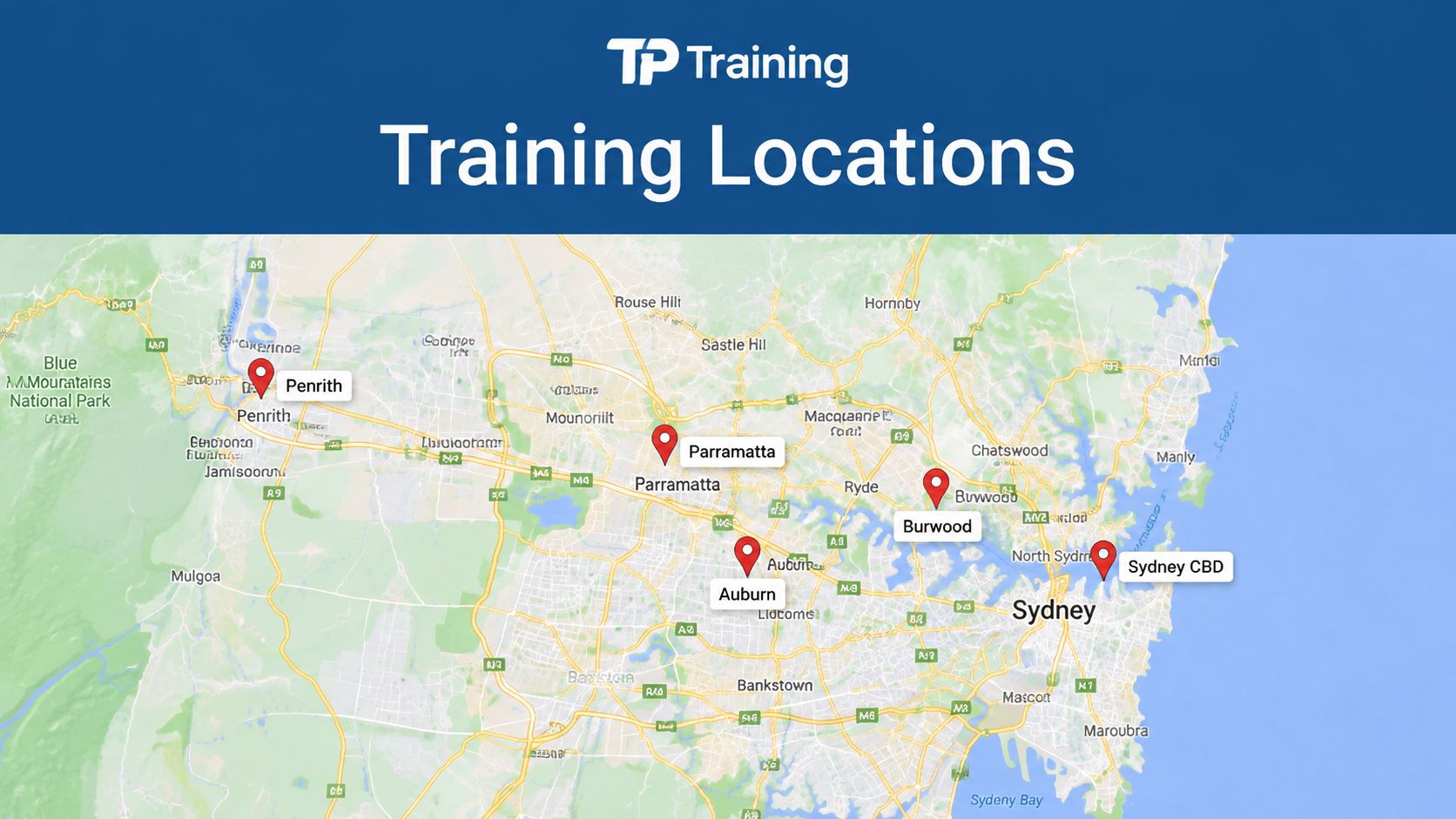
Flexible scheduling matters too. Weekday classes suit people who've already left a job or are between contracts, while weekend or accelerated options suit workers trying to upskill without losing a week of pay. If you're comparing delivery points, TP Training's centres in Penrith, Burwood, Auburn, Parramatta, and Sydney CBD suit different commuter patterns and site access needs.
The practical timeline from booking to site use
If you've already got your White Card and ID sorted, you can move from enquiry to training much faster than many expect. The main delay is usually the student, not the course. People wait until the week they need work, then discover they still need paperwork, PPE, or a USI.
For Sydney students trying to combine machine training with transport convenience, the suburban centres are often easier than the CBD if they're driving in. If you're already city-based, the CBD option keeps travel time down and suits people doing back-to-back short courses.
TP Training Locations Across Sydney and Western NSW
Location choice should be practical, not sentimental. I've seen students pick a campus because it sounded familiar, then waste time fighting traffic or parking before they've even touched a machine. Choose the centre that makes the whole day smoother, not the one with the nicest postcode.
How to choose the right site
- Penrith: Best fit for Western Sydney candidates, especially those who already work around growth corridors and civil projects.
- Parramatta: Good for public transport commuters and workers coming from the broader west.
- Auburn: Strong option for inner-west and south-west students who want a central, practical commute.
- Burwood: Handy for train users who want a more direct run into training without driving all day.
- Sydney CBD: Best for city workers, employers booking staff, or students pairing plant training with other short courses nearby.
The map below gives the basic spread of the five delivery centres.
What to confirm before you lock in
Check the date, the venue, the start time, and what PPE you need to bring. If you're booking for a crew, make sure everyone understands the same venue details, because mixed messages cost hours on the day. Employers booking multiple staff should also confirm whether they're using the same class cohort or splitting people across dates.
The rule is simple. If the venue gets you there calm, on time, and ready to work, it's the right venue.
Costs, Required Documents and How to Book Online
Cost questions usually come down to one thing: what you're paying for. In a proper skid steer course, you're paying for trainer time, machine hours, assessment time, and whether PPE is included or expected to be brought by the student. That's why cheap-looking offers often aren't cheap once the extras start showing up.
What to have ready before you click book
- Photo ID: Bring valid identification that matches your enrolment details.
- USI: Have your Unique Student Identifier ready. If you don't, sort it first through the official process, not on training day.
- Existing tickets: If you already hold a White Card or related site credential, keep the details handy.
- Closed-in footwear: Don't assume borrowing PPE on the day will be an option.
A clean booking process should be simple. Choose the course date, complete the enrolment details, pay the deposit or full fee, and wait for the confirmation email with the venue and start time. That's it. If a provider makes the online path hard to follow, expect the admin experience to be just as clunky later.
For the USI step, TP Training's guide on Unique Student Identifier, USI is the most relevant admin reference before you finish booking.
A quick reality check from the site floor
A first-year civil worker usually books because the supervisor asked for proof of competency before the next roster. A career changer books because they want a machine ticket that transfers into hireable work. An employer books a team because it's easier to get everyone assessed together than to chase individual compliance later.
If you're comparing the skid steer ticket with other machine tickets, don't overcomplicate it. Pick the course that matches the machine you'll be on, and get your paperwork done in one sitting.
Career Pathways and Real NSW Use Cases
A skid steer ticket is a stepping stone, not the end point. On NSW sites, it helps people move from labouring into operator work, and it gives supervisors a reason to trust you around live plant. That's the kind of progress that gets remembered when the foreman is choosing who gets the next machine shift.
Where the qualification pays off
Civil construction is the obvious lane, but it's not the only one. Landscaping crews use skid steers for site prep and material movement, demolition teams use them in tight access areas, and residential builders use them when a compact machine is the only sensible option. Local council work and quarry support roles also value people who can shift between machines without a long re-learning curve.
That flexibility matters if you're building a broader operator profile. A skid steer ticket pairs well with roller, backhoe, excavator, and traffic control credentials when you're trying to become the person employers can place almost anywhere. For people comparing plant pathways, TP Training's discussion of the most practical and affordable excavator training course in NSW is a useful next read if excavator work is also on your radar.
If you're funding a machine ticket as a business decision, it's smart to think beyond wages and look at the job pipeline too. The equipment financing tips by Business Loan Warrior can help employers think through asset costs when they're planning plant upgrades or expanding their crew.
What gets people hired
Employers don't hire the person with the fanciest wording on a certificate. They hire the person who turns up ready, understands the machine, and doesn't create avoidable risk.
That's why the best students stack proof of competency, keep their PPE sorted, and learn enough site language to work cleanly with other trades. If you want the shortest route into real NSW civil work, don't chase paperwork for its own sake. Get the machine skill, get the site basics, and keep building from there.
If you want a straight path into civil plant work, TP Training gives you the practical skid steer training, assessment structure, and NSW delivery options that employers recognise. Book the right course, arrive with your paperwork ready, and use TP Training to take the next step toward site-ready machine operation.

You may also like
Yellow Card Requirements in NSW: A Practical Guide
LV Rescue Training Explained What It Covers and Who Needs It