Blue Card Traffic Control: Your Complete NSW Guide for 2026
1,097,790 current blue card holders, 13,933 applicants, and 1,079,809 current employer links were active in Queensland at the last reporting point, which shows how large and continuous this kind of screening has become. In NSW, the Blue Card is the RIISS00054 Traffic Controller Skill Set, and it authorises entry-level work such as stopping and directing road users with a stop/slow bat.
If you're standing on your first roadside job, holding a bat, waiting for someone to tell you whether you're allowed to step into traffic, that's the question this guide answers. The Blue Card is not a vague safety badge. It's the qualification that prepares you for a very specific job at the stop point, in live roadwork conditions, where your decisions affect drivers, pedestrians, and the rest of the crew.
Table of Contents
- What the NSW Blue Card Actually Authorises
- The Four Units Inside the Blue Card Skill Set
- How the Blue Card Differs From the Yellow and Red Cards
- What Happens on a Blue Card Training Day
- Prerequisites and Practical Steps to Get Your Blue Card
- Validity, Renewal, and the Three-Year Refresher Cycle
- How TP Training Delivers the Course Across NSW
- Choosing the Right Blue Card Pathway for Your Career
What the NSW Blue Card Actually Authorises
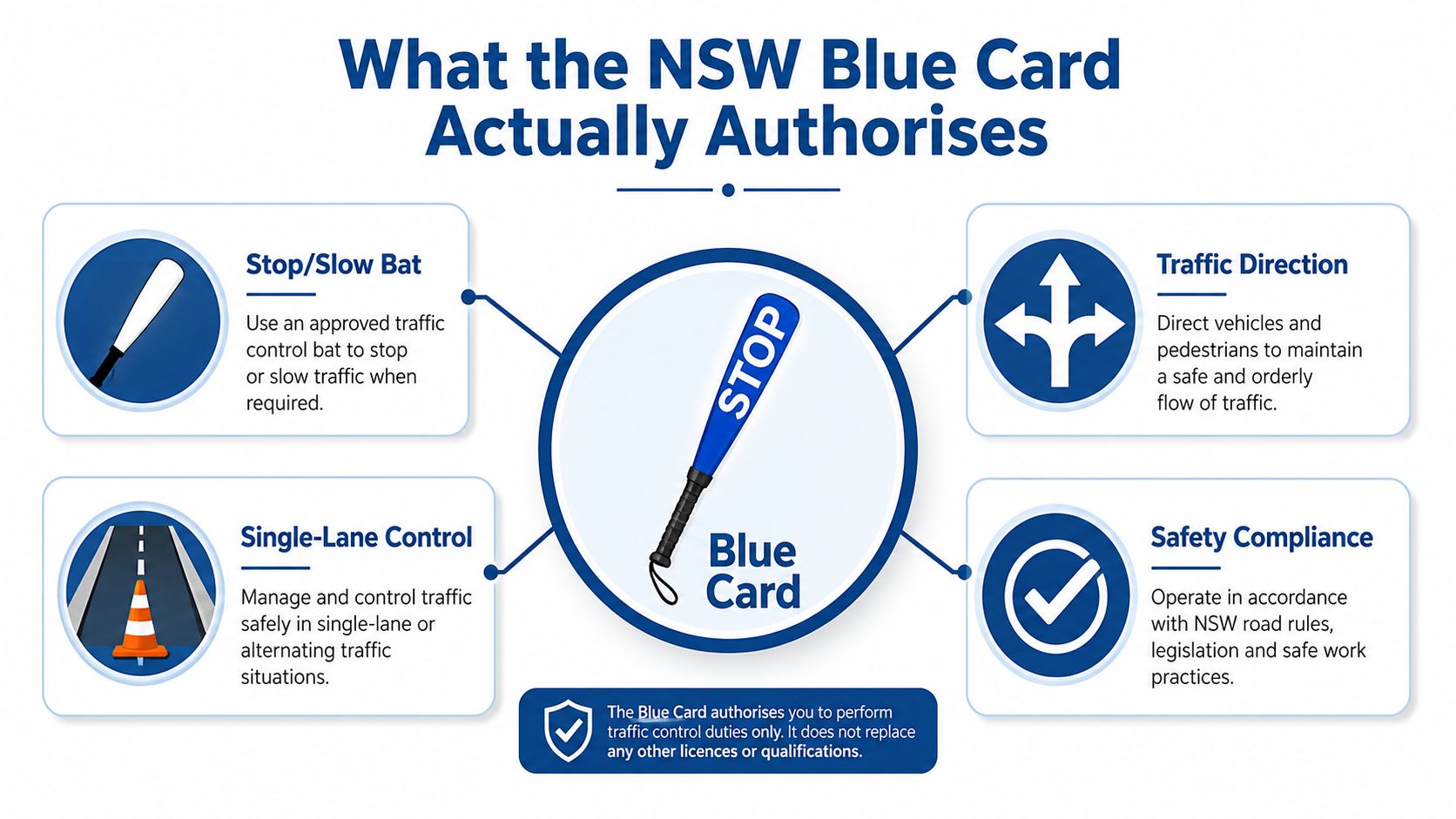
The stop point is where the job becomes real
A new controller often meets the Blue Card for the first time standing beside a one-lane roadwork site, bat in hand, waiting for the cue to stop traffic. That moment shows what the card does. It prepares a worker for the task at the control point.
The Blue Card maps to the RIISS00054 Traffic Controller Skill Set and includes RIIWHS201E, RIICOM201E, RIIWHS205E, and RIIWHS206E. Together, those units authorise the practical work of stopping and directing road users, deploying portable traffic control devices, and placing temporary signs in line with the site's Traffic Management Plan or Traffic Guidance Scheme. The qualification is tied to the role itself, not just the idea of being “around traffic”. You can see the same focus in the overview of traffic control training options in Sydney, which explains how the training connects to real site duties.
That is why the Blue Card is the entry-level qualification for traffic control work in NSW. It gives a worker the legal and practical foundation to stand at the control point and carry out the basic traffic-stream task safely, under the site's plan. A person without that training might know the words, but not the mechanics.
Practical rule: if your job involves the bat, the stop line, and direct interaction with moving vehicles, you're in Blue Card territory.
Why the card matters on an active worksite
Traffic control is a defined operational task with a clear boundary. One person controls the flow at the stop point, another may handle setup, and the site plan tells both of them what is approved.
That distinction reduces confusion on day one. It tells the worker where their authority starts, what tools they use, and what they must follow. It also helps supervisors place people in the right task without guessing.
For anyone trying to understand blue card traffic control, the simplest way to think about it is this. The card authorises the person who physically manages vehicle movement at the point where traffic must stop, wait, or proceed under direction. It is a role qualification, not a general workplace safety badge.
The Four Units Inside the Blue Card Skill Set
What each unit teaches in plain English
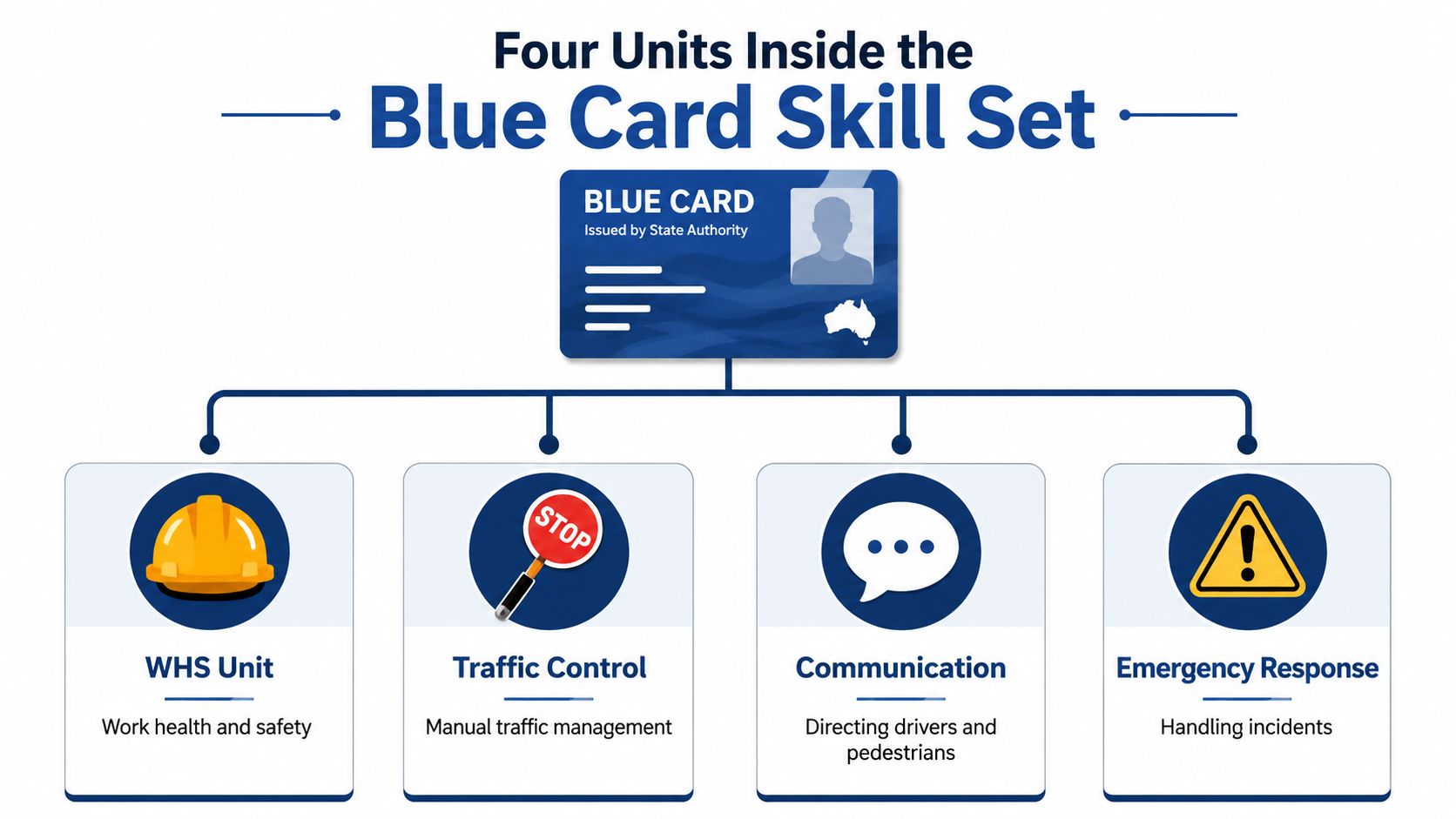
A new controller often sees four unit codes on the page and assumes they are four separate hurdles. In practice, they work together like the parts of one job, because traffic control combines safety awareness, clear communication, and direct control of live vehicles.
RIIWHS201E covers work health and safety basics. Before anyone steps into a live traffic environment, they need to understand how to protect themselves, protect the crew, and recognise the risks around the site. This unit keeps the rest of the role anchored in safe practice.
RIICOM201E is communication. On a roadside job, that means radios, hand signals, and short instructions that everyone on site can follow without guesswork. It is the shared language between the controller, the crew, and, where needed, motorists.
RIIWHS205E focuses on traffic control using a stop/slow bat. This is the part many picture first, because it is the visible front-line task at the stop point. The DLI Training summary of traffic controller duties notes that training covers stopping and directing road users, understanding stopping sight distances, monitoring traffic with portable devices and signs, and maintaining traffic incident reports (how to become a traffic controller and traffic implementer in Australia).
RIIWHS206E covers controlling traffic with portable devices and signs. That unit links the bat to the wider worksite, because the controller has to work with the signs, devices, and layout already placed on the road. It is the part that helps the stop point fit into the larger traffic plan.
How the units combine on site
The value of the skill set comes from how the units fit together in practice. A controller who can communicate clearly, judge sight distance, and respond to changing traffic conditions is more useful on site than someone who only knows the bat signals. That is why the Blue Card works as an entry package for the role, not as a single-skill ticket.
For a local example of how the course is presented, see TP Training's Traffic Control Course Sydney. That kind of course structure matches the job itself, because the work is physical, visible, and tied to the conditions at the stop point.
The person on the bat is not improvising. They are applying a specific skill set to a live roadway with a plan already in place.
The clearest way to describe the Blue Card is this. It certifies a worker to handle the first layer of traffic control, the live direction of road users, while using communication and control devices correctly. Once that is clear, the unit codes read less like jargon and more like the steps of the job itself.
How the Blue Card Differs From the Yellow and Red Cards
Blue, yellow, and red serve different jobs
A lot of learners mix these up because the cards all sit inside the same traffic control pathway. They're related, but they don't do the same job.
The Blue Card is the traffic-stream role. It's the person standing at the stop point, controlling road users with the bat and following the approved site arrangement. The Yellow Card is the site-setup and implementation role, where the worker interprets the approved setup and places signs and devices correctly. That distinction is made clearly in TP Training's own Blue and Yellow Card course information (Blue & Yellow Card course).
The Red Card sits higher up the chain. It authorises a person to prepare a Work Zone Traffic Management Plan. That's planning work, not stop-point work, so it belongs to a different stage of the job.
| Card | Role Focus | Typical Task on Site |
|---|---|---|
| Blue Card | Traffic-stream control | Stand at the stop point and direct road users |
| Yellow Card | Site setup and implementation | Place signs and devices according to the approved setup |
| Red Card | Traffic management planning | Prepare a Work Zone Traffic Management Plan |
Which card fits which career goal
If your immediate goal is to get on site and control traffic under direction, the Blue Card is the right starting point. If your goal is to move into setup responsibility, the Yellow Card becomes relevant after that. If you want to work in planning and documentation, the Red Card is a separate planning pathway.
Many people eventually stack skills, especially when they want more flexibility. But there's no value in chasing a more advanced card before you understand the one that matches your current role. A learner who wants the bat-side job needs Blue Card competence first, not a planning ticket.
For a person comparing options, the question is simple. Do you want to control traffic in the stream, implement the setup, or design the plan? The answer points to the card. If you're unsure, a Yellow Card traffic controller course overview can help you see how site implementation differs from bat work.
That's the practical way to think about the system. The cards aren't interchangeable. They're layers.
What Happens on a Blue Card Training Day
From check-in to practical assessment
Most first-time learners arrive nervous because they're not sure whether the day is classroom-only or hands-on. It's hands-on. The day usually starts with check-in, a PPE check, and basic orientation so everyone knows where they're supposed to be and what gear they'll use.
Then the course moves into the classroom. That's where the trainer explains the bat signals, the site plan, and the safety rules that make the practical side make sense. Learners who think the day is just about waving cars through usually relax once they see how structured it is.
The practical yard is where the lesson becomes real. Students practise the stop/slow bat, learn how to position themselves, and work with temporary signs or portable devices in a controlled setting. The final assessment usually combines the written knowledge check with the practical demonstration, so the trainer can see whether the learner understands both the rules and the movement.
Straight answer: you don't need to arrive knowing everything, but you do need to take the practical side seriously, because that's where the role either makes sense or doesn't.
What learners usually practise
The core skills are practical, not decorative. Learners practise:
- Stopping and directing vehicles, so the stop point feels controlled rather than rushed.
- Watching stopping sight distances, because a controller has to understand when a driver can realistically see the work zone.
- Using portable control devices and temporary signs, which keeps the site arrangement aligned with the approved plan.
- Recording incidents properly, because traffic control doesn't end when something unexpected happens.
That training shape matches how the role works in the field. The controller is not a site manager, and not a planner. They're the person who keeps the traffic stream moving safely under the site's directions.
If you're comparing training styles, the practical content matters more than the sales pitch. A course that only talks theory won't prepare you to stand on a roadside and make correct decisions under pressure. That's why people looking for real-world instruction often compare local options carefully before booking.
Prerequisites and Practical Steps to Get Your Blue Card
Who can enrol and what to bring
The entry requirements are usually straightforward, but learners still get tripped up by small things. You need to be ready to work on foot in a traffic environment, follow instructions clearly, and handle basic language and literacy tasks during training and assessment.
Bring the essentials you'd take to any practical training day. That usually means suitable clothing, the PPE requested by the provider, and your own readiness to concentrate for both theory and practical exercises. If you turn up unprepared, the day becomes harder than it needs to be.
Practical rule: if you'd be uncomfortable walking, standing, and reacting quickly around traffic, pause before booking. Traffic control is not a desk role.
The booking-to-certificate sequence
The process itself is simple when you treat it as a sequence.
- Choose a provider and location.
- Book your place online or by phone.
- Attend the training day and practical assessment.
- Complete the written and hands-on checks.
- Receive your statement of attainment.
That last step matters because it turns the training into a formal credential you can use when applying for work. Some providers issue same-day certification, which reduces the wait between assessment and paperwork.
If you're checking a practical provider, TP Training lists Traffic Controller Course Blue Card as a nationally recognised option with experienced trainers and hands-on learning across NSW. That kind of delivery suits the role because the qualification is built around doing, not just reading.
The easiest mistake to avoid is booking before you've worked out your travel, documents, and personal availability. A smooth enrolment saves stress on the day. A rushed one usually doesn't.
Validity, Renewal, and the Three-Year Refresher Cycle
What expiry really means for workers
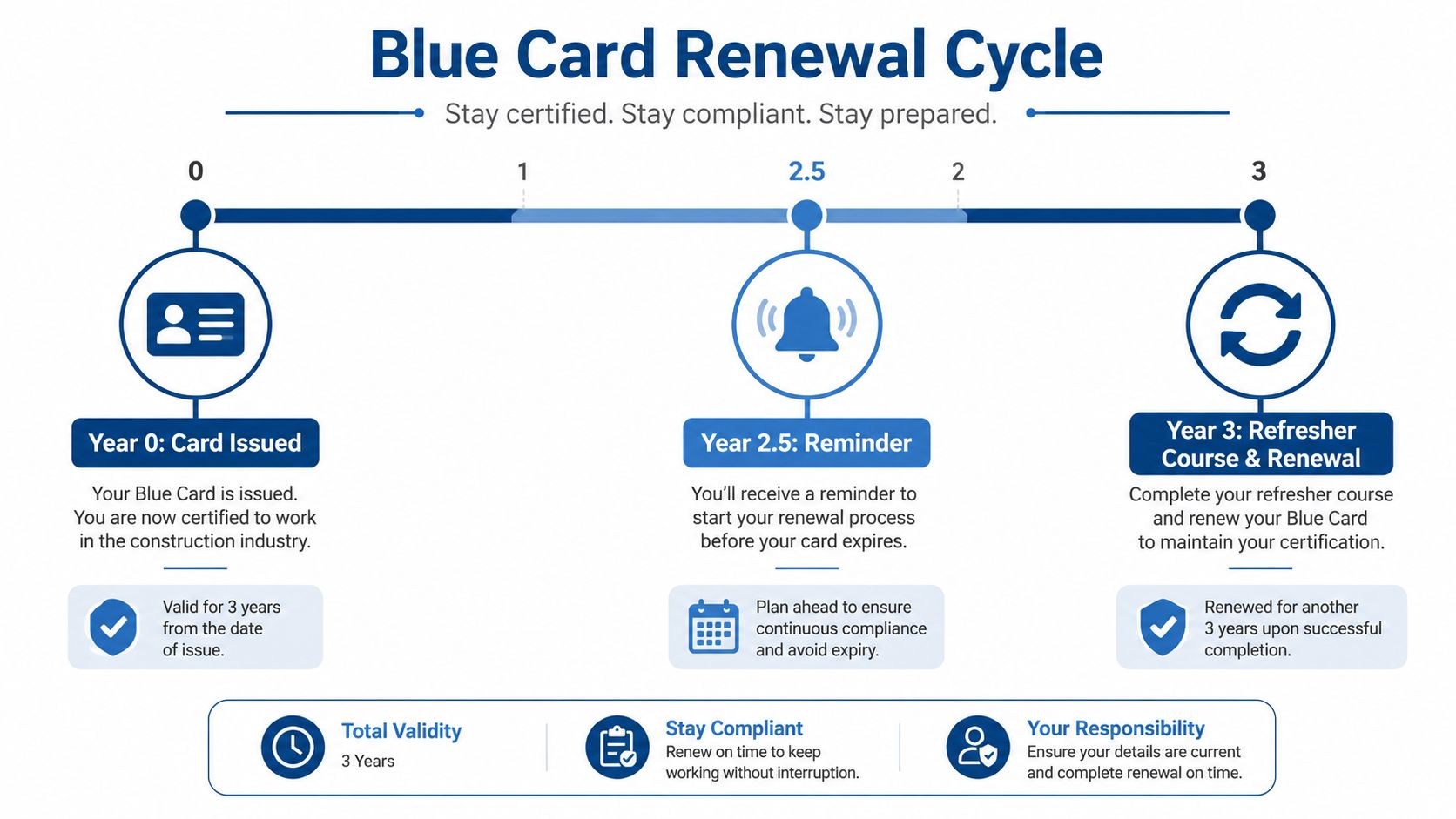
A Blue Card is not a once-off ticket you file away and forget. TP Training states that the card is valid for three years and must be renewed through an accredited refresher course (details on the three-year refresher cycle for Blue Card holders). That matters because traffic control work is shaped by site conditions, equipment, and compliance expectations, and those details can shift over time.
Once the card expires, the problem is practical, not just administrative. A worker may still remember the basics, but employers and principal contractors usually want a current credential before someone is sent to the roadside. The card is part of ongoing compliance, not just a milestone from the first training day.
The refresher cycle exists because the role relies on repeatable habits. Controllers need to keep current on how they position themselves, how they communicate, and how they use the equipment on site. If that currency lapses, the worker has to restore their status before they can be deployed again.
Why employers care about current cards
Employers care because the card sits inside the control system for live work. A current card shows a supervisor that the worker has recent training and still matches the qualification pathway. In road work, one small mistake can affect drivers and the crew at the same time, so that currency is checked with care.
Renewal also helps workers avoid a larger interruption later. If the card expires, the route back may not be a quick check-in. The safer habit is to track the expiry early and book the refresher before it becomes urgent.
The Blue & Yellow Card course (Blue & Yellow Card course) sits alongside that renewal cycle because it reflects the way traffic control training and refresher training connect across a worker's career. Renewal works best when it is treated like maintenance, not a crisis. In traffic control, keeping paperwork current is part of keeping the site moving.
How TP Training Delivers the Course Across NSW
Choosing a centre that suits your routine
TP Training delivers its traffic control training across Penrith, Burwood, Auburn, Parramatta, and Sydney CBD, which makes the course easier to fit around real life. That matters for job seekers and workers who can't afford to spend half a day crossing the city just to get to class.
A learner in western Sydney might choose Penrith or Parramatta because it reduces travel stress before an early start. Someone coming from inner suburbs may prefer Burwood or Sydney CBD. Auburn gives another practical option if that's closer to home or work.
The delivery model matters because the Blue Card is hands-on. A convenient centre lowers the barrier to attendance, especially for people juggling shifts, family, or other job applications. When the practical training is the same, location becomes a logistics decision rather than a course-quality decision.
What stays consistent across locations
The useful part is consistency. The course content is designed to be delivered as a practical, nationally recognised training experience, so the learner isn't getting a different qualification just because they booked at another site. That makes rescheduling easier if work or transport changes.
TP Training also notes multilingual support through its own assistance page, which can be important for learners who are more comfortable studying with language help nearby. If English isn't your first language, that support can remove a lot of first-day pressure (multilingual support).
For a student comparing options, the key benefit is practical continuity. The same type of job is being taught at every centre, so the outcome is about competence, not postcode. That's exactly what a traffic control learner needs when the goal is to get job-ready without unnecessary complications.
Choosing the Right Blue Card Pathway for Your Career
Match the card to the job you want
A new controller on a roadside job usually starts with one question, what work am I being trained to do? If the answer is standing at the stop point and holding the bat, the Blue Card is the right starting point. If the work shifts to placing signs and devices after the site is already set up, the Yellow Card is the next layer. If the job is about preparing traffic management plans, the Red Card sits in that planning stream.
That choice matters because each card matches a different part of the site. People lose time when they book training for a role they do not yet need. A better approach is to choose the card that fits the first task you want to perform, then add more training only when your role changes.
It also helps to understand how those roles connect across a project. Someone who can explain the move from blue to yellow to red can speak more clearly with employers and make better decisions about their next step. They can also use practical resources that sit alongside the wider coordination side of the work, such as effektiva AI-verktyg för speditörer, if their work later overlaps with logistics support.
A simple decision for first-time learners
For a first-time learner, the Blue Card is usually the place to begin. It gives you the entry-level qualification for the stop-point job, the part where you are physically managing traffic rather than planning the whole site. Once you have seen how a site runs and what your role looks like in practice, extra responsibility becomes easier to understand.
That is why many new controllers benefit from starting small. The card is not a general safety badge. It is a licence to do a specific job on a roadwork site, and the training is most useful when the learner understands that connection before they arrive.
TP Training offers a practical route into that pathway across NSW, with hands-on delivery that suits learners who want clear instruction before they step onto site. For someone at the start of traffic control work, that kind of structure reduces confusion and helps the course feel connected to the job itself.
If you are still deciding which pathway fits your next move, start with the work you want to do on day one, then choose the card that matches it. For Blue Card training, TP Training can help you work through that decision and point you toward the location that suits your plan.

You may also like
Yellow Card Requirements in NSW: A Practical Guide

LV Rescue Training Explained What It Covers and Who Needs It