
10 Problem Solving Methods That Actually Work
How often does the same issue come back a month after it was "solved"? Most workplaces don't fail for lack of effort. They fail because someone jumps to a fix before choosing a method that fits the problem in front of them. A knocked-over traffic sign, a pallet that keeps collapsing, a trainee who misses practical sessions, and a reversing near miss are not the same problem. One favourite tool will miss at least three of them.
Problem solving methods earn their keep when the situation picks the tool. A short root-cause conversation suits a single incident with a straight chain of events. A cause map suits a mess with several drivers. A formal risk process suits anything that can hurt someone. A small trial suits a procedure you want to change without gambling the whole site.
This guide walks through ten methods that hold up on construction sites, in warehouses, in hospitality venues, and in training rooms. You'll see when each one works, where it falls short, and which one to reach for first.
Table of Contents
- 1. PDCA (Plan-Do-Check-Act) Cycle
- 2. 5 Whys Root Cause Analysis
- 3. Fishbone (Ishikawa) Cause-and-Effect Diagram
- 4. Pareto Analysis (80/20 Rule)
- 5. Structured Brainstorming
- 6. DMAIC (Define, Measure, Analyse, Improve, Control)
- 7. 8D (Eight Disciplines) Problem Solving
- 8. Design Thinking
- 9. Risk Assessment and the Hierarchy of Controls
- 10. Job Safety Analysis (JSA) and Safe Work Method Statements (SWMS)
- Comparing the 10 Problem Solving Methods at a Glance
- Choosing Your Method and Building the Skills Behind It
1. PDCA (Plan-Do-Check-Act) Cycle
A civil crew that rewrites every pre-start at once is gambling. PDCA treats the change as a controlled experiment: Plan from evidence, Do a small trial, Check the result against the goal, and Act by standardising what worked or adjusting and repeating.
It suits safety procedures, training delivery, and site routines, because a bad full rollout creates its own incident. Say a crew trials a new pre-start checklist on one job, reviews incident notes after two weeks, then adopts it only if the trial holds. A cafe can test a revised coffee-machine opening procedure for one week before the manual changes.
A trial only counts if someone measures the change.
Keep the cycle small
- Write the goal first: Name what should improve, and how you'll know, before anyone edits the form.
- Cap the Do stage: One shift, one site, or one team keeps the risk low.
- Book the Act review: If it isn't in the diary at the start, the cycle never closes.
Practical rule: If you can't name the measure before the trial, you're still guessing.
Tie the Check stage to a workplace inspection checklist so you're looking at conditions, not opinions. PDCA is slow for an immediate hazard. Stop the job first, then use the cycle to improve the procedure.
2. 5 Whys Root Cause Analysis
Surface answers are usually the wrong ones. The 5 Whys asks why the problem happened, then why that answer happened, often about five times, until you reach a cause you can change. Many incidents look like a machine fault or a human slip. The chain usually ends in a gap in procedure, supervision, or training.
After a traffic control sign was knocked over, repeated whys showed the stands weren't checked at shift start. The fix was a daily inspection step, not a lecture. A warehouse traced repeated pallet collapses to uneven load-securing training, not faulty racking. Stopping at "the operator was careless" guarantees a repeat.
Two people with the paperwork will see the system gap faster than one person defending a story.

Stay on process and system causes. Verify each answer with a photo, a record, or a witness before the next why. Stop when the cause is something your team can control. The method fails when the chain isn't linear, or when blame is the point of the meeting. For falls and similar task hazards, pair the why-chain with a falls prevention programme so the last why becomes a control, not a slogan.
3. Fishbone (Ishikawa) Cause-and-Effect Diagram
Late materials on a civil job rarely have one parent. Put the problem at the head of the fish and map causes along bones such as People, Methods, Machines, Materials, Measurement, and Environment. A team chasing late deliveries might find scheduling, staff gaps, breakdowns, and weak supplier calls sitting on different bones. A first aid provider short of kit stock might find ordering, storage, and class demand, not "someone forgot".
The diagram stops the room locking onto the first idea. It is the wrong tool when you need a decision in the next ten minutes. Use it when the problem has several plausible drivers and people are talking past each other.
Sticky notes matter, because ideas move between categories once the group calms down. Mark the causes you think are most likely, then test those, don't "fix" the whole fish. After the action, reopen the diagram and check whether every serious branch was touched. What doesn't work is a pretty chart that nobody verifies. Treat unmarked branches as still open.
4. Pareto Analysis (80/20 Rule)
When the incident folder is thick and the training budget isn't, rank before you react. Pareto analysis orders problems by frequency or impact, usually as bars with a cumulative line. A small set of causes often accounts for most of the pain, so the vital few get the effort.
A safety officer reviewing a year of reports might find three hazard types behind most recorded injuries, and aim refreshers there first. A hospitality group might find most complaints sit in order accuracy and wait times, not the dozen minor themes on the sheet. Ranking is not the same as ignoring rare, severe harm. Pair the chart with a risk review so a low-frequency strike isn't buried under papercuts.
- Sort with one rule: Use the same categories all the way through, or the bars lie.
- Don't drop severity: A rare event that can kill someone still outranks a common bruise.
- Run it again: Repeat after the action so you see whether the vital few shrank.
Focus matters in high-harm work. A look at the most dangerous jobs in Australia is a reminder to spend scarce training time where harm concentrates, not where the last argument was loudest. Pareto needs decent records. Without them, you're voting, not analysing.
5. Structured Brainstorming
Unstructured "let's throw ideas around" usually means the loudest supervisor wins. Structured brainstorming generates a wide set of options before anyone scores them. Defer judgement, welcome odd ideas, and build on what someone else said. It pays when a crew is stuck, or when frontline workers, supervisors, and trainers see different parts of the job.
A civil team used silent writing to list ways to cut machine reversing incidents, then shortlisted a few for trial. A training centre asked students and trainers how to improve practical assessment flow and landed a new station layout. The silent start matters. Ten minutes of writing before talk stops the first speaker setting the whole list.
Put every idea on the sheet with no comment, then score later against safety, cost, and whether you can actually do it this month.
One person records. Evaluation is a separate step, not a running commentary. Brainstorming fails when it becomes the decision. Ideas aren't controls until someone tests them. It also fails if the people who do the task aren't in the room.
6. DMAIC (Define, Measure, Analyse, Improve, Control)
For problems you can count
DMAIC is the Six Sigma path for an existing process that keeps missing a measurable mark: defect rate, delay, or incident frequency. Define the problem and the target. Measure current performance. Analyse causes. Improve with a tested change. Control the new process so the gain doesn't fade after the project meeting.
Motorola developed Six Sigma, and General Electric later applied it widely across its businesses. You don't need that scale. A logistics operator can measure pick accuracy, trace errors to labelling, add a check, and keep a simple control plan so accuracy doesn't slide when the supervisor is on leave. I wouldn't start DMAIC on a one-off scare with no baseline. You'll spend the week building charts instead of making the area safe.
Define a problem statement with a number before you collect more data. Pilot on one aisle, one shift, or one product line so the team learns the rhythm. Without a control plan, Improve is just another poster. The trade-off is time. DMAIC is heavier than the 5 Whys, and it earns that weight only when the problem returns and you can measure it.
7. 8D (Eight Disciplines) Problem Solving
A fault that has already reached a customer, a hirer, or another crew needs a written record the next crew can follow. 8D runs a team through a clear problem description, containment, root cause, corrective action, prevention, and recognition of the people who did the work. Ford Motor Company developed Team Oriented Problem Solving and the 8D approach for quality issues across its supply chain. An equipment hire business can use the same spine after repeated scissor-lift alarms: quarantine affected units, then chase a faulty sensor back to the supplier process.
Containment is the step crews skip because they want the cause first. If someone could be hurt, isolate the plant or the task straight away as soon as the risk is identified, and keep working the cause in parallel. Sharing the lesson across depots is the prevention step. A perfect report that stays in one inbox will fail again on the next site.
Don't close the report until you've shown the corrective action stops the problem.
8D is too heavy for a spilt drink, and too light if you file it as paperwork after the units are already back on hire. I would reserve it for a recurring defect or a safety incident that has already left the yard. The discipline is the sequence, especially containment before debate.
8. Design Thinking
Sometimes you don't have a defect. You have a behaviour you don't understand. Design thinking starts with the people affected, then moves through empathise, define, ideate, prototype, and test. It fits unclear problems: trainees dropping out of practicals, workers who won't report hazards, guests unhappy with service for reasons the comment card never states.
A training provider who interviewed students missing practical sessions found travel and shift timing, not motivation, and moved class times. IDEO has used the same human-centred loop to redesign hospital and product experiences around the end user rather than the organisation's habits. That outside-in step is the point. If you only ask managers, you'll redesign the wrong thing.
A paper model is enough to test whether the new flow works for the people in it.
Talk to several people who live with the problem, not one supervisor's summary. Prototype cheaply: paper layouts, a role-play handover, a marked-up floor. Put a date on each stage or empathy interviews never end. Design thinking is a poor choice for a known breach of a safe-work rule. You don't ideate your way out of a missing exclusion zone.
9. Risk Assessment and the Hierarchy of Controls
A traffic crew still closing a live lane by hand is dealing with foreseeable harm. Safe Work Australia frames the work as identify hazards, assess risks, control risks, and review controls. You look for what could cause harm, then judge how serious and how likely that harm is. A shared method, such as Facility Management Insights on hazard scoring, keeps that judgement from drifting between supervisors. Choose the most effective control that is reasonably practicable. Eliminate the hazard where you reasonably can. Where you cannot, minimise the risk so far as is reasonably practicable. Issuing PPE and treating the job as finished falls short of that duty.
The hierarchy runs from strongest to weakest: elimination, substitution, isolation and engineering controls, administrative controls, then personal protective equipment. Replacing the manual closure with a pre-installed portable barrier moves the crew up that list. A warehouse that brings in mechanical lifting aids, instead of another manual-handling talk, does the same. Higher controls take more planning and plant. Signs and gloves are quicker, and they fail the day someone skips them.
Ask the people on the tools. They see the hazard the procedure missed. Remove or substitute the hazard before you rely on a sign or PPE. Review when the site changes. New plant, new weather, new traffic, or any incident can leave yesterday's control dead.
For how this looks on building work, see risk management in construction. I would use this method whenever harm is plausible, including after a near miss or a recurring unsafe condition. The job is to put the highest workable control in place.
10. Job Safety Analysis (JSA) and Safe Work Method Statements (SWMS)
A JSA breaks one task into steps, names the hazard at each step, and sets the control before anyone starts. On Australian construction and other high-risk work, that thinking is written up as a SWMS, prepared before certain high-risk construction work begins. Check current duties with SafeWork NSW rather than relying on an old template from another job.
A civil crew on excavation might cover underground service identification, trench support, and exclusion zones, then brief everyone before the bucket moves. A first aid provider can use the same task analysis for handling emergency gear in a scenario, so the drill doesn't create a manual-handling injury of its own. Recurring task hazards are where this method earns its place. A vague "be careful" briefing will not.
The four steps are easier to brief when the crew can see them.
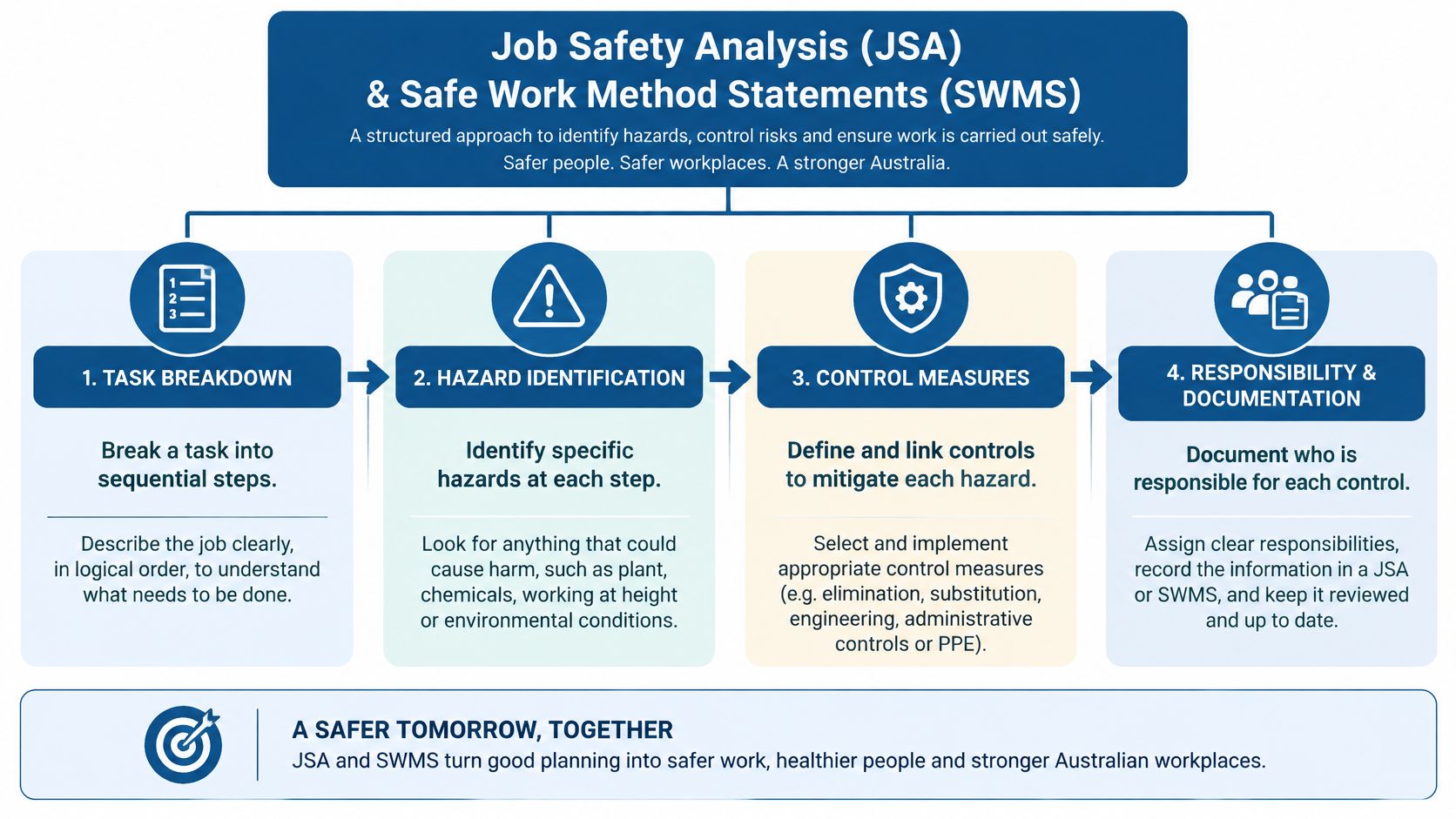
Walk the task with the workers who will do it. Brief before the start and record who was there. Rewrite the JSA or SWMS when the site, the plant, or the steps change. A document that describes last month's job is a liability, not a method. For a wider look at site practice, use this guide to on-site safety. If the task sits outside someone's qualification, induction, or machine experience, the correct control is to stop and escalate, not to improvise a creative workaround.
Comparing the 10 Problem Solving Methods at a Glance
| Method | Best For | Speed | Data Needed | Key Strength |
|---|---|---|---|---|
| PDCA (Plan-Do-Check-Act) Cycle | Testing and refining process improvements | Iterative; takes multiple cycles | Measurable results from a small trial | Low-risk, continuous improvement |
| 5 Whys Root Cause Analysis | Finding underlying causes of straightforward problems | Fast | Evidence to verify each answer | Simple, system-focused root cause analysis |
| Fishbone (Ishikawa) Cause-and-Effect Diagram | Exploring multiple possible causes as a team | Moderate; requires group discussion | Problem statement and team input | Organises potential causes visually |
| Pareto Analysis (80/20 Rule) | Prioritising the most frequent or impactful issues | Fast once data is available | Consistent counts or impact measures | Focuses effort on the vital few |
| Structured Brainstorming | Generating a broad range of possible solutions | Fast to set up | Team perspectives and a defined problem | Produces diverse ideas before evaluation |
| DMAIC (Define, Measure, Analyse, Improve, Control) | Improving complex, recurring processes with measurable outcomes | Time-intensive | Detailed performance data and measurement capability | Disciplined improvement with ongoing controls |
| 8D (Eight Disciplines) Problem Solving | Resolving significant product, process or safety problems | Moderate to time-intensive | Incident details, root-cause evidence and corrective-action records | Combines immediate containment with lasting prevention |
| Design Thinking | Addressing unclear, people-centred problems | Iterative; speed depends on testing | User research and feedback | Develops solutions around people's needs |
| Risk Assessment and the Hierarchy of Controls | Identifying workplace hazards and selecting controls | Varies with task and risk complexity | Hazard, likelihood and severity information | Prioritises effective controls, including hazard elimination |
| Job Safety Analysis (JSA) and Safe Work Method Statements (SWMS) | Managing hazards in specific tasks, especially high-risk work | Moderate; requires task review | Task steps, hazards, controls and responsibilities | Connects task steps directly to practical safety controls |
Choosing Your Method and Building the Skills Behind It
A repeat defect, a near miss, and a problem nobody can name yet do not need the same tool. Match the method to the situation in front of the crew, then practise it until the paperwork is not the only place the method lives.
When the same defect, or a stack of similar incidents, keeps coming back, start with the 5 Whys or Pareto analysis. You want a short, evidence-backed win, not a long list of causes and no fix. If the change has to be tested and then held, not just announced at a toolbox talk, move that finding into a small PDCA cycle or a DMAIC pilot. Check the result. Leave a control in place so last month's fix does not walk back onto the job.
Safety incidents sit in a different category. Stop the task, isolate the hazard, and work up the hierarchy of controls. Australian work health and safety duties expect elimination where you reasonably can, and minimisation where you cannot. A new rule and a piece of PPE are the last resort, not the first answer. Use a risk assessment, a JSA, and a SWMS when the work itself carries the risk: high-risk construction, traffic near live plant, or a task the person has not done on that machine. Escalate if the job sits beyond the qualification, the site induction, or the equipment the worker knows.
Unclear problems need a different pace. Design thinking and structured brainstorming earn their place when the team still cannot say what is wrong. Get the ideas on the wall before anyone scores them. Scoring too early kills the option that would have worked on site.
A method only works as well as the people using it. A crew that can run a short why-chain, read a cause map without blaming the newest worker, and stop a task outside their competence will beat a folder of unused templates. Build that habit inside time you already have. Ten minutes in a pre-start, a handover note that records what changed, and one closed PDCA cycle a month will outdo a long workshop nobody can attend.
If you want practical skill in workplace safety, traffic management, or civil construction, TP Training delivers nationally recognised, hands-on courses across its NSW training centres in Penrith, Burwood, Auburn, Parramatta, and Sydney CBD. Delivery covers workplace-based training, online options, classroom settings, and group sessions. Participants who need help with language, literacy, or numeracy can call 1800 577 301 to discuss their needs. Students with a disability, learning difficulty, or other special needs should notify TP Training at the time of booking so extra time for assessments, specialised equipment, or individualised learning support can be arranged.
Pick one method and apply it to a real problem this week. Put the review in the diary before you start. That habit is what stops a patched defect from returning as the next incident.
Problem solving on site gets sharper when the people doing the work hold current, practical qualifications for the plant, the traffic, and the hazards in front of them. TP Training runs nationally recognised courses across construction, traffic control, civil construction, first aid, and workplace safety, with flexible delivery options. Visit TP Training to compare options and book a course that matches the work your team does.

You may also like

Online Safety Training: What It Covers and Who Needs It

Construction Jobs No Experience: How to Get Hired in 2026