
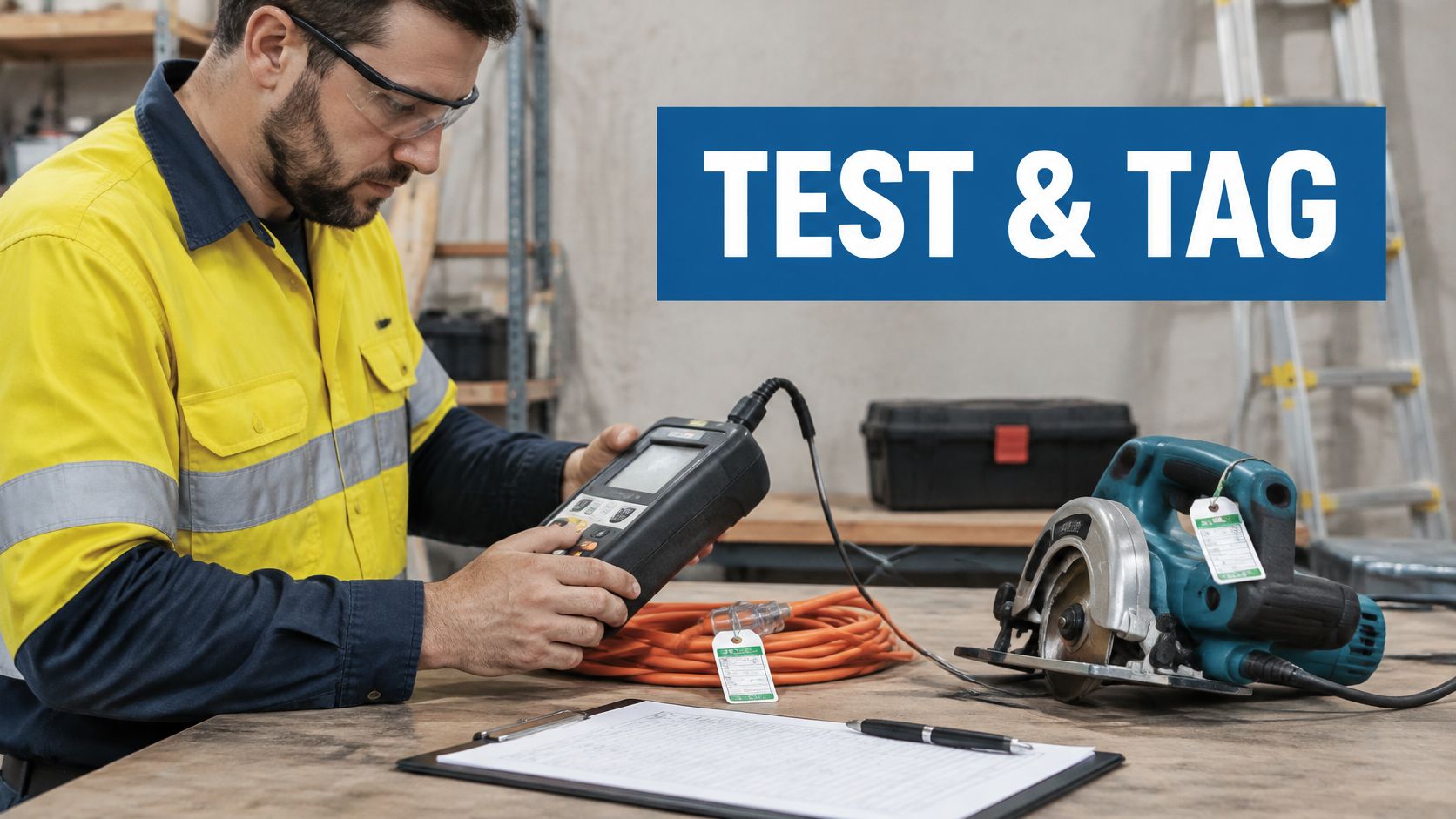
Test and Tag in Australia: Rules, Intervals and Records
You've got a tag on the grinder lead that says March, and the lead is due in three weeks. The register is a spreadsheet someone stopped updating in November, and the tool crib has a portable socket-outlet assembly sitting on a pallet that nobody can account for. Meanwhile the crew has moved twice since the last inspection and one of the leads has a nick in the sheath near the plug that everyone has walked past.
That gap between what's on the tag and what's happening on site is where most of the risk lives. Test and tag isn't a sticker program. It's a traceability and risk-control process, and it falls apart the moment the paperwork and the equipment stop matching.
Table of Contents
- What Test and Tag Means in Australia
- Testing Intervals by Setting and Site
- Records, Tags and Failed Equipment
- How to Test and Tag Equipment Step by Step
- Training Options and When to Hire a Professional
- Confirm Your Test and Tag Schedule and Records
What Test and Tag Means in Australia
In Australia, test and tag refers to the systematic visual inspection, electrical testing and labelling of plug-in electrical equipment and residual current devices (RCDs). SafeWork NSW puts the obligation plainly: electrical equipment must be regularly inspected and tested by a competent person when it is used in workplaces and may be exposed to damage, wear or electrical faults, as set out in its electrical safety guidance for NSW workplaces.
A useful way to hold it together is this. The tag is the receipt. The test is the check that the goods work. The record is the proof an inspector can ask for months later.
The definition that matters: Test and tag is a visual inspection, an electrical test and a durable record, applied to a plug-in item by a competent person at a defined interval.
Strip away any one of those and you do not have compliance. A tag with no register entry is decoration. A test with no tag is an undocumented result. A tag and a register with no visual inspection is a calendar exercise.
The national technical reference is AS/NZS 3760:2022, the Australian/New Zealand Standard for in-service safety inspection and testing of electrical equipment and RCDs. If a tester learned the job before the 2022 edition, make sure the method, limits and paperwork being used match the current edition rather than habit carried over from the old one.
Four details have to appear on the tag, or in a record that supports it:
- The tester's name, so competence and accountability are traceable to a person
- The test date, the starting point for the whole interval calculation
- The next due date, so anyone can see at a glance whether an item is current
- The test outcome, pass or fail, recorded rather than implied
Records are generally retained until the equipment is tested again, permanently removed, or disposed of. That is the traceability part, and it is the part that gets neglected first when a site gets busy.
Why does this carry so much weight in NSW construction and civil work? Portable leads, tools and equipment take impact, moisture, abrasion and constant relocation. Insulation and plugs wear in ways a quick glance will not pick up. If you are also managing the emergency side of site electrical risk, the discipline of low voltage rescue training sits alongside this work rather than replacing it.
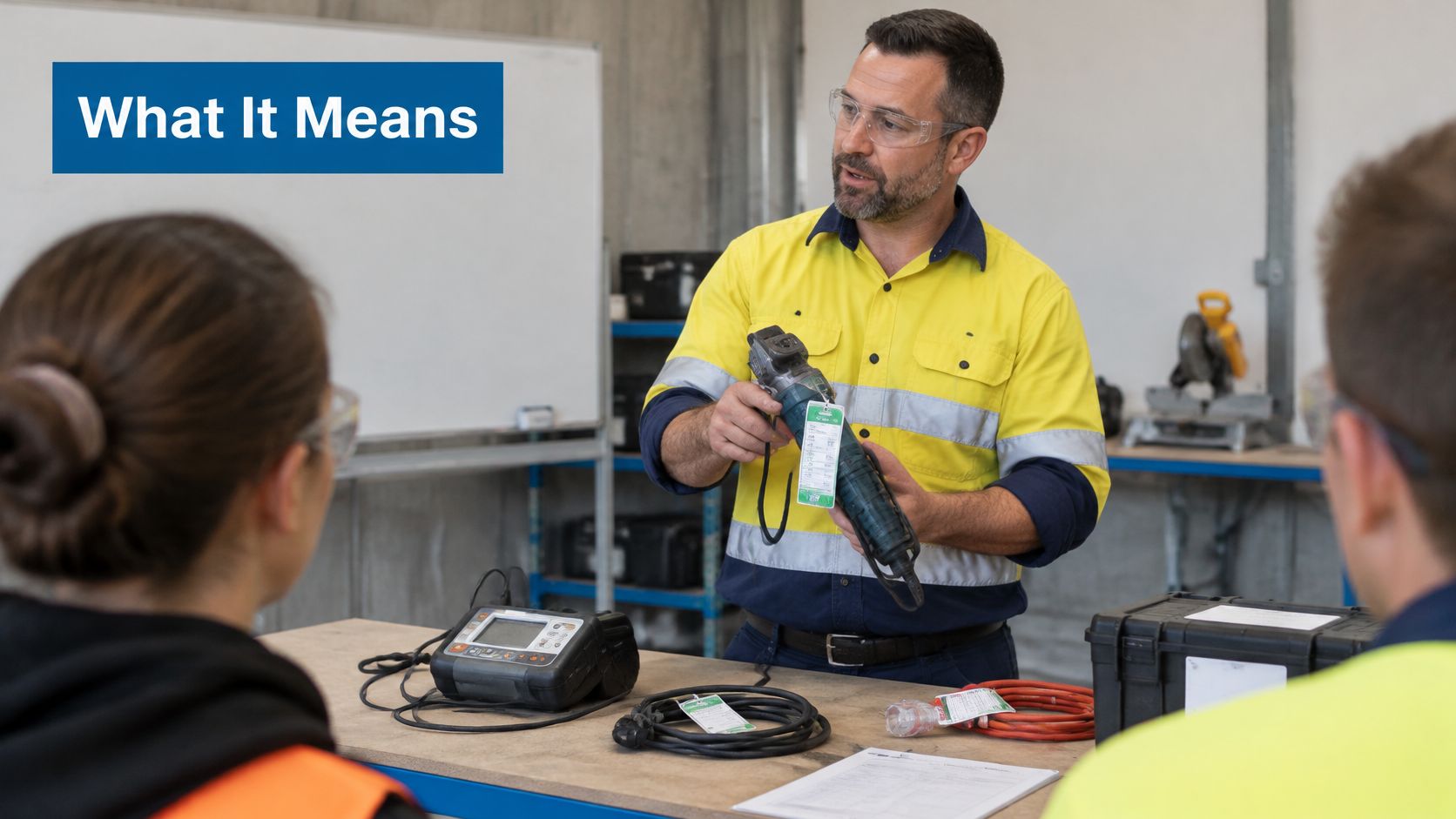
The employer duty sits behind all of it. The business must arrange regular inspection, testing and tagging of specified electrical equipment, keep every item within its required interval, and prevent anything that failed from staying in service. The interval belongs to the risk profile of the setting, not to one national sticker cycle, so the register has to show which rule applies to each item and why.
Tagging is one control inside a wider electrical-safety system, alongside safety switches, isolation procedures and pre-use checks. SafeWork NSW, SafeWork SA and the Queensland regulator all approach it from the same direction: someone has to own the schedule, and the evidence has to survive.
I would apply one test to your own gear this week. Pick up an item, read the tag, then find its register entry. If the entry does not exist, or does not match, the item is not under control yet, whatever the tag says.
Testing Intervals by Setting and Site
There's no single nationwide interval for every item. That's the first thing to unlearn. Annual testing is a general rule for higher-risk workplaces, not a universal legal period, and applying it to a construction site leaves portable tools exposed for nine months longer than NSW and SA schedules allow.
| Setting or equipment | Maximum interval | Jurisdiction and conditions |
|---|---|---|
| Construction and demolition portable equipment | Every 3 months | NSW and SA construction schedules |
| Construction wiring, switchboards and transportable structures | Before energisation, then visual reinspection every 6 months | NSW |
| Other construction equipment | Every 3 months | Queensland |
| Construction wiring, transportable structures, fixed and transportable equipment | Every 6 months | Queensland |
| Factories, workshops and fabrication areas | Every 6 months; visual inspection daily or before each use, whichever is longer | SA |
| Manufacturing equipment, double insulated | Every 12 months | Queensland |
| Manufacturing equipment, not double insulated | Every 6 months | Queensland |
| Cords flexing in normal use or hostile conditions | Every 12 months as a maximum; shorter where moved or damaged | SA |
| Service work equipment | Every 12 months | Queensland |
| Lower-risk, non-hostile areas | Up to 5 years | SA |
| Office equipment without a safety switch | Up to 5 years | Queensland |
| Residential-type accommodation | Every 2 years | SA |
| Commercial cleaning equipment | Every 6 months | SA |
| Hire equipment | Before each hire, and every 6 months | Queensland |
The decision rule is short. Find the row that matches your setting, then apply the most demanding row that could apply. If equipment moves, flexes or gets knocked about, use the shorter interval. Every figure above is a maximum, not a target, and none of them replace a pre-use check.
SafeWork South Australia's inspection and testing schedule breaks this down by environment under AS/NZS 3760:2022. Construction and demolition sites sit at 3 months, with visual inspection at 3 months and RCD push-button testing after connection to a socket and at least once each day the equipment is in use. Factories and workshops move to 6 months, with a visual inspection daily or before each use, whichever is longer. Cords that flex or face hostile conditions land at 12 months. Lower-risk non-hostile areas can stretch to 5 years, residential-type accommodation to 2 years, and commercial cleaning equipment to 6 months.
Queensland's testing and tagging guidance splits it differently, by equipment class as well as setting. Manufacturing equipment is 12 months if double insulated and 6 months if not. Service-work equipment is generally 12 months. Office equipment without a safety switch may reach 5 years. For construction work, transportable structures, fixed and transportable equipment and construction wiring, the interval is generally 6 months, while other construction equipment is 3 months.
The site case reads differently again
On NSW construction and demolition sites, two standards carry the load. AS/NZS 3012 governs the site electrical installation. AS/NZS 3760 governs in-service equipment. SafeWork NSW's construction and demolition electrical practices fact sheet sets portable equipment, including power tools, extension leads, portable socket-outlet assemblies and portable RCDs, at intervals not exceeding three months. Construction wiring, switchboards and transportable structures get inspected and tested before energisation, then visually reinspected at no more than six months.
Then the RCD layer, which is where a lot of sites fall short. Portable RCDs need a push-button test before each use and an operating-time test every three months. Fixed RCD push-button testing is listed at one month intervals. A tag on the lead tells you nothing about whether the RCD behind it will trip in time.
Picture two failures that happen on civil works regularly. A grinder lead dragged across a site gets its sheath abraded by aggregate, and the earth continuity degrades while the tag still reads current. A portable socket-outlet set down on a wet pad takes moisture into the enclosure overnight, and the insulation resistance drops before anyone plugs anything into it. Vibration, abrasion, moisture, dust, impact and relocation all attack insulation, earth continuity and plugs between formal inspections.
That's the mechanism behind the numbers. In 2024, SafeWork NSW found that 41 per cent of flexible cords, power tools and portable outlet assemblies inspected in the NSW construction sector had not been tested and tagged by a competent person, per its 2024 electrical safety in construction findings report.
Roughly two in five items sampled were outside the system entirely. Not failed on test. Not overdue by a week. Never tested by someone competent to do it.
The site rule I'd enforce without exception: any tool that has moved between sites gets a pre-use inspection before it's plugged in, regardless of what its tag says.
Employers can't delegate this to a colour chart. If you're working out where the accountability sits across supervisors, PCBU duties and subcontractors, the responsibilities of employers is the framework that determines who signs off the register.
Records, Tags and Failed Equipment
The register is the control. The tag is just its public face. If I were setting one up from scratch, each row would carry seven fields as a minimum.
Minimum register entry: asset number, description, location, tester, test date, result and next due date.
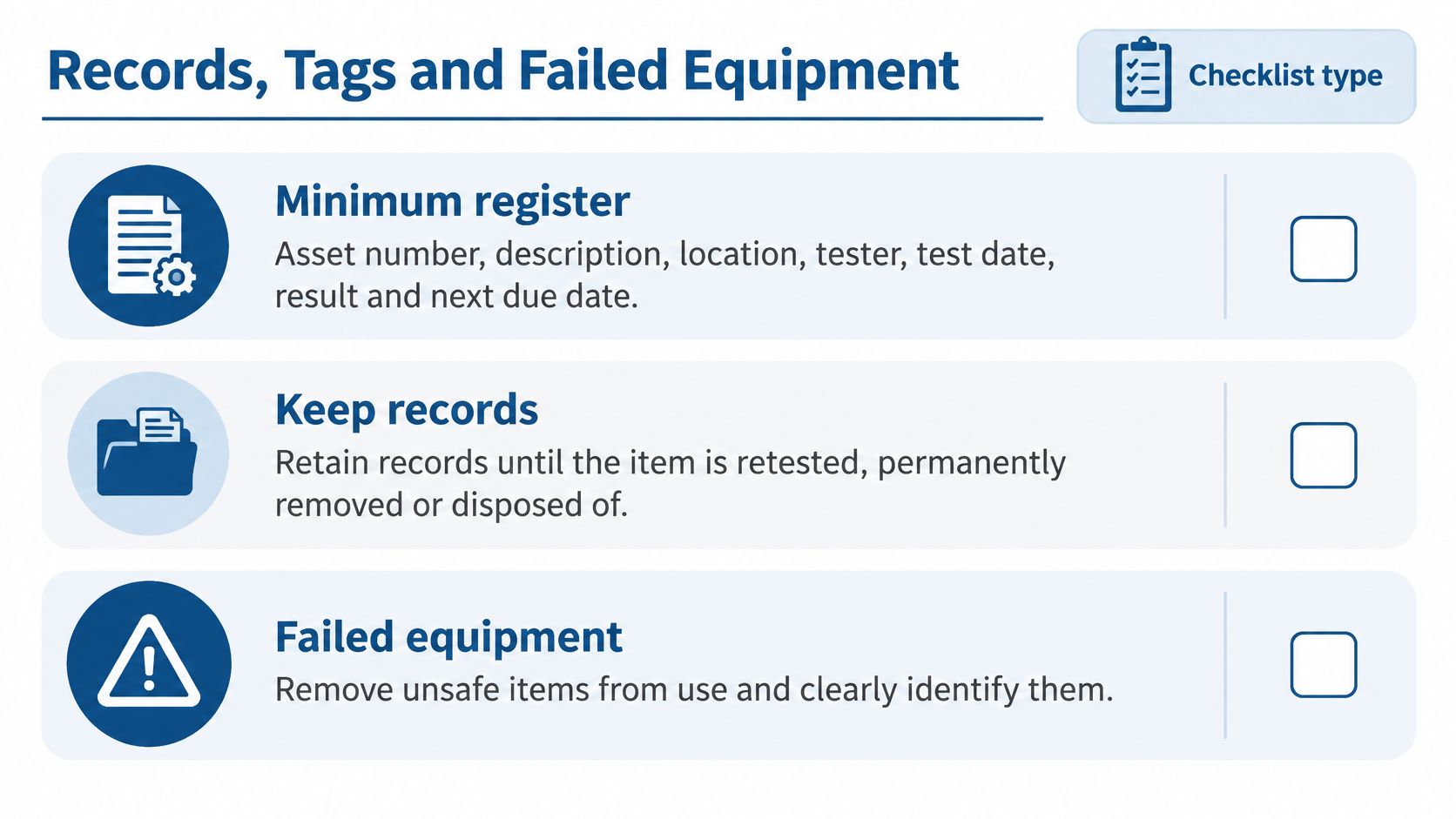
So a row might read: asset GR-014, 100 mm angle grinder with 5 m lead, located in the level 2 compound, tested by a named competent person on 12 March, pass, next due 12 June. Anyone can audit that against the physical item in under a minute. Records stay until the item is retested, permanently removed or disposed of.
Failed equipment is where the process most often collapses. An item that fails is withdrawn immediately, marked out of service, and kept out of use until it's repaired and retested. It doesn't get a fresh tag and go back in the van.
Safe Work Australia's guidance on electrical risks in the workplace also draws a line that surprises people: new, unused equipment generally doesn't require testing before first use, though it should still be inspected for damage from transport or installation. So a brand-new tool out of the box gets a visual check and a record, not a full electrical test.
When a current tag isn't enough
The question that causes the most argument on site is what to do with a tool that has a current tag but is damaged, wet, repaired, borrowed or newly moved between sites.
A current tag does not override a pre-use inspection, and it doesn't override the duty to isolate defective equipment. The tag records what was true on the test date. It says nothing about the drop the tool took this morning.
- Damaged: isolate it, tag it out, and let a competent person decide whether it's a repair and retest or a write-off
- Wet: keep it unplugged and out of the switchboard until it's dried and inspected, because moisture inside a housing isn't visible from the outside
- Repaired: any repair to a lead, plug or internal wiring resets the clock and needs a retest before it goes back into service
- Borrowed or relocated: treat it as untested until someone has checked it against a register, because you don't inherit someone else's records
The sign-off step is what holds it together. A supervisor should be able to spot-check any ten items on site and find a matching register entry for each: tester, test date, next due date, result. Any mismatch means the item comes out of service until it's resolved, not until the paperwork catches up. Our workplace inspection checklist covers the wider site walk if you want the electrical checks to sit inside a broader routine.
How to Test and Tag Equipment Step by Step
The sequence matters, because a visual fault should stop the process before the tester is even switched on. Most defects are visible. Running the electrical test first and trusting the meter over your eyes is how damaged leads get a pass they shouldn't have.
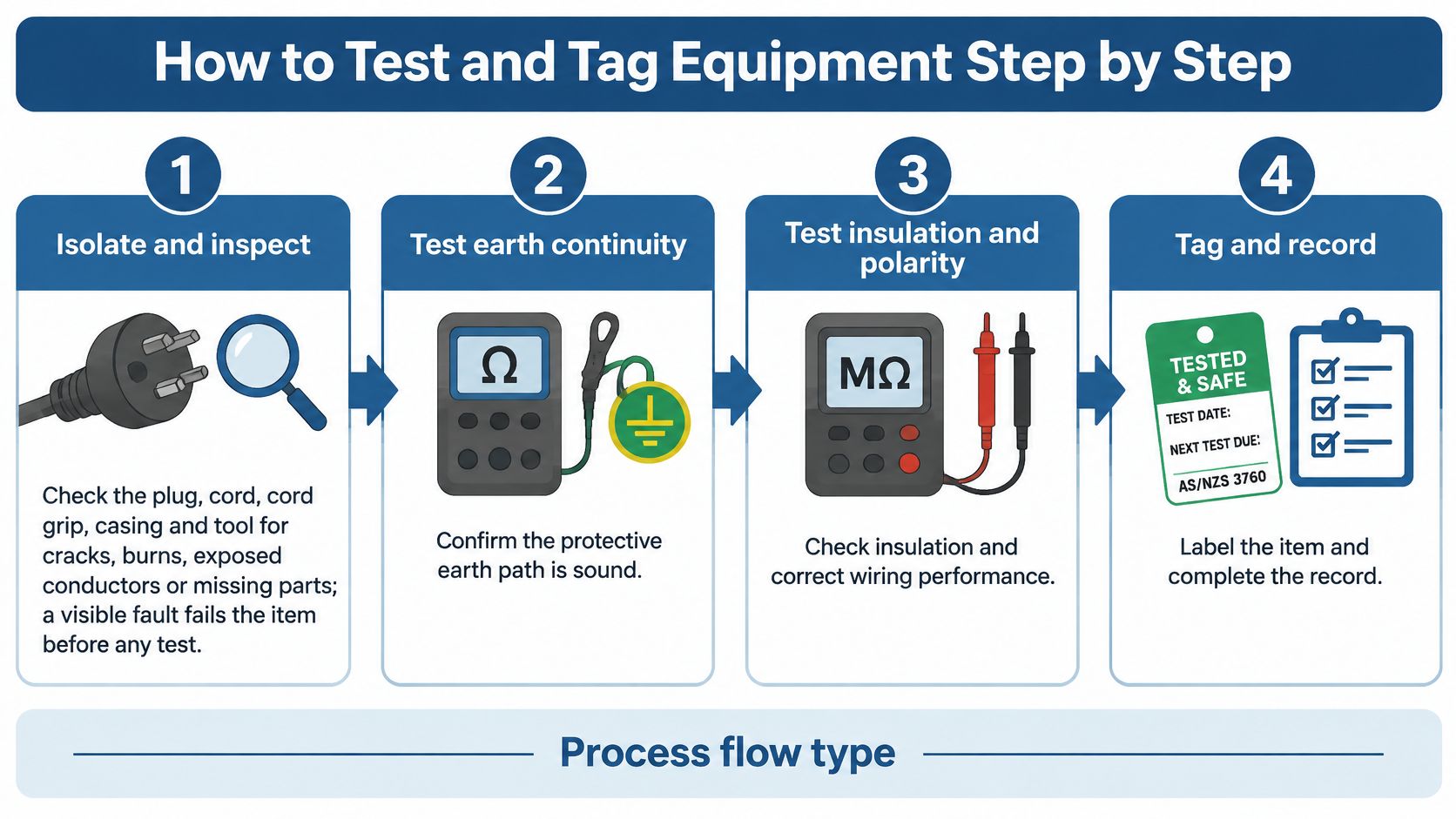
1. Isolate the item and inspect it visually. Check the plug, cord, cord grip, casing and the tool itself for cracks, burns, exposed conductors, bent pins or missing parts. Any visible fault fails the item before a single test runs. The common slip is testing a lead you already know is damaged, which produces a reading that means nothing.
2. Test earth continuity on Class I equipment. This confirms the protective earth path from the metalwork to the earth pin is low-resistance and continuous. A high reading usually points to a loose plug, a damaged lead or a poor earth connection. The slip here is testing with the plug half-seated and blaming the tool.
3. Run the insulation resistance test. This checks that insulation between live conductors and accessible surfaces is intact. For electronic equipment that could be damaged by the test voltage, use the earth leakage test the standard allows instead. The trap is applying an insulation test to sensitive electronics because that's the button you always press.
4. Test the RCD on leads and portable RCDs. Start with the push-button test, then run the operating-time test. The push button proves the mechanism trips. The operating-time test proves it trips fast enough.
5. Do a functional check. Run the tool or appliance under normal use. A grinder that tests fine electrically but won't spin up under load has a fault the meter won't show you. Skipping this is the most common shortcut on a busy day.
6. Apply the tag. Tester, test date, next due date and result. Write the next due date from the test date, not from today's date, not from the end of the month, and not from the last tag. That single error is behind most phantom overdue items chased on site.
7. Enter the result in the register and withdraw any failure. The record is what makes the test auditable months later. A failed item comes out of service immediately.
What a pass actually looks like: every reading within limits, the tag applied and legible, and the label matching its register entry. All three, or it isn't a pass.
Two practical notes from the bench. Tag placement matters: put it where it survives, on the plug end or the tool body rather than a section of lead that gets dragged and abraded. And don't re-tag over an old label, because stacked tags hide the history and make an overdue item look current.
Training Options and When to Hire a Professional
Testing has to be done by a competent person. An informal visual labelling exercise by whoever's free that afternoon doesn't meet the duty, and Queensland's test and tag course guidance is explicit that testing and tagging must be carried out by someone competent to do it. Employers arrange the regime, hold the interval, and keep failed equipment out of circulation.
That duty doesn't move because you outsourced the testing. It just changes who performs the task.

| Option | Best for | Trade-off |
|---|---|---|
| In-house competent person | Sites with many portable tools and regular testing | Needs documented competence, equipment and records |
| Accredited test and tag course for staff | Small teams testing their own equipment | Training time and cost; competence must be kept current |
| Contracted tester | Large or infrequent inventories across sites | Less control between visits; records must be transferred |
| Hire company testing | Hired-in tools and leads | Covers hired items only, under the hire company's own controls |
Hire equipment has its own controls, and they're stricter than most hirers assume. Queensland's guidance on hiring electrical equipment requires the hire company to ensure equipment is inspected and tested by a competent person before each hire unless it has a permanently connected safety switch that can't be disconnected, deactivated or removed. Hired equipment must also generally be inspected, tested and tagged every 6 months, with a durable tag showing the next scheduled test date. Failed items are withdrawn from hire and labelled unsafe.
The lesson for a hirer is simple. The hire company's tag tells you it was tested under their system. It doesn't tell you what happened to it on the last site, so check it yourself before it goes to work. If you're weighing up what a compliant regime costs against doing it in-house, these 2026 test and tag rates give a current benchmark for contracted pricing.
Triggers for bringing someone in
I'd call a professional in these situations rather than stretching an internal arrangement past its limit.
- No documented competence: nobody can produce evidence of training, so the duty isn't being met
- Inventory spread across many sites: the register stops being one person's job and starts being a system problem
- A backlog of failed or untagged items: the volume has outgrown the person doing it
- Switchboards or lifting controls in scope: the work has moved beyond portable appliances
- An insurer or principal contractor needs independent records: the documentation has to withstand external scrutiny
Whatever you choose, daily user checks stay with the people holding the tools. No testing regime, in-house or contracted, replaces a worker looking at a lead before they plug it in. If you're building the broader safety capability of a team, our workplace safety training covers the practical competencies that support this kind of day-to-day discipline.
Confirm Your Test and Tag Schedule and Records
Five steps get this from a vague obligation to a working system, and they're all doable inside a fortnight.
- List every plug-in item. Leads, power tools, portable RCDs, socket-outlet assemblies, cleaning gear and office equipment, each with its location and the setting it works in. Don't list the setting you'd like it to work in.
- Look up each item's maximum interval in the table above. Where an item moves, flexes or has been damaged, use the shorter interval. Where two rows could apply, use the demanding one.
- Check every tag against its register entry for tester, test date, next due date and result. Fix every mismatch before the next inspection, not after.
- Pull anything overdue, untagged or failed from use and mark it out of service until it's repaired and retested. That includes the items in the back of the ute.
- Confirm who is competent to test. If nobody can document it, book an accredited course or a contracted tester before the next due date arrives.
If the team needs accredited training as well, check the provider's registration on the national register before booking, and confirm the course covers the equipment you own. A course built around office appliances won't prepare anyone for a construction site's 240 V leads and portable RCDs.
Then set a next due date for every single item this week, with a named person against each date. An unowned date is the one that lapses. A safety and health policy that names the responsible role, the interval and the review cycle is what stops the register becoming a spreadsheet nobody opens until an inspector asks. Our guide to a safety and health policy shows the structure that makes those responsibilities stick.
The tag was never the point. The point is knowing, on any given morning, that every lead on your site has been looked at by someone competent, recorded against its own history, and pulled the moment it stops being safe. That's a system you can defend in an audit and, just as much, in a hospital corridor.
At TP Training, we're an authorised provider recognised by ASQA and registered as RTO No 21488, delivering nationally recognised training across Penrith, Burwood, Auburn, Parramatta and Sydney CBD. Our experienced trainers work with construction, civil, EWP and high-risk work crews on the practical competencies that keep a site compliant, from White Card and Traffic Control through to the safety and inspection skills covered here. Visit TP Training to find the course that fits your team's next due date.

You may also like
Dangerous Goods Class 3 Flammable Liquids: Rules and Risks

White Card Practice Test: Sample Questions and Answers