
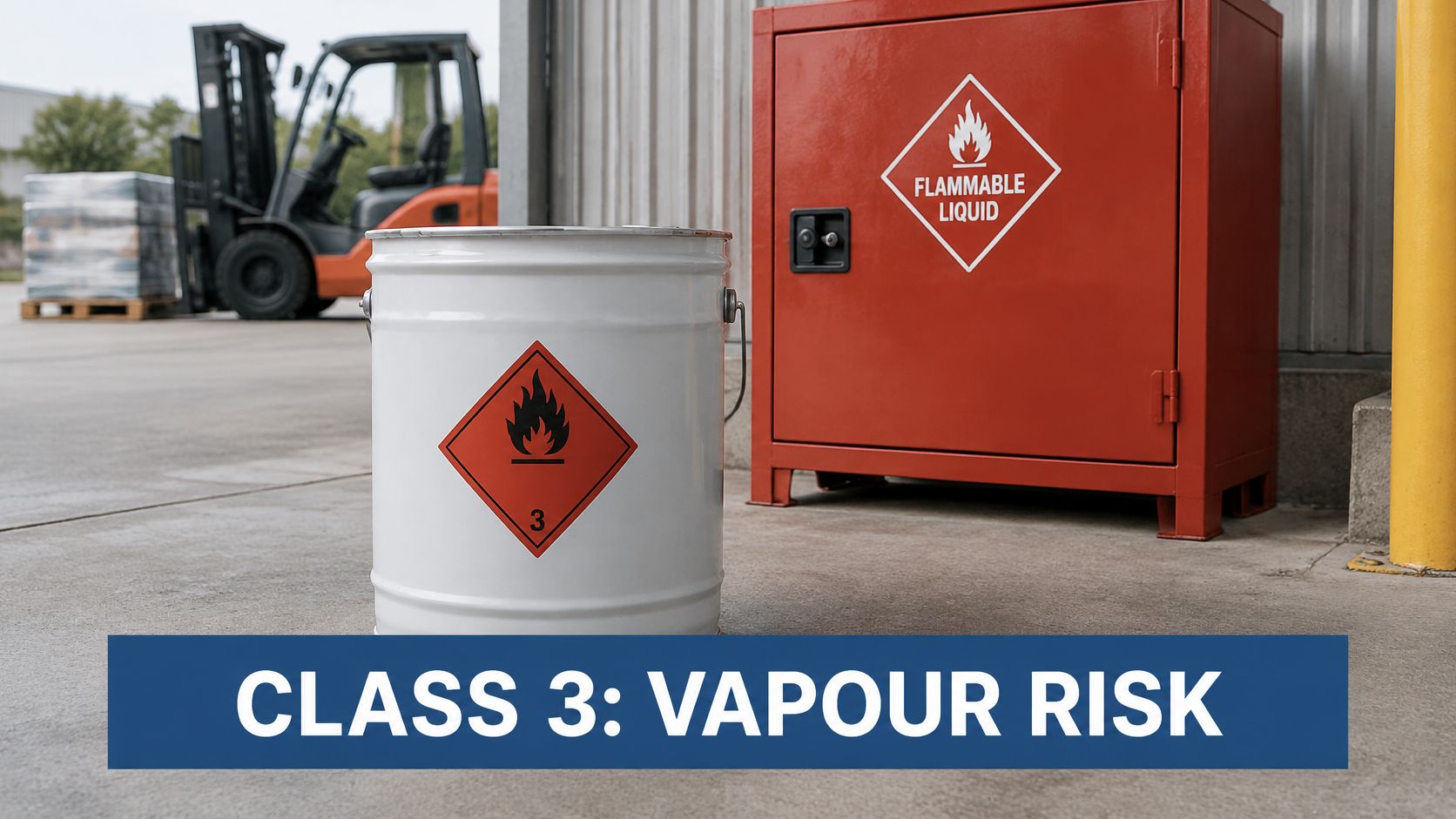
Dangerous Goods Class 3 Flammable Liquids: Rules and Risks
You're at the ute right now, sliding a 20-litre drum of paint thinner in beside the tools. The lid is on, the liquid isn't burning, and the load looks like any other job-site product. That calm look is where crews get caught. Dangerous goods class 3 flammable liquids are judged by the vapour they give off, not by how ordinary the tin looks, and a short run between sites can still be a transport task.
Table of Contents
- What Class 3 Flammable Liquids Are and Why Vapour Matters
- Flash Point and Packing Group Thresholds
- Common Class 3 Products Found on Job Sites
- Reading Labels, SDS Sections and UN Numbers
- Storage Controls That Stop Vapour Ignition
- Quantity Thresholds That Trigger Placards and Manifests
- Transport Duties, Training and Your Pre-Load Check
What Class 3 Flammable Liquids Are and Why Vapour Matters
Vapour does the travelling. A drum that looks sealed still releases ignitable vapour into the air above the liquid, and that vapour can drift toward a hot exhaust, a grinder spark, or a switch in the cab several metres away. The liquid itself stays put. The liquid works like a damp sponge, steadily breathing out a fuel-rich mist, and the mist is what finds the ignition point.
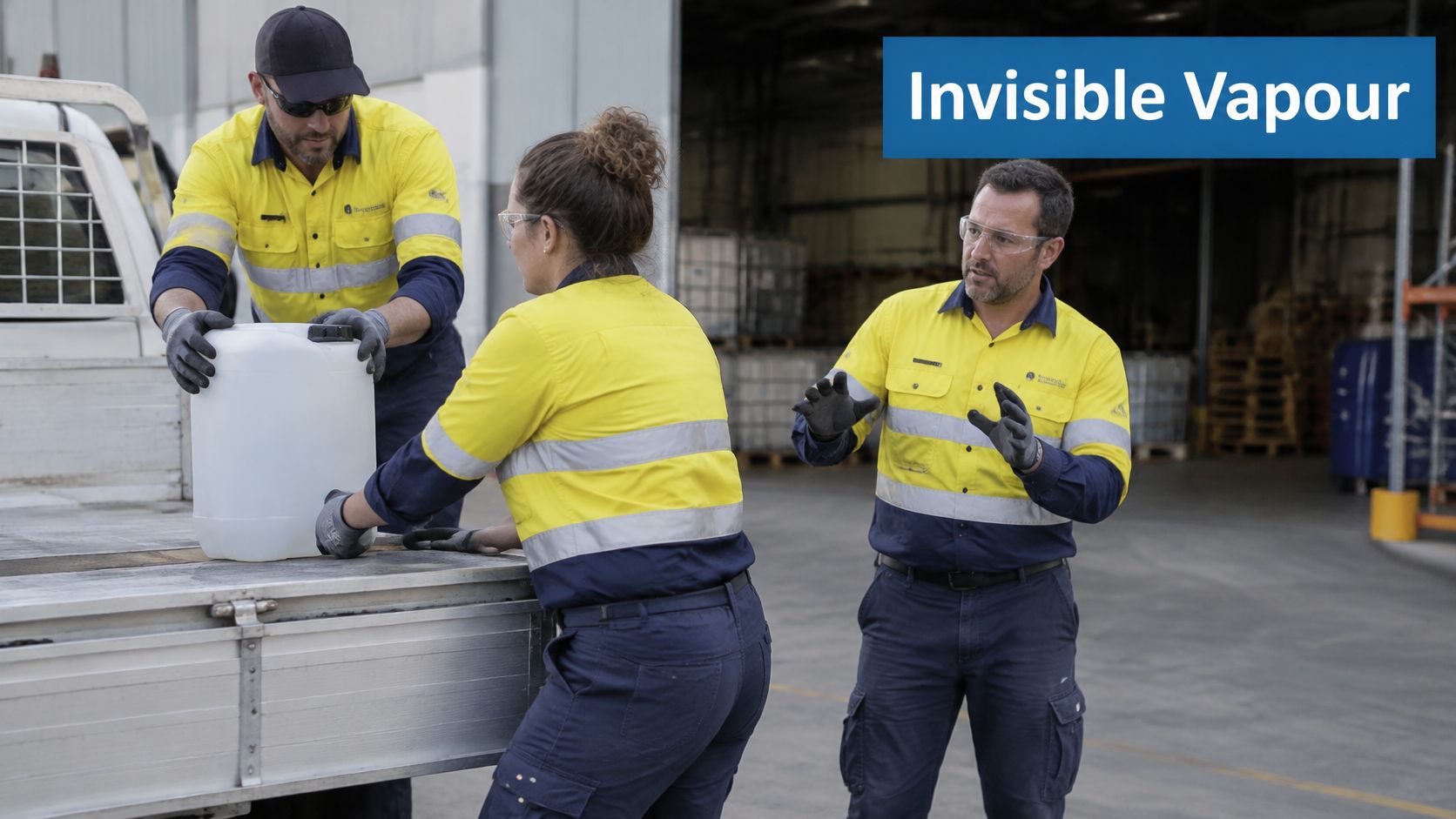
In Australia, Class 3 status comes from the flash point recorded for the liquid, and the name printed on the tin has no bearing on it. The Australian Code for the Transport of Dangerous Goods by Road and Rail (the ADG Code) sets the flammable-liquid definition at a flash point of not more than 60°C on the closed-cup test, or not more than 65.6°C on the open-cup test, and its scope covers flammable liquids, liquid desensitised explosives, and certain substances carried at high temperature. The Code also captures liquids carried at or above their flash point, and heated liquids that release flammable vapour at or below their maximum transport temperature.
Why the product name is a weak clue
Petrol, some solvents, paints, varnishes, lacquers, adhesives, and paint thinners can all sit under Class 3 while needing different controls. “Paint” or “solvent” doesn't tell you the flash point or which test produced it. The workplace GHS label doesn't settle the transport question either: a red flame pictogram on a store shelf signals a hazard, while the transport classification depends on the flash point and boiling point results recorded in the safety data sheet. Load size trips crews up as well. A single 20-litre drum is still a Class 3 load, and several small containers carried together add up to aggregated quantities that attract placarding and manifest duties, the same obligations a tanker faces.
Practical rule: Read the safety data sheet before you treat a familiar product as low risk. Ignitable vapour is what reaches the ignition source, even when the liquid itself never moves.
If a fire does start, the extinguisher has to match the fuel. A crew that already knows the different classes of fire extinguishers is less likely to grab the wrong one beside a solvent store. The check that settles every one of these questions is the same each time: the SDS, and the flash point it records.
Flash Point and Packing Group Thresholds
Flash point is the lowest temperature at which a liquid gives off enough vapour to ignite when a flame is offered. A kettle gives a useful picture: the lid rattles and steam lifts before the water boils. With a flammable liquid, ignitable vapour can be ready well before the liquid itself boils.
How the bands are set
Class 3 liquids are split by degree of danger. Queensland's dangerous goods definitions set Packing Group I as high danger where the initial boiling point is below 35°C, Packing Group II as medium danger, generally a flash point below 23°C with an initial boiling point above 35°C, and Packing Group III as low danger, a flash point from 23°C up to and including 60°C with an initial boiling point above 35°C. A liquid with a flash point above 35°C that does not sustain combustion may sit outside Class 3. Read the flash point from Section 9 before you act on a flame pictogram, because a workplace GHS label was never designed to settle transport classification.
| Packing Group | Initial Boiling Point | Flash Point | Degree of Danger |
|---|---|---|---|
| Packing Group I | Below 35°C | Boiling point sets this group; confirm the flash point on the SDS | High danger |
| Packing Group II | Above 35°C | Below 23°C | Medium danger |
| Packing Group III | Above 35°C | 23°C to 60°C (closed-cup) | Low danger |
| Outside Class 3 | Any | Above 60°C (closed-cup) or above 65.6°C (open-cup) | Not Class 3 unless carried at or above its flash point |
A low flash point can put one Class 3 liquid in a stricter band than another that carries the same broad class. The assigned group is what the Dangerous Goods List records, and it changes packaging performance, handling, transport documents, and what you tell emergency crews. The thresholds apply the same way to a single tin of thinners on a ute as they do to a tanker load, and the same way to several small containers counted together on a site.
Three steps that settle the band
- Open Section 9 of the SDS. Find the flash point and the test method, closed-cup or open-cup, plus the initial boiling point.
- Line those figures up with the table. Boiling point below 35°C points to Packing Group I. A flash point below 23°C with a higher boiling point points to Packing Group II. A flash point from 23°C to 60°C points to Packing Group III.
- Write the packing group down for the store record and for any consignment note. Years on the tools and the trade name are not the classification. The official entry is what the rules use.
The test method itself can shift the answer. Take a solvent blend that returns a closed-cup flash point of 24°C: it sits in Packing Group III. Run the same blend through an open-cup test and the figure can come back higher, yet the closed-cup result is what the band uses. Two SDS sheets for near-identical products can disagree for exactly this reason, so record the method alongside the number.
Common Class 3 Products Found on Job Sites
Fuel for plant, solvent-based coatings, thinners, adhesives, acetone cleaners, methylated spirits, and alcohol-based hand sanitiser pass through construction, civil, and warehouse sites every week, often without anyone calling them Class 3. Perfumes and some essential oils belong in the same family. The packaging differs across all of them, and the shared trait is ignitable vapour. One jerry can in a closed canopy or a carton of sanitiser in a parts cage can put enough vapour into the air to matter, and small containers add up fast when they share a vehicle or a storage cage.
What usually surprises a crew
The Dangerous Goods List in the ADG Code records the entries crews meet most often: petrol (motor spirit) is UN1203, commonly Packing Group II, and acetone, UN1090, and ethanol, UN1170, sit in the same band. Petrol's vapour can ignite at ordinary site temperatures, so that jerry can under a canopy is no harmless extra. Solvent-based paint and varnish, often UN1263, and many thinners move between Packing Group II and Packing Group III depending on the solvent blend.
Two named products sit near the boundary often enough to catch crews out. Automotive diesel for generators and compressors, and water-based acrylic interior paint, can each carry an SDS flash point at or above the 60°C closed-cup line, which pushes them outside Class 3. Check the SDS flash point for paint and fuel alike before assigning a group, because the trade name alone gives no answer.
| Product | UN Number | Typical Packing Group | What to Check |
|---|---|---|---|
| Petrol (motor spirit) | UN1203 | Packing Group II | Grade and SDS flash point |
| Acetone | UN1090 | Packing Group II | Confirm the SDS flash point |
| Ethanol or methylated spirits | UN1170 | Packing Group II | Concentration in the SDS |
| Solvent-based paint or varnish | UN1263 | Packing Group II or III | Solvent base and flash point |
| Paint thinner | UN1263 or UN1993 | Packing Group II or III | Flash point band in the SDS |
| Alcohol-based hand sanitiser | UN1170 when the SDS lists ethanol | Packing group printed in Section 14 | Alcohol content and flash point |
| Water-based paint | Not applicable if flash point is above 60°C | Not Class 3 | Confirm the flash point before treating it as outside Class 3 |
Treat the UN numbers and packing groups in that table as the usual entries, then prove each one against that product's SDS. A flammable sticker or a GHS flame pictogram on hand sanitiser warns the people who use it, and neither settles the transport entry on its own.
If you are unsure, hold the product as Class 3 until Section 9 and Section 14 say otherwise. That pause is cheaper than moving an unclassified tin onto a shared load, and it matters just as much for a single box as it does for a pallet.
Reading Labels, SDS Sections and UN Numbers
A carton of thinners can carry two sets of marks at once: the red Class 3 diamond for the road and a GHS flame pictogram aimed at the people who store and pour it. Those marks answer different questions. The GHS label protects handlers at the workplace, while the transport classification, the UN number, and the packing group get decided under the transport rules and written into the SDS. The same checks apply to a one-litre tin as to a pallet of drums. The product name on the front and the size of the load change nothing about which entry applies.
Four checks before the product moves
- Read the container. Confirm the flame pictogram and the hazard statement printed beside it. Statements in the H224 to H226 range grade how severe the flammability hazard is for the people using the product.
- Open SDS Section 2. The hazard statements live there, and a mismatch between the sheet and the tin usually shows up at this step.
- Open Section 14. Record the UN number, the proper shipping name, and the packing group. If the transport entry looks thin, the flash point and test method back in Section 9 support the call.
- Match the entry to the paperwork. The consignment note should carry the same UN number and proper shipping name as Section 14. When the container label and the transport entry disagree, the transport entry governs what moves on the road.
Petrol, acetone, ethanol, isopropanol, and solvent-based paints each travel under their own UN number and shipping name. Where a blend fits no specific entry, it still moves classified, under the generic “flammable liquid, n.o.s.” entry with a packing group assigned from its flash point data. “N.o.s.” is not a reason to skip that step.
| Identifier | Where to Find It | What It Tells You |
|---|---|---|
| Class 3 hazard label | Container and package | Red flame diamond with the number 3, marking a flammable liquid |
| Hazard statements | SDS Section 2 | How severe the flammability hazard is for handlers |
| UN number | SDS Section 14 | The transport identity that must appear on the consignment note |
| Proper shipping name | SDS Section 14 and the consignment note | The name carried on notes and placards |
| Packing group | SDS Section 14 | Which severity band the load sits in |
Keep a copy of that lookup beside the store-room door, and fold the same checks into a workplace inspection checklist so a new tin doesn't skip the register. Small containers count too, because a shelf of everyday tins still adds up to one aggregated site quantity. The pictogram alone cannot give you the transport entry. Section 14 is the line the driver and the paperwork have to follow.
Storage Controls That Stop Vapour Ignition
A spill doesn't have to sit next to a flame to start a fire. Vapour is heavier than many people expect and it travels along the floor, into a drain, or across a room toward a pilot light, a motor, or a switch. Distance from the tin is not protection if the air path is open.
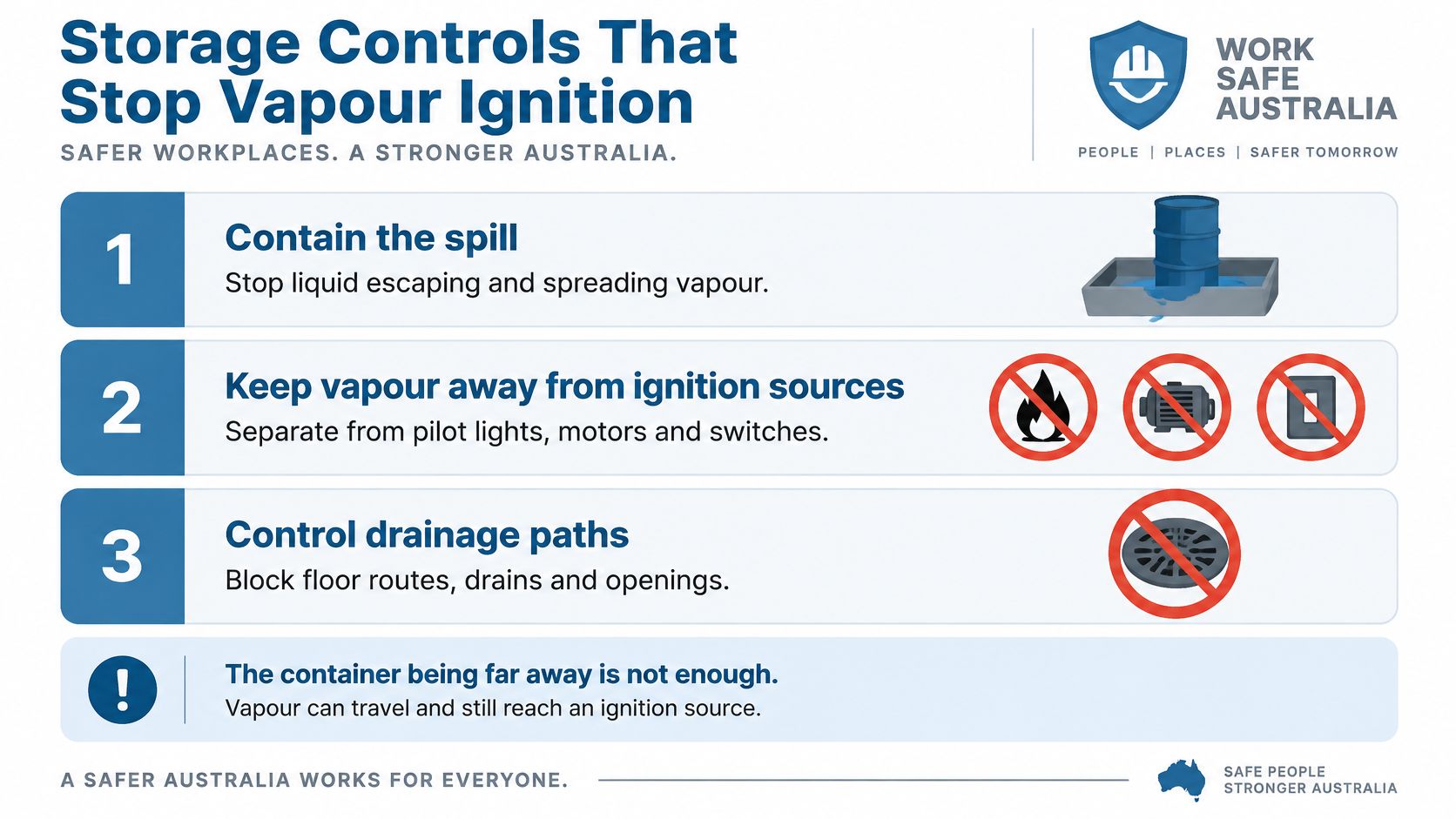
WorkSafe Victoria guidance says Class 3 flammable liquids should be kept in cabinets approved for Class 3 dangerous goods or in a dedicated packaged-goods store. Keep them away from ignition sources, and segregate them from oxidising agents, toxic substances, and corrosives. Keep quantities as low as the job allows, and use a flammable-liquids cabinet where you practicably can.
A sign-off list for the store
Group the walk-through so you don't sign off on a tidy room that still has an open path for vapour.
- Ignition: Clear pilot lights, hot work, grinders, and ordinary switches from the store. Where vapour can pool in a low spot or a pit, crews can find workplace gas detectors and check the air before anyone treats the space as clear. Any hot work nearby needs a current hot work permit so sparks aren't introduced while vapour is present.
- Segregation: Don't share a bay with oxidisers, toxics, or corrosives. A mixed spill can intensify a fire or add toxic smoke.
- Containment: Bunding has to hold a spill, and incompatible chemicals must not share bunding or the same drain. Ventilation should be built to stop vapour gathering, electrical gear should suit the area, containers should be sound, and the exit should stay clear.
The container being far from the flame is not enough. Vapour moves. The store has to interrupt that path.
Cold rooms need an extra line. If the room is held below the liquid's flash point, plan for ventilation or cooling failure, and for a way to de-energise electrical equipment. A closed tin and a swept floor don't replace that assessment.
Quantity Thresholds That Trigger Placards and Manifests
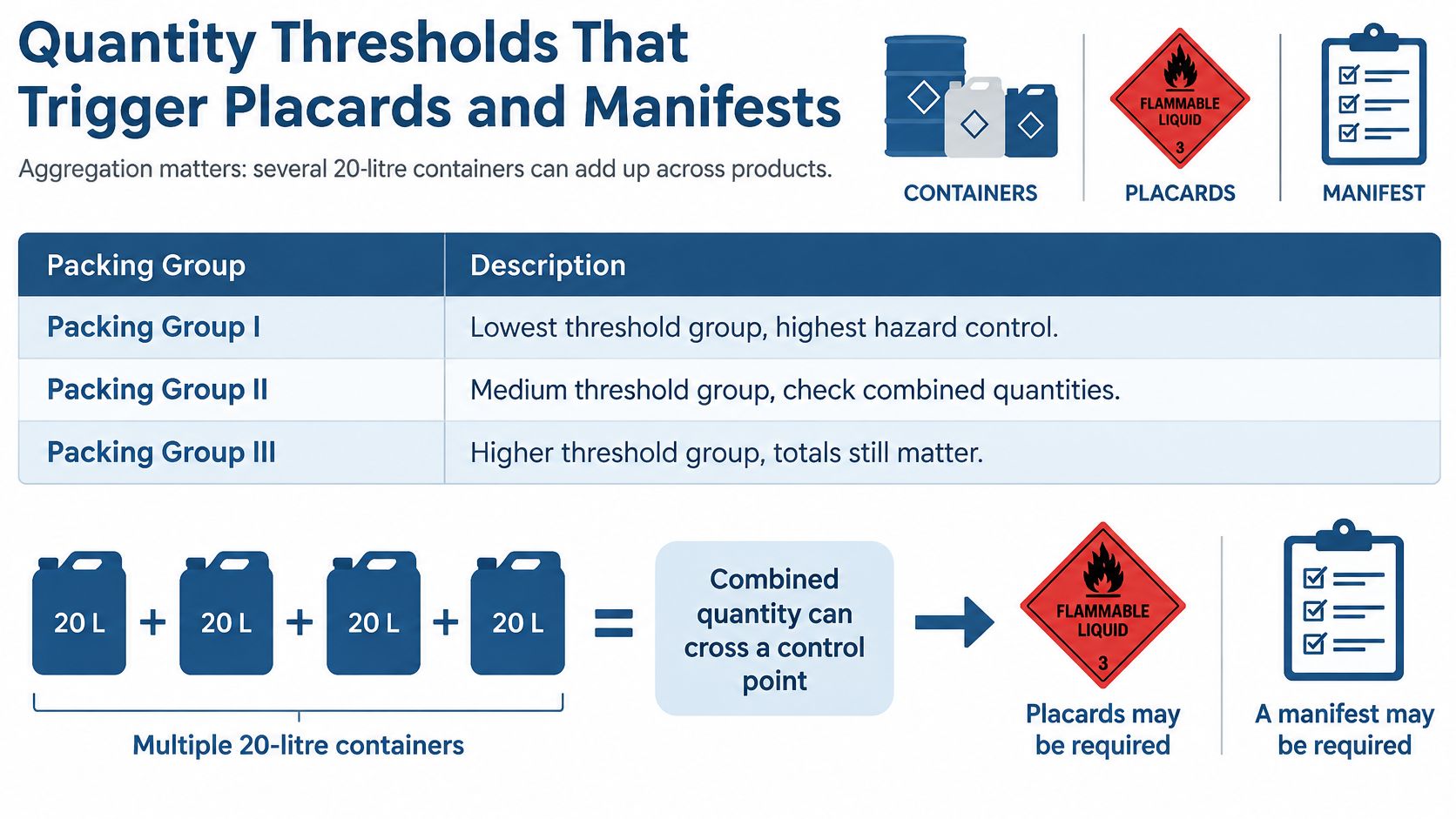
A site crosses a control point by adding products together, not only by owning one large tank. Five 20-litre drums of different solvents can matter as much as a single bulky container. Vehicles parked at the depot count in that picture when their loads are part of the workplace holding.
The figures that change the paperwork
Safe Work Australia sets placard thresholds at 50 L for GHS Category 1 flammable liquids, 250 L for Category 2, and 1,000 L for Category 3. Under the ADG framework those categories line up with Class 3 packing groups I, II, and III. Manifest thresholds sit higher, at 500 L, 2,500 L, and 10,000 L. Combined Category 1, 2, and 3 flammable liquids above 1,000 L can require placarding even when no single category has passed its own placard line.
| Category (Packing Group) | Placard Threshold | Manifest Threshold |
|---|---|---|
| Category 1 (Packing Group I) | 50 L | 500 L |
| Category 2 (Packing Group II) | 250 L | 2,500 L |
| Category 3 (Packing Group III) | 1,000 L | 10,000 L |
| Combined Categories 1, 2 and 3 | More than 1,000 L combined | Use each category's own manifest threshold |
One confusion is worth clearing up early. A workplace GHS label gives the hazard category used for storage and handling, and that is what the placard table above works from. Transport classification is a separate test under the ADG Code, built on the UN number and packing group in Section 14 of the SDS. A drum marked Category 2 on the shelf still needs its transport details confirmed before it goes on a ute.
Placard duty and manifest duty are separate as well. You can owe a placard from the combined 1,000 L line and still sit under each manifest figure. In NSW, these workplace duties sit under the Work Health and Safety Regulation 2017, which SafeWork NSW enforces, so that is the instrument to check rather than assuming the national guidance is the whole answer. A driver who may move goods above a transport threshold should look at what a dangerous goods driver's licence course covers, because the depot total and the ute total are judged differently. TP Training sets out the licence requirements for dangerous goods drivers for anyone weighing up that ticket.
Four steps for the inventory
- List every flammable product by GHS category and packing group, working from the SDS rather than the shelf label alone.
- Add the litres across the site, including utes and trucks that overnight at the depot.
- Compare each total with the placard column and the manifest column, then check the combined placard line.
- Recount when fuel or solvent arrives. Yesterday's total doesn't survive a delivery.
A supervisor who only watches the biggest container will miss the moment several ordinary drums, added together, change the signs and the manifest.
Transport Duties, Training and Your Pre-Load Check
The National Transport Commission states that ADG Code 7.9 could be used from 1 October 2024 and became compulsory from 1 October 2025. For a small operator, that cutover is a live compliance job. Placards and hazard diamonds are the visible part. The failures that hurt people are often quieter: a loose closure, a poor restraint, incompatible goods on the same tray, missing documents, or no spill gear.
Small loads still lose containment
A contractor moving drums, IBCs, paints, or fuel between a depot and a worksite faces vapour, ignition, and loss of containment. An IBC outlet tap can be knocked open, or a filling port left loose, and the spill starts during transfer before the truck reaches the highway. Calling the load “small” doesn't change that mechanism. NSW civil crews are especially exposed to this habit, because site-to-site runs feel routine.
The training a person needs follows the job they do.
- Workers who handle Class 3 need hazard communication and practice at reading an SDS, including Section 9 and Section 14.
- Supervisors need the inventory habit and the threshold comparison, plus enough authority to stop a load that isn't classified.
- Drivers who carry dangerous goods past the placard or manifest thresholds need a dangerous goods driver licence. Construction workers still need their general induction as well.
Employer responsibilities include giving people the information, training and equipment the task calls for. Our Dangerous Goods Drivers License Course is two-day training for transporting hazardous materials, delivered by experienced trainers with hands-on learning across NSW. It takes 2 days and costs $400.
The pre-load check
Run this before the vehicle moves, every time the products change.
- Pull the SDS for every flammable product. Confirm class, flash point, packing group, and UN number.
- Total the litres by category across the site and the vehicles, and sit those totals against the placard and manifest lines.
- Confirm the store controls are still in place for anything staying behind: cabinet or dedicated store, segregation, bunding, and ventilation.
- Secure the load. Check closures, restraint, and that incompatible products aren't sharing the vehicle. Carry spill-response gear, including a spill kit in the vehicle.
- Match people to the task. Each person on the crew should hold the induction, the handling training, or the driver licence that this quantity and this vehicle activity require. If a state or territory rule adds a further trigger, settle that before departure.
Check the SDS before you load, every time. Transport classification comes from the flash point, packing group and UN number it lists, and a familiar product on a small ute goes through the same test as a tanker.
TP Training runs practical, nationally recognised courses for people who move and store hazardous materials. If your next step is a licence, a construction induction, or a wider safety qualification, visit TP Training and choose the course that matches the job you do.

You may also like

White Card Practice Test: Sample Questions and Answers
Asbestos Removal Geelong: Who Can Do It and When