
RSA Training Sydney CBD: Rules, Course Details and Booking
You've found a bar job in the city, and the manager wants to know whether you have your RSA. You're ready to book a class, but you also need to know when you can start work and what happens after you pass.
The important distinction is between completing training and keeping your authority to work current. Your interim certificate can get you started, but organising your NSW competency card is what helps you avoid a gap in lawful shifts.
Table of Contents
- RSA Training in Sydney CBD at a Glance
- What RSA Training Teaches and Why It Changed
- NSW Legal Requirements and Penalties
- Who Qualifies and What to Bring to Class
- How to Go From Course Completion to Your Competency Card
- Late-Night Marshal Rules in the Sydney CBD Precinct
- Frequently Asked Questions
- Book Your RSA Course in Sydney CBD
RSA Training in Sydney CBD at a Glance
A restaurant floor role can involve carrying alcoholic drinks, even if your title is waiter rather than bartender. In NSW, anyone who sells, serves or supplies alcohol must have RSA training from a Liquor & Gaming NSW approved provider. Check the duties attached to the job, not only its title.
RSA requirements and course details in NSW
| Requirement | What You Need to Know | Action Before Class |
|---|---|---|
| Who must hold RSA | Anyone who sells, serves or supplies alcohol in NSW, including hospitality staff, security, crowd controllers and RSA marshals | Check the job requirement before your first roster |
| Approved provider | The course must be completed through a Liquor & Gaming NSW approved training provider | Check provider approval before paying |
| Interim certificate | It permits work for up to 90 days from course completion | Record your completion date and apply for your card promptly |
| Competency card | The ongoing NSW credential is issued after a 100-point identity check | Prepare original identification for the application |
| Refresher training | Required every five years, based on the earliest competency date | Set a reminder before the refresher is due |
| Course cost | Fees and inclusions may differ by session | Check the current fee and what it covers |
| If the card is delayed | The interim certificate ends at the 90-day limit, even if the card has not arrived | Follow up on the application before the certificate expires |
The Liquor & Gaming NSW RSA guide explains the 90-day interim period, 100-point identity check and five-year refresher requirement. The clock starts on the course completion date, so keep that date available when arranging your card application.
Check your session before booking
Confirm the session's timetable, assessment arrangements and total fee, then check that the booking names your intended venue. TP Training runs courses weekly at its Sydney locations, including Sydney CBD, Burwood, Parramatta and Penrith.
TP Training is approved by Liquor and Gaming NSW and accredited by the Australian Skills and Quality Authority (ASQA) to deliver the nationally recognised RSA course. If you're comparing workplace qualifications, this guide to short courses in NSW can help distinguish courses by the work they prepare you to do.
Treat the interim certificate as a 90-day working authority that ends before your permanent card arrives. Apply promptly and follow up if the card is delayed, so you can address any gap before the interim period expires.
What RSA Training Teaches and Why It Changed
Good alcohol service depends on workers noticing risk, making lawful decisions and responding calmly. When a patron's speech or coordination changes, staff need to assess what is happening, follow service rules and call for support when appropriate. They are not expected to diagnose a person or handle every difficult interaction alone.

Skills you practise on the floor
- Recognising intoxication: Assess behaviour, speech and coordination, rather than relying only on how many drinks you have served.
- Checking identification and refusing service: Examine ID carefully, then explain a lawful refusal calmly and without making it personal.
- De-escalating conflict: Keep your voice steady, avoid accusations and involve a supervisor if the interaction may become unsafe.
- Protecting vulnerable patrons: Notice when someone is unwell, isolated or at risk, then seek help using the venue's procedures.
RSA covers the patron, the worker and the venue. Refusing service is one part of that responsibility.
Our explanation of responsible service of alcohol gives further context for these everyday decisions.
Why patron safety now has a broader focus
From June 2025, the updated full RSA course included prevention of sexual harassment and sexual assault. More than 40,000 hospitality workers completed it within seven months, according to the NSW Government's venue-safety announcement.
For CBD venue staff, this means recognising inappropriate behaviour, supporting a patron or colleague and raising concerns through the proper channels. Follow venue procedures and seek support rather than trying to manage a potentially unsafe situation alone.
The risks are reflected in historical reporting. A NSW Bureau of Crime Statistics and Research study recorded 913 police-reported grievous-bodily-harm incidents in the CBD across the decade covered by data through 2013, with young adults representing 62% to 78% of assault incidents.
Those figures do not show that training alone prevents violence. RSA gives workers practical skills, while supervisors, security, incident reporting and clear escalation procedures contribute to a wider safety response. Finishing the course lets a worker start on the interim certificate. The 90-day window and permanent competency card determine how long they can continue working lawfully.
NSW Legal Requirements and Penalties
A worker may have to decide whether to serve a customer while a queue builds and a colleague says the ID was checked earlier. The legal question still rests with the person making the sale: you remain personally accountable for each sale, whatever the training record says. A relay is a useful image here only for the handover of responsibility. Procedures and supervisors can support your decision, but they cannot make an unlawful sale lawful.
In NSW, RSA is a required workplace credential for anyone seeking employment in an establishment that sells or serves alcohol. The course prepares workers to apply the rules, while day-to-day decisions remain their responsibility.
Personal liability at the point of service
Supplying alcohol to a minor on licensed premises can expose any person, not only the licensee, to a maximum court penalty of $11,000 and/or 12 months' imprisonment. The NSW Government's underage-supply guidance also lists a $1,100 on-the-spot penalty for specified underage-supply offences.
These penalties do not apply automatically to every RSA mistake. They show why you should verify age rather than rely on an earlier check. If a customer says a colleague checked their ID at the door, ask to see the identification yourself when needed and follow your venue's procedure. A queue or a customer's impatience does not change whether service is lawful.
Controls that support good decisions
- Documented ID checks: Know which documents your venue accepts, how to examine them and when to ask for help.
- A refusal script: Keep the wording calm and direct, for example, “I can't serve you alcohol. I'll ask my supervisor to assist.”
- An escalation path: Know which supervisor or security worker to contact and how to reach them.
- Incident recording: Record what you observed and did, using factual language rather than speculation or insults.
- Roster checks: Confirm that workers assigned to serve alcohol hold the required current competency.
Clear procedures help staff respond consistently under pressure. Supervisors can find proven team safety strategies to support team communication, though general workplace guidance does not replace NSW liquor requirements.
Use your RSA training to recognise when service should stop, when to seek assistance and what to record. Those steps support a sound decision and give the venue a clear account of what happened.
Who Qualifies and What to Bring to Class
If a Sydney venue offers you work serving alcohol, completing RSA training is part of preparing for the role. The course is required for anyone seeking employment in an establishment that sells or serves alcohol in NSW. This includes job seekers, career changers and hospitality staff.
Before booking, confirm the enrolment requirements, including what identification to bring and how to request learning support. Requirements for class enrolment are separate from the later Service NSW card application, so prepare for each step on its own.
Your preparation checklist
- Photo identification: Bring the identification specified in your enrolment instructions so your details can be checked for class.
- Matching personal details: Book using the name shown on your identification. Check spelling and surname details before submitting the booking to avoid a mismatch in your training record.
- Interstate RSA evidence: If you hold an interstate certificate, have it and its issue date available so the appropriate pathway can be checked.
- Booking confirmation: Keep your venue address, arrival instructions and contact details accessible. Confirm the location before travelling.
- Support requests: Raise language, literacy, accessibility or other learning needs before class so suitable arrangements can be discussed.
Keep course completion and the card process distinct
The documents needed to enrol in class are not the same as the original identity documents required for a competency-card application. Your course completion allows you to begin work on the interim certificate, but that certificate is valid for only 90 days. The permanent competency card and its deadline determine whether you can continue taking shifts lawfully. Keep the card application steps separate from your classroom checklist.
Hospitality applicants may also want to develop coffee-service skills. The barista course guide for NSW covers a separate training pathway. Barista skills do not replace RSA training or authorise alcohol service.
Sort out any booking-detail mismatch before class, while there is time to correct your training record. A prepared enrolment makes the first course step clearer, while timely card follow-through keeps later work on track.
How to Go From Course Completion to Your Competency Card
You finish the RSA assessment, receive an interim certificate and get offered a shift. The certificate starts the process, but it does not replace the permanent competency card. Treat the certificate like a temporary pass: track its expiry while you complete the application that keeps your work authority in order.
The NSW competency-card guide explains the application process. The 90-day interim period and 100-point identity check are covered earlier, so use that guidance as your reference and focus here on the practical sequence.
Turn completion into an application
Check your course record. Compare the recorded name and date of birth with your identification. If you spot an error, contact your training provider promptly so the course record can be corrected before it complicates the application.
Save your interim certificate and expiry date. Keep the certificate somewhere you can access it when needed, and note its expiry in your calendar. This gives you a clear deadline for arranging the next steps.
Arrange an in-person Service NSW visit. Check the current appointment arrangements and the original documents you need to bring. Your classroom enrolment documents and the card application requirements serve different purposes, so prepare for the application rather than assuming the class paperwork will be enough.
Apply before the certificate expires. Allow time to respond if Service NSW asks for further information. Keep your application reference and any instructions together, where you can find them easily.
Check your status before accepting shifts. Use the information supplied with your application to check its progress online. While it is being processed, confirm that your interim certificate is still valid. An application reference does not extend an expired certificate, so tell your employer if your authority is uncertain.
Check the record after the card is issued. Make sure the details shown match your course record and identification. Keep the expiry information with your employment records, so you know when to check the current refresher requirements.
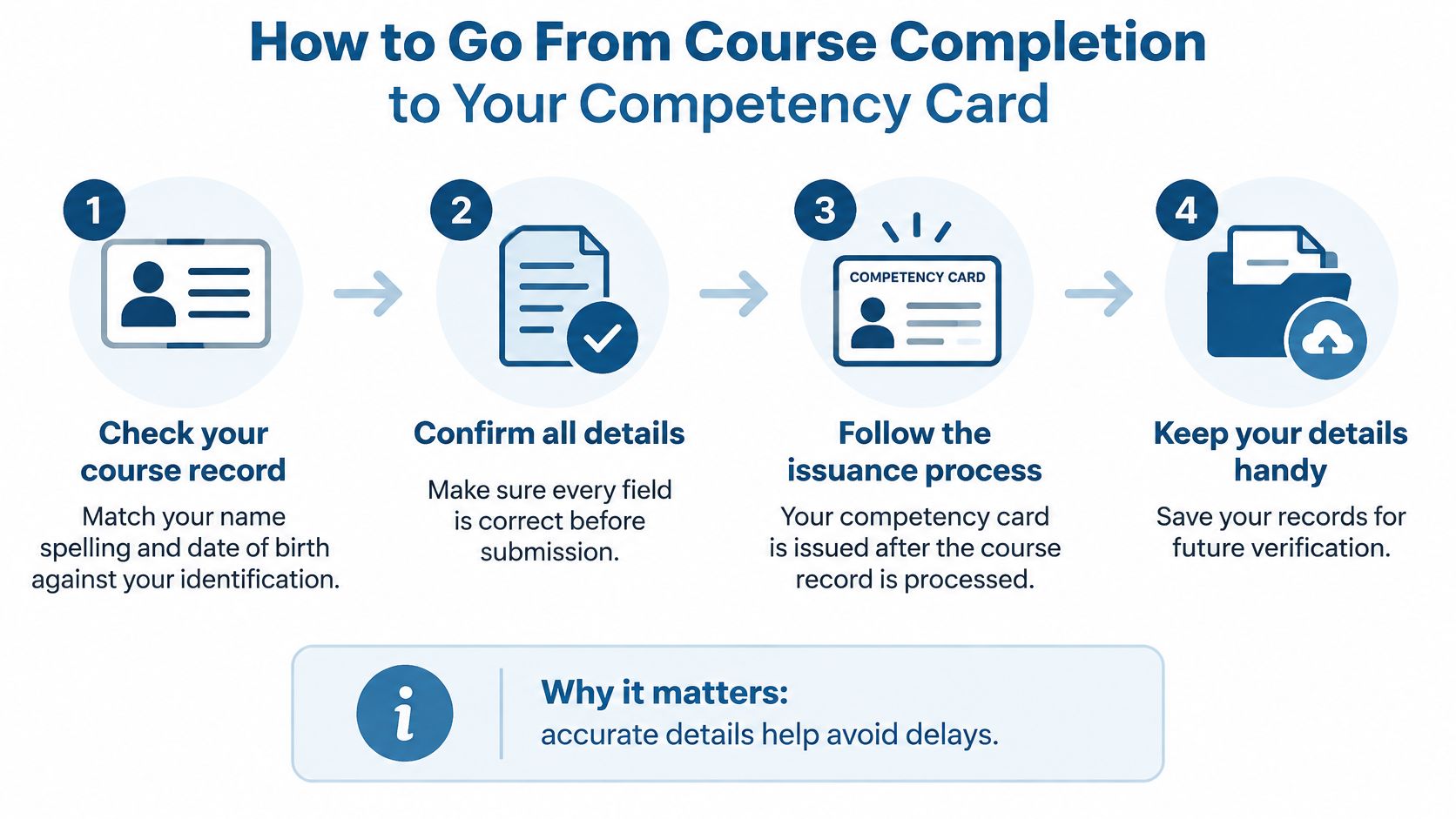
The infographic summarises the move from course completion to card application. Use it as a reminder, not as a substitute for the in-person application or the official instructions. Completing training alone does not issue the card.
Can you start work with an interstate RSA?
An interstate RSA certificate does not automatically follow the same pathway in NSW. The next step depends on where it was issued and how old it is. Check the NSW competency-card guide for the current bridging requirements and application steps before relying on an interstate qualification.
Ask whether you need bridging training, the full NSW course or a NSW competency card. Do not assume a colleague's pathway applies to you: their certificate and circumstances may differ. If you are unsure whether your certificate permits you to work, confirm your position before taking a shift.
Late-Night Marshal Rules in the Sydney CBD Precinct
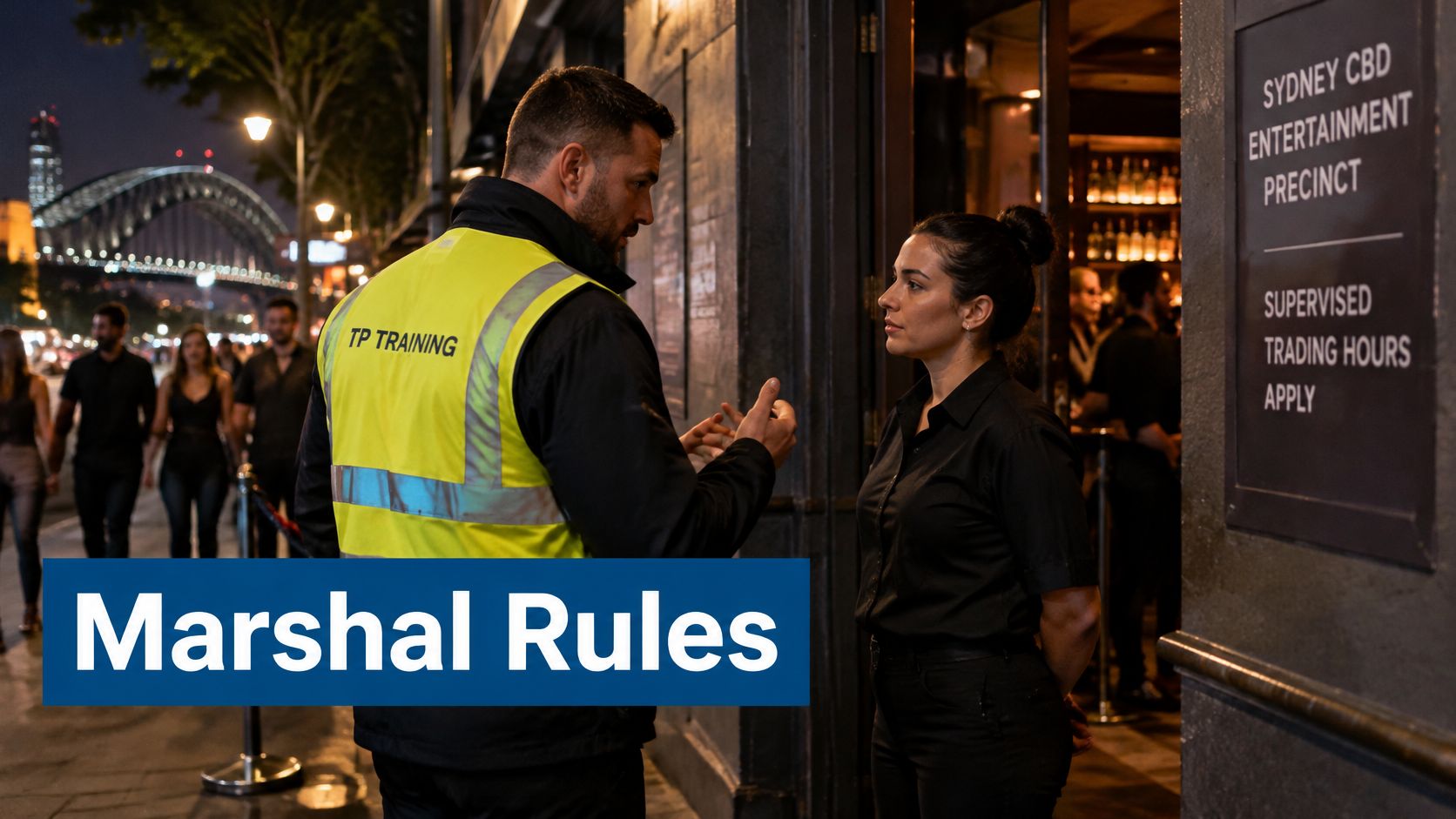
In a declared Sydney CBD venue, an RSA marshal must be on duty during the specified late-night trading period. If a patron reports aggressive behaviour, the marshal should alert the venue's response team and follow its procedures.
When the additional obligation applies
Under the NSW rules for RSA marshals in specific areas, venues covered by a declaration in the Sydney CBD Entertainment precinct must engage at least one RSA marshal during the supervised trading period. This runs from midnight until 3:30 am, or until the venue's required closing time if that is earlier, on Friday and Saturday nights, public-holiday nights and nights before public holidays. Only venues covered by a declaration must engage a marshal.
The marshal must hold valid RSA certification, shown by a photo competency card or valid interim certificate, and wear clothing that identifies them as the RSA marshal. The clothing identifies the role, but does not prove the worker holds the required credential.
Checks before accepting a marshal roster
- Ask about the declaration: Confirm whether the venue is covered and which shifts require marshal coverage.
- Check your credential: Make sure your RSA certification is valid for the rostered work.
- Clarify role boundaries: Find out who supervises you, who handles security intervention and how to report an incident.
A marshal helps the venue monitor RSA-related risks and pass concerns to the people responsible for responding. RSA training does not authorise security duties outside the marshal's role. When a concern arises, report it promptly and follow the venue's response procedure.
Frequently Asked Questions
What if the class I booked is full?
Contact the provider promptly to ask about another available session and check the transfer terms before changing your booking. Choose a replacement that still leaves time to complete the steps from course completion to your competency card. Completing the course allows you to start work on an interim certificate, but the 90-day window matters: you need the permanent competency card to keep working lawfully after it expires.
What can an employer verify on the spot?
An employer can check the credential you present, such as your interim certificate or photo competency card. Course attendance alone does not show that you hold the required credential. Keep your document accessible, and ask the employer what they need to see before your first shift.
Do I need RSA if I only work in a kitchen?
The requirement depends on your duties. If your role never involves selling, serving or supplying alcohol, RSA may not be required for that work. Check with your employer if kitchen staff sometimes deliver drinks or cover floor service.
Food handling is a separate responsibility. The NSW Food Safety Supervisor certificate guide explains that qualification pathway, which does not replace alcohol-service competency.
Before accepting extra duties: Check whether the task changes the credentials you need, not just whether you can physically do the work.
Book Your RSA Course in Sydney CBD
A CBD hospitality shift may begin soon after class, but course completion is only the first step. The interim certificate lets you start work while you apply for your competency card. Keep track of the 90-day window: the card determines whether you can continue working lawfully after that period.

Make the booking practical
- Confirm RSA is required for your role and check your expected start date.
- Choose a Sydney CBD session, then check its times and duration.
- Review the fee, inclusions and booking conditions before paying.
- Book through TP Training's website and use your confirmation to check the venue address.
- Bring identification that matches your booking name, and plan your Service NSW visit within the interim period.
TP Training runs courses weekly at its Sydney locations. It is also accredited by SafeWork NSW, a separate accreditation from approval to deliver RSA training. The Responsible Service of Alcohol course uses practical, hands-on learning with experienced trainers.
If you are comparing hospitality qualifications, the guide to RSA, RCG, food safety supervisor and barista training outlines related course options. Check the booking page for current session details, then select the Sydney CBD class that suits your schedule.

You may also like
Blue Card Training in NSW: How to Get Yours in 2026

White Card NSW: How to Get Certified and Keep It Valid