
White Card NSW: How to Get Certified and Keep It Valid
Anyone carrying out construction work in NSW needs a general construction induction card. You earn it by completing nationally specified training with a registered training organisation, passing the assessment, and having that RTO apply to SafeWork NSW, with a Statement of Training that covers you for up to 60 days while the card is processed.
Say your first shift is Monday and the gate wants proof you do not have in your pocket yet. The course is the straightforward part. The mistakes that stop people are a Statement of Training left on the kitchen bench, and a card that looks current but fails the two-year industry-activity test. A White Card NSW is the entry credential for construction work. It is not a pass to skip the rules of the site you are walking onto.
Table of Contents
- Who Needs a White Card in NSW
- Comparing Face-to-Face and Online Delivery
- ID and Evidence to Bring to Enrolment
- How to Get Your White Card Step by Step
- Keeping Your White Card Valid After Training
- Book Your White Card Course in Sydney or NSW
Who Needs a White Card in NSW
If you carry out construction work in NSW, you need a general construction induction card before you start. That group includes labourers, carpenters, site supervisors, subcontractors and apprentices, not only people who already hold a trade ticket.
The rule tracks a real injury record. Safe Work Australia's key WHS statistics put it plainly: 188 worker deaths from traumatic injuries nationally in 2024, with construction accounting for 37 fatalities, or 20% of all worker fatalities at a rate of 2.8 deaths per 100,000 workers, and NSW recording the highest jurisdictional toll in 2023 at 60 deaths.

Training introduces hazard identification, risk control, incident reporting, and the construction dangers tied to falls, vehicles, machinery, electricity and falling objects. Skill on a particular roof, crane or scaffold develops later, through site-specific training and supervision. For height work, a read such as a builder's guide to roofing liability sits alongside induction, since working at heights carries its own obligations.
The duty also reaches experienced workers coming back after time away. A card that fails the two-year industry-activity test will not get you through the gate, however current the plastic in your wallet looks. Treat "I had one years ago" as a question to answer before the first shift, never on the morning of it.
Find your role
| Role | Needs a White Card? | Notes |
|---|---|---|
| Labourer or carpenter on a building site | Yes | The core group the card was designed for |
| Site supervisor or foreman | Yes | Often responsible for checking others' cards before site access |
| Subcontractor doing hands-on work | Yes | Holds their own card; the principal contractor's card does not cover them |
| Apprentice or trainee working on site | Yes | Needed before construction work, separate from any trade licence |
| School student on construction workplace learning | Yes | Must hold the card before placement, plus a supervisor's site induction |
| Delivery driver dropping off materials | Usually no | Still must follow site induction, traffic and sign-in rules |
| Site visitor or engineer on a short inspection | Only for hands-on work | Hands-on work requires a card; observing only usually does not |
| Office staff with no site access | No | Sites may still require induction before any visit |
A driver who only drops materials at the gate usually does not need a card, but still follows traffic controls, sign-in and the site's own directions. An engineer on a short inspection needs a card only when the task turns hands-on. Watching a pour does not. Picking up a tool does.
Office staff with no site access do not need one. Book a visit, though, and many sites still induct you before you pass the hoarding.
Practical rule: The card covers general induction only. Every site runs its own induction before you start work, and holding the card does not skip that step.
People who send workers onto site carry a matching duty to check that training is in place. The responsibilities of employers spell out how that duty sits with induction records, not only with a verbal "he's done the course".
Comparing Face-to-Face and Online Delivery
NSW recognises face-to-face delivery and assessment, or real-time audio-visual delivery and assessment. A fully self-paced online course does not produce a valid card.
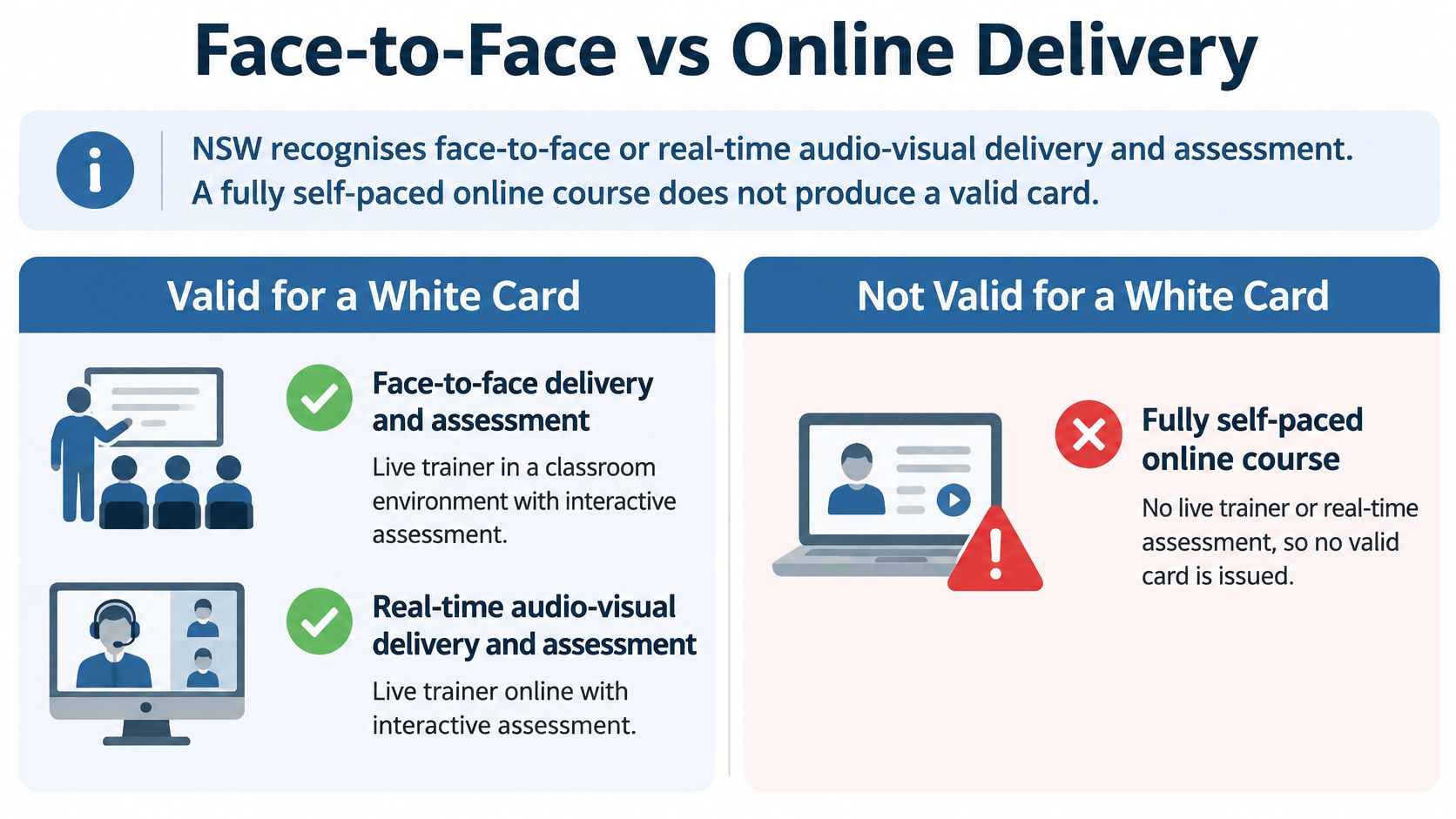
White Card delivery modes compared
| Delivery Mode | Accepted for NSW Card? | How Assessment Works | Best For |
|---|---|---|---|
| Face-to-face classroom | Yes | In-person questions and practical tasks | Learners who want a trainer on hand and reliable attendance |
| Live online with real-time audio-visual | Yes, when delivered and assessed live | Live trainer with screen-shared assessment | Regional learners or those who cannot take a full day off |
| Self-paced online modules only | No | Not valid as a standalone course | Revision alongside a live or face-to-face session |
| Hybrid with online theory and in-person assessment | Yes when the assessment is face-to-face or live | Confirm the assessment is face-to-face or live | Learners who want flexible theory with a checked result |
How to check a live online course
- Set times: The calendar should show a start and finish, not an open-ended login.
- Live assessment: Ask whether the trainer assesses you during that same session.
- Connection: Test your internet, camera and microphone the day before.
- Photo ID on camera: Expect to hold it up so the trainer can match you to the enrolment.
Choose the classroom if you learn better with a trainer beside you, or if your home connection drops out. Choose live online if you are in regional NSW or you cannot give up a full day on the tools. The trade-off is simple. The classroom costs you travel and a day. Live online saves the commute, and it fails if the call drops halfway through the assessment.
Say a labourer in western Sydney pays for a cheap self-paced course, finishes the videos on Sunday, and treats Monday as a formality. He then learns the course never led to a card, because nobody assessed him live. The fee is gone and the start is not.
Ask one question before you pay. How is the assessment delivered?
A page about free online White Card training still has to clear that live or classroom test. Click-through modules are useful revision next to a proper session. They are not the course on their own. I would not stake a start date on a provider that will not name who assesses you.
ID and Evidence to Bring to Enrolment
The RTO must verify your identity before training starts. Arrive with the documents ready, and make the spelling of your name identical on each one and on the enrolment form.
The working pattern is one primary photo ID, such as an Australian passport or driver licence, plus at least one supporting document that shows your name and, where the RTO asks, your address.
Accepted identity documents for White Card enrolment
| Document | Role in Identity Check | Check Before Enrolling |
|---|---|---|
| Australian passport | Primary photo ID | Confirm it is current and the name matches enrolment |
| Australian driver licence | Primary photo ID | Use the licence in the name you enrol under |
| Proof of age card | Photo ID | Confirm acceptance with the RTO first |
| Medicare card | Supporting document | Shows name only; cannot stand alone as photo ID |
| Birth certificate | Supporting document | Useful where name or record details need backing |
| Bank statement or utility bill | Supporting document | Check the date rule with the RTO |
| Marriage certificate or deed poll | Name change evidence | Bring for any name difference between documents |
| Overseas driver licence | Secondary ID that often needs a second check | Confirm acceptance with the RTO before booking |
The mismatches that cost a slot
A name change needs the marriage certificate or deed poll in the set you carry, not promised for later. An overseas licence is a common stall. Many RTOs will not treat it as enough photo ID until they run a second check, so ask before you book. The most common lost slot is dull. The form says one spelling and the licence says another, and the trainer cannot enrol you under a name the ID does not show.
A Medicare card, birth certificate or utility bill is not photo ID. None of them can stand alone.
Ask whether the RTO will look at copies or phone photos in advance, or whether it wants originals on the day. Confirm the set for your own case before you pay. If you do not yet have a Unique Student Identifier, use these five steps to create and manage your USI so enrolment is not waiting on a number you can fix the night before.
How to Get Your White Card Step by Step
A pass result does not put the plastic in your pocket the same afternoon. Service NSW sets out the general construction induction card application as a competency pathway: enrol with an RTO, complete the nationally specified general construction induction training, and show you understand hazards, WHS laws, risk controls, WHS management plans and Safe Work Method Statements. Get the delivery format settled at booking, because the wrong format cannot be rescued later by a good assessment.
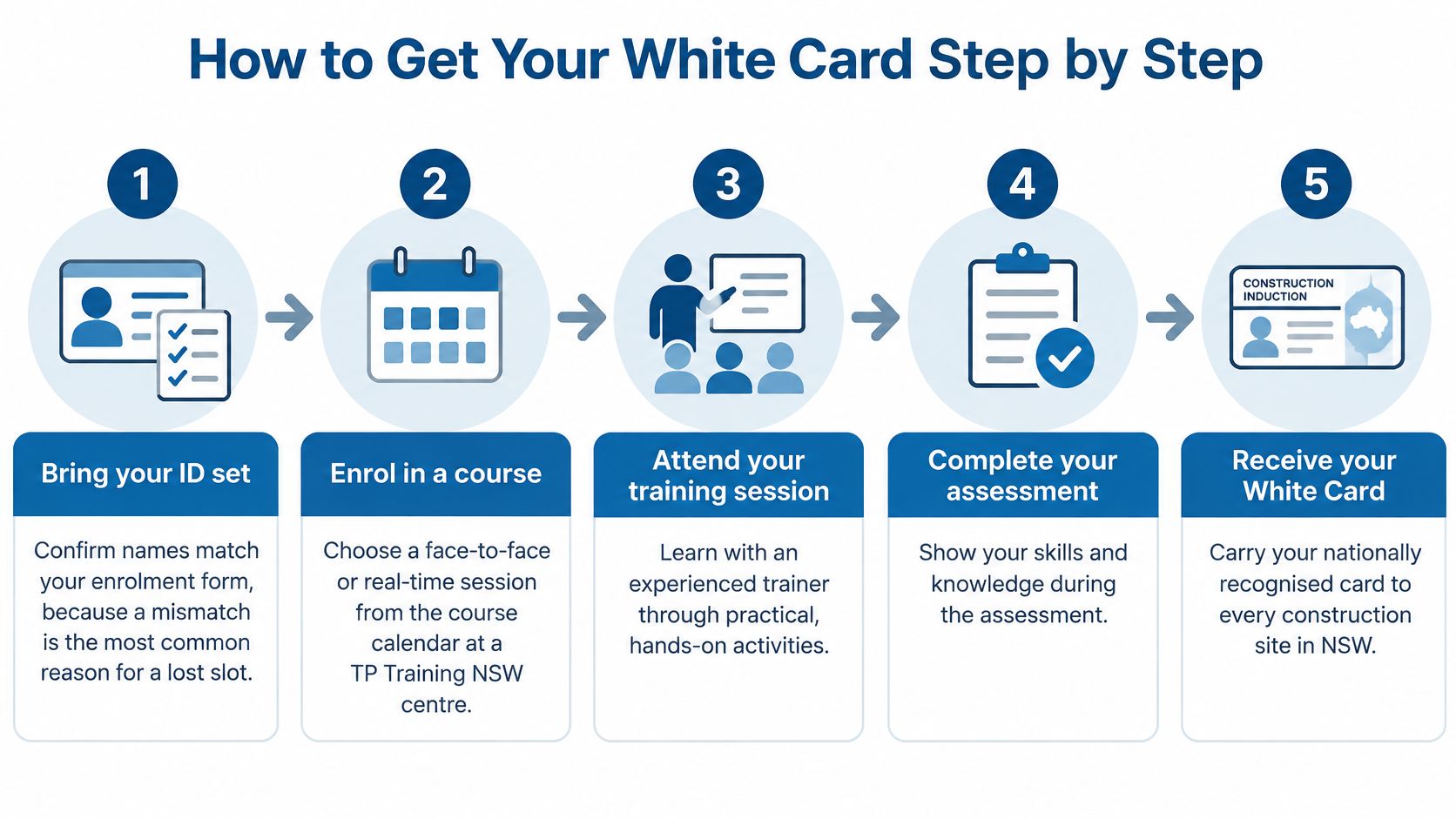
- Bring the ID set and match the names. Check the form against the licence the night before, including middle names and spacing. A mismatch can cost the seat before training starts.
- Enrol with an RTO in the right course. Confirm it is general construction induction and confirm the delivery mode while you book. Our outline of construction induction training shows the standard you are paying for.
- Train like the assessment is a conversation. The content runs through construction hazards, the WHS laws that apply, risk controls, and the dangers around falls, vehicles, machinery, electricity and falling objects. Sit where you can ask questions and practise explaining a control back to the trainer.
- Pass the assessment. You need to show understanding of hazards, controls, WHS management plans and Safe Work Method Statements. If you miss first time, any resit sits under the RTO's policy, so read that policy and choose a date that leaves room before a planned start.
- Let the RTO lodge the card. After you pass, the RTO confirms completion and submits the application to SafeWork NSW. You do not post the application yourself.
- Guard the Statement of Training. This is the step people fumble. It can be used for up to 60 days while the card is processed, and if SafeWork NSW has not decided the application within that time you are treated as holding the card until a decision is made. Put the paper statement in your work bag the same day and know where it is before the first gate.
- Check the card when it arrives. Match the name, dates and class to your documents before you file it away.
The order that avoids trouble is identity, the right course and format, active training, assessment, RTO lodgement, the 60-day statement in your bag, then a final check of the card. Compliance continues after the plastic arrives: recent construction work matters under the two-year activity rule, so keep evidence of site work current instead of trusting the card by itself.
Keeping Your White Card Valid After Training
A White Card counts only while two conditions hold at once. SafeWork NSW's fact sheet on recognition of general construction induction training cards sets out the test: an interstate or NSW card stays recognised only while it is valid in the issuing jurisdiction and you have not been out of construction work for more than two years. The NSW Code of Practice goes further. If you completed induction more than two years ago and have not performed construction work in that period, you must not be directed or allowed to undertake construction work until the induction requirement is addressed.
A card in the glovebox from a job three summers ago fails that test even though the plastic has not expired. Holding the card does not prove you are currently eligible to work. This is the part of White Card compliance that catches people out long after the course is done, and it is the gap supervisors miss when they only glance at the photo.
The pre-start check
Employers and principal contractors should run a documented check before site access, rather than a glance at the lanyard.
- Inspect the evidence: Look at the card, or at the application evidence if the card has not arrived.
- Confirm status: Check the issuing jurisdiction and that the card is still valid there.
- Ask about the last two years: You want evidence of construction work in that period, not a story about intending to return.
- Record the result: Write it down before the person is signed onto the site.
What applies when a White Card situation changes
| Situation | What Applies | What to Do |
|---|---|---|
| Card held and recent construction work | Still recognised while valid | Carry the card and check the site induction |
| Card held, no construction work for over two years | Not recognised until the induction is addressed | Complete induction again before working |
| Interstate card still valid in its issuing state | Recognised only while valid there and while work is current | Carry the card plus proof of recent work |
| Application pending beyond 60 days | Treated as holding the card until SafeWork NSW decides | Keep the Statement of Training and ask for status |
| Starting at a new construction site | The card alone is not enough | Complete the site-specific induction on day one |
Keep a simple log of the sites you have worked on, with dates. That log is what you show when someone asks whether you have been in construction during the last two years, and it is the fastest way to answer the question at a pre-start check. The Statement of Training is the second trap. If the 60 days run out before SafeWork NSW decides, the statement is the document that proves you are treated as holding the card, so keep it until a decision lands and ask for a status update rather than assuming the file is moving. If the number on the card is hard to read, how to find your White Card number is the practical fix before you are stuck at a sign-in desk. I would not turn up with only the plastic and a hope that last year's evidence still counts.
Book Your White Card Course in Sydney or NSW
The booking itself takes minutes. The mistakes happen around it: picking a date that leaves no room for a resit, paying a fee that does not cover the card application, or sitting the course so late that the Statement of Training is the only thing between you and a turned-away start.
We run NSW training at Penrith, Burwood, Auburn, Parramatta and Sydney CBD. The booking calendar lists Safety White Card intakes alongside the other course dates we publish, including traffic cards and hospitality short courses, so you can see what is on before you travel. TP Training is accredited by SafeWork NSW, which matters because the RTO is the party that submits your card application.
The White Card Training Course is practical, nationally recognised training delivered across NSW. As listed, the course takes 7 hours and costs $95. Government-regulated cards such as the White Card may still attract an application fee paid to the authority, so confirm the total before you pay, check our SafeWork NSW accreditation on the official register, and ask whether a resit fee applies.

Check these three points before you pay
- Closest centre: Penrith, Burwood, Auburn, Parramatta or Sydney CBD, against the shift you cannot miss.
- Resit room: a course date early enough that a second attempt still beats your first day on site.
- The fee: what the $95 covers, and whether a government application fee sits on top.
TP Training delivers the White Card as a 7-hour construction induction at centres across Sydney and wider NSW, and the Statement of Training from that day is what covers you while the card application is processed. Book a date with slack in it. Visit TP Training to check the next intake and reserve a seat.

You may also like

Yellow Card NSW: Requirements, Units and How to Enrol

Construction Induction Training in NSW Explained