Mock Interview Online Preparation Guide
Australian employers already regard interviews as the most important recruitment step in 77% of cases, and that rises to 79% in construction, according to Australian Jobs 2026. For a trade, civil, warehouse, traffic-control, hospitality or entry-level applicant, an online interview isn't a softer version of the thing. It tests whether you can communicate clearly, follow safety reasoning and stay composed while a camera, platform or screening system is assessing your response.
A useful mock interview online should therefore reproduce the conditions you'll face, not just ask generic questions in a comfortable room. You need practice for live conversation, recorded prompts, technical disruptions, practical scenarios and unexpected follow-ups.
Understanding the Shift to Digital Interviews
Recruitment in Australia has moved further online, including for roles that are performed outdoors, on worksites or in customer-facing environments. Jobs and Skills Australia reports that online job boards were used by 58% of recruiting employers in 2025, compared with 46% in 2016, while social-media recruitment rose from 6% to 19% over the same period. Online job boards also produced a successful hire for 40% of employers, making them the most successful recruitment channel in that report. Jobs and Skills Australia recruitment data
That matters because a digital application can lead to a screening call, a recorded video response or a later live interview. The job may involve operating machinery or controlling traffic, but the first judgement about your suitability may happen through a laptop or phone. Your practical skills still matter, but you must explain them in a format where the employer can't see your normal work habits.
The two formats you must rehearse
A live video interview happens in real time. You join an employer or recruiter through a video-conference link, answer follow-up questions and manage the normal rhythm of conversation. The interviewer may interrupt politely, ask for more detail or change direction after hearing your example.
A pre-recorded interview works differently. Questions appear on screen or are presented through a recording, and you submit your answer for later review. You may have limited preparation time, no visible listener and no opportunity to read the interviewer's reaction. Australian Government Job Jumpstart's explanation of video interview formats
Practising only with a friend in a relaxed conversation won't prepare you for both mechanics. Use one session to answer a person in real time, then use another to face the camera alone. In the second format, look at the camera, listen carefully to the prompt and deliver a complete answer without waiting for facial feedback.
Why vocational candidates need a different approach
The 2022 Jobs and Skills Australia Recruitment Experiences and Outlook Survey found that 9% of employers used formal online interviews and 14% used informal online interviews. Formal face-to-face interviews were reported by 32%, while informal face-to-face interviews accounted for 67% among employers relying only on informal discussions or interviews. Online interviews weren't yet dominant, but they were already part of the recruitment mix. Jobs and Skills Australia recruitment report
The same report found that interviews were particularly important in Construction, Manufacturing, and Health Care and Social Assistance, where employers identified them as the most important recruitment part in 79%, 83% and 84% of cases respectively. A candidate for civil works, logistics or hospitality can't assume that technical tickets will speak for themselves. You must show work attitude, reliability, safety judgement and the ability to explain what you did.
Practical rule: Treat the camera as the first worksite briefing. Be clear, prepared and ready to explain your decisions.
For training providers and job seekers, the wider shift also makes digital communication part of vocational readiness. Resources such as TP Training's website redesign update reflect how training organisations and candidates increasingly use digital channels to connect, learn and prepare for work.
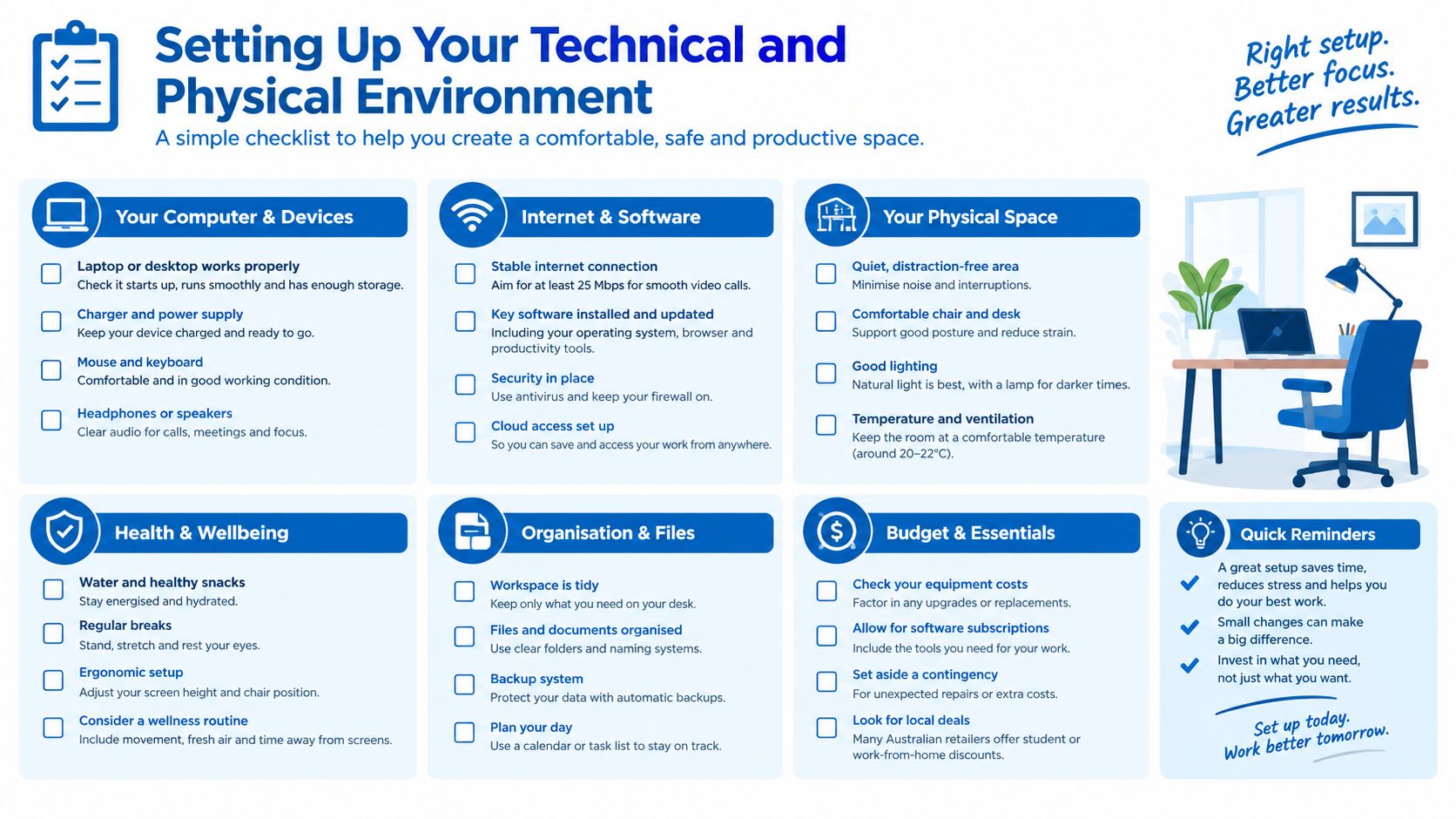
Setting Up Your Technical and Physical Environment
A strong answer can't recover from a dead microphone, a flat battery or a distracting background. Set up your interview space as if you're preparing equipment before a shift. The aim isn't to create an expensive studio. It's to remove avoidable problems so the employer hears your experience rather than your technology struggling.
Complete the physical setup first
Choose a quiet location where other people won't walk behind you or interrupt. Place the camera at eye level, with your head and shoulders centred. A desk stacked with books can raise a laptop if you don't have a stand. Face a window or lamp so light falls on your face, rather than sitting with a bright window behind you.
Keep the background tidy and neutral. You don't need a blank white wall, but remove anything that competes with your face or suggests that you're unprepared. Sit comfortably enough to stay still, yet keep your posture alert. If you need workplace adjustments for disability, arrange them before the session instead of trying to improvise under pressure.
The Australian Human Rights Commission advises candidates to allow at least 30 minutes before an interview to check technology and the background. Its interview preparation guide also recommends confirming the platform, invitation link, device, power, lighting, quietness and background.
Run a proper technology check
Use this sequence before every serious practice session:
- Confirm the platform: Open the exact meeting link or recording platform. Check whether it requires an installation, login or browser permission.
- Test camera and microphone: Record a short answer and play it back. Check that your voice is understandable and that your face isn't too dark.
- Stabilise the connection: Stop background downloads, close unused tabs and ask others on the network to avoid heavy streaming during the interview.
- Charge the device: Connect the laptop or phone to power. Keep a second device available if the employer permits an alternative connection.
- Disable interruptions: Turn off phone notifications, desktop alerts and unrelated applications. A ringing phone can make a prepared candidate look careless.
- Check the frame: Confirm that your eyes sit near the upper part of the screen and that the camera hasn't tilted towards the ceiling or your chest.
Job Jumpstart's video interview checklist recommends testing the internet, platform, camera and audio, closing unused applications, stopping downloads, disabling notifications and being ready at least 10 minutes before the scheduled start.
Run a trial call with someone who can comment on your eye contact, appearance, sound and answer length. A tool can confirm that your microphone works, but a person can tell you whether your explanation is easy to follow. You can also use online animated video preparation resources to help make practice more visual and repeatable.
Structuring Your Practice with Role-Specific Scenarios
Generic questions like “Tell me about yourself” rarely show whether a vocational candidate can work safely, follow procedure or speak up when something is going wrong. Strong practice starts with real tasks. Use examples where you stopped work, completed a pre-start check, dealt with a difficult member of the public, followed an instruction under pressure or reported an incident properly.
A simple structure helps. Situation, Task, Action, Result, or STAR, works well because it keeps your answer clear without sounding rehearsed. The point is not to label each part out loud. The point is to give enough detail for the interviewer, or an automated screening system, to understand the setting, your role, what you did and what changed because of your actions.
Turn practical experience into evidence
If you are asked, “Tell me about a time you identified a hazard,” your answer needs proof, not attitude.
Saying “I always take safety seriously and tell the supervisor when something looks wrong” sounds positive, but it does not show judgement. A stronger answer is built in sequence:
- Situation: Say where you were working and what changed.
- Task: State what you were responsible for protecting or completing.
- Action: Describe the immediate control, who you told and how you followed the process.
- Result: Explain what happened next, including what was corrected, recorded or learned.
For example, you might describe spotting an unstable access path near moving plant. A useful answer would explain that you paused the task, kept others clear, notified the supervisor, followed the site reporting process and resumed only when the area was safe. Keep it accurate. If the result was that the hazard was fixed before work continued, say that plainly.
This approach also helps in one-way video interviews. AI-assisted screening tools often score clarity, relevance and structure before a person reviews the answer. A direct story with a clear action sequence is easier to follow than a vague claim about being reliable.
Build a question bank from the job
Read the job ad and sort likely questions into practical groups before you start practising:
| Question group | Vocational evidence to prepare |
|---|---|
| Safety and compliance | Hazard reporting, stop-work decisions, PPE, pre-start checks and incident reporting |
| Teamwork and communication | Handover notes, radio communication, conflict resolution and following instructions |
| Technical work | Equipment operation, safe sequencing, maintenance checks and limits of competence |
| Customer or public contact | Clear directions, difficult conversations, patience and professional conduct |
This matters most for entry-level and trade pathways, where employers often want signs that you can follow process, communicate clearly and stay within your level of competence. For broader context on how training pathways build those habits, see this overview of vocational training in Australia.
For a traffic-control applicant, practice should sound like the role. Rehearse how you would explain a changed traffic condition, respond to a near miss, manage public confusion and escalate a concern without creating more risk. Candidates considering a Traffic Controller Course Blue Card can use that training as a base for examples that show safe communication and procedural discipline.
Keep your answer honest and adaptable
Prepare examples, not scripts. Memorised wording often falls apart when the interviewer changes one detail, asks for a shorter version or uses follow-up questions to test whether the story is genuine. Write down the situation, your responsibility, three actions and the result. Then practise saying it in plain language.
Use examples from training, volunteering, casual work, unpaid work or supervised tasks if your work history is short. You do not need years on site to show that you can follow a procedure, ask when unsure, report a hazard and learn from feedback.
That is the standard interviewers are usually testing for.
How Interview Pilot Can Help
An AI platform can help when you need repetition, privacy or practice outside normal training hours. Interview Pilot offers Interview Copilot for live online interviews, guided AI mock sessions and a searchable question bank. It supports macOS, Windows, iOS and Android, and the service states that it supports more than 99 languages.
Its practical value depends on how you use it. The mock sessions can provide automated prompts, while the question bank contains approximately 10,000 questions on paid plans across areas such as software, data, finance, consulting, operations and project management. Profile and document inputs can tailor prompts to your background, and customisation controls can adjust tone, depth and focus.
Where it helps
Use the tool for:
- Repetition: Practise answering aloud when a mentor isn't available.
- Prompt variety: Face questions that don't match your prepared wording.
- Language support: Rehearse clarity across different languages and accents.
- Device flexibility: Practise on desktop or mobile before a live interview.
- Self-review: Identify where you ramble, avoid the question or give weak evidence.
The service also lists Free, Weekly, Monthly and Yearly plans, paid-tier support, stated industry-standard encryption and public service-status information. Its site cites 450,000+ users and lists 99.99% availability over the recent 90-day period. Those are provider-stated product details, not evidence that an AI tool improves hiring outcomes.
Where it doesn't replace a person
An AI assistant may miss whether your safety explanation sounds realistic, whether you shift blame or whether an answer fits a particular Australian workplace. It also can't reliably judge whether you understand the difference between stopping work, isolating a hazard and escalating a matter under a site's process.
Don't use live answer suggestions to misrepresent your knowledge or bypass an employer's assessment rules. Use Interview Pilot for preparation, then test yourself without assistance. Your real objective is to explain your reasoning naturally when the prompt changes.
Running a Peer or Mentor Mock Interview Session
The most useful human practice isn't a friendly chat followed by “You did well”. It creates pressure, records observations and gives you a small number of changes to practise immediately. A peer, mentor or trainer doesn't need to imitate an interviewer perfectly. They need to ask relevant questions and score what the answer proves.
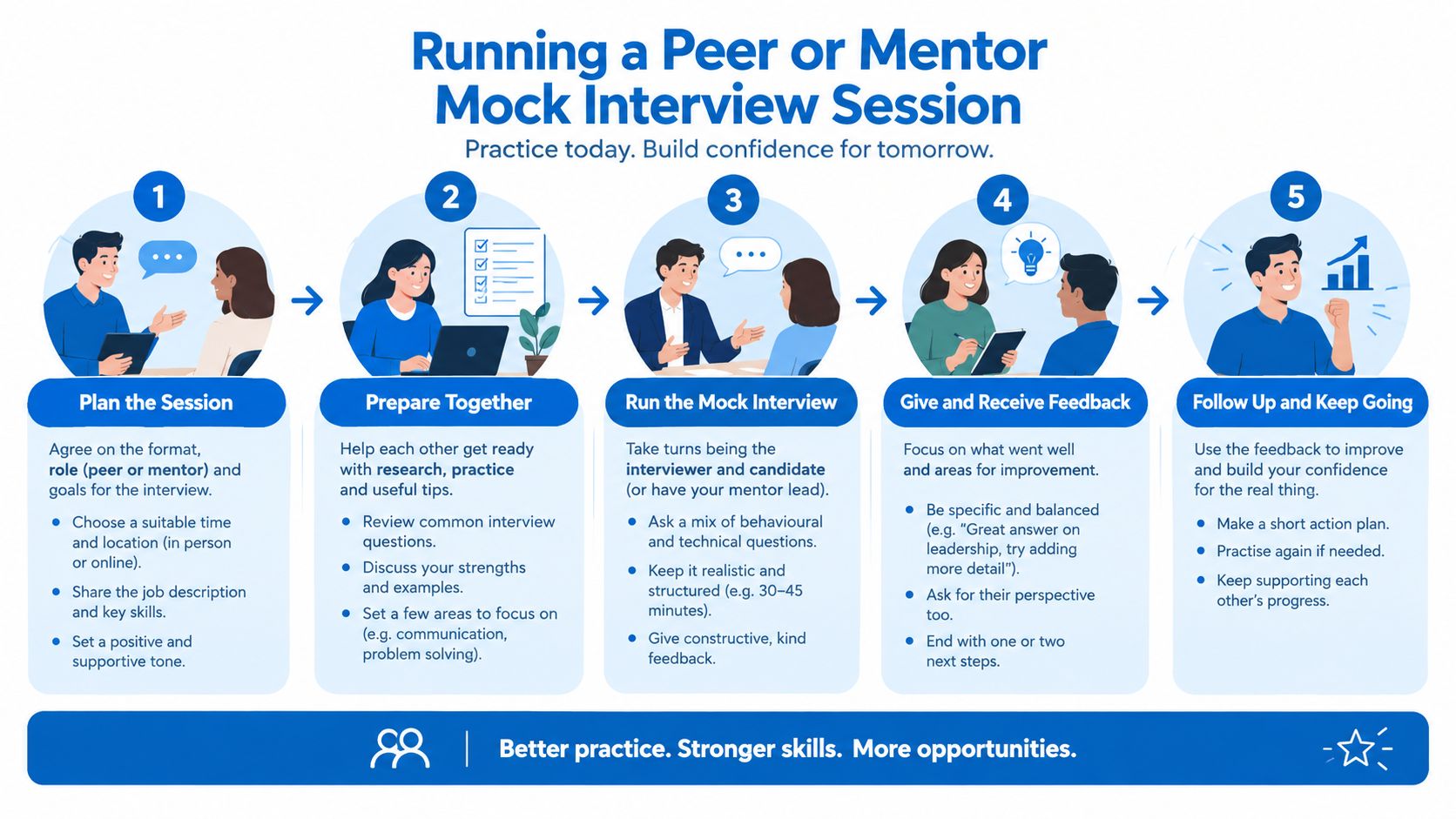
Use three passes
Pass one, baseline. Give the candidate the role description and start without coaching. Ask one opening question, one safety scenario, one teamwork question, one technical question and one closing question. Don't interrupt to rescue a weak answer. Record the session if the candidate agrees.
Pass two, targeted coaching. Choose one behavioural goal and one technical goal. For example, the behavioural goal may be to answer in a tighter sequence, while the technical goal may be to explain who must be notified after a hazard is identified. Re-ask only the questions that expose those weaknesses.
Pass three, timed retest. Change the wording, add an unscripted follow-up and run the answer under realistic video conditions. A candidate who only performs well with the original question hasn't yet built a dependable response pattern.
Score competence, not confidence
Use a four-level scale for each category:
| Category | Level 1 | Level 2 | Level 3 | Level 4 |
|---|---|---|---|---|
| Accuracy | Incorrect or unsafe | Partly correct | Correct with minor gaps | Clear and complete |
| Safety reasoning | Misses the risk | Notices risk without control | Gives a suitable control | Controls, communicates and escalates logically |
| Clarity | Difficult to follow | Some relevant detail | Organised answer | Concise, direct and easy to understand |
| Evidence | General claim | Vague example | Specific personal example | Specific example with a clear result |
Write one observation beside each score. “Needs confidence” isn't actionable. “Name the hazard before explaining the control” gives the candidate something to change.
Australian employers have identified practical interview errors that can damage an application, including failing to research the company or industry at 33%, arriving late at 29%, inappropriate attire at 27%, not asking questions at 25% and failing to turn off a mobile phone at 21%. The Robert Half Australia survey summary also reports that one-fifth identified failure to follow up as harmful. Convert those risks into checks before the retest.
A trainer managing several candidates can use class scheduling software to organise practice sessions, but the scoring method matters more than the booking system. Practical, nationally recognised Courses training with experienced trainers and hands-on learning across NSW can provide role context, while the mock interview should measure how well the candidate explains and applies that learning.
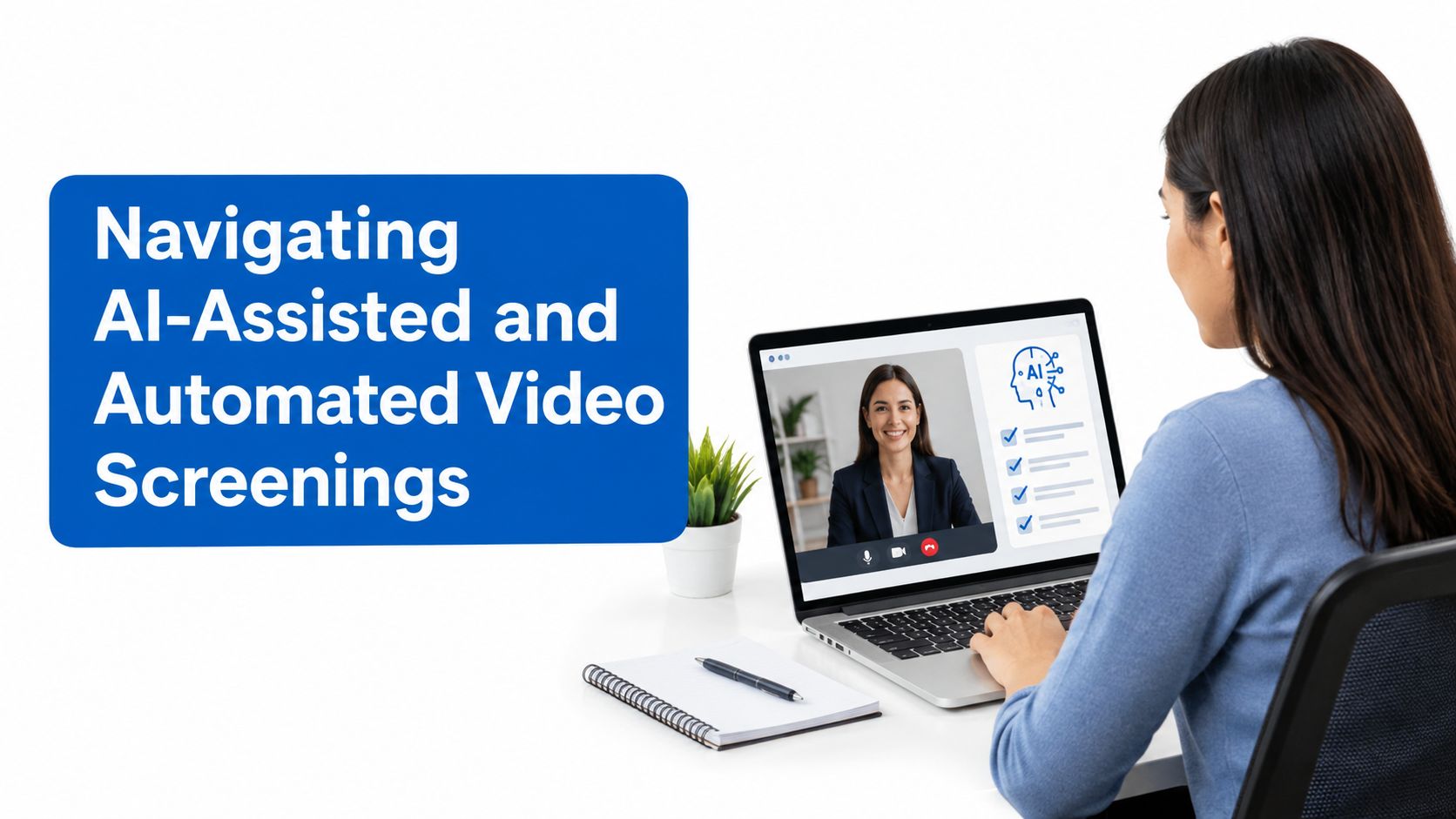
Navigating AI-Assisted and Automated Video Screenings
Your first interviewer may be software. In late 2025, 17% of Australian employers reported using AI to assist with candidate screening and shortlisting, and AI-assisted interviews were the second-most common recruitment use. Adoption was higher in the public sector at 27%, compared with 13% in the private sector, while 49% of employers said they weren't using AI anywhere in recruitment or selection. AHRI Work Outlook report
This is a mixed environment, not a universal rule. Some candidates will speak with a person immediately. Others will record answers to automated prompts before a human reviews anything. Prepare for both without trying to perform like a machine.
Answer the prompt, not an imagined algorithm
Automated systems may use speech-to-text, keyword detection or other screening assistance, but candidates rarely know precisely how an employer evaluates a recording. Stuffing an answer with keywords can make you sound unnatural and can hide the evidence the employer needs.
Use a simple pattern:
- Name the situation or risk.
- State your responsibility.
- Explain the action you personally took.
- Give the result or learning.
- Stop when the question has been answered.
Look at the camera without fixing your face into an artificial expression. Speak at a normal pace, use plain workplace language and pause briefly before answering. If a prompt is unclear, say what you understood and ask whether you may clarify, where the platform allows it.
Protect authenticity and fairness
Australian research warns that AI recruitment systems can create discrimination risks for people with disability, older workers, women and candidates who speak English with an accent. Trying to alter your accent, exaggerate eye contact or mimic a supposed “ideal” facial expression may harm rather than help you.
A better approach is to ask the recruiter how recordings are assessed, whether preparation time is limited, how long responses may be and what adjustment process applies if you have a disability or technical need. Save the invitation and instructions so you can identify what the employer requires.
AI use by candidates also creates a trust issue. Australian reporting found that 22% of surveyed job seekers used AI to generate interview answers, while 27% used AI for an interview test or skills assessment. Include an unscripted follow-up in your practice. Explain why you chose a control, what you would do if the supervisor disagreed and which part of the procedure you would check. A response that only works when copied from a script won't survive those questions.
Professional coaching is worthwhile when you keep repeating the same problem, have little interview experience, are returning to work or are applying for a role where unsafe wording could undermine your application. The aim isn't to polish you into a corporate performer. It's to make your real competence easier to hear.
Booking Professional Mock Interviews and Next Steps
Peer practice works well for repetition, but it has limits. A friend may not know whether your answer reflects a safe traffic-control decision, an appropriate plant pre-start process or the communication expected on a construction site. Professional feedback becomes more useful when the role involves compliance, public safety, machinery or a significant career change.
Choose coaching when you need an outside assessment of role-specific evidence. Ask the trainer to work from the actual position description, not a generic list of interview questions. Bring the job advertisement, your application, relevant tickets, a short work history and any questions you expect to find difficult.
What a worthwhile session should include
A practical service should give you more than encouragement. It should include:
- Role matching: Questions should reflect the duties, hazards and people you'll encounter.
- Evidence testing: The trainer should ask what you personally did, not accept broad claims.
- Technical realism: Scenarios should include reporting a hazard, checking equipment, communicating a change or responding to an incident.
- Digital rehearsal: The session should use the same live or recorded format as the employer where possible.
- Written targets: You should leave with one communication goal and one technical goal to practise.
- A retest: The trainer should check whether you applied the feedback under pressure.
For candidates in NSW, TP Training delivers practical, nationally recognised vocational and safety training with experienced trainers and hands-on learning across training centres including Penrith, Burwood, Auburn, Parramatta and Sydney CBD. Its relevance here is straightforward: a candidate can use vocational training to strengthen practical knowledge, then use a mock interview to practise explaining that knowledge clearly.
A targeted local option may also suit someone preparing for equipment-related work. EWP training in Sydney is one example of the type of vocational preparation that can sit alongside interview practice. Training and interviewing serve different purposes. A qualification doesn't guarantee a job, and a polished answer can't substitute for safe ability, but each can support the other.
Keep a simple progress record
After every session, record the date, role, questions asked, rubric scores, repeated filler words and the next two actions. Keep the first recording so you can compare it with the retest. Don't measure progress only by how confident you feel. Check whether your answers are more accurate, safer, clearer and better supported by evidence.
Your next practice should include one live conversation, one recorded response and one unscripted follow-up. Prepare two genuine questions for the employer, research the organisation and check the technology well before the appointment. The Australian Public Service Commission interview guidance also recommends using the job description to generate likely questions, preparing relevant examples, identifying your top three skills and asking for clarification when a question isn't clear.
Start with the role you want, not a generic script. Build five practical examples, test your camera and microphone, complete the three-pass session and write down the two improvements that matter most. Then book a professional session if your scores stay weak or your role carries significant safety responsibility. TP Training can help you build practical vocational capability across NSW, while disciplined online rehearsal helps you explain that capability when the first opportunity arrives through a screen.
Ready for your next interview? Choose the target role, prepare one safety example and one teamwork example today, then complete a recorded mock interview before your application goes out. If you need practical vocational preparation in NSW, review the relevant TP Training course options and use your next session to prove what you can do, not just say that you're confident.

You may also like

Trade Courses Sydney: 3 Career Pathways Worth Exploring

Government Fund Courses in Australia: A Practical Guide