Asthma and Anaphylaxis Training in NSW
A student in a childcare room starts coughing hard after morning tea. A construction worker on a dusty site suddenly wheezes and struggles to speak. Both situations look like asthma at first, but either could be anaphylaxis, and the correct first treatment may be an adrenaline autoinjector rather than a reliever puffer. In those seconds, confident action matters more than a perfect diagnosis.
Asthma and anaphylaxis training gives childcare workers, supervisors, first aiders and employers a practical response for these uncertain moments. The skills include recognising deteriorating breathing, following the four-minute asthma sequence, using an adrenaline device, calling Triple Zero (000), positioning the person safely and starting CPR when required. For broader first aid preparation, CPR and first aid training guidance can help workers understand how respiratory emergencies fit into their wider response responsibilities.
Table of Contents
- The Split-Second Decision That Saves Lives
- Core Emergency Protocols and Device Techniques
- Navigating the Diagnostic Overlap Under Pressure
- Workplace Compliance and Industry Requirements
- Staying Current with Evolving Medical Devices
- Course Options and Training Locations in Sydney
- Building a Safer Environment for Everyone
The Split-Second Decision That Saves Lives
A young person leans forward, breathing rapidly and producing a high-pitched wheeze. One supervisor reaches for a blue or grey reliever puffer. Another asks about recent food, insect stings or a new product. There is no visible rash, and nobody knows whether an allergy plan exists.
This is the diagnostic overlap responders face. Wheezing, coughing, hoarse voice and severe breathing difficulty can occur in asthma or anaphylaxis. Medical history may be unavailable, and waiting to identify the condition with certainty can cost time. A sudden reaction after an unexpected exposure should raise concern, even when the person appears to have asthma.
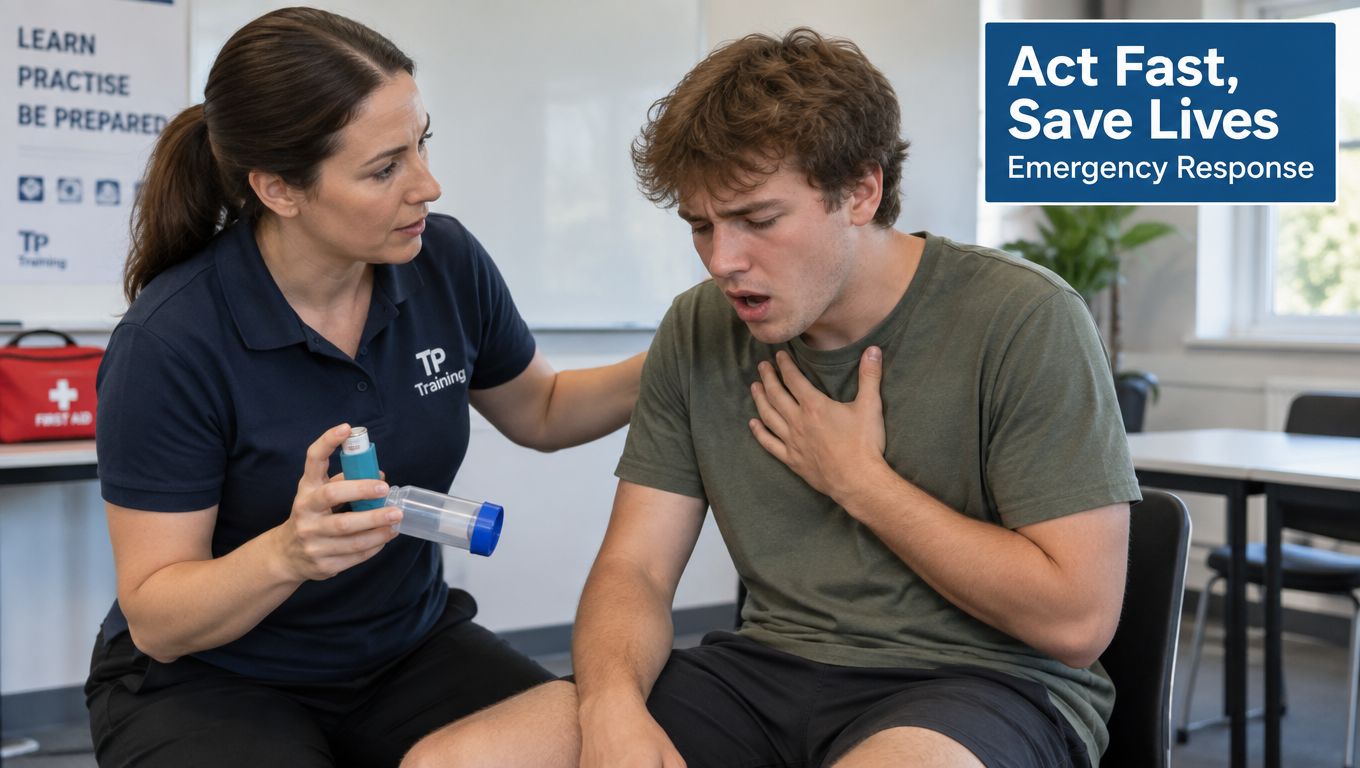
The decision rule is clear: if anaphylaxis is possible, adrenaline comes first. Use that rule when someone with known asthma and allergies develops sudden wheezing, ongoing coughing, a hoarse voice or severe breathing difficulty. Use it when the symptoms could be either condition and no confident distinction is possible. Skin signs may be absent, so waiting for hives can delay treatment for a life-threatening allergic reaction.
Asthma affects many people across Australia and remains a frequent reason for urgent medical care. That wider context matters in childcare rooms, workplaces and public settings, where a responder may encounter breathing distress without knowing the person's diagnosis. For broader first aid preparation, CPR and first aid training guidance can show how respiratory emergencies fit within wider response responsibilities.
Practical rule: When breathing difficulty is sudden, severe or unexplained, do not assume it is ordinary asthma. Consider anaphylaxis and follow the emergency plan available.
Training turns this rule into a rehearsed response. Learners practise spotting warning signs, communicating clearly with Triple Zero (000), selecting the appropriate device and monitoring the person until paramedics arrive. The goal is not to make workers diagnose a medical condition. It is to help them choose a safe, timely action when asthma and anaphylaxis look alike.
Core Emergency Protocols and Device Techniques
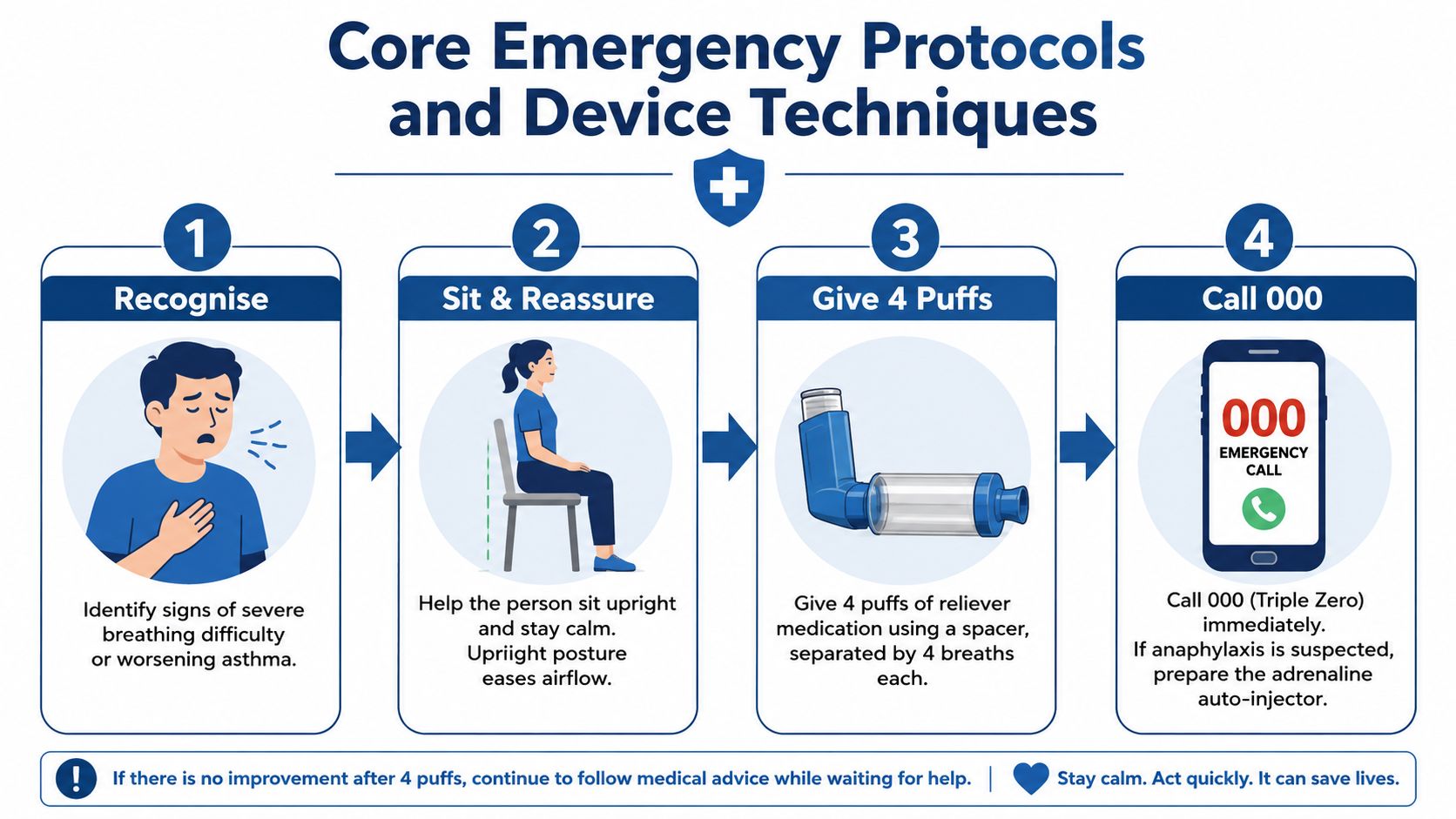
A drill starts with a worker finding a reliever puffer while a colleague reports worsening breathing. The first person keeps the casualty upright, another calls Triple Zero (000), and everyone follows the same sequence. Rehearsal turns a stressful moment into a set of familiar actions. Asthma and anaphylaxis training should include trainer devices, role-play and timed practice, not written instructions alone.
This sequence aligns with the HLTAID011 Provide First Aid unit, which covers these emergency steps and device techniques.
The asthma sequence
For someone showing signs of an asthma attack, Australian first aid guidance uses a four-minute response sequence:
- Sit the person upright. Keep them calm and support them in a comfortable upright position. Do not make them lie down during an asthma attack.
- Give four puffs of a blue or grey reliever puffer. Use a spacer when available. Give each puff separately, followed by four breaths.
- Wait four minutes. Watch the person's breathing, responsiveness and ability to speak.
- Call Triple Zero (000) if symptoms do not improve. Continue the four-puff cycle while waiting for emergency assistance.
The timing acts like a track for the response. It prevents vague instructions such as “use the inhaler” from replacing specific actions. During a workplace drill, workers should locate the puffer and spacer, explain each step, assign a colleague to call 000 and keep another person with the casualty.
The anaphylaxis sequence
Anaphylaxis follows a different priority. Give intramuscular adrenaline without delay, lay the person flat and stop them from standing or walking. Place the autoinjector against the outer mid-thigh at a 90-degree angle. It can be used through clothing if necessary.
Call Triple Zero (000) immediately after giving adrenaline. If breathing difficulty means the person cannot remain flat, they may sit with their legs outstretched, but they should not stand or walk. If they become unconscious, place them in the recovery position. If there is no response after five minutes, a further adrenaline dose may be needed. Hospital observation is required because symptoms can return.
The physical skills responders must practise
Responders need to perform several actions in the right order:
- Recognise deterioration: Look for severe breathing difficulty, difficulty speaking, collapse, unusual wheezing or a rapidly worsening condition.
- Position safely: Keep someone with suspected anaphylaxis flat and still unless breathing difficulty requires a seated position with legs outstretched.
- Use the device correctly: Place the adrenaline autoinjector against the outer mid-thigh at 90 degrees and follow the instructions for the available device.
- Escalate early: Call 000, describe the symptoms, say whether adrenaline has been given and follow the call-taker's directions.
- Monitor continuously: Be ready to repeat emergency care, commence CPR or use an AED if the person becomes unresponsive and is not breathing normally.
These skills should become automatic enough for one worker to provide care while another controls the scene, clears access for paramedics and retrieves the person's action plan.
Navigating the Diagnostic Overlap Under Pressure
The most dangerous assumption is that asthma and anaphylaxis always look different. A person can have no obvious rash and still be experiencing anaphylaxis. A person with a known history of asthma can also develop an allergic reaction that causes bronchospasm, so a reliever puffer alone may not address the emergency.
When the cause isn't clear
Use this decision rule: if sudden breathing difficulty could be anaphylaxis, give the adrenaline autoinjector first. This includes a person with known asthma and allergy who develops wheezing, persistent coughing or a hoarse voice. Give the asthma reliever after adrenaline, not instead of it.
The ASCIA acute anaphylaxis guidance makes the treatment order clear for this overlap. Responders shouldn't wait for skin symptoms, a confirmed food exposure or a complete medical history before acting when severe, sudden breathing difficulty suggests anaphylaxis.
That can feel counterintuitive to a worker who has been taught to reach for an inhaler whenever someone wheezes. Training needs to address that hesitation directly. Learners should hear the scenario, identify the uncertainty and explain why adrenaline is the safer first response when anaphylaxis can't be ruled out.
Scenario practice builds judgement
A useful exercise might involve a child who develops a hoarse voice and cough after eating, without visible hives. Another might involve a worker who collapses near a chemical storage area and has no known medical history. A third could involve a person who carries both an asthma action plan and an adrenaline autoinjector.
In each scenario, the learner should have to:
- State the concern: Explain that the symptoms may indicate anaphylaxis, severe asthma or both.
- Choose the priority treatment: Give adrenaline first when anaphylaxis is suspected or the diagnosis is uncertain.
- Communicate the handover: Tell 000 what happened, what symptoms are present, which medication was given and when.
- Continue observation: Watch breathing and responsiveness, prepare for a further dose after five minutes if there's no response, and begin CPR if required.
This is different from memorising two unrelated checklists. It develops the judgement needed when the person doesn't match a neat textbook example. Food businesses and public-facing workplaces can also benefit from understanding how emergency response sits alongside broader safety responsibilities, including the role discussed in food safety supervisor training information.
Workplace Compliance and Industry Requirements
A worker collapses near a dusty work area, a child develops breathing difficulty after eating, or a customer begins wheezing in a café. In each setting, the first responder may face the same problem: asthma and anaphylaxis can look alike at the start, while the workplace still needs a clear plan before paramedics arrive.
Asthma is common in Australia, and severe breathing emergencies can be fatal. A person may carry an asthma reliever, an adrenaline autoinjector, a written action plan, or none of these. Staff should therefore treat respiratory-emergency readiness as part of everyday workplace safety, not as a childcare-only concern. Where symptoms are unclear, procedures should support rapid escalation and a response that does not depend on waiting for a rash or a confirmed diagnosis.
Different workplaces create different response problems
Any workplace with visitors, contractors, or shared spaces faces the same risk. The setting changes the likely trigger, the available equipment, and the way responders must communicate.
| Industry sector | Primary risk factor | Compliance driver |
|---|---|---|
| Education and care | Children may have known or unknown allergies, and staff may need to respond before a parent or medical professional arrives. | Organised procedures, suitable training, current action plans, and staff who can recognise anaphylaxis or worsening asthma. |
| Hospitality | Food exposure can occur in kitchens, cafés, restaurants, and catering environments, while customers may have no visible allergy history. | Staff awareness, emergency escalation, clear communication, and a response that does not rely on waiting for a rash. |
| Construction and civil works | Dust, exertion, environmental exposure, and remote work areas can complicate breathing emergencies. | Site induction, accessible first aid equipment, reliable communication, and workers who can respond while awaiting emergency services. |
| Offices and warehouses | Mixed workforces, visitors, and contractors may have medical conditions unknown to colleagues. | A documented first aid system, trained personnel, kit checks, and practical drills suited to the workplace layout. |
Education and care services should check the current requirements for their setting and confirm that the course content meets those needs. A parliamentary document has raised a quality-assurance concern: although ACECQA lists suitable courses, no transparent process guarantees consistent training content or quality between providers. This makes provider selection and internal review important.
Employers also need clear records and assigned duties. Guidance on workplace compliance for Dynamics 365 can provide context for managing compliance activities systematically. It does not replace first aid training, but it may support the administrative work of recording responsibilities, checks, and review dates.
Write the emergency roles down. One person retrieves the first aid kit, another calls 000, another meets the ambulance, and another supervises children or other workers. Employers can review these arrangements through guidance on employer responsibilities, then test them in a realistic drill. A drill can reveal whether staff know where equipment is, who makes the call, and how information will be handed to paramedics.
Staying Current with Evolving Medical Devices
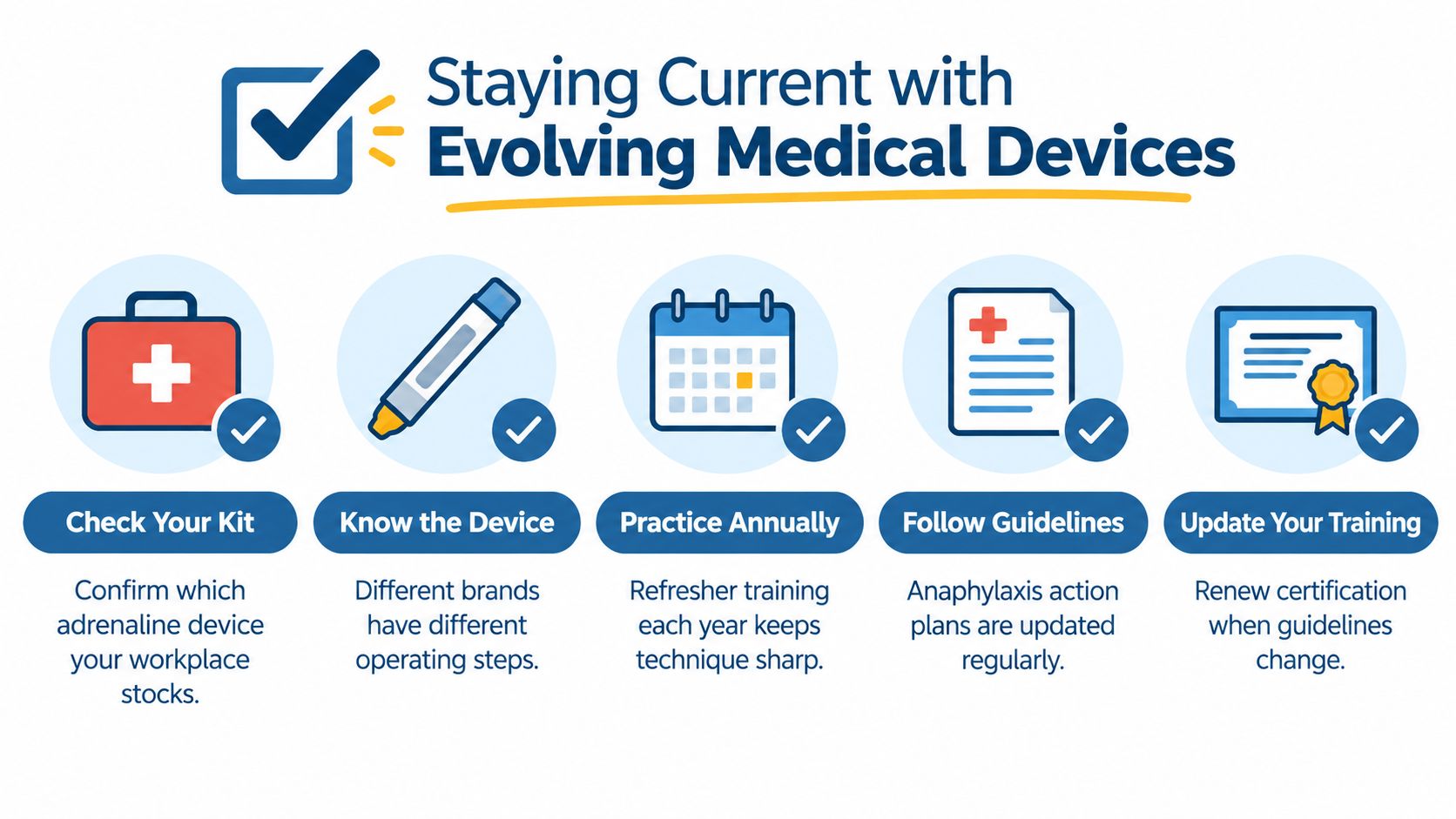
A certificate doesn't make a responder permanently familiar with every device. The equipment in a first aid kit may differ from the trainer device used in a classroom, and a worker may move between sites with different procedures.
ASCIA's 2026 update reports multiple adrenaline devices approved for use in Australia, including EpiPen, Anapen, Jext and neffy, with guidelines, training and action plans being updated to reflect these devices. The update is available through ASCIA's anaphylaxis information. Each workplace should identify the device it stocks and make sure responders know how to follow that device's instructions.
Make the kit part of the training
A practical update process should include these checks:
- Check the kit: Confirm which adrenaline device the workplace holds, where it is stored and whether staff can reach it quickly.
- Know the device: Review its activation method, dose limitations, storage instructions and expiry information.
- Practise with the trainer: Use the same type of trainer device where possible, then reinforce the rule to follow the instructions on the available device.
- Review action plans: Check that current asthma and anaphylaxis action plans are accessible to the people who may need them.
- Update competence: Revisit the response after a guideline change, equipment change or workplace change, rather than treating the original course as the final practice session.
A childcare centre may have a general-use adrenaline autoinjector, while a construction site may hold equipment purchased at a different time by a different supplier. A warehouse may have workers from several employers sharing one first aid area. These arrangements make device recognition and team communication just as important as the injection technique itself.
Refresher activities should also cover the full sequence, including keeping the person flat and still, calling 000, reassessing after five minutes and starting CPR if the person becomes unresponsive and isn't breathing normally. Competence means knowing what to do with the device in front of you, not remembering the brand demonstrated during an earlier class.
Course Options and Training Locations in Sydney
The right course should leave learners able to demonstrate the response, not just describe it. Before booking, ask whether the assessment includes realistic asthma and anaphylaxis scenarios, trainer-device practice, positioning, emergency-call communication and the transition to CPR when required.
Choose training that matches the workplace
Childcare workers may need scenarios involving a child, an action plan, a general-use autoinjector and communication with a parent or supervisor. Construction supervisors may need a drill involving a worker in PPE, a remote work area, dust exposure and a delayed ambulance handover. Hospitality teams can practise responding to a customer with unknown allergy history while another staff member controls the venue.
TP Training delivers practical first aid and workplace safety courses through training centres in Penrith, Burwood, Auburn, Parramatta and Sydney CBD. Learners can choose a location that fits their work or study arrangements, while employers can consider whether a group booking and workplace-specific scenarios would better suit their team. Workers near western Sydney can also review first aid training in Penrith when selecting a convenient venue.

Prepare before attending
Bring the questions that affect your actual workplace:
- What does our first aid kit contain? Identify the adrenaline device, inhaler equipment and action plans available.
- Who takes each role? Decide who calls 000, retrieves equipment, manages bystanders and meets paramedics.
- What could delay help? Consider site access, locked areas, noisy plant, multiple floors or outdoor work zones.
- Which additional qualifications matter? Construction workers may combine first aid with a White Card, while hospitality workers may also need a Food Safety Supervisor qualification.
- How will competence be maintained? Record equipment checks, practise the emergency sequence and review procedures when devices or guidelines change.
A hands-on session should make the correct response feel familiar without creating false confidence. Learners still need to follow the person's action plan, the device instructions and emergency-service directions at the time of an incident.
Building a Safer Environment for Everyone
Prepared responders don't need to diagnose perfectly. They need to recognise danger, consider anaphylaxis when breathing symptoms are sudden or unclear, give the correct first treatment, position the person safely and activate emergency help.
The wider asthma burden reinforces the need for this capability. Asthma was recorded as an underlying or associated cause in 2,472 deaths in 2022 when associated causes were included in the AIHW data, so workplaces should treat respiratory emergencies as a realistic safety concern rather than a remote possibility. Employers can also reduce avoidable confusion by checking their first aid kit, reviewing action plans and ensuring workers know which adrenaline device is available.
Environmental controls have a supporting role too. Organisations managing airborne irritants may find practical background in resources such as air duct cleaning for allergy sufferers, but cleaning and prevention measures never replace emergency response training.
Audit your kit this week, identify the devices and action plans on site, and ask workers to practise the asthma and anaphylaxis response under supervision. TP Training provides practical first aid and workplace safety training across Sydney locations, helping teams rehearse the decisions, device techniques and escalation steps that matter when breathing deteriorates. Visit TP Training to review available courses and choose a training location for your workplace or team.

You may also like
First Aid Training for Construction Workers NSW
Traffic Management Signs: A Complete Work Zone Reference